
Deuteronomy 28:30

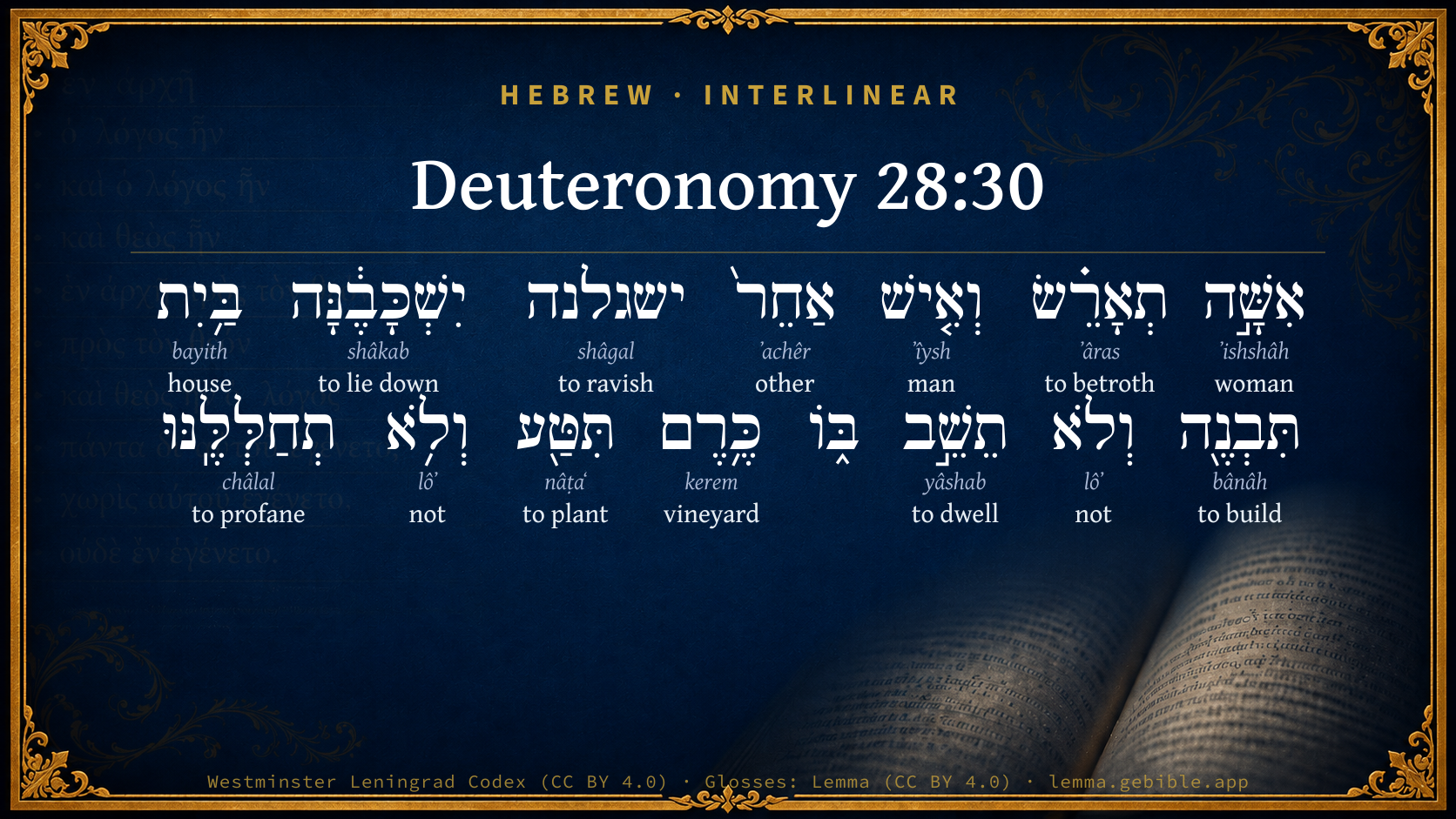
Hebrew (Westminster Leningrad Codex) Deuteronomy 28:30 appears in the Hebrew Old Testament. The text above is from the Westminster Leningrad Codex. Each word links to its Strong’s number, a concise gloss, and parsing drawn from the Open Scriptures Hebrew Bible morphology. Click any word for its full Brown-Driver-Briggs (BDB) entry.
Download image
Cite this verse

Deuteronomy 28:30 (World English Bible). Public Domain. Lemma interlinear Bible study tool, https://lemma.gebible.app/v/deuteronomy/28/30.

Show BibTeX & RIS
BibTeX
RIS
English Translation
You shall betroth a wife, and another man shall lie with her: you shall build a house, and you shall not dwell therein: you shall plant a vineyard, and shall not use the fruit of it.
World English Bible · Public Domain
Highlights
  • 1 first appearance in the Hebrew Bible
Full analysis ↓
Download a study sheet

One document with this verse’s original text, its word-by-word gloss line, the meaning frame, cross-references with their text, attributed commentary, and full source and license credits — printable, and it pastes into notes with its structure intact.

This verse Autodidact and up

Study sheet (.html) Plain text (.txt)

A passage Seminary Student

Up to 50 verses in one chapter. A passage sheet keeps up to 6 commentary sources and 12 cross-references per verse, in the order this page ranks them, and says so on the sheet whenever that leaves anything out. Ask for a single verse and you get the Autodidact verse sheet above.

Everything on this page stays free to read, with no account — the sheet is a download of what is already on screen, not access to it.

Want to remove ads? Support Godless Engineer
Compare translations 3

The same verse in 3 English versions, stacked beneath the original-language interlinear above. Click any original word for its lexicon entry.

Each is an independent rendering of the whole verse — the interlinear is not word-aligned to these translations.

Highlighted words mark where these versions differ — a whole-verse word diff, not a word-by-word alignment.

  • World English Bible Public Domain
    You shall betroth a wife, and another man shall lie with her: you shall build a house, and you shall not dwell therein: you shall plant a vineyard, and shall not use the fruit of it.
  • King James Version Public Domain
    Thou shalt betroth a wife, and another man shall lie with her: thou shalt build an house, and thou shalt not dwell therein: thou shalt plant a vineyard, and shalt not gather the grapes thereof.
  • unfoldingWord Literal Text CC BY-SA 4.0
    You will betroth a woman, but another man will rape her. You will build a house but not live in it; you will plant a vineyard but not use it.

unfoldingWord Literal Text — © unfoldingWord, licensed CC BY-SA 4.0. Word-aligned USFM3 via Door43 (git.door43.org/unfoldingWord/en_ult).

Versions to compare (up to 4)

3 of 4 selected

Show all 18 translations

Every available English version of this verse, each an independent rendering of the whole verse.

  • World English Bible Public Domain
    You shall betroth a wife, and another man shall lie with her: you shall build a house, and you shall not dwell therein: you shall plant a vineyard, and shall not use the fruit of it.
  • Berean Standard Bible Public Domain
    You will be pledged in marriage to a woman, but another man will violate her. You will build a house but will not live in it. You will plant a vineyard but will not enjoy its fruit.
  • Majority Standard Bible Public Domain
    You will be pledged in marriage to a woman, but another man will violate her. You will build a house but will not live in it. You will plant a vineyard but will not enjoy its fruit.
  • King James Version Public Domain
    Thou shalt betroth a wife, and another man shall lie with her: thou shalt build an house, and thou shalt not dwell therein: thou shalt plant a vineyard, and shalt not gather the grapes thereof.
  • American Standard Version (1901) Public Domain
    Thou shalt betroth a wife, and another man shall lie with her: thou shalt build a house, and thou shalt not dwell therein: thou shalt plant a vineyard, and shalt not use the fruit thereof.
  • Revised Version (1885) Public Domain
    Thou shalt betroth a wife, and another man shall lie with her: thou shalt build an house, and thou shalt not dwell therein: thou shalt plant a vineyard, and shalt not use the fruit thereof.
  • Geneva Bible (1599) Public Domain
    Thou shalt betroth a wife, and another man shall lye with her: thou shalt builde an house, and shalt not dwell therein: thou shalt plant a vineyard, and shalt not eate the fruite.
  • Douay-Rheims (1899) Public Domain
    Mayst thou take a wife, and another sleep with her. Mayst thou build a house, and not dwell therein. Mayest thou plant a vineyard and not gather the vintage thereof.
  • Young's Literal Translation Public Domain
    `A woman thou dost betroth, and another man doth lie with her; a house thou dost build, and dost not dwell in it; a vineyard thou dost plant, and dost not make it common;
  • Literal Standard Version CC BY-SA 4.0
    You betroth a woman, and another man lies with her; you build a house, and do not dwell in it; you plant a vineyard, and do not make it common;
  • Unlocked Literal Bible CC BY-SA 4.0
    You will become engaged to a woman, but another man will seize her and rape her. You will build a house but not live in it; you will plant a vineyard but not enjoy its fruit.
  • unfoldingWord Literal Text CC BY-SA 4.0
    You will betroth a woman, but another man will rape her. You will build a house but not live in it; you will plant a vineyard but not use it.
  • Darby Bible Public Domain
    Thou shalt betroth a wife, and another man shall lie with her; thou shalt build a house, and thou shalt not dwell therein; thou shalt plant a vineyard, and shalt not eat of it.
  • World Messianic Bible Public Domain
    You will betroth a wife, and another man shall lie with her. You will build a house, and you won’t dwell in it. You will plant a vineyard, and not use its fruit.
  • Webster's Bible Public Domain
    Thou shalt betroth a wife, and another man shall lie with her: thou shalt build a house, and thou shalt not dwell in it: thou shalt plant a vineyard, and shalt not gather the grapes of it.
  • Free Bible Version CC BY-SA 4.0
    You will be engaged to marry a woman, but another man will sleep with her. You will build a house but you won't live in it. You will plant a vineyard but won't benefit from any harvest.
  • Bible in Basic English Public Domain
    You will take a wife, but another man will have the use of her: the house which your hands have made will never be your resting-place: you will make a vine-garden, and never take the fruit of it.
  • JPS Tanakh (1917) Public Domain
    Thou shalt betroth a wife, and another man shall lie with her; thou shalt build a house, and thou shalt not dwell therein; thou shalt plant a vineyard, and shalt not use the fruit thereof.

Literal Standard Version (2020), Covenant Press — licensed CC BY-SA 4.0. Text via the HelloAO Bible API (eBible.org). Unlocked Literal Bible (unfoldingWord) — licensed CC BY-SA 4.0. Text via the HelloAO Bible API (eBible.org). unfoldingWord Literal Text — © unfoldingWord, licensed CC BY-SA 4.0. Word-aligned USFM3 via Door43 (git.door43.org/unfoldingWord/en_ult). Free Bible Version, Dr. Jonathan Gallagher — licensed CC BY-SA 4.0. Text via the HelloAO Bible API (eBible.org).

Word by word

More ways to search: Search by grammar → Find every occurrence → Compare this word →

Practice this passage: Drill this verse → Learn its vocabulary →

ישגלנה
shâgal
H7693
“to ravish · her”
Verb, Qal, Imperfect, 3rd Person, Masculine, Singular + Suffix, Personal, 3rd Person, Feminine, Singular
Part of Speech
Verb
Stem
Qal
Form
Imperfect
Person
3rd Person
Gender
Masculine
Number
Singular
Full BDB Definition

Origin: a primitive root

TWOT: 2327

to violate, ravish - (Qal) to violate, ravish - (Niphal) to be ravished - (Pual) to be ravished
  1. אִשָּׁ֣ה ʼishshâh H802 “woman” Noun, Common, Feminine, Singular, Absolute
  2. תְאָרֵ֗שׂ ʼâras H781 “to betroth” Verb, Piel, Imperfect, 2nd Person, Masculine, Singular
  3. וְאִ֤ישׁ ʼîysh H376 “and · man” Conjunction + Noun, Common, Masculine, Singular, Absolute
  4. אַחֵר֙ ʼachêr H312 “other” Adjective, Adjective, Masculine, Singular, Absolute
  5. יִשְׁכָּבֶ֔נָּה shâkab H7901 “to lie down · her” Verb, Qal, Imperfect, 3rd Person, Masculine, Singular + Suffix, Personal, 3rd Person, Feminine, Singular
  6. בַּ֥יִת bayith H1004 “house” Noun, Common, Masculine, Singular, Absolute
  7. תִּבְנֶ֖ה bânâh H1129 “to build” Verb, Qal, Imperfect, 2nd Person, Masculine, Singular
  8. וְלֹא lôʼ H3808 “and · not” Conjunction + Particle, Negative
  9. תֵשֵׁ֣ב yâshab H3427 “to dwell” Verb, Qal, Imperfect, 2nd Person, Masculine, Singular
  10. כֶּ֥רֶם kerem H3754 “vineyard” Noun, Common, Both, Singular, Absolute
  11. תִּטַּ֖ע nâṭaʻ H5193 “to plant” Verb, Qal, Imperfect, 2nd Person, Masculine, Singular
  12. וְלֹ֥א lôʼ H3808 “and · not” Conjunction + Particle, Negative
  13. תְחַלְּלֶּֽנּוּ châlal H2490 “to profane · him” Verb, Piel, Imperfect, 2nd Person, Masculine, Singular + Suffix, Personal, 3rd Person, Masculine, Singular

About this verse

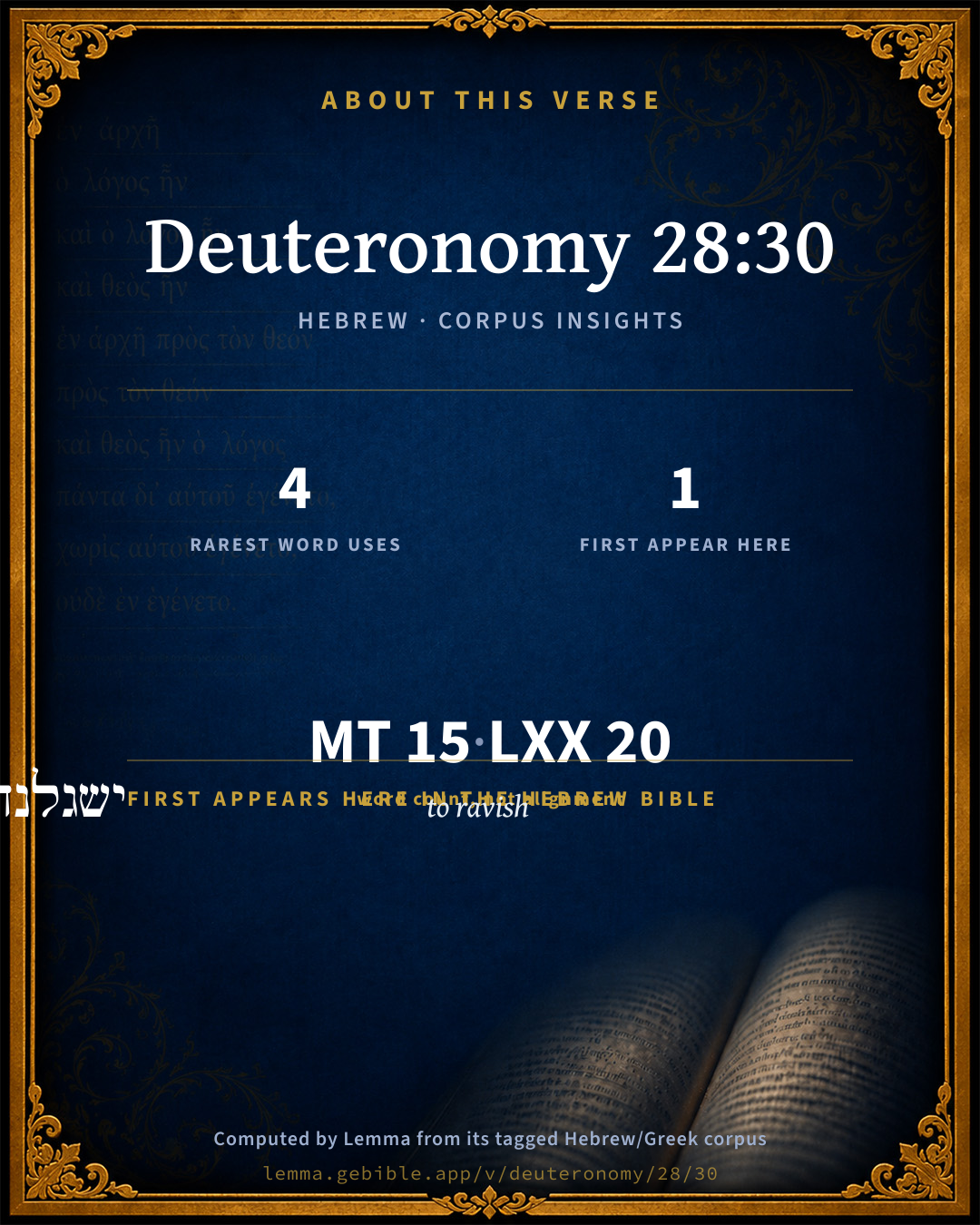
These counts appear in no published source. They are computed here, from the morphology-tagged text and Lemma’s own curated glosses. What Lemma adds →

15
words
13
distinct lemmas
Pentateuch
section

Notable vocabulary

The rarest word here is ישגלנה to ravish H7693 — appearing just 4 times in the whole Hebrew Bible.

First appearance in Scripture

This word makes its first canonical appearance in the Hebrew Bible here:

  • ישגלנה to ravish H7693

Shared distinctive vocabulary

ישגלנה to ravish H7693 occurs in 4 verses of the Hebrew Bible. Also found in:

Grammatical profile

  • 7 verbs
  • 4 nouns
  • 1 adjective
  • 1 preposition
  • 2 particles

Verb forms

  • תְאָרֵ֗שׂ Piel · Imperfect
  • ישגלנה Qal · Imperfect
  • יִשְׁכָּבֶ֔נָּה Qal · Imperfect
  • תִּבְנֶ֖ה Qal · Imperfect
  • תֵשֵׁ֣ב Qal · Imperfect
  • תִּטַּ֖ע Qal · Imperfect
  • תְחַלְּלֶּֽנּוּ Piel · Imperfect

Repetition

A word recurs within this verse — often emphatic in Hebrew:

  • וְלֹא not H3808 ×2

Hebrew & Septuagint length

In English translation the verse runs 36 words from the Hebrew and 36 from the Septuagint (LXX English) — the same length.

A rough comparison of the two English renderings, which tokenize alike — not a word-level alignment.

Word counts can differ between the Hebrew and the Greek without any difference in meaning — e.g. the Hebrew direct-object marker אֵת has no separate Greek word, and Greek often adds the article ὁ.

In the original languages it is 15 Hebrew tokens and 20 Greek tokens — but the two are counted differently (Hebrew bundles its prefixes and suffixes into one token; the Greek is in lemma form), so that isn’t a like-for-like length.

Cross-references

12

Topical passages linked to Deuteronomy 28:30 in the Treasury of Scripture Knowledge — connected by theme and wording, ordered by reader-vote popularity; previews shown in the World English Bible.

  • Amos 5:11 Forasmuch therefore as you trample on the poor, And take taxes from him of wheat: You have built houses of hewn stone, But you will not dwell in them. You have planted pleasant vineyards, But you shall not drink their wine.
  • Jeremiah 8:10 Therefore will I give their wives to others, and their fields to those who shall possess them: for everyone from the least even to the greatest is given to covetousness; from the prophet even to the priest every one deals falsely.
  • Job 31:10 Then let my wife grind for another, And let others sleep with her.
  • Isaiah 5:9–10 In my ears, Yahweh of Hosts says: "Surely many houses will be desolate, Even great and beautiful, unoccupied.
  • Jeremiah 12:13 They have sown wheat, and have reaped thorns; they have put themselves to pain, and profit nothing: and you shall be ashamed of your fruits, because of the fierce anger of Yahweh.
  • Lamentations 5:2 Our inheritance is turned to strangers, Our houses to aliens.
  • Deuteronomy 20:6–7 What man is there who has planted a vineyard, and has not used the fruit of it? let him go and return to his house, lest he die in the battle, and another man use the fruit of it.
  • Isaiah 65:21–22 They shall build houses, and inhabit them; and they shall plant vineyards, and eat the fruit of them.
  • Hosea 4:2 There is cursing, lying, murder, stealing, and committing adultery; They break boundaries, and bloodshed causes bloodshed.
  • Micah 6:15 You will sow, but won't reap. You will tread the olives, but won't anoint yourself with oil; And crush grapes, but won't drink the wine.
  • Zephaniah 1:13 Their wealth will become a spoil, and their houses a desolation. Yes, they will build houses, but won't inhabit them. They will plant vineyards, but won't drink their wine.
  • Job 3:18 There the prisoners are at ease together. They don't hear the voice of the taskmaster.

Cross-references courtesy of OpenBible.info (CC BY 4.0).

Hebrew and Greek witnesses Masoretic Hebrew ↔ Greek Septuagint

The same verse in the two great witnesses to the Old Testament, shown verse-for-verse.

These are two independent witnesses, not word-aligned to each other, and the Septuagint is shown in lemma (dictionary) form.

Hebrew Deuteronomy 28:30 Masoretic · Westminster Leningrad Codex

אִשָּׁ֣ה תְאָרֵ֗שׂ וְאִ֤ישׁ אַחֵר֙ ישגלנה יִשְׁכָּבֶ֔נָּה בַּ֥יִת תִּבְנֶ֖ה וְלֹא תֵשֵׁ֣ב בּ֑וֹ כֶּ֥רֶם תִּטַּ֖ע וְלֹ֥א תְחַלְּלֶּֽנּוּ

You shall betroth a wife, and another man shall lie with her: you shall build a house, and you shall not dwell therein: you shall plant a vineyard, and shall not use the fruit of it.

World English Bible · Public Domain

Greek LXX Deuteronomy 28:30 Septuagint · lemma form

γυνή λαμβάνω καί ἀνήρ ἕτερος ἔχω αὐτός οἰκία οἰκοδομέω καί οὐ οἰκέω ἐν αὐτός ἀμπελών φυτεύω καί οὐ τρυγάω αὐτός

you shall take a wife, and another man shall have her; you shall build a house, and you shall not dwell in it; you shall plant a vineyard, and shall not gather the grapes of it.

LXX2012 (modern English Septuagint) · Public Domain

On this verse, Haydock's Catholic Bible Commentary discusses the Septuagint’s reading. Read the note in Commentary ↓

Hebrew: Westminster Leningrad Codex (CC BY 4.0). Greek: Septuagint (public domain); English from LXX2012 (modern English Septuagint) (Public Domain). How the Septuagint differs from the Hebrew →

Targum (Aramaic paraphrase)

2

The Targum is the ancient Jewish Aramaic paraphrase of the Hebrew Scriptures — an interpretive translation, not the Hebrew text itself. Onkelos (literal) and Pseudo-Jonathan (expansive) render the Torah, and Jonathan the Prophets. Coverage is partial: where no permissively-licensed English translation exists for a verse, only the Aramaic is shown. This is verse-level text, not a word-by-word alignment to the Hebrew.

  1. Targum Onkelos Torah (Genesis–Deuteronomy)
    אִתְּתָא תֵירוֹס וּגְבַר אָחֳרָן יִשְׁכְּבִנַהּ בֵּיתָא תִבְנֵי וְלָא תֵיתֵב בֵּהּ כַּרְמָא תִצוֹב וְלָא תְחַלִנֵהּ

    (no public-domain English translation for this verse)

    Targum Onkelos — Aramaic: “Onkelos Genesis” (public domain); “Onkelos Exodus” (public domain); “Onkelos Leviticus” (public domain); “Onkelos Numbers” (public domain); “Onkelos Deuteronomy” (public domain). English: “Sefaria Community Translation” (CC0 1.0 (public-domain dedication)); “J.W. Etheridge. The Targums of Onkelos and Jonathan Ben Uzziel on the Pentateuch. London: Longmans, Green, 1862” (public domain). Text via Sefaria.

  2. Targum Pseudo-Jonathan Torah (Genesis–Deuteronomy)
    אִיתָא תְּקַדֵשׁ וּגְבַר חוֹרַן יְשַׁמֵשׁ עִמָהּ בֵּיתָא תִבְנֵי וְלָא תִיתַב בֵּיהּ כַּרְמָא תִנְצוֹב וְלָא תַחְלִינֵיהּ

    Thou wilt betroth a wife, but another man will have her; thou wilt build a house, but not dwell in it; thou wilt plant a vineyard, but not make it common.

    Targum Pseudo-Jonathan — Aramaic: “Targum Jonathan on Genesis” (public domain); “Targum Jonathan on Exodus” (public domain); “Targum Jonathan on Leviticus” (public domain); “Targum Jonathan on Numbers” (public domain); “Targum Jonathan on Deuteronomy” (public domain). English: “The Targum of Jonathan ben Uzziel, trans. J. W. Etheridge, London, 1862” (public domain). Text via Sefaria.

Commentary

Notes on Deuteronomy 28:30 from classic Christian and Jewish commentators (each source and its license shown beneath its notes). The classic Christian expositions comment on the surrounding passage and are grouped to its opening verse, so a note may address several verses; the Jewish commentaries on the Tanakh (Rashi and others) are per-verse, so they appear only where the commentator wrote on this verse.

Lemma curates 59 commentaries, every one of them public domain or Creative Commons licensed, each selected and text-cleaned for this edition rather than reprinted as found. About our sources →

Trapp's Complete Commentary

John Trapp

Deu 28:30 Thou shalt betroth a wife, and another man shall lie with her: thou shalt build an house, and thou shalt not dwell therein: thou shalt plant a vineyard, and shalt not gather the grapes thereof.

Ver. 30. Thou shalt built a house, &c.] A great aggravation of a man’s misery it is, to fall from high hopes, to fail of large expectations, as Haman did, and Absalom, and Alexander the Great, and Tamerlane, who preparing to perfect his conquest of the Greek Empire, and having given a good beginning thereunto, in the midst of his high hopes and greatest power, died of an ague, Jan. 27, 1462. {a} Many men spend their strength and waste their wits in getting these outward things, and in learning how to put them to their delightfullest use: and then, when to possess them might seem a happiness, either they die or are otherwise deprived of all the sweet they have laboured for.

{a} Turk. Hist.

John Trapp, A Commentary or Exposition upon All the Books of the Old and New Testament (1647–1656) — public domain. Text from a community e-Sword module.

Geneva Bible (1599)

Geneva Bible translators

Hebrew, make it common.

Geneva Bible (1599) marginal notes — public domain. Text via Bolls.life.

Adam Clarke's Commentary

Verse 30. Thou shalt betroth a wife, c.] Can any heart imagine any thing more grievous than the evils threatened in this and the following verses? To be on the brink of all social and domestic happiness, and then to be suddenly deprived of all, and see an enemy possess and enjoy every thing that was dear to them, must excite them to the utmost pitch of distraction and madness. They have, it is true, grievously sinned but, O ye Christians, have they not grievously suffered for it? Is not the stroke of God heavy enough upon them? Do not then, by unkind treatment or cruel Oppression, increase their miseries. They are, above all others, the men who have seen affliction by the stroke of his rod; La 3:1.

Adam Clarke's Commentary on the Bible (1810–1826) — public domain. Text from a community e-Sword/MySword module.

The Cambridge Bible for Schools and Colleges

gen. ed. J. J. S. Perowne

30. Cp. Deu_20:5-7. The Heb. text employs a more violent term.

The Cambridge Bible for Schools and Colleges (gen. ed. J. J. S. Perowne; Cambridge University Press, 1878–1918) — public domain. Text from a community e-Sword module.

John Gill's Exposition

The fruit of thy land, and all thy labour, shall a nation which thou knowest not eat up,.... The same was prophesied of by Jeremiah, concerning the Babylonish captivity, and was fulfilled in it, Jer 5:17; and has been also verified in the frequent pillage and spoil of this people, in their present state; for though they have no land to till, from whence to gather fruit, yet they are employed in manufactures and merchandise, the fruit and benefit of which they have been frequently stripped of:

and thou shall be only oppressed and crushed always; this seems best to agree with their present case; for in their former captivities they were not always oppressed and crushed, but had respite and deliverance; See Gill on Deu 28:29.

John Gill's Exposition of the Whole Bible (1746–1763) — public domain (CC PDM 1.0). Text via the HelloAO Bible API.

Haydock's Catholic Bible Commentary

Her. Job makes use of the same imprecation, Job xxxi. 10. Let my wife be the harlot of another. But he immediately subjoins, For this is a heinous crime, &c., which may be applied, both to him who seeks to commit an impure action, (ver. 9,) and to those who attempt to punish it by a similar abomination. No person is allowed to wish that a sin may be committed. The Hebrew and Septuagint very properly render all these imprecations in the future tense. "Thou shalt marry (or betroth) a wife, and another man shall," which, no doubt, would be an intolerable provocation. (Haydock)

George Leo Haydock (1774–1849), Haydock's Catholic Family Bible and Commentary, 1859 edition — public domain. Excludes Psalms (Douay-Rheims chapter numbering differs from Protestant) and Deuterocanonical books (Catholic canon only).

Matthew Poole's English Annotations

Another man shall lie with her before thou canst consummate thy marriage, and enjoy her as thy wife. And so in the following branches.

Matthew Poole's English Annotations on the Holy Bible (1683–1685) — public domain. Text from a community e-Sword/MySword module.

Whedon's Commentary on the Bible

Daniel D. Whedon

30. Betroth a wife — Though all the preparations for domestic life may be made, disobedience will bring dire dis-appointment. The wife, the home, the vineyard, shall be another’s.

Daniel D. Whedon (gen. ed.), Commentary on the Old and New Testaments (1874–1909) — public domain. Text from a community e-Sword module.

The Pulpit Commentary

Vers. 30-34. The spoliation of them should be utter. All most dear and precious to them should be the prey of their enemies. Wife, house, vineyard, herd, and flock should be ruthlessly taken from them; sons and daughters should be carried into captivity, and their eyes should look for them in rain, with constant and wasting longing (cf. Jer_8:20; Amo_5:11; Mic_6:15; Zep_1:13; 2Ch_29:9; Neh_11:36; Jer_5:15)

And shalt not gather the grapes thereof; margin, "Hebrew, profane." This is the literal rendering of the verb; the meaning is that given in the text. A vineyard was, for the first three years after it was planted, held sacred; (Lev_19:23) after that, its consecration ceased, and the fruit might be gathered for common use, (cf. Deu_20:6) and it was said to be profaned.

The Pulpit Commentary (1880–1919), ed. H.D.M. Spence-Jones & Joseph S. Exell — public domain. Text from a community e-Sword module.

unfoldingWord translationNotes

Door43 World Missions Community

General Information:

Moses speaks to the Israelites as if they were one man, so the words "you" and "your" here are singular. (See: Forms of You)

Your ox will be slain before your eyes

This can be stated in active form. AT: "You will watch as someone kills your ox" (See: Active or Passive)

your donkey will be forcibly taken away from before you and will not be restored to you

This can be stated in active form. AT: "someone will take your donkey by force and will not give it back" (See: Active or Passive)

Your sheep will be given to your enemies

This can be stated in active form. AT: "I will give your sheep to your enemies" or "I will allow your enemies to take your sheep" (See: Active or Passive)

translationWords

had relations with

life

vineyard

fruit

cow

donkey

ewe

unfoldingWord translationNotes — © Distant Shores Media and the Door43 World Missions Community, licensed CC BY-SA 4.0. Source: git.door43.org/Door43/en_tn.

Rashi

Rabbi Shlomo Yitzchaki (Rashi)

ישגלנה is connected in meaning with the noun שגל, a concubine; Scripture, however, paraphrases it by using a more decent, expression, viz., ישכבנה (i.e. the קרי is ישכבנה). This is a variation such as writers make to avoid an indecent expression (Megillah 25b; cf. Rashi on Genesis 18:22 and Note p. 266).

תחללנו THOU SHALT NOT MAKE IT חולין in the fourth year so as to be able to eat its fruits (cf. Rashi on Deuteronomy 20:6).

Rashi on the Tanakh — English translations: “The Judaica Press complete Tanach with Rashi, translated by A. J. Rosenberg” (CC BY 4.0); “Pentateuch with Rashi's commentary by M. Rosenbaum and A.M. Silbermann, 1929-1934” (public domain); “The Metsudah Tanach series, Lakewood, N.J” (CC BY 4.0); and “The Book of Joshua, Metsudah Publications, 1997” (CC BY 4.0). Text via Sefaria.

Lesson kit

Teaching starters — assembled from the data on this page, not authored interpretation. Every prompt links to the verse data it draws on. Edit before teaching.

Deuteronomy, in the Pentateuch, opens this verse with 15 words (13 distinct Hebrew lemmas). Its most distinctive word is shâgal (“to ravish”). A historical commentator’s framing appears above. Read the whole chapter for the surrounding context.

Discussion questions

  1. What does “to ravish” (shâgal) contribute to the verse as a whole?
  2. The word “to ravish” first appears here in Scripture. What is being introduced at this debut?
  3. Isaiah 13:16 shares the word «to ravish» with this verse. How do the two illuminate each other?
  4. “not” occurs 2× in this one verse. What is the effect of the repetition?
  5. These translations render this verse differently. What is at stake in choosing one wording over another?
  6. The verb «תְאָרֵ֗שׂ» is Piel Imperfect. How does its form color the action?
  7. Reading how Trapp's Complete Commentary and Geneva Bible (1599) read this verse, where do the two commentators agree and where do they part?

Things to notice

Reading settings

Reading text

Shown beneath each verse's original-language words.

Old Testament
Old Testament edition

Read the OT as the Masoretic Hebrew (MT) or the Greek Septuagint (LXX).

English shown for the Greek Septuagint (in the Hebrew ↔ Greek comparison).

Comparing translations? Open the Compare panel on any verse page to stack up to four side by side.