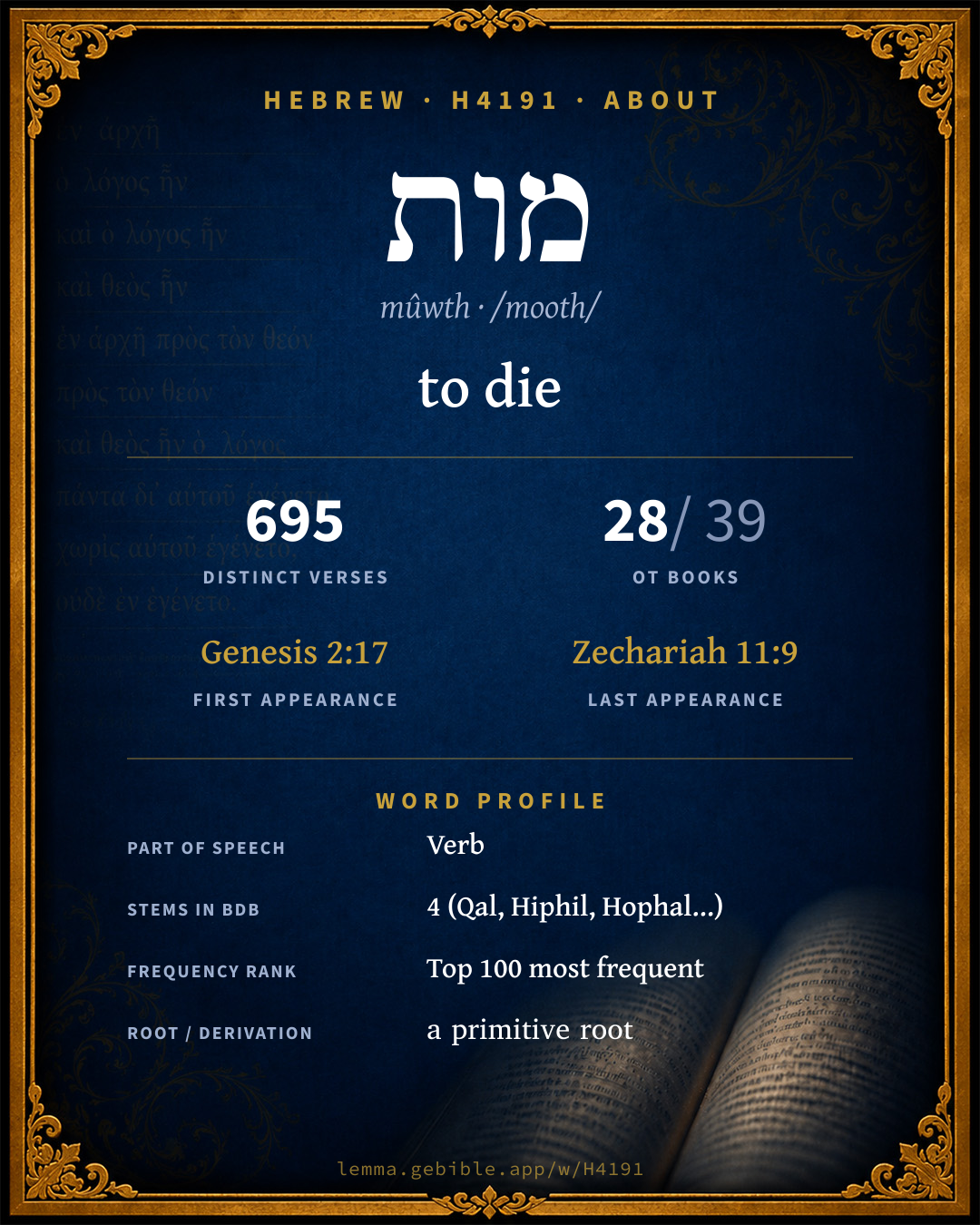
מוּת
to die
also: kill, have one executed fuller range ↓
Full lexicon entry — Brown-Driver-Briggs (BDB)
From Brown-Driver-Briggs (BDB)
Where this word appears
See every Qal verb in the Hebrew Bible →
Grammar key — what these labels mean
Part of speech
- Verb
- An action or state-of-being word.
- Noun
- A naming word — a person, place, thing, or idea.
Noun type
- Common
- A common noun — a general class of person, place, or thing (“king,” “city,” “water”), not a specific name.
Stem
- Qal
- The basic, simple active stem — the plain form of the verb (“he wrote”). Here: ‘die’
- Hophal
- The passive counterpart of the Hiphil (“he was caused to…”). Here: ‘by conspiracy 2 K 11’
- Hiphil
- The causative active stem (“he caused / brought about”). Here: ‘of killing men in personal combat’
- Polel
- A stem of hollow/geminate roots functioning like the Piel — intensive active.
Form
- Sequential Imperfect
- An imperfect with prefixed waw — the standard past-narrative form (waw-consecutive imperfect).
- Imperfect
- An incomplete, ongoing, or future action (“he will / would write”).
- Infinitive Absolute
- An unbound verbal noun, often intensifying or standing in for a finite verb.
- Perfect
- A completed action or state — Hebrew marks aspect (completeness) more than strict tense (“he wrote”).
- Sequential Perfect
- A perfect with prefixed waw continuing a preceding imperfect or command (waw-consecutive perfect).
- Infinitive Construct
- A bound verbal noun, frequently with prepositions (“to write / in writing”).
- Participle Active
- A verbal adjective expressing ongoing or characteristic action (“writing / one who writes”).
- Imperative
- A direct command (“write!”).
- Jussive
- A third- or second-person volitional form expressing wish or command (“let him write”).
- Participle Passive
- A verbal adjective expressing action received (“written”).
- Cohortative
- A first-person volitional form expressing wish or resolve (“let me / let us write”).
State
- Absolute
- The independent form of a noun, not bound to a following word.
- Construct
- A noun bound to a following noun in a possessive / “of” relationship (the construct chain).
Person
- 3rd Person
- The one spoken about (“he / she / it / they”).
- 2nd Person
- The one addressed (“you”).
- 1st Person
- The speaker (“I / we”).
Gender
- Masculine
- Grammatically masculine.
- Common
- Either gender — not distinguished for this form.
- Feminine
- Grammatically feminine.
Number
- Singular
- One.
- Plural
- More than one (in Hebrew, generally three or more).
Grammatical forms 81 distinct
- Verb, Qal, Sequential Imperfect, 3rd Person, Masculine, Singular 127 times (15%)
- Verb, Qal, Imperfect, 3rd Person, Masculine, Singular 67 times (8%)
- Verb, Qal, Perfect, 3rd Person, Masculine, Singular 55 times (7%)
- Verb, Qal, Participle Active, Masculine, Singular, Absolute 55 times (7%)
- Verb, Hophal, Imperfect, 3rd Person, Masculine, Singular 49 times (6%)
- Verb, Qal, Infinitive Absolute 49 times (6%)
- Verb, Hiphil, Infinitive Construct 38 times (5%)
- Verb, Qal, Imperfect, 3rd Person, Masculine, Plural 31 times (4%)
+73 more forms (368 occurrences)
Parsed forms decoded from the imported morphology (morphhb / Westminster Leningrad Codex — WLC text public domain, morphhb tagging CC BY 4.0), counted across 839 parsed occurrences — not distinct verses.
Page 1 of 4 — showing verses 1–200 of 695 distinct verses where H4191 appears, across 28 books. Click any verse to open its interlinear word-by-word view. Verse text shown in the World English Bible for context — . Each verse’s Hebrew form is shown with its reference; the English is not keyword-highlighted, since the data carries no word-level English alignment. Use “Compare translations” on any verse to read it across multiple English versions. This concordance covers the Hebrew Bible; Septuagint (Greek Old Testament) occurrences are not indexed here.
Genesis 72 verses
- Genesis 2:17 מ֥וֹת תָּמֽוּת Qal inf.abs Qal impf 2ms but of the tree of the knowledge of good and evil, you shall not eat of it: for in the day that you eat of it you will surely die."
- Genesis 3:3 תְּמֻתֽוּ/ן Qal impf 2mp + sfx n but of the fruit of the tree which is in the midst of the garden, God has said, 'You shall not eat of it, neither shall you touch it, lest you die.'"
- Genesis 3:4 מ֖וֹת תְּמֻתֽוּ/ן Qal inf.abs Qal impf 2mp + sfx n The serpent said to the woman, "You won't surely die,
- Genesis 5:5 וַ/יָּמֹֽת conj + Qal wimpf 3ms All the days that Adam lived were nine hundred thirty years, then he died.
- Genesis 5:8 וַ/יָּמֹֽת conj + Qal wimpf 3ms All the days of Seth were nine hundred twelve years, then he died.
- Genesis 5:11 וַ/יָּמֹֽת conj + Qal wimpf 3ms All the days of Enosh were nine hundred five years, then he died.
- Genesis 5:14 וַ/יָּמֹֽת conj + Qal wimpf 3ms and all the days of Kenan were nine hundred ten years, then he died.
- Genesis 5:17 וַ/יָּמֹֽת conj + Qal wimpf 3ms All the days of Mahalalel were eight hundred ninety-five years, then he died.
- Genesis 5:20 וַ/יָּמֹֽת conj + Qal wimpf 3ms All the days of Jared were nine hundred sixty-two years, then he died.
- Genesis 5:27 וַ/יָּמֹֽת conj + Qal wimpf 3ms All the days of Methuselah were nine hundred sixty-nine years, then he died.
- Genesis 5:31 וַ/יָּמֹֽת conj + Qal wimpf 3ms All the days of Lamech were seven hundred seventy-seven years, then he died.
- Genesis 7:22 מֵֽתוּ Qal pf 3cp All in whose nostrils was the breath of the spirit of life, of all that was on the dry land, died.
- Genesis 9:29 וַ/יָּמֹֽת conj + Qal wimpf 3ms All the days of Noah were nine hundred fifty years, then he died.
- Genesis 11:28 וַ/יָּ֣מָת conj + Qal wimpf 3ms Haran died before his father Terah in the land of his birth, in Ur of the Chaldees.
- Genesis 11:32 וַ/יָּ֥מָת conj + Qal wimpf 3ms The days of Terah were two hundred five years. Terah died in Haran.
- Genesis 18:25 לְ/הָמִ֤ית prep + Hiphil inf.cs Be it far from you to do things like that, to kill the righteous with the wicked, that so the righteous should be as the wicked. May that be far from you. Shouldn't the Judge of all the earth do right?"
- Genesis 19:19 וָ/מַֽתִּי conj + Qal pf 1cs See now, your servant has found favor in your sight, and you have magnified your loving kindness, which you have shown to me in saving my life. I can't escape to the mountain, lest evil overtake me, and I die.
- Genesis 20:3 מֵת֙ Qal ptcp.act ms But God came to Abimelech in a dream of the night, and said to him, "Behold, you are a dead man, because of the woman whom you have taken. For she is a man's wife."
- Genesis 20:7 מ֣וֹת תָּמ֔וּת Qal inf.abs Qal impf 2ms Now therefore, restore the man's wife. For he is a prophet, and he will pray for you, and you will live. If you don't restore her, know for sure that you will die, you, and all who are yours."
- Genesis 23:2 וַ/תָּ֣מָת conj + Qal wimpf 3fs Sarah died in Kiriath Arba (the same is Hebron), in the land of Canaan. Abraham came to mourn for Sarah, and to weep for her.
- Genesis 23:3 מֵת֑/וֹ Qal ptcp.act ms cs + sfx pers 3ms Abraham rose up from before his dead, and spoke to the children of Heth, saying,
- Genesis 23:4 מֵתִ֖/י Qal ptcp.act ms cs + sfx pers 1cs "I am a stranger and a foreigner living with you. Give me a possession of a burying-place with you, that I may bury my dead out of my sight."
- Genesis 23:6 מֵתֶ֑/ךָ מֵתֶֽ/ךָ Qal ptcp.act ms cs + sfx pers 2ms Qal ptcp.act ms cs + sfx pers 2ms "Hear us, my lord. You are a prince of God among us. In the choice of our tombs bury your dead. None of us will withhold from you his tomb, but that you may bury your dead."
- Genesis 23:8 מֵתִ/י֙ Qal ptcp.act ms cs + sfx pers 1cs He talked with them, saying, "If it be your mind that I should bury my dead out of my sight, hear me, and entreat for me to Ephron the son of Zohar,
- Genesis 23:11 מֵתֶֽ/ךָ Qal ptcp.act ms cs + sfx pers 2ms "No, my lord, hear me. I give you the field, and I give you the cave that is in it. In the presence of the children of my people I give it to you. Bury your dead."
- Genesis 23:13 מֵתִ֖/י Qal ptcp.act ms cs + sfx pers 1cs He spoke to Ephron in the audience of the people of the land, saying, "But if you will, please hear me. I will give the price of the field. Take it from me, and I will bury my dead there."
- Genesis 23:15 מֵתְ/ךָ֖ Qal ptcp.act ms cs + sfx pers 2ms "My lord, listen to me. What is a piece of land worth four hundred shekels of silver between me and you? Therefore bury your dead."
- Genesis 25:8 וַ/יָּ֧מָת conj + Qal wimpf 3ms Abraham gave up the spirit, and died in a good old age, an old man, and full of years, and was gathered to his people.
- Genesis 25:17 וַ/יָּ֔מָת conj + Qal wimpf 3ms These are the years of the life of Ishmael: one hundred thirty-seven years. He gave up the spirit and died, and was gathered to his people.
- Genesis 25:32 לָ/מ֑וּת prep + Qal inf.cs Esau said, "Behold, I am about to die. What good is the birthright to me?"
- Genesis 26:9 אָמ֖וּת Qal impf 1cs Abimelech called Isaac, and said, "Behold, surely she is your wife. Why did you say, 'She is my sister?'" Isaac said to him, "Because I said, 'Lest I die because of her.'"
- Genesis 26:11 מ֥וֹת יוּמָֽת Qal inf.abs Hophal impf 3ms Abimelech charged all the people, saying, "He who touches this man or his wife will surely be put to death."
- Genesis 27:4 אָמֽוּת Qal impf 1cs Make me savory food, such as I love, and bring it to me, that I may eat, and that my soul may bless you before I die."
- Genesis 30:1 מֵתָ֥ה Qal ptcp.act fs When Rachel saw that she bore Jacob no children, Rachel envied her sister. She said to Jacob, "Give me children, or else I will die."
- Genesis 33:13 וָ/מֵ֖תוּ conj + Qal wpf 3cp Jacob said to him, "My lord knows that the children are tender, and that the flocks and herds with me have their young, and if they overdrive them one day, all the flocks will die.
- Genesis 35:8 וַ/תָּ֤מָת conj + Qal wimpf 3fs Deborah, Rebekah's nurse, died, and she was buried below Bethel under the oak; and the name of it was called Allon Bacuth.
- Genesis 35:18 מֵ֔תָה Qal pf 3fs It happened, as her soul was departing (for she died), that she named him Ben-oni, but his father named him Benjamin.
- Genesis 35:19 וַ/תָּ֖מָת conj + Qal wimpf 3fs Rachel died, and was buried in the way to Ephrath (the same is Bethlehem).
- Genesis 35:29 וַ/יָּ֨מָת֙ conj + Qal wimpf 3ms Isaac gave up the spirit, and died, and was gathered to his people, old and full of days. Esau and Jacob, his sons, buried him.
- Genesis 36:33 וַ/יָּ֖מָת conj + Qal wimpf 3ms Bela died, and Jobab, the son of Zerah of Bozrah, reigned in his place.
- Genesis 36:34 וַ/יָּ֖מָת conj + Qal wimpf 3ms Jobab died, and Husham of the land of the Temanites reigned in his place.
- Genesis 36:35 וַ/יָּ֖מָת conj + Qal wimpf 3ms Husham died, and Hadad, the son of Bedad, who struck Midian in the field of Moab, reigned in his place. The name of his city was Avith.
- Genesis 36:36 וַ/יָּ֖מָת conj + Qal wimpf 3ms Hadad died, and Samlah of Masrekah reigned in his place.
- Genesis 36:37 וַ/יָּ֖מָת conj + Qal wimpf 3ms Samlah died, and Shaul of Rehoboth by the river, reigned in his place.
- Genesis 36:38 וַ/יָּ֖מָת conj + Qal wimpf 3ms Shaul died, and Baal Hanan, the son of Achbor reigned in his place.
- Genesis 36:39 וַ/יָּמָת֮ conj + Qal wimpf 3ms Baal Hanan the son of Achbor died, and Hadar reigned in his place. The name of his city was Pau. His wife's name was Mehetabel, the daughter of Matred, the daughter of Me-zahab.
- Genesis 37:18 לַ/הֲמִיתֽ/וֹ prep + Hiphil inf.cs + sfx pers 3ms They saw him afar off, and before he came near to them, they conspired against him to kill him.
- Genesis 38:7 וַ/יְמִתֵ֖/הוּ conj + Hiphil wimpf 3ms + sfx pers 3ms Er, Judah's firstborn, was wicked in the sight of Yahweh. Yahweh killed him.
- Genesis 38:10 וַ/יָּ֖מֶת conj + Hiphil wimpf 3ms The thing which he did was evil in the sight of Yahweh, and he killed him also.
- Genesis 38:11 יָמ֥וּת Qal impf 3ms Then Judah said to Tamar, his daughter-in-law, "Remain a widow in your father's house, until Shelah, my son, is grown up;" for he said, "Lest he also die, like his brothers." Tamar went and lived in her father's house.
- Genesis 38:12 וַ/תָּ֖מָת conj + Qal wimpf 3fs After many days, Shua's daughter, the wife of Judah, died. Judah was comforted, and went up to his sheep-shearers to Timnah, he and his friend Hirah, the Adullamite.
- Genesis 42:2 נָמֽוּת Qal impf 1cp He said, "Behold, I have heard that there is grain in Egypt. Go down there, and buy for us from there, so that we may live, and not die."
- Genesis 42:20 תָמ֑וּתוּ Qal impf 2mp Bring your youngest brother to me; so will your words be verified, and you won't die." They did so.
- Genesis 42:37 תָּמִ֔ית Hiphil impf 2ms Reuben spoke to his father, saying, "Kill my two sons, if I don't bring him to you. Deliver him into my hand, and I will bring him to you again."
- Genesis 42:38 מֵ֜ת Qal pf 3ms He said, "My son shall not go down with you; for his brother is dead, and he only is left. If harm happens to him by the way in which you go, then you will bring down my gray hairs with sorrow to Sheol."
- Genesis 43:8 נָמ֔וּת Qal impf 1cp Judah said to Israel, his father, "Send the boy with me, and we will arise and go, so that we may live, and not die, both we, and you, and also our little ones.
- Genesis 44:9 וָ/מֵ֑ת conj + Qal wpf 3ms With whoever of your servants it be found, let him die, and we also will be my lord's bondservants."
- Genesis 44:20 מֵ֜ת Qal pf 3ms We said to my lord, 'We have a father, an old man, and a child of his old age, a little one; and his brother is dead, and he alone is left of his mother; and his father loves him.'
- Genesis 44:22 וָ/מֵֽת conj + Qal wpf 3ms We said to my lord, 'The boy can't leave his father: for if he should leave his father, his father would die.'
- Genesis 44:31 וָ/מֵ֑ת conj + Qal wpf 3ms it will happen, when he sees that the boy is no more, that he will die. Your servants will bring down the gray hairs of your servant, our father, with sorrow to Sheol.
- Genesis 45:28 אָמֽוּת Qal impf 1cs Israel said, "It is enough. Joseph my son is still alive. I will go and see him before I die."
- Genesis 46:12 וַ/יָּ֨מָת conj + Qal wimpf 3ms The sons of Judah: Er, Onan, Shelah, Perez, and Zerah; but Er and Onan died in the land of Canaan. The sons of Perez were Hezron and Hamul.
- Genesis 46:30 אָמ֣וּתָה Qal coh 1cs Israel said to Joseph, "Now let me die, since I have seen your face, that you are still alive."
- Genesis 47:15 נָמ֖וּת Qal impf 1cp When the money was all spent in the land of Egypt, and in the land of Canaan, all the Egyptians came to Joseph, and said, "Give us bread, for why should we die in your presence? For our money fails."
- Genesis 47:19 נָמ֣וּת נָמ֔וּת Qal impf 1cp Qal impf 1cp Why should we die before your eyes, both we and our land? Buy us and our land for bread, and we and our land will be servants to Pharaoh. Give us seed, that we may live, and not die, and that the land won't be desolate."
- Genesis 47:29 לָ/מוּת֒ prep + Qal inf.cs The time drew near that Israel must die, and he called his son Joseph, and said to him, "If now I have found favor in your sight, please put your hand under my thigh, and deal kindly and truly with me. Please don't bury me in Egypt,
- Genesis 48:7 מֵ֩תָה֩ Qal pf 3fs As for me, when I came from Paddan, Rachel died by me in the land of Canaan in the way, when there was still some distance to come to Ephrath, and I buried her there in the way to Ephrath (the same is Bethlehem)."
- Genesis 48:21 מֵ֑ת Qal ptcp.act ms Israel said to Joseph, "Behold, I am dying, but God will be with you, and bring you again to the land of your fathers.
- Genesis 50:5 מֵת֒ Qal ptcp.act ms 'My father made me swear, saying, "Behold, I am dying. Bury me in my grave which I have dug for myself in the land of Canaan." Now therefore, please let me go up and bury my father, and I will come again.'"
- Genesis 50:15 מֵ֣ת Qal pf 3ms When Joseph's brothers saw that their father was dead, they said, "It may be that Joseph will hate us, and will fully pay us back for all of the evil which we did to him.
- Genesis 50:24 מֵ֑ת Qal ptcp.act ms Joseph said to his brothers, "I am dying, but God will surely visit you, and bring you up out of this land to the land which he swore to Abraham, to Isaac, and to Jacob."
- Genesis 50:26 וַ/יָּ֣מָת conj + Qal wimpf 3ms So Joseph died, being one hundred ten years old, and they embalmed him, and he was put in a coffin in Egypt.
Exodus 46 verses
- Exodus 1:6 וַ/יָּ֤מָת conj + Qal wimpf 3ms Joseph died, as did all his brothers, and all that generation.
- Exodus 1:16 וַ/הֲמִתֶּ֣ן conj + Hiphil wpf 2fp and he said, "When you perform the duty of a midwife to the Hebrew women, and see them on the birth stool; if it is a son, then you shall kill him; but if it is a daughter, then she shall live."
- Exodus 2:23 וַ/יָּ֨מָת֙ conj + Qal wimpf 3ms It happened in the course of those many days, that the king of Egypt died, and the children of Israel sighed because of the bondage, and they cried, and their cry came up to God because of the bondage.
- Exodus 4:19 מֵ֨תוּ֙ Qal pf 3cp Yahweh said to Moses in Midian, "Go, return into Egypt; for all the men who sought your life are dead."
- Exodus 4:24 הֲמִיתֽ/וֹ Hiphil inf.cs + sfx pers 3ms It happened on the way at a lodging place, that Yahweh met him and wanted to kill him.
- Exodus 7:18 תָּמ֖וּת Qal impf 3fs The fish that are in the river shall die, and the river shall become foul; and the Egyptians shall loathe to drink water from the river."'"
- Exodus 7:21 מֵ֨תָה֙ Qal pf 3fs The fish that were in the river died; and the river became foul, and the Egyptians couldn't drink water from the river; and the blood was throughout all the land of Egypt.
- Exodus 8:13 וַ/יָּמֻ֨תוּ֙ conj + Qal wimpf 3mp Yahweh did according to the word of Moses, and the frogs died out of the houses, out of the courts, and out of the fields.
- Exodus 9:4 יָמ֛וּת Qal impf 3ms Yahweh will make a distinction between the cattle of Israel and the cattle of Egypt; and there shall nothing die of all that belongs to the children of Israel."'"
- Exodus 9:6 וַ/יָּ֕מָת מֵ֥ת conj + Qal wimpf 3ms Qal pf 3ms Yahweh did that thing on the next day; and all the cattle of Egypt died, but of the cattle of the children of Israel, not one died.
- Exodus 9:7 מֵ֛ת Qal pf 3ms Pharaoh sent, and, behold, there was not so much as one of the cattle of the Israelites dead. But the heart of Pharaoh was stubborn, and he didn't let the people go.
- Exodus 9:19 וָ/מֵֽתוּ conj + Qal wpf 3cp Now therefore command that all of your cattle and all that you have in the field be brought into shelter. Every man and animal that is found in the field, and isn't brought home, the hail shall come down on them, and they shall die."'"
- Exodus 10:28 תָּמֽוּת Qal impf 2ms Pharaoh said to him, "Get away from me! Be careful to see my face no more; for in the day you see my face you shall die!"
- Exodus 11:5 וּ/מֵ֣ת conj + Qal wpf 3ms and all the firstborn in the land of Egypt shall die, from the firstborn of Pharaoh who sits on his throne, even to the firstborn of the maid-servant who is behind the mill; and all the firstborn of cattle.
- Exodus 12:30 מֵֽת Qal ptcp.act ms Pharaoh rose up in the night, he, and all his servants, and all the Egyptians; and there was a great cry in Egypt, for there was not a house where there was not one dead.
- Exodus 12:33 מֵתִֽים Qal ptcp.act mp The Egyptians were urgent with the people, to send them out of the land in haste, for they said, "We are all dead men."
- Exodus 14:11 לָ/מ֣וּת prep + Qal inf.cs They said to Moses, "Because there were no graves in Egypt, have you taken us away to die in the wilderness? Why have you treated us this way, to bring us forth out of Egypt?
- Exodus 14:12 מִ/מֻּתֵ֖/נוּ prep + Qal inf.cs + sfx pers 1cp Isn't this the word that we spoke to you in Egypt, saying, 'Leave us alone, that we may serve the Egyptians?' For it were better for us to serve the Egyptians, than that we should die in the wilderness."
- Exodus 14:30 מֵ֖ת Qal ptcp.act ms Thus Yahweh saved Israel that day out of the hand of the Egyptians; and Israel saw the Egyptians dead on the seashore.
- Exodus 16:3 מוּתֵ֤/נוּ לְ/הָמִ֛ית Qal inf.cs + sfx pers 1cp prep + Hiphil inf.cs and the children of Israel said to them, "We wish that we had died by the hand of Yahweh in the land of Egypt, when we sat by the flesh-pots, when we ate our fill of bread, for you have brought us out into this wilderness, to kill this whole assembly with hunger."
- Exodus 17:3 לְ/הָמִ֥ית prep + Hiphil inf.cs The people were thirsty for water there; and the people murmured against Moses, and said, "Why have you brought us up out of Egypt, to kill us, our children, and our livestock with thirst?"
- Exodus 19:12 מ֥וֹת יוּמָֽת Qal inf.abs Hophal impf 3ms You shall set bounds to the people round about, saying, 'Be careful that you don't go up onto the mountain, or touch its border. Whoever touches the mountain shall be surely put to death.
- Exodus 20:19 נָמֽוּת Qal impf 1cp They said to Moses, "Speak with us yourself, and we will listen; but don't let God speak with us, lest we die."
- Exodus 21:12 וָ/מֵ֖ת מ֥וֹת יוּמָֽת conj + Qal wpf 3ms Qal inf.abs Hophal impf 3ms "One who strikes a man so that he dies shall surely be put to death,
- Exodus 21:14 לָ/מֽוּת prep + Qal inf.cs If a man schemes and comes presumptuously on his neighbor to kill him, you shall take him from my altar, that he may die.
- Exodus 21:15 מ֥וֹת יוּמָֽת Qal inf.abs Hophal impf 3ms "Anyone who attacks his father or his mother shall be surely put to death.
- Exodus 21:16 מ֥וֹת יוּמָֽת Qal inf.abs Hophal impf 3ms "Anyone who kidnaps someone and sells him, or if he is found in his hand, he shall surely be put to death.
- Exodus 21:17 מ֥וֹת יוּמָֽת Qal inf.abs Hophal impf 3ms "Anyone who curses his father or his mother shall surely be put to death.
- Exodus 21:18 יָמ֖וּת Qal impf 3ms "If men quarrel and one strikes the other with a stone, or with his fist, and he doesn't die, but is confined to bed;
- Exodus 21:20 וּ/מֵ֖ת conj + Qal wpf 3ms "If a man strikes his servant or his maid with a rod, and he dies under his hand, he shall surely be punished.
- Exodus 21:28 וָ/מֵ֑ת conj + Qal pf 3ms "If a bull gores a man or a woman to death, the bull shall surely be stoned, and its flesh shall not be eaten; but the owner of the bull shall not be held responsible.
- Exodus 21:29 וְ/הֵמִ֥ית יוּמָֽת conj + Hiphil wpf 3ms Hophal impf 3ms But if the bull had a habit of goring in the past, and it has been testified to its owner, and he has not kept it in, but it has killed a man or a woman, the bull shall be stoned, and its owner shall also be put to death.
- Exodus 21:34 וְ/הַ/מֵּ֖ת conj + ptcl def.art + Qal ptcp.act ms the owner of the pit shall make it good. He shall give money to its owner, and the dead animal shall be his.
- Exodus 21:35 וָ/מֵ֑ת הַ/מֵּ֖ת conj + Qal wpf 3ms ptcl def.art + Qal ptcp.act ms "If one man's bull injures another's, so that it dies, then they shall sell the live bull, and divide its price; and they shall also divide the dead animal.
- Exodus 21:36 וְ/הַ/מֵּ֖ת conj + ptcl def.art + Qal ptcp.act ms Or if it is known that the bull was in the habit of goring in the past, and its owner has not kept it in, he shall surely pay bull for bull, and the dead animal shall be his own.
- Exodus 22:2 וָ/מֵ֑ת conj + Qal pf 3ms If the thief is found breaking in, and is struck so that he dies, there shall be no guilt of bloodshed for him.
- Exodus 22:10 וּ/מֵ֛ת conj + Qal pf 3ms "If a man delivers to his neighbor a donkey, an ox, a sheep, or any animal to keep, and it dies or is injured, or driven away, no man seeing it;
- Exodus 22:14 מֵ֑ת Qal pf 3ms "If a man borrows anything of his neighbor's, and it is injured, or dies, the owner of it not being with it, he shall surely make restitution.
- Exodus 22:19 מ֥וֹת יוּמָֽת Qal inf.abs Hophal impf 3ms "Whoever has sex with an animal shall surely be put to death.
- Exodus 28:35 יָמֽוּת Qal impf 3ms It shall be on Aaron to minister: and the sound of it shall be heard when he goes in to the holy place before Yahweh, and when he comes out, that he not die.
- Exodus 28:43 וָ/מֵ֑תוּ conj + Qal wpf 3cp They shall be on Aaron, and on his sons, when they go in to the tent of meeting, or when they come near to the altar to minister in the holy place; that they don't bear iniquity, and die: it shall be a statute forever to him and to his descendants after him.
- Exodus 30:20 יָמֻ֑תוּ Qal impf 3mp When they go into the tent of meeting, they shall wash with water, that they not die; or when they come near to the altar to minister, to burn an offering made by fire to Yahweh.
- Exodus 30:21 יָמֻ֑תוּ Qal impf 3mp So they shall wash their hands and their feet, that they not die: and it shall be a statute forever to them, even to him and to his descendants throughout their generations."
- Exodus 31:14 מ֣וֹת יוּמָ֔ת Qal inf.abs Hophal impf 3ms You shall keep the Sabbath therefore; for it is holy to you. Everyone who profanes it shall surely be put to death; for whoever does any work therein, that soul shall be cut off from among his people.
- Exodus 31:15 מ֥וֹת יוּמָֽת Qal inf.abs Hophal impf 3ms Six days shall work be done, but on the seventh day is a Sabbath of solemn rest, holy to Yahweh. Whoever does any work on the Sabbath day shall surely be put to death.
- Exodus 35:2 יוּמָֽת Hophal impf 3ms 'Six days shall work be done, but on the seventh day there shall be a holy day for you, a Sabbath of solemn rest to Yahweh: whoever does any work in it shall be put to death.
Leviticus 28 verses
- Leviticus 8:35 תָמ֑וּתוּ Qal impf 2mp At the door of the Tent of Meeting you shall stay day and night seven days, and keep the charge of Yahweh, that you don't die: for so I am commanded."
- Leviticus 10:2 וַ/יָּמֻ֖תוּ conj + Qal wimpf 3mp And fire came forth from before Yahweh, and devoured them, and they died before Yahweh.
- Leviticus 10:6 תָמֻ֔תוּ Qal impf 2mp Moses said to Aaron, and to Eleazar and to Ithamar, his sons, "Don't let the hair of your heads go loose, neither tear your clothes; that you don't die, and that he not be angry with all the congregation: but let your brothers, the whole house of Israel, bewail the burning which Yahweh has kindled.
- Leviticus 10:7 תָּמֻ֔תוּ Qal impf 2mp You shall not go out from the door of the Tent of Meeting, lest you die; for the anointing oil of Yahweh is on you." They did according to the word of Moses.
- Leviticus 10:9 תָמֻ֑תוּ Qal impf 2mp "Drink no wine nor strong drink, you, nor your sons with you, when you go into the Tent of Meeting, that you don't die: it shall be a statute forever throughout your generations:
- Leviticus 11:39 יָמוּת֙ Qal impf 3ms "'If any animal, of which you may eat, dies; he who touches its carcass shall be unclean until the evening.
- Leviticus 15:31 יָמֻ֨תוּ֙ Qal impf 3mp "'Thus you shall separate the children of Israel from their uncleanness, so they will not die in their uncleanness, when they defile my tabernacle that is in their midst.'"
- Leviticus 16:1 וַ/יָּמֻֽתוּ conj + Qal wimpf 3mp Yahweh spoke to Moses, after the death of the two sons of Aaron, when they drew near before Yahweh, and died;
- Leviticus 16:2 יָמ֔וּת Qal impf 3ms and Yahweh said to Moses, "Tell Aaron your brother, not to come at all times into the Most Holy Place within the veil, before the mercy seat which is on the ark; lest he die: for I will appear in the cloud on the mercy seat.
- Leviticus 16:13 יָמֽוּת Qal impf 3ms and he shall put the incense on the fire before Yahweh, that the cloud of the incense may cover the mercy seat that is on the testimony, so that he will not die.
- Leviticus 19:20 יוּמְת֖וּ Hophal impf 3mp "'If a man lies carnally with a woman who is a slave girl, pledged to be married to another man, and not ransomed, or given her freedom; they shall be punished. They shall not be put to death, because she was not free.
- Leviticus 20:2 מ֣וֹת יוּמָ֑ת Qal inf.abs Hophal impf 3ms "Moreover, you shall tell the children of Israel, 'Anyone of the children of Israel, or of the strangers who live as foreigners in Israel, who gives any of his seed to Molech; he shall surely be put to death. The people of the land shall stone him with stones.
- Leviticus 20:4 הָמִ֥ית Hiphil inf.cs If the people of the land all hide their eyes from that person, when he gives of his seed to Molech, and don't put him to death;
- Leviticus 20:9 מ֣וֹת יוּמָ֑ת Qal inf.abs Hophal impf 3ms "'For everyone who curses his father or his mother shall surely be put to death: he has cursed his father or his mother; his blood shall be upon him.
- Leviticus 20:10 מֽוֹת יוּמַ֥ת Qal inf.abs Hophal impf 3ms "'The man who commits adultery with another man's wife, even he who commits adultery with his neighbor's wife, the adulterer and the adulteress shall surely be put to death.
- Leviticus 20:11 מֽוֹת יוּמְת֥וּ Qal inf.abs Hophal impf 3mp The man who lies with his father's wife has uncovered his father's nakedness: both of them shall surely be put to death; their blood shall be upon them.
- Leviticus 20:12 מ֥וֹת יוּמְת֖וּ Qal inf.abs Hophal impf 3mp "'If a man lies with his daughter-in-law, both of them shall surely be put to death: they have committed a perversion; their blood shall be upon them.
- Leviticus 20:13 מ֥וֹת יוּמָ֖תוּ Qal inf.abs Hophal impf 3mp If a man lies with a male, as with a woman, both of them have committed an abomination: they shall surely be put to death; their blood shall be upon them.
- Leviticus 20:15 מ֣וֹת יוּמָ֑ת Qal inf.abs Hophal impf 3ms "'If a man lies with an animal, he shall surely be put to death; and you shall kill the animal.
- Leviticus 20:16 מ֥וֹת יוּמָ֖תוּ Qal inf.abs Hophal impf 3mp "'If a woman approaches any animal, and lies down with it, you shall kill the woman, and the animal: they shall surely be put to death; their blood shall be upon them.
- Leviticus 20:20 יָמֻֽתוּ Qal impf 3mp If a man lies with his uncle's wife, he has uncovered his uncle's nakedness: they shall bear their sin; they shall die childless.
- Leviticus 20:27 מ֣וֹת יוּמָ֑תוּ Qal inf.abs Hophal impf 3mp "'A man or a woman that is a medium, or is a wizard, shall surely be put to death: they shall stone them with stones; their blood shall be upon them.'"
- Leviticus 21:11 מֵ֖ת Qal ptcp.act ms neither shall he go in to any dead body, nor defile himself for his father, or for his mother;
- Leviticus 22:9 וּ/מֵ֥תוּ conj + Qal wpf 3cp "'They shall therefore keep my charge, lest they bear sin for it, and die therein, if they profane it. I am Yahweh who sanctifies them.
- Leviticus 24:16 מ֣וֹת יוּמָ֔ת יוּמָֽת Qal inf.abs Hophal impf 3ms Hophal impf 3ms He who blasphemes the name of Yahweh, he shall surely be put to death; all the congregation shall certainly stone him: the foreigner as well as the native-born, when he blasphemes the Name, shall be put to death.
- Leviticus 24:17 מ֖וֹת יוּמָֽת Qal inf.abs Hophal impf 3ms "'He who strikes any man mortally shall surely be put to death.
- Leviticus 24:21 יוּמָֽת Hophal impf 3ms He who kills an animal shall make it good; and he who kills a man shall be put to death.
- Leviticus 27:29 מ֖וֹת יוּמָֽת Qal inf.abs Hophal impf 3ms "'No one devoted, who shall be devoted from among men, shall be ransomed; he shall surely be put to death.
Numbers 57 verses
- Numbers 1:51 יוּמָֽת Hophal impf 3ms When the tabernacle is to move, the Levites shall take it down; and when the tabernacle is to be set up, the Levites shall set it up. The stranger who comes near shall be put to death.
- Numbers 3:4 וַ/יָּ֣מָת conj + Qal wimpf 3ms Nadab and Abihu died before Yahweh, when they offered strange fire before Yahweh, in the wilderness of Sinai, and they had no children. Eleazar and Ithamar ministered in the priest's office in the presence of Aaron their father.
- Numbers 3:10 יוּמָֽת Hophal impf 3ms You shall appoint Aaron and his sons, and they shall keep their priesthood. The stranger who comes near shall be put to death."
- Numbers 3:38 יוּמָֽת Hophal impf 3ms Those who encamp before the tabernacle eastward, in front of the Tent of Meeting toward the sunrise, shall be Moses, and Aaron and his sons, keeping the charge of the sanctuary for the charge of the children of Israel. The stranger who comes near shall be put to death.
- Numbers 4:15 וָ/מֵ֑תוּ conj + Qal wpf 3cp "When Aaron and his sons have finished covering the sanctuary, and all the furniture of the sanctuary, as the camp moves forward; after that, the sons of Kohath shall come to carry it: but they shall not touch the sanctuary, lest they die. These things are the burden of the sons of Kohath in the Tent of Meeting.
- Numbers 4:19 יָמֻ֔תוּ Qal impf 3mp but thus do to them, that they may live, and not die, when they approach to the most holy things: Aaron and his sons shall go in, and appoint them everyone to his service and to his burden;
- Numbers 4:20 וָ/מֵֽתוּ conj + Qal wpf 3cp but they shall not go in to see the sanctuary even for a moment, lest they die."
- Numbers 6:6 מֵ֖ת Qal ptcp.act ms "All the days that he separates himself to Yahweh he shall not go near a dead body.
- Numbers 6:9 יָמ֨וּת מֵ֤ת Qal impf 3ms Qal ptcp.act ms "If any man dies very suddenly beside him, and he defiles the head of his separation; then he shall shave his head in the day of his cleansing. On the seventh day he shall shave it.
- Numbers 12:12 כַּ/מֵּ֑ת prep det + Qal ptcp.act ms Let her not, I pray, be as one dead, of whom the flesh is half consumed when he comes out of his mother's womb.
- Numbers 14:2 מַ֨תְנוּ֙ מָֽתְנוּ Qal pf 1cp Qal pf 1cp All the children of Israel murmured against Moses and against Aaron: and the whole congregation said to them, Would that we had died in the land of Egypt! or would that we had died in this wilderness!
- Numbers 14:15 וְ/הֵמַתָּ֛ה conj + Hiphil pf 2ms Now if you shall kill this people as one man, then the nations which have heard the fame of you will speak, saying,
- Numbers 14:35 יָמֻֽתוּ Qal impf 3mp I, Yahweh, have spoken, surely this will I do to all this evil congregation, who are gathered together against me: in this wilderness they shall be consumed, and there they shall die.
- Numbers 14:37 וַ/יָּמֻ֨תוּ֙ conj + Qal wimpf 3mp even those men who did bring up an evil report of the land, died by the plague before Yahweh.
- Numbers 15:35 מ֥וֹת יוּמַ֖ת Qal inf.abs Hophal impf 3ms Yahweh said to Moses, The man shall surely be put to death: all the congregation shall stone him with stones outside of the camp.
- Numbers 15:36 וַ/יָּמֹ֑ת conj + Qal wimpf 3ms All the congregation brought him outside of the camp, and stoned him to death with stones; as Yahweh commanded Moses.
- Numbers 16:13 לַ/הֲמִיתֵ֖/נוּ prep + Hiphil inf.cs + sfx pers 1cp is it a small thing that you have brought us up out of a land flowing with milk and honey, to kill us in the wilderness, but you must needs make yourself also a prince over us?
- Numbers 16:29 יְמֻת֣וּ/ן Qal impf 3mp + sfx n If these men die the common death of all men, or if they be visited after the visitation of all men; then Yahweh hasn't sent me.
- Numbers 16:41 הֲמִתֶּ֖ם Hiphil pf 2mp But on the next day all the congregation of the children of Israel murmured against Moses and against Aaron, saying, You have killed the people of Yahweh.
- Numbers 16:48 הַ/מֵּתִ֖ים ptcl def.art + Qal ptcp.act mp He stood between the dead and the living; and the plague was stayed.
- Numbers 16:49 הַ/מֵּתִים֙ הַ/מֵּתִ֖ים ptcl def.art + Qal ptcp.act mp ptcl def.art + Qal ptcp.act mp Now those who died by the plague were fourteen thousand and seven hundred, besides those who died about the matter of Korah.
- Numbers 17:10 יָמֻֽתוּ Qal impf 3mp Yahweh said to Moses, Put back the rod of Aaron before the testimony, to be kept for a token against the children of rebellion; that you may make an end of their murmurings against me, that they not die.
- Numbers 17:13 יָמ֑וּת Qal impf 3ms Everyone who comes near, who comes near to the tent of Yahweh, dies: shall we perish all of us?
- Numbers 18:3 יָמֻ֥תוּ Qal impf 3mp They shall keep your charge, and the charge of all the Tent: only they shall not come near to the vessels of the sanctuary and to the altar, that they not die, neither they, nor you.
- Numbers 18:7 יוּמָֽת Hophal impf 3ms You and your sons with you shall keep your priesthood for everything of the altar, and for that within the veil; and you shall serve: I give you the priesthood as a service of gift: and the stranger who comes near shall be put to death.
- Numbers 18:22 לָ/מֽוּת prep + Qal inf.cs Henceforth the children of Israel shall not come near the tent of meeting, lest they bear sin, and die.
- Numbers 18:32 תָמֽוּתוּ Qal impf 2mp You shall bear no sin by reason of it, when you have heaved from it the best of it: and you shall not profane the holy things of the children of Israel, that you not die.
- Numbers 19:11 בְּ/מֵ֖ת prep + Qal ptcp.act ms He who touches the dead body of any man shall be unclean seven days:
- Numbers 19:13 בְּ/מֵ֣ת יָמ֜וּת prep + Qal ptcp.act ms Qal impf 3ms Whoever touches a dead person, the body of a man who has died, and doesn't purifies himself, defiles the tent of Yahweh; and that soul shall be cut off from Israel: because the water for impurity was not sprinkled on him, he shall be unclean; his uncleanness is yet on him.
- Numbers 19:14 יָמ֣וּת Qal impf 3ms This is the law when a man dies in a tent: everyone who comes into the tent, and everyone who is in the tent, shall be unclean seven days.
- Numbers 19:16 בְ/מֵ֔ת prep + Qal ptcp.act ms Whoever in the open field touches one who is slain with a sword, or a dead body, or a bone of a man, or a grave, shall be unclean seven days.
- Numbers 19:18 בַ/מֵּ֖ת prep det + Qal ptcp.act ms and a clean person shall take hyssop, and dip it in the water, and sprinkle it on the tent, and on all the vessels, and on the persons who were there, and on him who touched the bone, or the slain, or the dead, or the grave:
- Numbers 20:1 וַ/תָּ֤מָת conj + Qal wimpf 3fs The children of Israel, even the whole congregation, came into the wilderness of Zin in the first month: and the people abode in Kadesh; and Miriam died there, and was buried there.
- Numbers 20:4 לָ/מ֣וּת prep + Qal inf.cs Why have you brought the assembly of Yahweh into this wilderness, that we should die there, we and our animals?
- Numbers 20:26 וּ/מֵ֥ת conj + Qal wpf 3ms and strip Aaron of his garments, and put them on Eleazar his son: and Aaron shall be gathered [to his people], and shall die there.
- Numbers 20:28 וַ/יָּ֧מָת conj + Qal wimpf 3ms Moses stripped Aaron of his garments, and put them on Eleazar his son; and Aaron died there on the top of the mountain: and Moses and Eleazar came down from the mountain.
- Numbers 21:5 לָ/מ֖וּת prep + Qal inf.cs The people spoke against God, and against Moses, Why have you brought us up out of Egypt to die in the wilderness? for there is no bread, and there is no water; and our soul loathes this light bread.
- Numbers 21:6 וַ/יָּ֥מָת conj + Qal wimpf 3ms Yahweh sent fiery serpents among the people, and they bit the people; and much people of Israel died.
- Numbers 23:10 תָּמֹ֤ת Qal juss 3fs Who can count the dust of Jacob, Or number the fourth part of Israel? Let me die the death of the righteous, Let my last end be like his!
- Numbers 25:9 הַ/מֵּתִ֖ים ptcl def.art + Qal ptcp.act mp Those who died by the plague were twenty-four thousand.
- Numbers 26:11 מֵֽתוּ Qal pf 3cp Notwithstanding, the sons of Korah didn't die.
- Numbers 26:19 וַ/יָּ֥מָת conj + Qal wimpf 3ms The sons of Judah: Er and Onan; and Er and Onan died in the land of Canaan.
- Numbers 26:61 וַ/יָּ֥מָת conj + Qal wimpf 3ms Nadab and Abihu died, when they offered strange fire before Yahweh.
- Numbers 26:65 מ֥וֹת יָמֻ֖תוּ Qal inf.abs Qal impf 3mp For Yahweh had said of them, They shall surely die in the wilderness. There was not left a man of them, save Caleb the son of Jephunneh, and Joshua the son of Nun.
- Numbers 27:3 מֵ֣ת מֵ֔ת Qal pf 3ms Qal pf 3ms Our father died in the wilderness, and he was not among the company of those who gathered themselves together against Yahweh in the company of Korah: but he died in his own sin; and he had no sons.
- Numbers 27:8 יָמ֗וּת Qal impf 3ms You shall speak to the children of Israel, saying, If a man die, and have no son, then you shall cause his inheritance to pass to his daughter.
- Numbers 33:38 וַ/יָּ֣מָת conj + Qal wimpf 3ms Aaron the priest went up into Mount Hor at the commandment of Yahweh, and died there, in the fortieth year after the children of Israel were come out of the land of Egypt, in the fifth month, on the first day of the month.
- Numbers 35:12 יָמוּת֙ Qal impf 3ms The cities shall be to you for refuge from the avenger, that the manslayer not die, until he stands before the congregation for judgment.
- Numbers 35:16 וַ/יָּמֹ֖ת מ֥וֹת יוּמַ֖ת conj + Qal wimpf 3ms Qal inf.abs Hophal impf 3ms But if he struck him with an instrument of iron, so that he died, he is a murderer: the murderer shall surely be put to death.
- Numbers 35:17 יָמ֨וּת וַ/יָּמֹ֖ת מ֥וֹת יוּמַ֖ת Qal impf 3ms conj + Qal wimpf 3ms Qal inf.abs Hophal impf 3ms If he struck him with a stone in the hand, by which a man may die, and he died, he is a murderer: the murderer shall surely be put to death.
- Numbers 35:18 יָמ֨וּת וַ/יָּמֹ֖ת מ֥וֹת יוּמַ֖ת Qal impf 3ms conj + Qal wimpf 3ms Qal inf.abs Hophal impf 3ms Or if he struck him with a weapon of wood in the hand, by which a man may die, and he died, he is a murderer: the murderer shall surely be put to death.
- Numbers 35:19 יָמִ֖ית יְמִיתֶֽ/נּוּ Hiphil impf 3ms Hiphil impf 3ms + sfx pers 3ms The avenger of blood shall himself put the murderer to death: when he meets him, he shall put him to death.
- Numbers 35:20 וַ/יָּמֹֽת conj + Qal wimpf 3ms If he thrust him of hatred, or hurled at him, lying in wait, so that he died,
- Numbers 35:21 וַ/יָּמֹ֔ת מֽוֹת יוּמַ֥ת יָמִ֛ית conj + Qal wimpf 3ms Qal inf.abs Hophal impf 3ms Hiphil impf 3ms or in enmity struck him with his hand, so that he died; he who struck him shall surely be put to death; he is a murderer: the avenger of blood shall put the murderer to death, when he meets him.
About this entry
At a glance — auto-summarized from this page’s data, not written by a person. Every figure links to its source below. This summary describes the numbers; it doesn’t interpret them.
The Hebrew verb מות centers on the idea of “to die.” Where the King James Version keeps “slay,” modern versions use “died” — see the renderings breakdown. It appears 695 verses across 28 books of the Hebrew Bible, among its most common vocabulary. Its earliest occurrence is Genesis 2:17. Different stems carry different senses — BDB groups them under 4 stems, among them Qal and Hiphil. For the data behind this summary, explore the sense tree and the renderings breakdown below.
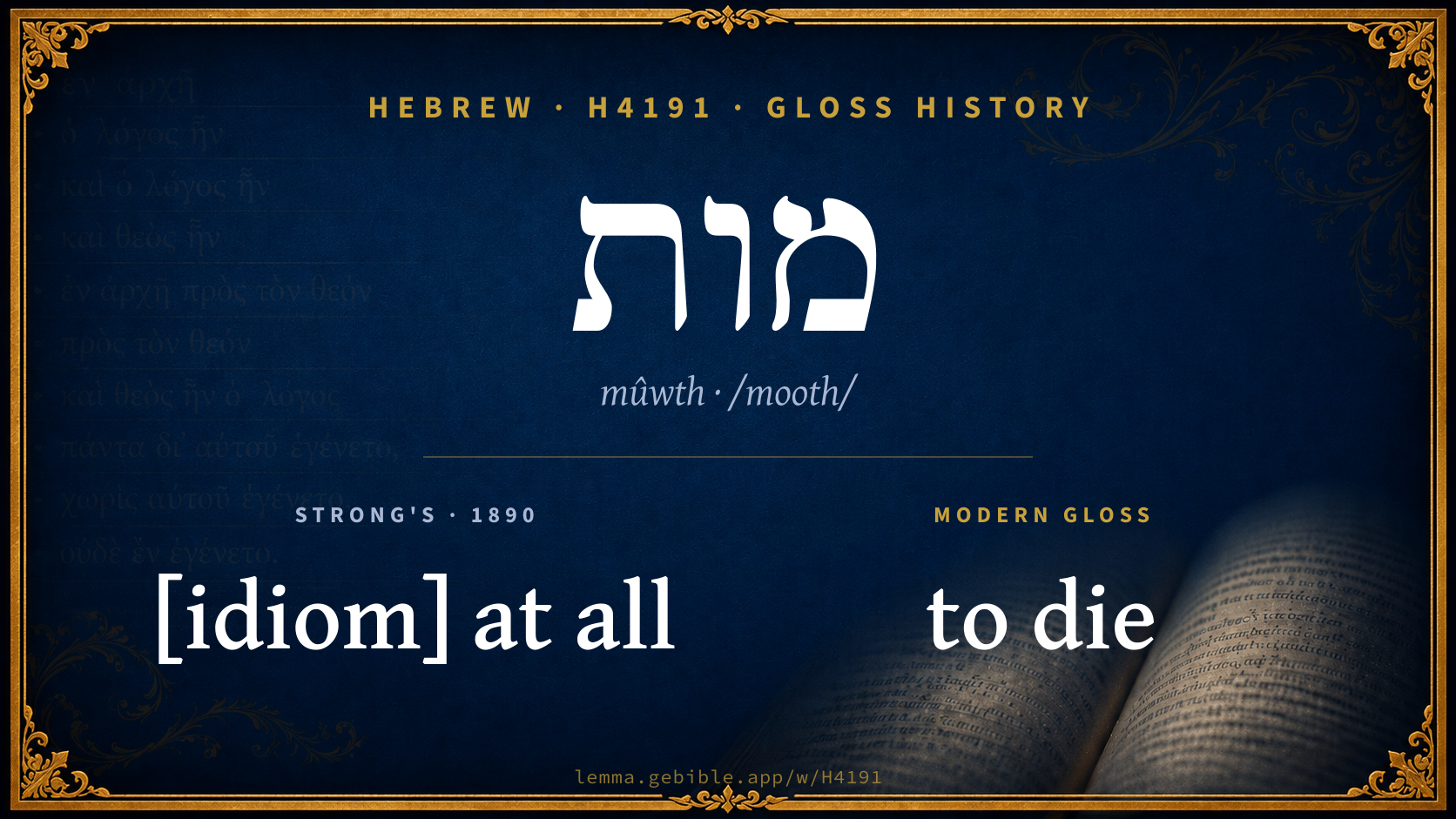
Gloss history
Strong's 1890 vs modern scholarship
About this word
Strong's H4191 catalogs a Hebrew word from the Hebrew Old Testament.
These counts are not copied from any lexicon or concordance. They are computed here, from the morphology-tagged Hebrew Old Testament. What Lemma adds →
- 695
- distinct verses
- The word appears in 695 distinct verses.
- 28 / 39
- OT books
- The word appears in 28 of 39 Old Testament books.
- #54
- by frequency
- Top 100 most frequent Hebrew words (rank 54 of 8,640 Hebrew words by occurrence).
View all 695 occurrences in the concordance →
By section of the Old Testament
By traditional corpus
Conventional, traditional groupings — biblical authorship is debated, so this is a traditional corpus grouping, not an authorship claim. Each share is this word’s portion of its verses in that division of the Hebrew canon. Each figure is a share of the word’s 695 distinct verses.
- Prophets (Nevi'im) 353 verses · 51%
- Torah (Pentateuch) 242 verses · 35%
- Writings (Ketuvim) 100 verses · 14%
How translations render this word
Counts come from each version’s own published word-to-Strong’s tagging or interlinear alignment — an approximate guide to how each version renders this word, not a word-level alignment the data otherwise carries. Because each total is that version’s own tagged count, the per-version totals vary from one another and need not match the appearance or distinct-verse counts above. These counts may also differ from a printed concordance because Lemma counts each distinctly tagged rendering and does not collapse phrase taggings into a single head-word total. This is a fixed set of word-tagged versions (KJV, ASV, BSB, ULT) and does not change with the reading translation you choose elsewhere. Each version’s license is shown beside its name below (and on Sources).
- King James Version: Died 97×, Die 57×, Dead 49×
- American Standard Version: Died 97×, Die 48×, Dead 37×
- Berean Standard Bible: Died 98×, Die 65×, Dead 44×
- unfoldingWord Literal Text: Died 97×, Die 85×, He died 57×
King James Version Public Domain
Renders H4191 across 833 tagged occurrences — most commonly:
Plus other, less common renderings. Plus 174 renderings that appear only once — usually multi-word phrases or single function words the recovered tagging swept in, not distinct renderings. Not rendered by a distinct English word in 2 further occurrences.
American Standard Version Public Domain
Renders H4191 across 831 tagged occurrences — most commonly:
Plus other, less common renderings. Plus 227 renderings that appear only once — usually multi-word phrases or single function words the recovered tagging swept in, not distinct renderings.
Berean Standard Bible Public Domain
Renders H4191 across 771 tagged occurrences — most commonly:
Plus other, less common renderings. Plus 141 renderings that appear only once — usually multi-word phrases or single function words the recovered tagging swept in, not distinct renderings. Not rendered by a distinct English word in 69 further occurrences.
unfoldingWord Literal Text CC BY-SA 4.0
Renders H4191 across 995 tagged occurrences — most commonly:
Plus other, less common renderings. Plus 112 renderings that appear only once — usually multi-word phrases or single function words the recovered tagging swept in, not distinct renderings.
25 senses and sub-senses in the full BDB
Hebrew verbs can shift meaning by stem (binyan): Qal is the basic action, Niphal is often passive or reflexive, Piel often intensifies or makes it factitive, and Hiphil is typically causative. The senses below are grouped under the stem BDB assigns to each. This entry also uses Hophal (the passive of Hiphil) and one or more reduplicated stems (the Pōlēl/Pilpēl type), which for hollow or geminate roots behave much like Piel — often intensive or iterative.
What do BDB’s symbols mean?
BDB uses these scholarly abbreviations:
| Symbol | Meaning |
|---|---|
| 𝔊 | the Septuagint (the ancient Greek translation, LXX) |
| 𝔙 | the Vulgate (the Latin translation) |
| 𝔖 | the Syriac version (the Peshitta) |
| 𝔗 | the Targum (the Aramaic translation) |
| ψ | the Psalms |
| √ | root (the underlying root or stem) |
| ‖ | parallel passage (a synonymous or contrasted parallel) |
| † | the dagger: every passage where the word occurs is cited |
The 25 senses and sub-senses the full Brown-Driver-Briggs lexicon distinguishes for this word, in lexicon order (not ranked by frequency), with BDB’s own verbatim wording and sub-sense lettering. Shown in Hebrew script with BDB’s own scholarly abbreviations. The condensed entry is in the Lexicon Entry tab. See also the Forms in the corpus table below.
Qal
- Pf. 3 ms. מֵת Gn 42:38 +; 3 fs. מֵ֫תָה Gn 35:18 +; 2 ms. מַתָּה Ez 28:8; 1 s. וָמַ֑תִּי Gn 19:19; 3 mpl. מֵ֫תוּ Gn 7:22 +; 1 pl. מַתְנוּ Nu 14:2 2 K 7:4; מָ֑תְנוּ Nu 14:9 +; Impf. יָמוּת Gn 38:11 +; יָמֹ֑ת Dt 33:6 +; וַיָּ֫מָת Gn 11:28 +; 1 s. אָמוּת Gn 26:9 +; אָמֻת 2 S 19:38; אָמוּ֫תָה Gn 46:30; 3 mpl. יָמ֫וּתוּ 1 S 2:23 +; יְמֻתוּן Nu 16:29; 3 fpl. תְּמוּתֶ֫נָה Ez 13:19 (Ges§ 72, 5) +; Imv. מֻת Dt 32:50 Jb 2:9; Inf. abs. מוֹת Gn 2:17 +; cstr. מוּת Gn 25:32 +; sf. מוּתִי 2 S 19:1; מֻתָן 2 S 20:3, etc.; Pt. מֵת Gn 20:3 +; sf. מֵתִי Gn 23:4 +; fs. מֵתָה Gn 30:1 Zc 11:9; pl. מֵתִים Ex 12:33 +; cstr. מֵתֵי Is 22:2 +; sf. מֵתֶיךָ Is 26:19;— e.g. Genesis 42:38
- 1. die, of natural or other causes:
- a. (1) of man, †וַיִּגְוַע וַיָּמָת and he expired and died Gn 25:8 (+ בְּשֵׂיבָה טוֹבָה, v. infr.), v 17 35:29 (P); †וַיָּמָת וַיִּקָּבֵר Ju 10:2, 5; 8:32; 12:7, 10, 12, 15 2 S 17:23; †וימת וימלך תַּחְתָּיו and he died and—reigned in his stead Gn 36:33, 34, 35, 36, 37, 38, 39 (P), 2 S 10:1 = 1 Ch 19:1, 2 K 1:17; 8:15; 13:24 1 Ch 1:44, 45, 46, 47, 48, 49, 50; וימת בְּשֵׂיבָה טוֹבָה and he died in a good old age 1 Ch 29:28 (+ Gn 25:8, v. supr.); as the result of smiting הכה Ex 21:18, 20, 22 (E); + במלחמה Dt 20:5, 6, 7 2 S 19:11; בַּחֶרֶב Je 11:22; ברעב v 22; מפני הרעב 38:9; בְּדֶבֶר 21:6; באבן Nu 35:17, 23 (P); †בַּמַּגֵּפָה Nu 14:37; 17:14; 25:9 (P). (2) fig. of wisdom, עִמָּכֶם תָּמוּת חָכְמָה Jb 12:2; of courage, וַיָּמָת לִבּוֹ בְּקִרְבּוֹ and his heart died within him 1 S 25:37.—2 S 2:31 del. מֵ֑תוּ We Dr Kit Bu, cf. 𝔊. e.g. Genesis 25:8
- b. of animals Lv 11:39; cattle Gn 33:13 (J), fish Ex 7:18 (E), frogs Ex 8:9 (J), lion Ec 9:4, worm Is 66:24; כֶּלֶב מֵת, dead dog (in proverb) 1 S 24:15 2 S 9:8; 16:9. e.g. Leviticus 11:39
- c. a tree Jb 14:8. e.g. Job 14:8
- d. זִבְחֵי מֵתִים ψ 106:28 sacrifices to the dead (idols). e.g. Psalms 106:28
- 2. die as a penalty = be put to death:
- a. by human authority Gn 42:20 Ex 10:28; 21:14 (E), Gn 44:9 Jos 2:14 (J), Lv 20:20 (H), Nu 35:12, 30(×2) (P), especially D, Dt 17:5, 6; 18:20; 19:12; 22:22, 25; 24:7 Ju 6:30 1 S 14:43, 45(×2); 2 Sa 19:24 Je 38:24; מות יָמוּת, die = be put to a violent death (> AV RV surely die), 1 S 14:39, 44; 22:16; 1 K 2:37, 42 (all Judaic), Je 26:8, all of capital punishment; 2 K 8:10 (Ephr.) of assassination; מוֹת יוּמַת be put to a violent death, in the codes of Ex 21:12, 15, 16, 17; 22:18 (E), Lv 20:2, 9, 10, 11, 12, 13, 15, 16, 27; 24:16, 17 (H), Ex 31:14, 15 Nu 15:35; 35:16, 17, 18, 21, 31 Lv 27:29 (P; never in D; D uses verb, either Qal or Hiph., without inf. abs.); it is used in narratives Gn 26:11(J), Ex 19:12 (E), Ju 21:5. מ׳ is preceded by רגם Nu 15:36 (P), Dt 21:21 1 K 12:18 = 2 Ch 10:18, 1 K 21:13; סקל Dt 13:11 17:5; 22:21, 24 1 K 21:10, 13, 14, 15; פגע 1 K 2:25, 46; רמס 2 K 7:17, 20; בְּיַד גֹּאֵל Jos 20:9 (P). e.g. Genesis 42:20
- b. inflicted by God, Gn 20:3, 7; Jos 10:11 (E), Gn 3:3; 38:11; Ex 11:5; 12:33 (J), 28:35; 30:20(×2) Lv 8:35; 10:2, 6, 7, 9; 16:1, 2, 13 Nu 3:4; 4:19, 20; 14:35; 17:14, 25, 28; 18:3, 32; 26:11, 61 (P), Dt 5:22(×2); 18:16 Ju 6:23 1 S 5:12; 12:19; 25:17, 38, 39; 2 S 6:7; 12:13; 1 K 19:4; 2 K 14:6 = 2 Ch 25:4, 1 Ch 24:2; 2 Ch 13:20; 2 K 19:35 = Is 37:36, Ez 3:20; 18:4, 20, 21, 28; 33:15; מוֹת יָמוּת Gn 2:17; 3:4 (J), 20:7 (E), Ju 13:21, 22; 2 S 12:14; 14:14; 2 K 1:4, 6, 16 (all Judaic), Nu 26:65 (P), Ez 3:18; 33:8, 14; מוֹת יוּמַת 18:13, ביד יהוה Ex 16:3 (P); בחטא Lv 22:9 (H), Nu 27:3 (P), 2 K 14:6 = 2 Ch 25:4; לשׂאת חטא למות Nu 18:22 (P); בחטאת Ez 3:20; 18:24; בטמאה Lv 15:21 (P); בעון Je 31:30; Ez 3:18, 19; 18:17, 18; 33:8, 9; לא ישׂאו עון ומתו Ex 28:43 Nu 4:15 (P); בעול Ez 18:26; 33:13, 18; על עול 18:26; במעל 1 Ch 10:13. e.g. Genesis 20:3
- c. die, perish, of a nation by divine judgment, Moab Am 2:2, Ephraim Ho 13:1; בית ישׂראל Ez 18:31; 33:1. e.g. Amos 2:2
- d. die prematurely, by neglect of wise moral conduct Pr 5:23; 10:21; 15:10; 19:16; 23:13; Ec 7:17.— e.g. Proverbs 5:23
- On (לַבֵּן) עַל־מוּת ψ 9:1; 48:15 v. עַלְמָה sub II. עלם. e.g. Psalms 9:1
Poʿlel
- Pf. ms. sf. מוֹתְתַנִי Je 20:17; 1 s. מֹתַתִּי 2 S 1:16; Impf. 3 ms. sf. יְמֹתְתֵהוּ 1 S 17:51; 3 fs. תְּמוֹתֵת ψ 34:22; 1 s. sf. אֲמֹתְתֵהוּ 2 S 1:10; Imv. sf. מוֹתְתֵנִי Ju 9:54; מֹתְתֵנִי 2 S 1:9; inf. מוֹתֵת ψ 109:16; Pt. מְמוֹתֵת 1 S 14:13;—kill, put to death, despatch (intens.), abs. 1 S 14:13, elsewhere c. acc. Ju 9:54; 1 S 17:51; 2 S 1:9, 10, 16; Je 20:17; ψ 34:22; 109:16. e.g. Jeremiah 20:17
Hiphil
- Pf. 3 ms. הֵמִית Ju 16:30 +; sf. וֶהֱמִתָ֑נִי 2 S 14:32; הֱמִיתָם Je 41:8; 3 fs. sf. הֱמִיתָ֑תְהוּ 2 Ch 22:11; 2 ms. הֵמַתָּה Nu 14:15; 1 s. sf. הֲמִיתִּיו (read הֲמִתִּיו) 1 S 17:35; 3 mpl. הֵמִיתוּ 1 S 30:2 +, etc.; Impf. יָמִית Nu 35:19 +; וַיָּ֫מֶת Gn 38:10 +; sf. יְמִיתֵהוּ 1 K 13:24 +; יְמִתֶנּוּ Nu 35:19 +; Imv. sf. הֲמִיתֵנִי 1 S 20:8; pl. הָמִיתוּ 1 S 22:17; Inf. abs. הָמֵת 2 K 11:15 +; cstr. הָמִית Lv 20:4 +; Pt. מֵמִית 1 S 2:6; pl. מְמִיתִים 2 K 17:26; מְמִתִים Je 26:15 Jb 33:22;—kill, put to death: e.g. Judges 16:30
- 1. abs. Jb 9:23, elsewhere c. acc., subj. man, e.g. Job 9:23
- a. of killing men in personal combat, or in war, often preceded by הכּה smite Jos 10:26; 11:17; 17:50 +; of destroying a city 2 S 20:19 (‖ השׁחית v 20). e.g. Joshua 10:26
- b. by authority, espec. in capital punishment Ex 1:16 (E), Lv 20:4 (H), Nu 35:19(×2), 21 (P), Dt 13:10; 17:7 Ju 20:13 1 S 11:12; 28:9 2 S 14:7, 32; 21:4 1 K 2:26, 34; 11:40; 19:17(×2) 2 K 14:6 = 2 Ch 25:4; Is 11:4; Je 26:15, 21, 24; 38:15, 16, 25; Est 4:11; בַּחֶרֶב 1 K 1:51; 2:8; 2 K 11:20 = 2 Ch 23:21; הָמֵת יָמִית Ju 15:13 1 K 3:26, 27; Je 26:19; 38:15. e.g. Exodus 1:16
- 2. subj. God, by inflicting penalty, abs. Dt 32:39; 1 S 2:6; 2 K 5:7, elsewhere c. acc. Gn 18:25; 38:7, 10; Ex 4:24; Nu 14:15 (J), Dt 9:28; Ju 13:23; 1 S 2:25; 5:10, 11; 1 Ch 2:3; 10:14; Is 65:15; Ho 9:16; ברעב Is 14:30; בצמא Ho 2:5; of killing fish ψ 105:29; מְמִיתִים Jb 33:22 executioners, angels of death. e.g. Deuteronomy 32:39
- 3. of animals killing men, e.g. ox Ex 21:29 (E), lion 1 K 13:24, 26; 2 K 17:26. e.g. Exodus 21:29
- 4. bring to a premature death Pr 19:18; 21:25. e.g. Proverbs 19:18
Hophal
- Pf. הוּמָ֑ת 2 K 11:2 +; 3 mpl. הֻמְתוּ 2 S 21:9; Impf. יוּמַת Lv 20:10 +; יוּמָ֑ת Gn 26:11 +; Pt. מוּמָת 1 S 19:11, pl. מוּמָתִים 2 K 11:2 (Qr), 2 Ch 22:11;—be killed, put to death: e.g. 2 Kings 11:2
- 1. by conspiracy 2 K 11:2, 2 = 2 Ch 22:11, 2 K 11:8, 15, 16 2 Ch 23:7, 14. e.g. 2 Kings 11:2
- 2. by capital punishment Ex 21:29 (E), 35:2 Nu 1:51; 3;10, 38; 18:7 (P), Lv 19:20; 24:16, 21 (H), Dt 13:6; 17:6(×2); 21:22; 24:16(×3) = 2 K 14:6(×3), Jos 1:18 (all D) Ju 6:31; 1 S 11:13; 19:6, 11; 20:32; 2 S 19:22, 23; 21:9; 1 K 2:24; 2 Ch 15:13; Je 38:4, and the phrase מוֹת יוּמת (see Qal 2 a). e.g. Exodus 21:29
- 3. by divine infliction, in the phrase מות יוּמת (see Qal 2 b).
- 4. die prematurely Pr 19:16. e.g. Proverbs 19:16
Senses from the full Brown-Driver-Briggs lexicon (Brown, Driver, Briggs; Oxford 1906 — public domain), digitized via Sefaria, supplemented by the OpenScriptures HebrewLexicon (CC BY 4.0). Full attribution on Sources.
Word origin
vb. die (NH id. (rare); Assyrian mâtu DlHWB 395, Arabic مَاتَ, Ethiopic ሞተ, Aramaic מוּת, מִית, ܡܺܝܬ; Nab. מות EutNab 14, 6; Zinj. מת DHMSendsch.Gloss.);—
— Brown-Driver-Briggs (Oxford 1906, public domain), digitized via Sefaria, supplemented by the OpenScriptures HebrewLexicon (CC BY 4.0). See Sources.
Origin: a primitive root
Jastrow Dictionary
A second Hebrew/Aramaic lexicon for comparison, covering Aramaic and post-biblical (Talmudic, Targumic, Midrashic) usage that the biblical-Hebrew BDB does not. Matched by lemma rather than by Strong’s number, so a lemma may carry more than one Jastrow headword (shown separately below), and the entries cover usage well beyond the Bible.
מוֹת
- (b. h.) to die. Gitt. VII, 3, a. fr. אם מַתִּי if I should die. Gen. R. s. 9 (play on מְאֹד, Gen. I, 31) והנה טזב מוֹת behold, it is good to die.—Kidd. 72ᵇ כשמֵת ר׳ וכ׳ when R … died. M. Kat. 28ᵃ מת פתאום if one dies suddenly. Sabb. 55ᵇ בחטאם מֵתוּ died for their sin. Tam. 32ᵃ (in Chald. dict.) מה יעביד אינש ויָמוֹת וכ׳ what must man do in order to die? Let him feed himself, v. הָיָה. Shebu. 18ᵃ, v. וָטוּב; a. v. fr.—V. מֵת. e.g. Genesis 1:31
- to put to death; to cause death. Snh. 53ᵃ אם אי אתה יכול לַהֲמִיתוֹ … שאתה מֵמִיתוֹ וכ׳ that if you cannot put him to death in the manner legally prescribed, you must execute judgment by whatever means you can. Ib. 56ᵇ דברים … מְמִיתִין עליהן acts on which a Jewish court passes a sentence of death. Tam. l. c. (in Chald. dict.) מה יעבד אינש … יָמִית עצמו what must man do in order to live?… Let him starve himself (his appetites). Ber. 63ᵇ אין ד"ת … שממית עצמו עליה the words of the Law remain only with him who kills himself (denies himself all enjoyments) for its sake (with play on Num. XIX, 14); a. v. fr. e.g. Numbers 19:14
- to be put to death. Keth. 37ᵇ מוּמָתִין בסייף those put to death by the sword. Snh. 55ᵇ מומתין על ידה are put to death on her account; a. fr.
מוּת
- v. מִית
מָוֶת
- preced.) death. Ab. II, 4 אל … עד יום מוֹתְךָ do not trust thyself (that thou wilt not sin) until thy dying day; Ber. 29ᵃ. Ib. 17ᵃ סוף אדם לַמָּ׳ man’s final destiny in death; a. v. fr.—מלאך המ׳ (abbrev. מה"מ) the angel of death. Ab. Zar. 5ᵃ. Gen. R. s. 9 והנה טוב מאד זה מה"מ ‘and behold, it was very good’ (Gen. I, 31) this refers to the angel of death; a. fr. e.g. Genesis 1:31
מוֹת ²
- Targ. Ex. X, 17. Targ. Jer. XI, 19 סמא דמ׳ poison; a. fr.—Targ. Y. Gen. XXXV, 18 fem.—Sabb. 88ᵇ סמא דמ׳, v. supra; Yoma 72ᵇ.—Yeb. 63ᵃ מידי דקשי ממ׳ something harder than death. M. Kat. 28ᵇ, v. חֲבוּלְיָא; a. fr.
A Dictionary of the Targumim, the Talmud Babli and Yerushalmi, and the Midrashic Literature (Marcus Jastrow; London, Luzac, 1903) — Public Domain. Digitized via Sefaria. Digitized via Sefaria. Full attribution on Sources.
Forms in the corpus
The 372 distinct written forms H4191 takes in the Hebrew Bible, most frequent first — each parse links to that stem’s occurrences in the concordance. Hebrew forms include their vowel points and cantillation, so a single lemma takes many written forms.
The 60 most common forms are shown; 312 rarer forms follow in the full concordance.
Same root — word family
Other BDB entries built from the same root as H4191, grouped by Strong’s listed origin. These share a root / origin per the lexicon — not necessarily a shared meaning. Each links to that word’s own entry.
Derived from this word
Compare all same-root words → Showing 4 of 5 — not the complete family. They share a root, not necessarily a meaning.
Septuagint verse parallels
This word appears in 672 verses that also exist in the Greek Old Testament (Septuagint), out of the 695 Hebrew verses it occurs in. You can read those verses in Greek by switching the Old Testament edition to the Septuagint.
Read these verses in the Septuagint
- Genesis 2:17
- Exodus 1:6
- Leviticus 8:35
- Numbers 1:51
- Deuteronomy 2:16
- Joshua 1:2
- Judges 1:7
- Ruth 1:3
- 1 Samuel 2:6
- 2 Samuel 1:4
- 1 Kings 1:51
- 2 Kings 1:4
This is a verse-level parallel only — the same verses exist in both the Hebrew and Greek Old Testaments. No word-level Hebrew↔Greek correspondence is claimed: the data carries no such alignment, so no Greek word is shown as this Hebrew word’s translation. Coverage is not total — the Septuagint omits the deuterocanon and renumbers the Psalms, so some Hebrew verses have no direct Greek parallel.