Genesis 23:8

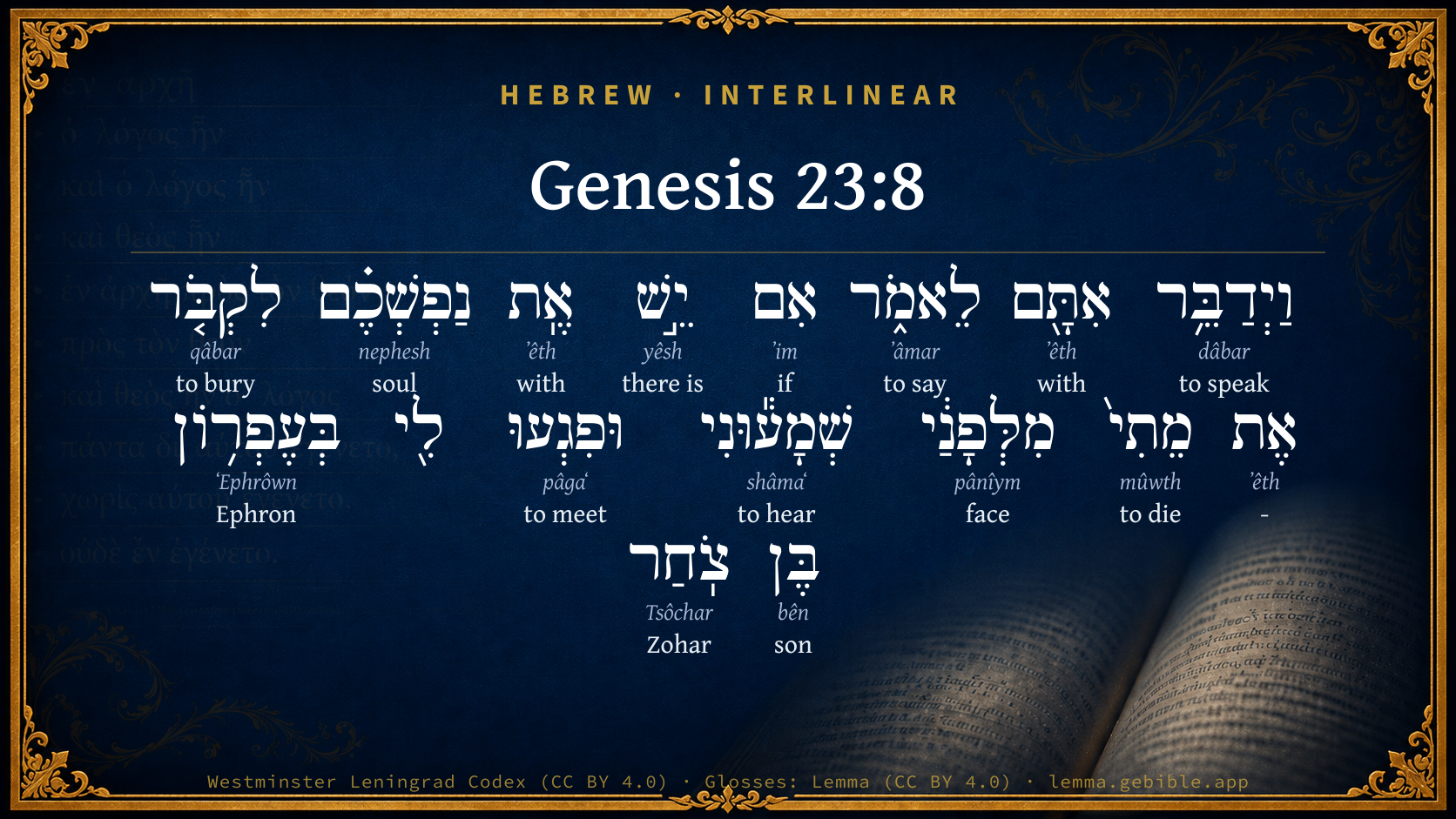
Hebrew (Westminster Leningrad Codex) Genesis 23:8 appears in the Hebrew Old Testament. The text above is from the Westminster Leningrad Codex. Each word links to its Strong’s number, a concise gloss, and parsing drawn from the Open Scriptures Hebrew Bible morphology. Click any word for its full Brown-Driver-Briggs (BDB) entry.
Download image
Cite this verse

Genesis 23:8 (World English Bible). Public Domain. Lemma interlinear Bible study tool, https://lemma.gebible.app/v/genesis/23/8.

Show BibTeX & RIS
BibTeX
RIS
English Translation
He talked with them, saying, "If it be your mind that I should bury my dead out of my sight, hear me, and entreat for me to Ephron the son of Zohar,
World English Bible · Public Domain
Highlights
  • 3 first appearances in the Hebrew Bible
Full analysis ↓
Download a study sheet

One document with this verse’s original text, its word-by-word gloss line, the meaning frame, cross-references with their text, attributed commentary, and full source and license credits — printable, and it pastes into notes with its structure intact.

This verse Autodidact and up

Study sheet (.html) Plain text (.txt)

A passage Seminary Student

Up to 50 verses in one chapter. A passage sheet keeps up to 6 commentary sources and 12 cross-references per verse, in the order this page ranks them, and says so on the sheet whenever that leaves anything out. Ask for a single verse and you get the Autodidact verse sheet above.

Everything on this page stays free to read, with no account — the sheet is a download of what is already on screen, not access to it.

Want to remove ads? Support Godless Engineer
Compare translations 3

The same verse in 3 English versions, stacked beneath the original-language interlinear above. Click any original word for its lexicon entry.

Each is an independent rendering of the whole verse — the interlinear is not word-aligned to these translations.

Highlighted words mark where these versions differ — a whole-verse word diff, not a word-by-word alignment.

  • World English Bible Public Domain
    He talked with them, saying, "If it be your mind that I should bury my dead out of my sight, hear me, and entreat for me to Ephron the son of Zohar,
  • King James Version Public Domain
    And he communed with them, saying, If it be your mind that I should bury my dead out of my sight; hear me, and entreat for me to Ephron the son of Zohar,
  • unfoldingWord Literal Text CC BY-SA 4.0
    and he said to them, saying, “If it is your will to bury my dead from before me, listen to me and intercede for me with Ephron, the son of Zohar,

unfoldingWord Literal Text — © unfoldingWord, licensed CC BY-SA 4.0. Word-aligned USFM3 via Door43 (git.door43.org/unfoldingWord/en_ult).

Versions to compare (up to 4)

3 of 4 selected

Show all 18 translations

Every available English version of this verse, each an independent rendering of the whole verse.

  • World English Bible Public Domain
    He talked with them, saying, "If it be your mind that I should bury my dead out of my sight, hear me, and entreat for me to Ephron the son of Zohar,
  • Berean Standard Bible Public Domain
    “If you are willing for me to bury my dead,” he said to them, “listen to me, and approach Ephron son of Zohar on my behalf
  • Majority Standard Bible Public Domain
    “If you are willing for me to bury my dead,” he said to them, “listen to me, and approach Ephron son of Zohar on my behalf
  • King James Version Public Domain
    And he communed with them, saying, If it be your mind that I should bury my dead out of my sight; hear me, and entreat for me to Ephron the son of Zohar,
  • American Standard Version (1901) Public Domain
    And he communed with them, saying, If it be your mind that I should bury my dead out of my sight, hear me, and entreat for me to Ephron the son of Zohar,
  • Revised Version (1885) Public Domain
    And he communed with them, saying, If it be your mind that I should bury my dead out of my sight, hear me, and entreat for me to Ephron the son of Zohar,
  • Geneva Bible (1599) Public Domain
    And he communed with them, saying, If it be your minde, that I shall bury my dead out of my sight, heare me, and intreate for me to Ephron the sonne of Zohar,
  • Douay-Rheims (1899) Public Domain
    And said to them: If it please your soul that I should bury my dead, hear me, and intercede for me to Ephron the son of Seor.
  • Young's Literal Translation Public Domain
    and he speaketh with them, saying, `If it is your desire to bury my dead from before me, hear me, and meet for me with Ephron, son of Zoar;
  • Literal Standard Version CC BY-SA 4.0
    and he speaks with them, saying, “If it is your desire to bury my dead from before me, hear me, and meet for me with Ephron, son of Zoar;
  • Unlocked Literal Bible CC BY-SA 4.0
    He spoke to them, saying, “If you agree that I should bury my dead, then hear me and plead with Ephron son of Zohar, for me.
  • unfoldingWord Literal Text CC BY-SA 4.0
    and he said to them, saying, “If it is your will to bury my dead from before me, listen to me and intercede for me with Ephron, the son of Zohar,
  • Darby Bible Public Domain
    and spoke to them, saying, If it be your will that I should bury my dead from before me, hear me, and entreat for me Ephron the son of Zohar,
  • World Messianic Bible Public Domain
    He talked with them, saying, “If you agree that I should bury my dead out of my sight, hear me, and entreat for me to Ephron the son of Zohar,
  • Webster's Bible Public Domain
    And he communed with them, saying, If it is your mind that I should bury my dead out of my sight, hear me, and entreat for me to Ephron the son of Zohar,
  • Free Bible Version CC BY-SA 4.0
    and said to them, “If you agree to help me bury my dead, listen to my proposal. Could you please ask Ephron, son of Zohar,
  • Bible in Basic English Public Domain
    And he said to them, If you will let me put my dead to rest here, make a request for me to Ephron, the son of Zohar,
  • JPS Tanakh (1917) Public Domain
    And he spoke with them, saying: 'If it be your mind that I should bury my dead out of my sight, hear me, and entreat for me to Ephron the son of Zohar,

Literal Standard Version (2020), Covenant Press — licensed CC BY-SA 4.0. Text via the HelloAO Bible API (eBible.org). Unlocked Literal Bible (unfoldingWord) — licensed CC BY-SA 4.0. Text via the HelloAO Bible API (eBible.org). unfoldingWord Literal Text — © unfoldingWord, licensed CC BY-SA 4.0. Word-aligned USFM3 via Door43 (git.door43.org/unfoldingWord/en_ult). Free Bible Version, Dr. Jonathan Gallagher — licensed CC BY-SA 4.0. Text via the HelloAO Bible API (eBible.org).

Word by word

More ways to search: Search by grammar → Find every occurrence → Compare this word →

Practice this passage: Drill this verse → Learn its vocabulary →

צֹֽחַר
Tsôchar
H6714
“Zohar”
Noun, Proper
Part of Speech
Noun
Type
Proper
Full BDB Definition

Origin: from the same as H6713

TWOT: None

Zohar = "tawny" - a Judaite, son of Ashur by wife Helah - father of Ephron the Hittite - one of the sons of Simeon; also 'Zerah'
  1. וַיְדַבֵּ֥ר dâbar H1696 “and · to speak” Conjunction + Verb, Piel, Sequential Imperfect, 3rd Person, Masculine, Singular
  2. אִתָּ֖ם ʼêth H854 “with · them” Preposition + Suffix, Personal, 3rd Person, Masculine, Plural
  3. לֵאמֹ֑ר ʼâmar H559 “to say” Preposition + Verb, Qal, Infinitive Construct
  4. אִם ʼim H518 “if” Conjunction
  5. יֵ֣שׁ yêsh H3426 “there is” Particle, Demonstrative
  6. אֶֽת ʼêth H854 “with” Preposition
  7. נַפְשְׁכֶ֗ם nephesh H5315 “soul · your” Noun, Common, Both, Singular, Construct + Suffix, Personal, 2nd Person, Masculine, Plural
  8. לִקְבֹּ֤ר qâbar H6912 “to bury” Preposition + Verb, Qal, Infinitive Construct
  9. אֶת ʼêth H853 “-” Particle, Direct Object
  10. מֵתִי֙ mûwth H4191 “dying · me” Verb, Qal, Participle Active, Masculine, Singular, Construct + Suffix, Personal, 1st Person, Common, Singular
  11. מִלְּפָנַ֔י pânîym H6440 “from · to/for · face(s) · my” Preposition + Preposition + Noun, Common, Both, Plural, Construct + Suffix, Personal, 1st Person, Common, Singular
  12. שְׁמָע֕וּנִי shâmaʻ H8085 “hear · me” Verb, Qal, Imperative, 2nd Person, Masculine, Plural + Suffix, Personal, 1st Person, Common, Singular
  13. וּפִגְעוּ pâgaʻ H6293 “and · meet” Conjunction + Verb, Qal, Imperative, 2nd Person, Masculine, Plural
  14. בְּעֶפְר֥וֹן ʻEphrôwn H6085 “in/at · Ephron” Preposition + Noun, Proper
  15. בֶּן bên H1121 “son of” Noun, Common, Masculine, Singular, Construct

About this verse

These counts appear in no published source. They are computed here, from the morphology-tagged text and Lemma’s own curated glosses. What Lemma adds →

17
words
15
distinct lemmas
Pentateuch
section

Notable vocabulary

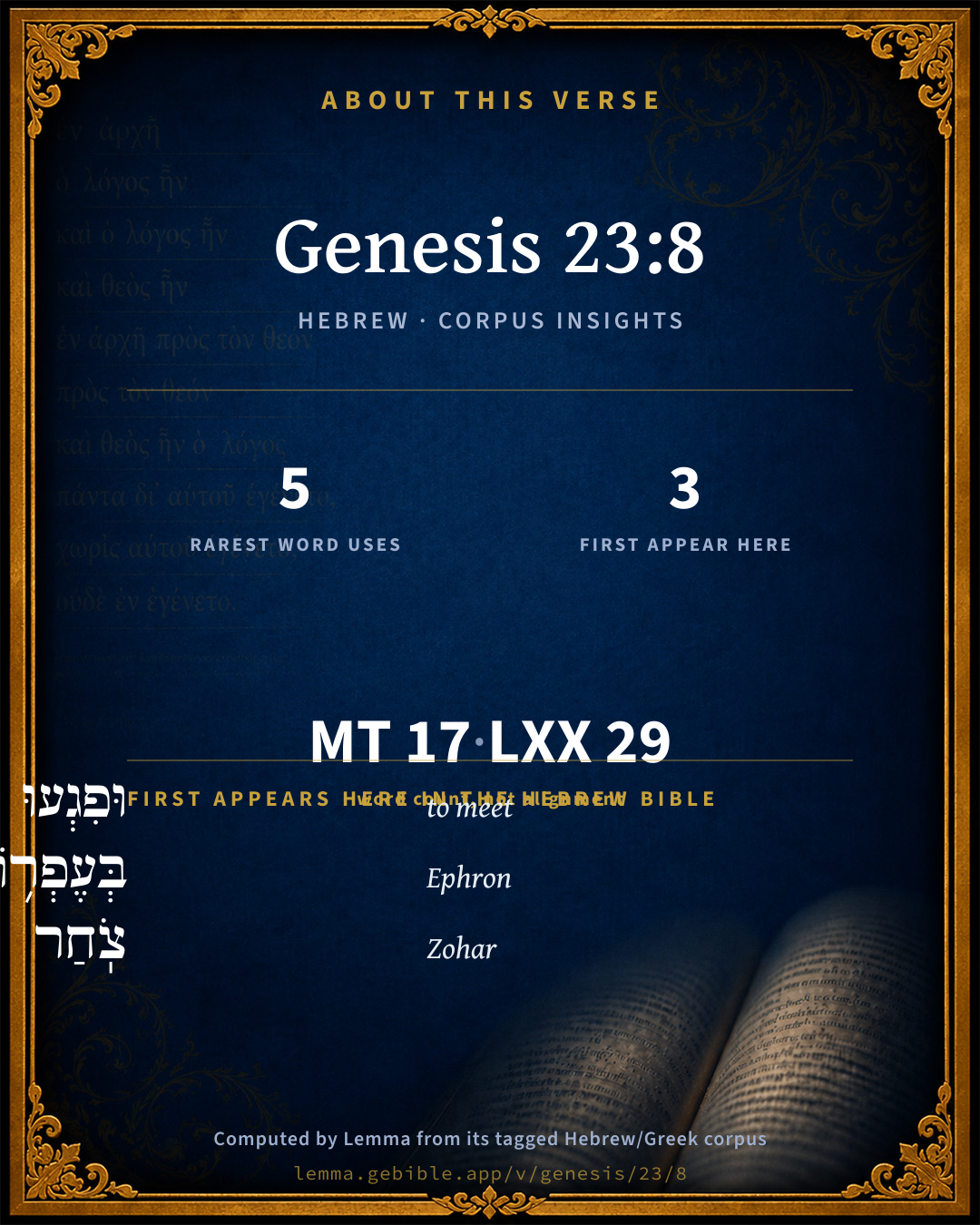
The rarest word here is צֹֽחַר Zohar H6714 — appearing just 5 times in the whole Hebrew Bible.

First appearance in Scripture

These words make their first canonical appearance in the Hebrew Bible here:

  • וּפִגְעוּ to meet H6293
  • בְּעֶפְר֥וֹן Ephron H6085
  • צֹֽחַר Zohar H6714

Shared distinctive vocabulary

צֹֽחַר Zohar H6714 occurs in 5 verses of the Hebrew Bible. Also found in:

Grammatical profile

  • 6 verbs
  • 5 nouns
  • 3 prepositions
  • 1 conjunction
  • 2 particles

Verb forms

  • וַיְדַבֵּ֥ר Piel · Sequential Imperfect
  • לֵאמֹ֑ר Qal · Infinitive Construct
  • לִקְבֹּ֤ר Qal · Infinitive Construct
  • מֵתִי֙ Qal · Participle Active
  • שְׁמָע֕וּנִי Qal · Imperative
  • וּפִגְעוּ Qal · Imperative

Repetition

A word recurs within this verse — often emphatic in Hebrew:

  • אִתָּ֖ם with H854 ×2

Hebrew & Septuagint length

In English translation the verse runs 32 words from the Hebrew and 35 from the Septuagint (LXX English) — closely comparable.

A rough comparison of the two English renderings, which tokenize alike — not a word-level alignment.

Word counts can differ between the Hebrew and the Greek without any difference in meaning — e.g. the Hebrew direct-object marker אֵת has no separate Greek word, and Greek often adds the article ὁ.

In the original languages it is 17 Hebrew tokens and 29 Greek tokens — but the two are counted differently (Hebrew bundles its prefixes and suffixes into one token; the Greek is in lemma form), so that isn’t a like-for-like length.

Cross-references

5

Topical passages linked to Genesis 23:8 in the Treasury of Scripture Knowledge — connected by theme and wording, ordered by reader-vote popularity; previews shown in the World English Bible.

  • Genesis 25:9 Isaac and Ishmael, his sons, buried him in the cave of Machpelah, in the field of Ephron, the son of Zohar the Hittite, which is before Mamre,
  • 1 Kings 2:17 He said, Please speak to Solomon the king (for he will not tell you 'no'), that he give me Abishag the Shunammite as wife.
  • Luke 7:3–4 When he heard about Jesus, he sent to him elders of the Jews, asking him to come and save his servant.
  • Hebrews 7:26 For such a high priest was fitting for us: holy, guiltless, undefiled, separated from sinners, and made higher than the heavens;
  • 1 John 2:1–2 My little children, I write these things to you so that you may not sin. If anyone sins, we have a Counselor with the Father, Jesus Christ, the righteous.

Cross-references courtesy of OpenBible.info (CC BY 4.0).

Hebrew and Greek witnesses Masoretic Hebrew ↔ Greek Septuagint

The same verse in the two great witnesses to the Old Testament, shown verse-for-verse.

These are two independent witnesses, not word-aligned to each other, and the Septuagint is shown in lemma (dictionary) form.

Hebrew Genesis 23:8 Masoretic · Westminster Leningrad Codex

וַיְדַבֵּ֥ר אִתָּ֖ם לֵאמֹ֑ר אִם יֵ֣שׁ אֶֽת נַפְשְׁכֶ֗ם לִקְבֹּ֤ר אֶת מֵתִי֙ מִלְּפָנַ֔י שְׁמָע֕וּנִי וּפִגְעוּ לִ֖י בְּעֶפְר֥וֹן בֶּן צֹֽחַר

He talked with them, saying, "If it be your mind that I should bury my dead out of my sight, hear me, and entreat for me to Ephron the son of Zohar,

World English Bible · Public Domain

Greek LXX Genesis 23:8 Septuagint · lemma form

καί λαλέω πρός αὐτός αβρααμ λέγω εἰ ἔχω ὁ ψυχή σύ ὥστε θάπτω ὁ νεκρός ἐγώ ἀπό πρόσωπον ἐγώ ἀκούω ἐγώ καί λαλέω περί ἐγώ εφρων ὁ ὁ σααρ

And Abraam spoke to them, saying, If you⌃ have it in your mind that I should bury my dead out of my sight, listen to me, and speak for me to Ephron the son Saar.

LXX2012 (modern English Septuagint) · Public Domain

On this verse, The Pulpit Commentary discusses the Septuagint’s reading. Read the note in Commentary ↓

Hebrew: Westminster Leningrad Codex (CC BY 4.0). Greek: Septuagint (public domain); English from LXX2012 (modern English Septuagint) (Public Domain). How the Septuagint differs from the Hebrew →

Targum (Aramaic paraphrase)

2

The Targum is the ancient Jewish Aramaic paraphrase of the Hebrew Scriptures — an interpretive translation, not the Hebrew text itself. Onkelos (literal) and Pseudo-Jonathan (expansive) render the Torah, and Jonathan the Prophets. Coverage is partial: where no permissively-licensed English translation exists for a verse, only the Aramaic is shown. This is verse-level text, not a word-by-word alignment to the Hebrew.

  1. Targum Onkelos Torah (Genesis–Deuteronomy)
    וּמַלֵּל עִמְּהוֹן לְמֵימָר אִם אִית רַעֲוָא בְנַפְשְׁכוֹן לְמִקְבַּר יָת מִיתִי מִן קֳדָמַי קַבִּילוּ מִנִּי וּבְעוּ לִי מִן עֶפְרוֹן בַּר צוֹחַר

    (no public-domain English translation for this verse)

    Targum Onkelos — Aramaic: “Onkelos Genesis” (public domain); “Onkelos Exodus” (public domain); “Onkelos Leviticus” (public domain); “Onkelos Numbers” (public domain); “Onkelos Deuteronomy” (public domain). English: “Sefaria Community Translation” (CC0 1.0 (public-domain dedication)); “J.W. Etheridge. The Targums of Onkelos and Jonathan Ben Uzziel on the Pentateuch. London: Longmans, Green, 1862” (public domain). Text via Sefaria.

  2. Targum Pseudo-Jonathan Torah (Genesis–Deuteronomy)
    וּמַלֵיל עִמְהוֹן לְמֵימַר אִין אִית רְעוּ עִם נַפְשֵׁיכוֹן לְמִיקְבַּר יַת מֵיתִי מִן מֶחֱמֵי אַפַּיַי קַבְּלוּ מִינִי וּבְעוּ עָלַי קֳדָם עֶפְרוֹן בַּר צוֹחַר

    And he spake with them, saying, If it be with the consent of your mind that I bury my dead from before my face, receive of me, and intercede for me before Ephron bar Zochar

    Targum Pseudo-Jonathan — Aramaic: “Targum Jonathan on Genesis” (public domain); “Targum Jonathan on Exodus” (public domain); “Targum Jonathan on Leviticus” (public domain); “Targum Jonathan on Numbers” (public domain); “Targum Jonathan on Deuteronomy” (public domain). English: “The Targum of Jonathan ben Uzziel, trans. J. W. Etheridge, London, 1862” (public domain). Text via Sefaria.

Commentary

Notes on Genesis 23:8 from classic Christian and Jewish commentators (each source and its license shown beneath its notes). The classic Christian expositions comment on the surrounding passage and are grouped to its opening verse, so a note may address several verses; the Jewish commentaries on the Tanakh (Rashi and others) are per-verse, so they appear only where the commentator wrote on this verse.

Lemma curates 59 commentaries, every one of them public domain or Creative Commons licensed, each selected and text-cleaned for this edition rather than reprinted as found. About our sources →

Trapp's Complete Commentary

John Trapp

Gen 23:8 And he communed with them, saying, If it be your mind that I should bury my dead out of my sight; hear me, and intreat for me to Ephron the son of Zohar,

Ver. 8. If it be your mind that I should bury my dead.] Alexander the Great lay unburied thirty days together. His conquests above ground purchased him no title for habitation underground. So Pompey the Great,

“ Nidus pascit aves, iacet in qui possidet orbem,

Exiguae telluris inops .” - Claudian.

Ut cui modo ad victoriam terra defuerat, deesset ad sepulturam , saith Paterculus. So William the Conqueror’s corpse lay unburied for three days; his interment being hindered by one that claimed the ground to be his. {a} Abraham therefore doth well to make sure of a place of sepulture for him and his; and this at Hebron - which signifieth society or conjunction - for there lay those reverend couples, Abraham and Sarah, Isaac and Rebecca, Jacob and Leah, &c. These died upon the Promised Land, and being there buried, kept possession, as it were, for their posterity; as those that are dead in Christ do of heaven, for the saints that survive them. Sepulchres are symbols of the communion of saints, and of the resurrection of the dead. Hence the Hebrews call church yards Bethchajim, the house of the living. {b} Job also calls the grave "the congregation house of all living". {Job 30:23} As the apostle after him calleth heaven "the congregation house of the firstborn". {Heb 12:23} The Hebrews call it gnolam hammalachim, the world of angels; and the author to the Hebrews, saith that the saints are come by Christ "to an innumerable company of angels". {πανηγυριν, Heb 12:23} When godly men die, they are said to be gathered to their people. They do no more than repatriasse , as Bernard hath it; they are not put out of service, but removed only out of one room into another, out of the outter houses into the presence chamber. They change their place, but not their company, as good Dr Preston said upon his death bed. They are gathered by Christ’s hand, as lilies, {Son 6:2} and transplanted into the Paradise of God. And this, Plotinus the Philosopher had a notion of, when breathing his last, he said, That in me that is divine, I resign up to the First Divine, that is, to God. {c} As for the body it is but the case, the cabinet, the suit, the slough, the sheath of the soul, as Daniel calleth it. Scaligeri quod reliquum est ,{ d} was Julius Scaliger’s epitaph. It returns to its original dust, and is sown as seed in the ground till the resurrection. {1Co 15:35}

{a} Daniel’s Chron., fol. 50.

{b} Veteres sepulchrum mortuorum domicilium credebant, et portum corporis appellabant . - Turneb.

{c} το εν εμοι θειον αναγω επι το πρωτογονον θειον. - Synes., epist. 139.

{d} λειψανα.

John Trapp, A Commentary or Exposition upon All the Books of the Old and New Testament (1647–1656) — public domain. Text from a community e-Sword module.

Geneva Bible (1599)

Geneva Bible translators

Hebrew, in your soul.

Geneva Bible (1599) marginal notes — public domain. Text via Bolls.life.

Adam Clarke's Commentary

Verse 8. Entreat for me to Ephron] Abraham had already seen the cave and field, and finding to whom they belonged, and that they would answer his purpose, came to the gate of Hebron, where the elders of the people sat to administer justice, &c., and where bargains and sales were made and witnessed, and having addressed himself to the elders, among whom Ephron was, though it appears he was not personally known to Abraham, he begged them to use their influence with the owner of the cave and field to sell it to him, that it might serve him and his family for a place of sepulture.

Adam Clarke's Commentary on the Bible (1810–1826) — public domain. Text from a community e-Sword/MySword module.

John Calvin's Commentaries

8. If it be in your mind. Abraham constitutes them his advocates with Ephron, to persuade him to sell the double cave. Some suppose the cave to have been so formed that one part was above, and the other below. Let every one be at liberty to adopt what opinion he pleases; I, however, rather suppose, that there was one entrance, but that within, the cave was divided by a middle partition. It is more pertinent to remarks that Abraham, by offering a full price, cultivated and maintained equity. Where is there one to be found, who, in buying, and in other business, does not eagerly pursue his own advantage at another’s cost? For while the seller sets the price at twice the worth of a thing, that he may extort as much as possible from the buyer, and the buyers in return, by shuffling, attempts to reduce it to a low price, there is no end of bargaining. And although avarice has specious pretexts, it yet causes those who make contracts with each other, to forget the claims of equity and justice. This also, finally deserves to be noticed; that Abraham often declares that he was buying the field for a place of sepulture. And Moses is the more minute in this matter, that we may learn, with our father Abraham, to raise our minds to the hope of the resurrection. He saw the half of himself taken away; but because he was certain that his wife was not exiled from the kingdom of God, he hides her dead body in the tomb, until he and she should be gathered together.

John Calvin's Commentaries (1540-1563) — public domain. Text from the Calvin Translation Society English edition (1840s-50s) via the Christian Classics Ethereal Library (ccel.org). Calvin's coverage is partial (roughly two-thirds of the Bible); uncommented books and verses are honest gaps, never fabricated. The 19th-century editor's footnotes and remarks are omitted so the notes are faithfully Calvin's own voice.

The Cambridge Bible for Schools and Colleges

gen. ed. J. J. S. Perowne

8. communed with] Heb. “spake with.” The word “communed” is unnecessarily formal as a translation, cf. Gen_18:33.

The Cambridge Bible for Schools and Colleges (gen. ed. J. J. S. Perowne; Cambridge University Press, 1878–1918) — public domain. Text from a community e-Sword module.

John Gill's Exposition

And he communed with them,.... Entered into a discourse and conversation with them upon the above subject:

saying, if it be your mind that I should bury my dead out of my sight; that is, in some place belonging to them, otherwise they could have no objection to the burying of his wife anywhere else: if now what they had said were not spoken in a complaisant way, but it was their real mind and will, and they were sincere and hearty in it, and very desirous of obliging him with a place among them for the interment of his dead; then he had this favour to ask of them:

hear me, and entreat for me to Ephron the son of Zohar; a principal man among the Hittites, who had a field and a cave in it, near where Abraham dwelt, and very convenient for him, and for this purpose of his now under consideration: this man seems to be present at this time, as appears from Gen 23:10; but Abraham did not think fit to address him himself, lest he should not so well and so easily succeed; and therefore entreats the princes of Heth to unite in a request to Ephron for the favour after mentioned, which he supposed they would not be backward to, if they were hearty in this affair; and, if Ephron was present, as he seems to be, it was a very handsome, honourable, and modest address to him through his brethren, which he could not with any politeness well withstand. The request follows:

John Gill's Exposition of the Whole Bible (1746–1763) — public domain (CC PDM 1.0). Text via the HelloAO Bible API.

Matthew Poole's English Annotations

Heb. If it be with, i.e. agreeable to, your soul, that is, your will, or good pleasure; for so the soul is sometimes taken, as Deu 23:24; Psa 27:12; 41:2.

Matthew Poole's English Annotations on the Holy Bible (1683–1685) — public domain. Text from a community e-Sword/MySword module.

Whedon's Commentary on the Bible

Daniel D. Whedon

8. He communed with them — Thus it appears there was a large amount of talking on the occasion.

Entreat for me — He seeks the mediation and help of these Hittites that he may obtain his desire. Much depends, in such transactions, on influence brought to bear on the owner.

Daniel D. Whedon (gen. ed.), Commentary on the Old and New Testaments (1874–1909) — public domain. Text from a community e-Sword module.

The Pulpit Commentary

Vers. 8, 9. And he communed with them, saying, If it be year mind literally, if it be with your souls, the word nephesh being used in this sense in Psa_27:12 Psa_41:3 Psa_105:22 that I should bury my dead out of my might; hear me, and entreat for me to Ephron the son of Zohar. The ruler of the city (Keil) but this is doubtful (Lange). "There is scarcely anything in the habits of Orientals more annoying to us Occidentals than this universal custom of employing mediators to pass between you and-those with whom you wish to do business. Nothing can be done without them. A merchant cannot sell a piece of print, nor a farmer a yoke of oxen, nor any one rent a house, buy a horse, or get a wife, without a succession of go-betweens. Of course Abraham knew that this matter of the field could not be brought about without the intervention of the neighbors of Ephron, and therefore he applies to them first" ("Land and Book," p. 579). That he may give me the cave of Machpelah, Machpelah is regarded as a proper noun (Gesenius, Keil, Kalisch, Rosenm as in Gen_49:30, though by others it is considered as an appellative, signifying that the cave was double (LXX, Vulgate) either as consisting of a cave within a cave (Hamerus), or of one cave exterior and another interior (Abort Ezra), or as having room for two bodies (Calvin), or as possessing two entrances (Jewish interpreters). It is probable the cave received its name from its peculiar form,which he hath (Ephron s ownership of the cave is expressly recognized, and its situation is next described), which is in the end of his field that the cession of it will not injure his property" (Wordsworth). At the same time Abraham makes it clear that an honest purchase is what he contemplates. For as much money as it is worth literally, for full silver. (1Ch_21:22) Cf. siller (Scotch) for money. This is the first mention of the use of the precious metals as a medium of exchange, though they must have been so employed at a very early period (vide Gen_13:2) he shall give it me for a possession of a burying-place amongst you. The early Chaldaeans were accustomed to bury their dead in strongly-constructed brick vaults. Those found at Mughheir are seven feet long, three feet seven inches broad, and five feet high, are composed of sun-dried bricks embedded in mud, and exhibit a remarkable form and construction of arch, resembling that occur ring in Egyptian buildings and Scythian tombs, in which the successive layers of brick are made to overlap until they come so close that the aperture may be covered by a single brick (Rawlinson"s "Ancient Monarchies," Vol. 1. p. 86). In the absence of such artificial receptacles for the dead, the nearest substitute the patriarch could obtain was one of those natural grottoes which the limestone hills of Canaan so readily afforded.

The Pulpit Commentary (1880–1919), ed. H.D.M. Spence-Jones & Joseph S. Exell — public domain. Text from a community e-Sword module.

Rashi

Rabbi Shlomo Yitzchaki (Rashi)

נפשכם means YOUR WILL.

ופגעו לי — This phrase signifies entreaty, as (Ruth 1:16) “Do not entreat (תפגעי) me”.

Rashi on the Tanakh — English translations: “The Judaica Press complete Tanach with Rashi, translated by A. J. Rosenberg” (CC BY 4.0); “Pentateuch with Rashi's commentary by M. Rosenbaum and A.M. Silbermann, 1929-1934” (public domain); “The Metsudah Tanach series, Lakewood, N.J” (CC BY 4.0); and “The Book of Joshua, Metsudah Publications, 1997” (CC BY 4.0). Text via Sefaria.

Ramban (Nachmanides)

Rabbi Moshe ben Nachman (Ramban / Nachmanides)

IF IT BE YOUR MIND TO BURY MY DEAD FROM BEFORE ME. The intent thereof is: “I will not bury my dead in another burial ground. However if it be your desire that I bury my dead, entreat for me to Ephron who has a cave at the end of his field, which is not used as his family burial-place but as a field.” The meaning of the word milphanai, (from before me), is that if you will not do so I will entomb her in a casket. It may be that it means “my dead wife who is before me, and as an obligation I must hurry to bury her.” The reason Abraham requested, and entreat for me, is that Ephron was a rich and distinguished person, as is indicated by his saying, What is that between me and thee? It would therefore not be to his honor to sell his ancestral inheritance, as was the case with Naboth of Jezreel. It was for this reason that Abraham did not go to Ephron to offer him an inflated price for the field, but instead he asked of the people of the city to entreat to him [Ephron] on his behalf in an honorable way.

Ramban (Nachmanides) on the Tanakh — English translation: “Commentary on the Torah by Ramban (Nachmanides). Translated and annotated by Charles B. Chavel. New York, Shilo Pub. House, 1971-1976” (CC BY 4.0). Text via Sefaria.

Radak

Rabbi David Kimhi (Radak)

וידבר...את נפשכם, the word את נפשכם means ברצונכם “your pleasure, your goodwill.” We find the word נפש used also in this sense in Psalms 27,12 אל תתנני בנפש צרי, “do not deliver me to the pleasure of my oppressors.”

ופגעו לי, “plead on my behalf.”

Radak on the Tanakh — English translations: “Sefaria Community Translation” (CC0 1.0 (public-domain dedication)); “Eliyahu Munk, HaChut Hameshulash” (CC BY 4.0); “Rabbi Mike Feuer, Jerusalem Anthology” (CC BY 4.0); and “R. David Kimhi on the first book of Psalms, Translated by R.G. Finch, London, 1919” (public domain). Text via Sefaria.

Lesson kit

Teaching starters — assembled from the data on this page, not authored interpretation. Every prompt links to the verse data it draws on. Edit before teaching.

Genesis, in the Pentateuch, opens this verse with 17 words (15 distinct Hebrew lemmas). Its most distinctive word is Tsôchar (“Zohar”). A historical commentator’s framing appears above. Read the whole chapter for the surrounding context.

Discussion questions

  1. The word Tsôchar carries the sense “Zohar.” How does it shape the verse?
  2. 3 words make their first appearance in Scripture here. What does this debut establish?
  3. How does Genesis 25:9, which shares the word «Zohar», read alongside this verse?
  4. What does the repetition of “with” (2× in this one verse) do in this verse?
  5. The translations on this page render this verse differently — a whole-verse word diff, not a word-by-word alignment. What might account for the different wordings?
  6. «וַיְדַבֵּ֥ר» is a Piel Sequential Imperfect verb. How does that grammatical form shape the action described?
  7. Compare how Trapp's Complete Commentary and Geneva Bible (1599) read this verse. Where do they agree or differ?

Things to notice

Reading settings

Reading text

Shown beneath each verse's original-language words.

Old Testament
Old Testament edition

Read the OT as the Masoretic Hebrew (MT) or the Greek Septuagint (LXX).

English shown for the Greek Septuagint (in the Hebrew ↔ Greek comparison).

Comparing translations? Open the Compare panel on any verse page to stack up to four side by side.