
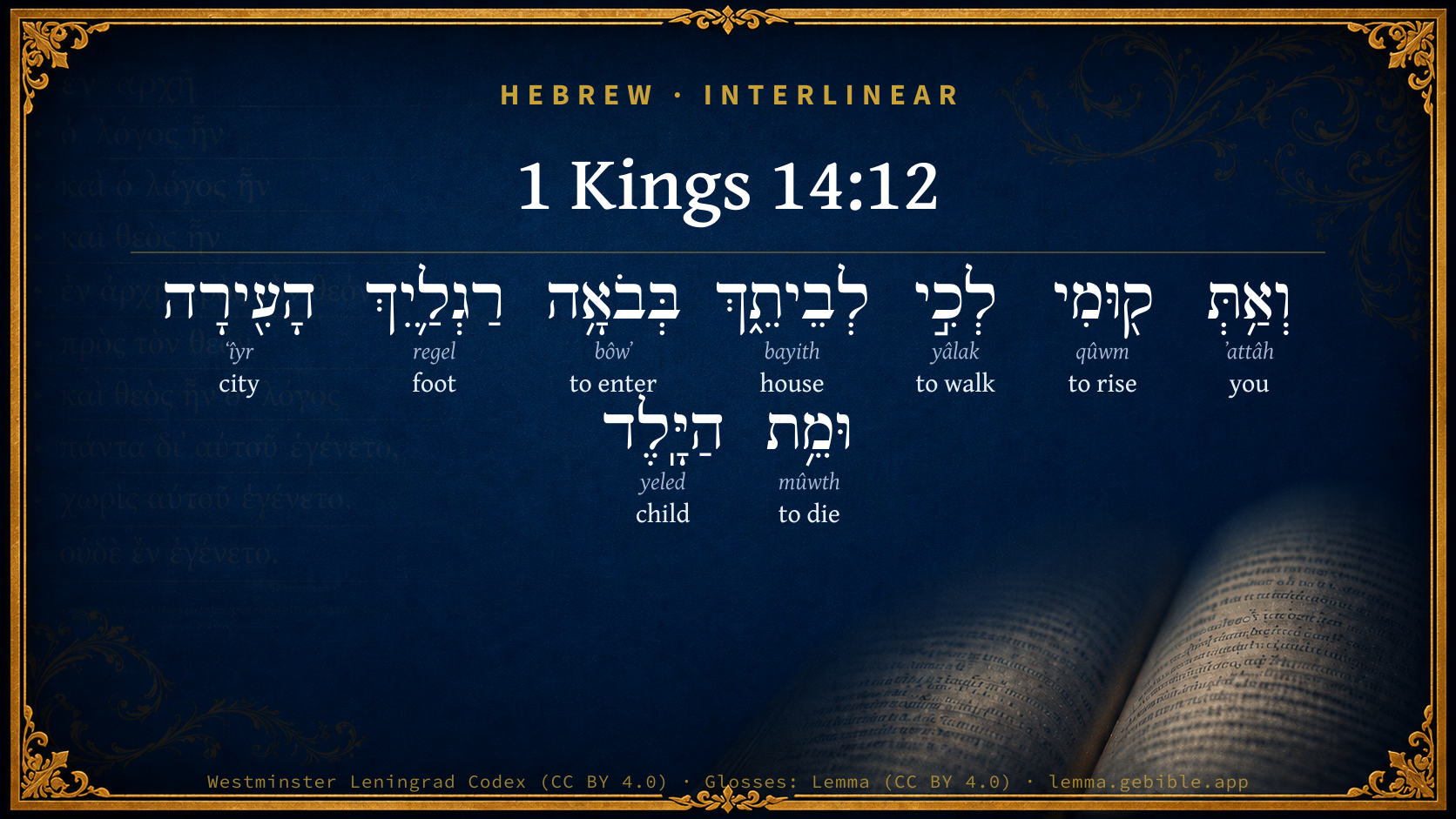
1 Kings 14:12

Hebrew (Westminster Leningrad Codex) 1 Kings 14:12 appears in the Hebrew Old Testament. The text above is from the Westminster Leningrad Codex. Each word links to its Strong’s number, a concise gloss, and parsing drawn from the Open Scriptures Hebrew Bible morphology. Click any word for its full Brown-Driver-Briggs (BDB) entry.
Download image
Cite this verse

1 Kings 14:12 (World English Bible). Public Domain. Lemma interlinear Bible study tool, https://lemma.gebible.app/v/1-kings/14/12.

Show BibTeX & RIS
BibTeX
RIS
English Translation
Arise you therefore, get you to your house: [and] when your feet enter into the city, the child shall die.
World English Bible · Public Domain
Download a study sheet

One document with this verse’s original text, its word-by-word gloss line, the meaning frame, cross-references with their text, attributed commentary, and full source and license credits — printable, and it pastes into notes with its structure intact.

This verse Autodidact and up

Study sheet (.html) Plain text (.txt)

A passage Seminary Student

Up to 50 verses in one chapter. A passage sheet keeps up to 6 commentary sources and 12 cross-references per verse, in the order this page ranks them, and says so on the sheet whenever that leaves anything out. Ask for a single verse and you get the Autodidact verse sheet above.

Everything on this page stays free to read, with no account — the sheet is a download of what is already on screen, not access to it.

Want to remove ads? Support Godless Engineer
Compare translations 3

The same verse in 3 English versions, stacked beneath the original-language interlinear above. Click any original word for its lexicon entry.

Each is an independent rendering of the whole verse — the interlinear is not word-aligned to these translations.

Highlighted words mark where these versions differ — a whole-verse word diff, not a word-by-word alignment.

  • World English Bible Public Domain
    Arise you therefore, get you to your house: [and] when your feet enter into the city, the child shall die.
  • King James Version Public Domain
    Arise thou therefore, get thee to thine own house: and when thy feet enter into the city, the child shall die.
  • unfoldingWord Literal Text CC BY-SA 4.0
    Now you, arise, go to your house. When your feet enter the city, then the child will die.

unfoldingWord Literal Text — © unfoldingWord, licensed CC BY-SA 4.0. Word-aligned USFM3 via Door43 (git.door43.org/unfoldingWord/en_ult).

Versions to compare (up to 4)

3 of 4 selected

Show all 18 translations

Every available English version of this verse, each an independent rendering of the whole verse.

  • World English Bible Public Domain
    Arise you therefore, get you to your house: [and] when your feet enter into the city, the child shall die.
  • Berean Standard Bible Public Domain
    As for you, get up and go home. When your feet enter the city, the child will die.
  • Majority Standard Bible Public Domain
    As for you, get up and go home. When your feet enter the city, the child will die.
  • King James Version Public Domain
    Arise thou therefore, get thee to thine own house: and when thy feet enter into the city, the child shall die.
  • American Standard Version (1901) Public Domain
    Arise thou therefore, get thee to thy house: `and' when thy feet enter into the city, the child shall die.
  • Revised Version (1885) Public Domain
    Arise thou therefore, get thee to thine house: and when thy feet enter into the city, the child shall die.
  • Geneva Bible (1599) Public Domain
    Vp therefore and get thee to thine house: for when thy feete enter into the citie, the childe shall die.
  • Douay-Rheims (1899) Public Domain
    Arise thou therefore, and go to thy house: and when thy feet shall be entering into the city, the child shall die,
  • Young's Literal Translation Public Domain
    `And thou, rise, go to thy house; in the going in of thy feet to the city -- hath the lad died;
  • Literal Standard Version CC BY-SA 4.0
    And you, rise, go to your house; in the going in of your feet to the city, the boy has died;
  • Unlocked Literal Bible CC BY-SA 4.0
    So arise, wife of Jeroboam, and go back to your home; when your feet enter the city, the child Abijah will die.
  • unfoldingWord Literal Text CC BY-SA 4.0
    Now you, arise, go to your house. When your feet enter the city, then the child will die.
  • Darby Bible Public Domain
    And thou, arise, go to thine own house; when thy feet enter into the city, the child shall die.
  • World Messianic Bible Public Domain
    Arise therefore, and go to your house. When your feet enter into the city, the child will die.
  • Webster's Bible Public Domain
    Arise thou therefore, depart to thy own house: and when thy feet enter into the city, the child shall die.
  • Free Bible Version CC BY-SA 4.0
    As for you, get up and go home. As soon as you arrive in the city, the child will die.
  • Bible in Basic English Public Domain
    Up, then! go back to your house; and in the hour when your feet go into the town, the death of the child will take place.
  • JPS Tanakh (1917) Public Domain
    Arise thou therefore, get thee to thy house; and when thy feet enter into the city, the child shall die.

Literal Standard Version (2020), Covenant Press — licensed CC BY-SA 4.0. Text via the HelloAO Bible API (eBible.org). Unlocked Literal Bible (unfoldingWord) — licensed CC BY-SA 4.0. Text via the HelloAO Bible API (eBible.org). unfoldingWord Literal Text — © unfoldingWord, licensed CC BY-SA 4.0. Word-aligned USFM3 via Door43 (git.door43.org/unfoldingWord/en_ult). Free Bible Version, Dr. Jonathan Gallagher — licensed CC BY-SA 4.0. Text via the HelloAO Bible API (eBible.org).

Word by word

More ways to search: Search by grammar → Find every occurrence → Compare this word →

Practice this passage: Drill this verse → Learn its vocabulary →

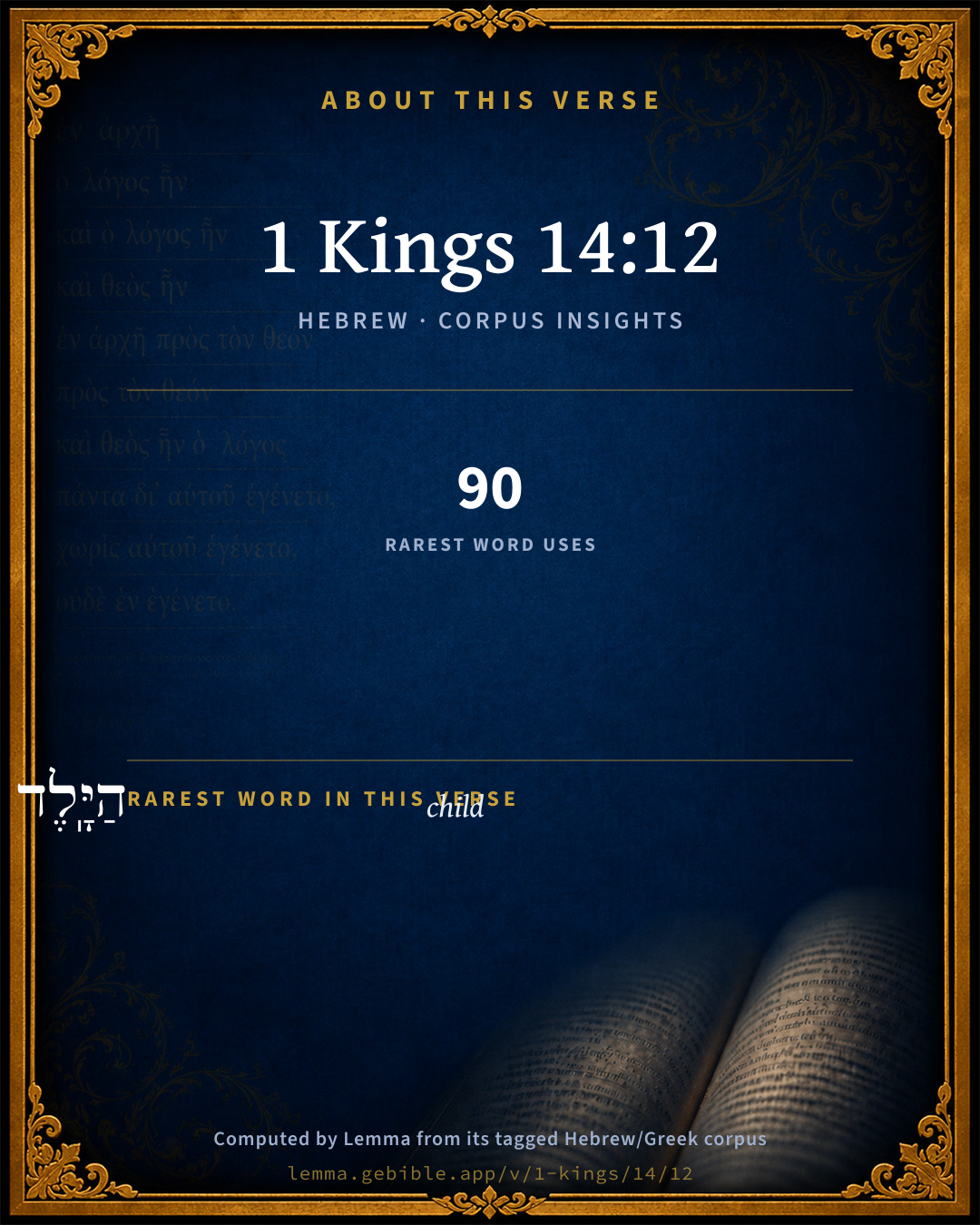
הַיָּֽלֶד
yeled
H3206
“the · child”
Particle, Definite Article + Noun, Common, Masculine, Singular, Absolute
Part of Speech
Particle + Noun
Type
Common
Gender
Masculine
Number
Singular
State
Absolute
Full BDB Definition

Origin: from H3205

TWOT: 867b

child, son, boy, offspring, youth - child, son, boy - child, children - descendants - youth - apostate Israelites (figuratively)
  1. וְאַ֥תְּ ʼattâh H859 “and · you” Conjunction + Pronoun, Personal, 2nd Person, Feminine, Singular
  2. ק֖וּמִי qûwm H6965 “rise” Verb, Qal, Imperative, 2nd Person, Feminine, Singular
  3. לְכִ֣י yâlak H3212 “walk” Verb, Qal, Imperative, 2nd Person, Feminine, Singular
  4. לְבֵיתֵ֑ךְ bayith H1004 “to/for · house · your” Preposition + Noun, Common, Masculine, Singular, Construct + Suffix, Personal, 2nd Person, Feminine, Singular
  5. בְּבֹאָ֥ה bôwʼ H935 “in/at · to enter” Preposition + Verb, Qal, Infinitive Construct
  6. רַגְלַ֛יִךְ regel H7272 “feet · your” Noun, Common, Feminine, Dual, Construct + Suffix, Personal, 2nd Person, Feminine, Singular
  7. הָעִ֖ירָה ʻîyr H5892 “the · city · toward” Particle, Definite Article + Noun, Common, Feminine, Singular, Absolute + Suffix, Demonstrative
  8. וּמֵ֥ת mûwth H4191 “and · to die” Conjunction + Verb, Qal, Sequential Perfect, 3rd Person, Masculine, Singular

About this verse

These counts appear in no published source. They are computed here, from the morphology-tagged text and Lemma’s own curated glosses. What Lemma adds →

9
words
9
distinct lemmas
Historical
section

Grammatical profile

  • 4 verbs
  • 4 nouns
  • 1 pronoun

Verb forms

  • ק֖וּמִי Qal · Imperative
  • לְכִ֣י Qal · Imperative
  • בְּבֹאָ֥ה Qal · Infinitive Construct
  • וּמֵ֥ת Qal · Sequential Perfect

Cross-references

5

Topical passages linked to 1 Kings 14:12 in the Treasury of Scripture Knowledge — connected by theme and wording, ordered by reader-vote popularity; previews shown in the World English Bible.

  • 1 Kings 14:3 Take with you ten loaves, and cakes, and a jar of honey, and go to him: he will tell you what shall become of the child.
  • 1 Kings 14:16–17 He will give Israel up because of the sins of Jeroboam, which he has sinned, and with which he has made Israel to sin.
  • 2 Kings 1:6 They said to him, There came up a man to meet us, and said to us, Go, turn again to the king who sent you, and tell him, Thus says Yahweh, Is it because there is no God in Israel, that you send to inquire of Baal Zebub, the god of Ekron? therefore you shall not come down from the bed where you are gone up, but shall surely die.
  • 2 Kings 1:16 He said to him, Thus says Yahweh, Because you have sent messengers to inquire of Baal Zebub, the god of Ekron, is it because there is no God in Israel to inquire of his word? therefore you shall not come down from the bed where you are gone up, but shall surely die.
  • John 4:50–52 Jesus said to him, "Go your way. Your son lives." The man believed the word that Jesus spoke to him, and he went his way.

Cross-references courtesy of OpenBible.info (CC BY 4.0).

Hebrew and Greek witnesses Masoretic Hebrew ↔ Greek Septuagint

The same verse in the two great witnesses to the Old Testament, shown verse-for-verse.

These are two independent witnesses, not word-aligned to each other, and the Septuagint is shown in lemma (dictionary) form.

Hebrew 1 Kings 14:12 Masoretic · Westminster Leningrad Codex

וְאַ֥תְּ ק֖וּמִי לְכִ֣י לְבֵיתֵ֑ךְ בְּבֹאָ֥ה רַגְלַ֛יִךְ הָעִ֖ירָה וּמֵ֥ת הַיָּֽלֶד

Arise you therefore, get you to your house: [and] when your feet enter into the city, the child shall die.

World English Bible · Public Domain

Hebrew: Westminster Leningrad Codex (CC BY 4.0). Greek: Septuagint (public domain); English from a public-domain English Septuagint. How the Septuagint differs from the Hebrew →

Targum (Aramaic paraphrase)

1

The Targum is the ancient Jewish Aramaic paraphrase of the Hebrew Scriptures — an interpretive translation, not the Hebrew text itself. Onkelos (literal) and Pseudo-Jonathan (expansive) render the Torah, and Jonathan the Prophets. Coverage is partial: where no permissively-licensed English translation exists for a verse, only the Aramaic is shown. This is verse-level text, not a word-by-word alignment to the Hebrew.

  1. Targum Jonathan Prophets (Joshua–Malachi)
    וְאַתְּ קוּמִי אֱזִילִי לְבֵיתָךְ בְּמֵיעַל רִגְלַיִךְ לְקַרְתָּא יְמוּת רַבְיָא:

    (no public-domain English translation for this verse)

    Targum Jonathan — Aramaic: “Mikraot Gedolot” (public domain). English: “Sefaria Community Translation” (CC0 1.0 (public-domain dedication)); “London "Chaldee Paraphrase," 1871” (public domain). Text via Sefaria.

Commentary

Notes on 1 Kings 14:12 from classic Christian and Jewish commentators (each source and its license shown beneath its notes). The classic Christian expositions comment on the surrounding passage and are grouped to its opening verse, so a note may address several verses; the Jewish commentaries on the Tanakh (Rashi and others) are per-verse, so they appear only where the commentator wrote on this verse.

Lemma curates 59 commentaries, every one of them public domain or Creative Commons licensed, each selected and text-cleaned for this edition rather than reprinted as found. About our sources →

Trapp's Complete Commentary

John Trapp

1Ki 14:12 Arise thou therefore, get thee to thine own house: [and] when thy feet enter into the city, the child shall die.

Ver. 12. The child shall die.] This heavy news could not but pierce through the mother’s soul as a sword. {Luk 2:35} A child he is called, because dearly beloved of his parents; but he was of age enough to choose the good and refuse the evil. {1Ki 14:13}

John Trapp, A Commentary or Exposition upon All the Books of the Old and New Testament (1647–1656) — public domain. Text from a community e-Sword module.

Joseph Benson's Commentary

1Ki 14:12. When thy feet enter into the city — Or, rather, when thy feet have entered: that is, presently upon thy entrance into the city; when thou art gone but a little way in it, even as far as the threshold of the king’s door, (1Ki 14:17,) the child shall die — And by this judge of the truth of the rest of my prophecy.

Joseph Benson's Commentary on the Old and New Testaments (1811–1818) — public domain. Text from a community e-Sword module.

Jamieson, Fausset & Brown

Robert Jamieson, A. R. Fausset & David Brown

the child shall die--The death and general lamentation felt through the country at the loss of the prince were also predicted. The reason for the profound regret shown at his death arose, according to Jewish writers, from his being decidedly opposed to the erection of the golden calves, and using his influence with his father to allow his subjects the free privilege of going to worship in Jerusalem.

Jamieson, Fausset & Brown — Commentary Critical and Explanatory on the Whole Bible (1871) — public domain (CC PDM 1.0). Text via the HelloAO Bible API.

The Cambridge Bible for Schools and Colleges

gen. ed. J. J. S. Perowne

12. to thine own house] There is nothing in the text to represent ‘own’. It adds nothing to the sense, and may be omitted.

The Cambridge Bible for Schools and Colleges (gen. ed. J. J. S. Perowne; Cambridge University Press, 1878–1918) — public domain. Text from a community e-Sword module.

John Gill's Exposition

And all Israel shall mourn for him, and bury him,.... Give him an honourable interment, and follow him to the grave with lamentation, because he was the heir apparent to the throne, and an hopeful prince, of whom they had raised expectations; that when he came to the throne things would take a different turn, especially in matters of religion, and they might fear, he being removed, things would grow worse instead of better:

for he only of Jeroboam shall come to the grave; or be buried, the rest should be devoured by dogs or fowls:

because in him there is found some good thing towards the Lord God of Israel in the house of Jeroboam; the principles of grace were implanted, and seeds of piety and religion sown in his heart; and there appeared a disposition of mind, and desires in him to the name of God, and the remembrance of it; or to his pure worship and service; it might be discerned that he had a dislike of idolatry, and a desire to have true religion restored. The Jews say (k) that this good thing in him was, that he was the means of removing the watch or guards that were placed in the way to hinder the Israelites from going up to the feasts of the Lord.

(k) T. Bab. Moed Katon, fol. 28. 2.

John Gill's Exposition of the Whole Bible (1746–1763) — public domain (CC PDM 1.0). Text via the HelloAO Bible API.

Matthew Poole's English Annotations

Presently upon thy entrance into the city; when thou art gone but a little way in it, even as far as to the threshold of the king’s door, 1Ki 14:17, which possibly was near the gates of the city. And by the event of this branch judge of the truth of the rest of my prophecy.

Matthew Poole's English Annotations on the Holy Bible (1683–1685) — public domain. Text from a community e-Sword/MySword module.

Whedon's Commentary on the Bible

Daniel D. Whedon

12. When thy feet enter — “Her first impulse must have been to fly home to receive his dying kiss; but her second to linger, as if to protract that dear life which must close the moment she entered the city.” — Kitto.

Daniel D. Whedon (gen. ed.), Commentary on the Old and New Testaments (1874–1909) — public domain. Text from a community e-Sword module.

The Pulpit Commentary

Arise thou therefore, get thee to thine own house: and when thy feet enter into the city, the child Heb. then the child. This is the force of the w shall die. This was "the sign that the Lord hath spoken" (ch. 13:3). The death of the child at the precise moment of the return should serve as an earnest and foretaste of the doom just denounced.

Vers. 12-14.

The Reprobate"s Doom.

In the queen of Jeroboam we see a remarkable messenger. For she went as messenger from a king and returned as messenger from a prophet. Her message in the first instance was simple, but in her return twofold. She brings a message to the king, and with it a message also to the nation. The message to the king brings

I HEAVY TIDINGS RESPECTING ABIJAH.

1. As to the issue of his illness.

(1) "The child shall die." This is a direct answer to the question with which the royal messenger was charged (ver. 3). Here was the withering of a limb of Jeroboam"s family answering to the sign of the withering of his arm. (see 1Ki_13:4)

(2) The king does not now ask for the restoration of the child as he had done for the restoration of his arm. (1Ki_13:6) He did not even ask, in time, that the judgment might be averted. How could he, without repenting of his sin? Note: The descents of depravity, like those of natural gravitation, are in accelerating degrees.

(3) This judgment is the signal that the season of retributions has now fairly set in. What a horror to wake up to such a conviction! "Be sure your sin will find you out.

2. As to the near approach of his death.

(1) "When thy feet enter into the city." Every step of the queen"s advance over that twelve miles from Shiloh to Tirzah measured a stride of death towards his victim. Do we sufficiently realize the fact that this is the case with us in passing through the journey of life?

(2) What must have been the conflict in the heart of the queen? Maternal affection would urge her steps with speed that she might see her son alive. Yet was it a race with death; and death was first at the palace. That monster overtakes the swiftest. If he passes one it is to strike another, and so that the recoil of his sting may wound the trembling heart.

3. As to the circumstances attending. "All Israel shall mourn for him and bury him;" but for him only of the royal family, "because in him there is found some good thing towards the Lord God of Israel." Hence learns

(1) God"s punishments are discriminative. He does not overlook the good in the evil.

(2) Yet the good suffer with the evil. Abijah dies for the sin of his father. Christ dies for the sin of the world. But in His death is life to the believer.

(3) Still the good suffer for their good. They are taken away from evil to come. Had Abijah lived he might have been drawn into his father"s sin. God often takes them soonest whom He loves best.

(4) The evil suffer in the good, Jeroboam had reason to mourn the loss of the best of his family. So had Israel, since the succession would now open to a wicked prince. Note: We should pray for the preservation of virtuous and useful lives. Especially so when such are found in seats of power and influence.

II HEAVY TIDINGS RESPECTING HIS SURVIVORS.

1. They are devoted to extermination.

(1) This as a general fact was already known.

(2) It is now published with additional circumstance. The agent that shall effect it is one who shall himself mount the throne of Israel.

(3) This was fulfilled to the letter. (see 1Ki_15:27-30)

2. Judgment will come speedily.

(1) Some think this exclamation of the prophet, "But what? Even now" arose from his having seen that this would be the case.

(2) So it proved. Within two years Jeroboam died. He was succeeded by Nadab, who two years later was slain by Baasha. In that time also, and by the same hand, the predicted extermination was completed.

(3) "The wicked do not live out half their days." This is true of dynasties as of individuals. The dynasty of Jeroboam lasted only four and twenty years.

J.A.M.

The Pulpit Commentary (1880–1919), ed. H.D.M. Spence-Jones & Joseph S. Exell — public domain. Text from a community e-Sword module.

John Wesley's Explanatory Notes

When, &c. - Presently upon thy entrance into the city; when thou art gone but a little way in it, even as far as to the threshold of the king's door, ver. 17, which possibly was near the gates of the city. And by this judge of the truth of the rest of my prophecy.

John Wesley, Explanatory Notes Upon the Whole Bible (1754–1765) — public domain. Text via the GEBible commentary corpus.

Lesson kit

Teaching starters — assembled from the data on this page, not authored interpretation. Every prompt links to the verse data it draws on. Edit before teaching.

1 Kings, in the Historical, opens this verse with 9 words (9 distinct Hebrew lemmas). Its most distinctive word is yeled (“child”). A historical commentator’s framing appears above. Read the whole chapter for the surrounding context.

Discussion questions

  1. What does “child” (yeled) contribute to the verse as a whole?
  2. How does 1 Kings 14:3, which shares this passage’s theme, read alongside this verse?
  3. The translations on this page render this verse differently — a whole-verse word diff, not a word-by-word alignment. What might account for the different wordings?
  4. «ק֖וּמִי» is a Qal Imperative verb. How does that grammatical form shape the action described?
  5. Compare how Trapp's Complete Commentary and Joseph Benson's Commentary read this verse. Where do they agree or differ?

Things to notice

Reading settings

Reading text

Shown beneath each verse's original-language words.

Old Testament
Old Testament edition

Read the OT as the Masoretic Hebrew (MT) or the Greek Septuagint (LXX).

English shown for the Greek Septuagint (in the Hebrew ↔ Greek comparison).

Comparing translations? Open the Compare panel on any verse page to stack up to four side by side.