Deuteronomy 17:6

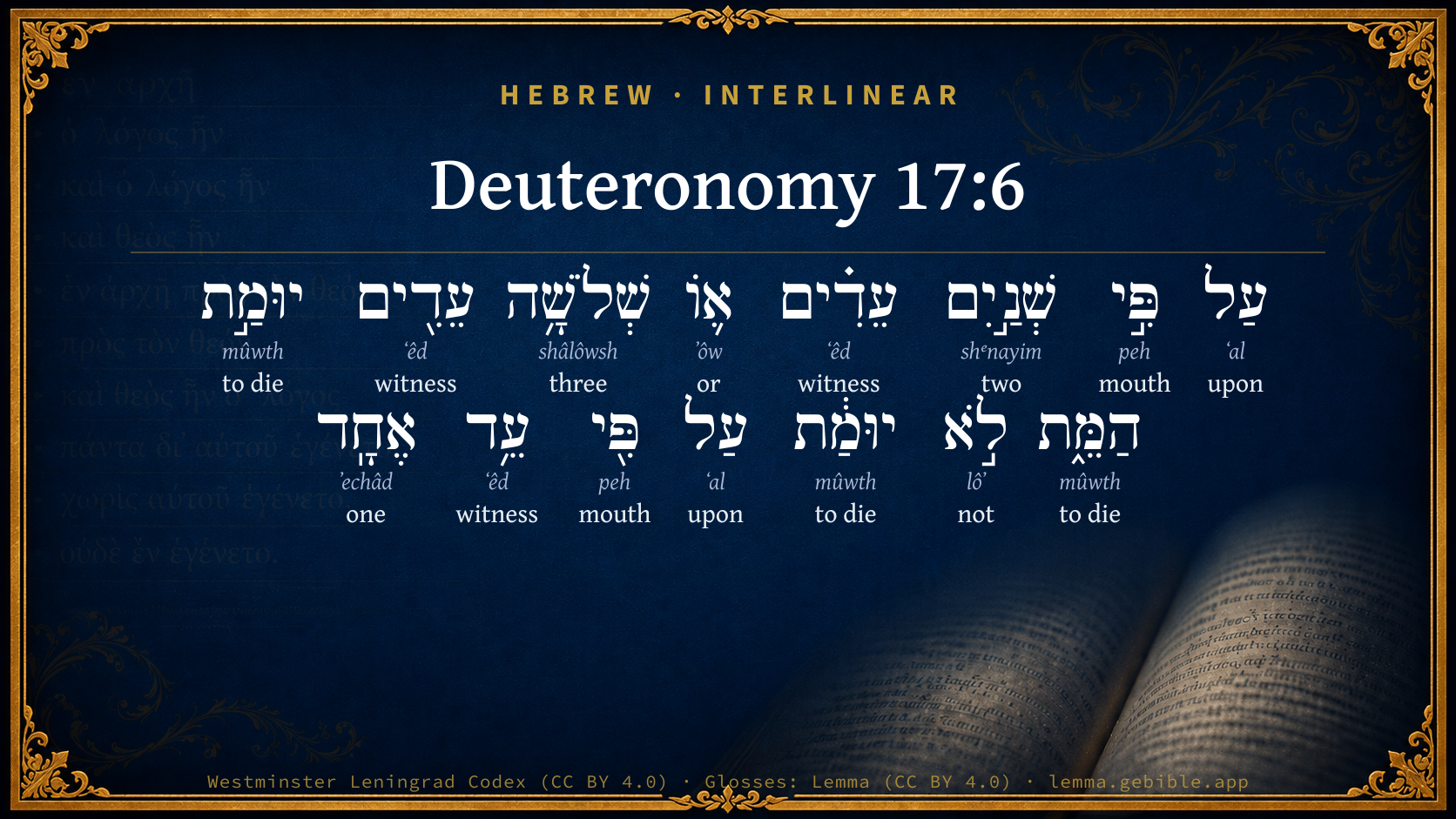
Hebrew (Westminster Leningrad Codex) Deuteronomy 17:6 appears in the Hebrew Old Testament. The text above is from the Westminster Leningrad Codex. Each word links to its Strong’s number, a concise gloss, and parsing drawn from the Open Scriptures Hebrew Bible morphology. Click any word for its full Brown-Driver-Briggs (BDB) entry.
Download image
Cite this verse

Deuteronomy 17:6 (World English Bible). Public Domain. Lemma interlinear Bible study tool, https://lemma.gebible.app/v/deuteronomy/17/6.

Show BibTeX & RIS
BibTeX
RIS
English Translation
At the mouth of two witnesses, or three witnesses, shall he who is to die be put to death; at the mouth of one witness he shall not be put to death.
World English Bible · Public Domain
Download a study sheet

One document with this verse’s original text, its word-by-word gloss line, the meaning frame, cross-references with their text, attributed commentary, and full source and license credits — printable, and it pastes into notes with its structure intact.

This verse Autodidact and up

Study sheet (.html) Plain text (.txt)

A passage Seminary Student

Up to 50 verses in one chapter. A passage sheet keeps up to 6 commentary sources and 12 cross-references per verse, in the order this page ranks them, and says so on the sheet whenever that leaves anything out. Ask for a single verse and you get the Autodidact verse sheet above.

Everything on this page stays free to read, with no account — the sheet is a download of what is already on screen, not access to it.

Want to remove ads? Support Godless Engineer
Compare translations 3

The same verse in 3 English versions, stacked beneath the original-language interlinear above. Click any original word for its lexicon entry.

Each is an independent rendering of the whole verse — the interlinear is not word-aligned to these translations.

Highlighted words mark where these versions differ — a whole-verse word diff, not a word-by-word alignment.

  • World English Bible Public Domain
    At the mouth of two witnesses, or three witnesses, shall he who is to die be put to death; at the mouth of one witness he shall not be put to death.
  • King James Version Public Domain
    At the mouth of two witnesses, or three witnesses, shall he that is worthy of death be put to death; but at the mouth of one witness he shall not be put to death.
  • unfoldingWord Literal Text CC BY-SA 4.0
    At the mouth of two witnesses or three witnesses, he who is to die shall die. He shall not die at the mouth of one witness.

unfoldingWord Literal Text — © unfoldingWord, licensed CC BY-SA 4.0. Word-aligned USFM3 via Door43 (git.door43.org/unfoldingWord/en_ult).

Versions to compare (up to 4)

3 of 4 selected

Show all 18 translations

Every available English version of this verse, each an independent rendering of the whole verse.

  • World English Bible Public Domain
    At the mouth of two witnesses, or three witnesses, shall he who is to die be put to death; at the mouth of one witness he shall not be put to death.
  • Berean Standard Bible Public Domain
    On the testimony of two or three witnesses a man shall be put to death, but he shall not be executed on the testimony of a lone witness.
  • Majority Standard Bible Public Domain
    On the testimony of two or three witnesses a man shall be put to death, but he shall not be executed on the testimony of a lone witness.
  • King James Version Public Domain
    At the mouth of two witnesses, or three witnesses, shall he that is worthy of death be put to death; but at the mouth of one witness he shall not be put to death.
  • American Standard Version (1901) Public Domain
    At the mouth of two witnesses, or three witnesses, shall he that is to die be put to death; at the mouth of one witness he shall not be put to death.
  • Revised Version (1885) Public Domain
    At the mouth of two witnesses, or three witnesses, shall he that is to die be put to death; at the mouth of one witness he shall not be put to death.
  • Geneva Bible (1599) Public Domain
    At the mouth of two or three witnesses shall he that is woorthie of death, die: but at the mouth of one witnesse, he shall not die.
  • Douay-Rheims (1899) Public Domain
    By the mouth of two or three witnesses shall he die that is to be slain. Let no man be put to death, when only one beareth witness against him.
  • Young's Literal Translation Public Domain
    By the mouth of two witnesses or of three witnesses is he who is dead put to death; he is not put to death by the mouth of one witness;
  • Literal Standard Version CC BY-SA 4.0
    By the mouth of two witnesses or three witnesses is he who is being put to death put to death; he is not put to death by the mouth of one witness;
  • Unlocked Literal Bible CC BY-SA 4.0
    At the mouth of two witnesses, or three witnesses, will he who must die be put to death; but at the mouth of only one witness he must not be put to death.
  • unfoldingWord Literal Text CC BY-SA 4.0
    At the mouth of two witnesses or three witnesses, he who is to die shall die. He shall not die at the mouth of one witness.
  • Darby Bible Public Domain
    At the mouth of two witnesses, or three witnesses, shall he that is to die be put to death: he shall not be put to death at the mouth of one witness.
  • World Messianic Bible Public Domain
    At the mouth of two witnesses, or three witnesses, he who is to die shall be put to death. At the mouth of one witness he shall not be put to death.
  • Webster's Bible Public Domain
    At the mouth of two witnesses, or three witnesses, shall he that is worthy of death be put to death; but at the mouth of one witness he shall not be put to death.
  • Free Bible Version CC BY-SA 4.0
    That person is to be executed based on the evidence given by two or three witnesses. No one shall be executed on the evidence given by a single witness.
  • Bible in Basic English Public Domain
    On the word of two or three witnesses, a man may be given the punishment of death; but he is not to be put to death on the word of one witness.
  • JPS Tanakh (1917) Public Domain
    At the mouth of two witnesses, or three witnesses, shall he that is to die be put to death; at the mouth of one witness he shall not be put to death.

Literal Standard Version (2020), Covenant Press — licensed CC BY-SA 4.0. Text via the HelloAO Bible API (eBible.org). Unlocked Literal Bible (unfoldingWord) — licensed CC BY-SA 4.0. Text via the HelloAO Bible API (eBible.org). unfoldingWord Literal Text — © unfoldingWord, licensed CC BY-SA 4.0. Word-aligned USFM3 via Door43 (git.door43.org/unfoldingWord/en_ult). Free Bible Version, Dr. Jonathan Gallagher — licensed CC BY-SA 4.0. Text via the HelloAO Bible API (eBible.org).

Word by word

More ways to search: Search by grammar → Find every occurrence → Compare this word →

Practice this passage: Drill this verse → Learn its vocabulary →

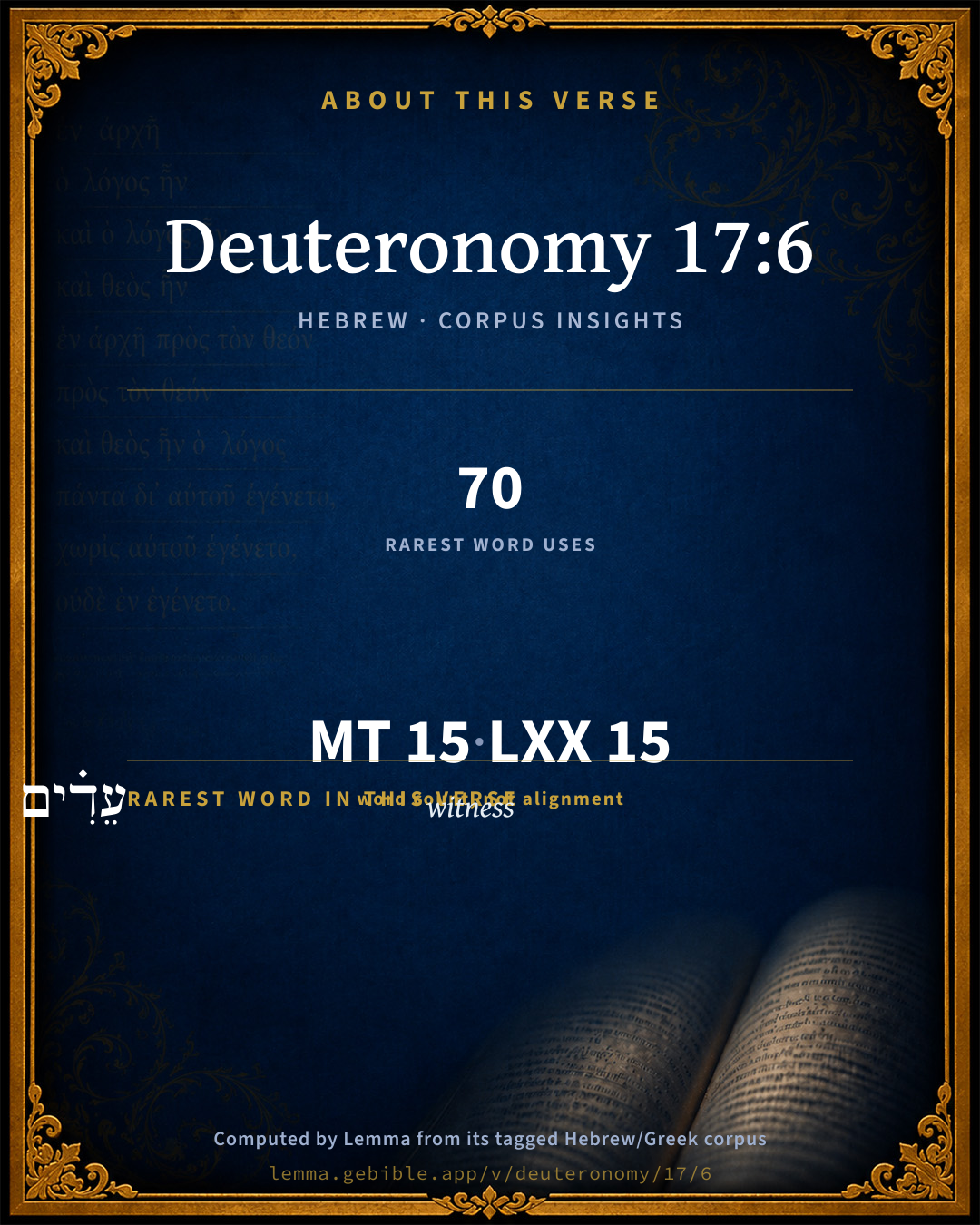
עֵדִ֗ים
ʻêd
H5707
“witnesses”
Noun, Common, Masculine, Plural, Absolute
Part of Speech
Noun
Type
Common
Gender
Masculine
Number
Plural
State
Absolute
Full BDB Definition

Origin: contracted from H5749

TWOT: 1576b

witness - witness, testimony, evidence (of things) - witness (of people)
  1. עַל ʻal H5921 “upon” Preposition
  2. פִּ֣י peh H6310 “mouth of” Noun, Common, Masculine, Singular, Construct
  3. שְׁנַ֣יִם shᵉnayim H8147 “two” Adjective, Cardinal number, Masculine, Dual, Absolute
  4. א֛וֹ ʼôw H176 “or” Conjunction
  5. שְׁלֹשָׁ֥ה shâlôwsh H7969 “three” Adjective, Cardinal number, Masculine, Singular, Absolute
  6. עֵדִ֖ים ʻêd H5707 “witnesses” Noun, Common, Masculine, Plural, Absolute
  7. יוּמַ֣ת mûwth H4191 “to die” Verb, Hophal, Imperfect, 3rd Person, Masculine, Singular
  8. הַמֵּ֑ת mûwth H4191 “the · dying” Particle, Definite Article + Verb, Qal, Participle Active, Masculine, Singular, Absolute
  9. לֹ֣א lôʼ H3808 “not” Particle, Negative
  10. יוּמַ֔ת mûwth H4191 “to die” Verb, Hophal, Imperfect, 3rd Person, Masculine, Singular
  11. עַל ʻal H5921 “upon” Preposition
  12. פִּ֖י peh H6310 “mouth of” Noun, Common, Masculine, Singular, Construct
  13. עֵ֥ד ʻêd H5707 “witness” Noun, Common, Masculine, Singular, Absolute
  14. אֶחָֽד ʼechâd H259 “one” Adjective, Cardinal number, Masculine, Singular, Absolute

About this verse

These counts appear in no published source. They are computed here, from the morphology-tagged text and Lemma’s own curated glosses. What Lemma adds →

15
words
9
distinct lemmas
Pentateuch
section

Grammatical profile

  • 3 verbs
  • 5 nouns
  • 3 adjectives
  • 2 prepositions
  • 1 conjunction
  • 1 particle

Verb forms

  • יוּמַ֣ת Hophal · Imperfect
  • הַמֵּ֑ת Qal · Participle Active
  • יוּמַ֔ת Hophal · Imperfect

Repetition

Words recur within this verse — often emphatic in Hebrew:

  • עֵדִ֗ים witness H5707 ×3
  • יוּמַ֣ת to die H4191 ×3
  • עַל upon H5921 ×2
  • פִּ֣י mouth H6310 ×2

Hebrew & Septuagint length

In English translation the verse runs 32 words from the Hebrew and 27 from the Septuagint (LXX English) — closely comparable.

A rough comparison of the two English renderings, which tokenize alike — not a word-level alignment.

Word counts can differ between the Hebrew and the Greek without any difference in meaning — e.g. the Hebrew direct-object marker אֵת has no separate Greek word, and Greek often adds the article ὁ.

In the original languages it is 15 Hebrew tokens and 15 Greek tokens — but the two are counted differently (Hebrew bundles its prefixes and suffixes into one token; the Greek is in lemma form), so that isn’t a like-for-like length.

Cross-references

7

Topical passages linked to Deuteronomy 17:6 in the Treasury of Scripture Knowledge — connected by theme and wording, ordered by reader-vote popularity; previews shown in the World English Bible.

  • Numbers 35:30 Whoever kills any person, the murderer shall be slain at the mouth of witnesses: but one witness shall not testify against any person that he die.
  • Hebrews 10:28 A man who disregards Moses' law dies without compassion on the word of two or three witnesses.
  • Deuteronomy 19:15 One witness shall not rise up against a man for any iniquity, or for any sin, in any sin that he sins: at the mouth of two witnesses, or at the mouth of three witnesses, shall a matter be established.
  • Matthew 18:16 But if he doesn't listen, take one or two more with you, that at the mouth of two or three witnesses every word may be established.
  • 1 Timothy 5:19 Don't receive an accusation against an elder, except at the word of two or three witnesses.
  • John 8:17–18 It's also written in your law that the testimony of two people is valid.
  • 2 Corinthians 13:1 This is the third time I am coming to you. "At the mouth of two or three witnesses shall every word established."

Cross-references courtesy of OpenBible.info (CC BY 4.0).

Hebrew and Greek witnesses Masoretic Hebrew ↔ Greek Septuagint

The same verse in the two great witnesses to the Old Testament, shown verse-for-verse.

These are two independent witnesses, not word-aligned to each other, and the Septuagint is shown in lemma (dictionary) form.

Hebrew Deuteronomy 17:6 Masoretic · Westminster Leningrad Codex

עַל פִּ֣י שְׁנַ֣יִם עֵדִ֗ים א֛וֹ שְׁלֹשָׁ֥ה עֵדִ֖ים יוּמַ֣ת הַמֵּ֑ת לֹ֣א יוּמַ֔ת עַל פִּ֖י עֵ֥ד אֶחָֽד

At the mouth of two witnesses, or three witnesses, shall he who is to die be put to death; at the mouth of one witness he shall not be put to death.

World English Bible · Public Domain

Greek LXX Deuteronomy 17:6 Septuagint · lemma form

ἐπί δύο μάρτυς ἤ ἐπί τρεῖς μάρτυς ἀποθνήσκω ὁ ἀποθνήσκω οὐ ἀποθνήσκω ἐπί εἷς μάρτυς

He shall die on the testimony of two or three witnesses; a man who is put to death shall not be put to death for one witness.

LXX2012 (modern English Septuagint) · Public Domain

On this verse, The Cambridge Bible for Schools and Colleges discusses the Septuagint’s reading. Read the note in Commentary ↓

Hebrew: Westminster Leningrad Codex (CC BY 4.0). Greek: Septuagint (public domain); English from LXX2012 (modern English Septuagint) (Public Domain). How the Septuagint differs from the Hebrew →

Targum (Aramaic paraphrase)

2

The Targum is the ancient Jewish Aramaic paraphrase of the Hebrew Scriptures — an interpretive translation, not the Hebrew text itself. Onkelos (literal) and Pseudo-Jonathan (expansive) render the Torah, and Jonathan the Prophets. Coverage is partial: where no permissively-licensed English translation exists for a verse, only the Aramaic is shown. This is verse-level text, not a word-by-word alignment to the Hebrew.

  1. Targum Onkelos Torah (Genesis–Deuteronomy)
    עַל מֵימַר תְּרֵין סַהֲדִין אוֹ תְּלָתָא סַהֲדִין יִתְקְטִל דְחַיַב קְטוֹל לָא יִתְקְטֵל עַל מֵימַר סָהִיד חָד

    (no public-domain English translation for this verse)

    Targum Onkelos — Aramaic: “Onkelos Genesis” (public domain); “Onkelos Exodus” (public domain); “Onkelos Leviticus” (public domain); “Onkelos Numbers” (public domain); “Onkelos Deuteronomy” (public domain). English: “Sefaria Community Translation” (CC0 1.0 (public-domain dedication)); “J.W. Etheridge. The Targums of Onkelos and Jonathan Ben Uzziel on the Pentateuch. London: Longmans, Green, 1862” (public domain). Text via Sefaria.

  2. Targum Pseudo-Jonathan Torah (Genesis–Deuteronomy)
    עַל מֵימַר תְּרֵין סַהֲדִין אוֹ תְּלָתָא סַהֲדִין יִתְקְטֵיל דְּמִתְחַיֵּיב קָטוֹלָא לָא יִתְקְטֵיל עַל מֵימַר סָהִיד חָד

    Upon the word of two witnesses or of three he shall die who is guilty of death; they shall not be put to death on the word of one witness.

    Targum Pseudo-Jonathan — Aramaic: “Targum Jonathan on Genesis” (public domain); “Targum Jonathan on Exodus” (public domain); “Targum Jonathan on Leviticus” (public domain); “Targum Jonathan on Numbers” (public domain); “Targum Jonathan on Deuteronomy” (public domain). English: “The Targum of Jonathan ben Uzziel, trans. J. W. Etheridge, London, 1862” (public domain). Text via Sefaria.

Commentary

Notes on Deuteronomy 17:6 from classic Christian and Jewish commentators (each source and its license shown beneath its notes). The classic Christian expositions comment on the surrounding passage and are grouped to its opening verse, so a note may address several verses; the Jewish commentaries on the Tanakh (Rashi and others) are per-verse, so they appear only where the commentator wrote on this verse.

Lemma curates 59 commentaries, every one of them public domain or Creative Commons licensed, each selected and text-cleaned for this edition rather than reprinted as found. About our sources →

Trapp's Complete Commentary

John Trapp

Deu 17:6 At the mouth of two witnesses, or three witnesses, shall he that is worthy of death be put to death; [but] at the mouth of one witness he shall not be put to death.

Ver. 8. Too hard for thee in judgment,] i.e., For thee, O judge, who art thereupon to consult with the priests, and by them to be informed of the true sense and meaning of God’s law. For apices iuris non sunt ius. And the Rabbins have a saying, Nulla est obiectio in Lege, quae non habet solutionem in latere. Now the priest’s lips should preserve knowledge, and the law should be sought at his mouth; the high priest also, in some cases, was to inquire, and answer after the judgment of Urim, before the Lord. {Num 27:21} This the Pope cannot do, and therefore cannot claim the final determination of all causes and controversies, though his parasites tell him,

“ Oraclis vocis mundi moderaris habenas:

Et meritb in terris diceris esse Deus. ”

John Trapp, A Commentary or Exposition upon All the Books of the Old and New Testament (1647–1656) — public domain. Text from a community e-Sword module.

Joseph Benson's Commentary

Deu 17:6. Witnesses — Namely, credible and competent witnesses. The Jews rejected the testimonies of children, women, servants, familiar friends, or enemies, persons of dissolute lives or evil fame.

Joseph Benson's Commentary on the Old and New Testaments (1811–1818) — public domain. Text from a community e-Sword module.

Geneva Bible (1599)

Geneva Bible translators

Hebrew, of two witnesses or three witnesses.

Geneva Bible (1599) marginal notes — public domain. Text via Bolls.life.

Adam Clarke's Commentary

Verse 6. Two witnesses] ONE might be deceived, or be prejudiced or malicious; therefore God required two substantial witnesses for the support of the charge.

Adam Clarke's Commentary on the Bible (1810–1826) — public domain. Text from a community e-Sword/MySword module.

The Cambridge Bible for Schools and Colleges

gen. ed. J. J. S. Perowne

6. At the mouth of two witnesses or at the mouth of three witnesses] So Sam. and LXX, as in Deu_19:15, where the law, here applied to a particular case, is more generally stated. Cp. P, Num_35:30.

The Cambridge Bible for Schools and Colleges (gen. ed. J. J. S. Perowne; Cambridge University Press, 1878–1918) — public domain. Text from a community e-Sword module.

John Gill's Exposition

At the mouth of two witnesses, or three witnesses, shall he that is worthy of death be put to death,.... The idolater found guilty was to be stoned; two witnesses were sufficient to prove a fact, if three the better, but, on the testimony of one, sentence might not be pronounced. Aben Ezra observes, that some say, if two witnesses contradict two other, a third turns the scale and determines the matter; and others say, that two who are wise men will do, and three of others; and because it is said "at the mouth" of these witnesses, it is concluded, that a testimony should be verbal and not written; should not be recorded, neither in pecuniary cases nor in capital ones, but from the mouth of the witnesses, as it is said "at the mouth", &c. at their mouth, and not from their handwriting (e):

but at the mouth of one witness he shall not be put to death; so careful is the Lord of the lives of men, that none should be taken away but upon full and sufficient evidence, even in cases in which his own glory and honour is so much concerned.

(e) Maimon. Hilchot Eduth, c. 3. sect. 4.

John Gill's Exposition of the Whole Bible (1746–1763) — public domain (CC PDM 1.0). Text via the HelloAO Bible API.

Haydock's Catholic Bible Commentary

Slain. When the action was public, this formality was not requisite, chap. xiii. 9. --- Him. One witness was never admitted to prove any crime; neither would the Jews receive for witnesses, women, infants under thirteen, slaves, publicans, thieves, &c. (Josephus, [Antiquities?] iv. last chapter.) The Rabbins also reject other notorious offenders, enemies, relations, and those who had not a competent knowledge of the law, &c. (Ap. Selden, Syn. ii. 13. 11.; and Grotius) --- But we could wish for some authors of more credit. (Calmet)

George Leo Haydock (1774–1849), Haydock's Catholic Family Bible and Commentary, 1859 edition — public domain. Excludes Psalms (Douay-Rheims chapter numbering differs from Protestant) and Deuterocanonical books (Catholic canon only).

Matthew Poole's English Annotations

At the mouth, i.e. upon the testimony delivered upon oath before the magistrates.

Three witnesses, to wit, credible and competent witnesses. The Jews rejected the testimonies of madmen. children, women, servants, familiar friends, or enemies, persons of dissolute lives and evil fame.

Matthew Poole's English Annotations on the Holy Bible (1683–1685) — public domain. Text from a community e-Sword/MySword module.

The Pulpit Commentary

Vers. 6, 7. Only on the testimony of more than one witness could the accused be condemned; (of Num_35:30) and the hand of the witnesses was to be first against him to put him to death a rule which would tend to prevent accusations being lightly adduced, as none would venture to witness against any one unless so deeply convinced of his guilt that they were willing to assume the responsibility of inflicting on him the last penalty with their own hands. Worthy of death be put to death; i.e. adjudged or appointed to death; literally, the dead man shall die. tme, the part. of tWm, to die, is here equivalent to twm B, son of death, (1Sa_20:31) or tw,m; vyai, a man of death, (1Ki_2:26) i.e. one assigned to death, already the property of death, and so as good as dead.

Put the evil away; literally, consume or sweep away the evil. The verb rB; means primarily to consume by burning.

The Pulpit Commentary (1880–1919), ed. H.D.M. Spence-Jones & Joseph S. Exell — public domain. Text from a community e-Sword module.

John Wesley's Explanatory Notes

Witnesses - Namely, credible and competent witnesses. The Jews rejected the testimonies of children, women, servants, familiar friends or enemies, persons of dissolute lives or evil fame.

John Wesley, Explanatory Notes Upon the Whole Bible (1754–1765) — public domain. Text via the GEBible commentary corpus.

Rashi

Rabbi Shlomo Yitzchaki (Rashi)

שנים עדים או שלשה [BY THE MOUTH OF] TWO WITNESSES OR THREE [WITNESSES, SHALL HE THAT IS WORTHY OF DEATH BE PUT TO DEATH] — But if evidence can be established by two witnesses to what end does it (Scripture) mention to you explicitly that it may be established by three? Scripture does so in order to compare the evidence of three witnesses to that of two (to make the same law apply to both cases). How is it in the case of two? Their evidence forms one testimony; so, too, does the evidence of three (or many) witnesses form one testimony and they cannot be declared “plotting witnesses” unless all of them are proved to be “plotting witnesses” (Makkot 5b).

Rashi on the Tanakh — English translations: “The Judaica Press complete Tanach with Rashi, translated by A. J. Rosenberg” (CC BY 4.0); “Pentateuch with Rashi's commentary by M. Rosenbaum and A.M. Silbermann, 1929-1934” (public domain); “The Metsudah Tanach series, Lakewood, N.J” (CC BY 4.0); and “The Book of Joshua, Metsudah Publications, 1997” (CC BY 4.0). Text via Sefaria.

Ramban (Nachmanides)

Rabbi Moshe ben Nachman (Ramban / Nachmanides)

AT THE MOUTH OF TWO WITNESSES, OR THREE WITNESSES, SHALL HE THAT IS TO DIE BE PUT TO DEATH. “If the evidence can be sustained by two witnesses, why did Scripture specify ‘three?’ It is to liken three to two: just as the evidence of two witnesses forms a single unit of testimony, so does the evidence of three, constitute a single unit of testimony and they are not subject to the law of plotting witnesses [which declares that whatever they plotted to do to their brother should be done to them] unless all three are proven to be plotters.” This is Rashi’s language. So also the principle [of a single unit of testimony] applies if one of the witnesses is found to be a kinsman [and hence ineligible to testify] or to have some other disqualification — the testimony of all is void. If they are proven to have been plotting witnesses, [in which case] all of them are subject to the death-penalty or payment of money [as the case may be, and the third witness cannot claim immunity because of his argument that even had he not testified the evidence of the first two witnesses was sufficient to sustain the charge], since the main intent of Scripture was to liken the evidence of three witnesses to that of two in every respect, according to the opinion of our Rabbis. And the Gaon Rav Saadia, p. 521, Note 74. Rav Saadia’s comment is quoted here by Ibn Ezra. said, by way of the plain meaning of Scripture, that the interpretation of the verse is as follows: “two witnesses, or three judges who [officially] accept the testimony of the two witnesses.” thus means: “upon the testimony of two witnesses who appear before the entire court of twenty-three judges, or by the word of the three judges who officially accepted the testimony of the witnesses and later relayed it to the entire court — shall the one that is to die be put to death. Ramban will refute this interpretation of the Gaon, for there is in the verse etc. But there is in the verse no mention of acceptance of the testimony; instead, it refers explicitly to witnesses. But it seems to me that the Gaon erred in his [statement of this] law, for testimony in capital cases cannot be accepted except in the presence of a Sanhedrin of twenty-three judges [and not, as Rav Saadia holds, before only three judges]! Rather, the plain meaning of the verse is that the condemned man shall be put to death at the mouth of two witnesses if no more are there, or at the mouth of three witnesses if three witnesses are to be found there. Scripture thus states: when it will be told thee, and thou hear it you are to inquire diligently into the matter by means of the testimony of all the witnesses found there. Thus if we heard that he transgressed in the presence of three people, we should send for them and have them all come to court and testify. The same law applies to a hundred, for by hearing the words of them all, the truth will become clear. But if not more [than two] were present, or they [the others] left and are not to be found, then two are sufficient.

Ramban (Nachmanides) on the Tanakh — English translation: “Commentary on the Torah by Ramban (Nachmanides). Translated and annotated by Charles B. Chavel. New York, Shilo Pub. House, 1971-1976” (CC BY 4.0). Text via Sefaria.

Lesson kit

Teaching starters — assembled from the data on this page, not authored interpretation. Every prompt links to the verse data it draws on. Edit before teaching.

Deuteronomy, in the Pentateuch, opens this verse with 15 words (9 distinct Hebrew lemmas). Its most distinctive word is ʻêd (“witness”). A historical commentator’s framing appears above. Read the whole chapter for the surrounding context.

Discussion questions

  1. What does “witness” (ʻêd) contribute to the verse as a whole?
  2. How does Numbers 35:30, which shares this passage’s theme, read alongside this verse?
  3. What does the repetition of “witness” (3× in this one verse) do in this verse?
  4. These translations render this verse differently; the difference is in the English rendering, not the original. What questions does that raise?
  5. «יוּמַ֣ת» is a Hophal Imperfect verb. How does that grammatical form shape the action described?
  6. Compare how Trapp's Complete Commentary and Joseph Benson's Commentary read this verse. Where do they agree or differ?

Things to notice

Reading settings

Reading text

Shown beneath each verse's original-language words.

Old Testament
Old Testament edition

Read the OT as the Masoretic Hebrew (MT) or the Greek Septuagint (LXX).

English shown for the Greek Septuagint (in the Hebrew ↔ Greek comparison).

Comparing translations? Open the Compare panel on any verse page to stack up to four side by side.