Genesis 2:17

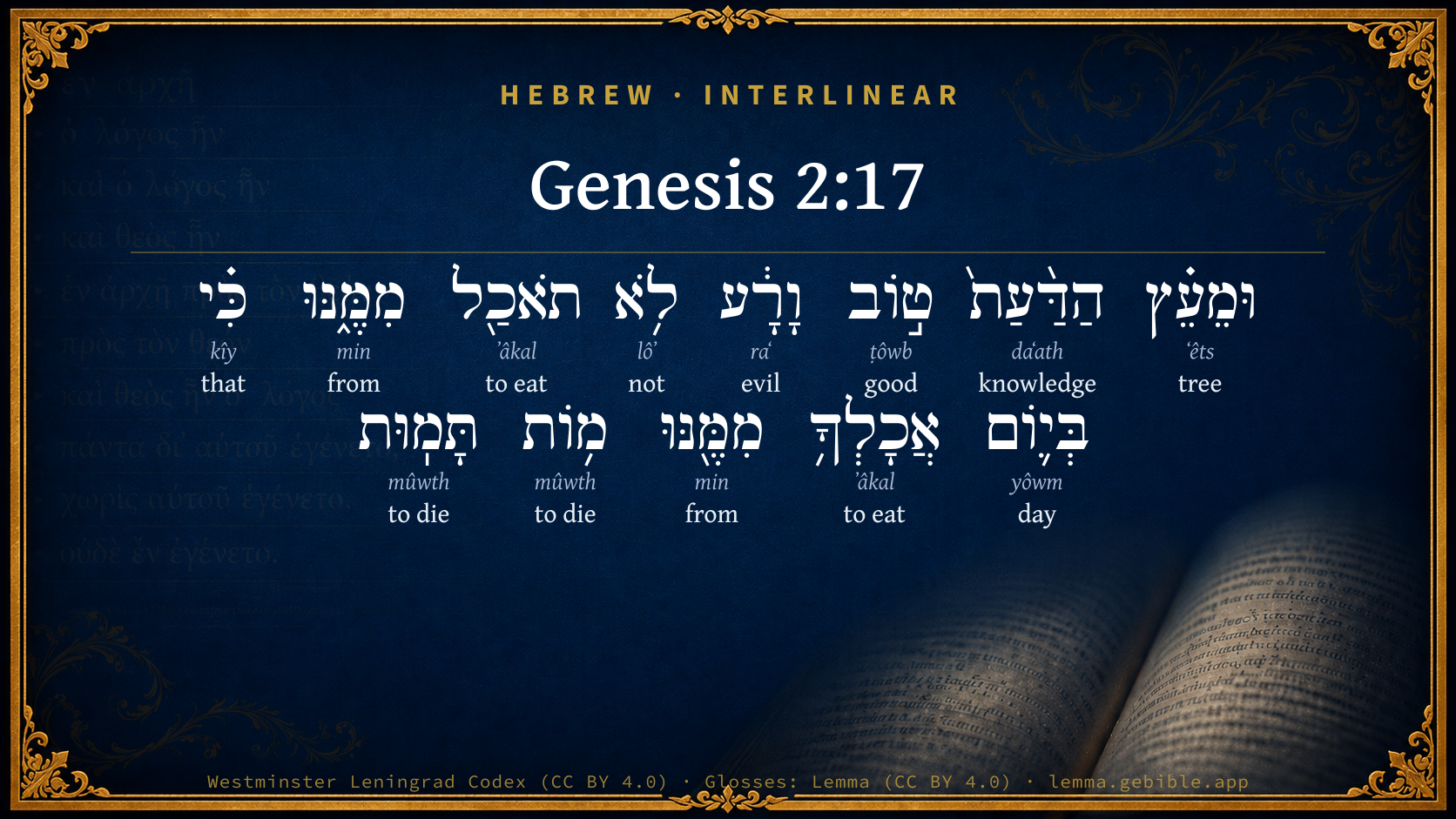
Hebrew (Westminster Leningrad Codex) Genesis 2:17 appears in the Hebrew Old Testament. The text above is from the Westminster Leningrad Codex. Each word links to its Strong’s number, a concise gloss, and parsing drawn from the Open Scriptures Hebrew Bible morphology. Click any word for its full Brown-Driver-Briggs (BDB) entry.
Download image
Cite this verse

Genesis 2:17 (World English Bible). Public Domain. Lemma interlinear Bible study tool, https://lemma.gebible.app/v/genesis/2/17.

Show BibTeX & RIS
BibTeX
RIS
English Translation
but of the tree of the knowledge of good and evil, you shall not eat of it: for in the day that you eat of it you will surely die."
World English Bible · Public Domain
Highlights
  • 1 first appearance in the Hebrew Bible
Full analysis ↓
Download a study sheet

One document with this verse’s original text, its word-by-word gloss line, the meaning frame, cross-references with their text, attributed commentary, and full source and license credits — printable, and it pastes into notes with its structure intact.

This verse Autodidact and up

Study sheet (.html) Plain text (.txt)

A passage Seminary Student

Up to 50 verses in one chapter. A passage sheet keeps up to 6 commentary sources and 12 cross-references per verse, in the order this page ranks them, and says so on the sheet whenever that leaves anything out. Ask for a single verse and you get the Autodidact verse sheet above.

Everything on this page stays free to read, with no account — the sheet is a download of what is already on screen, not access to it.

Want to remove ads? Support Godless Engineer
Compare translations 3

The same verse in 3 English versions, stacked beneath the original-language interlinear above. Click any original word for its lexicon entry.

Each is an independent rendering of the whole verse — the interlinear is not word-aligned to these translations.

Highlighted words mark where these versions differ — a whole-verse word diff, not a word-by-word alignment.

  • World English Bible Public Domain
    but of the tree of the knowledge of good and evil, you shall not eat of it: for in the day that you eat of it you will surely die."
  • King James Version Public Domain
    But of the tree of the knowledge of good and evil, thou shalt not eat of it: for in the day that thou eatest thereof thou shalt surely die.
  • unfoldingWord Literal Text CC BY-SA 4.0
    but you must not eat from the tree of the knowledge of good and evil, because on the day you eat from it you will surely die.”

unfoldingWord Literal Text — © unfoldingWord, licensed CC BY-SA 4.0. Word-aligned USFM3 via Door43 (git.door43.org/unfoldingWord/en_ult).

Versions to compare (up to 4)

3 of 4 selected

Show all 18 translations

Every available English version of this verse, each an independent rendering of the whole verse.

  • World English Bible Public Domain
    but of the tree of the knowledge of good and evil, you shall not eat of it: for in the day that you eat of it you will surely die."
  • Berean Standard Bible Public Domain
    but you must not eat from the tree of the knowledge of good and evil; for in the day that you eat of it, you will surely die.”
  • Majority Standard Bible Public Domain
    but you must not eat from the tree of the knowledge of good and evil; for in the day that you eat of it, you will surely die.”
  • King James Version Public Domain
    But of the tree of the knowledge of good and evil, thou shalt not eat of it: for in the day that thou eatest thereof thou shalt surely die.
  • American Standard Version (1901) Public Domain
    but of the tree of the knowledge of good and evil, thou shalt not eat of it: for in the day that thou eatest thereof thou shalt surely die.
  • Revised Version (1885) Public Domain
    but of the tree of the knowledge of good and evil, thou shalt not eat of it: for in the day that thou eatest thereof thou shalt surely die.
  • Geneva Bible (1599) Public Domain
    But of the tree of knowledge of good and euill, thou shalt not eate of it: for in the day that thou eatest thereof, thou shalt die the death.
  • Douay-Rheims (1899) Public Domain
    But of the tree of knowledge of good and evil, thou shalt not eat. for in what day soever thou shalt eat of it, thou shalt die the death.
  • Young's Literal Translation Public Domain
    and of the tree of knowledge of good and evil, thou dost not eat of it, for in the day of thine eating of it -- dying thou dost die.'
  • Literal Standard Version CC BY-SA 4.0
    but from the Tree of the Knowledge of Good and Evil, you do not eat from it, for in the day of your eating from it—dying you die.”
  • Unlocked Literal Bible CC BY-SA 4.0
    But from the tree of the knowledge of good and evil you may not eat, for on the day that you eat from it, you will surely die.”
  • unfoldingWord Literal Text CC BY-SA 4.0
    but you must not eat from the tree of the knowledge of good and evil, because on the day you eat from it you will surely die.”
  • Darby Bible Public Domain
    but of the tree of the knowledge of good and evil, thou shalt not eat of it; for in the day that thou eatest of it thou shalt certainly die.
  • World Messianic Bible Public Domain
    but you shall not eat of the tree of the knowledge of good and evil; for in the day that you eat of it, you will surely die.”
  • Webster's Bible Public Domain
    But of the tree of the knowledge of good and evil, thou shalt not eat of it: for in the day that thou eatest of it thou shalt surely die.
  • Free Bible Version CC BY-SA 4.0
    but you must not eat from the tree of the knowledge of good and evil, because the day you eat from it you are certain to die.”
  • Bible in Basic English Public Domain
    But of the fruit of the tree of the knowledge of good and evil you may not take; for on the day when you take of it, death will certainly come to you.
  • JPS Tanakh (1917) Public Domain
    but of the tree of the knowledge of good and evil, thou shalt not eat of it; for in the day that thou eatest thereof thou shalt surely die.'

Literal Standard Version (2020), Covenant Press — licensed CC BY-SA 4.0. Text via the HelloAO Bible API (eBible.org). Unlocked Literal Bible (unfoldingWord) — licensed CC BY-SA 4.0. Text via the HelloAO Bible API (eBible.org). unfoldingWord Literal Text — © unfoldingWord, licensed CC BY-SA 4.0. Word-aligned USFM3 via Door43 (git.door43.org/unfoldingWord/en_ult). Free Bible Version, Dr. Jonathan Gallagher — licensed CC BY-SA 4.0. Text via the HelloAO Bible API (eBible.org).

Word by word

More ways to search: Search by grammar → Find every occurrence → Compare this word →

Practice this passage: Drill this verse → Learn its vocabulary →

הַדַּ֨עַת֙
daʻath
H1847
“the · knowledge”
Particle, Definite Article + Noun, Common, Feminine, Singular, Absolute
Part of Speech
Particle + Noun
Type
Common
Gender
Feminine
Number
Singular
State
Absolute
Full BDB Definition

Origin: from H3045

TWOT: 848c

knowledge - knowledge, perception, skill - discernment, understanding, wisdom
  1. וּמֵעֵ֗ץ ʻêts H6086 “and · from · tree of” Conjunction + Preposition + Noun, Common, Masculine, Singular, Construct
  2. ט֣וֹב ṭôwb H2896 “good” Adjective, Adjective, Masculine, Singular, Absolute
  3. וָרָ֔ע raʻ H7451 “and · evil” Conjunction + Adjective, Adjective, Masculine, Singular, Absolute
  4. לֹ֥א lôʼ H3808 “not” Particle, Negative
  5. תֹאכַ֖ל ʼâkal H398 “to eat” Verb, Qal, Imperfect, 2nd Person, Masculine, Singular
  6. מִמֶּ֑נּוּ min H4480 “from · us” Preposition + Suffix, Personal, 1st Person, Common, Plural
  7. כִּ֗י kîy H3588 “that” Conjunction
  8. בְּי֛וֹם yôwm H3117 “in/at · day of” Preposition + Noun, Common, Masculine, Singular, Construct
  9. אֲכָלְךָ֥ ʼâkal H398 “to eat · you” Verb, Qal, Infinitive Construct + Suffix, Personal, 2nd Person, Masculine, Singular
  10. מִמֶּ֖נּוּ min H4480 “from · us” Preposition + Suffix, Personal, 1st Person, Common, Plural
  11. מ֥וֹת mûwth H4191 “to die” Verb, Qal, Infinitive Absolute
  12. תָּמֽוּת mûwth H4191 “to die” Verb, Qal, Imperfect, 2nd Person, Masculine, Singular

About this verse

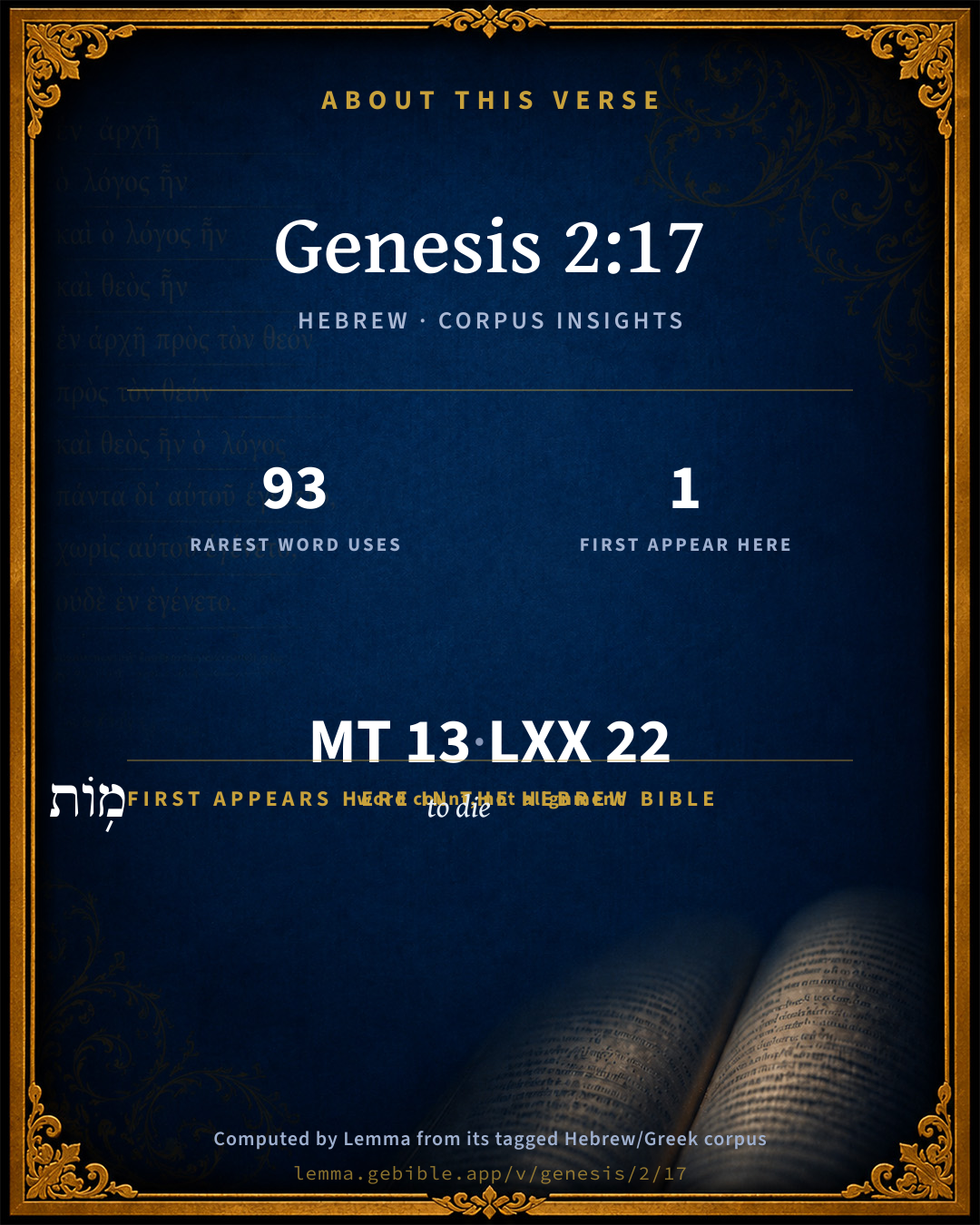
These counts appear in no published source. They are computed here, from the morphology-tagged text and Lemma’s own curated glosses. What Lemma adds →

13
words
10
distinct lemmas
Pentateuch
section

First appearance in Scripture

This word makes its first canonical appearance in the Hebrew Bible here:

  • מ֥וֹת to die H4191

Grammatical profile

  • 4 verbs
  • 3 nouns
  • 2 adjectives
  • 2 prepositions
  • 1 conjunction
  • 1 particle

Verb forms

  • תֹאכַ֖ל Qal · Imperfect
  • אֲכָלְךָ֥ Qal · Infinitive Construct
  • מ֥וֹת Qal · Infinitive Absolute
  • תָּמֽוּת Qal · Imperfect

Repetition

Words recur within this verse — often emphatic in Hebrew:

  • תֹאכַ֖ל to eat H398 ×2
  • מ֥וֹת to die H4191 ×2
  • מִמֶּ֑נּוּ from H4480 ×2

Hebrew & Septuagint length

In English translation the verse runs 30 words from the Hebrew and 28 from the Septuagint (LXX English) — closely comparable.

A rough comparison of the two English renderings, which tokenize alike — not a word-level alignment.

Word counts can differ between the Hebrew and the Greek without any difference in meaning — e.g. the Hebrew direct-object marker אֵת has no separate Greek word, and Greek often adds the article ὁ.

In the original languages it is 13 Hebrew tokens and 22 Greek tokens — but the two are counted differently (Hebrew bundles its prefixes and suffixes into one token; the Greek is in lemma form), so that isn’t a like-for-like length.

Cross-references

42

Topical passages linked to Genesis 2:17 in the Treasury of Scripture Knowledge — connected by theme and wording, ordered by reader-vote popularity; previews shown in the World English Bible.

  • Romans 6:23 For the wages of sin is death, but the free gift of God is eternal life in Christ Jesus our Lord.
  • James 1:15 Then the lust, when it has conceived, bears sin; and the sin, when it is full grown, brings forth death.
  • Genesis 3:19 By the sweat of your face will you eat bread until you return to the ground, for out of it you were taken. For you are dust, and to dust you shall return."
  • 1 Corinthians 15:56 The sting of death is sin, and the power of sin is the law.
  • 1 Corinthians 15:22 For as in Adam all die, so also in Christ all will be made alive.
  • Galatians 3:10 For as many as are of the works of the law are under a curse. For it is written, "Cursed is everyone who doesn't continue in all things that are written in the book of the law, to do them."
  • Revelation 21:8 But for the cowardly, unbelieving, sinners, abominable, murderers, sexually immoral, sorcerers, idolaters, and all liars, their part is in the lake that burns with fire and sulfur, which is the second death."
  • Colossians 2:13 You were dead through your trespasses and the uncircumcision of your flesh. He made you alive together with him, having forgiven us all our trespasses,
  • 1 John 5:16 If anyone sees his brother sinning a sin not leading to death, he shall ask, and God will give him life for those who sin not leading to death. There is a sin leading to death. I don't say that he should make a request concerning this.
  • Genesis 3:17 To Adam he said, "Because you have listened to your wife's voice, and have eaten of the tree, of which I commanded you, saying, 'You shall not eat of it,' cursed is the ground for your sake. In toil you will eat of it all the days of your life.
  • Ezekiel 18:32 For I have no pleasure in the death of him who dies, says the Lord Yahweh: therefore turn yourselves, and live.
  • 1 Timothy 5:6 But she who gives herself to pleasure is dead while she lives.
  • Romans 7:10–13 The commandment, which was for life, this I found to be for death;
  • Genesis 3:11 God said, "Who told you that you were naked? Have you eaten from the tree that I commanded you not to eat from?"
  • Romans 1:32 who, knowing the ordinance of God, that those who practice such things are worthy of death, not only do the same, but also approve of those who practice them.
  • Ephesians 2:1–6 You were made alive when you were dead in transgressions and sins,
  • Romans 5:12–21 Therefore, as sin entered into the world through one man, and death through sin; and so death passed to all men, because all sinned.
  • Romans 6:16 Don't you know that to whom you present yourselves as servants to obedience, his servants you are whom you obey; whether of sin to death, or of obedience to righteousness?
  • Ephesians 5:14 Therefore he says, "Awake, you who sleep, and arise from the dead, and Christ will shine on you."
  • Ezekiel 18:4 Behold, all souls are mine; as the soul of the father, so also the soul of the son is mine: the soul who sins, he shall die.
  • Romans 8:2 For the law of the Spirit of life in Christ Jesus made me free from the law of sin and of death.
  • Ezekiel 3:18–20 When I tell the wicked, You shall surely die; and you give him no warning, nor speak to warn the wicked from his wicked way, to save his life; the same wicked man shall die in his iniquity; but his blood will I require at your hand.
  • Ezekiel 33:8 When I tell the wicked, O wicked man, you shall surely die, and you don't speak to warn the wicked from his way; that wicked man shall die in his iniquity, but his blood will I require at your hand.
  • Revelation 20:14 Death and Hades were thrown into the lake of fire. This is the second death, the lake of fire.
  • Deuteronomy 30:15 Behold, I have set before you this day life and good, and death and evil;
  • Deuteronomy 30:19 I call heaven and earth to witness against you this day, that I have set before you life and death, the blessing and the curse: therefore choose life, that you may live, you and your seed;
  • Genesis 2:9 Out of the ground Yahweh God made every tree to grow that is pleasant to the sight, and good for food; the tree of life also in the midst of the garden, and the tree of the knowledge of good and evil.
  • Genesis 20:7 Now therefore, restore the man's wife. For he is a prophet, and he will pray for you, and you will live. If you don't restore her, know for sure that you will die, you, and all who are yours."
  • Numbers 26:65 For Yahweh had said of them, They shall surely die in the wilderness. There was not left a man of them, save Caleb the son of Jephunneh, and Joshua the son of Nun.
  • Deuteronomy 27:26 Cursed be he who doesn't confirm the words of this law to do them. All the people shall say, Amen.
  • 1 Samuel 14:39 For, as Yahweh lives, who saves Israel, though it be in Jonathan my son, he shall surely die. But there was not a man among all the people who answered him.
  • 1 Kings 2:42 The king sent and called for Shimei, and said to him, Didn't I adjure you by Yahweh, and protest to you, saying, Know for certain, that on the day you go out, and walk abroad any where, you shall surely die? and you said to me, The saying that I have heard is good.
  • Ezekiel 18:13 has given forth on interest, and has taken increase; shall he then live? he shall not live: he has done all these abominations; he shall surely die; his blood shall be on him.
  • Ezekiel 33:14 Again, when I say to the wicked, You shall surely die; if he turn from his sin, and do that which is lawful and right;
  • Revelation 20:6 Blessed and holy is he who has part in the first resurrection. Over these, the second death has no power, but they will be priests of God and of Christ, and will reign with him one thousand years.
  • Genesis 3:1–4 Now the serpent was more subtle than any animal of the field which Yahweh God had made. He said to the woman, "Yes, has God said, 'You shall not eat of any tree of the garden?'"
  • 1 Samuel 14:44 Saul said, God do so and more also; for you shall surely die, Jonathan.
  • 1 Samuel 20:31 For as long as the son of Jesse lives on the earth, you shall not be established, nor your kingdom. Therefore now send and bring him to me, for he shall surely die.
  • 1 Samuel 22:16 The king said, You shall surely die, Ahimelech, you, and all your father's house.
  • Jeremiah 26:8 It happened, when Jeremiah had made an end of speaking all that Yahweh had commanded him to speak to all the people, that the priests and the prophets and all the people laid hold on him, saying, You shall surely die.
  • Revelation 2:11 He who has an ear, let him hear what the Spirit says to the assemblies. He who overcomes won't be harmed by the second death.
  • 1 Kings 2:37 For on the day you go out, and pass over the brook Kidron, know you for certain that you shall surely die: your blood shall be on your own head.

Cross-references courtesy of OpenBible.info (CC BY 4.0).

Hebrew and Greek witnesses Masoretic Hebrew ↔ Greek Septuagint

The same verse in the two great witnesses to the Old Testament, shown verse-for-verse.

These are two independent witnesses, not word-aligned to each other, and the Septuagint is shown in lemma (dictionary) form.

Hebrew Genesis 2:17 Masoretic · Westminster Leningrad Codex

וּמֵעֵ֗ץ הַדַּ֨עַת֙ ט֣וֹב וָרָ֔ע לֹ֥א תֹאכַ֖ל מִמֶּ֑נּוּ כִּ֗י בְּי֛וֹם אֲכָלְךָ֥ מִמֶּ֖נּוּ מ֥וֹת תָּמֽוּת

but of the tree of the knowledge of good and evil, you shall not eat of it: for in the day that you eat of it you will surely die."

World English Bible · Public Domain

Greek LXX Genesis 2:17 Septuagint · lemma form

ἀπό δέ ὁ ξύλον ὁ γιγνώσκω καλός καί πονηρός οὐ ἐσθίω ἀπό αὐτός ὅς δέ ἄν ἡμέρα ἐσθίω ἀπό αὐτός θάνατος ἀποθνήσκω

but of the tree of the knowledge of good and evil—of it you⌃ shall not eat, but in whatever day you⌃ eat of it, you⌃ shall surely die.

LXX2012 (modern English Septuagint) · Public Domain

Hebrew: Westminster Leningrad Codex (CC BY 4.0). Greek: Septuagint (public domain); English from LXX2012 (modern English Septuagint) (Public Domain). How the Septuagint differs from the Hebrew →

Targum (Aramaic paraphrase)

2

The Targum is the ancient Jewish Aramaic paraphrase of the Hebrew Scriptures — an interpretive translation, not the Hebrew text itself. Onkelos (literal) and Pseudo-Jonathan (expansive) render the Torah, and Jonathan the Prophets. Coverage is partial: where no permissively-licensed English translation exists for a verse, only the Aramaic is shown. This is verse-level text, not a word-by-word alignment to the Hebrew.

  1. Targum Onkelos Torah (Genesis–Deuteronomy)
    וּמֵאִילָן דְּאָכְלִין פֵּירוֹהִי חַכִּימִין בֵּין טַב לְבִישׁ לָא תֵיכוּל מִנֵּהּ אֲרֵי בְּיוֹמָא דְתֵיכוּל מִנֵּהּ מֵימַת תְּמוּת

    (no public-domain English translation for this verse)

    Targum Onkelos — Aramaic: “Onkelos Genesis” (public domain); “Onkelos Exodus” (public domain); “Onkelos Leviticus” (public domain); “Onkelos Numbers” (public domain); “Onkelos Deuteronomy” (public domain). English: “Sefaria Community Translation” (CC0 1.0 (public-domain dedication)); “J.W. Etheridge. The Targums of Onkelos and Jonathan Ben Uzziel on the Pentateuch. London: Longmans, Green, 1862” (public domain). Text via Sefaria.

  2. Targum Pseudo-Jonathan Torah (Genesis–Deuteronomy)
    וּמֵאִילַן דְאָכְלִין פֵּירוֹהִי חַכְּמִין לְמִידַע בֵּין טַב לְבִישׁ לָא תֵיכוּל מִנֵיהּ אֲרֵי בְּיוֹמָא דְתֵיכוּל מִנֵיהּ תְּהֵי חַיָיב קְטוֹל

    But of the tree of whose fruit they who eat (become) wise to know between good and evil, thou shalt not eat: for in the day that thou eatest thou wilt be guilty of death.

    Targum Pseudo-Jonathan — Aramaic: “Targum Jonathan on Genesis” (public domain); “Targum Jonathan on Exodus” (public domain); “Targum Jonathan on Leviticus” (public domain); “Targum Jonathan on Numbers” (public domain); “Targum Jonathan on Deuteronomy” (public domain). English: “The Targum of Jonathan ben Uzziel, trans. J. W. Etheridge, London, 1862” (public domain). Text via Sefaria.

Commentary

Notes on Genesis 2:17 from classic Christian and Jewish commentators (each source and its license shown beneath its notes). The classic Christian expositions comment on the surrounding passage and are grouped to its opening verse, so a note may address several verses; the Jewish commentaries on the Tanakh (Rashi and others) are per-verse, so they appear only where the commentator wrote on this verse.

Lemma curates 59 commentaries, every one of them public domain or Creative Commons licensed, each selected and text-cleaned for this edition rather than reprinted as found. About our sources →

Trapp's Complete Commentary

John Trapp

Gen 2:17 But of the tree of the knowledge of good and evil, thou shalt not eat of it: for in the day that thou eatest thereof thou shalt surely die.

Ver. 17. But of the tree, &c.] An exploratory prohibition. God knew well where we are weakest, and worst able to withstand; viz., about moderating the pleasures of our touch and taste, because these befall us not as men, but as living creatures. {a} Here, therefore, he lays a law upon Adam for the trial of his love, which, left to his own free will, he soon transgressed.

Thou shalt surely die.] Thou shalt surely and shortly, saith Zuinglius; or suddenly, die. {Certissime citissimeque morieris} And without doubt every man should die the same day he is born: the wages of death should be paid him presently. But Christ begs their lives for a season. For which cause he is said to be "the Saviour of all men," {1Ti 4:10} not of eternal preservation, but of temporal reservation. In which respect, also, God is said "so to have loved the world, that he gave his only begotten Son," &c. {Joh 3:16} It was a mercy to all mankind that the Messiah was promised and provided, "sealed and sent into the world," that some might be saved, and the rest sustained in life, for their sakes. Symmachus renders it, Thou shalt be mortal.

{a} Arist. Ethic., l. i., c. 3.

John Trapp, A Commentary or Exposition upon All the Books of the Old and New Testament (1647–1656) — public domain. Text from a community e-Sword module.

Joseph Benson's Commentary

Gen 2:17. Of the tree of knowledge thou shalt not eat — Hitherto God has been manifested as man’s powerful Creator and bountiful Benefactor: now he appears as his Ruler and Lawgiver, and, as such, enters into covenant with him. He gives him but one positive precept, to try his obedience, which, as his Sovereign Lord, he had a right to do, annexing death to the breach, and, of consequence, life and immortality to the observance of it. It is evident, however, that this was not all God required of man, but that a law was written on his heart, requiring him to love God to the utmost extent of his capacity, and to imitate him in all holiness and righteousness. Thou shalt surely die — The death here threatened is evidently to be considered as opposed to the life (or lives rather, Gen 2:7) which God had bestowed on him. This was not only the natural life of his body, in its union with his soul, but the spiritual life of his soul, in its union with God, and the eternal life of both. The threatening then implies: Thou shalt not only lose all the happiness thou hast, either in possession or prospect, and become liable to the death of thy body, and all the miseries which precede and accompany it; but thou shalt lose thy spiritual life, and become dead to God and things divine, and shalt even forfeit thy title to immortality, and be liable to death eternal. And all this in the day thou eatest thereof.

Joseph Benson's Commentary on the Old and New Testaments (1811–1818) — public domain. Text from a community e-Sword module.

Whedon's Commentary on the Bible

Daniel D. Whedon

17. Of the tree of the knowledge of good and evil — It is idle to speculate on the physical nature of this mysterious tree; and the supposition that its fruit contained a natural poison, which must sooner or later have resulted in the death of the eater, is without warrant in the Scripture. Nordo we see sound reason in classing this account of the tree of knowledge with the myths and traditions of prophetic trees, or in seeking to identify it (or the tree of life) with the sacred plant or branch which appears so noticeably on Chaldean, Assyrian, and Persian monuments. All that clearly appears in this narrative is, that the fruit of a particular tree (or, perhaps, class of trees) was designated as not to be eaten, and the name seems to have been given in anticipation of what would result from eating the forbidden fruit. Its name, therefore, indicated the moral purpose which it served rather than any natural or physical character of the tree itself. The design of the prohibition of this particular fruit was to test man’s moral nature, to develop his love for his Maker by deliberate choice of the good and deliberate rejection of the evil. Thus would he come to distinguish clearly between good and evil by acquiring a godlike permanence in the good, and like steadfast opposition to all evil.

By disobedience he came to know good and evil in the Satanic way, becoming experimentally identified with the evil, and thus opposed to God.

The disposition which some have shown to ridicule the literal interpretation of this narrative, and to assume that it was unworthy of God and incompatible with the dignity of man’s original state to make his and his posterity’s happiness depend upon the non-eating of a certain tree, springs from notions of God and of man which are unscriptural. The simplicity, clearness, and positive character of the prohibition are conspicuous marks of its fitness as a moral test. The newly created Adam, with great possibilities, was yet undeveloped and undisciplined. His mental and religious nature, like that of a child, would be best trained by a positive commandment, which rested in the authority of the Creator rather than in the reason of the creature whose love and loyalty were to be tested. Moreover, as food was a natural want of man, the most convenient and suitable form of the first law given for his moral guidance was one in which a broad permission and a single prohibition related to the matter of eating.

In the day that thou eatest thereof thou shalt surely die — Solemn and startling words to be uttered in the bowers of paradise! What all this terrible penalty involved was doubtless a mystery to the man, and no subsequent revelation has fully cleared the awful mystery. The comments of Muller (Christian Doctrine of Sin, vol. ii, page 291, Edinburgh, 1868) furnish an excellent statement of the doctrine of the ancient Scripture: “If we compare the penalty of death threatened Gen_2:17, with the fulfilment of the sentence after the first transgression, (Gen_3:16-22,) two things are manifest. On the one hand we find that the death which was to follow the commission of sin included not only physical death, but the various ills that flesh is heir to — the manifold pains and miseries of our earthly lot; and these are represented as resulting from sin, which ends in death. Thus the well known difficulty involved in the word ביום, in the day, is at once obviated. In the very day of disobedience a life begins which is at the same time a death. It thus appears, too, that when the serpent in his subtlety said to Eve, ‘Ye shall not surely die,’ this was not a bare lie, but a half truth, and therefore a double deception. But, on the other hand, we find by comparing the two passages that physical death is the real kernel and gist of the punishment. For the sentence pronounced concludes with the prophecy of death, making this the most important element, by emphatic repetition; (Gen_3:19;) and the account of the execution of the sentence lays stress chiefly upon the fact of man’s exclusion from the means of imperishable life.” See Gen_3:22; Gen_3:24.

Daniel D. Whedon (gen. ed.), Commentary on the Old and New Testaments (1874–1909) — public domain. Text from a community e-Sword module.

Tyndale Open Study Notes

Tyndale Open Resources

2:17 except (literally but you must not eat): This prohibition is given in the same legal format as Israel’s Ten Commandments (see Exod 20:1-17; Deut 5:6-21). The Lord built law and obedience into the fabric of his covenant relationship with humanity. • the knowledge of good and evil: See study note on 2:9. • you are sure to die: The consequences of disobedience would be immediate spiritual death (loss of relationship with God) and eventual physical death (see 3:22-23; Eccl 12:6-7).

Tyndale Open Study Notes — © Tyndale Open Resources, licensed CC BY-SA 4.0. Text via the HelloAO Bible API.

Geneva Bible (1599)

Geneva Bible translators

By this death he meaneth the separation of man from God, who is our life and chief felicity: and also that our disobedience is the cause thereof.

Or, whensoever.

Geneva Bible (1599) marginal notes — public domain. Text via Bolls.life.

Jamieson, Fausset & Brown

Robert Jamieson, A. R. Fausset & David Brown

thou shalt not eat of it . . . thou shalt surely die--no reason assigned for the prohibition, but death was to be the punishment of disobedience. A positive command like this was not only the simplest and easiest, but the only trial to which their fidelity could be exposed.

Jamieson, Fausset & Brown — Commentary Critical and Explanatory on the Whole Bible (1871) — public domain (CC PDM 1.0). Text via the HelloAO Bible API.

Adam Clarke's Commentary

Verse 17. Of the tree of the knowledge - thou shalt not eat] This is the first positive precept God gave to man; and it was given as a test of obedience, and a proof of his being in a dependent, probationary state. It was necessary that, while constituted lord of this lower world, he should know that he was only God's vicegerent, and must be accountable to him for the use of his mental and corporeal powers, and for the use he made of the different creatures put under his care. The man from whose mind the strong impression of this dependence and responsibility is erased, necessarily loses sight of his origin and end, and is capable of any species of wickedness. As God is sovereign, he has a right to give to his creatures what commands he thinks proper. An intelligent creature, without a law to regulate his conduct, is an absurdity; this would destroy at once the idea of his dependency and accountableness. Man must ever feel God as his sovereign, and act under his authority, which he cannot do unless he have a rule of conduct. This rule God gives: and it is no matter of what kind it is, as long as obedience to it is not beyond the powers of the creature who is to obey. God says: There is a certain fruit-bearing tree; thou shalt not eat of its fruit; but of all the other fruits, and they are all that are necessary, for thee, thou mayest freely, liberally eat. Had he not an absolute right to say so? And was not man bound to obey?

Thou shalt surely die.] מות תמות moth tamuth; Literally, a death thou shalt die; or, dying thou shalt die. Thou shalt not only die spiritually, by losing the life of God, but from that moment thou shalt become mortal, and shalt continue in a dying state till thou die. This we find literally accomplished; every moment of man's life may be considered as an act of dying, till soul and body are separated. Other meanings have been given of this passage, but they are in general either fanciful or incorrect.

Adam Clarke's Commentary on the Bible (1810–1826) — public domain. Text from a community e-Sword/MySword module.

The Cambridge Bible for Schools and Colleges

gen. ed. J. J. S. Perowne

17. of the tree of the knowledge of good and evil] See above, on Gen_2:9. Here only one tree is mentioned, as in Gen_3:3; and it seems not unlikely that the mention of “the tree of life” did not belong to the main original version of the story, but was derived from a separate source.

thou shalt not eat of it] In this prohibition man is apprised of another element in the discipline to which he is subjected in the garden of the Lord God. In Gen_2:15 it is his physical and intellectual powers which are to be exercised: in this verse he receives warning of a moral discipline. His moral being is to be tested by a simple injunction for which no reason is assigned. No hardship is imposed: but a limitation to self-gratification is required. He who makes the requisition has given freely the enjoyment of everything beside. Man’s character is to be tested in the simplest manner. Will he shew obedience to the Divine will and trust in the Divine goodness?

in the day that … die] Literally, in the day that Adam ate of the fruit, he did not die. This is one of the minor inconsistencies in the story which are not explained for us. Either we are to assume that, in some fuller version of it, the Lord God was described as “repenting” of the sentence of immediate death, as changing His mind and sparing man in His mercy: or the words “in the day, &c.” are to be regarded as metaphorical, and the doom, “thou shalt surely die,” merely means “thou shalt become mortal.”

We must not infer from this verse that the Lord God was considered, to have made man other than mortal. It is clear from Gen_3:22, that man was created a mortal being. Perhaps, in one version of the story, he was intended to eat of the tree of life “and live for ever.”

The Cambridge Bible for Schools and Colleges (gen. ed. J. J. S. Perowne; Cambridge University Press, 1878–1918) — public domain. Text from a community e-Sword module.

John Gill's Exposition

But of the tree of knowledge of good and evil,.... Of the name of this tree, and the reasons of it; see Gill on Gen 2:9.

thou shalt not eat of it; not that this tree had any efficacy in it to increase knowledge, and improve in science and understanding, as Satan suggested God knew; and therefore forbid the eating of it out of envy to man, which the divine Being is capable of; or that there was anything hurtful in it to the bodies of men, if they had eaten of it; or that it was unlawful and evil of itself, if it had not been expressly prohibited: but it was, previous to this injunction, a quite indifferent thing whether man ate of it or not; and therefore was pitched upon as a trial of man's obedience to God, under whose government he was, and whom it was fit he should obey in all things; and since he had a grant of all the trees of the garden but this, it was the greater aggravation of his offence that he should not abstain from it:

for in the day thou eatest thereof thou shalt surely die; or "in dying, die" (z); which denotes the certainty of it, as our version expresses it; and may have regard to more deaths than one; not only a corporeal one, which in some sense immediately took place, man became at once a mortal creature, who otherwise continuing in a state of innocence, and by eating of the tree of life, he was allowed to do, would have lived an immortal life; of the eating of which tree, by sinning he was debarred, his natural life not now to be continued long, at least not for ever; he was immediately arraigned, tried, and condemned to death, was found guilty of it, and became obnoxious to it, and death at once began to work in him; sin sowed the seeds of it in his body, and a train of miseries, afflictions, and diseases, began to appear, which at length issued in death. Moreover, a spiritual or moral death immediately ensued; he lost his original righteousness, in which he was created; the image of God in him was deformed; the powers and faculties of his soul were corrupted, and he became dead in sins and trespasses; the consequence of which, had it not been for the interposition of a surety and Saviour, who engaged to make satisfaction to law and justice, must have been eternal death, or an everlasting separation from God, to him and all his posterity; for the wages of sin is death, even death eternal, Rom 6:23. So the Jews (a) interpret this of death, both in this world and in the world to come.

(z) Pagninus, Montanus, &c. (a) Tikkune Zohar, correct. 24. fol. 68. 1. correct. 54. fol. 90. 2. correct. 66. fol. 100. 1.

John Gill's Exposition of the Whole Bible (1746–1763) — public domain (CC PDM 1.0). Text via the HelloAO Bible API.

Haydock's Catholic Bible Commentary

The death of the soul, and become obnoxious to that of the body; thou shalt become a mortal and lose all the privileges of innocence. Though Adam lived 930 years after this, he was dying daily; he carried along with him the seeds of death, as we do, from our very conception. He had leave to eat of any fruit in this delicious garden, one only excepted, and this one prohibition makes him more eager to taste of that tree than of all the rest. So we struggle constantly to attain what is forbidden, and covet what is denied, cupimusque negata. God laid this easy command upon Adam, to give him an opportunity of shewing his ready obedience, and to assert his own absolute dominion over him. Eve was already formed, and was apprised of this positive command, (chap. iii. 3.) and therefore, transgressing, is justly punished with her husband. True obedience does not inquire why a thing is commanded, but submits without demur. Would a parent be satisfied with his child, if he should refuse to obey, because he could not discern the propriety of the restraint? If he should forbid him to touch some delicious fruits which he had reserved for strangers, and the child were to eat them, excusing himself very impertinently and blasphemously, with those much abused words of our Saviour, It is not what enters into the mouth that defiles a man, &c. would not even a Protestant parent be enraged and seize the rod, though he could not but see that he was thus condemning his own conduct, in disregarding, on the very same plea, the fasts and days of abstinence, prescribed by the Church and by God’s authority? All meats are good, as that fruit most certainly was which Adam was forbidden to eat; though some have foolishly surmised that it was poisonous; but, the crime of disobedience draws on punishment. (Haydock) --- Even when the sin is remitted, as it was to Adam, the penalty is not of course released, as some have pretended. This also clearly appears in baptized infants, who suffer the penalties due to original sin, as much as those who have not been admitted to the laver of regeneration. (St. Augustine; Worthington; Tirinus, &c.) --- If on this occasion, Eve had alone transgressed, as she was not the head, her sin would have hurt only herself. But with Adam, the representative of all his posterity, God made a sort of compact, (Osee vi. 7.) giving him to understand, that if he continued faithful, his children should be born in the state of innocence like himself, happy and immortal, to be translated in due time to a happier Paradise, &c. but if he should refuse to obey, his sin should be communicated to all his race, who should be, by nature, children of wrath. --- (St. Augustine, City of God xvi. 27; Ven. Bede in Luc. 11; &c.) --- (Haydock) (Calmet)

George Leo Haydock (1774–1849), Haydock's Catholic Family Bible and Commentary, 1859 edition — public domain. Excludes Psalms (Douay-Rheims chapter numbering differs from Protestant) and Deuterocanonical books (Catholic canon only).

Matthew Poole's English Annotations

With a threefold death.

1. Spiritual, by the guilt and power of sin: at that instant thou shalt be dead in trespasses and sins, Eph 2:1.

2. Temporal, or the death of the body, which shall then begin in thee, by decays, infirmities, terrors, dangers, and other harbingers of death.

3. Eternal, which shall immediately succeed the other.

Matthew Poole's English Annotations on the Holy Bible (1683–1685) — public domain. Text from a community e-Sword/MySword module.

Ramban (Nachmanides)

Rabbi Moshe ben Nachman (Ramban / Nachmanides)

THOU SHALT NOT EAT OF IT. He admonishes him against eating the fruit, for the tree itself is not edible. And so it says further on: But of the fruit of the tree which is in the midst of the garden. Similarly, And eat ye every one of his vine, and every one of his fig tree [means “of the fruit of his vine and of the fruit of his fig-tree].” Likewise, In toil shalt thou eat it means “eat its fruit.”

IN THE DAY THOU EATEST THEREOF THOU SHALT SURELY DIE. At the time you eat of it, you will be condemned to die. Similarly, we find: On the day thou goest out, and walkest abroad any whither, thou shalt surely die.. This does not mean that he [Shimi] is to die immediately on that day; nor does it refer to his mere knowledge thereof, namely that he is to know that he will die eventually for all the living know that they shall die. But it does mean that at the time he [Shimi] goes forth from Jerusalem, he is liable to death at the hand of the king, and he will slay him when he pleases. [Similarly, in the verses:] But they shall not go in to see the holy things as they are being covered, lest they die; And they shall not bear sin for it, and die thereby. Their intent is [not that those who transgress against these prohibitions will die immediately], but only that they will be liable to death and will die on account of this sin of theirs.Now in the opinion of men versed in the sciences of nature, man was destined to die from the beginning of his formation, on account of his being a composite [of the four elements, and everything that is composite must revert to its original components]. But now He decreed that if he will sin he will die on account of his sin, like those who are liable to death at the hands of Heaven for such sins as a non-priest eating the Heave-offering, or a priest who has drunk wine or who does not wear the [required number of priestly] garments when performing the Service in the Sanctuary, and other cases. There the intent is that they will die prematurely on account of their sin. This is why in stating the punishment [after Adam ate of the fruit of the tree of knowledge] He said, Till thou return to the ground; for out of it wast thou taken; for dust thou art, and unto dust shalt thou return, by your nature. In the beginning before he sinned, Adam also ate of the fruit of the tree and of the seeds of the earth; and if so, there was bound to be depletion in his body, and he was subject to the cause of existence and destruction. [Thus the opinion of the men of science.]But in the opinion of our Rabbis, if Adam had not sinned he would have never died, since the higher soul bestows life forever, and the Will of G-d which is in him at the time of his formation would always cleave to him and he would exist forever, as I have explained in the verse, And G-d saw that it was good. Know that composition indicates destruction only in the opinion of those wanting in faith, who hold that creation came by necessity. But in the opinion of men of faith who say that the world was created by the simple Will of G-d, its existence will also continue forever as long as it is His desire. This is clear truth. That being so, In the day thou eatest thereof thou shalt surely die means that then you will be condemned to die since you will no longer exist forever by My Will. And the matter of eating [from the other trees] was to Adam at first only a source of enjoyment. And it is possible that the fruits of the garden of Eden were absorbed in his limbs as the Manna, and they sustain those that eat them. But when He decreed upon him, And thou shalt eat the herb of the field and with the sweat of his face he shall eat bread of the earth, Verse 19. this [the food] became a cause for decomposition since he is dust, and dust he eats, and unto dust he shall return.

Ramban (Nachmanides) on the Tanakh — English translation: “Commentary on the Torah by Ramban (Nachmanides). Translated and annotated by Charles B. Chavel. New York, Shilo Pub. House, 1971-1976” (CC BY 4.0). Text via Sefaria.

Radak

Rabbi David Kimhi (Radak)

ומעץ הדעת טוב ורע, one of the operative, though apparently superfluous, words in this verse is the word ממנו, “from it.” Seeing that the verse had already commenced with the words ומעץ, “and from the tree,” this word appears redundant. It may therefore have been inserted in order to emphasise the severity of the effects of ignoring this warning. Alternately, the word refers to the fruit, seeing the fruit of the tree had not been mentioned at all previously. Interestingly, G’d had not forbidden Adam to eat from the fruit of the tree of life, but, on the contrary, the fruit of this tree was included in the instruction to eat “from all the trees of the garden you shall surely eat.” This subject is dealt with at greater length in the kabbalistic writings of our sages.

מות תמות, mortality will be decreed for you as something occurring far sooner than would have been the case otherwise. Our sages (Bereshit Rabbah 19,8) explain that the word ביום does not refer to a day of our lives, i.e. a period of 24 hours, but refers to a “day” in G’d’s calendar, i.e. 1000 years in terms of our lives. Man was henceforth not to reach the age of 1000 years. Adam, who had been slated to live for 1000 years, actually lived only 930 years, having bequeathed the other 70 years to his descendants. They base this on Psalms 90,10 ימי שנותנו בהם שבעים שנה, “the number of years of our lives is 70.” [according to Rabbi David Luriah the words לבניו in this Midrash refer specifically to David. Ed.] According to the above we must conclude that the sages of the Midrash consider death per se as a curse, based on Deuteronomy 30,15 כי הרע הוא המות והטוב הוא החיים, “for life is good and death is evil.” As to “knowledge of good and evil,” there are a number of explanations of these words. (Ibn Ezra) It may refer to the intimacy experienced between man and his wife when engaging in marital intercourse. The fruit of that tree created the mating instinct in man. The word טוב refers to copulation that is permitted and the word רע would refer to copulation which is forbidden. Adam was full of knowledge, and it is preposterous to assume that he had no concept of what is good and what is evil before he ate from that tree. However, he had lacked the biological urge to engage in marital intercourse. This is proved by the fact that after both he and his wife had eaten from the tree of knowledge they are quoted as saying that “their eyes were opened and they realised that they were naked,” in the sense that they lacked something which they had not been aware of needing. (Genesis 3,7). The meaning of the words והייתם כאלוקים, (3,5) is “you will be like the angels.” The common denominator between Adam and the angels at that stage was that both the angels and man had no inkling of the mating instinct. It is true that merely by observing the animals’ behaviour they realised that the males and females engaged in such activities, however they had no understanding of how such a process of creating progeny applied to themselves. Alternatively, we may understand the serpent as not having the slightest idea of what the concepts טוב ורע, “good and evil” represented. Even though Chavah is not quoted in the text of having used these words, it is quite impossible to assume that the entire dialogue between the serpent and Chavah has been recorded here. Unless there had been some discussion between them before the words recorded in the text, whence did the serpent know that G’d had forbidden the fruit of the trees, as it had claimed to know? She must have learned such details from the words of the woman. Furthermore, the very opening remark of the serpent, אף, suggests that this is a continuation of the preceding parts of the dialogue which the Torah did not consider worth reporting. Nowhere else is the word אף used as the opening remark in a dialogue. (Ibn Ezra)

Radak on the Tanakh — English translations: “Sefaria Community Translation” (CC0 1.0 (public-domain dedication)); “Eliyahu Munk, HaChut Hameshulash” (CC BY 4.0); “Rabbi Mike Feuer, Jerusalem Anthology” (CC BY 4.0); and “R. David Kimhi on the first book of Psalms, Translated by R.G. Finch, London, 1919” (public domain). Text via Sefaria.

Ibn Ezra

Rabbi Abraham ibn Ezra

Ad-noy Elokim commanded. Hashem would not have commanded Adam to begin with if he possessed no intelligence. Moreover, he obviously possessed the intellect to give names to the other creatures. It was only knowledge of good and evil that he lacked.

Ibn Ezra on the Tanakh — English translations: “Sefaria Community Translation” (CC0 1.0 (public-domain dedication)); “Yalkut, Sifsei Chachomim Chumash, Metsudah Publications, 2009” (CC BY 4.0); and “Commentary of Ibn Ezra on Isaiah - trans. by M. Friedlander, 1873” (public domain). Text via Sefaria.

Lesson kit

Teaching starters — assembled from the data on this page, not authored interpretation. Every prompt links to the verse data it draws on. Edit before teaching.

Genesis, in the Pentateuch, opens this verse with 13 words (10 distinct Hebrew lemmas). Its most distinctive word is daʻath (“knowledge”). A historical commentator’s framing appears above. Read the whole chapter for the surrounding context.

Discussion questions

  1. The word daʻath carries the sense “knowledge.” How does it shape the verse?
  2. The word “to die” first appears here in Scripture. What is being introduced at this debut?
  3. Romans 6:23 shares this passage’s theme. How do the two illuminate each other?
  4. “to eat” occurs 2× in this one verse. What is the effect of the repetition?
  5. These translations render this verse differently. What is at stake in choosing one wording over another?
  6. The verb «תֹאכַ֖ל» is Qal Imperfect. How does its form color the action?
  7. Reading how Trapp's Complete Commentary and Joseph Benson's Commentary read this verse, where do the two commentators agree and where do they part?

Things to notice

Reading settings

Reading text

Shown beneath each verse's original-language words.

Old Testament
Old Testament edition

Read the OT as the Masoretic Hebrew (MT) or the Greek Septuagint (LXX).

English shown for the Greek Septuagint (in the Hebrew ↔ Greek comparison).

Comparing translations? Open the Compare panel on any verse page to stack up to four side by side.