
Genesis 46:30

Hebrew (Westminster Leningrad Codex) Genesis 46:30 appears in the Hebrew Old Testament. The text above is from the Westminster Leningrad Codex. Each word links to its Strong’s number, a concise gloss, and parsing drawn from the Open Scriptures Hebrew Bible morphology. Click any word for its full Brown-Driver-Briggs (BDB) entry.
Download image
Cite this verse

Genesis 46:30 (World English Bible). Public Domain. Lemma interlinear Bible study tool, https://lemma.gebible.app/v/genesis/46/30.

Show BibTeX & RIS
BibTeX
RIS
English Translation
Israel said to Joseph, "Now let me die, since I have seen your face, that you are still alive."
World English Bible · Public Domain
Download a study sheet

One document with this verse’s original text, its word-by-word gloss line, the meaning frame, cross-references with their text, attributed commentary, and full source and license credits — printable, and it pastes into notes with its structure intact.

This verse Autodidact and up

Study sheet (.html) Plain text (.txt)

A passage Seminary Student

Up to 50 verses in one chapter. A passage sheet keeps up to 6 commentary sources and 12 cross-references per verse, in the order this page ranks them, and says so on the sheet whenever that leaves anything out. Ask for a single verse and you get the Autodidact verse sheet above.

Everything on this page stays free to read, with no account — the sheet is a download of what is already on screen, not access to it.

Want to remove ads? Support Godless Engineer
Compare translations 3

The same verse in 3 English versions, stacked beneath the original-language interlinear above. Click any original word for its lexicon entry.

Each is an independent rendering of the whole verse — the interlinear is not word-aligned to these translations.

Highlighted words mark where these versions differ — a whole-verse word diff, not a word-by-word alignment.

  • World English Bible Public Domain
    Israel said to Joseph, "Now let me die, since I have seen your face, that you are still alive."
  • King James Version Public Domain
    And Israel said unto Joseph, Now let me die, since I have seen thy face, because thou art yet alive.
  • unfoldingWord Literal Text CC BY-SA 4.0
    Then Israel said to Joseph, “Now I can die, since I have seen your face, that you still alive!”

unfoldingWord Literal Text — © unfoldingWord, licensed CC BY-SA 4.0. Word-aligned USFM3 via Door43 (git.door43.org/unfoldingWord/en_ult).

Versions to compare (up to 4)

3 of 4 selected

Show all 18 translations

Every available English version of this verse, each an independent rendering of the whole verse.

  • World English Bible Public Domain
    Israel said to Joseph, "Now let me die, since I have seen your face, that you are still alive."
  • Berean Standard Bible Public Domain
    Then Israel said to Joseph, “Finally I can die, now that I have seen your face and know that you are still alive!”
  • Majority Standard Bible Public Domain
    Then Israel said to Joseph, “Finally I can die, now that I have seen your face and know that you are still alive!”
  • King James Version Public Domain
    And Israel said unto Joseph, Now let me die, since I have seen thy face, because thou art yet alive.
  • American Standard Version (1901) Public Domain
    And Israel said unto Joseph, Now let me die, since I have seen thy face, that thou art yet alive.
  • Revised Version (1885) Public Domain
    And Israel said unto Joseph, Now let me die, since I have seen thy face, that thou art yet alive.
  • Geneva Bible (1599) Public Domain
    And Israel sayde vnto Ioseph, Now let me die, since I haue seene thy face, and that thou art yet aliue.
  • Douay-Rheims (1899) Public Domain
    And the father said to Joseph: Now shall I die with joy, because I have seen thy face, and leave thee alive.
  • Young's Literal Translation Public Domain
    and Israel saith unto Joseph, `Let me die this time, after my seeing thy face, for thou `art' yet alive.'
  • Literal Standard Version CC BY-SA 4.0
    and Israel says to Joseph, “Let me die this time, after my seeing your face, for you [are] yet alive.”
  • Unlocked Literal Bible CC BY-SA 4.0
    Israel said to Joseph, “Now let me die, since I have seen your face, that you are still alive.”
  • unfoldingWord Literal Text CC BY-SA 4.0
    Then Israel said to Joseph, “Now I can die, since I have seen your face, that you still alive!”
  • Darby Bible Public Domain
    And Israel said to Joseph, Now let me die, after I have seen thy face, since thou still livest.
  • World Messianic Bible Public Domain
    Israel said to Joseph, “Now let me die, since I have seen your face, that you are still alive.”
  • Webster's Bible Public Domain
    And Israel said to Joseph, Now let me die, since I have seen thy face, because thou art yet alive.
  • Free Bible Version CC BY-SA 4.0
    “Now I can die in peace because I have seen your face again and know you're still alive,” Israel told Joseph.
  • Bible in Basic English Public Domain
    And Israel said to Joseph, Now that I have seen you living again, I am ready for death.
  • JPS Tanakh (1917) Public Domain
    And Israel said unto Joseph: 'Now let me die, since I have seen thy face, that thou art yet alive.'

Literal Standard Version (2020), Covenant Press — licensed CC BY-SA 4.0. Text via the HelloAO Bible API (eBible.org). Unlocked Literal Bible (unfoldingWord) — licensed CC BY-SA 4.0. Text via the HelloAO Bible API (eBible.org). unfoldingWord Literal Text — © unfoldingWord, licensed CC BY-SA 4.0. Word-aligned USFM3 via Door43 (git.door43.org/unfoldingWord/en_ult). Free Bible Version, Dr. Jonathan Gallagher — licensed CC BY-SA 4.0. Text via the HelloAO Bible API (eBible.org).

Word by word

More ways to search: Search by grammar → Find every occurrence → Compare this word →

Practice this passage: Drill this verse → Learn its vocabulary →

הַפָּ֑עַם
paʻam
H6471
“the · time”
Particle, Definite Article + Noun, Common, Feminine, Singular, Absolute
Part of Speech
Particle + Noun
Type
Common
Gender
Feminine
Number
Singular
State
Absolute
Full BDB Definition

Origin: from H6470

TWOT: 1793a

stroke, beat, foot, step, anvil, occurrence - foot, hoof-beat, footfall, footstep - anvil - occurrence, time, stroke, beat - one time, once, twice, thrice, as time on time, at this repetition, this once, now at length, now...now, at one time...at another
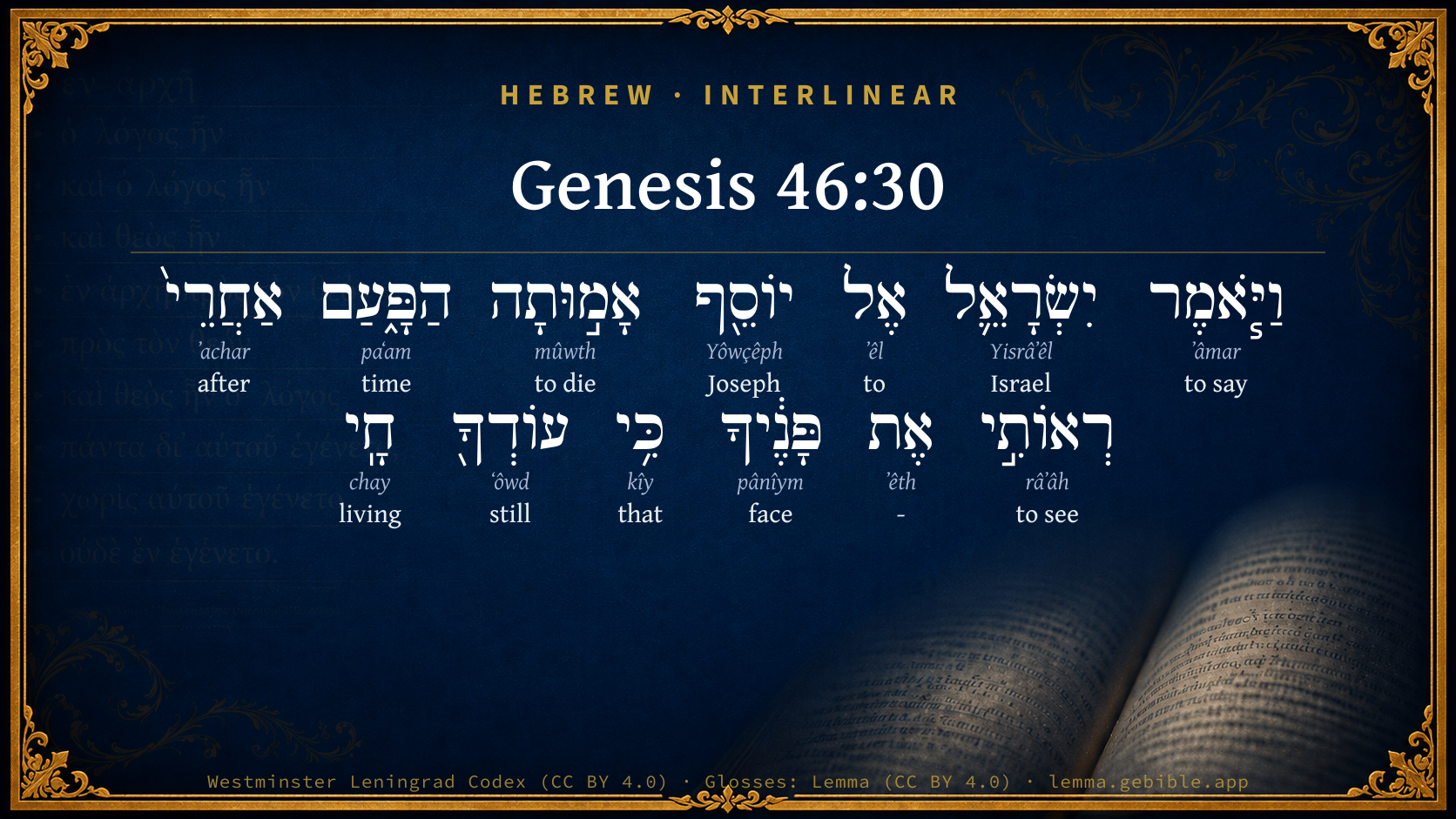
  1. וַיֹּ֧אמֶר ʼâmar H559 “and · to say” Conjunction + Verb, Qal, Sequential Imperfect, 3rd Person, Masculine, Singular
  2. יִשְׂרָאֵ֛ל Yisrâʼêl H3478 “Israel” Noun, Proper
  3. אֶל ʼêl H413 “to” Preposition
  4. יוֹסֵ֖ף Yôwçêph H3130 “Joseph” Noun, Proper
  5. אָמ֣וּתָה mûwth H4191 “to die” Verb, Qal, Cohortative, 1st Person, Common, Singular
  6. אַחֲרֵי֙ ʼachar H310 “after” Preposition
  7. רְאוֹתִ֣י râʼâh H7200 “to see · me” Verb, Qal, Infinitive Construct + Suffix, Personal, 1st Person, Common, Singular
  8. אֶת ʼêth H853 “-” Particle, Direct Object
  9. פָּנֶ֔יךָ pânîym H6440 “face(s) · your” Noun, Common, Both, Plural, Construct + Suffix, Personal, 2nd Person, Masculine, Singular
  10. כִּ֥י kîy H3588 “that” Conjunction
  11. עוֹדְךָ֖ ʻôwd H5750 “still · your” Adverb + Suffix, Personal, 2nd Person, Masculine, Singular
  12. חָֽי chay H2416 “living” Adjective, Adjective, Masculine, Singular, Absolute

About this verse

These counts appear in no published source. They are computed here, from the morphology-tagged text and Lemma’s own curated glosses. What Lemma adds →

13
words
13
distinct lemmas
Pentateuch
section

Grammatical profile

  • 3 verbs
  • 4 nouns
  • 1 adjective
  • 2 prepositions
  • 1 conjunction
  • 1 adverb
  • 1 particle

Verb forms

  • וַיֹּ֧אמֶר Qal · Sequential Imperfect
  • אָמ֣וּתָה Qal · Cohortative
  • רְאוֹתִ֣י Qal · Infinitive Construct

Hebrew & Septuagint length

In English translation the verse runs 19 words from the Hebrew and 22 from the Septuagint (LXX English) — closely comparable.

A rough comparison of the two English renderings, which tokenize alike — not a word-level alignment.

Word counts can differ between the Hebrew and the Greek without any difference in meaning — e.g. the Hebrew direct-object marker אֵת has no separate Greek word, and Greek often adds the article ὁ.

In the original languages it is 13 Hebrew tokens and 18 Greek tokens — but the two are counted differently (Hebrew bundles its prefixes and suffixes into one token; the Greek is in lemma form), so that isn’t a like-for-like length.

Cross-references

2

Topical passages linked to Genesis 46:30 in the Treasury of Scripture Knowledge — connected by theme and wording, ordered by reader-vote popularity; previews shown in the World English Bible.

  • Luke 2:29–30 "Now you are releasing your servant, Master, According to your word, in peace;
  • Genesis 45:28 Israel said, "It is enough. Joseph my son is still alive. I will go and see him before I die."

Cross-references courtesy of OpenBible.info (CC BY 4.0).

Hebrew and Greek witnesses Masoretic Hebrew ↔ Greek Septuagint

The same verse in the two great witnesses to the Old Testament, shown verse-for-verse.

These are two independent witnesses, not word-aligned to each other, and the Septuagint is shown in lemma (dictionary) form.

Hebrew Genesis 46:30 Masoretic · Westminster Leningrad Codex

וַיֹּ֧אמֶר יִשְׂרָאֵ֛ל אֶל יוֹסֵ֖ף אָמ֣וּתָה הַפָּ֑עַם אַחֲרֵי֙ רְאוֹתִ֣י אֶת פָּנֶ֔יךָ כִּ֥י עוֹדְךָ֖ חָֽי

Israel said to Joseph, "Now let me die, since I have seen your face, that you are still alive."

World English Bible · Public Domain

Greek LXX Genesis 46:30 Septuagint · lemma form

καί εἶπον ἰσραήλ πρός ιωσηφ ἀποθνήσκω ἀπό ὁ νῦν ἐπεί ὁράω ὁ πρόσωπον σύ ἔτι γάρ σύ ζάω

And Israel said to Joseph, After this I will gladly die, since I have seen your face, for you are yet living.

LXX2012 (modern English Septuagint) · Public Domain

Hebrew: Westminster Leningrad Codex (CC BY 4.0). Greek: Septuagint (public domain); English from LXX2012 (modern English Septuagint) (Public Domain). How the Septuagint differs from the Hebrew →

Targum (Aramaic paraphrase)

2

The Targum is the ancient Jewish Aramaic paraphrase of the Hebrew Scriptures — an interpretive translation, not the Hebrew text itself. Onkelos (literal) and Pseudo-Jonathan (expansive) render the Torah, and Jonathan the Prophets. Coverage is partial: where no permissively-licensed English translation exists for a verse, only the Aramaic is shown. This is verse-level text, not a word-by-word alignment to the Hebrew.

  1. Targum Onkelos Torah (Genesis–Deuteronomy)
    וַאֲמַר יִשְׂרָאֵל לְיוֹסֵף אִלּוּ אֲנָא מָאִית זִמְנָא הָדָא מְנַחֵם אֲנָא בָּתַר דַּחֲזֵיתִי יָת אַפָיךְ אֲרֵי עַד כְּעַן אַתְּ קַיָּם

    (no public-domain English translation for this verse)

    Targum Onkelos — Aramaic: “Onkelos Genesis” (public domain); “Onkelos Exodus” (public domain); “Onkelos Leviticus” (public domain); “Onkelos Numbers” (public domain); “Onkelos Deuteronomy” (public domain). English: “Sefaria Community Translation” (CC0 1.0 (public-domain dedication)); “J.W. Etheridge. The Targums of Onkelos and Jonathan Ben Uzziel on the Pentateuch. London: Longmans, Green, 1862” (public domain). Text via Sefaria.

  2. Targum Pseudo-Jonathan Torah (Genesis–Deuteronomy)
    וַאֲמַר יִשְרָאֵל לְיוֹסֵף אִין מַיְיתָנָא בַּהֲדָא זִמְנָא מִתְנַחֵם אֲנָא דִי בְמֵיתוּתָא דְמַיְיתִין בָּהּ צַדִיקַיָא אֲנָא מַיִית בָּתַר דְחָמִית סְבַר אַפָּךְ אֲרוּם עַד כְּדוֹן אַנְתְּ קַיָים

    And Israel said to Joseph, If at this time I die, I am Comforted: for with the death that the righteous die shall I die, after seeing thy face, because thou art yet alive.

    Targum Pseudo-Jonathan — Aramaic: “Targum Jonathan on Genesis” (public domain); “Targum Jonathan on Exodus” (public domain); “Targum Jonathan on Leviticus” (public domain); “Targum Jonathan on Numbers” (public domain); “Targum Jonathan on Deuteronomy” (public domain). English: “The Targum of Jonathan ben Uzziel, trans. J. W. Etheridge, London, 1862” (public domain). Text via Sefaria.

Commentary

Notes on Genesis 46:30 from classic Christian and Jewish commentators (each source and its license shown beneath its notes). The classic Christian expositions comment on the surrounding passage and are grouped to its opening verse, so a note may address several verses; the Jewish commentaries on the Tanakh (Rashi and others) are per-verse, so they appear only where the commentator wrote on this verse.

Lemma curates 59 commentaries, every one of them public domain or Creative Commons licensed, each selected and text-cleaned for this edition rather than reprinted as found. About our sources →

Trapp's Complete Commentary

John Trapp

Gen 46:30 And Israel said unto Joseph, Now let me die, since I have seen thy face, because thou [art] yet alive.

Ver. 30. Vow let me die.] What would this good old man have said, had he seen Christ in the flesh, which was one of Augustine’s three wishes? {a} How merrily would he have sung out his soul, as Simeon did, {Luk 2:29-30} who had long looked for the consolation of Israel; and having now laid in his heart what he lapt in his arms, cries, "Nunc dimittis Domine": I fear no sin, I dread no death (as one Englisheth it): I have lived enough, I have my life: I have longed enough, I have my love: I have seen enough, I have my light: I have served enough, I have my saint: I have sorrowed enough, I have my joy. Sweet babe! let this song serve for a lullaby to thee, and a funeral for me. Oh, sleep in my arms; and let me sleep in thy peace.

Because thou art yet alive.] If this were so great a matter to Jacob, what should it be to us, that Christ was dead, and is alive; yea, that he ever lives to make request for us; and that he stands at the right hand of his Father, when any Stephen of his is stoned, {Act 7:56} as ready prest to interpose between them and any harm that may thereby come unto them! If Seneca could say to his Polybius, Fas tibi non est, salvo Caesare de fortuna tun queri; how much less cause have we to complain, so long as Christ is alive! Can our hearts die within us, while our head is the Lord of life, yea, "our life," as St Paul calls him? {Col 3:4}

{a} Optavit se videre potuisse Romam in flore, Paulum in ore, Christum in corpore.

John Trapp, A Commentary or Exposition upon All the Books of the Old and New Testament (1647–1656) — public domain. Text from a community e-Sword module.

Tyndale Open Study Notes

Tyndale Open Resources

46:30 Jacob was satisfied just to see his beloved son alive—the firstborn of his chosen wife Rachel and the designated family leader (see study note on 48:5-7; see also 1 Chr 5:1-2). More than just a family reunion, this was confirmation that God’s plan was intact.

Tyndale Open Study Notes — © Tyndale Open Resources, licensed CC BY-SA 4.0. Text via the HelloAO Bible API.

Adam Clarke's Commentary

Verse 30. Now let me die, since I have seen thy face] Perhaps old Simeon had this place in view when, seeing the salvation of Israel, he said, Lord, now lettest thou thy servant depart in peace, &c., Lu 2:29.

Adam Clarke's Commentary on the Bible (1810–1826) — public domain. Text from a community e-Sword/MySword module.

Ellicott's Commentary for English Readers

(30) Now let me die.—Heb., I would die this time (Gen_2:23), after I have seen thy face, &c. Calmly will Jacob wait for death now that the great longing of his soul has been satisfied.

A Bible Commentary for English Readers, edited by Charles John Ellicott (1878–1897) — public domain. Text from a community e-Sword module.

John Gill's Exposition

That ye shall say, thy servants' trade hath been about cattle,.... Breeding, feeding, and selling them:

from our youth, even until now: this had been their constant employment, they never followed any other:

both we, and also our fathers; their father, grandfather, and great grandfather, Abraham, Isaac, and Jacob, were all of the same occupation:

that ye may dwell in the land of Goshen; Joseph instructed his brethren to be very particular in the account of their occupation to Pharaoh, that it might be a direction to him how to dispose of them, and where to settle them, namely, in the land of Goshen; which was a country that abounded with good pasture, and so the fittest place for them to be fixed in: and besides this, Joseph had some other reasons for placing them there, as that they might be near to him, who might dwell at On or Heliopolis, to which place, or province, Goshen belonged; and that being also the nearest part of the land to Canaan, they might the more easily and sooner get away when there was an occasion for it; as well as he was desirous they should not be brought into the heart of the land, lest they should be corrupted with the superstition, and idolatry, and vices of the people; and being afar off, both from the court, and the body of the people, might be less subject to their contempt and insults, since it follows:

for every shepherd is an abomination unto the Egyptians; not because shepherds ate of the milk and flesh of the creatures they fed, which the Egyptians abstained from; for the Egyptians in those times did eat the flesh of slain beasts, see Gen 43:16; nor because they fed, and slew, and ate those creatures, which the Egyptians worshipped as gods, as Jarchi; for it does not appear that the Egyptians were so early worshippers of such creatures; nor is this phrase, "every shepherd", to be understood of any other than foreign shepherds; for one of the three sorts of the people of Egypt, as distinct from, and under the king, priests, and soldiers, according to Diodorus Siculus (d), were shepherds, and were not despised on that account; for, as the same writer says, all the Egyptians were reckoned equally noble and honourable (e); and such it is plain there were in Egypt, in the times of Joseph, see Gen 47:6; and goat herds were had in esteem and honour by those about Mendes, though swine herds were not (f): wherefore this must be understood of foreign shepherds, the Egyptians having been greatly distressed by such, who either came out of Ethiopia, and lived by plunder and robbery (g), or out of Phoenicia or Arabia; for, according to Manetho (h), it was said that they were Arabians or Phoenicians who entered into Egypt, burnt their cities, &c. and set up kings of their own, called their Hycsi, or pastor kings: and therefore Joseph might the rather fear his brethren and father's family would be the more contemptible in that they came from Canaan, which was near to Arabia and Phoenicia; but Dr. Lightfoot (i) is of opinion, that the Egyptians, being plagued for Abraham's and Sarah's sake, made a law, that for the future none should converse with Hebrews, nor with foreign shepherds, so familiarly as to eat or drink with them.

(d) Bibliothec. l. 1. p. 67. (e) lbid. p. 83. (f) Herodot. Euterpe, sive, l. 2. p. 46, 47. (g) Gaulmin. Not. in Dfore Hayamim, p. 267. (h) Apud Joseph. contr. Apion. l. 1. sect. 14. (i) Works: vol. 1. p. 694.

Next: Genesis Chapter 47

John Gill's Exposition of the Whole Bible (1746–1763) — public domain (CC PDM 1.0). Text via the HelloAO Bible API.

Matthew Poole's English Annotations

Now I expect no greater happiness upon earth, and therefore am content to die. Compare Luk 2:29.

Matthew Poole's English Annotations on the Holy Bible (1683–1685) — public domain. Text from a community e-Sword/MySword module.

The Pulpit Commentary

And Israel (realizing something of the same holy satisfaction as he trembled in his son"s embrace) said unto Joseph, Now let me die, since I have seen thy face, because thou art still alive literally, I will die this time, after I have seen thy face, that (Keil, Kalisch), or since, thou art still alive; the meaning of the patriarch being that, since with his own eyes he was now assured of Joseph"s happiness, he had nothing more to live for, the last earthly longing of his heart having been completely satisfied, and was perfectly prepared for the last scene of all ready, whenever God willed, to be gathered to his fathers.

The Pulpit Commentary (1880–1919), ed. H.D.M. Spence-Jones & Joseph S. Exell — public domain. Text from a community e-Sword module.

John Wesley's Explanatory Notes

Now let me die - Not but that it was farther desirable to live with Joseph, and to see his honour and usefulness; but he had so much satisfaction in this first meeting, that he thought it too much to desire or expect any more in this world.

John Wesley, Explanatory Notes Upon the Whole Bible (1754–1765) — public domain. Text via the GEBible commentary corpus.

Rashi

Rabbi Shlomo Yitzchaki (Rashi)

אמותה הפעם NOW, I WILL FAIN DIE — It's literal meaning is as the Targum renders it. A Midrashic explanation is (being based upon the literal translation. “I will die this once”): I had thought that I would die two deaths, in this world and also in the world to come, because the Divine Presence departed from me and I therefore thought that God would hold me responsible for your death. Now, since you are alive I will die only once, in this world (Midrash Tanchuma, Vayigash 9).

Rashi on the Tanakh — English translations: “The Judaica Press complete Tanach with Rashi, translated by A. J. Rosenberg” (CC BY 4.0); “Pentateuch with Rashi's commentary by M. Rosenbaum and A.M. Silbermann, 1929-1934” (public domain); “The Metsudah Tanach series, Lakewood, N.J” (CC BY 4.0); and “The Book of Joshua, Metsudah Publications, 1997” (CC BY 4.0). Text via Sefaria.

Radak

Rabbi David Kimhi (Radak)

אמותה הפעם, I am not longer dissatisfied if I were to die now, having been granted my wish to see you with my own eyes once more before my death.

Radak on the Tanakh — English translations: “Sefaria Community Translation” (CC0 1.0 (public-domain dedication)); “Eliyahu Munk, HaChut Hameshulash” (CC BY 4.0); “Rabbi Mike Feuer, Jerusalem Anthology” (CC BY 4.0); and “R. David Kimhi on the first book of Psalms, Translated by R.G. Finch, London, 1919” (public domain). Text via Sefaria.

Lesson kit

Teaching starters — assembled from the data on this page, not authored interpretation. Every prompt links to the verse data it draws on. Edit before teaching.

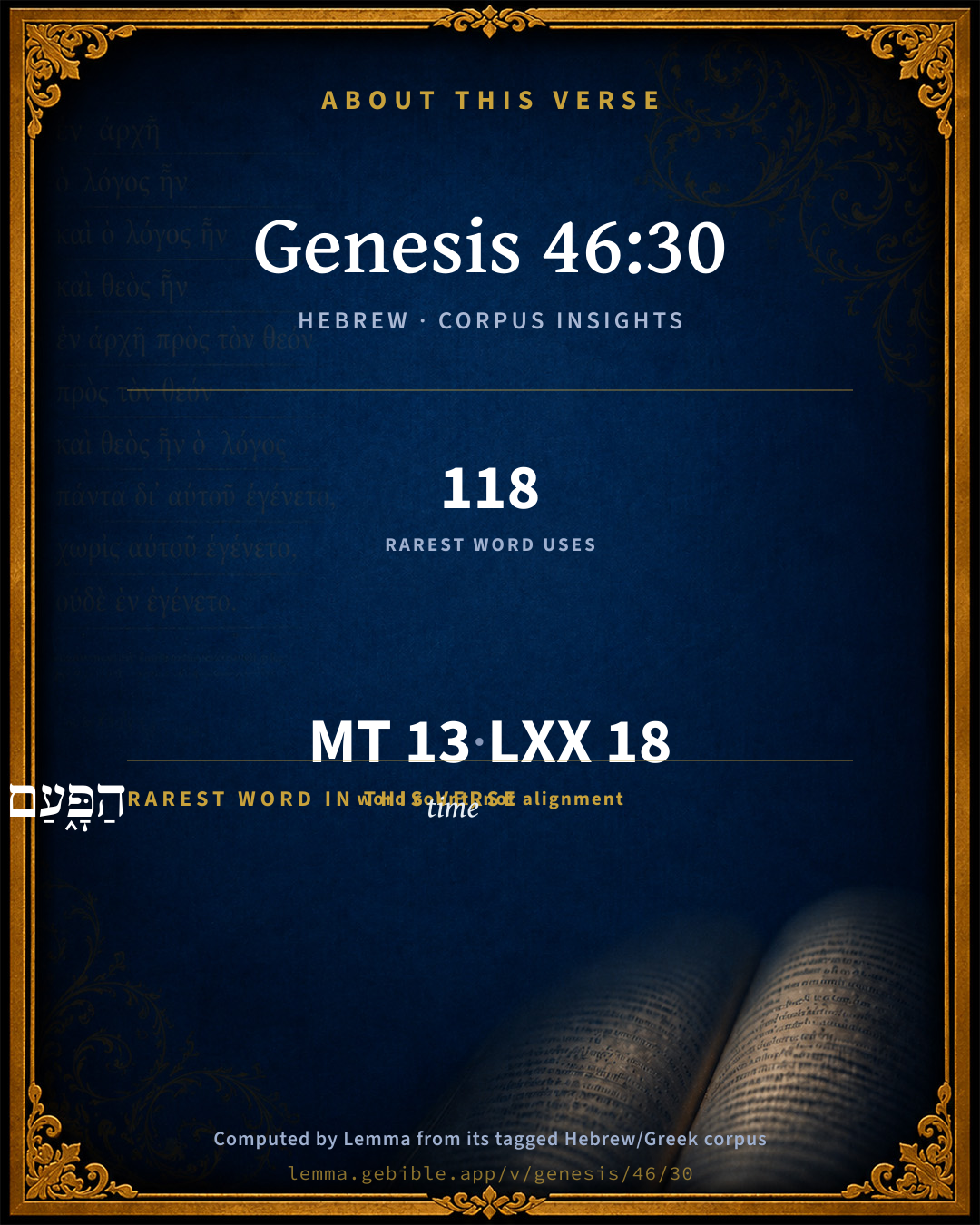
Genesis, in the Pentateuch, opens this verse with 13 words (13 distinct Hebrew lemmas). Its most distinctive word is paʻam (“time”). A historical commentator’s framing appears above. Read the whole chapter for the surrounding context.

Discussion questions

  1. What does “time” (paʻam) contribute to the verse as a whole?
  2. How does Luke 2:29–30, which shares this passage’s theme, read alongside this verse?
  3. The translations on this page render this verse differently — a whole-verse word diff, not a word-by-word alignment. What might account for the different wordings?
  4. «וַיֹּ֧אמֶר» is a Qal Sequential Imperfect verb. How does that grammatical form shape the action described?
  5. Compare how Trapp's Complete Commentary and Tyndale Open Study Notes read this verse. Where do they agree or differ?

Things to notice

Reading settings

Reading text

Shown beneath each verse's original-language words.

Old Testament
Old Testament edition

Read the OT as the Masoretic Hebrew (MT) or the Greek Septuagint (LXX).

English shown for the Greek Septuagint (in the Hebrew ↔ Greek comparison).

Comparing translations? Open the Compare panel on any verse page to stack up to four side by side.