Leviticus 20:11

Hebrew (Westminster Leningrad Codex) Leviticus 20:11 appears in the Hebrew Old Testament. The text above is from the Westminster Leningrad Codex. Each word links to its Strong’s number, a concise gloss, and parsing drawn from the Open Scriptures Hebrew Bible morphology. Click any word for its full Brown-Driver-Briggs (BDB) entry.
Download image
Cite this verse

Leviticus 20:11 (World English Bible). Public Domain. Lemma interlinear Bible study tool, https://lemma.gebible.app/v/leviticus/20/11.

Show BibTeX & RIS
BibTeX
RIS
English Translation
The man who lies with his father's wife has uncovered his father's nakedness: both of them shall surely be put to death; their blood shall be upon them.
World English Bible · Public Domain
Download a study sheet

One document with this verse’s original text, its word-by-word gloss line, the meaning frame, cross-references with their text, attributed commentary, and full source and license credits — printable, and it pastes into notes with its structure intact.

This verse Autodidact and up

Study sheet (.html) Plain text (.txt)

A passage Seminary Student

Up to 50 verses in one chapter. A passage sheet keeps up to 6 commentary sources and 12 cross-references per verse, in the order this page ranks them, and says so on the sheet whenever that leaves anything out. Ask for a single verse and you get the Autodidact verse sheet above.

Everything on this page stays free to read, with no account — the sheet is a download of what is already on screen, not access to it.

Want to remove ads? Support Godless Engineer
Compare translations 3

The same verse in 3 English versions, stacked beneath the original-language interlinear above. Click any original word for its lexicon entry.

Each is an independent rendering of the whole verse — the interlinear is not word-aligned to these translations.

Highlighted words mark where these versions differ — a whole-verse word diff, not a word-by-word alignment.

  • World English Bible Public Domain
    The man who lies with his father's wife has uncovered his father's nakedness: both of them shall surely be put to death; their blood shall be upon them.
  • King James Version Public Domain
    And the man that lieth with his father's wife hath uncovered his father's nakedness: both of them shall surely be put to death; their blood shall be upon them.
  • unfoldingWord Literal Text CC BY-SA 4.0
    And a man who lies with the wife of his father—he has uncovered the nakedness of his father. Dying, both of them shall be executed; their blood on them.

unfoldingWord Literal Text — © unfoldingWord, licensed CC BY-SA 4.0. Word-aligned USFM3 via Door43 (git.door43.org/unfoldingWord/en_ult).

Versions to compare (up to 4)

3 of 4 selected

Show all 18 translations

Every available English version of this verse, each an independent rendering of the whole verse.

  • World English Bible Public Domain
    The man who lies with his father's wife has uncovered his father's nakedness: both of them shall surely be put to death; their blood shall be upon them.
  • Berean Standard Bible Public Domain
    If a man lies with his father’s wife, he has uncovered his father’s nakedness. Both must surely be put to death; their blood is upon them.
  • Majority Standard Bible Public Domain
    If a man lies with his father’s wife, he has uncovered his father’s nakedness. Both must surely be put to death; their blood is upon them.
  • King James Version Public Domain
    And the man that lieth with his father's wife hath uncovered his father's nakedness: both of them shall surely be put to death; their blood shall be upon them.
  • American Standard Version (1901) Public Domain
    And the man that lieth with his father's wife hath uncovered his father's nakedness: both of them shall surely be put to death; their blood shall be upon them.
  • Revised Version (1885) Public Domain
    And the man that lieth with his father’s wife hath uncovered his father’s nakedness: both of them shall surely be put to death; their blood shall be upon them.
  • Geneva Bible (1599) Public Domain
    And the man that lyeth with his fathers wife, because hee hath vncouered his fathers shame, they shall both dye: their blood shalbe vpon them.
  • Douay-Rheims (1899) Public Domain
    If a man lie with his stepmother, and discover the nakedness of his father, let them both be put to death: their blood be upon them.
  • Young's Literal Translation Public Domain
    `And a man who lieth with his father's wife -- the nakedness of his father he hath uncovered -- both of them are certainly put to death; their blood `is' on them.
  • Literal Standard Version CC BY-SA 4.0
    And a man who lies with his father’s wife—he has uncovered the nakedness of his father—both of them are certainly put to death; their blood [is] on them.
  • Unlocked Literal Bible CC BY-SA 4.0
    If a man lies with his father's wife, he uncovers his father's nakedness. Both the son and his father's wife must certainly be put to death. Their blood is upon them.
  • unfoldingWord Literal Text CC BY-SA 4.0
    And a man who lies with the wife of his father—he has uncovered the nakedness of his father. Dying, both of them shall be executed; their blood on them.
  • Darby Bible Public Domain
    And a man that lieth with his father's wife hath uncovered his father's nakedness: both of them shall certainly be put to death; their blood is upon them.
  • World Messianic Bible Public Domain
    “‘The man who lies with his father’s wife has uncovered his father’s nakedness. Both of them shall surely be put to death. Their blood shall be upon themselves.
  • Webster's Bible Public Domain
    And the man that lieth with his father's wife hath uncovered his father's nakedness; both of them shall surely be put to death: their blood shall be upon them.
  • Free Bible Version CC BY-SA 4.0
    A man who has sex with his father's wife has brought shame on his father. Both the man and the woman must be executed. Both must surely be put to death; they bear the responsibility for their punishment.
  • Bible in Basic English Public Domain
    And the man who has sex relations with his father's wife has put shame on his father: the two of them are to be put to death; their blood will be on them.
  • JPS Tanakh (1917) Public Domain
    And the man that lieth with his father's wife — he hath uncovered his father's nakedness — both of them shall surely be put to death; their blood shall be upon them.

Literal Standard Version (2020), Covenant Press — licensed CC BY-SA 4.0. Text via the HelloAO Bible API (eBible.org). Unlocked Literal Bible (unfoldingWord) — licensed CC BY-SA 4.0. Text via the HelloAO Bible API (eBible.org). unfoldingWord Literal Text — © unfoldingWord, licensed CC BY-SA 4.0. Word-aligned USFM3 via Door43 (git.door43.org/unfoldingWord/en_ult). Free Bible Version, Dr. Jonathan Gallagher — licensed CC BY-SA 4.0. Text via the HelloAO Bible API (eBible.org).

Word by word

More ways to search: Search by grammar → Find every occurrence → Compare this word →

Practice this passage: Drill this verse → Learn its vocabulary →

עֶרְוַ֥ת
ʻervâh
H6172
“nakedness of”
Noun, Common, Feminine, Singular, Construct
Part of Speech
Noun
Type
Common
Gender
Feminine
Number
Singular
State
Construct
Full BDB Definition

Origin: from H6168

TWOT: 1692b

nakedness, nudity, shame, pudenda - pudenda (implying shameful exposure) - nakedness of a thing, indecency, improper behaviour - exposed, undefended (figuratively)
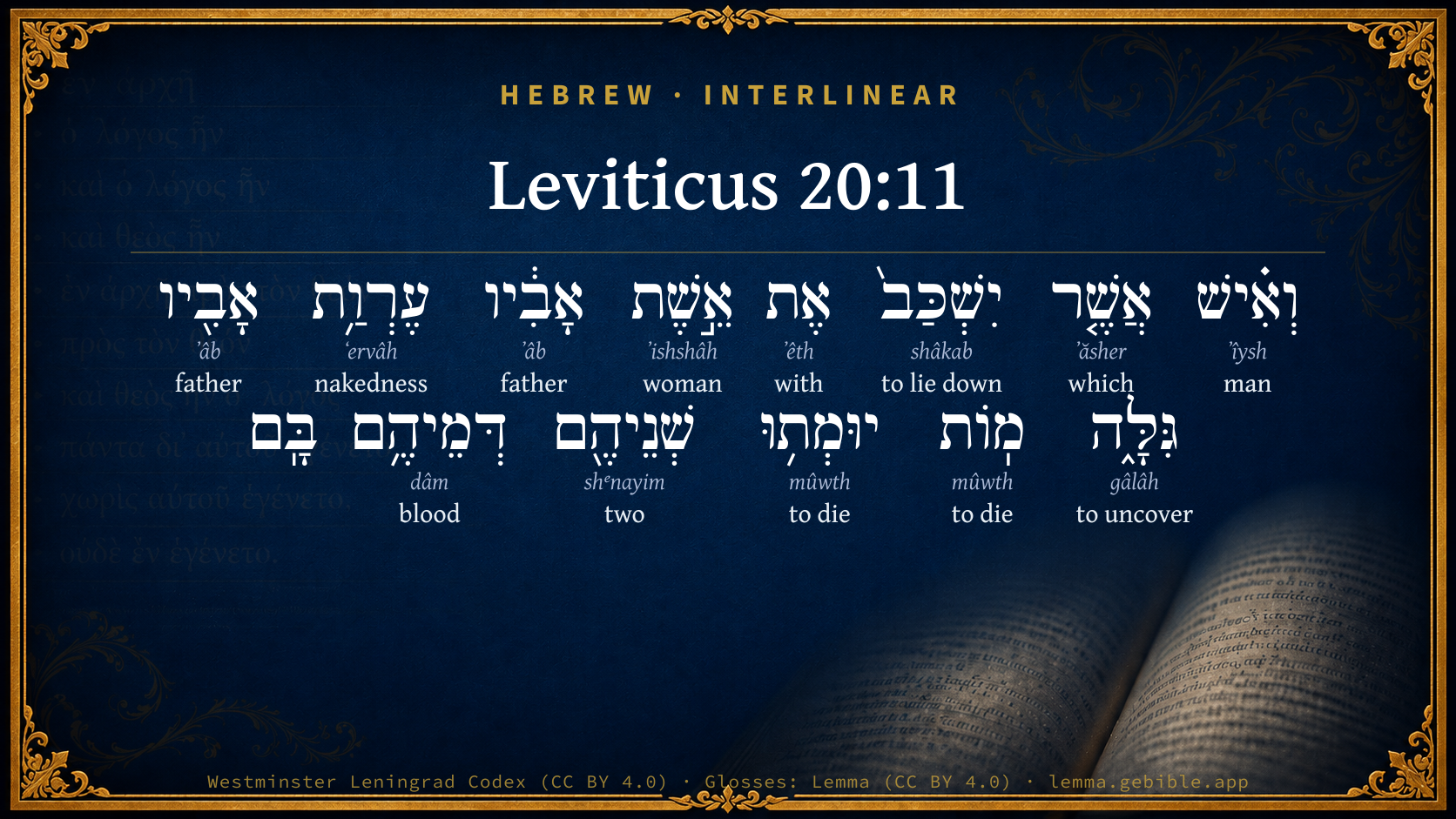
  1. וְאִ֗ישׁ ʼîysh H376 “and · man” Conjunction + Noun, Common, Masculine, Singular, Absolute
  2. אֲשֶׁ֤ר ʼăsher H834 “which” Particle, Relative
  3. יִשְׁכַּב֙ shâkab H7901 “to lie down” Verb, Qal, Imperfect, 3rd Person, Masculine, Singular
  4. אֶת ʼêth H854 “with” Preposition
  5. אֵ֣שֶׁת ʼishshâh H802 “woman of” Noun, Common, Feminine, Singular, Construct
  6. אָבִ֔יו ʼâb H1 “father · his” Noun, Common, Masculine, Singular, Construct + Suffix, Personal, 3rd Person, Masculine, Singular
  7. אָבִ֖יו ʼâb H1 “father · his” Noun, Common, Masculine, Singular, Construct + Suffix, Personal, 3rd Person, Masculine, Singular
  8. גִּלָּ֑ה gâlâh H1540 “to uncover” Verb, Piel, Perfect, 3rd Person, Masculine, Singular
  9. מֽוֹת mûwth H4191 “to die” Verb, Qal, Infinitive Absolute
  10. יוּמְת֥וּ mûwth H4191 “to die” Verb, Hophal, Imperfect, 3rd Person, Masculine, Plural
  11. שְׁנֵיהֶ֖ם shᵉnayim H8147 “two · their” Adjective, Cardinal number, Masculine, Dual, Construct + Suffix, Personal, 3rd Person, Masculine, Plural
  12. דְּמֵיהֶ֥ם dâm H1818 “blood · their” Noun, Common, Masculine, Plural, Construct + Suffix, Personal, 3rd Person, Masculine, Plural

About this verse

These counts appear in no published source. They are computed here, from the morphology-tagged text and Lemma’s own curated glosses. What Lemma adds →

14
words
11
distinct lemmas
Pentateuch
section

Shared distinctive vocabulary

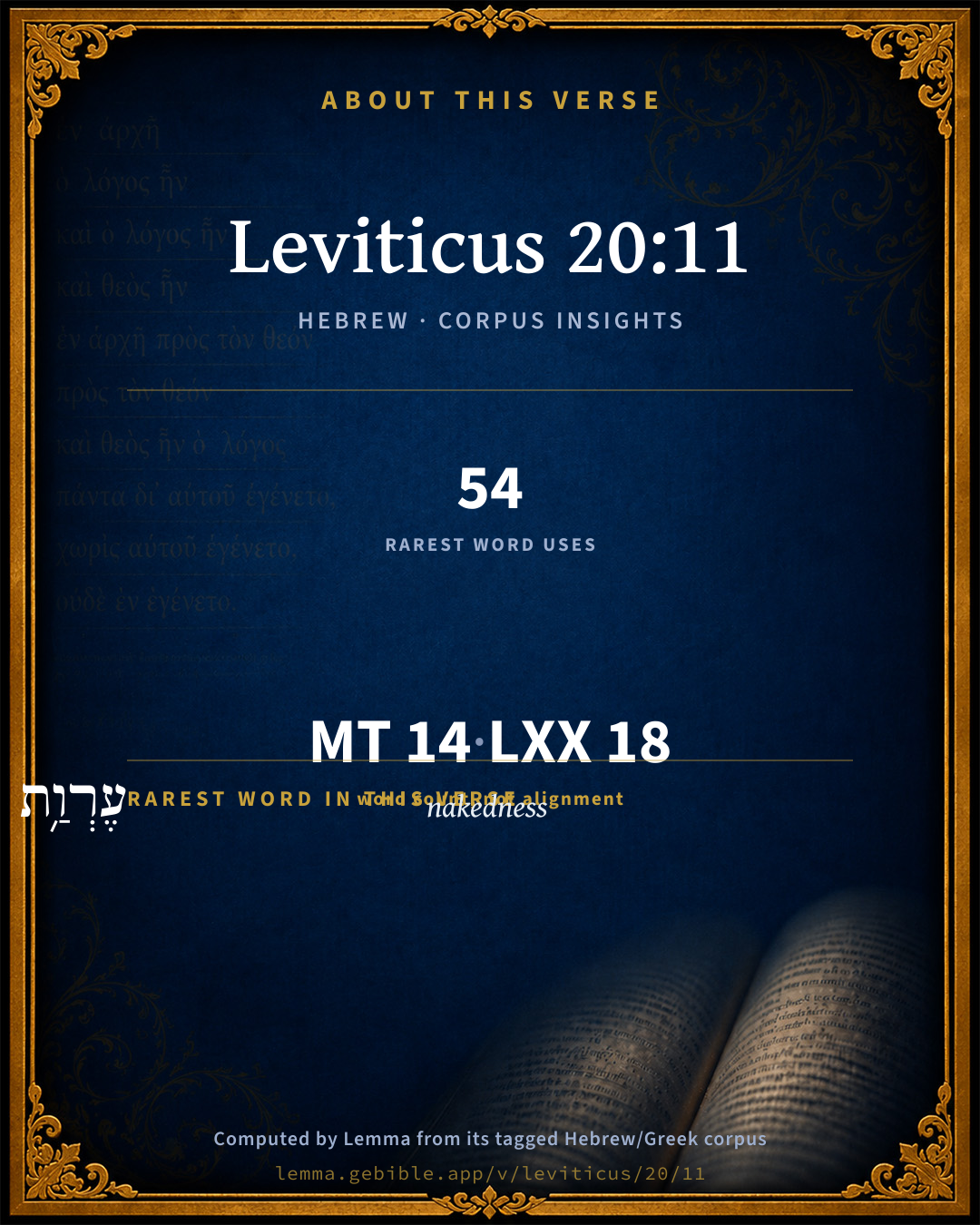
עֶרְוַ֥ת nakedness H6172 occurs in 40 verses of the Hebrew Bible. Also found in:

Grammatical profile

  • 4 verbs
  • 6 nouns
  • 1 adjective
  • 2 prepositions
  • 1 particle

Verb forms

  • יִשְׁכַּב֙ Qal · Imperfect
  • גִּלָּ֑ה Piel · Perfect
  • מֽוֹת Qal · Infinitive Absolute
  • יוּמְת֥וּ Hophal · Imperfect

Repetition

Words recur within this verse — often emphatic in Hebrew:

  • אָבִ֔יו father H1 ×2
  • מֽוֹת to die H4191 ×2

Hebrew & Septuagint length

In English translation the verse runs 28 words from the Hebrew and 25 from the Septuagint (LXX English) — closely comparable.

A rough comparison of the two English renderings, which tokenize alike — not a word-level alignment.

Word counts can differ between the Hebrew and the Greek without any difference in meaning — e.g. the Hebrew direct-object marker אֵת has no separate Greek word, and Greek often adds the article ὁ.

In the original languages it is 14 Hebrew tokens and 18 Greek tokens — but the two are counted differently (Hebrew bundles its prefixes and suffixes into one token; the Greek is in lemma form), so that isn’t a like-for-like length.

Cross-references

5

Topical passages linked to Leviticus 20:11 in the Treasury of Scripture Knowledge — connected by theme and wording, ordered by reader-vote popularity; previews shown in the World English Bible.

  • Deuteronomy 27:20 Cursed be he who lies with his father's wife, because he has uncovered his father's skirt. All the people shall say, Amen.
  • Deuteronomy 27:23 Cursed be he who lies with his mother-in-law. All the people shall say, Amen.
  • Leviticus 18:7–8 "'You shall not uncover the nakedness of your father, nor the nakedness of your mother: she is your mother. You shall not uncover her nakedness.
  • Amos 2:7 They trample on the dust of the earth on the head of the poor, And deny justice to the oppressed; And a man and his father use the same maiden, to profane my holy name;
  • 1 Corinthians 5:1 It is actually reported that there is sexual immorality among you, and such sexual immorality as is not even named among the Gentiles, that one has his father's wife.

Cross-references courtesy of OpenBible.info (CC BY 4.0).

Hebrew and Greek witnesses Masoretic Hebrew ↔ Greek Septuagint

The same verse in the two great witnesses to the Old Testament, shown verse-for-verse.

These are two independent witnesses, not word-aligned to each other, and the Septuagint is shown in lemma (dictionary) form.

Hebrew Leviticus 20:11 Masoretic · Westminster Leningrad Codex

וְאִ֗ישׁ אֲשֶׁ֤ר יִשְׁכַּב֙ אֶת אֵ֣שֶׁת אָבִ֔יו עֶרְוַ֥ת אָבִ֖יו גִּלָּ֑ה מֽוֹת יוּמְת֥וּ שְׁנֵיהֶ֖ם דְּמֵיהֶ֥ם בָּֽם

The man who lies with his father's wife has uncovered his father's nakedness: both of them shall surely be put to death; their blood shall be upon them.

World English Bible · Public Domain

Greek LXX Leviticus 20:11 Septuagint · lemma form

ἐάν τις κοιμάω μετά γυνή ὁ πατήρ αὐτός ἀσχημοσύνη ὁ πατήρ αὐτός ἀποκαλύπτω θάνατος θανατόω ἀμφότεροι ἔνοχος εἰμί

And if any one should lie with his father's wife, he has uncovered his father's nakedness: let them both die the death, they are guilty.

LXX2012 (modern English Septuagint) · Public Domain

Hebrew: Westminster Leningrad Codex (CC BY 4.0). Greek: Septuagint (public domain); English from LXX2012 (modern English Septuagint) (Public Domain). How the Septuagint differs from the Hebrew →

Targum (Aramaic paraphrase)

2

The Targum is the ancient Jewish Aramaic paraphrase of the Hebrew Scriptures — an interpretive translation, not the Hebrew text itself. Onkelos (literal) and Pseudo-Jonathan (expansive) render the Torah, and Jonathan the Prophets. Coverage is partial: where no permissively-licensed English translation exists for a verse, only the Aramaic is shown. This is verse-level text, not a word-by-word alignment to the Hebrew.

  1. Targum Onkelos Torah (Genesis–Deuteronomy)
    וּגְבַר דִי יִשְׁכּוּב עִם אִתַּת אֲבוּהִי עֶרְיְתָא דַאֲבוּהִי גַלִי אִתְקַטָלָא יִתְקַטְלוּן תַּרְוֵיהוֹן קְטָלָא חַיָבִין

    (no public-domain English translation for this verse)

    Targum Onkelos — Aramaic: “Onkelos Genesis” (public domain); “Onkelos Exodus” (public domain); “Onkelos Leviticus” (public domain); “Onkelos Numbers” (public domain); “Onkelos Deuteronomy” (public domain). English: “Sefaria Community Translation” (CC0 1.0 (public-domain dedication)); “J.W. Etheridge. The Targums of Onkelos and Jonathan Ben Uzziel on the Pentateuch. London: Longmans, Green, 1862” (public domain). Text via Sefaria.

  2. Targum Pseudo-Jonathan Torah (Genesis–Deuteronomy)
    וּגְבַר דִי יְשַׁמֵשׁ עִם אִתַּת אָבוֹי בֵּין דְהִיא אִמֵיהּ בֵּין דְהִיא חוֹרַנְיָיתָא עֲרְיָיתָא דְאָבוֹי בָּזֵי אִיתְקְטָלָא יִתְקַטְלוּן תְּרֵיהוֹן קְטָלָא חַיָיבִין בְּאַטְלוּת אַבְנִין

    And a man who lieth with his father's wife, whether his own mother or another wife, and who hath dishonoured the nakedness of his father shall be verily put to death: both of them are guilty of death by the casting of stones.

    Targum Pseudo-Jonathan — Aramaic: “Targum Jonathan on Genesis” (public domain); “Targum Jonathan on Exodus” (public domain); “Targum Jonathan on Leviticus” (public domain); “Targum Jonathan on Numbers” (public domain); “Targum Jonathan on Deuteronomy” (public domain). English: “The Targum of Jonathan ben Uzziel, trans. J. W. Etheridge, London, 1862” (public domain). Text via Sefaria.

Commentary

Notes on Leviticus 20:11 from classic Christian and Jewish commentators (each source and its license shown beneath its notes). The classic Christian expositions comment on the surrounding passage and are grouped to its opening verse, so a note may address several verses; the Jewish commentaries on the Tanakh (Rashi and others) are per-verse, so they appear only where the commentator wrote on this verse.

Lemma curates 59 commentaries, every one of them public domain or Creative Commons licensed, each selected and text-cleaned for this edition rather than reprinted as found. About our sources →

Trapp's Complete Commentary

John Trapp

Lev 20:11 And the man that lieth with his father’s wife hath uncovered his father’s nakedness: both of them shall surely be put to death; their blood [shall be] upon them.

Ver. 11-14. See on Lev 18:1-30.

John Trapp, A Commentary or Exposition upon All the Books of the Old and New Testament (1647–1656) — public domain. Text from a community e-Sword module.

Tyndale Open Study Notes

Tyndale Open Resources

20:11 See study note on 18:7-8. This injunction made it clear that the crime was seen as both incest and adultery.

Tyndale Open Study Notes — © Tyndale Open Resources, licensed CC BY-SA 4.0. Text via the HelloAO Bible API.

Geneva Bible (1599)

Geneva Bible translators

Lev. 28:8; Deut. 22:30

Geneva Bible (1599) marginal notes — public domain. Text via Bolls.life.

Ellicott's Commentary for English Readers

(11) His father’s wife.—Here the penalty is enacted for the sin prohibited in Lev_18:8.

A Bible Commentary for English Readers, edited by Charles John Ellicott (1878–1897) — public domain. Text from a community e-Sword module.

John Gill's Exposition

And the man that lieth with his father's wife,.... Whether she be his mother, or another woman, as the Targum of Jonathan; that is, whether she is his own mother, or a stepmother, or whether he did this in the lifetime of his father, or after his death, or whether she was betrothed or married, it mattered not; according to the Jewish tradition (d), this is a breach of the law, Lev 18:8; and a man guilty of this

hath uncovered his father's nakedness; and which is a foul and shameful piece of wickedness; the penalty follows:

both of them shall be put to death; by casting stones on them, as the Targum of Jonathan adds; for, as before observed, wherever the following phrase:

their blood shall be upon them, is used, stoning is meant; and so, according to the Misnah (e), all those were to be stoned, after mentioned, of whom this phrase is used.

(d) Misn. ut supra, (Sanhedrin, c. 7.) sect. 4. (e) lbid.

John Gill's Exposition of the Whole Bible (1746–1763) — public domain (CC PDM 1.0). Text via the HelloAO Bible API.

Haydock's Catholic Bible Commentary

Father. See chap. xviii. 8. It is supposed that the father was dead, otherwise the punishment would probably be greater than for adultery. The Samaritan, "with the wife of his father’s brother." (Calmet)

George Leo Haydock (1774–1849), Haydock's Catholic Family Bible and Commentary, 1859 edition — public domain. Excludes Psalms (Douay-Rheims chapter numbering differs from Protestant) and Deuterocanonical books (Catholic canon only).

The Pulpit Commentary

Vers. 11, 12. It should be noted that intercourse with a stepmother or daughter-in-law are put, by the punishment inflicted upon them, on the same level with adultery and unnatural crimes (verses 10, 13, 15, 16).

The Pulpit Commentary (1880–1919), ed. H.D.M. Spence-Jones & Joseph S. Exell — public domain. Text from a community e-Sword module.

Lesson kit

Teaching starters — assembled from the data on this page, not authored interpretation. Every prompt links to the verse data it draws on. Edit before teaching.

Leviticus, in the Pentateuch, opens this verse with 14 words (11 distinct Hebrew lemmas). Its most distinctive word is ʻervâh (“nakedness”). A historical commentator’s framing appears above. Read the whole chapter for the surrounding context.

Discussion questions

  1. How does “nakedness” (ʻervâh) shape what this verse is saying?
  2. Genesis 9:22 shares the word «nakedness» with this verse. How do the two illuminate each other?
  3. “father” occurs 2× in this one verse. What is the effect of the repetition?
  4. These translations render this verse differently; the difference is in the English rendering, not the original. What questions does that raise?
  5. The verb «יִשְׁכַּב֙» is Qal Imperfect. How does its form color the action?
  6. Reading how Trapp's Complete Commentary and Tyndale Open Study Notes read this verse, where do the two commentators agree and where do they part?

Things to notice

Reading settings

Reading text

Shown beneath each verse's original-language words.

Old Testament
Old Testament edition

Read the OT as the Masoretic Hebrew (MT) or the Greek Septuagint (LXX).

English shown for the Greek Septuagint (in the Hebrew ↔ Greek comparison).

Comparing translations? Open the Compare panel on any verse page to stack up to four side by side.