
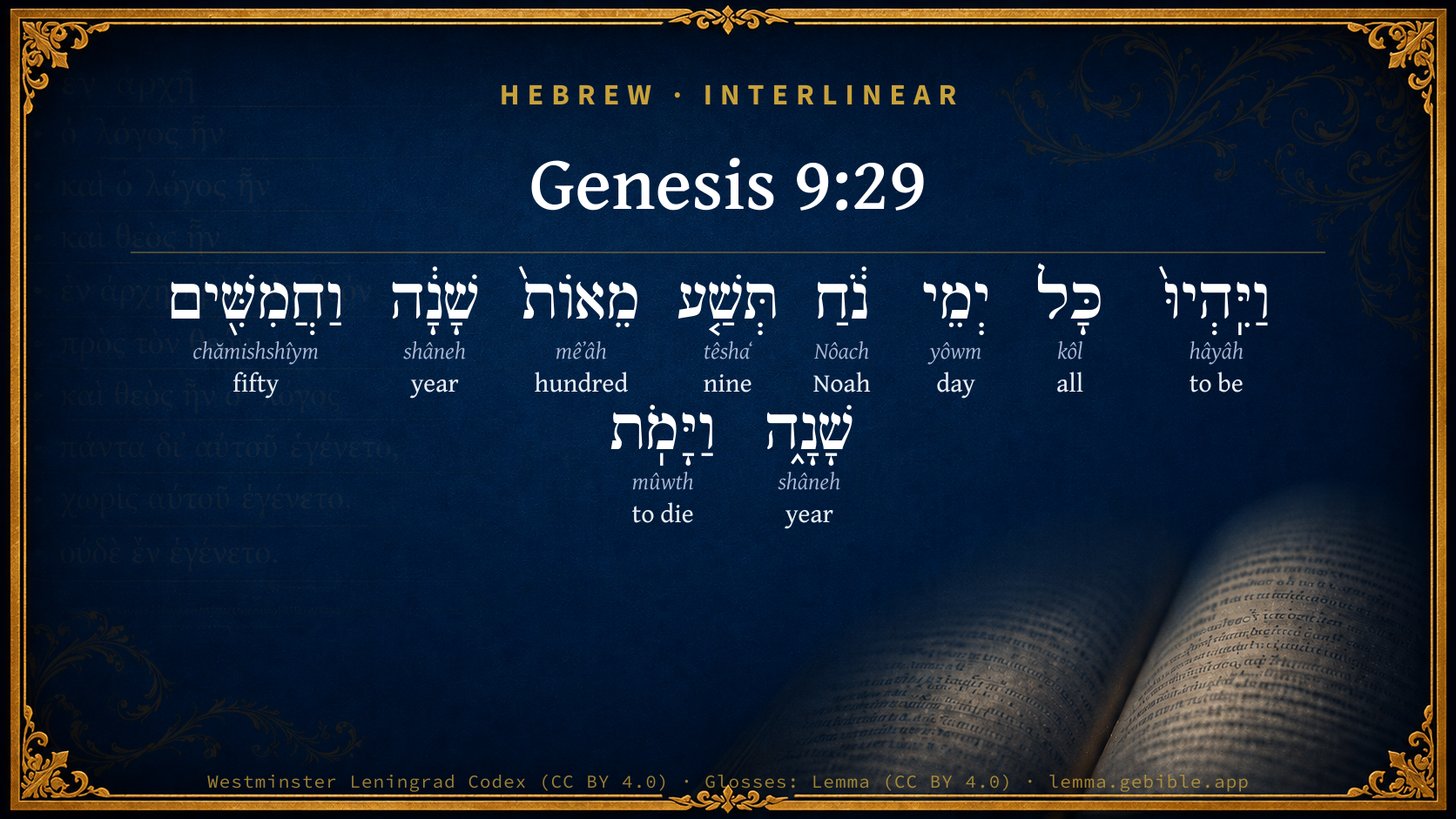
Genesis 9:29

Hebrew (Westminster Leningrad Codex) Genesis 9:29 appears in the Hebrew Old Testament. The text above is from the Westminster Leningrad Codex. Each word links to its Strong’s number, a concise gloss, and parsing drawn from the Open Scriptures Hebrew Bible morphology. Click any word for its full Brown-Driver-Briggs (BDB) entry.
Download image
Cite this verse

Genesis 9:29 (World English Bible). Public Domain. Lemma interlinear Bible study tool, https://lemma.gebible.app/v/genesis/9/29.

Show BibTeX & RIS
BibTeX
RIS
English Translation
All the days of Noah were nine hundred fifty years, then he died.
World English Bible · Public Domain
Download a study sheet

One document with this verse’s original text, its word-by-word gloss line, the meaning frame, cross-references with their text, attributed commentary, and full source and license credits — printable, and it pastes into notes with its structure intact.

This verse Autodidact and up

Study sheet (.html) Plain text (.txt)

A passage Seminary Student

Up to 50 verses in one chapter. A passage sheet keeps up to 6 commentary sources and 12 cross-references per verse, in the order this page ranks them, and says so on the sheet whenever that leaves anything out. Ask for a single verse and you get the Autodidact verse sheet above.

Everything on this page stays free to read, with no account — the sheet is a download of what is already on screen, not access to it.

Want to remove ads? Support Godless Engineer
Compare translations 3

The same verse in 3 English versions, stacked beneath the original-language interlinear above. Click any original word for its lexicon entry.

Each is an independent rendering of the whole verse — the interlinear is not word-aligned to these translations.

Highlighted words mark where these versions differ — a whole-verse word diff, not a word-by-word alignment.

  • World English Bible Public Domain
    All the days of Noah were nine hundred fifty years, then he died.
  • King James Version Public Domain
    And all the days of Noah were nine hundred and fifty years: and he died.
  • unfoldingWord Literal Text CC BY-SA 4.0
    So all the days of Noah were 950 years, and he died.

unfoldingWord Literal Text — © unfoldingWord, licensed CC BY-SA 4.0. Word-aligned USFM3 via Door43 (git.door43.org/unfoldingWord/en_ult).

Versions to compare (up to 4)

3 of 4 selected

Show all 18 translations

Every available English version of this verse, each an independent rendering of the whole verse.

  • World English Bible Public Domain
    All the days of Noah were nine hundred fifty years, then he died.
  • Berean Standard Bible Public Domain
    So Noah lived a total of 950 years, and then he died.
  • Majority Standard Bible Public Domain
    So Noah lived a total of 950 years, and then he died.
  • King James Version Public Domain
    And all the days of Noah were nine hundred and fifty years: and he died.
  • American Standard Version (1901) Public Domain
    And all the days of Noah were nine hundred and fifty years: And he died.
  • Revised Version (1885) Public Domain
    And all the days of Noah were nine hundred and fifty years: and he died.
  • Geneva Bible (1599) Public Domain
    So all the dayes of Noah were nine hundreth and fiftie yeeres: and he died.
  • Douay-Rheims (1899) Public Domain
    And all his days were in the whole nine hundred and fifty years: and he died.
  • Young's Literal Translation Public Domain
    and all the days of Noah are nine hundred and fifty years, and he dieth.
  • Literal Standard Version CC BY-SA 4.0
    and all the days of Noah are nine hundred and fifty years, and he dies.
  • Unlocked Literal Bible CC BY-SA 4.0
    All the days of Noah were nine hundred fifty years, and then he died.
  • unfoldingWord Literal Text CC BY-SA 4.0
    So all the days of Noah were 950 years, and he died.
  • Darby Bible Public Domain
    And all the days of Noah were nine hundred and fifty years; and he died.
  • World Messianic Bible Public Domain
    All the days of Noah were nine hundred fifty years, and then he died.
  • Webster's Bible Public Domain
    And all the days of Noah were nine hundred and fifty years: and he died.
  • Free Bible Version CC BY-SA 4.0
    Noah lived a total of 950 years, and then he died.
  • Bible in Basic English Public Domain
    all the years of his life were nine hundred and fifty: and he came to his end.
  • JPS Tanakh (1917) Public Domain
    And all the days of Noah were nine hundred and fifty years; and he died.

Literal Standard Version (2020), Covenant Press — licensed CC BY-SA 4.0. Text via the HelloAO Bible API (eBible.org). Unlocked Literal Bible (unfoldingWord) — licensed CC BY-SA 4.0. Text via the HelloAO Bible API (eBible.org). unfoldingWord Literal Text — © unfoldingWord, licensed CC BY-SA 4.0. Word-aligned USFM3 via Door43 (git.door43.org/unfoldingWord/en_ult). Free Bible Version, Dr. Jonathan Gallagher — licensed CC BY-SA 4.0. Text via the HelloAO Bible API (eBible.org).

Word by word

More ways to search: Search by grammar → Find every occurrence → Compare this word →

Practice this passage: Drill this verse → Learn its vocabulary →

נֹ֔חַ
Nôach
H5146
“Noah”
Noun, Proper
Part of Speech
Noun
Type
Proper
Full BDB Definition

Origin: the same as H5118

TWOT: 1323b

Noah = "rest" - son of Lamech, father of Shem, Ham, and Japheth; builder of the ark which saved his family from the destruction of the world which God sent on the world by the flood; became the new seminal head of mankind because his family were the only survivors of the flood
  1. וַיִּֽהְיוּ֙ hâyâh H1961 “and · to be” Conjunction + Verb, Qal, Sequential Imperfect, 3rd Person, Masculine, Plural
  2. כָּל kôl H3605 “all of” Noun, Common, Masculine, Singular, Construct
  3. יְמֵי yôwm H3117 “days of” Noun, Common, Masculine, Plural, Construct
  4. תְּשַׁ֤ע têshaʻ H8672 “nine” Adjective, Cardinal number, Feminine, Singular, Absolute
  5. מֵאוֹת֙ mêʼâh H3967 “hundred” Adjective, Cardinal number, Both, Plural, Absolute
  6. שָׁנָ֔ה shâneh H8141 “year” Noun, Common, Feminine, Singular, Absolute
  7. וַחֲמִשִּׁ֖ים chămishshîym H2572 “and · fifty” Conjunction + Adjective, Cardinal number, Both, Plural, Absolute
  8. שָׁנָ֑ה shâneh H8141 “year” Noun, Common, Feminine, Singular, Absolute
  9. וַיָּמֹֽת mûwth H4191 “and · to die” Conjunction + Verb, Qal, Sequential Imperfect, 3rd Person, Masculine, Singular

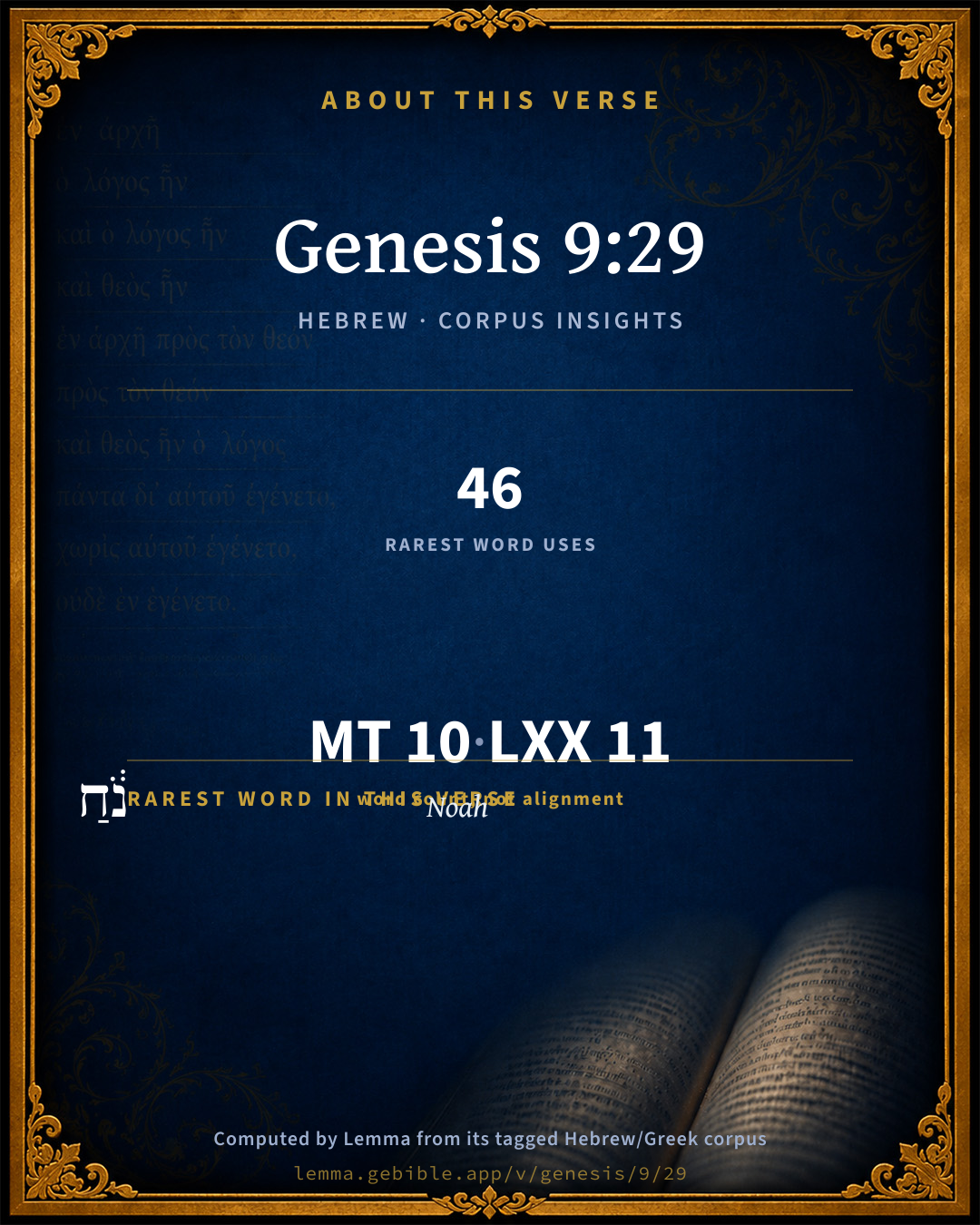
About this verse

These counts appear in no published source. They are computed here, from the morphology-tagged text and Lemma’s own curated glosses. What Lemma adds →

10
words
9
distinct lemmas
Pentateuch
section

Shared distinctive vocabulary

נֹ֔חַ Noah H5146 occurs in 39 verses of the Hebrew Bible. Also found in:

Grammatical profile

  • 2 verbs
  • 5 nouns
  • 3 adjectives

Verb forms

  • וַיִּֽהְיוּ֙ Qal · Sequential Imperfect
  • וַיָּמֹֽת Qal · Sequential Imperfect

Repetition

A word recurs within this verse — often emphatic in Hebrew:

  • שָׁנָ֔ה year H8141 ×2

Hebrew & Septuagint length

In English translation the verse runs 13 words from the Hebrew and 15 from the Septuagint (LXX English) — closely comparable.

A rough comparison of the two English renderings, which tokenize alike — not a word-level alignment.

Word counts can differ between the Hebrew and the Greek without any difference in meaning — e.g. the Hebrew direct-object marker אֵת has no separate Greek word, and Greek often adds the article ὁ.

In the original languages it is 10 Hebrew tokens and 11 Greek tokens — but the two are counted differently (Hebrew bundles its prefixes and suffixes into one token; the Greek is in lemma form), so that isn’t a like-for-like length.

Cross-references

6

Topical passages linked to Genesis 9:29 in the Treasury of Scripture Knowledge — connected by theme and wording, ordered by reader-vote popularity; previews shown in the World English Bible.

  • Genesis 5:27 All the days of Methuselah were nine hundred sixty-nine years, then he died.
  • Genesis 5:32 Noah was five hundred years old, and Noah became the father of Shem, Ham, and Japheth.
  • Psalms 90:10 The days of our years are seventy, Or even by reason of strength eighty years; Yet their pride is but labor and sorrow, For it passes quickly, and we fly away.
  • Genesis 5:5 All the days that Adam lived were nine hundred thirty years, then he died.
  • Genesis 5:20 All the days of Jared were nine hundred sixty-two years, then he died.
  • Genesis 11:11–25 Shem lived after he became the father of Arpachshad five hundred years, and became the father of sons and daughters.

Cross-references courtesy of OpenBible.info (CC BY 4.0).

Hebrew and Greek witnesses Masoretic Hebrew ↔ Greek Septuagint

The same verse in the two great witnesses to the Old Testament, shown verse-for-verse.

These are two independent witnesses, not word-aligned to each other, and the Septuagint is shown in lemma (dictionary) form.

Hebrew Genesis 9:29 Masoretic · Westminster Leningrad Codex

וַיִּֽהְיוּ֙ כָּל יְמֵי נֹ֔חַ תְּשַׁ֤ע מֵאוֹת֙ שָׁנָ֔ה וַחֲמִשִּׁ֖ים שָׁנָ֑ה וַיָּמֹֽת

All the days of Noah were nine hundred fifty years, then he died.

World English Bible · Public Domain

Greek LXX Genesis 9:29 Septuagint · lemma form

καί γίγνομαι πᾶς ὁ ἡμέρα νωε ἐννακόσιοι πεντήκοντα ἔτος καί ἀποθνήσκω

And all the days of Noe were nine hundred and fifty years, and he died.

LXX2012 (modern English Septuagint) · Public Domain

Hebrew: Westminster Leningrad Codex (CC BY 4.0). Greek: Septuagint (public domain); English from LXX2012 (modern English Septuagint) (Public Domain). How the Septuagint differs from the Hebrew →

Targum (Aramaic paraphrase)

2

The Targum is the ancient Jewish Aramaic paraphrase of the Hebrew Scriptures — an interpretive translation, not the Hebrew text itself. Onkelos (literal) and Pseudo-Jonathan (expansive) render the Torah, and Jonathan the Prophets. Coverage is partial: where no permissively-licensed English translation exists for a verse, only the Aramaic is shown. This is verse-level text, not a word-by-word alignment to the Hebrew.

  1. Targum Onkelos Torah (Genesis–Deuteronomy)
    וַהֲווֹ כָל יוֹמֵי נֹחַ תְּשַׁע מְאָה וְחַמְשִׁין שְׁנִין וּמִית

    And all the days of Noach were nine hundred and fifty years; and he died.

    Targum Onkelos — Aramaic: “Onkelos Genesis” (public domain); “Onkelos Exodus” (public domain); “Onkelos Leviticus” (public domain); “Onkelos Numbers” (public domain); “Onkelos Deuteronomy” (public domain). English: “Sefaria Community Translation” (CC0 1.0 (public-domain dedication)); “J.W. Etheridge. The Targums of Onkelos and Jonathan Ben Uzziel on the Pentateuch. London: Longmans, Green, 1862” (public domain). Text via Sefaria.

  2. Targum Pseudo-Jonathan Torah (Genesis–Deuteronomy)
    וַהֲווֹ כָּל יוֹמֵי נחַ תְּשַׁע מְאָה וְחַמְשִׁין שְׁנִין וּמִית

    And all the days of Noach were nine hundred and fifty years; and he died.

    Targum Pseudo-Jonathan — Aramaic: “Targum Jonathan on Genesis” (public domain); “Targum Jonathan on Exodus” (public domain); “Targum Jonathan on Leviticus” (public domain); “Targum Jonathan on Numbers” (public domain); “Targum Jonathan on Deuteronomy” (public domain). English: “The Targum of Jonathan ben Uzziel, trans. J. W. Etheridge, London, 1862” (public domain). Text via Sefaria.

Commentary

Notes on Genesis 9:29 from classic Christian and Jewish commentators (each source and its license shown beneath its notes). The classic Christian expositions comment on the surrounding passage and are grouped to its opening verse, so a note may address several verses; the Jewish commentaries on the Tanakh (Rashi and others) are per-verse, so they appear only where the commentator wrote on this verse.

Lemma curates 59 commentaries, every one of them public domain or Creative Commons licensed, each selected and text-cleaned for this edition rather than reprinted as found. About our sources →

Trapp's Complete Commentary

John Trapp

Gen 9:29 And all the days of Noah were nine hundred and fifty years: and he died.

Ver. 29. {See Trapp on "Gen 9:28"}

John Trapp, A Commentary or Exposition upon All the Books of the Old and New Testament (1647–1656) — public domain. Text from a community e-Sword module.

Joseph Benson's Commentary

Gen 9:29. All the days of Noah were nine hundred and fifty years — Here the clause, and he begat sons and daughters, is omitted, whence we may infer that he had no more than the three sons already mentioned.

Joseph Benson's Commentary on the Old and New Testaments (1811–1818) — public domain. Text from a community e-Sword module.

Adam Clarke's Commentary

Verse 29. The days of Noah were nine hundred and fifty years] The oldest patriarch on record, except Methuselah and Jared. This, according to the common reckoning, was A. M. 2006, but according to Dr. Hales, 3505.

"HAM," says Dr. Hales, "signifies burnt or black, and this name was peculiarly significant of the regions allotted to his family. To the Cushites, or children of his eldest son Cush, were allotted the hot southern regions of Asia, along the coasts of the Persian Gulf, Susiana or Chusistan, Arabia, c. to the sons of Canaan, Palestine and Syria; to the sons of Misraim, Egypt and Libya, in Africa.

The Hamites in general, like the Canaanites of old, were a seafaring race, and sooner arrived at civilization and the luxuries of life than their simpler pastoral and agricultural brethren of the other two families. The first great empires of Assyria and Egypt were founded by them, and the republics of Sidon, Tyre, and Carthage were early distinguished for their commerce but they sooner also fell to decay; and Egypt, which was one of the first, became the last and basest of the kingdoms, Eze 29:15, and has been successively in subjection to the Shemites and Japhethites, as have also the settlements of the other branches of the Hamites.

"SHEM signifies name or renown; and his indeed was great in a temporal and spiritual sense. The finest regions of Upper and Middle Asia allotted to his family, Armenia, Mesopotamia, Assyria, Media, Persia, c., to the Indus and Ganges, and perhaps to China eastward.

"The chief renown of Shem was of a spiritual nature: he was destined to be the lineal ancestor of the blessed seed of the woman and to this glorious privilege Noah, to whom it was probably revealed, might have alluded in that devout ejaculation, Blessed be the LORD, the GOD of Shem! The pastoral life of the Shemites is strongly marked in the prophecy by the tents of Shem; and such it remains to the present day, throughout their midland settlements in Asia.

"JAPHETH signifies enlargement; and how wonderfully did Providence enlarge the boundaries of Japheth! His posterity diverged eastward and westward throughout the whole extent of Asia, north of the great range of Taurus, as far as the Eastern Ocean, whence they probably crossed over to America by Behring's Straits from Kamtschatka, and in the opposite direction throughout Europe to the Mediterranean Sea and the Atlantic Ocean; from whence also they might have crossed over to America by Newfoundland, where traces of early settlements remain in parts now desert. Thus did they gradually enlarge themselves till they literally encompassed the earth, within the precincts of the northern temperate zone, to which their roving hunter's life contributed not a little. Their progress northwards was checked by the much greater extent of the Black Sea in ancient times, and the increasing rigour of the climates: but their hardy race, and enterprising, warlike genius, made them frequently encroach southwards on the settlements of Shem, whose pastoral and agricultural occupations rendered them more inactive, peaceable. and unwarlike; and so they dwelt in the tents of Shem when the Scythians invaded Media, and subdued western Asia southwards as far as Egypt, in the days of Cyaxares; when the Greeks, and afterwards the Romans, overran and subdued the Assyrians, Medes, and Persians in the east, and the Syrians and Jews in the south; as foretold by the Syrian prophet Balaam, Nu 24:24: -

Ships shall come from Chittim,

And shall afflict the Assyrians, and afflict the Hebrews;

But he (the invader) shall perish himself at last.

"And by Moses: And the Lord shall bring thee (the Jews) into Egypt (or bondage) again with ships, c., De 28:68. And by Daniel: For the ships of Chittim shall come against him, viz., Antiochus, king of Syria, Da 11:30. In these passages Chittim denotes the southern coasts of Europe, bounding the Mediterranean, called the isles of the Gentiles or Nations see Ge 10:5. And the isles of Chittim are mentioned Jer 2:10. And in after times the Tartars in the east have repeatedly invaded and subdued the Hindoos and the Chinese; while the warlike and enterprising genius of the greatest of the isles of the Gentiles, GREAT BRITAIN and IRELAND, have spread their colonies, their arms, their language, their arts, and in some measure their religion, from the rising to the setting sun." See Dr. Hales's Analysis of Chronology, vol. 1., p. 352, &c.

Though what is left undone should not cause us to lose sight of what is done, yet we have reason to lament that the inhabitants of the British isles, who of all nations under heaven have the purest light of Divine revelation, and the best means of diffusing it, have been much more intent on spreading their conquests and extending their commerce, than in propagating the Gospel of the Son of God. But the nation, by getting the Bible translated into every living language, and sending it to all parts of the habitable globe, and, by its various missionary societies, sending men of God to explain and enforce the doctrines and precepts of this sacred book, is rapidly redeeming its character, and becoming great in goodness and benevolence over the whole earth!

Adam Clarke's Commentary on the Bible (1810–1826) — public domain. Text from a community e-Sword/MySword module.

Ellicott's Commentary for English Readers

(29) All the days of Noah.—While Noah attained to the same age as the antediluvian patriarchs, 950 years, human life was fast diminishing. The whole life-time of Shem was 600 years; that of Peleg, a few generations afterwards, only 239. After him only one man, Terah, is described as living more than 200 years, and of his age there is great doubt. (See Note on Gen_11:32.) Thus before Shem’s death the age of man was rapidly shortening, and things were settling down to that condition in which they are set before us in profane literature.

A Bible Commentary for English Readers, edited by Charles John Ellicott (1878–1897) — public domain. Text from a community e-Sword module.

Haydock's Catholic Bible Commentary

He died, having witnessed the attempt of his children to build the tower of Babel, (we may suppose with disapprobation) and having been concerned in the dispersing of nations. Some imagine he travelled eastward, and founded the empire of China, which is denied by others. (Haydock) --- The fathers conclude that he had no children after the deluge, as the Scripture mentions the world was divided among his three sons and their offspring. Perhaps the fabulous account of Saturn is a perversion of Noe’s history, as the three great pagan deities, Jupiter, Neptune, and Pluto, to whom Saturn gave the empire of heaven, seas and hell, may have been intended for the three sons of Noe. The Egyptians have attributed to their Osiris the erecting of altars, cultivating vines, teaching agriculture, &c. for which we have seen Noe was so famous. (Calmet) --- This great and virtuous patriarch had only been dead two years, when the faithful Abraham was born, as it were to succeed him in maintaining the cause of God. (Haydock) --- The Rabbins assert, that God gave some general laws to Noe, which were necessarily to be observed by all who would obtain salvation: 1. To obey the laws. 2. Not to curse God. 3. Nor admit of any false god, nor of any superstition. 4. Not to marry one’s mother, mother-in-law, sister by the same mother, or another person’s wife, nor to commit sins against nature. 5. Not to shed blood, that of beasts must be buried. 6. Not to steal, or break one’s word. 7. Not to eat the limb of a living creature. Maimonides thinks this last was given to Noe, the rest to Adam. (Calmet)

George Leo Haydock (1774–1849), Haydock's Catholic Family Bible and Commentary, 1859 edition — public domain. Excludes Psalms (Douay-Rheims chapter numbering differs from Protestant) and Deuterocanonical books (Catholic canon only).

Matthew Poole's English Annotations

Here is an omission of that solemn clause used in all the preceding generations, and he begat sons and daughters; which implies that Noah had no more than these three sons, which also appears from Gen 9:19.

Matthew Poole's English Annotations on the Holy Bible (1683–1685) — public domain. Text from a community e-Sword/MySword module.

Lesson kit

Teaching starters — assembled from the data on this page, not authored interpretation. Every prompt links to the verse data it draws on. Edit before teaching.

Genesis, in the Pentateuch, opens this verse with 10 words (9 distinct Hebrew lemmas). Its most distinctive word is Nôach (“Noah”). A historical commentator’s framing appears above. Read the whole chapter for the surrounding context.

Discussion questions

  1. The word Nôach carries the sense “Noah.” How does it shape the verse?
  2. Genesis 5:29 shares the word «Noah» with this verse. How do the two illuminate each other?
  3. “year” occurs 2× in this one verse. What is the effect of the repetition?
  4. These translations render this verse differently. What is at stake in choosing one wording over another?
  5. The verb «וַיִּֽהְיוּ֙» is Qal Sequential Imperfect. How does its form color the action?
  6. Reading how Trapp's Complete Commentary and Joseph Benson's Commentary read this verse, where do the two commentators agree and where do they part?

Things to notice

Reading settings

Reading text

Shown beneath each verse's original-language words.

Old Testament
Old Testament edition

Read the OT as the Masoretic Hebrew (MT) or the Greek Septuagint (LXX).

English shown for the Greek Septuagint (in the Hebrew ↔ Greek comparison).

Comparing translations? Open the Compare panel on any verse page to stack up to four side by side.