Numbers 3:10

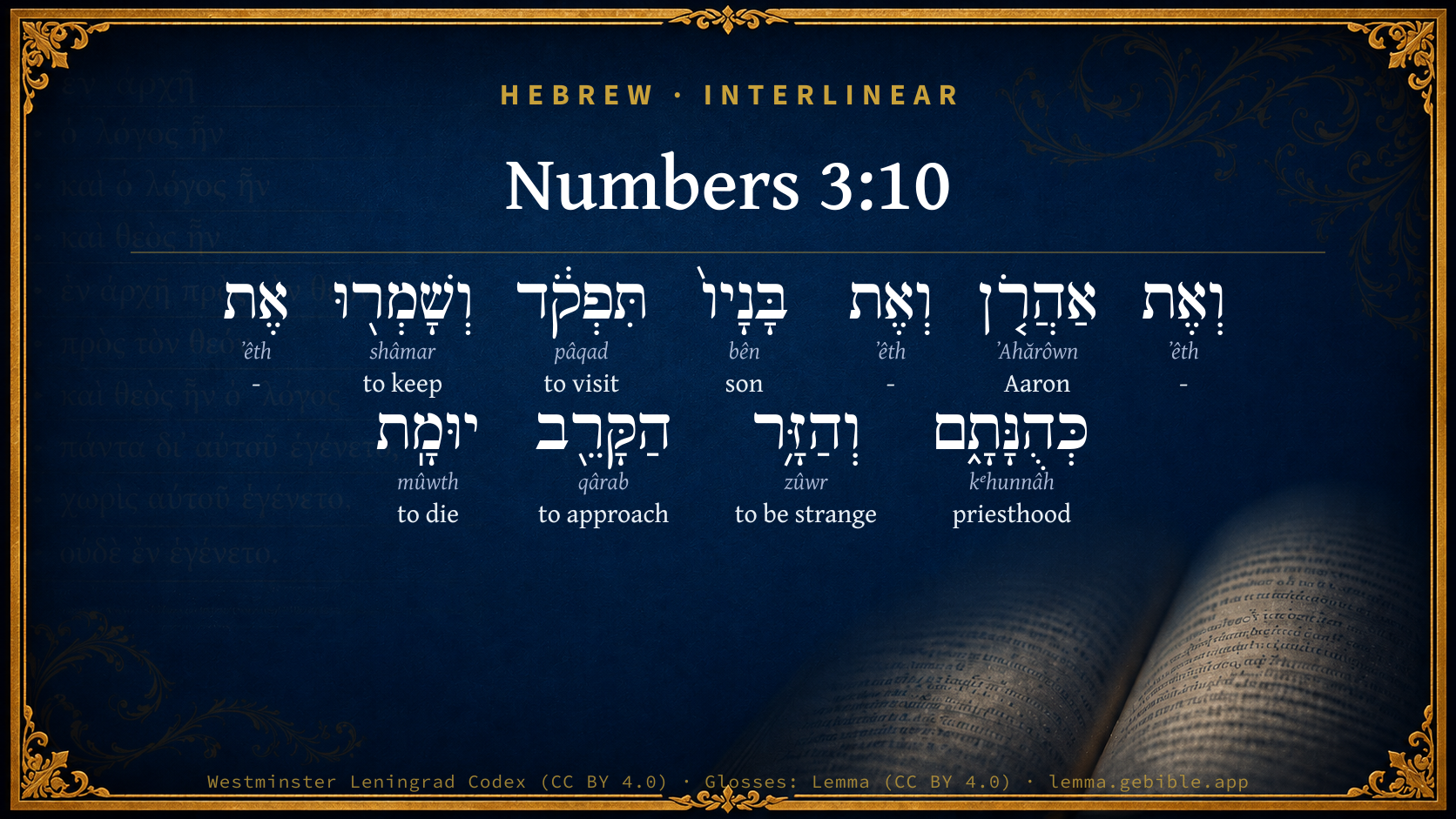
Hebrew (Westminster Leningrad Codex) Numbers 3:10 appears in the Hebrew Old Testament. The text above is from the Westminster Leningrad Codex. Each word links to its Strong’s number, a concise gloss, and parsing drawn from the Open Scriptures Hebrew Bible morphology. Click any word for its full Brown-Driver-Briggs (BDB) entry.
Download image
Cite this verse

Numbers 3:10 (World English Bible). Public Domain. Lemma interlinear Bible study tool, https://lemma.gebible.app/v/numbers/3/10.

Show BibTeX & RIS
BibTeX
RIS
English Translation
You shall appoint Aaron and his sons, and they shall keep their priesthood. The stranger who comes near shall be put to death."
World English Bible · Public Domain
Download a study sheet

One document with this verse’s original text, its word-by-word gloss line, the meaning frame, cross-references with their text, attributed commentary, and full source and license credits — printable, and it pastes into notes with its structure intact.

This verse Autodidact and up

Study sheet (.html) Plain text (.txt)

A passage Seminary Student

Up to 50 verses in one chapter. A passage sheet keeps up to 6 commentary sources and 12 cross-references per verse, in the order this page ranks them, and says so on the sheet whenever that leaves anything out. Ask for a single verse and you get the Autodidact verse sheet above.

Everything on this page stays free to read, with no account — the sheet is a download of what is already on screen, not access to it.

Want to remove ads? Support Godless Engineer
Compare translations 3

The same verse in 3 English versions, stacked beneath the original-language interlinear above. Click any original word for its lexicon entry.

Each is an independent rendering of the whole verse — the interlinear is not word-aligned to these translations.

Highlighted words mark where these versions differ — a whole-verse word diff, not a word-by-word alignment.

  • World English Bible Public Domain
    You shall appoint Aaron and his sons, and they shall keep their priesthood. The stranger who comes near shall be put to death."
  • King James Version Public Domain
    And thou shalt appoint Aaron and his sons, and they shall wait on their priest's office: and the stranger that cometh nigh shall be put to death.
  • unfoldingWord Literal Text CC BY-SA 4.0
    And you shall count Aaron and his sons, and they shall keep their priesthood. And the stranger who comes near shall be put to death.”

unfoldingWord Literal Text — © unfoldingWord, licensed CC BY-SA 4.0. Word-aligned USFM3 via Door43 (git.door43.org/unfoldingWord/en_ult).

Versions to compare (up to 4)

3 of 4 selected

Show all 18 translations

Every available English version of this verse, each an independent rendering of the whole verse.

  • World English Bible Public Domain
    You shall appoint Aaron and his sons, and they shall keep their priesthood. The stranger who comes near shall be put to death."
  • Berean Standard Bible Public Domain
    So you shall appoint Aaron and his sons to carry out the duties of the priesthood; but any outsider who approaches the tabernacle must be put to death.”
  • Majority Standard Bible Public Domain
    So you shall appoint Aaron and his sons to carry out the duties of the priesthood; but any outsider who approaches the tabernacle must be put to death.”
  • King James Version Public Domain
    And thou shalt appoint Aaron and his sons, and they shall wait on their priest's office: and the stranger that cometh nigh shall be put to death.
  • American Standard Version (1901) Public Domain
    And thou shalt appoint Aaron and his sons, and they shall keep their priesthood: and the stranger that cometh nigh shall be put to death.
  • Revised Version (1885) Public Domain
    And thou shalt appoint Aaron and his sons, and they shall keep their priesthood: and the stranger that cometh nigh shall be put to death.
  • Geneva Bible (1599) Public Domain
    And thou shalt appoint Aaron and his sonnes to execute their Priestes office: and the stranger that commeth neere, shalbe slayne.
  • Douay-Rheims (1899) Public Domain
    To Aaron and to his sons, to whom they are delivered by the children of Israel. But thou shalt appoint Aaron and his sons over the service of priesthood. The stranger that approacheth to minister, shall be put to death.
  • Young's Literal Translation Public Domain
    `And Aaron and his sons thou dost appoint, and they have kept their priesthood, and the stranger who cometh near is put to death.'
  • Literal Standard Version CC BY-SA 4.0
    And you appoint Aaron and his sons, and they have kept their priesthood, and the stranger who comes near is put to death.”
  • Unlocked Literal Bible CC BY-SA 4.0
    You must appoint Aaron and his sons as priests, but any foreigner who comes near must be put to death.”
  • unfoldingWord Literal Text CC BY-SA 4.0
    And you shall count Aaron and his sons, and they shall keep their priesthood. And the stranger who comes near shall be put to death.”
  • Darby Bible Public Domain
    And Aaron and his sons shalt thou appoint that they may attend to their priest's office; and the stranger that cometh near shall be put to death.
  • World Messianic Bible Public Domain
    You shall appoint Aaron and his sons, and they shall keep their priesthood, but the stranger who comes near shall be put to death.”
  • Webster's Bible Public Domain
    And thou shalt appoint Aaron and his sons, and they shall wait on their priest's office: and the stranger that cometh nigh shall be put to death.
  • Free Bible Version CC BY-SA 4.0
    You are to appoint Aaron and his sons to have the responsibility of the priesthood. Anyone else who tries to act as a priest must be executed.”
  • Bible in Basic English Public Domain
    And give orders that Aaron and his sons are to keep their place as priests; any strange person who comes near is to be put to death.
  • JPS Tanakh (1917) Public Domain
    And thou shalt appoint Aaron and his sons, that they may keep their priesthood; and the common man that draweth nigh shall be put to death.'

Literal Standard Version (2020), Covenant Press — licensed CC BY-SA 4.0. Text via the HelloAO Bible API (eBible.org). Unlocked Literal Bible (unfoldingWord) — licensed CC BY-SA 4.0. Text via the HelloAO Bible API (eBible.org). unfoldingWord Literal Text — © unfoldingWord, licensed CC BY-SA 4.0. Word-aligned USFM3 via Door43 (git.door43.org/unfoldingWord/en_ult). Free Bible Version, Dr. Jonathan Gallagher — licensed CC BY-SA 4.0. Text via the HelloAO Bible API (eBible.org).

Word by word

More ways to search: Search by grammar → Find every occurrence → Compare this word →

Practice this passage: Drill this verse → Learn its vocabulary →

כְּהֻנָּתָ֑ם
kᵉhunnâh
H3550
“priesthood · their”
Noun, Common, Feminine, Singular, Construct + Suffix, Personal, 3rd Person, Masculine, Plural
Part of Speech
Noun
Type
Common
Gender
Feminine
Number
Singular
State
Construct
Full BDB Definition

Origin: from H3547

TWOT: 959b

priesthood
  1. וְאֶת ʼêth H853 “and · -” Conjunction + Particle, Direct Object
  2. אַהֲרֹ֤ן ʼAhărôwn H175 “Aaron” Noun, Proper
  3. וְאֶת ʼêth H853 “and · -” Conjunction + Particle, Direct Object
  4. בָּנָיו֙ bên H1121 “sons · his” Noun, Common, Masculine, Plural, Construct + Suffix, Personal, 3rd Person, Masculine, Singular
  5. תִּפְקֹ֔ד pâqad H6485 “to visit” Verb, Qal, Imperfect, 2nd Person, Masculine, Singular
  6. וְשָׁמְר֖וּ shâmar H8104 “and · to keep” Conjunction + Verb, Qal, Sequential Perfect, 3rd Person, Common, Plural
  7. אֶת ʼêth H853 “-” Particle, Direct Object
  8. וְהַזָּ֥ר zûwr H2114 “and · the · strange” Conjunction + Particle, Definite Article + Adjective, Adjective, Masculine, Singular, Absolute
  9. הַקָּרֵ֖ב qârab H7126 “the · approaching” Particle, Definite Article + Adjective, Adjective, Masculine, Singular, Absolute
  10. יוּמָֽת mûwth H4191 “to die” Verb, Hophal, Imperfect, 3rd Person, Masculine, Singular

About this verse

These counts appear in no published source. They are computed here, from the morphology-tagged text and Lemma’s own curated glosses. What Lemma adds →

11
words
9
distinct lemmas
Pentateuch
section

Notable vocabulary

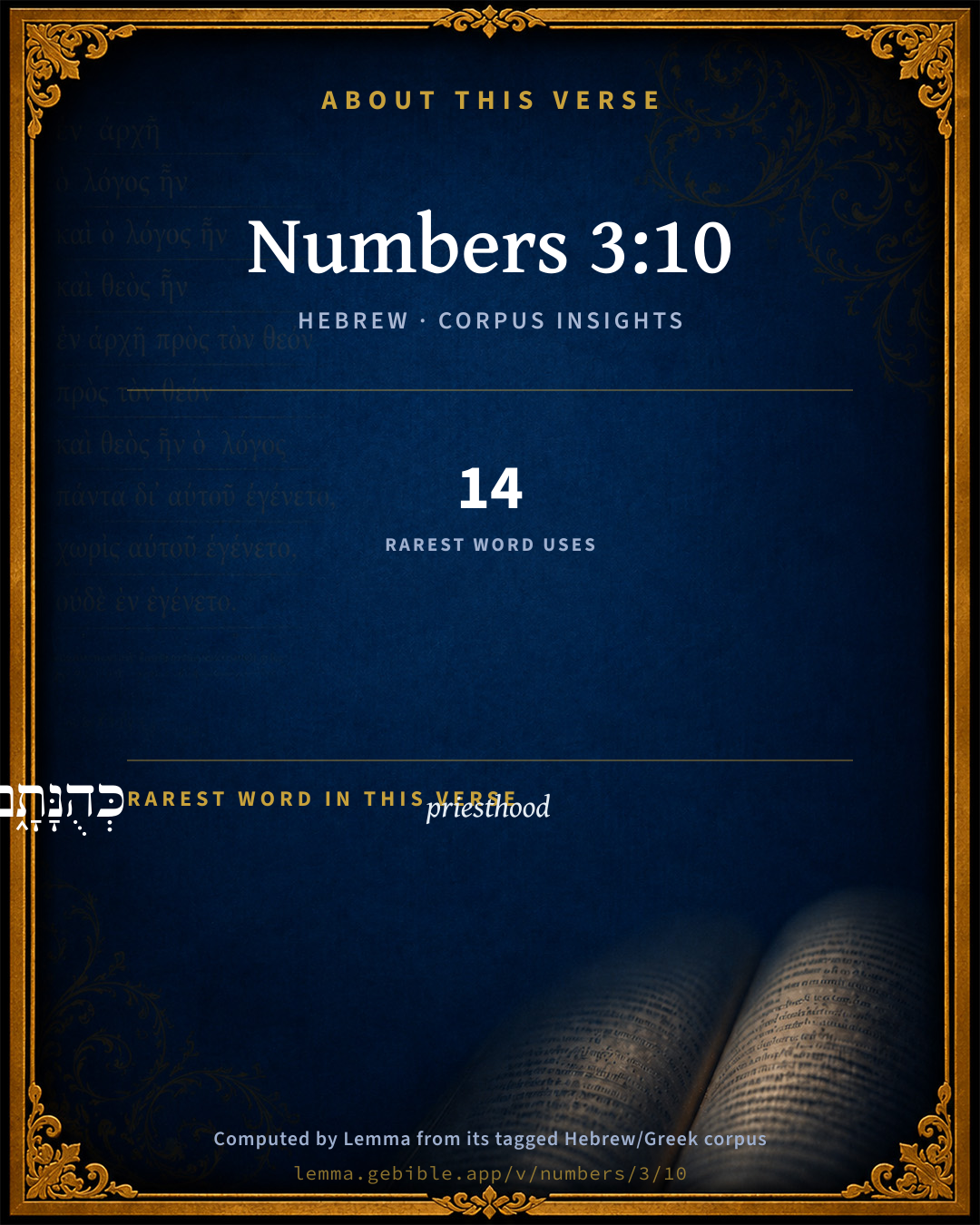
The rarest word here is כְּהֻנָּתָ֑ם priesthood H3550 — appearing just 14 times in the whole Hebrew Bible.

Shared distinctive vocabulary

כְּהֻנָּתָ֑ם priesthood H3550 occurs in 12 verses of the Hebrew Bible. Also found in:

Grammatical profile

  • 3 verbs
  • 3 nouns
  • 2 adjectives
  • 3 particles

Verb forms

  • תִּפְקֹ֔ד Qal · Imperfect
  • וְשָׁמְר֖וּ Qal · Sequential Perfect
  • יוּמָֽת Hophal · Imperfect

Hebrew & Septuagint length

In English translation the verse runs 23 words from the Hebrew and 40 from the Septuagint (LXX English) — the Septuagint runs noticeably longer here. See the side-by-side →

A rough comparison of the two English renderings, which tokenize alike — not a word-level alignment.

Word counts can differ between the Hebrew and the Greek without any difference in meaning — e.g. the Hebrew direct-object marker אֵת has no separate Greek word, and Greek often adds the article ὁ.

Cross-references

18

Topical passages linked to Numbers 3:10 in the Treasury of Scripture Knowledge — connected by theme and wording, ordered by reader-vote popularity; previews shown in the World English Bible.

  • Numbers 1:51 When the tabernacle is to move, the Levites shall take it down; and when the tabernacle is to be set up, the Levites shall set it up. The stranger who comes near shall be put to death.
  • Numbers 3:38 Those who encamp before the tabernacle eastward, in front of the Tent of Meeting toward the sunrise, shall be Moses, and Aaron and his sons, keeping the charge of the sanctuary for the charge of the children of Israel. The stranger who comes near shall be put to death.
  • Numbers 18:7 You and your sons with you shall keep your priesthood for everything of the altar, and for that within the veil; and you shall serve: I give you the priesthood as a service of gift: and the stranger who comes near shall be put to death.
  • Romans 12:7 or service, let us give ourselves to service; or he who teaches, to his teaching;
  • Exodus 29:9 You shall dress them with belts, Aaron and his sons, and bind headbands on them: and they shall have the priesthood by a perpetual statute: and you shall consecrate Aaron and his sons.
  • Numbers 16:35 Fire came forth from Yahweh, and devoured the two hundred fifty men who offered the incense.
  • Numbers 16:40 to be a memorial to the children of Israel, to the end that no stranger, who isn't of the seed of Aaron, comes near to burn incense before Yahweh; that he not be as Korah, and as his company: as Yahweh spoke to him by Moses.
  • Numbers 18:3 They shall keep your charge, and the charge of all the Tent: only they shall not come near to the vessels of the sanctuary and to the altar, that they not die, neither they, nor you.
  • 2 Chronicles 26:16–21 But when he was strong, his heart was lifted up, so that he did corruptly, and he trespassed against Yahweh his God; for he went into the temple of Yahweh to burn incense on the altar of incense.
  • Ezekiel 44:8 You have not kept the charge of my holy things; but you have set keepers of my charge in my sanctuary for yourselves.
  • Acts 6:3–4 Therefore select from among you, brothers, seven men of good report, full of the Holy Spirit and of wisdom, whom we may appoint over this business.
  • Ephesians 2:19 So then you are no longer strangers and foreigners, but you are fellow citizens with the saints, and of the household of God,
  • 1 Timothy 4:15–16 Be diligent in these things. Give yourself wholly to them, that your progress may be revealed to all.
  • Hebrews 8:4 For if he were on earth, he would not be a priest at all, seeing there are priests who offer the gifts according to the law;
  • Hebrews 10:19–22 Having therefore, brothers, boldness to enter into the holy place by the blood of Jesus,
  • 1 Samuel 6:19 He struck of the men of Beth-shemesh, because they had looked into the ark of Yahweh, he struck of the people fifty thousand seventy men; and the people mourned, because Yahweh had struck the people with a great slaughter.
  • 2 Samuel 6:7 The anger of Yahweh was kindled against Uzzah; and God struck him there for his error; and there he died by the ark of God.
  • 1 Chronicles 6:32 They ministered with song before the tent of the tent of meeting, until Solomon had built the house of Yahweh in Jerusalem: and they waited on their office according to their order.

Cross-references courtesy of OpenBible.info (CC BY 4.0).

Hebrew and Greek witnesses Masoretic Hebrew ↔ Greek Septuagint

The same verse in the two great witnesses to the Old Testament, shown verse-for-verse.

Here the Septuagint runs noticeably longer than the Hebrew — LXX2012 (modern English Septuagint) 40 words vs World English Bible 23. A rough length comparison of the two English translations, not a word-level alignment — read both below.

These are two independent witnesses, not word-aligned to each other, and the Septuagint is shown in lemma (dictionary) form.

Hebrew Numbers 3:10 Masoretic · Westminster Leningrad Codex

וְאֶת אַהֲרֹ֤ן וְאֶת בָּנָיו֙ תִּפְקֹ֔ד וְשָׁמְר֖וּ אֶת כְּהֻנָּתָ֑ם וְהַזָּ֥ר הַקָּרֵ֖ב יוּמָֽת

You shall appoint Aaron and his sons, and they shall keep their priesthood. The stranger who comes near shall be put to death."

World English Bible · Public Domain

Greek LXX Numbers 3:10 Septuagint · lemma form

καί ἀαρών καί ὁ υἱός αὐτός καταἵστημι ἐπί ὁ σκηνή ὁ μαρτύριον καί φυλάσσω ὁ ἱερατεία αὐτός καί πᾶς ὁ κατά ὁ βωμός καί ἔσω ὁ καταπέτασμα καί ὁ ἀλλογενής ὁ ἅπτομαι ἀποθνήσκω

And you shall appoint Aaron and his sons over the tabernacle of witness; and they shall keep their charge of priesthood, and all things belonging to the altar, and within the veil; and the stranger that touches them shall die.

LXX2012 (modern English Septuagint) · Public Domain

On this verse, The Cambridge Bible for Schools and Colleges discusses the Septuagint’s reading. Read the note in Commentary ↓

Hebrew: Westminster Leningrad Codex (CC BY 4.0). Greek: Septuagint (public domain); English from LXX2012 (modern English Septuagint) (Public Domain). How the Septuagint differs from the Hebrew →

Targum (Aramaic paraphrase)

2

The Targum is the ancient Jewish Aramaic paraphrase of the Hebrew Scriptures — an interpretive translation, not the Hebrew text itself. Onkelos (literal) and Pseudo-Jonathan (expansive) render the Torah, and Jonathan the Prophets. Coverage is partial: where no permissively-licensed English translation exists for a verse, only the Aramaic is shown. This is verse-level text, not a word-by-word alignment to the Hebrew.

  1. Targum Onkelos Torah (Genesis–Deuteronomy)
    וְיָת אַהֲרֹן וְיָת בְּנוֹהִי תְּמַנֵי וְיִטְרוּן יָת כְּהֻנַתְהוֹן וְחִלוֹנַי דְיִקְרַב יִתְקְטֵל

    (no public-domain English translation for this verse)

    Targum Onkelos — Aramaic: “Onkelos Genesis” (public domain); “Onkelos Exodus” (public domain); “Onkelos Leviticus” (public domain); “Onkelos Numbers” (public domain); “Onkelos Deuteronomy” (public domain). English: “Sefaria Community Translation” (CC0 1.0 (public-domain dedication)); “J.W. Etheridge. The Targums of Onkelos and Jonathan Ben Uzziel on the Pentateuch. London: Longmans, Green, 1862” (public domain). Text via Sefaria.

  2. Targum Pseudo-Jonathan Torah (Genesis–Deuteronomy)
    וְיַת אַהֲרן וְיַת בְּנוֹי תְמַנֵי וְיִטְרוּן יַת כְּהוּנַתְהוֹן וְחִילוֹנֵי דְיִקְרַב יִתְקְטֵל בְּאֵישָׁא מְצַלְהֲבָא קֳדָם יְיָ

    and number thou Aharon and his sons, that they may keep their priesthood; and the stranger who cometh near shall be slain by the flame from. before the Lord.

    Targum Pseudo-Jonathan — Aramaic: “Targum Jonathan on Genesis” (public domain); “Targum Jonathan on Exodus” (public domain); “Targum Jonathan on Leviticus” (public domain); “Targum Jonathan on Numbers” (public domain); “Targum Jonathan on Deuteronomy” (public domain). English: “The Targum of Jonathan ben Uzziel, trans. J. W. Etheridge, London, 1862” (public domain). Text via Sefaria.

Commentary

Notes on Numbers 3:10 from classic Christian and Jewish commentators (each source and its license shown beneath its notes). The classic Christian expositions comment on the surrounding passage and are grouped to its opening verse, so a note may address several verses; the Jewish commentaries on the Tanakh (Rashi and others) are per-verse, so they appear only where the commentator wrote on this verse.

Lemma curates 59 commentaries, every one of them public domain or Creative Commons licensed, each selected and text-cleaned for this edition rather than reprinted as found. About our sources →

Trapp's Complete Commentary

John Trapp

Num 3:10 And thou shalt appoint Aaron and his sons, and they shall wait on their priest’s office: and the stranger that cometh nigh shall be put to death.

Ver. 10. And the stranger.] Though a Levite, yet if not of Aaron’s seed. {Num 18:3 Heb 5:4} Let this be thought upon by our too bold intruders into the work of the ministry.

John Trapp, A Commentary or Exposition upon All the Books of the Old and New Testament (1647–1656) — public domain. Text from a community e-Sword module.

Joseph Benson's Commentary

Num 3:10. The stranger — That is, every one who is of another family than Aaron’s; yea, though he be a Levite. That cometh nigh — To execute any part of the priest’s office.

Joseph Benson's Commentary on the Old and New Testaments (1811–1818) — public domain. Text from a community e-Sword module.

Tyndale Open Study Notes

Tyndale Open Resources

3:10 The sanctuary was sacred (1:51; 3:38; 18:7); it was not to be approached by the unqualified (cp. 3:4).

Tyndale Open Study Notes — © Tyndale Open Resources, licensed CC BY-SA 4.0. Text via the HelloAO Bible API.

Geneva Bible (1599)

Geneva Bible translators

Any that would minister not being a Levite.

Geneva Bible (1599) marginal notes — public domain. Text via Bolls.life.

Adam Clarke's Commentary

Verse 10. Aaron and his sons - shall wait on their priest's office] It was the business of the priests to offer the different sacrifices to God; to consecrate the shew-bread, pour out the libations, burn the incense, sprinkle the blood of the victims, and bless the people. In a word, they were the servants of God alone.

Adam Clarke's Commentary on the Bible (1810–1826) — public domain. Text from a community e-Sword/MySword module.

Ellicott's Commentary for English Readers

(10) Thou shalt appoint.—Or, number. The word is the same as that which is used for the numbering of the Israelites generally (Num_1:19) and for the numbering of the Levites (Num_3:15).

A Bible Commentary for English Readers, edited by Charles John Ellicott (1878–1897) — public domain. Text from a community e-Sword module.

The Cambridge Bible for Schools and Colleges

gen. ed. J. J. S. Perowne

10. keep their priesthood] i.e. perform the duties of their priesthood. LXX. adds ‘and everything about the altar and within the veil’; cf. Num_18:7.

cometh nigh] approaches the sanctuary to perform a priestly office.

The Cambridge Bible for Schools and Colleges (gen. ed. J. J. S. Perowne; Cambridge University Press, 1878–1918) — public domain. Text from a community e-Sword module.

John Gill's Exposition

And thou shalt appoint Aaron and his sons,.... To the priestly office; this was done before, but is renewed for the confirmation of it, and repeated to put them in mind of it, that they be careful to execute it, as follows:

and they shall wait on their priest's office, to do what was peculiar to it, both in the holy and in the most holy place, at the altar, and within, the vail, where the Levites had nothing to do; and this is observed that the priests might take notice, that by the gift of the Levites to them, they were not excused from doing any part of service which was proper to them as priests; for they were given them that they might more readily attend their office, and be wholly employed in it; just as, under the Gospel dispensation, deacons were appointed to take care of the secular affairs of the church, that the apostles might give up themselves to the word of God and prayer, Act 6:2,

and the stranger that cometh nigh shall be put to death; that comes nigh to perform any part of the priest's office peculiar to him as to offer sacrifice, burn incense, &c. whether he be a common Israelite, or even a Levite, as Korah was; any that was not a priest was reckoned a stranger, and so to be put to death for intruding into the office, as the above mentioned person was: so Aben Ezra interprets it of anyone that came nigh to a priest, to be with him or join with him in the execution of his office, whether an Israelite or a Levite, he shall die: the Targum of Jonathan adds, by flaming fire before the Lord.

John Gill's Exposition of the Whole Bible (1746–1763) — public domain (CC PDM 1.0). Text via the HelloAO Bible API.

Haydock's Catholic Bible Commentary

To whom. Samaritan and Septuagint, "to me." They must serve God in the persons of his priests. They are called a gift, people bestowed, as the Nothnim, to serve in the meanest functions; and hence the Nathineans take their name. The Gabaonites were employed by Josue in this quality, Josue ix. 23. --- Over. Hebrew, "they shall retain," &c. They shall permit no stranger to interfere. Cuneus (Rep. ii. 11,) observes, that if a Levite undertook to do the office allotted to another, he was to be slain, after sentence had been passed by the judge. (Calmet)

George Leo Haydock (1774–1849), Haydock's Catholic Family Bible and Commentary, 1859 edition — public domain. Excludes Psalms (Douay-Rheims chapter numbering differs from Protestant) and Deuterocanonical books (Catholic canon only).

Matthew Poole's English Annotations

They shall wait, in their own persons, not by the Levites.

The stranger, i.e. every one who is of another family than Aaron’s, yea, though he be a Levite. See Num 1:53; 16:40.

That cometh nigh, to wit, to execute any part of the priest’s office.

Matthew Poole's English Annotations on the Holy Bible (1683–1685) — public domain. Text from a community e-Sword/MySword module.

The Pulpit Commentary

The stranger that cometh nigh. This constantly recurring formula has not always quite the same meaning: in Num_1:51 it signified any one not of the tribe of Levi; here it includes even the Levite who was not also a priest. The separation of the Levites for the ministry of the tabernacle was not to infringe in the least upon the exclusive rights of Aaron and his sons.

The Pulpit Commentary (1880–1919), ed. H.D.M. Spence-Jones & Joseph S. Exell — public domain. Text from a community e-Sword module.

John Wesley's Explanatory Notes

The stranger - That is, every one who is of another family than Aaron's; yea, though he be a Levite. That cometh nigh - To execute any part of the priest's office.

John Wesley, Explanatory Notes Upon the Whole Bible (1754–1765) — public domain. Text via the GEBible commentary corpus.

Rashi

Rabbi Shlomo Yitzchaki (Rashi)

ואת אהרן ואת בניו תפקד AND THOU SHALT CHARGE AARON AND HIS SONS — The word תפקד is an expression for “appointing” and not an expression for “counting” (although it is Kal, and usually “appointing” is expressed by the Hiphil of the verb; cf. Rashi on Numbers 1:50).

ושמרו את כהנתם AND THEY SHALL KEEP THEIR PRIESTS OFFICE — the receiving of the blood in holy vessels, the sprinkling of it, the burning of the fat and the other rites which are entrusted to the priests’ charge.

Rashi on the Tanakh — English translations: “The Judaica Press complete Tanach with Rashi, translated by A. J. Rosenberg” (CC BY 4.0); “Pentateuch with Rashi's commentary by M. Rosenbaum and A.M. Silbermann, 1929-1934” (public domain); “The Metsudah Tanach series, Lakewood, N.J” (CC BY 4.0); and “The Book of Joshua, Metsudah Publications, 1997” (CC BY 4.0). Text via Sefaria.

Lesson kit

Teaching starters — assembled from the data on this page, not authored interpretation. Every prompt links to the verse data it draws on. Edit before teaching.

Numbers, in the Pentateuch, opens this verse with 11 words (9 distinct Hebrew lemmas). Its most distinctive word is kᵉhunnâh (“priesthood”). The Greek Septuagint runs longer here. A historical commentator’s framing appears above. Read the whole chapter for the surrounding context.

Discussion questions

  1. What does “priesthood” (kᵉhunnâh) contribute to the verse as a whole?
  2. Exodus 29:9 shares the word «priesthood» with this verse. How do the two illuminate each other?
  3. Compared with the Hebrew, the Septuagint runs longer here. What questions does that raise?
  4. These translations render this verse differently. What is at stake in choosing one wording over another?
  5. The verb «תִּפְקֹ֔ד» is Qal Imperfect. How does its form color the action?
  6. Reading how Trapp's Complete Commentary and Joseph Benson's Commentary read this verse, where do the two commentators agree and where do they part?

Things to notice

Reading settings

Reading text

Shown beneath each verse's original-language words.

Old Testament
Old Testament edition

Read the OT as the Masoretic Hebrew (MT) or the Greek Septuagint (LXX).

English shown for the Greek Septuagint (in the Hebrew ↔ Greek comparison).

Comparing translations? Open the Compare panel on any verse page to stack up to four side by side.