
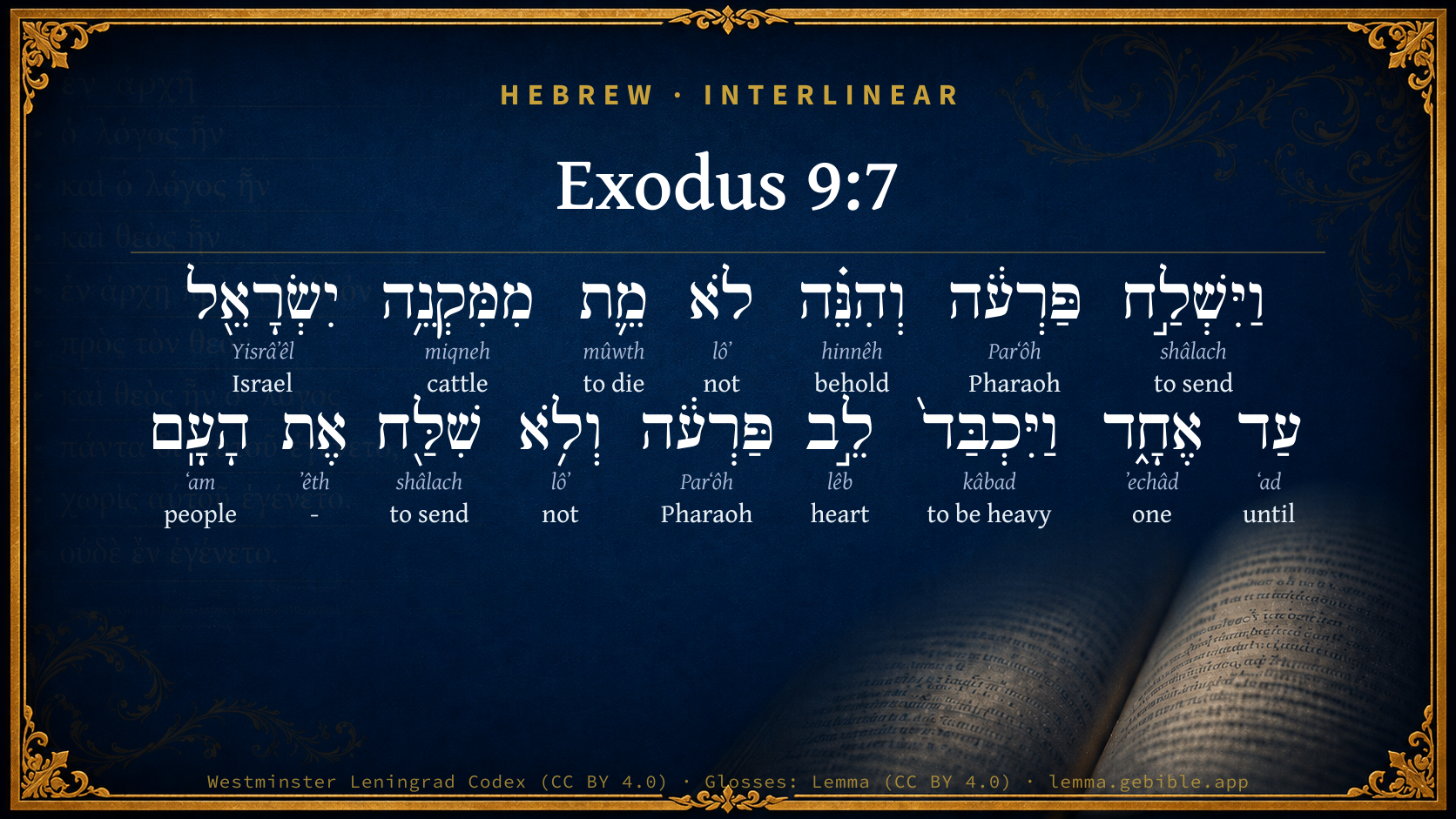
Exodus 9:7

Hebrew (Westminster Leningrad Codex) Exodus 9:7 appears in the Hebrew Old Testament. The text above is from the Westminster Leningrad Codex. Each word links to its Strong’s number, a concise gloss, and parsing drawn from the Open Scriptures Hebrew Bible morphology. Click any word for its full Brown-Driver-Briggs (BDB) entry.
Download image
Cite this verse

Exodus 9:7 (World English Bible). Public Domain. Lemma interlinear Bible study tool, https://lemma.gebible.app/v/exodus/9/7.

Show BibTeX & RIS
BibTeX
RIS
English Translation
Pharaoh sent, and, behold, there was not so much as one of the cattle of the Israelites dead. But the heart of Pharaoh was stubborn, and he didn't let the people go.
World English Bible · Public Domain
Download a study sheet

One document with this verse’s original text, its word-by-word gloss line, the meaning frame, cross-references with their text, attributed commentary, and full source and license credits — printable, and it pastes into notes with its structure intact.

This verse Autodidact and up

Study sheet (.html) Plain text (.txt)

A passage Seminary Student

Up to 50 verses in one chapter. A passage sheet keeps up to 6 commentary sources and 12 cross-references per verse, in the order this page ranks them, and says so on the sheet whenever that leaves anything out. Ask for a single verse and you get the Autodidact verse sheet above.

Everything on this page stays free to read, with no account — the sheet is a download of what is already on screen, not access to it.

Want to remove ads? Support Godless Engineer
Compare translations 3

The same verse in 3 English versions, stacked beneath the original-language interlinear above. Click any original word for its lexicon entry.

Each is an independent rendering of the whole verse — the interlinear is not word-aligned to these translations.

Highlighted words mark where these versions differ — a whole-verse word diff, not a word-by-word alignment.

  • World English Bible Public Domain
    Pharaoh sent, and, behold, there was not so much as one of the cattle of the Israelites dead. But the heart of Pharaoh was stubborn, and he didn't let the people go.
  • King James Version Public Domain
    And Pharaoh sent, and, behold, there was not one of the cattle of the Israelites dead. And the heart of Pharaoh was hardened, and he did not let the people go.
  • unfoldingWord Literal Text CC BY-SA 4.0
    And Pharaoh sent, and, behold, not even one of the livestock of Israel had died. But the heart of Pharaoh was heavy, and he did not let the people go.

unfoldingWord Literal Text — © unfoldingWord, licensed CC BY-SA 4.0. Word-aligned USFM3 via Door43 (git.door43.org/unfoldingWord/en_ult).

Versions to compare (up to 4)

3 of 4 selected

Show all 18 translations

Every available English version of this verse, each an independent rendering of the whole verse.

  • World English Bible Public Domain
    Pharaoh sent, and, behold, there was not so much as one of the cattle of the Israelites dead. But the heart of Pharaoh was stubborn, and he didn't let the people go.
  • Berean Standard Bible Public Domain
    Pharaoh sent officials and found that none of the livestock of the Israelites had died. But Pharaoh’s heart was hardened, and he would not let the people go.
  • Majority Standard Bible Public Domain
    Pharaoh sent officials and found that none of the livestock of the Israelites had died. But Pharaoh’s heart was hardened, and he would not let the people go.
  • King James Version Public Domain
    And Pharaoh sent, and, behold, there was not one of the cattle of the Israelites dead. And the heart of Pharaoh was hardened, and he did not let the people go.
  • American Standard Version (1901) Public Domain
    And Pharaoh sent, and, behold, there was not so much as one of the cattle of the Israelites dead. But the heart of Pharaoh was stubborn, and he did not let the people go.
  • Revised Version (1885) Public Domain
    And Pharaoh sent, and, behold, there was not so much as one of the cattle of the Israelites dead. But the heart of Pharaoh was stubborn, and he did not let the people go.
  • Geneva Bible (1599) Public Domain
    Then Pharaoh sent, and beholde, there was not one of the cattell of the Israelites dead: and the heart of Pharaoh was obstinate, and hee did not let the people goe.
  • Douay-Rheims (1899) Public Domain
    And Pharao sent to see: and there was not any thing dead of that which Israel possessed. And Pharao's heart was hardened, and he did not let the people go.
  • Young's Literal Translation Public Domain
    and Pharaoh sendeth, and lo, not even one of the cattle of Israel hath died, and the heart of Pharaoh is hard, and he hath not sent the people away.
  • Literal Standard Version CC BY-SA 4.0
    and Pharaoh sends, and behold, not even one of the livestock of Israel has died, and the heart of Pharaoh is hard, and he has not sent the people away.
  • Unlocked Literal Bible CC BY-SA 4.0
    Pharaoh investigated, and, behold, not even one animal of the Israelites died. But his heart was stubborn, so he did not let the people go.
  • unfoldingWord Literal Text CC BY-SA 4.0
    And Pharaoh sent, and, behold, not even one of the livestock of Israel had died. But the heart of Pharaoh was heavy, and he did not let the people go.
  • Darby Bible Public Domain
    And Pharaoh sent, and behold, there was not one of the cattle of the Israelites dead. But the heart of Pharaoh was hardened, and he did not let the people go.
  • World Messianic Bible Public Domain
    Pharaoh sent, and, behold, there was not so much as one of the livestock of the Israelites dead. But the heart of Pharaoh was stubborn, and he didn’t let the people go.
  • Webster's Bible Public Domain
    And Pharaoh sent, and behold, there was not one of the cattle of the Israelites dead. And the heart of Pharaoh was hardened, and he did not let the people go.
  • Free Bible Version CC BY-SA 4.0
    Pharaoh sent out officials and discovered that not a single one of the Israelites' livestock had died. But Pharaoh was stubborn, and he would not let the people leave.
  • Bible in Basic English Public Domain
    And Pharaoh sent and got word that there was no loss of any of the cattle of Israel. But the heart of Pharaoh was hard and he did not let the people go.
  • JPS Tanakh (1917) Public Domain
    And Pharaoh sent, and, behold, there was not so much as one of the cattle of the Israelites dead. But the heart of Pharaoh was stubborn, and he did not let the people go.

Literal Standard Version (2020), Covenant Press — licensed CC BY-SA 4.0. Text via the HelloAO Bible API (eBible.org). Unlocked Literal Bible (unfoldingWord) — licensed CC BY-SA 4.0. Text via the HelloAO Bible API (eBible.org). unfoldingWord Literal Text — © unfoldingWord, licensed CC BY-SA 4.0. Word-aligned USFM3 via Door43 (git.door43.org/unfoldingWord/en_ult). Free Bible Version, Dr. Jonathan Gallagher — licensed CC BY-SA 4.0. Text via the HelloAO Bible API (eBible.org).

Word by word

More ways to search: Search by grammar → Find every occurrence → Compare this word →

Practice this passage: Drill this verse → Learn its vocabulary →

מִמִּקְנֵ֥ה
miqneh
H4735
“from · cattle of”
Preposition + Noun, Common, Masculine, Singular, Construct
Part of Speech
Preposition + Noun
Type
Common
Gender
Masculine
Number
Singular
State
Construct
Full BDB Definition

Origin: from H7069

TWOT: 2039b

cattle, livestock - cattle, livestock - in general of a purchasable domestic animal - cows, sheep, goats (in herds and flocks)
  1. וַיִּשְׁלַ֣ח shâlach H7971 “and · to send” Conjunction + Verb, Qal, Sequential Imperfect, 3rd Person, Masculine, Singular
  2. פַּרְעֹ֔ה Parʻôh H6547 “Pharaoh” Noun, Proper
  3. וְהִנֵּ֗ה hinnêh H2009 “and · behold” Conjunction + Particle, Demonstrative
  4. לֹא lôʼ H3808 “not” Particle, Negative
  5. מֵ֛ת mûwth H4191 “to die” Verb, Qal, Perfect, 3rd Person, Masculine, Singular
  6. יִשְׂרָאֵ֖ל Yisrâʼêl H3478 “Israel” Noun, Proper
  7. עַד ʻad H5704 “until” Preposition
  8. אֶחָ֑ד ʼechâd H259 “one” Adjective, Cardinal number, Masculine, Singular, Absolute
  9. וַיִּכְבַּד֙ kâbad H3513 “and · to be heavy” Conjunction + Verb, Qal, Sequential Imperfect, 3rd Person, Masculine, Singular
  10. לֵ֣ב lêb H3820 “heart of” Noun, Common, Masculine, Singular, Construct
  11. פַּרְעֹ֔ה Parʻôh H6547 “Pharaoh” Noun, Proper
  12. וְלֹ֥א lôʼ H3808 “and · not” Conjunction + Particle, Negative
  13. שִׁלַּ֖ח shâlach H7971 “to send” Verb, Piel, Perfect, 3rd Person, Masculine, Singular
  14. אֶת ʼêth H853 “-” Particle, Direct Object
  15. הָעָֽם ʻam H5971 “the · people” Particle, Definite Article + Noun, Common, Masculine, Singular, Absolute

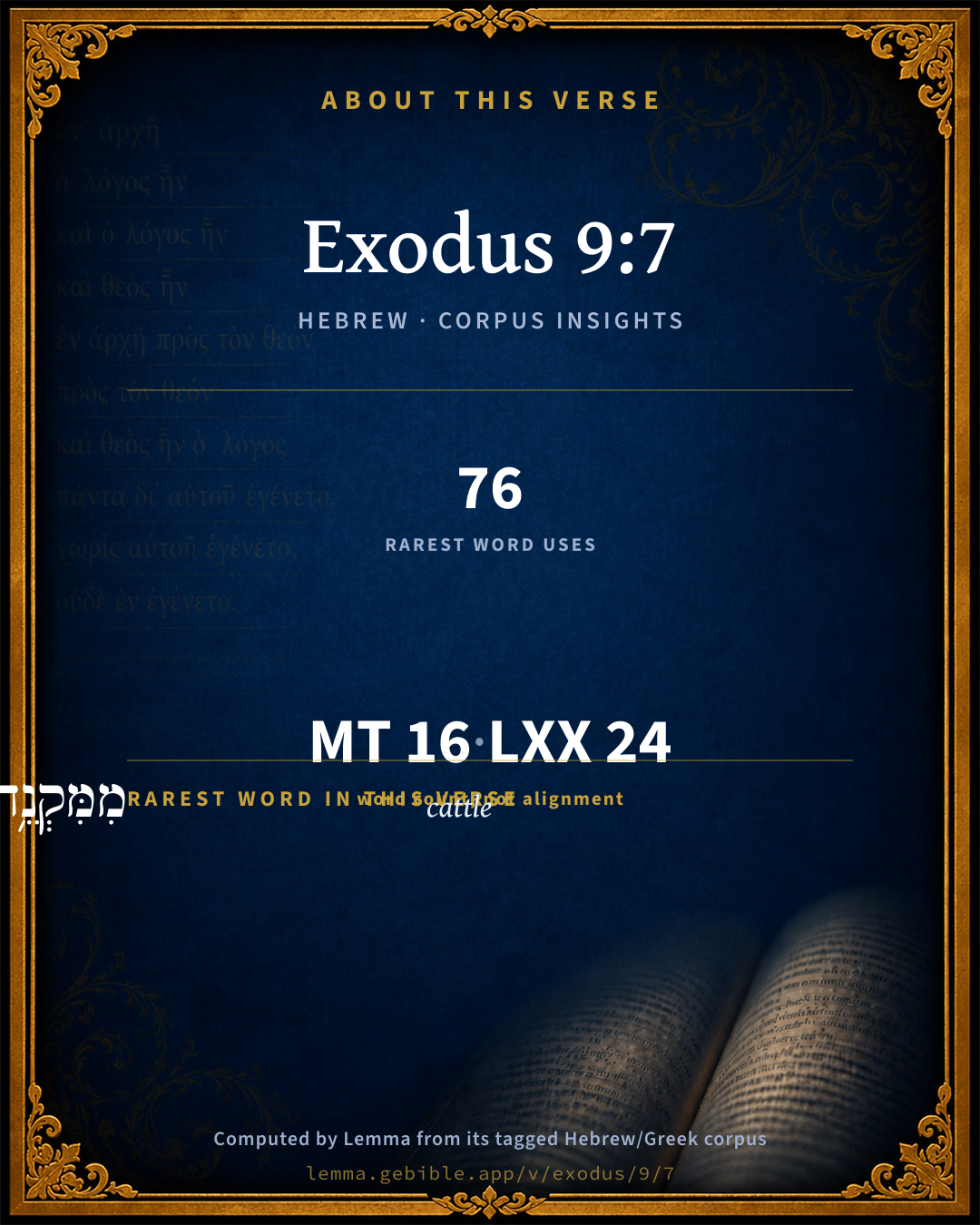
About this verse

These counts appear in no published source. They are computed here, from the morphology-tagged text and Lemma’s own curated glosses. What Lemma adds →

16
words
13
distinct lemmas
Pentateuch
section

Grammatical profile

  • 4 verbs
  • 6 nouns
  • 1 adjective
  • 1 preposition
  • 4 particles

Verb forms

  • וַיִּשְׁלַ֣ח Qal · Sequential Imperfect
  • מֵ֛ת Qal · Perfect
  • וַיִּכְבַּד֙ Qal · Sequential Imperfect
  • שִׁלַּ֖ח Piel · Perfect

Repetition

Words recur within this verse — often emphatic in Hebrew:

  • וַיִּשְׁלַ֣ח to send H7971 ×2
  • פַּרְעֹ֔ה Pharaoh H6547 ×2
  • לֹא not H3808 ×2

Hebrew & Septuagint length

In English translation the verse runs 32 words from the Hebrew and 32 from the Septuagint (LXX English) — the same length.

A rough comparison of the two English renderings, which tokenize alike — not a word-level alignment.

Word counts can differ between the Hebrew and the Greek without any difference in meaning — e.g. the Hebrew direct-object marker אֵת has no separate Greek word, and Greek often adds the article ὁ.

In the original languages it is 16 Hebrew tokens and 24 Greek tokens — but the two are counted differently (Hebrew bundles its prefixes and suffixes into one token; the Greek is in lemma form), so that isn’t a like-for-like length.

Cross-references

8

Topical passages linked to Exodus 9:7 in the Treasury of Scripture Knowledge — connected by theme and wording, ordered by reader-vote popularity; previews shown in the World English Bible.

  • Exodus 7:14 Yahweh said to Moses, "Pharaoh's heart is stubborn. He refuses to let the people go.
  • Exodus 8:32 Pharaoh hardened his heart this time also, and he didn't let the people go.
  • Exodus 9:12 Yahweh hardened the heart of Pharaoh, and he didn't listen to them, as Yahweh had spoken to Moses.
  • Job 9:4 God who is wise in heart, and mighty in strength: Who has hardened himself against him, and prospered?
  • Proverbs 29:1 He who is often rebuked and stiffens his neck Will be destroyed suddenly, with no remedy.
  • Isaiah 48:4 Because I knew that you are obstinate, and your neck is an iron sinew, and your brow brass;
  • Daniel 5:20 But when his heart was lifted up, and his spirit was hardened so that he dealt proudly, he was deposed from his kingly throne, and they took his glory from him:
  • Romans 9:18 So then, he has mercy on whom he desires, and he hardens whom he desires.

Cross-references courtesy of OpenBible.info (CC BY 4.0).

Hebrew and Greek witnesses Masoretic Hebrew ↔ Greek Septuagint

The same verse in the two great witnesses to the Old Testament, shown verse-for-verse.

These are two independent witnesses, not word-aligned to each other, and the Septuagint is shown in lemma (dictionary) form.

Hebrew Exodus 9:7 Masoretic · Westminster Leningrad Codex

וַיִּשְׁלַ֣ח פַּרְעֹ֔ה וְהִנֵּ֗ה לֹא מֵ֛ת מִמִּקְנֵ֥ה יִשְׂרָאֵ֖ל עַד אֶחָ֑ד וַיִּכְבַּד֙ לֵ֣ב פַּרְעֹ֔ה וְלֹ֥א שִׁלַּ֖ח אֶת הָעָֽם

Pharaoh sent, and, behold, there was not so much as one of the cattle of the Israelites dead. But the heart of Pharaoh was stubborn, and he didn't let the people go.

World English Bible · Public Domain

Greek LXX Exodus 9:7 Septuagint · lemma form

ὁράω δέ φαραώ ὅτι οὐ τελευτάω ἀπό πᾶς ὁ κτῆνος ὁ υἱός ἰσραήλ οὐδείς βαρύνω ὁ καρδία φαραώ καί οὐ ἐκ ἀποστέλλω ὁ λαός

And when Pharao saw, that of all the cattle of the children of Israel there died not one, the heart of Pharao was hardened, and he did not let the people go.

LXX2012 (modern English Septuagint) · Public Domain

Hebrew: Westminster Leningrad Codex (CC BY 4.0). Greek: Septuagint (public domain); English from LXX2012 (modern English Septuagint) (Public Domain). How the Septuagint differs from the Hebrew →

Targum (Aramaic paraphrase)

2

The Targum is the ancient Jewish Aramaic paraphrase of the Hebrew Scriptures — an interpretive translation, not the Hebrew text itself. Onkelos (literal) and Pseudo-Jonathan (expansive) render the Torah, and Jonathan the Prophets. Coverage is partial: where no permissively-licensed English translation exists for a verse, only the Aramaic is shown. This is verse-level text, not a word-by-word alignment to the Hebrew.

  1. Targum Onkelos Torah (Genesis–Deuteronomy)
    וּשְׁלַח פַּרְעֹה וְהָא לָא מִית מִבְּעִירָא דְיִשְׂרָאֵל עַד חָד וְאִתְיַקַר לִבָּא דְפַרְעֹה וְלָא שַׁלַח יָת עַמָא:

    (no public-domain English translation for this verse)

    Targum Onkelos — Aramaic: “Onkelos Genesis” (public domain); “Onkelos Exodus” (public domain); “Onkelos Leviticus” (public domain); “Onkelos Numbers” (public domain); “Onkelos Deuteronomy” (public domain). English: “Sefaria Community Translation” (CC0 1.0 (public-domain dedication)); “J.W. Etheridge. The Targums of Onkelos and Jonathan Ben Uzziel on the Pentateuch. London: Longmans, Green, 1862” (public domain). Text via Sefaria.

  2. Targum Pseudo-Jonathan Torah (Genesis–Deuteronomy)
    וְשָׁדַר פַּרְעה פּוּלִין לְמֶחֱמֵי וְהָא לָא מִית מִבְּעִירָא דִבְנֵי יִשְרָאֵל עַד חָד וְאִתְיַיקַר יִצְרָא דְלִבָּא דְפַרְעה וְלָא פְטַר יַת עַמָא

    And Pharoh sent certain to look; and, behold, not one of the cattle of the sons of Israel had died, not even one. But the disposition of Pharoh, heart was aggravated, and he would not release the people.

    Targum Pseudo-Jonathan — Aramaic: “Targum Jonathan on Genesis” (public domain); “Targum Jonathan on Exodus” (public domain); “Targum Jonathan on Leviticus” (public domain); “Targum Jonathan on Numbers” (public domain); “Targum Jonathan on Deuteronomy” (public domain). English: “The Targum of Jonathan ben Uzziel, trans. J. W. Etheridge, London, 1862” (public domain). Text via Sefaria.

Commentary

Notes on Exodus 9:7 from classic Christian and Jewish commentators (each source and its license shown beneath its notes). The classic Christian expositions comment on the surrounding passage and are grouped to its opening verse, so a note may address several verses; the Jewish commentaries on the Tanakh (Rashi and others) are per-verse, so they appear only where the commentator wrote on this verse.

Lemma curates 59 commentaries, every one of them public domain or Creative Commons licensed, each selected and text-cleaned for this edition rather than reprinted as found. About our sources →

Trapp's Complete Commentary

John Trapp

Exo 9:7 And Pharaoh sent, and, behold, there was not one of the cattle of the Israelites dead. And the heart of Pharaoh was hardened, and he did not let the people go.

Ver. 7. And the heart of Pharaoh was hardened.] Like a smith’s anvil, he grew harder for hammering. There was little need to say to Pharaoh, as the smith did to the Landgrave of Thuring, Durescite, durescite, O in felix Lantgravi. {a} He hardened fast enough.

{a} Pet. Nicol. Gelstronp.

John Trapp, A Commentary or Exposition upon All the Books of the Old and New Testament (1647–1656) — public domain. Text from a community e-Sword module.

Joseph Benson's Commentary

Exo 9:7. Pharaoh sent — It seems as if Pharaoh, notwithstanding all he had seen, could not conceive that such a distinction could be made between cattle feeding together in the same or similar pastures, that those of the Egyptians alone should be stricken, while those of the Israelites were not affected; and therefore he sent expressly to know the truth of it: when behold, (and well might it be said, behold! for it was worthy of both notice and admiration,) there was not one of the cattle of the Israelites dead — But, notwithstanding this most convincing evidence of the distinguishing favour of God toward his people, such was the unwillingness of Pharaoh to part with the advantage which the service of the Israelites was to him, that he could not bring himself to consent to their departure.

Joseph Benson's Commentary on the Old and New Testaments (1811–1818) — public domain. Text from a community e-Sword module.

Geneva Bible (1599)

Geneva Bible translators

Into the land of Goshen, where the Israelites dwelled.

Geneva Bible (1599) marginal notes — public domain. Text via Bolls.life.

Jamieson, Fausset & Brown

Robert Jamieson, A. R. Fausset & David Brown

Pharaoh sent . . . there was not one of the cattle of the Israelites dead--The despatch of confidential messengers indicates that he would not give credit to vague reports, and we may conclude that some impression had been made on his mind by that extraordinary exemption, but it was neither a good nor a permanent impression. His pride and obstinacy were in no degree subdued.

Jamieson, Fausset & Brown — Commentary Critical and Explanatory on the Whole Bible (1871) — public domain (CC PDM 1.0). Text via the HelloAO Bible API.

Adam Clarke's Commentary

Verse 7. And Pharaoh sent, &c.] Finding so many of his own cattle and those of his subjects slain, he sent to see whether the mortality had reached to the cattle of the Israelites, that he might know whether this were a judgment inflicted by their God, and probably designing to replace the lost cattle of the Egyptians with those of the Israelites.

Adam Clarke's Commentary on the Bible (1810–1826) — public domain. Text from a community e-Sword/MySword module.

Ellicott's Commentary for English Readers

(7) Pharaoh sent.—The Pharaoh evidently did not believe it possible that there should be such a widespread destruction of the Egyptian cattle without the Hebrew cattle suffering at all. He therefore sent persons to inquire and report on the facts. These persons found the announcement of Moses fulfilled to the letter. This was the more surprising, as Goshen consisted mainly of the low flat tract bordering on the Menzaleh marshes.

The heart of Pharaoh was hardened.—Even the exact correspondence of the result with the announcement did not soften the heart of the king. It remained dull and unimpressed—literally, “heavy” kâbêd). Loss of property would not much distress an absolute monarch, who could easily exact the value of what he had lost from his subjects.

A Bible Commentary for English Readers, edited by Charles John Ellicott (1878–1897) — public domain. Text from a community e-Sword module.

The Cambridge Bible for Schools and Colleges

gen. ed. J. J. S. Perowne

7. was stubborn] lit. heavy; the word regularly used by J (v. 34, Exo_7:14, Exo_8:15; Exo_8:32, Exo_10:1).

The Cambridge Bible for Schools and Colleges (gen. ed. J. J. S. Perowne; Cambridge University Press, 1878–1918) — public domain. Text from a community e-Sword module.

John Gill's Exposition

And Pharaoh sent,.... Messengers to the land of Goshen, to see whether the murrain was upon the cattle of Israel or not, and whether any of them died or not. The Targum of Jonathan is,"he sent to Pelusium to see"

and inquire about this matter; that is, to Raamses, for so that paraphrase calls Raamses in Exo 1:11 a city built by the Israelites, and where many of them might dwell. This Pharaoh did, not merely out of curiosity, but to know whether the divine prediction was accomplished, and that he might have wherewith to confront it, could he find the murrain was upon any of the cattle of Israel, or any died of it; and if they did not, his view might be to convert them to his own use, and make up his loss, and the loss of his people, in a good measure in this way, and perhaps this may be the reason why he so little regarded this plague:

and, behold, there was not one of the cattle of the Israelites dead; which was very wonderful, and therefore a "behold", a note of admiration, is prefixed to it, yet it made no impression on Pharaoh:

and the heart of Pharaoh was hardened, and he did not let the people go; though this plague was so heavy upon him and his people, and the loss they sustained so great: in the other plagues of the water, the frogs, lice, and flies, though very troublesome and terrible, yet the loss was not very great; but here much damage was done to their property, yet this did not make his heart relent, or cause him to yield to let Israel go.

John Gill's Exposition of the Whole Bible (1746–1763) — public domain (CC PDM 1.0). Text via the HelloAO Bible API.

Albert Barnes' Notes on the Bible

Was hardened - See Exo 4:21. Pharaoh probably attributed the exemption of the Israelites to natural causes. They were a pastoral race, well acquainted with all that pertained to the care of cattle; and dwelling in a healthy district probably far more than the rest of Lower Egypt.

Albert Barnes' Notes on the Bible (1834–1885) — public domain. Text from a community e-Sword/MySword module.

Haydock's Catholic Bible Commentary

Hardened. He did not beg for a deliverance, as the beasts were dead. (Menochius)

George Leo Haydock (1774–1849), Haydock's Catholic Family Bible and Commentary, 1859 edition — public domain. Excludes Psalms (Douay-Rheims chapter numbering differs from Protestant) and Deuterocanonical books (Catholic canon only).

Whedon's Commentary on the Bible

Daniel D. Whedon

7. And Pharaoh sent… and the heart of Pharaoh was hardened — Here, as in Exo_7:22, the grammatical construction implies cause and effect. This marked manifestation in behalf of Israel aroused the anger and obstinacy of Pharaoh the more. He does not melt or waver, and on this occasion is not awed even into temporary submission.

Daniel D. Whedon (gen. ed.), Commentary on the Old and New Testaments (1874–1909) — public domain. Text from a community e-Sword module.

The Pulpit Commentary

And Pharaoh sent. This time the king had the curiosity to send out and see whether the Israelites had been spared. Though he found the fact correspond to the announcement, he was not seriously impressed. Perhaps he thought the Israelites took better care of their cattle and were better cattle doctors than his own people. (The doctoring of cattle is represented on the monuments. Rosellini, Mon. Civ. pl. 31.) Or he may have attributed the escape of their animals to the more healthy air of Goshen. Pharaoh"s heart was hardened. The plague affected him less than others had done, rather than more. He was so rich that an affliction which touched nothing but property seemed a trivial matter What cared he for the sufferings of the poor beasts, or the ruin of those who depended upon the breeding and feeding of cattle

The Pulpit Commentary (1880–1919), ed. H.D.M. Spence-Jones & Joseph S. Exell — public domain. Text from a community e-Sword module.

Keil & Delitzsch

C. F. Keil & F. Delitzsch

But Pharaoh's heart still continued hardened, though he convinced himself by direct inquiry that the cattle of the Israelites had been spared.

Keil & Delitzsch — Biblical Commentary on the Old Testament (1861–1891) — public domain (CC PDM 1.0). Text via the HelloAO Bible API. (Old Testament only.)

Lesson kit

Teaching starters — assembled from the data on this page, not authored interpretation. Every prompt links to the verse data it draws on. Edit before teaching.

Exodus, in the Pentateuch, opens this verse with 16 words (13 distinct Hebrew lemmas). Its most distinctive word is miqneh (“cattle”). A historical commentator’s framing appears above. Read the whole chapter for the surrounding context.

Discussion questions

  1. What does “cattle” (miqneh) contribute to the verse as a whole?
  2. Exodus 7:14 shares this passage’s theme. How do the two illuminate each other?
  3. “to send” occurs 2× in this one verse. What is the effect of the repetition?
  4. These translations render this verse differently; the difference is in the English rendering, not the original. What questions does that raise?
  5. The verb «וַיִּשְׁלַ֣ח» is Qal Sequential Imperfect. How does its form color the action?
  6. Reading how Trapp's Complete Commentary and Joseph Benson's Commentary read this verse, where do the two commentators agree and where do they part?

Things to notice

Reading settings

Reading text

Shown beneath each verse's original-language words.

Old Testament
Old Testament edition

Read the OT as the Masoretic Hebrew (MT) or the Greek Septuagint (LXX).

English shown for the Greek Septuagint (in the Hebrew ↔ Greek comparison).

Comparing translations? Open the Compare panel on any verse page to stack up to four side by side.