
Exodus 21:36

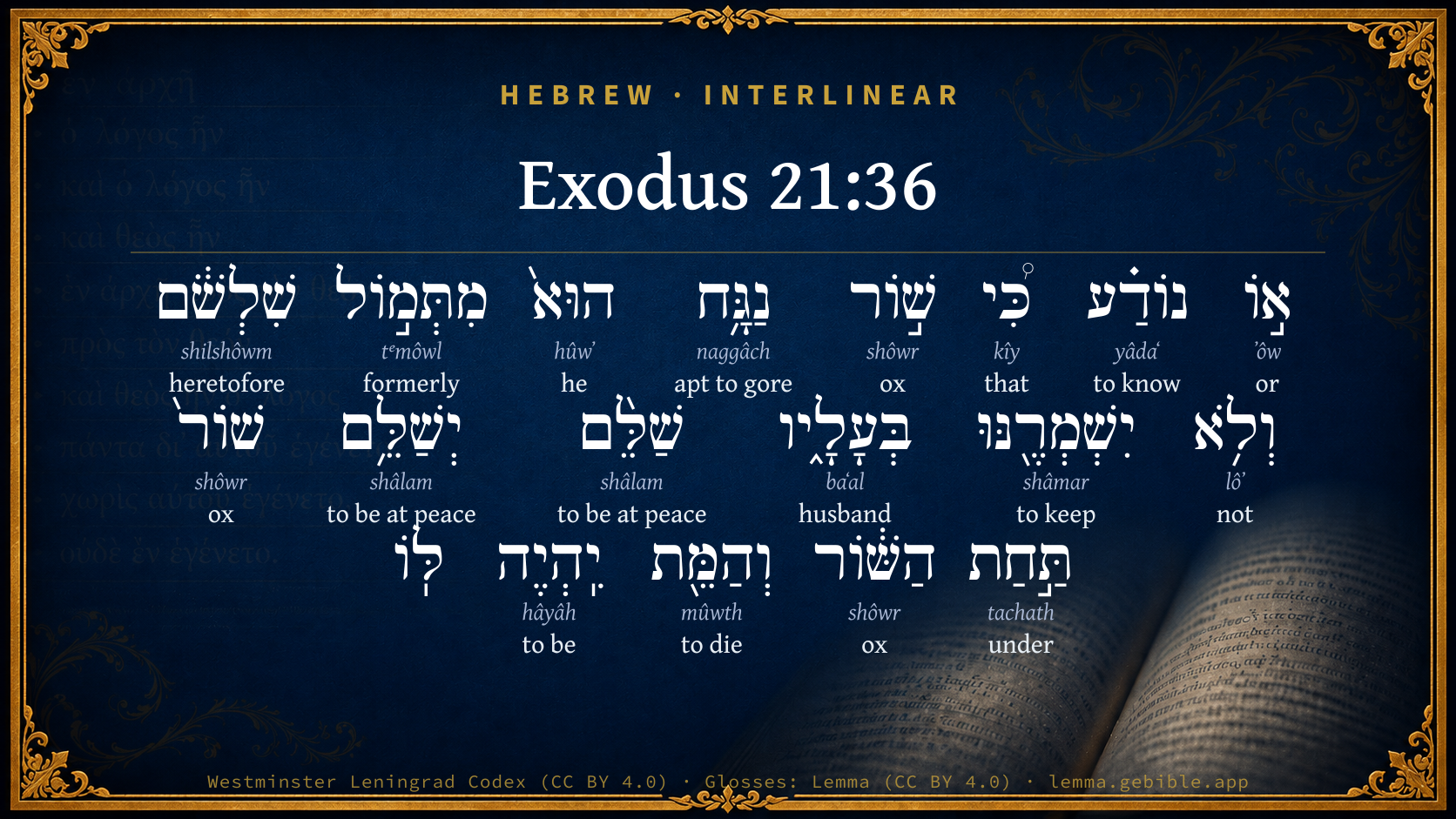
Hebrew (Westminster Leningrad Codex) Exodus 21:36 appears in the Hebrew Old Testament. The text above is from the Westminster Leningrad Codex. Each word links to its Strong’s number, a concise gloss, and parsing drawn from the Open Scriptures Hebrew Bible morphology. Click any word for its full Brown-Driver-Briggs (BDB) entry.
Download image
Cite this verse

Exodus 21:36 (World English Bible). Public Domain. Lemma interlinear Bible study tool, https://lemma.gebible.app/v/exodus/21/36.

Show BibTeX & RIS
BibTeX
RIS
English Translation
Or if it is known that the bull was in the habit of goring in the past, and its owner has not kept it in, he shall surely pay bull for bull, and the dead animal shall be his own.
World English Bible · Public Domain
Download a study sheet

One document with this verse’s original text, its word-by-word gloss line, the meaning frame, cross-references with their text, attributed commentary, and full source and license credits — printable, and it pastes into notes with its structure intact.

This verse Autodidact and up

Study sheet (.html) Plain text (.txt)

A passage Seminary Student

Up to 50 verses in one chapter. A passage sheet keeps up to 6 commentary sources and 12 cross-references per verse, in the order this page ranks them, and says so on the sheet whenever that leaves anything out. Ask for a single verse and you get the Autodidact verse sheet above.

Everything on this page stays free to read, with no account — the sheet is a download of what is already on screen, not access to it.

Want to remove ads? Support Godless Engineer
Compare translations 3

The same verse in 3 English versions, stacked beneath the original-language interlinear above. Click any original word for its lexicon entry.

Each is an independent rendering of the whole verse — the interlinear is not word-aligned to these translations.

Highlighted words mark where these versions differ — a whole-verse word diff, not a word-by-word alignment.

  • World English Bible Public Domain
    Or if it is known that the bull was in the habit of goring in the past, and its owner has not kept it in, he shall surely pay bull for bull, and the dead animal shall be his own.
  • King James Version Public Domain
    Or if it be known that the ox hath used to push in time past, and his owner hath not kept him in; he shall surely pay ox for ox; and the dead shall be his own.
  • unfoldingWord Literal Text CC BY-SA 4.0
    If it was known that the ox had a habit of goring in the past, and its owner has not kept it in, he shall surely compensate ox for ox, and the dead animal shall become his own.

unfoldingWord Literal Text — © unfoldingWord, licensed CC BY-SA 4.0. Word-aligned USFM3 via Door43 (git.door43.org/unfoldingWord/en_ult).

Versions to compare (up to 4)

3 of 4 selected

Show all 18 translations

Every available English version of this verse, each an independent rendering of the whole verse.

  • World English Bible Public Domain
    Or if it is known that the bull was in the habit of goring in the past, and its owner has not kept it in, he shall surely pay bull for bull, and the dead animal shall be his own.
  • Berean Standard Bible Public Domain
    But if it was known that the ox had a habit of goring, yet its owner failed to restrain it, he shall pay full compensation, ox for ox, and the dead animal will be his.
  • Majority Standard Bible Public Domain
    But if it was known that the ox had a habit of goring, yet its owner failed to restrain it, he shall pay full compensation, ox for ox, and the dead animal will be his.
  • King James Version Public Domain
    Or if it be known that the ox hath used to push in time past, and his owner hath not kept him in; he shall surely pay ox for ox; and the dead shall be his own.
  • American Standard Version (1901) Public Domain
    Or if it be known that the ox was wont to gore in time past, and its owner hath not kept it in, he shall surely pay ox for ox, and the dead `beast' shall be his own.
  • Revised Version (1885) Public Domain
    Or if it be known that the ox was wont to gore in time past, and his owner hath not kept him in; he shall surely pay ox for ox, and the dead beast shall be his own.
  • Geneva Bible (1599) Public Domain
    Or if it bee knowen that the oxe hath vsed to push in times past, and his master hath not kept him, he shall pay oxe for oxe, but the dead shall be his owne.
  • Douay-Rheims (1899) Public Domain
    But if he knew that his ox was wont to push yesterday and the day before, and his master did not keep him in: he shall pay ox for ox, and shall take the whole carcass.
  • Young's Literal Translation Public Domain
    or, it hath been known that the ox is `one' accustomed to gore heretofore, and its owner doth not watch it, he certainly repayeth ox for ox, and the dead is his.
  • Literal Standard Version CC BY-SA 4.0
    or, [if] it has been known that the ox is [one] accustomed to gore before, and its owner does not watch it, he certainly repays ox for ox, and the dead is his.
  • Unlocked Literal Bible CC BY-SA 4.0
    But if it was known that the ox had a habit of goring in time past, and its owner has not kept it in, he must surely pay ox for ox, and the dead animal will become his own.
  • unfoldingWord Literal Text CC BY-SA 4.0
    If it was known that the ox had a habit of goring in the past, and its owner has not kept it in, he shall surely compensate ox for ox, and the dead animal shall become his own.
  • Darby Bible Public Domain
    Or if it be known that the ox have gored heretofore, and its owner have not kept him in, he shall in any case restore ox for ox; and the dead shall be his.
  • World Messianic Bible Public Domain
    Or if it is known that the bull was in the habit of goring in the past, and its owner has not kept it in, he shall surely pay bull for bull, and the dead animal shall be his own.
  • Webster's Bible Public Domain
    Or if it shall be known that the ox hath used to push in time past, and his owner hath not restrained him; he shall surely pay ox for ox, and the dead shall be his own.
  • Free Bible Version CC BY-SA 4.0
    But if it was known that the ox had repeatedly hurt people with its horns, and its owner had been warned but still didn't keep it under control, full compensation must be paid, ox for ox, but the owner can keep the dead animal.”
  • Bible in Basic English Public Domain
    But if it is common knowledge that the ox has frequently done such damage in the past, and its owner has not kept it under control, he will have to give ox for ox; and the dead beast will be his.
  • JPS Tanakh (1917) Public Domain
    Or if it be known that the ox was wont to gore in time past, and its owner hath not kept it in; he shall surely pay ox for ox, and the dead beast shall be his own.

Literal Standard Version (2020), Covenant Press — licensed CC BY-SA 4.0. Text via the HelloAO Bible API (eBible.org). Unlocked Literal Bible (unfoldingWord) — licensed CC BY-SA 4.0. Text via the HelloAO Bible API (eBible.org). unfoldingWord Literal Text — © unfoldingWord, licensed CC BY-SA 4.0. Word-aligned USFM3 via Door43 (git.door43.org/unfoldingWord/en_ult). Free Bible Version, Dr. Jonathan Gallagher — licensed CC BY-SA 4.0. Text via the HelloAO Bible API (eBible.org).

Word by word

More ways to search: Search by grammar → Find every occurrence → Compare this word →

Practice this passage: Drill this verse → Learn its vocabulary →

נַגָּ֥ח
naggâch
H5056
“apt to gore”
Adjective, Adjective, Masculine, Singular, Absolute
Part of Speech
Adjective
Type
Adjective
Gender
Masculine
Number
Singular
State
Absolute
Full BDB Definition

Origin: from H5055

TWOT: 1291a

addicted to goring, apt to gore
  1. א֣וֹ ʼôw H176 “or” Conjunction
  2. נוֹדַ֗ע yâdaʻ H3045 “to know” Verb, Niphal, Perfect, 3rd Person, Masculine, Singular
  3. כִּ֠י kîy H3588 “that” Conjunction
  4. שׁ֣וֹר shôwr H7794 “ox” Noun, Common, Masculine, Singular, Absolute
  5. הוּא֙ hûwʼ H1931 “he” Pronoun, Personal, 3rd Person, Masculine, Singular
  6. מִתְּמ֣וֹל tᵉmôwl H8543 “from · formerly” Preposition + Adverb
  7. שִׁלְשֹׁ֔ם shilshôwm H8032 “heretofore” Adverb
  8. וְלֹ֥א lôʼ H3808 “and · not” Conjunction + Particle, Negative
  9. יִשְׁמְרֶ֖נּוּ shâmar H8104 “to keep · him” Verb, Qal, Imperfect, 3rd Person, Masculine, Singular + Suffix, Personal, 3rd Person, Masculine, Singular
  10. בְּעָלָ֑יו baʻal H1167 “husbands · his” Noun, Common, Masculine, Plural, Construct + Suffix, Personal, 3rd Person, Masculine, Singular
  11. שַׁלֵּ֨ם shâlam H7999 “to be at peace” Verb, Piel, Infinitive Absolute
  12. יְשַׁלֵּ֥ם shâlam H7999 “to be at peace” Verb, Piel, Imperfect, 3rd Person, Masculine, Singular
  13. שׁוֹר֙ shôwr H7794 “ox” Noun, Common, Masculine, Singular, Absolute
  14. תַּ֣חַת tachath H8478 “under” Preposition
  15. הַשּׁ֔וֹר shôwr H7794 “the · ox” Particle, Definite Article + Noun, Common, Masculine, Singular, Absolute
  16. וְהַמֵּ֖ת mûwth H4191 “and · the · dying” Conjunction + Particle, Definite Article + Verb, Qal, Participle Active, Masculine, Singular, Absolute
  17. יִֽהְיֶה hâyâh H1961 “to be” Verb, Qal, Imperfect, 3rd Person, Masculine, Singular

About this verse

These counts appear in no published source. They are computed here, from the morphology-tagged text and Lemma’s own curated glosses. What Lemma adds →

19
words
15
distinct lemmas
Pentateuch
section

Notable vocabulary

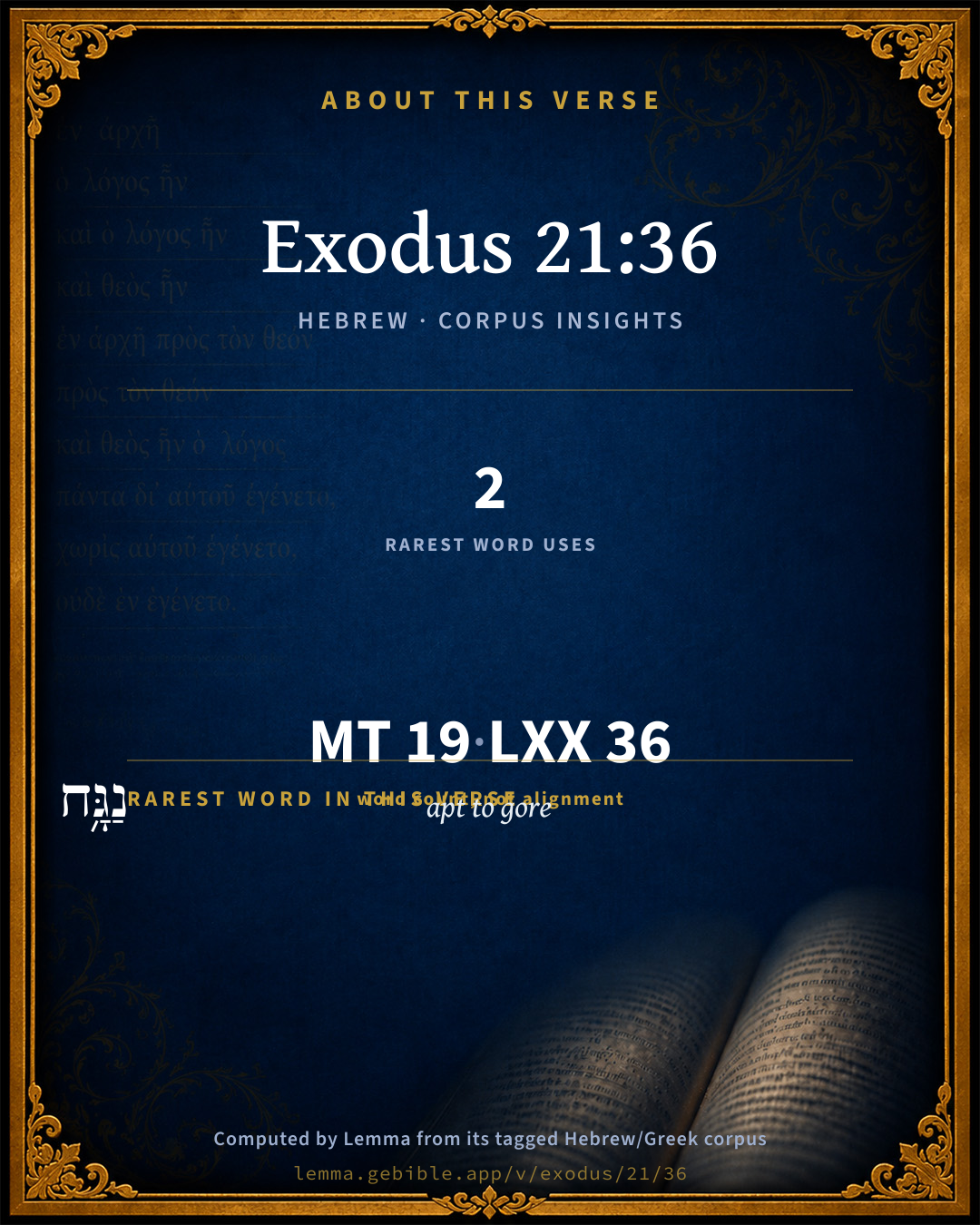
The rarest word here is נַגָּ֥ח apt to gore H5056 — appearing just 2 times in the whole Hebrew Bible.

Shared distinctive vocabulary

נַגָּ֥ח apt to gore H5056 occurs in 2 verses of the Hebrew Bible. Also found in:

Grammatical profile

  • 6 verbs
  • 4 nouns
  • 1 adjective
  • 1 pronoun
  • 2 prepositions
  • 2 conjunctions
  • 2 adverbs
  • 1 particle

Verb forms

  • נוֹדַ֗ע Niphal · Perfect
  • יִשְׁמְרֶ֖נּוּ Qal · Imperfect
  • שַׁלֵּ֨ם Piel · Infinitive Absolute
  • יְשַׁלֵּ֥ם Piel · Imperfect
  • וְהַמֵּ֖ת Qal · Participle Active
  • יִֽהְיֶה Qal · Imperfect

Repetition

Words recur within this verse — often emphatic in Hebrew:

  • שׁ֣וֹר ox H7794 ×3
  • שַׁלֵּ֨ם to be at peace H7999 ×2

Hebrew & Septuagint length

In English translation the verse runs 40 words from the Hebrew and 41 from the Septuagint (LXX English) — closely comparable.

A rough comparison of the two English renderings, which tokenize alike — not a word-level alignment.

Word counts can differ between the Hebrew and the Greek without any difference in meaning — e.g. the Hebrew direct-object marker אֵת has no separate Greek word, and Greek often adds the article ὁ.

In the original languages it is 19 Hebrew tokens and 36 Greek tokens — but the two are counted differently (Hebrew bundles its prefixes and suffixes into one token; the Greek is in lemma form), so that isn’t a like-for-like length.

Hebrew and Greek witnesses Masoretic Hebrew ↔ Greek Septuagint

The same verse in the two great witnesses to the Old Testament, shown verse-for-verse.

These are two independent witnesses, not word-aligned to each other, and the Septuagint is shown in lemma (dictionary) form.

Hebrew Exodus 21:36 Masoretic · Westminster Leningrad Codex

א֣וֹ נוֹדַ֗ע כִּ֠י שׁ֣וֹר נַגָּ֥ח הוּא֙ מִתְּמ֣וֹל שִׁלְשֹׁ֔ם וְלֹ֥א יִשְׁמְרֶ֖נּוּ בְּעָלָ֑יו שַׁלֵּ֨ם יְשַׁלֵּ֥ם שׁוֹר֙ תַּ֣חַת הַשּׁ֔וֹר וְהַמֵּ֖ת יִֽהְיֶה לּֽוֹ

Or if it is known that the bull was in the habit of goring in the past, and its owner has not kept it in, he shall surely pay bull for bull, and the dead animal shall be his own.

World English Bible · Public Domain

Greek LXX Exodus 21:36 Septuagint · lemma form

ἐάν δέ γνωρίζω ὁ ταῦρος ὅτι κερατιστής εἰμί πρό ὁ χθές καί πρό ὁ τρίτος ἡμέρα καί διαμαρτυρέω εἰμί ὁ κύριος αὐτός καί μή ἀπο ἀναἵζω αὐτός ἀποτίνω ταῦρος ἀντί ταῦρος ὁ δέ τελευτάω αὐτός εἰμί

But if the bull be known to have been given to goring in time past, and they have testified to his owner, and he have not removed him, he shall repay bull for bull, but the dead shall be his own.

LXX2012 (modern English Septuagint) · Public Domain

Hebrew: Westminster Leningrad Codex (CC BY 4.0). Greek: Septuagint (public domain); English from LXX2012 (modern English Septuagint) (Public Domain). How the Septuagint differs from the Hebrew →

Targum (Aramaic paraphrase)

2

The Targum is the ancient Jewish Aramaic paraphrase of the Hebrew Scriptures — an interpretive translation, not the Hebrew text itself. Onkelos (literal) and Pseudo-Jonathan (expansive) render the Torah, and Jonathan the Prophets. Coverage is partial: where no permissively-licensed English translation exists for a verse, only the Aramaic is shown. This is verse-level text, not a word-by-word alignment to the Hebrew.

  1. Targum Onkelos Torah (Genesis–Deuteronomy)
    אוֹ אִתְיְדַע אֲרֵי תוֹר נַגַח הוּא מֵאִתְּמַלֵי וּמִדְקַמוֹהִי וְלָא נָטְרֵהּ מָרֵהּ שַׁלָמָא יְשַׁלֵם תּוֹרָא חֲלַף תּוֹרָא וּמֵיתָא יְהֵא דִילֵהּ:

    (no public-domain English translation for this verse)

    Targum Onkelos — Aramaic: “Onkelos Genesis” (public domain); “Onkelos Exodus” (public domain); “Onkelos Leviticus” (public domain); “Onkelos Numbers” (public domain); “Onkelos Deuteronomy” (public domain). English: “Sefaria Community Translation” (CC0 1.0 (public-domain dedication)); “J.W. Etheridge. The Targums of Onkelos and Jonathan Ben Uzziel on the Pentateuch. London: Longmans, Green, 1862” (public domain). Text via Sefaria.

  2. Targum Pseudo-Jonathan Torah (Genesis–Deuteronomy)
    אִין אִישְׁתְּמוֹדַע אֲרוּם תּוֹר נַגְחָן הוּא מֵאִתְמְלֵי וּמִדְקֳדָמוֹי וְלָא נַטְרֵיהּ מָרֵיהּ שַׁלְמָא יְשַׁלֵם תּוֹרָא חוֹלַף תּוֹרָא וּנְבֵילְתָּא וּמוֹשְׁכָא יְהֵי דִילֵיהּ

    But if it hath been known that the ox was wont to gore in time past, and his master did not restrain him, he shall surely deliver ox for ox; but the carcase and the skin shall be his.

    Targum Pseudo-Jonathan — Aramaic: “Targum Jonathan on Genesis” (public domain); “Targum Jonathan on Exodus” (public domain); “Targum Jonathan on Leviticus” (public domain); “Targum Jonathan on Numbers” (public domain); “Targum Jonathan on Deuteronomy” (public domain). English: “The Targum of Jonathan ben Uzziel, trans. J. W. Etheridge, London, 1862” (public domain). Text via Sefaria.

Commentary

Notes on Exodus 21:36 from classic Christian and Jewish commentators (each source and its license shown beneath its notes). The classic Christian expositions comment on the surrounding passage and are grouped to its opening verse, so a note may address several verses; the Jewish commentaries on the Tanakh (Rashi and others) are per-verse, so they appear only where the commentator wrote on this verse.

Lemma curates 59 commentaries, every one of them public domain or Creative Commons licensed, each selected and text-cleaned for this edition rather than reprinted as found. About our sources →

Trapp's Complete Commentary

John Trapp

Exo 21:36 Or if it be known that the ox hath used to push in time past, and his owner hath not kept him in; he shall surely pay ox for ox; and the dead shall be his own.

Ver. 36. Ox for ox.] These were those "right judgments, true laws, good statutes, and commandments." {Neh 9:13}

John Trapp, A Commentary or Exposition upon All the Books of the Old and New Testament (1647–1656) — public domain. Text from a community e-Sword module.

The Cambridge Bible for Schools and Colleges

gen. ed. J. J. S. Perowne

36. and the dead beast shall be his] as v. 34.

The Cambridge Bible for Schools and Colleges (gen. ed. J. J. S. Perowne; Cambridge University Press, 1878–1918) — public domain. Text from a community e-Sword module.

John Gill's Exposition

Or if it be known that the ox hath used to push in time past,.... If it is a plain case, and a thing well known in the neighbourhood, and there are witnesses enough to testify it, that it has yesterday, and for two or three days running, pushed with his horns men and cattle, as they have come in his way; see Gill on Exo 21:29.

and his owner hath not kept him in; took no care to prevent his doing mischief by putting him into a barn or out house, or into an enclosure, where he could do no damage to any:

he shall surely pay ox for ox; that is, he shall give as good an ox to him, whose ox has been killed by his, as that was, or pay him the full worth and value of it: and the dead shall be his own; shall not be divided as in the preceding case, but shall be the proprietor's wholly, that is, the sufferer's; because the owner of the vicious ox took no care of him, though it was well known he was mischievous, for which negligence he was punished this way.

Next: Exodus Chapter 22

John Gill's Exposition of the Whole Bible (1746–1763) — public domain (CC PDM 1.0). Text via the HelloAO Bible API.

Matthew Poole's English Annotations

Ox for ox; an ox of equal value with that slain ox, or the price and worth of it.

Matthew Poole's English Annotations on the Holy Bible (1683–1685) — public domain. Text from a community e-Sword/MySword module.

Rashi

Rabbi Shlomo Yitzchaki (Rashi)

או נודע means, OR it was not a תם but IT IS KNOWN THAT THE OX WAS WONT TO THRUST to-day yesterday and the day before yesterday — thus you have the three acts of goring required to make it a שלם ישלם שור (Bava Kamma 23b)

.מועד HE SHALL SURELY PAY AN OX [FOR THE OX] — i. e. the full damage.

והמת יהיה לו AND THE DEAD SHALL BELONG TO HIM — to the claimant (Bava Kamma 23b) as part of this full payment. In addition to it the defendant has to complete the amount until the claimant has been paid for his entire loss.

Rashi on the Tanakh — English translations: “The Judaica Press complete Tanach with Rashi, translated by A. J. Rosenberg” (CC BY 4.0); “Pentateuch with Rashi's commentary by M. Rosenbaum and A.M. Silbermann, 1929-1934” (public domain); “The Metsudah Tanach series, Lakewood, N.J” (CC BY 4.0); and “The Book of Joshua, Metsudah Publications, 1997” (CC BY 4.0). Text via Sefaria.

Ramban (Nachmanides)

Rabbi Moshe ben Nachman (Ramban / Nachmanides)

OR IF IT BE KNOWN THAT THE OX WAS WONT TO GORE IN TIME PAST, AND ITS OWNER HATH NOT KEPT IT IN, HE SHALL SURELY PAY AN OX FOR AN OX. It is known that if a Tam is an animal which has not injured, or killed [an animal] more than three times and whose owner has not been warned that it is dangerous and must be guarded. For whatever damages a Tam does, its owner pays only half the loss. The Tam is distinguished from a Muad, an animal which has killed or injured at least four times, and whose owner has been warned that it is dangerous and must be guarded. For whatever damage it does, the owner must pay in full. too is properly guarded by its owner, but through an accident it so happened that it went out and caused damage, the owner is certainly not liable., (see Note above) since the same law applies to a Tam as well. Ramban proceeds to remove this difficulty. Thus the reason why He states only with reference to a Muad, is an animal which has not injured, or killed [an animal] more than three times and whose owner has not been warned that it is dangerous and must be guarded. For whatever damages a Tam does, its owner pays only half the loss. The Tam is distinguished from a Muad, an animal which has killed or injured at least four times, and whose owner has been warned that it is dangerous and must be guarded. For whatever damage it does, the owner must pay in full. and its owner hath not kept it in, [when the same principle would apply to a Tam as well] is, according to that Sage in the Talmud who says that a Muad needs better guarding than a Tam, as follows: Scripture states that if the ox was wont to gore and warning had been given to its owner, and he hath not kept it in and guarded it better in view of its dangerous nature, so that it went out and caused damage, the owner must pay the full damage. According to the opinion of that Sage ). who holds that the degree of guarding necessary for both Tam and Muad is an animal which has not injured, or killed [an animal] more than three times and whose owner has not been warned that it is dangerous and must be guarded. For whatever damages a Tam does, its owner pays only half the loss. The Tam is distinguished from a Muad, an animal which has killed or injured at least four times, and whose owner has been warned that it is dangerous and must be guarded. For whatever damage it does, the owner must pay in full. is alike, the meaning of the verse is as follows: If it be known to the owner that the ox was wont to gore and now too [i.e., at the fourth time] he hath not kept it in, he is liable to pay the full damage on account of his grave negligence.

AND THE DEAD BEAST SHALL BELONG TO HIM — “to the one who suffered the damage, and the one who caused the damage adds to it until he completes the amount, so that the one who was damaged will have been paid for his entire loss.” This is Rashi’s language, and is in accordance with the teaching of our Rabbis., 10b. And if so, it is proper that we explain the verse as follows: he shall surely pay ox for ox “with” the dead beast which shall, belong to him. Similarly, and Joseph was in Egypt, means: “with” Joseph who was in Egypt [they were seventy souls]. Likewise, I cannot endure iniquity ‘va’atzarah’ [literally: “and the solemn assembly”] means with the solemn assembly, similar to that which He said, I hate robbery ‘b’olah’ — “with” a burnt-offering., 61:8.According to the simple meaning of Scripture it is possible to explain the expression, and the dead shall belong to him — to the one who caused the damage, the verse thus stating: he shall surely pay ox for ox, but he may keep the carcass, so that in making monetary compensation he can turn it over to the one who suffered the damage as part payment. Thus according to both interpretations the law is alike — the owner of the dead animal attends to the carcass, and its value is determined as at the time of its death, to be taken by him as part payment, according to the words of our Rabbis.

Ramban (Nachmanides) on the Tanakh — English translation: “Commentary on the Torah by Ramban (Nachmanides). Translated and annotated by Charles B. Chavel. New York, Shilo Pub. House, 1971-1976” (CC BY 4.0). Text via Sefaria.

Lesson kit

Teaching starters — assembled from the data on this page, not authored interpretation. Every prompt links to the verse data it draws on. Edit before teaching.

Exodus, in the Pentateuch, opens this verse with 19 words (15 distinct Hebrew lemmas). Its most distinctive word is naggâch (“apt to gore”). A historical commentator’s framing appears above. Read the whole chapter for the surrounding context.

Discussion questions

  1. How does “apt to gore” (naggâch) shape what this verse is saying?
  2. Exodus 21:29 shares the word «apt to gore» with this verse. How do the two illuminate each other?
  3. “ox” occurs 3× in this one verse. What is the effect of the repetition?
  4. These translations render this verse differently. What is at stake in choosing one wording over another?
  5. The verb «נוֹדַ֗ע» is Niphal Perfect. How does its form color the action?
  6. Reading how Trapp's Complete Commentary and The Cambridge Bible for Schools and Colleges read this verse, where do the two commentators agree and where do they part?

Things to notice

Reading settings

Reading text

Shown beneath each verse's original-language words.

Old Testament
Old Testament edition

Read the OT as the Masoretic Hebrew (MT) or the Greek Septuagint (LXX).

English shown for the Greek Septuagint (in the Hebrew ↔ Greek comparison).

Comparing translations? Open the Compare panel on any verse page to stack up to four side by side.