
2 Samuel 1:4

Hebrew (Westminster Leningrad Codex) 2 Samuel 1:4 appears in the Hebrew Old Testament. The text above is from the Westminster Leningrad Codex. Each word links to its Strong’s number, a concise gloss, and parsing drawn from the Open Scriptures Hebrew Bible morphology. Click any word for its full Brown-Driver-Briggs (BDB) entry.
Download image
Cite this verse

2 Samuel 1:4 (World English Bible). Public Domain. Lemma interlinear Bible study tool, https://lemma.gebible.app/v/2-samuel/1/4.

Show BibTeX & RIS
BibTeX
RIS
English Translation
David said to him, How went the matter? Please tell me. He answered, The people are fled from the battle, and many of the people also are fallen and dead; and Saul and Jonathan his son are dead also.
World English Bible · Public Domain
Download a study sheet

One document with this verse’s original text, its word-by-word gloss line, the meaning frame, cross-references with their text, attributed commentary, and full source and license credits — printable, and it pastes into notes with its structure intact.

This verse Autodidact and up

Study sheet (.html) Plain text (.txt)

A passage Seminary Student

Up to 50 verses in one chapter. A passage sheet keeps up to 6 commentary sources and 12 cross-references per verse, in the order this page ranks them, and says so on the sheet whenever that leaves anything out. Ask for a single verse and you get the Autodidact verse sheet above.

Everything on this page stays free to read, with no account — the sheet is a download of what is already on screen, not access to it.

Want to remove ads? Support Godless Engineer
Compare translations 3

The same verse in 3 English versions, stacked beneath the original-language interlinear above. Click any original word for its lexicon entry.

Each is an independent rendering of the whole verse — the interlinear is not word-aligned to these translations.

Highlighted words mark where these versions differ — a whole-verse word diff, not a word-by-word alignment.

  • World English Bible Public Domain
    David said to him, How went the matter? Please tell me. He answered, The people are fled from the battle, and many of the people also are fallen and dead; and Saul and Jonathan his son are dead also.
  • King James Version Public Domain
    And David said unto him, How went the matter? I pray thee, tell me. And he answered, That the people are fled from the battle, and many of the people also are fallen and dead; and Saul and Jonathan his son are dead also.
  • unfoldingWord Literal Text CC BY-SA 4.0
    And David said to him, “How was the matter? Declare to me, please.” And he said that the people had fled from the battle, and also many from the people had fallen and died, and also Saul and Jonathan his son had died.

unfoldingWord Literal Text — © unfoldingWord, licensed CC BY-SA 4.0. Word-aligned USFM3 via Door43 (git.door43.org/unfoldingWord/en_ult).

Versions to compare (up to 4)

3 of 4 selected

Show all 18 translations

Every available English version of this verse, each an independent rendering of the whole verse.

  • World English Bible Public Domain
    David said to him, How went the matter? Please tell me. He answered, The people are fled from the battle, and many of the people also are fallen and dead; and Saul and Jonathan his son are dead also.
  • Berean Standard Bible Public Domain
    “What was the outcome?” David asked. “Please tell me.” “The troops fled from the battle,” he replied. “Many of them fell and died. And Saul and his son Jonathan are also dead.”
  • Majority Standard Bible Public Domain
    “What was the outcome?” David asked. “Please tell me.” “The troops fled from the battle,” he replied. “Many of them fell and died. And Saul and his son Jonathan are also dead.”
  • King James Version Public Domain
    And David said unto him, How went the matter? I pray thee, tell me. And he answered, That the people are fled from the battle, and many of the people also are fallen and dead; and Saul and Jonathan his son are dead also.
  • American Standard Version (1901) Public Domain
    And David said unto him, How went the matter? I pray thee, tell me. And he answered, The people are fled from the battle, and many of the people also are fallen and dead; and Saul and Jonathan his son are dead also.
  • Revised Version (1885) Public Domain
    And David said unto him, How went the matter? I pray thee, tell me. And he answered, The people are fled from the battle, and many of the people also are fallen and dead; and Saul and Jonathan his son are dead also.
  • Geneva Bible (1599) Public Domain
    And Dauid saide vnto him, What is done? I pray thee, tell me. Then he said, that the people is fled from the battel, and many of the people are ouerthrowen, and dead, and also Saul and Ionathan his sonne are dead.
  • Douay-Rheims (1899) Public Domain
    And David said unto him: What is the matter that is come to pass? tell me. He said: The people are fled from the battle, and many of the people are fallen and dead: moreover Saul and Jonathan his son are slain.
  • Young's Literal Translation Public Domain
    And David saith unto him, `What hath been the matter? declare, I pray thee, to me.' And he saith, that `The people hath fled from the battle, and also a multitude hath fallen of the people, and they die; and also Saul and Jonathan his son have died.'
  • Literal Standard Version CC BY-SA 4.0
    And David says to him, “What has been the matter? Please declare [it] to me.” And he says, “That the people have fled from the battle, and also a multitude of the people have fallen, and they die; and also Saul and his son Jonathan have died.”
  • Unlocked Literal Bible CC BY-SA 4.0
    David said to him, “Please tell me how things went.” He answered, “The people fled from the battle. Many have fallen and many are dead. Saul and Jonathan his son are also dead.”
  • unfoldingWord Literal Text CC BY-SA 4.0
    And David said to him, “How was the matter? Declare to me, please.” And he said that the people had fled from the battle, and also many from the people had fallen and died, and also Saul and Jonathan his son had died.
  • Darby Bible Public Domain
    And David said to him, What has taken place? I pray thee, tell me. And he said that the people had fled from the battle, and many of the people also had fallen and died, and that Saul and Jonathan his son were dead also.
  • World Messianic Bible Public Domain
    David said to him, “How did it go? Please tell me.” He answered, “The people have fled from the battle, and many of the people also have fallen and are dead. Saul and Jonathan his son are dead also.”
  • Webster's Bible Public Domain
    And David said to him, How went the matter? I pray thee, tell me. And he answered, That the people have fled from the battle, and many of the people also have fallen, and are dead; and Saul and Jonathan his son are dead also.
  • Free Bible Version CC BY-SA 4.0
    “Tell me what happened,” David asked. “The army ran away from the battle,” the man replied. “Many of them died, and Saul and his son Jonathan also died.”
  • Bible in Basic English Public Domain
    And David said to him, How did things go? Give me the news. And in answer he said, The people have gone in flight from the fight, and a great number of them are dead; and Saul and his son Jonathan are dead.
  • JPS Tanakh (1917) Public Domain
    And David said unto him: 'How went the matter? I pray thee, tell me.' And he answered: 'The people are fled from the battle, and many of the people also are fallen and dead; and Saul and Jonathan his son are dead also.'

Literal Standard Version (2020), Covenant Press — licensed CC BY-SA 4.0. Text via the HelloAO Bible API (eBible.org). Unlocked Literal Bible (unfoldingWord) — licensed CC BY-SA 4.0. Text via the HelloAO Bible API (eBible.org). unfoldingWord Literal Text — © unfoldingWord, licensed CC BY-SA 4.0. Word-aligned USFM3 via Door43 (git.door43.org/unfoldingWord/en_ult). Free Bible Version, Dr. Jonathan Gallagher — licensed CC BY-SA 4.0. Text via the HelloAO Bible API (eBible.org).

Word by word

More ways to search: Search by grammar → Find every occurrence → Compare this word →

Practice this passage: Drill this verse → Learn its vocabulary →

וִיהוֹנָתָ֥ן
Yᵉhôwnâthân
H3083
“and · Jonathan”
Conjunction + Noun, Proper
Part of Speech
Conjunction + Noun
Type
Proper
Full BDB Definition

Origin: from H3068 and H5414

TWOT: None

Jonathan or Jehonathan = "Jehovah has given" - a son of king Saul and a friend of David - a son of the high priest Abiathar and the last descendant of Eli of whom we hear - a nephew of David who like David slew a giant of Gath - an uncle of David - one of David's mighty warriors - one of David's treasurers - a scribe in the time of Jeremiah - a Levite and father of Zechariah, a priest who blew the trumpet at the dedication of the wall - a son or descendant of Gershom, the son of Moses, and a priest to the tribe of Dan - a son of Kareah and a brother of Johanan; a Judaite captain after the fall of Jerusalem - another Judaite father of Peleth - father of Ebed in the time of Ezra - son of Asahel in the time of Ezra - a priest of the family of Melicu in the time of Nehemiah - son of Joiada and his successor to the high priesthood in the time of Nehemiah
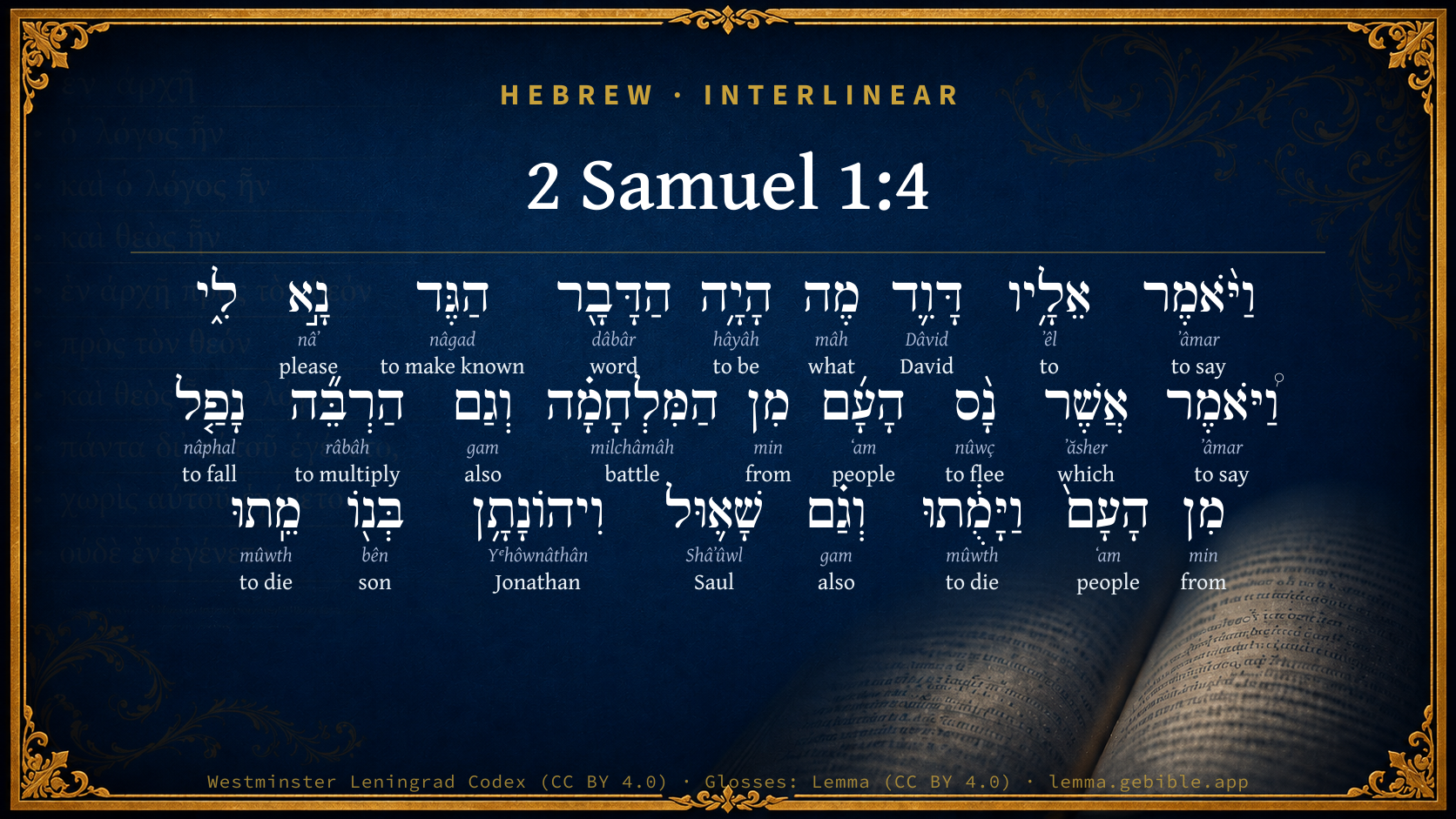
  1. וַיֹּ֨אמֶר ʼâmar H559 “and · to say” Conjunction + Verb, Qal, Sequential Imperfect, 3rd Person, Masculine, Singular
  2. אֵלָ֥יו ʼêl H413 “to · him” Preposition + Suffix, Personal, 3rd Person, Masculine, Singular
  3. דָּוִ֛ד Dâvid H1732 “David” Noun, Proper
  4. מֶה mâh H4100 “what” Particle, Interrogative
  5. הָיָ֥ה hâyâh H1961 “to be” Verb, Qal, Perfect, 3rd Person, Masculine, Singular
  6. הַדָּבָ֖ר dâbâr H1697 “the · word” Particle, Definite Article + Noun, Common, Masculine, Singular, Absolute
  7. הַגֶּד nâgad H5046 “make known” Verb, Hiphil, Imperative, 2nd Person, Masculine, Singular
  8. נָ֣א nâʼ H4994 “please” Particle, Exhortation
  9. וַ֠יֹּאמֶר ʼâmar H559 “and · to say” Conjunction + Verb, Qal, Sequential Imperfect, 3rd Person, Masculine, Singular
  10. אֲשֶׁר ʼăsher H834 “which” Particle, Relative
  11. נָ֨ס nûwç H5127 “to flee” Verb, Qal, Perfect, 3rd Person, Masculine, Singular
  12. הָעָ֜ם ʻam H5971 “the · people” Particle, Definite Article + Noun, Common, Masculine, Singular, Absolute
  13. מִן min H4480 “from” Preposition
  14. הַמִּלְחָמָ֗ה milchâmâh H4421 “the · battle” Particle, Definite Article + Noun, Common, Feminine, Singular, Absolute
  15. וְגַם gam H1571 “and · also” Conjunction + Particle, Accusative
  16. הַרְבֵּ֞ה râbâh H7235 “to multiply” Verb, Hiphil, Infinitive Absolute
  17. נָפַ֤ל nâphal H5307 “to fall” Verb, Qal, Perfect, 3rd Person, Masculine, Singular
  18. מִן min H4480 “from” Preposition
  19. הָעָם֙ ʻam H5971 “the · people” Particle, Definite Article + Noun, Common, Masculine, Singular, Absolute
  20. וַיָּמֻ֔תוּ mûwth H4191 “and · to die” Conjunction + Verb, Qal, Sequential Imperfect, 3rd Person, Masculine, Plural
  21. וְגַ֗ם gam H1571 “and · also” Conjunction + Particle, Accusative
  22. שָׁא֛וּל Shâʼûwl H7586 “Saul” Noun, Proper
  23. בְּנ֖וֹ bên H1121 “son · his” Noun, Common, Masculine, Singular, Construct + Suffix, Personal, 3rd Person, Masculine, Singular
  24. מֵֽתוּ mûwth H4191 “to die” Verb, Qal, Perfect, 3rd Person, Common, Plural

About this verse

These counts appear in no published source. They are computed here, from the morphology-tagged text and Lemma’s own curated glosses. What Lemma adds →

26
words
20
distinct lemmas
Historical
section

Grammatical profile

  • 9 verbs
  • 8 nouns
  • 4 prepositions
  • 5 particles

Verb forms

  • וַיֹּ֨אמֶר Qal · Sequential Imperfect
  • הָיָ֥ה Qal · Perfect
  • הַגֶּד Hiphil · Imperative
  • וַ֠יֹּאמֶר Qal · Sequential Imperfect
  • נָ֨ס Qal · Perfect
  • הַרְבֵּ֞ה Hiphil · Infinitive Absolute
  • נָפַ֤ל Qal · Perfect
  • וַיָּמֻ֔תוּ Qal · Sequential Imperfect
  • מֵֽתוּ Qal · Perfect

Repetition

Words recur within this verse — often emphatic in Hebrew:

  • וַיֹּ֨אמֶר to say H559 ×2
  • הָעָ֜ם people H5971 ×2
  • וְגַם also H1571 ×2
  • וַיָּמֻ֔תוּ to die H4191 ×2
  • מִן from H4480 ×2

Hebrew & Septuagint length

In English translation the verse runs 39 words from the Hebrew and 39 from the Septuagint (LXX English) — the same length.

A rough comparison of the two English renderings, which tokenize alike — not a word-level alignment.

Word counts can differ between the Hebrew and the Greek without any difference in meaning — e.g. the Hebrew direct-object marker אֵת has no separate Greek word, and Greek often adds the article ὁ.

In the original languages it is 26 Hebrew tokens and 37 Greek tokens — but the two are counted differently (Hebrew bundles its prefixes and suffixes into one token; the Greek is in lemma form), so that isn’t a like-for-like length.

Cross-references

3

Topical passages linked to 2 Samuel 1:4 in the Treasury of Scripture Knowledge — connected by theme and wording, ordered by reader-vote popularity; previews shown in the World English Bible.

  • 1 Samuel 4:16 The man said to Eli, I am he who came out of the army, and I fled today out of the army. He said, How went the matter, my son?
  • 1 Samuel 31:1–6 Now the Philistines fought against Israel: and the men of Israel fled from before the Philistines, and fell down slain on Mount Gilboa.
  • 1 Chronicles 10:1–6 Now the Philistines fought against Israel: and the men of Israel fled from before the Philistines, and fell down slain on Mount Gilboa.

Cross-references courtesy of OpenBible.info (CC BY 4.0).

Hebrew and Greek witnesses Masoretic Hebrew ↔ Greek Septuagint

The same verse in the two great witnesses to the Old Testament, shown verse-for-verse.

These are two independent witnesses, not word-aligned to each other, and the Septuagint is shown in lemma (dictionary) form.

Hebrew 2 Samuel 1:4 Masoretic · Westminster Leningrad Codex

וַיֹּ֨אמֶר אֵלָ֥יו דָּוִ֛ד מֶה הָיָ֥ה הַדָּבָ֖ר הַגֶּד נָ֣א לִ֑י וַ֠יֹּאמֶר אֲשֶׁר נָ֨ס הָעָ֜ם מִן הַמִּלְחָמָ֗ה וְגַם הַרְבֵּ֞ה נָפַ֤ל מִן הָעָם֙ וַיָּמֻ֔תוּ וְגַ֗ם שָׁא֛וּל וִיהוֹנָתָ֥ן בְּנ֖וֹ מֵֽתוּ

David said to him, How went the matter? Please tell me. He answered, The people are fled from the battle, and many of the people also are fallen and dead; and Saul and Jonathan his son are dead also.

World English Bible · Public Domain

Greek LXX 2 Samuel 1:4 Septuagint · lemma form

καί εἶπον αὐτός δαυίδ τίς ὁ λόγος οὗτος ἀποἀγγέλλω ἐγώ καί εἶπον ὅτι φεύγω ὁ λαός ἐκ ὁ πόλεμος καί πίπτω πολύς ἐκ ὁ λαός καί ἀποθνήσκω καί ἀποθνήσκω καί σαούλ καί ιωναθαν ὁ υἱός αὐτός ἀποθνήσκω

And David said to him, What is the matter? tell me. And he said, The people fled out of the battle, and many of the people have fallen and are dead, and Saul and Jonathan his son are dead.

LXX2012 (modern English Septuagint) · Public Domain

Hebrew: Westminster Leningrad Codex (CC BY 4.0). Greek: Septuagint (public domain); English from LXX2012 (modern English Septuagint) (Public Domain). How the Septuagint differs from the Hebrew →

Targum (Aramaic paraphrase)

1

The Targum is the ancient Jewish Aramaic paraphrase of the Hebrew Scriptures — an interpretive translation, not the Hebrew text itself. Onkelos (literal) and Pseudo-Jonathan (expansive) render the Torah, and Jonathan the Prophets. Coverage is partial: where no permissively-licensed English translation exists for a verse, only the Aramaic is shown. This is verse-level text, not a word-by-word alignment to the Hebrew.

  1. Targum Jonathan Prophets (Joshua–Malachi)
    וַאֲמַר לֵיהּ דָוִד מֶה הֲוָה פִתְגָמָא חַוִי כְעַן לִי וַאֲמַר דְאַפִּיךְ עַמָא מִן קְרָבָא וְאַף סַגִי נְפַל מִן עַמָא וְאִתְקְטָלוּ וְאַף שָׁאוּל וִיהוֹנָתָן בְּרֵיהּ מִיתוּ:

    (no public-domain English translation for this verse)

    Targum Jonathan — Aramaic: “Mikraot Gedolot” (public domain). English: “Sefaria Community Translation” (CC0 1.0 (public-domain dedication)); “London "Chaldee Paraphrase," 1871” (public domain). Text via Sefaria.

Commentary

Notes on 2 Samuel 1:4 from classic Christian and Jewish commentators (each source and its license shown beneath its notes). The classic Christian expositions comment on the surrounding passage and are grouped to its opening verse, so a note may address several verses; the Jewish commentaries on the Tanakh (Rashi and others) are per-verse, so they appear only where the commentator wrote on this verse.

Lemma curates 59 commentaries, every one of them public domain or Creative Commons licensed, each selected and text-cleaned for this edition rather than reprinted as found. About our sources →

Trapp's Complete Commentary

John Trapp

2Sa 1:4 And David said unto him, How went the matter? I pray thee, tell me. And he answered, That the people are fled from the battle, and many of the people also are fallen and dead; and Saul and Jonathan his son are dead also.

Ver. 4. How went the matter? I pray thee, tell me.] He was very desirous to hear what was the issue of the battle, and how it went with the poor people of God; and hence this earnest inquiry. So 1Sa 4:13. {See Trapp on "1Sa 4:13"}

John Trapp, A Commentary or Exposition upon All the Books of the Old and New Testament (1647–1656) — public domain. Text from a community e-Sword module.

Tyndale Open Study Notes

Tyndale Open Resources

1:4 What happened? David was not aware of what had happened to Saul—he had no part in Saul’s death. • Saul and . . . Jonathan are also dead: Two other sons of Saul, Abinadab and Malkishua, were killed as well (1 Sam 31:2). The Amalekite was either unaware of their deaths or he mentioned only the son who would stand in the way of David’s uncontested path to Israel’s throne.

Tyndale Open Study Notes — © Tyndale Open Resources, licensed CC BY-SA 4.0. Text via the HelloAO Bible API.

The Cambridge Bible for Schools and Colleges

gen. ed. J. J. S. Perowne

4. How went the matter?] Lit. What was the affair? the same phrase as that used by Eli in 1Sa_4:16. The form of the Amalekite’s answer also closely corresponds to that of the man of Benjamin there. The rout, the slaughter among the people, the death of the leaders, are mentioned in an ascending climax.

many of the people] No contradiction to 1Sa_31:6, where “all his men” refers to Saul’s immediate body-guard.

The Cambridge Bible for Schools and Colleges (gen. ed. J. J. S. Perowne; Cambridge University Press, 1878–1918) — public domain. Text from a community e-Sword module.

John Gill's Exposition

And David said unto him, how went the matter? I pray thee, tell me,.... That is, how went the battle? on which side the victory?

and he answered, that the people are fled from the battle; meaning the people of Israel, they had given way, and turned their backs upon their enemies, and were fled:

and many of the people also are fallen and dead; fell by the sword in the pursuit of them, and were not only wounded, but were slain, and these great numbers of them:

and Saul and Jonathan his son are dead also; which are mentioned last, because they fell some of the last; and this part of the account is reserved by the messenger to the last, because it was the article of the greatest importance; the death of these two persons, the one the enemy, and the other the friend of David, and the death of both made way for his accession to the throne.

John Gill's Exposition of the Whole Bible (1746–1763) — public domain (CC PDM 1.0). Text via the HelloAO Bible API.

Matthew Poole's English Annotations

He mentions only these two, as those who seemed most to obstruct David’s coming to the crown.

Matthew Poole's English Annotations on the Holy Bible (1683–1685) — public domain. Text from a community e-Sword/MySword module.

Whedon's Commentary on the Bible

Daniel D. Whedon

4. The people are fled — This announcement of the bitter tidings is climacteric, like that of 1Sa_4:17, where see note.

Daniel D. Whedon (gen. ed.), Commentary on the Old and New Testaments (1874–1909) — public domain. Text from a community e-Sword module.

Lesson kit

Teaching starters — assembled from the data on this page, not authored interpretation. Every prompt links to the verse data it draws on. Edit before teaching.

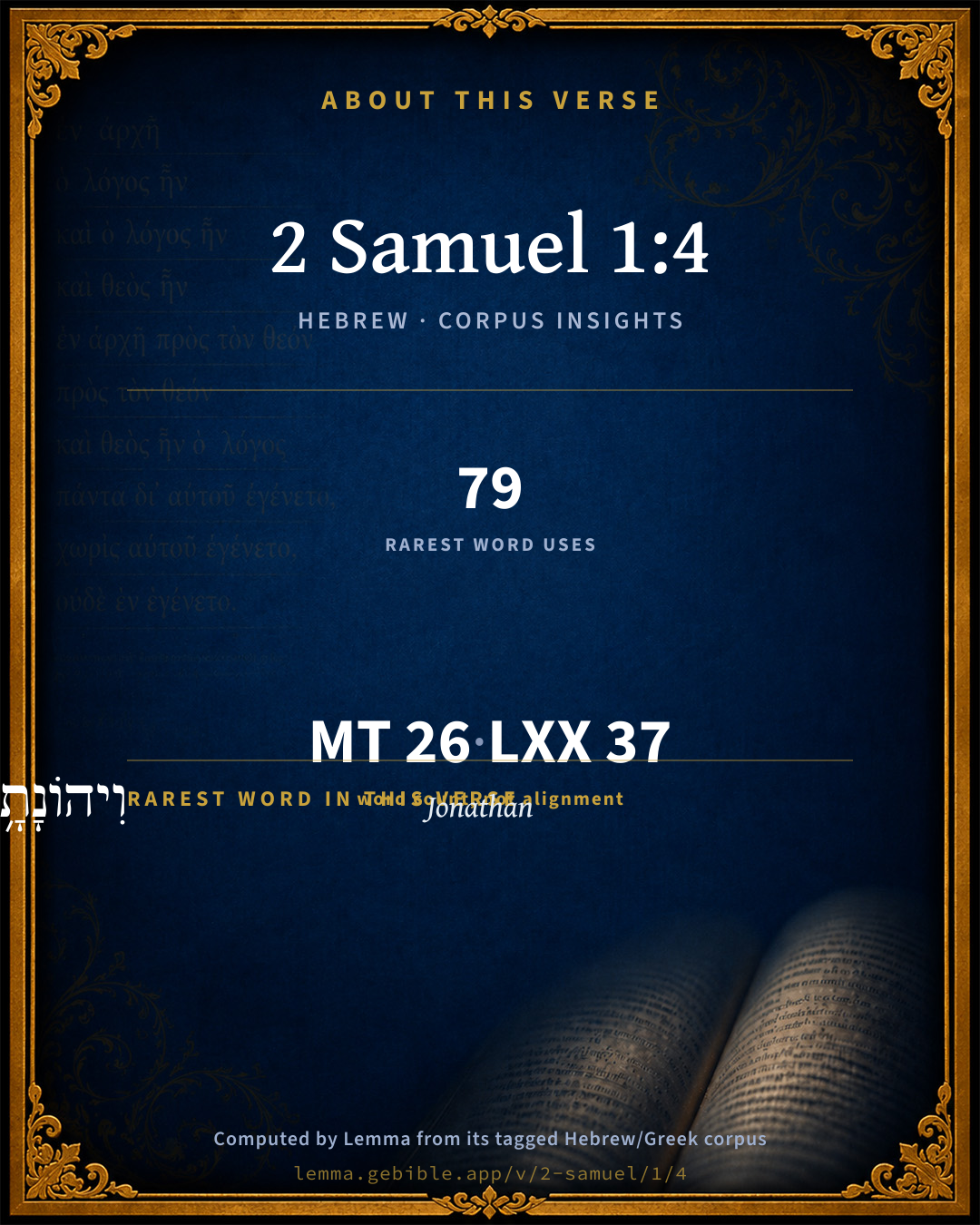
2 Samuel, in the Historical, opens this verse with 26 words (20 distinct Hebrew lemmas). Its most distinctive word is Yᵉhôwnâthân (“Jonathan”). A historical commentator’s framing appears above. Read the whole chapter for the surrounding context.

Discussion questions

  1. How does “Jonathan” (Yᵉhôwnâthân) shape what this verse is saying?
  2. 1 Samuel 4:16 shares this passage’s theme. How do the two illuminate each other?
  3. “to say” occurs 2× in this one verse. What is the effect of the repetition?
  4. These translations render this verse differently. What is at stake in choosing one wording over another?
  5. The verb «וַיֹּ֨אמֶר» is Qal Sequential Imperfect. How does its form color the action?
  6. Reading how Trapp's Complete Commentary and Tyndale Open Study Notes read this verse, where do the two commentators agree and where do they part?

Things to notice

Reading settings

Reading text

Shown beneath each verse's original-language words.

Old Testament
Old Testament edition

Read the OT as the Masoretic Hebrew (MT) or the Greek Septuagint (LXX).

English shown for the Greek Septuagint (in the Hebrew ↔ Greek comparison).

Comparing translations? Open the Compare panel on any verse page to stack up to four side by side.