Exodus 20:19

Hebrew (Westminster Leningrad Codex) Exodus 20:19 appears in the Hebrew Old Testament. The text above is from the Westminster Leningrad Codex. Each word links to its Strong’s number, a concise gloss, and parsing drawn from the Open Scriptures Hebrew Bible morphology. Click any word for its full Brown-Driver-Briggs (BDB) entry.
Download image
Cite this verse

Exodus 20:19 (World English Bible). Public Domain. Lemma interlinear Bible study tool, https://lemma.gebible.app/v/exodus/20/19.

Show BibTeX & RIS
BibTeX
RIS
English Translation
They said to Moses, "Speak with us yourself, and we will listen; but don't let God speak with us, lest we die."
World English Bible · Public Domain
Download a study sheet

One document with this verse’s original text, its word-by-word gloss line, the meaning frame, cross-references with their text, attributed commentary, and full source and license credits — printable, and it pastes into notes with its structure intact.

This verse Autodidact and up

Study sheet (.html) Plain text (.txt)

A passage Seminary Student

Up to 50 verses in one chapter. A passage sheet keeps up to 6 commentary sources and 12 cross-references per verse, in the order this page ranks them, and says so on the sheet whenever that leaves anything out. Ask for a single verse and you get the Autodidact verse sheet above.

Everything on this page stays free to read, with no account — the sheet is a download of what is already on screen, not access to it.

Want to remove ads? Support Godless Engineer
Compare translations 3

The same verse in 3 English versions, stacked beneath the original-language interlinear above. Click any original word for its lexicon entry.

Each is an independent rendering of the whole verse — the interlinear is not word-aligned to these translations.

Highlighted words mark where these versions differ — a whole-verse word diff, not a word-by-word alignment.

  • World English Bible Public Domain
    They said to Moses, "Speak with us yourself, and we will listen; but don't let God speak with us, lest we die."
  • King James Version Public Domain
    And they said unto Moses, Speak thou with us, and we will hear: but let not God speak with us, lest we die.
  • unfoldingWord Literal Text CC BY-SA 4.0
    They said to Moses, “You speak to us and let us listen! But do not let God speak to us, lest we die.”

unfoldingWord Literal Text — © unfoldingWord, licensed CC BY-SA 4.0. Word-aligned USFM3 via Door43 (git.door43.org/unfoldingWord/en_ult).

Versions to compare (up to 4)

3 of 4 selected

Show all 18 translations

Every available English version of this verse, each an independent rendering of the whole verse.

  • World English Bible Public Domain
    They said to Moses, "Speak with us yourself, and we will listen; but don't let God speak with us, lest we die."
  • Berean Standard Bible Public Domain
    “Speak to us yourself and we will listen,” they said to Moses. “But do not let God speak to us, or we will die.”
  • Majority Standard Bible Public Domain
    “Speak to us yourself and we will listen,” they said to Moses. “But do not let God speak to us, or we will die.”
  • King James Version Public Domain
    And they said unto Moses, Speak thou with us, and we will hear: but let not God speak with us, lest we die.
  • American Standard Version (1901) Public Domain
    And they said unto Moses, Speak thou with us, and we will hear; but let not God speak with us, lest we die.
  • Revised Version (1885) Public Domain
    And they said unto Moses, Speak thou with us, and we will hear: but let not God speak with us, lest we die.
  • Geneva Bible (1599) Public Domain
    And sayde vnto Moses, Talke thou with vs, and we will heare: but let not God talke with vs, lest we die.
  • Douay-Rheims (1899) Public Domain
    Saying to Moses: Speak thou to us, and we will hear: let not the Lord speak to us, lest we die.
  • Young's Literal Translation Public Domain
    and say unto Moses, `Speak thou with us, and we hear, and let not God speak with us, lest we die.'
  • Literal Standard Version CC BY-SA 4.0
    and say to Moses, “Speak with us, and we hear, and do not let God speak with us, lest we die.”
  • Unlocked Literal Bible CC BY-SA 4.0
    They said to Moses, “Speak to us, and we will listen; but do not let God speak to us, or we will die.”
  • unfoldingWord Literal Text CC BY-SA 4.0
    They said to Moses, “You speak to us and let us listen! But do not let God speak to us, lest we die.”
  • Darby Bible Public Domain
    and said to Moses, Speak thou with us, and we will hear; but let not God speak with us, lest we die.
  • World Messianic Bible Public Domain
    They said to Moses, “Speak with us yourself, and we will listen; but don’t let God speak with us, lest we die.”
  • Webster's Bible Public Domain
    And they said to Moses, Speak thou with us, and we will hear: but let not God speak with us, lest we die.
  • Free Bible Version CC BY-SA 4.0
    “You speak to us, and we'll listen,” they said to Moses. “But don't let God speak to us, or we'll die.”
  • Bible in Basic English Public Domain
    And they said to Moses, To your words we will give ear, but let not the voice of God come to our ears, for fear death may come on us.
  • JPS Tanakh (1917) Public Domain
    (20-16) And they said unto Moses: 'Speak thou with us, and we will hear; but let not God speak with us, lest we die.'

Literal Standard Version (2020), Covenant Press — licensed CC BY-SA 4.0. Text via the HelloAO Bible API (eBible.org). Unlocked Literal Bible (unfoldingWord) — licensed CC BY-SA 4.0. Text via the HelloAO Bible API (eBible.org). unfoldingWord Literal Text — © unfoldingWord, licensed CC BY-SA 4.0. Word-aligned USFM3 via Door43 (git.door43.org/unfoldingWord/en_ult). Free Bible Version, Dr. Jonathan Gallagher — licensed CC BY-SA 4.0. Text via the HelloAO Bible API (eBible.org).

Word by word

More ways to search: Search by grammar → Find every occurrence → Compare this word →

Practice this passage: Drill this verse → Learn its vocabulary →

פֶּן
pên
H6435
“lest”
Conjunction
Part of Speech
Conjunction
Full BDB Definition

Origin: from H6437

TWOT: 1780

lest, not, beware lest (conjunction) - lest (adverb)
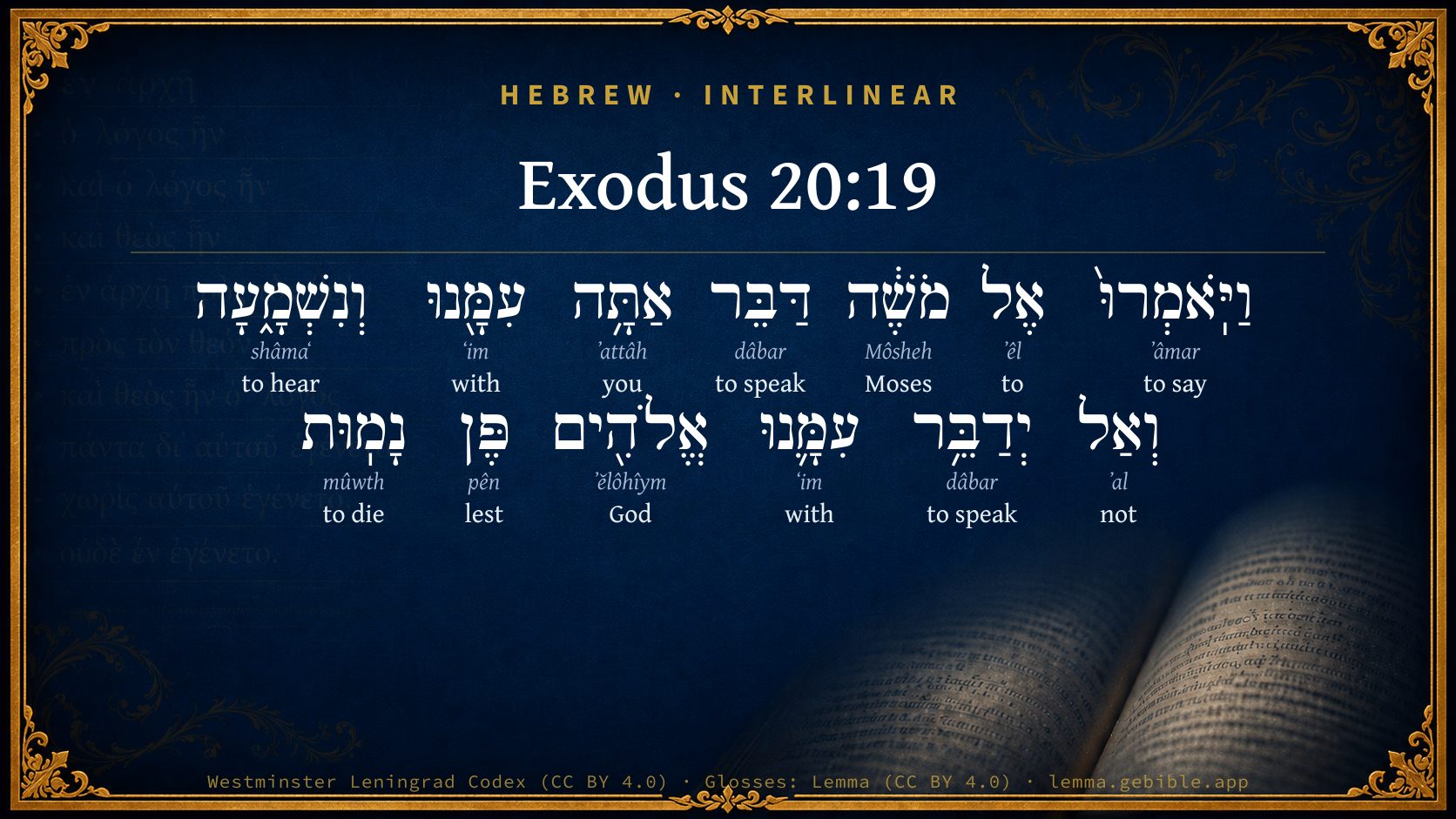
  1. וַיֹּֽאמְרוּ֙ ʼâmar H559 “and · to say” Conjunction + Verb, Qal, Sequential Imperfect, 3rd Person, Masculine, Plural
  2. אֶל ʼêl H413 “to” Preposition
  3. מֹשֶׁ֔ה Môsheh H4872 “Moses” Noun, Proper
  4. דַּבֵּר dâbar H1696 “speak” Verb, Piel, Imperative, 2nd Person, Masculine, Singular
  5. אַתָּ֥ה ʼattâh H859 “you” Pronoun, Personal, 2nd Person, Masculine, Singular
  6. עִמָּ֖נוּ ʻim H5973 “with · us” Preposition + Suffix, Personal, 1st Person, Common, Plural
  7. וְנִשְׁמָ֑עָה shâmaʻ H8085 “and · to hear” Conjunction + Verb, Qal, Cohortative, 1st Person, Common, Plural
  8. וְאַל ʼal H408 “and · not” Conjunction + Particle, Negative
  9. יְדַבֵּ֥ר dâbar H1696 “to speak” Verb, Piel, Jussive, 3rd Person, Masculine, Singular
  10. עִמָּ֛נוּ ʻim H5973 “with · us” Preposition + Suffix, Personal, 1st Person, Common, Plural
  11. אֱלֹהִ֖ים ʼĕlôhîym H430 “God(s)” Noun, Common, Masculine, Plural, Absolute
  12. נָמֽוּת mûwth H4191 “to die” Verb, Qal, Imperfect, 1st Person, Common, Plural

About this verse

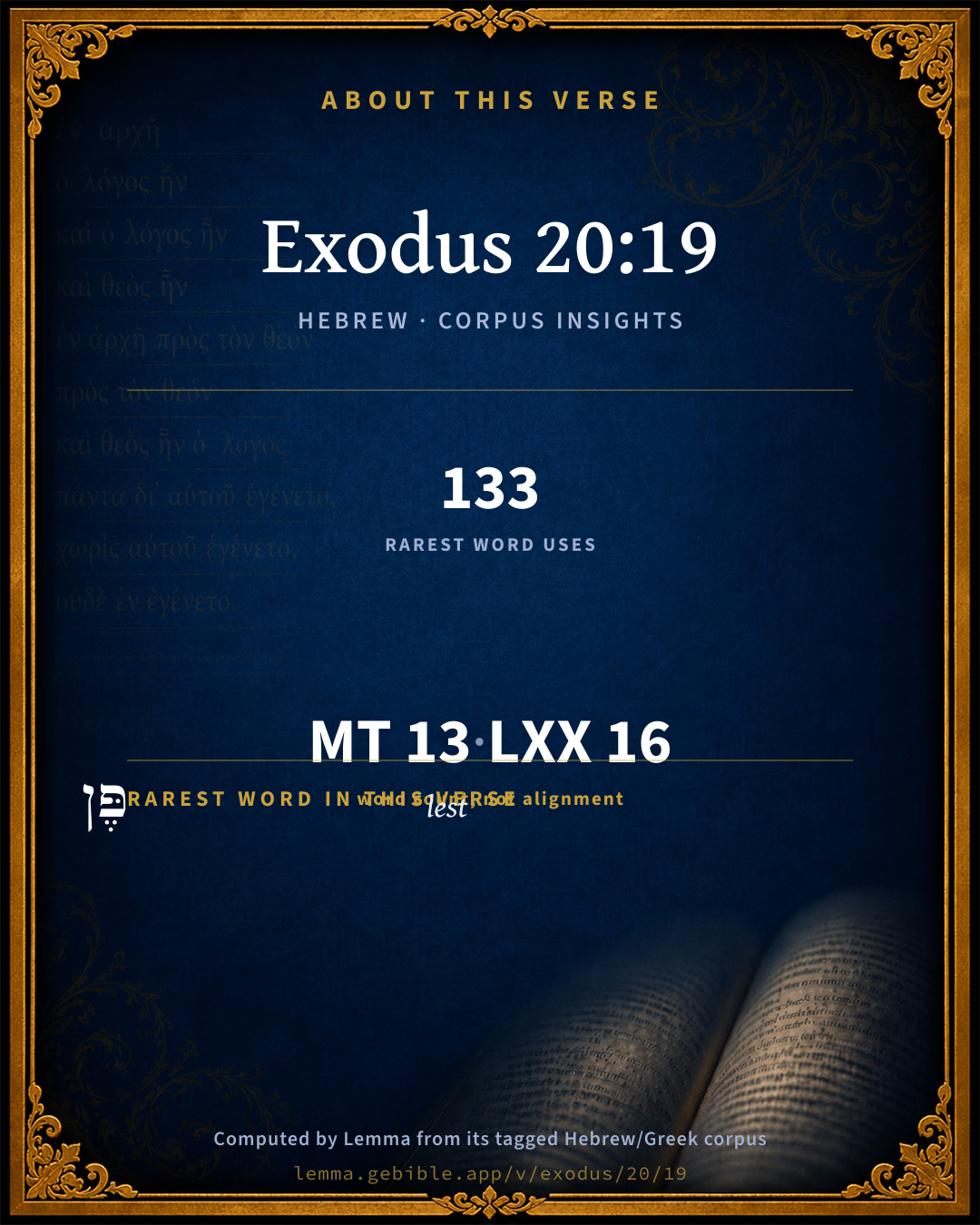
These counts appear in no published source. They are computed here, from the morphology-tagged text and Lemma’s own curated glosses. What Lemma adds →

13
words
11
distinct lemmas
Pentateuch
section

Grammatical profile

  • 5 verbs
  • 2 nouns
  • 1 pronoun
  • 3 prepositions
  • 1 conjunction
  • 1 particle

Verb forms

  • וַיֹּֽאמְרוּ֙ Qal · Sequential Imperfect
  • דַּבֵּר Piel · Imperative
  • וְנִשְׁמָ֑עָה Qal · Cohortative
  • יְדַבֵּ֥ר Piel · Jussive
  • נָמֽוּת Qal · Imperfect

Repetition

Words recur within this verse — often emphatic in Hebrew:

  • דַּבֵּר to speak H1696 ×2
  • עִמָּ֖נוּ with H5973 ×2

Hebrew & Septuagint length

In English translation the verse runs 22 words from the Hebrew and 18 from the Septuagint (LXX English) — closely comparable.

A rough comparison of the two English renderings, which tokenize alike — not a word-level alignment.

Word counts can differ between the Hebrew and the Greek without any difference in meaning — e.g. the Hebrew direct-object marker אֵת has no separate Greek word, and Greek often adds the article ὁ.

In the original languages it is 13 Hebrew tokens and 16 Greek tokens — but the two are counted differently (Hebrew bundles its prefixes and suffixes into one token; the Greek is in lemma form), so that isn’t a like-for-like length.

Cross-references

8

Topical passages linked to Exodus 20:19 in the Treasury of Scripture Knowledge — connected by theme and wording, ordered by reader-vote popularity; previews shown in the World English Bible.

  • Deuteronomy 18:16 according to all that you desired of Yahweh your God in Horeb in the day of the assembly, saying, Let me not hear again the voice of Yahweh my God, neither let me see this great fire any more, that I not die.
  • Acts 7:38 This is he who was in the assembly in the wilderness with the angel that spoke to him on Mount Sinai, and with our fathers, who received living oracles to give to us,
  • Exodus 33:20 He said, "You cannot see my face, for man may not see me and live."
  • Deuteronomy 5:23–27 It happened, when you heard the voice out of the midst of the darkness, while the mountain was burning with fire, that you came near to me, even all the heads of your tribes, and your elders;
  • Genesis 32:30 Jacob called the name of the place Peniel: for, he said, "I have seen God face to face, and my life is preserved."
  • Deuteronomy 5:5 (I stood between Yahweh and you at that time, to show you the word of Yahweh: for you were afraid because of the fire, and didn't go up onto the mountain;) saying,
  • Galatians 3:19 What then is the law? It was added because of transgressions, until the seed should come to whom the promise has been made. It was ordained through angels by the hand of a mediator.
  • Hebrews 12:19 the sound of a trumpet, and the voice of words; which those who heard it begged that not one more word should be spoken to them,

Cross-references courtesy of OpenBible.info (CC BY 4.0).

Hebrew and Greek witnesses Masoretic Hebrew ↔ Greek Septuagint

The same verse in the two great witnesses to the Old Testament, shown verse-for-verse.

These are two independent witnesses, not word-aligned to each other, and the Septuagint is shown in lemma (dictionary) form.

Hebrew Exodus 20:19 Masoretic · Westminster Leningrad Codex

וַיֹּֽאמְרוּ֙ אֶל מֹשֶׁ֔ה דַּבֵּר אַתָּ֥ה עִמָּ֖נוּ וְנִשְׁמָ֑עָה וְאַל יְדַבֵּ֥ר עִמָּ֛נוּ אֱלֹהִ֖ים פֶּן נָמֽוּת

They said to Moses, "Speak with us yourself, and we will listen; but don't let God speak with us, lest we die."

World English Bible · Public Domain

Greek LXX Exodus 20:19 Septuagint · lemma form

καί εἶπον πρός μωυσῆς λαλέω σύ ἐγώ καί μή λαλέω πρός ἐγώ ὁ θεός μήποτε ἀποθνήσκω

and said to Moses, Speak you to us, and let not God speak to us, lest we die.

LXX2012 (modern English Septuagint) · Public Domain

Hebrew: Westminster Leningrad Codex (CC BY 4.0). Greek: Septuagint (public domain); English from LXX2012 (modern English Septuagint) (Public Domain). How the Septuagint differs from the Hebrew →

Targum (Aramaic paraphrase)

2

The Targum is the ancient Jewish Aramaic paraphrase of the Hebrew Scriptures — an interpretive translation, not the Hebrew text itself. Onkelos (literal) and Pseudo-Jonathan (expansive) render the Torah, and Jonathan the Prophets. Coverage is partial: where no permissively-licensed English translation exists for a verse, only the Aramaic is shown. This is verse-level text, not a word-by-word alignment to the Hebrew.

  1. Targum Onkelos Torah (Genesis–Deuteronomy)
    וַאֲמַר יְיָ לְמשֶׁה כִּדְנַן תֵּימַר לִבְנֵי יִשְׂרָאֵל אַתּוּן חֲזִיתּוּן אֲרֵי מִן שְׁמַיָא מַלֵילִית עִמְכוֹן:

    (no public-domain English translation for this verse)

    Targum Onkelos — Aramaic: “Onkelos Genesis” (public domain); “Onkelos Exodus” (public domain); “Onkelos Leviticus” (public domain); “Onkelos Numbers” (public domain); “Onkelos Deuteronomy” (public domain). English: “Sefaria Community Translation” (CC0 1.0 (public-domain dedication)); “J.W. Etheridge. The Targums of Onkelos and Jonathan Ben Uzziel on the Pentateuch. London: Longmans, Green, 1862” (public domain). Text via Sefaria.

  2. Targum Pseudo-Jonathan Torah (Genesis–Deuteronomy)
    וַאֲמַר יְיָ לְמשֶׁה כִּדְנָא תֵימַר לִבְנֵי יִשְרָאֵל אַתּוּן חֲמִיתּוּן אֲרוּם מִן שְׁמַיָא מַלֵּילִית עִמְכוֹן

    And the Lord said to Mosheh, Speak thus to the sons of Israel: You have seen that from the heavens I have spoken with you;

    Targum Pseudo-Jonathan — Aramaic: “Targum Jonathan on Genesis” (public domain); “Targum Jonathan on Exodus” (public domain); “Targum Jonathan on Leviticus” (public domain); “Targum Jonathan on Numbers” (public domain); “Targum Jonathan on Deuteronomy” (public domain). English: “The Targum of Jonathan ben Uzziel, trans. J. W. Etheridge, London, 1862” (public domain). Text via Sefaria.

Commentary

Notes on Exodus 20:19 from classic Christian and Jewish commentators (each source and its license shown beneath its notes). The classic Christian expositions comment on the surrounding passage and are grouped to its opening verse, so a note may address several verses; the Jewish commentaries on the Tanakh (Rashi and others) are per-verse, so they appear only where the commentator wrote on this verse.

Lemma curates 59 commentaries, every one of them public domain or Creative Commons licensed, each selected and text-cleaned for this edition rather than reprinted as found. About our sources →

Trapp's Complete Commentary

John Trapp

Exo 20:19 And they said unto Moses, Speak thou with us, and we will hear: but let not God speak with us, lest we die.

Ver. 19. Speak thou with us.] See here what a mercy it is to have the mind of God made known by men like ourselves; that may say unto us, as Elihu did to Job, "Behold, I am according to thy wish in God’s stead: I also am cut out of the clay. Behold, my terror shall not make thee afraid, neither shall my hand be heavy upon thee." {Job 33:6-7}

John Trapp, A Commentary or Exposition upon All the Books of the Old and New Testament (1647–1656) — public domain. Text from a community e-Sword module.

Jamieson, Fausset & Brown

Robert Jamieson, A. R. Fausset & David Brown

let not God speak with us, lest we die, &c.--The phenomena of thunder and lightning had been one of the plagues so fatal to Egypt, and as they heard God speaking to them now, they were apprehensive of instant death also. Even Moses himself, the mediator of the old covenant, did "exceedingly quake and fear" (Heb 12:21). But doubtless God spake what gave him relief--restored him to a frame of mind fit for the ministrations committed to him; and hence immediately after he was enabled to relieve and comfort them with the relief and comfort which he himself had received from God (Co2 1:4).

Jamieson, Fausset & Brown — Commentary Critical and Explanatory on the Whole Bible (1871) — public domain (CC PDM 1.0). Text via the HelloAO Bible API.

Ellicott's Commentary for English Readers

(19) Speak thou with us.—Comp. Deu_5:24-27, where the words of the people are reported at greater length :—“Behold, the Lord our God hath shewed us his glory and his greatness, and we have heard his voice out of the midst of the fire: we have seen this day that God doth talk with man, and he liveth. Now therefore why should we die? For this great fire will consume us: if we hear the voice of the Lord our God any more, then we shall die. For who is there of all flesh, that hath heard the voice of the living God speaking out of the midst of the fire, as we have, and lived? Go thou near, and hear all that the Lord our God shall say: and speak thou unto us all that the Lord our God shall speak unto thee; and we will hear it, and do it.”

A Bible Commentary for English Readers, edited by Charles John Ellicott (1878–1897) — public domain. Text from a community e-Sword module.

The Cambridge Bible for Schools and Colleges

gen. ed. J. J. S. Perowne

19. Speak thou (emph.), … and we will hear] i.e. it is implied, listen and obey (see Deu_5:27 end).

lest we die] cf. Deu_5:25 f.

The Cambridge Bible for Schools and Colleges (gen. ed. J. J. S. Perowne; Cambridge University Press, 1878–1918) — public domain. Text from a community e-Sword module.

John Gill's Exposition

And the people stood afar off,.... Still kept their distance in their camp and tents; or the heads and elders of the people having had this conversation with Moses, returned to their tents as they were bid, Deu 5:30 and to the people in the camp, and there they continued while Moses went up to God with their request:

and Moses drew near to the thick darkness where God was; the thick cloud, Exo 19:9 as Jarchi interprets it, and who observes from their doctors that there were three enclosures about the divine Majesty, darkness, a cloud, and thick darkness; and so Moses passed through the darkness, and the cloud, to the thick darkness where Jehovah was, and where he is said to dwell when the temple was built, Kg1 8:8 and they have an observation that the word rendered "drew near" is transitive, and should be translated, "he was brought near" or, "made to draw nigh"; Michael and Gabriel being sent to him, took hold of his hands and brought him against his will unto the thick darkness (r); but if the word will admit of such a version, the sense is either that he was caused to draw near through the importunity of the people; or rather through the call of God to him, or an impulse of his upon his mind, which obliged him to it.

(r) Pirke Eliezer, c. 41.

John Gill's Exposition of the Whole Bible (1746–1763) — public domain (CC PDM 1.0). Text via the HelloAO Bible API.

Haydock's Catholic Bible Commentary

Die. The Samaritan copy inserts here what we read [in] Deuteronomy v. 24, 25, 26, 27.

George Leo Haydock (1774–1849), Haydock's Catholic Family Bible and Commentary, 1859 edition — public domain. Excludes Psalms (Douay-Rheims chapter numbering differs from Protestant) and Deuterocanonical books (Catholic canon only).

Matthew Poole's English Annotations

This they speak from a sense of their own guilt, and of the greatness and holiness of the Divine Majesty, to whom they durst not approach but by a mediator. See Deu 5:27; 18:16; Gal 3:19.

Matthew Poole's English Annotations on the Holy Bible (1683–1685) — public domain. Text from a community e-Sword/MySword module.

Whedon's Commentary on the Bible

Daniel D. Whedon

19. Let not God speak with us, lest we die — Comp. Deu_5:25-26. This sentiment accords with the prevalent belief of the ancient Hebrews, that the immediate vision of God must produce death. See notes on Gen_16:13; Gen_32:30, and Jdg_6:22.

Daniel D. Whedon (gen. ed.), Commentary on the Old and New Testaments (1874–1909) — public domain. Text from a community e-Sword module.

The Pulpit Commentary

And they said unto Moses. Their whole speech, as delivered in Deuteronomy, was as follows: the Lord our God hath shewed us his glory and his greatness, and we have heard his voice out of the midst of the fire: we have seen this day, that God doth talk with man, and he liveth. Now, therefore, why should we die? for this great fire will consume us: if we hear the voice of the Lord our God any more, then we shall die. For who is there of all flesh, that hath heard the voice of the living God, speaking out of the midst of the fire, as we have, and lived? Go then near, and hear all that the Lord our God shall say; and speak thou unto us all that the Lord our God shall speak unto thee; and. we will hear it, and do. (Deu_5:24-27) The speech is here abbreviated greatly; but its essential points are preserved thou with us be thou our intermediary not God speak with us, lest we die.

The Pulpit Commentary (1880–1919), ed. H.D.M. Spence-Jones & Joseph S. Exell — public domain. Text from a community e-Sword module.

John Wesley's Explanatory Notes

Speak thou with us - Hereby they obliged themselves to acquiesce in the mediation of Moses, they themselves nominating him as a fit person to deal between them and God, and promising to hearken to him as to God's messenger.

John Wesley, Explanatory Notes Upon the Whole Bible (1754–1765) — public domain. Text via the GEBible commentary corpus.

Rashi

Rabbi Shlomo Yitzchaki (Rashi)

כה תאמר THUS THOU SHALT SAY — in this (the Holy) language (Mekhilta).

אתם ראיתם YE HAVE SEEN — There is a difference between what a person himself sees and what others relate to him, for what others relate to him sometimes his heart is divided in its opinion so that he does not believe (Mekhilta).

כי מן השמים דברתי THAT I HAVE SPOKEN [TO YOU] FROM HEAVEN — But another verse states, (Exodus 19:20) “And the Lord came down upon mount Sinai”, and thus the two verses appear to be contradictory! There now comes a third verse and harmonises them: (Deuteronomy 4:36) “Out of heaven He made thee hear His voice that He might instruct thee; and upon the earth He showed thee His great fire” — His glory was in the heavens but His fire and His power were upon the earth. Another explanation: He bent down the heavens and the heavens of heavens, and spread them out upon the mountain; similarly it states, (Psalms 18:10) “He bowed the heavens and came down” (Mekhilta).

Rashi on the Tanakh — English translations: “The Judaica Press complete Tanach with Rashi, translated by A. J. Rosenberg” (CC BY 4.0); “Pentateuch with Rashi's commentary by M. Rosenbaum and A.M. Silbermann, 1929-1934” (public domain); “The Metsudah Tanach series, Lakewood, N.J” (CC BY 4.0); and “The Book of Joshua, Metsudah Publications, 1997” (CC BY 4.0). Text via Sefaria.

Ramban (Nachmanides)

Rabbi Moshe ben Nachman (Ramban / Nachmanides)

YE YOURSELVES HAVE SEEN THAT I HAVE TALKED WITH YOU FROM HEAVEN. He commanded that Moses tell them: “Since you yourselves have seen that I have talked with you from heaven and that I am Master in heaven and upon the earth, do not combine gods of silver or gods of gold with Me, for you have no need of another aid with Me.” The purport of the verse is: Ye shall not make with Me gods of silver, and ye shall not make unto you gods of gold. In my opinion, the explanation of the verse is as follows: “Do not make gods of silver or gods of gold to be to you for gods with Him; and ye shall not make them altogether.” Thus He warned against believing in them, and again warned against merely making them, similar to the verse, Neither shall ye rear you up a graven image, or a pillar., i.e., to believe in them — and then He warned against the mere making of them. By way of the Truth, [the mystic lore of the Cabala], the meaning of the word iti (with Me) is like the Expression al panai (before My face), and I have already alluded to its explanation. Rashi wrote: “That I have talked with you from heaven. But another verse states, And the Eternal came down upon Sinai!, 19:20. There comes a third verse to harmonize them: Out of heaven He made thee to hear His Voice, that He might instruct thee; and upon earth He made thee to see His great fire. His Glory was in heaven, and His might was [manifest] upon the earth.” Thus Rashi’s language. But it is not precise. The harmonizing of the verses is indeed a Midrash of the Sages, and it is true that G-d was in heaven, and His Glory was upon Mount Sinai, for G-d was in the fire, and it is written, Thou camest down also upon Mount Sinai, and spokest with them from heaven. All the verses in their various expressions are thus clear to all who know [the mystic teachings of the Cabala]. I have already explained it all above., 19:20. And Rabbi Abraham ibn Ezra wrote that he who has a discerning heart will understand the meaning thereof in the section of Ki Thisa. The words of a wise man’s mouth are gracious.

Ramban (Nachmanides) on the Tanakh — English translation: “Commentary on the Torah by Ramban (Nachmanides). Translated and annotated by Charles B. Chavel. New York, Shilo Pub. House, 1971-1976” (CC BY 4.0). Text via Sefaria.

Lesson kit

Teaching starters — assembled from the data on this page, not authored interpretation. Every prompt links to the verse data it draws on. Edit before teaching.

Exodus, in the Pentateuch, opens this verse with 13 words (11 distinct Hebrew lemmas). Its most distinctive word is pên (“lest”). A historical commentator’s framing appears above. Read the whole chapter for the surrounding context.

Discussion questions

  1. How does “lest” (pên) shape what this verse is saying?
  2. Deuteronomy 18:16 shares this passage’s theme. How do the two illuminate each other?
  3. “to speak” occurs 2× in this one verse. What is the effect of the repetition?
  4. These translations render this verse differently. What is at stake in choosing one wording over another?
  5. The verb «וַיֹּֽאמְרוּ֙» is Qal Sequential Imperfect. How does its form color the action?
  6. Reading how Trapp's Complete Commentary and Jamieson, Fausset & Brown read this verse, where do the two commentators agree and where do they part?

Things to notice

Reading settings

Reading text

Shown beneath each verse's original-language words.

Old Testament
Old Testament edition

Read the OT as the Masoretic Hebrew (MT) or the Greek Septuagint (LXX).

English shown for the Greek Septuagint (in the Hebrew ↔ Greek comparison).

Comparing translations? Open the Compare panel on any verse page to stack up to four side by side.