
Exodus 9:19

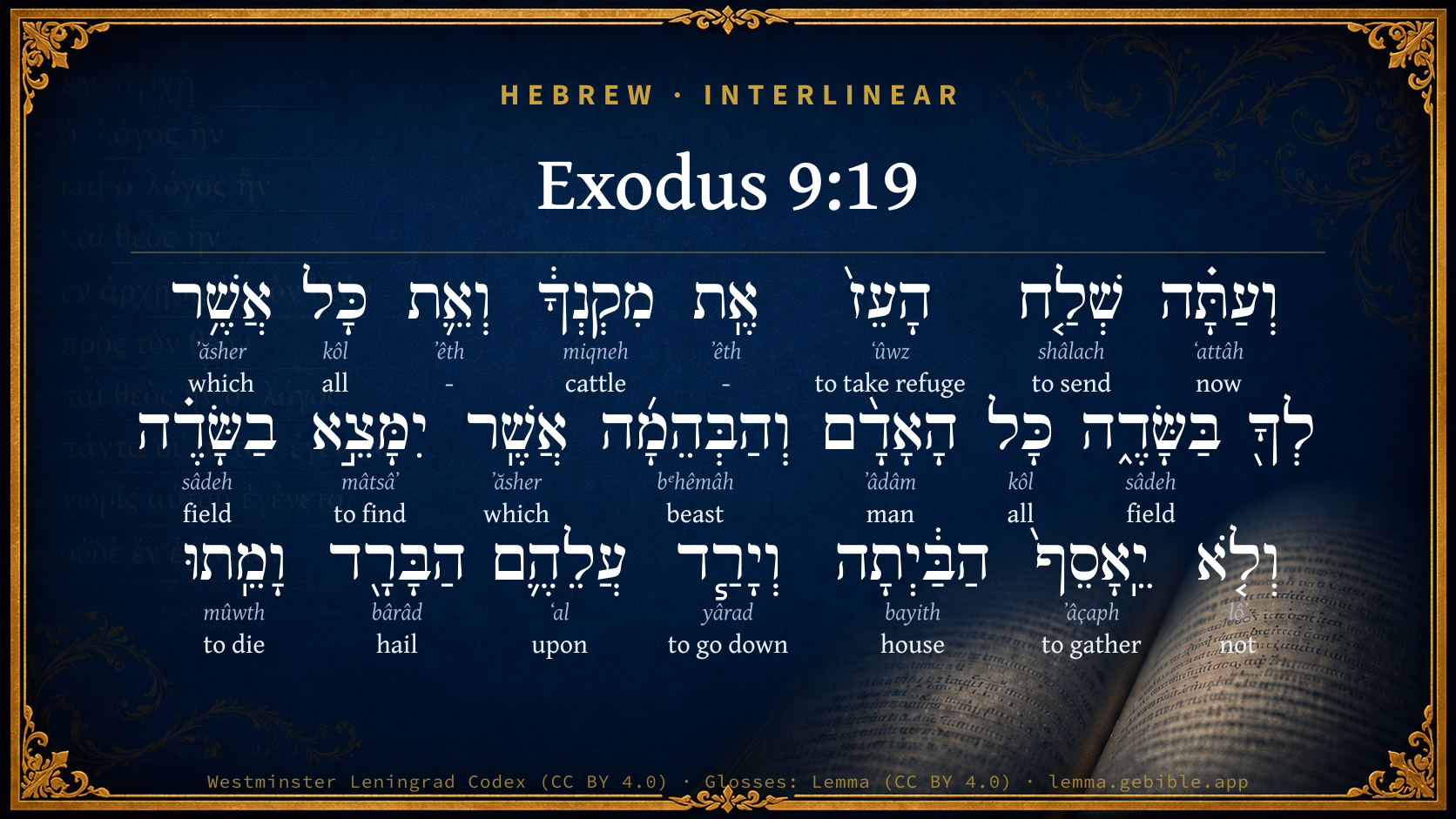
Hebrew (Westminster Leningrad Codex) Exodus 9:19 appears in the Hebrew Old Testament. The text above is from the Westminster Leningrad Codex. Each word links to its Strong’s number, a concise gloss, and parsing drawn from the Open Scriptures Hebrew Bible morphology. Click any word for its full Brown-Driver-Briggs (BDB) entry.
Download image
Cite this verse

Exodus 9:19 (World English Bible). Public Domain. Lemma interlinear Bible study tool, https://lemma.gebible.app/v/exodus/9/19.

Show BibTeX & RIS
BibTeX
RIS
English Translation
Now therefore command that all of your cattle and all that you have in the field be brought into shelter. Every man and animal that is found in the field, and isn't brought home, the hail shall come down on them, and they shall die."'"
World English Bible · Public Domain
Highlights
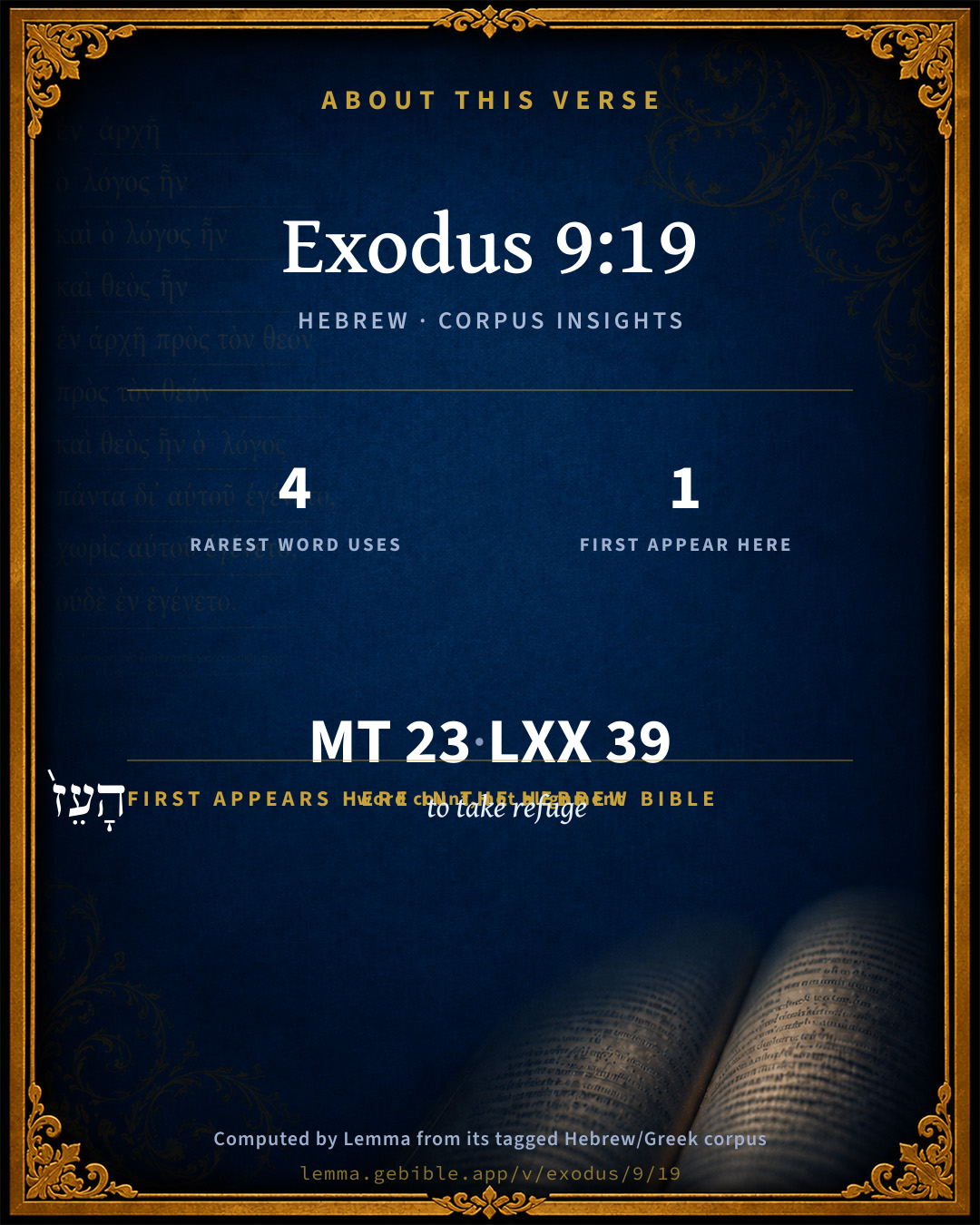
  • 1 first appearance in the Hebrew Bible
Full analysis ↓
Download a study sheet

One document with this verse’s original text, its word-by-word gloss line, the meaning frame, cross-references with their text, attributed commentary, and full source and license credits — printable, and it pastes into notes with its structure intact.

This verse Autodidact and up

Study sheet (.html) Plain text (.txt)

A passage Seminary Student

Up to 50 verses in one chapter. A passage sheet keeps up to 6 commentary sources and 12 cross-references per verse, in the order this page ranks them, and says so on the sheet whenever that leaves anything out. Ask for a single verse and you get the Autodidact verse sheet above.

Everything on this page stays free to read, with no account — the sheet is a download of what is already on screen, not access to it.

Want to remove ads? Support Godless Engineer
Compare translations 3

The same verse in 3 English versions, stacked beneath the original-language interlinear above. Click any original word for its lexicon entry.

Each is an independent rendering of the whole verse — the interlinear is not word-aligned to these translations.

Highlighted words mark where these versions differ — a whole-verse word diff, not a word-by-word alignment.

  • World English Bible Public Domain
    Now therefore command that all of your cattle and all that you have in the field be brought into shelter. Every man and animal that is found in the field, and isn't brought home, the hail shall come down on them, and they shall die."'"
  • King James Version Public Domain
    Send therefore now, and gather thy cattle, and all that thou hast in the field; for upon every man and beast which shall be found in the field, and shall not be brought home, the hail shall come down upon them, and they shall die.
  • unfoldingWord Literal Text CC BY-SA 4.0
    And now send and bring to safety your livestock and all that is yours in the field, and the hail will come down on every man and beast that is found in the field and was not gathered to the house, and they will die.”’”

unfoldingWord Literal Text — © unfoldingWord, licensed CC BY-SA 4.0. Word-aligned USFM3 via Door43 (git.door43.org/unfoldingWord/en_ult).

Versions to compare (up to 4)

3 of 4 selected

Show all 18 translations

Every available English version of this verse, each an independent rendering of the whole verse.

  • World English Bible Public Domain
    Now therefore command that all of your cattle and all that you have in the field be brought into shelter. Every man and animal that is found in the field, and isn't brought home, the hail shall come down on them, and they shall die."'"
  • Berean Standard Bible Public Domain
    So give orders now to shelter your livestock and everything you have in the field. Every man or beast that remains in the field and is not brought inside will die when the hail comes down upon them.’”
  • Majority Standard Bible Public Domain
    So give orders now to shelter your livestock and everything you have in the field. Every man or beast that remains in the field and is not brought inside will die when the hail comes down upon them.’”
  • King James Version Public Domain
    Send therefore now, and gather thy cattle, and all that thou hast in the field; for upon every man and beast which shall be found in the field, and shall not be brought home, the hail shall come down upon them, and they shall die.
  • American Standard Version (1901) Public Domain
    Now therefore send, hasten in thy cattle and all that thou hast in the field; `for' every man and beast that shall be found in the field, and shall not be brought home, the hail shall come down upon them, and they shall die.
  • Revised Version (1885) Public Domain
    Now therefore send, hasten in thy cattle and all that thou hast in the field; for every man and beast which shall be found in the field, and shall not be brought home, the hail shall come down upon them, and they shall die.
  • Geneva Bible (1599) Public Domain
    Send therefore nowe, and gather the cattell, and all that thou hast in the fielde: for vpon all the men, and the beastes, which are found in the field, and not brought home, the haile shall fall vpon them, and they shall die.
  • Douay-Rheims (1899) Public Domain
    Send therefore now presently, and gather together thy cattle, and all that thou hast in the field: for men and beasts, and all things that shall be found abroad, and not gathered together out of the fields, which the hail shall fall upon, shall die.
  • Young's Literal Translation Public Domain
    `And, now, send, strengthen thy cattle and all that thou hast in the field; every man and beast which is found in the field, and is not gathered into the house -- come down on them hath the hail, and they have died.'
  • Literal Standard Version CC BY-SA 4.0
    And now, send, strengthen your livestock and all that you have in the field; every man and beast which is found in the field, and is not gathered into the house—the hail has come down on them, and they have died.”
  • Unlocked Literal Bible CC BY-SA 4.0
    Now then, send men and gather your cattle and everything you have in the fields to a safe place. Every man and animal that is in the field and is not brought home—the hail will come down on them, and they will die.”'”
  • unfoldingWord Literal Text CC BY-SA 4.0
    And now send and bring to safety your livestock and all that is yours in the field, and the hail will come down on every man and beast that is found in the field and was not gathered to the house, and they will die.”’”
  • Darby Bible Public Domain
    And now send, [and] secure thy cattle, and all that thou hast in the field: all the men and the cattle that are found in the field, and are not brought home -- on them the hail shall come down, and they shall die.
  • World Messianic Bible Public Domain
    Now therefore command that all of your livestock and all that you have in the field be brought into shelter. The hail will come down on every man and animal that is found in the field, and isn’t brought home, and they will die.”’”
  • Webster's Bible Public Domain
    Send therefore now, and gather thy cattle, and all that thou hast in the field: for upon every man and beast which shall be found in the field, and shall not be brought home, the hail shall come down upon them, and they shall die.
  • Free Bible Version CC BY-SA 4.0
    So order your livestock and everything you have in the field to be brought inside. Every person and every animal that stays outside and is not brought inside will die when the hail falls on them.’”
  • Bible in Basic English Public Domain
    Then send quickly and get in your cattle and all you have from the fields; for if any man or beast in the field has not been put under cover, the ice-storm will come down on them with destruction.
  • JPS Tanakh (1917) Public Domain
    Now therefore send, hasten in thy cattle and all that thou hast in the field; for every man and beast that shall be found in the field, and shall not be brought home, the hail shall come down upon them, and they shall die.'

Literal Standard Version (2020), Covenant Press — licensed CC BY-SA 4.0. Text via the HelloAO Bible API (eBible.org). Unlocked Literal Bible (unfoldingWord) — licensed CC BY-SA 4.0. Text via the HelloAO Bible API (eBible.org). unfoldingWord Literal Text — © unfoldingWord, licensed CC BY-SA 4.0. Word-aligned USFM3 via Door43 (git.door43.org/unfoldingWord/en_ult). Free Bible Version, Dr. Jonathan Gallagher — licensed CC BY-SA 4.0. Text via the HelloAO Bible API (eBible.org).

Word by word

More ways to search: Search by grammar → Find every occurrence → Compare this word →

Practice this passage: Drill this verse → Learn its vocabulary →

הָעֵז֙
ʻûwz
H5756
“take refuge”
Verb, Hiphil, Imperative, 2nd Person, Masculine, Singular
Part of Speech
Verb
Stem
Hiphil
Form
Imperative
Person
2nd Person
Gender
Masculine
Number
Singular
Full BDB Definition

Origin: a primitive root

TWOT: 1578

(Hiphil) to take refuge, bring to refuge, seek refuge
  1. וְעַתָּ֗ה ʻattâh H6258 “and · now” Conjunction + Adverb
  2. שְׁלַ֤ח shâlach H7971 “send” Verb, Qal, Imperative, 2nd Person, Masculine, Singular
  3. אֶֽת ʼêth H853 “-” Particle, Direct Object
  4. מִקְנְךָ֔ miqneh H4735 “cattle · your” Noun, Common, Masculine, Singular, Construct + Suffix, Personal, 2nd Person, Masculine, Singular
  5. וְאֵ֛ת ʼêth H853 “and · -” Conjunction + Particle, Direct Object
  6. כָּל kôl H3605 “all of” Noun, Common, Masculine, Singular, Construct
  7. אֲשֶׁ֥ר ʼăsher H834 “which” Particle, Relative
  8. בַּשָּׂדֶ֑ה sâdeh H7704 “in/at the · field” Preposition, Determined + Noun, Common, Masculine, Singular, Absolute
  9. כָּל kôl H3605 “all of” Noun, Common, Masculine, Singular, Construct
  10. הָאָדָ֨ם ʼâdâm H120 “the · man” Particle, Definite Article + Noun, Common, Masculine, Singular, Absolute
  11. וְהַבְּהֵמָ֜ה bᵉhêmâh H929 “and · the · beast” Conjunction + Particle, Definite Article + Noun, Common, Feminine, Singular, Absolute
  12. אֲשֶֽׁר ʼăsher H834 “which” Particle, Relative
  13. יִמָּצֵ֣א mâtsâʼ H4672 “to find” Verb, Niphal, Imperfect, 3rd Person, Masculine, Singular
  14. בַשָּׂדֶ֗ה sâdeh H7704 “in/at the · field” Preposition, Determined + Noun, Common, Masculine, Singular, Absolute
  15. וְלֹ֤א lôʼ H3808 “and · not” Conjunction + Particle, Negative
  16. יֵֽאָסֵף֙ ʼâçaph H622 “to gather” Verb, Niphal, Imperfect, 3rd Person, Masculine, Singular
  17. הַבַּ֔יְתָה bayith H1004 “the · house · toward” Particle, Definite Article + Noun, Common, Masculine, Singular, Absolute + Suffix, Demonstrative
  18. וְיָרַ֧ד yârad H3381 “and · to go down” Conjunction + Verb, Qal, Sequential Perfect, 3rd Person, Masculine, Singular
  19. עֲלֵהֶ֛ם ʻal H5921 “upon · them” Preposition + Suffix, Personal, 3rd Person, Masculine, Plural
  20. הַבָּרָ֖ד bârâd H1259 “the · hail” Particle, Definite Article + Noun, Common, Masculine, Singular, Absolute
  21. וָמֵֽתוּ mûwth H4191 “and · to die” Conjunction + Verb, Qal, Sequential Perfect, 3rd Person, Common, Plural

About this verse

These counts appear in no published source. They are computed here, from the morphology-tagged text and Lemma’s own curated glosses. What Lemma adds →

23
words
18
distinct lemmas
Pentateuch
section

Notable vocabulary

The rarest word here is הָעֵז֙ to take refuge H5756 — appearing just 4 times in the whole Hebrew Bible.

First appearance in Scripture

This word makes its first canonical appearance in the Hebrew Bible here:

  • הָעֵז֙ to take refuge H5756

Shared distinctive vocabulary

הָעֵז֙ to take refuge H5756 occurs in 4 verses of the Hebrew Bible. Also found in:

Grammatical profile

  • 6 verbs
  • 9 nouns
  • 2 prepositions
  • 1 adverb
  • 5 particles

Verb forms

  • שְׁלַ֤ח Qal · Imperative
  • הָעֵז֙ Hiphil · Imperative
  • יִמָּצֵ֣א Niphal · Imperfect
  • יֵֽאָסֵף֙ Niphal · Imperfect
  • וְיָרַ֧ד Qal · Sequential Perfect
  • וָמֵֽתוּ Qal · Sequential Perfect

Repetition

Words recur within this verse — often emphatic in Hebrew:

  • כָּל all H3605 ×2
  • בַּשָּׂדֶ֑ה field H7704 ×2
  • אֲשֶׁ֥ר which H834 ×2

Hebrew & Septuagint length

In English translation the verse runs 45 words from the Hebrew and 46 from the Septuagint (LXX English) — closely comparable.

A rough comparison of the two English renderings, which tokenize alike — not a word-level alignment.

Word counts can differ between the Hebrew and the Greek without any difference in meaning — e.g. the Hebrew direct-object marker אֵת has no separate Greek word, and Greek often adds the article ὁ.

In the original languages it is 23 Hebrew tokens and 39 Greek tokens — but the two are counted differently (Hebrew bundles its prefixes and suffixes into one token; the Greek is in lemma form), so that isn’t a like-for-like length.

Cross-references

1

Topical passages linked to Exodus 9:19 in the Treasury of Scripture Knowledge — connected by theme and wording, ordered by reader-vote popularity; previews shown in the World English Bible.

  • Habakkuk 3:2 Yahweh, I have heard of your fame. I stand in awe of your deeds, Yahweh. Renew your work in the midst of the years. In the midst of the years make it known. In wrath, you remember mercy.

Cross-references courtesy of OpenBible.info (CC BY 4.0).

Hebrew and Greek witnesses Masoretic Hebrew ↔ Greek Septuagint

The same verse in the two great witnesses to the Old Testament, shown verse-for-verse.

These are two independent witnesses, not word-aligned to each other, and the Septuagint is shown in lemma (dictionary) form.

Hebrew Exodus 9:19 Masoretic · Westminster Leningrad Codex

וְעַתָּ֗ה שְׁלַ֤ח הָעֵז֙ אֶֽת מִקְנְךָ֔ וְאֵ֛ת כָּל אֲשֶׁ֥ר לְךָ֖ בַּשָּׂדֶ֑ה כָּל הָאָדָ֨ם וְהַבְּהֵמָ֜ה אֲשֶֽׁר יִמָּצֵ֣א בַשָּׂדֶ֗ה וְלֹ֤א יֵֽאָסֵף֙ הַבַּ֔יְתָה וְיָרַ֧ד עֲלֵהֶ֛ם הַבָּרָ֖ד וָמֵֽתוּ

Now therefore command that all of your cattle and all that you have in the field be brought into shelter. Every man and animal that is found in the field, and isn't brought home, the hail shall come down on them, and they shall die."'"

World English Bible · Public Domain

Greek LXX Exodus 9:19 Septuagint · lemma form

νῦν οὖν κατασπεύδω συνἄγω ὁ κτῆνος σύ καί ὅσος σύ εἰμί ἐν ὁ πεδίον πᾶς γάρ ὁ ἄνθρωπος καί ὁ κτῆνος ὅσος ἄν εὑρίσκω ἐν ὁ πεδίον καί μή εἰςἔρχομαι εἰς οἰκία πίπτω δέ ἐπί αὐτός ὁ χάλαζα τελευτάω

Now then hasten to gather your cattle, and all that you have in the fields; for all the men and cattle as many as shall be found in the fields, and shall not enter into a house, (but the hail shall fall upon them,) shall die.

LXX2012 (modern English Septuagint) · Public Domain

Hebrew: Westminster Leningrad Codex (CC BY 4.0). Greek: Septuagint (public domain); English from LXX2012 (modern English Septuagint) (Public Domain). How the Septuagint differs from the Hebrew →

Targum (Aramaic paraphrase)

2

The Targum is the ancient Jewish Aramaic paraphrase of the Hebrew Scriptures — an interpretive translation, not the Hebrew text itself. Onkelos (literal) and Pseudo-Jonathan (expansive) render the Torah, and Jonathan the Prophets. Coverage is partial: where no permissively-licensed English translation exists for a verse, only the Aramaic is shown. This is verse-level text, not a word-by-word alignment to the Hebrew.

  1. Targum Onkelos Torah (Genesis–Deuteronomy)
    וּכְעַן שְׁלַח כְּנוֹשׁ יָת בְּעִירָךְ וְיָת כָּל דִי לָךְ בְּחַקְלָא כָּל אֲנָשָׁא וּבְעִירָא דְאִשְׁתְּכַח בְּחַקְלָא וְלָא יִתְכְּנֵשׁ לְבֵיתָא וְיֵחוֹת עֲלֵיהוֹן בַּרְדָא וִימוּתוּן:

    (no public-domain English translation for this verse)

    Targum Onkelos — Aramaic: “Onkelos Genesis” (public domain); “Onkelos Exodus” (public domain); “Onkelos Leviticus” (public domain); “Onkelos Numbers” (public domain); “Onkelos Deuteronomy” (public domain). English: “Sefaria Community Translation” (CC0 1.0 (public-domain dedication)); “J.W. Etheridge. The Targums of Onkelos and Jonathan Ben Uzziel on the Pentateuch. London: Longmans, Green, 1862” (public domain). Text via Sefaria.

  2. Targum Pseudo-Jonathan Torah (Genesis–Deuteronomy)
    וּכְדוּן שְׁדַר כְּנוֹשׁ יַת גֵיתָךְ וְיַת כָּל דִילָךְ בְּחַקְלָא כָּל אֵינָשָׁא וּבְעִירָא דְאִשְׁתַּכַּח בְּחַקְלָא וְלָא יִתְכְּנוֹשׁ לְבֵיתָא וְיֵיחוֹת עִילַוֵהוֹן בַּרְדָא וִימוּתוּן

    But now send, gather together thy flocks, and all that thou hast in the field (for) upon all men and cattle that are found in the field, and not gathered together within the house, will the hail come down, and they will die.

    Targum Pseudo-Jonathan — Aramaic: “Targum Jonathan on Genesis” (public domain); “Targum Jonathan on Exodus” (public domain); “Targum Jonathan on Leviticus” (public domain); “Targum Jonathan on Numbers” (public domain); “Targum Jonathan on Deuteronomy” (public domain). English: “The Targum of Jonathan ben Uzziel, trans. J. W. Etheridge, London, 1862” (public domain). Text via Sefaria.

Commentary

Notes on Exodus 9:19 from classic Christian and Jewish commentators (each source and its license shown beneath its notes). The classic Christian expositions comment on the surrounding passage and are grouped to its opening verse, so a note may address several verses; the Jewish commentaries on the Tanakh (Rashi and others) are per-verse, so they appear only where the commentator wrote on this verse.

Lemma curates 59 commentaries, every one of them public domain or Creative Commons licensed, each selected and text-cleaned for this edition rather than reprinted as found. About our sources →

Trapp's Complete Commentary

John Trapp

Exo 9:19 Send therefore now, [and] gather thy cattle, and all that thou hast in the field; [for upon] every man and beast which shall be found in the field, and shall not be brought home, the hail shall come down upon them, and they shall die.

Ver. 19. Send therefore now.] Here "(mercy rejoiceth against judgment," {Jas 2:13} if by any means he might be wrought upon. Sed Rhinoceros interimi potest, capi non potest. It was past time of day to do Pharaoh good.

John Trapp, A Commentary or Exposition upon All the Books of the Old and New Testament (1647–1656) — public domain. Text from a community e-Sword module.

Joseph Benson's Commentary

Exo 9:19. Send now therefore and gather thy cattle — This warning God gives to mitigate the severity of the judgment, to show his justice in punishing so wicked and obstinate a people as would not hearken either to his words or former works, and especially to make a difference between the penitent and the incorrigible Egyptians, it being far from God to inflict the same punishment on those who mourn because of any national crime, and those who for their profit or pleasure will continue to do wickedly.

Joseph Benson's Commentary on the Old and New Testaments (1811–1818) — public domain. Text from a community e-Sword module.

Geneva Bible (1599)

Geneva Bible translators

Here we see though God’s wrath be kindled, yet there is a certain mercy showed even to his enemies.

Geneva Bible (1599) marginal notes — public domain. Text via Bolls.life.

Adam Clarke's Commentary

Verse 19. Send - now, and gather thy cattle] So in the midst of judgment, God remembered mercy. The miracle should be wrought that they might know he was the Lord; but all the lives both of men and beasts might have been saved, had Pharaoh and his servants taken the warning so mercifully given them. While some regarded not the word of the Lord, others feared it, and their cattle and their servants were saved, See Ex 9:20-21.

Adam Clarke's Commentary on the Bible (1810–1826) — public domain. Text from a community e-Sword/MySword module.

Ellicott's Commentary for English Readers

(19) Gather thy cattle.—The peculiar circumstances of Egypt, where the whole country was overflowed by the Nile during some months of each year, caused the provision of shelter for cattle to be abnormally great. Every year, at the time of the inundation, all the cattle had to be “gathered” into sheds and cattle-yards in the immediate vicinity of the villages and towns, which were protected from the inundation by high mounds. Thus it would have been easy to house all the cattle that remained to the Egyptians after the murrain, if the warning here given had been attended to generally.

A Bible Commentary for English Readers, edited by Charles John Ellicott (1878–1897) — public domain. Text from a community e-Sword module.

The Cambridge Bible for Schools and Colleges

gen. ed. J. J. S. Perowne

19. Advice to the Pharaoh, and, implicitly (cf. vv. 20, 21), to his servants as well, to bring their cattle quickly into safety. The advice gives the Pharaoh an opportunity of shewing what his frame of mind is, according as he follows or disregards the advice. According to v. 6 the Egyptians had indeed no ‘cattle’ left after the murrain; but (as was remarked on v. 6) ‘all’ in Hebrew is not always to be taken literally. The inconsistency is however remarkable: contrast Exo_10:5; Exo_10:15.

The Cambridge Bible for Schools and Colleges (gen. ed. J. J. S. Perowne; Cambridge University Press, 1878–1918) — public domain. Text from a community e-Sword module.

John Gill's Exposition

Send therefore now, and gather thy cattle, and all that thou hast in the field,.... The servants that were at work there: this is said to denote both the certainty of the plague, and the terribleness of it, that all, both men and beast, would perish by it, if care was not taken to get them home; and also to show the wonderful clemency and mercy of God to such rebellious, hardened, and undeserving creatures, as Pharaoh and his people were; in the midst of wrath and judgment God remembers mercy:

for upon every man and beast which shall be found in the field, and shall not be brought home; and there sheltered in houses, barns, and stables:

the hail shall come down upon them, and they shall die; the hailstones that would fall would be so large and so heavy as to kill both men and beasts, like those which fell from heaven upon the Canaanites in the days of Joshua, which killed more than the sword did, Jos 10:11.

John Gill's Exposition of the Whole Bible (1746–1763) — public domain (CC PDM 1.0). Text via the HelloAO Bible API.

Haydock's Catholic Bible Commentary

Cattle. Some had escaped the former plague, or the Egyptians had purchased more from their neighbours, and in the land of Gessen. (Haydock) --- God tempers justice with mercy. (St. Augustine, q. 33.) --- Die. This message was accordingly delivered to Pharao. (Samaritan copy) (Haydock)

George Leo Haydock (1774–1849), Haydock's Catholic Family Bible and Commentary, 1859 edition — public domain. Excludes Psalms (Douay-Rheims chapter numbering differs from Protestant) and Deuterocanonical books (Catholic canon only).

Matthew Poole's English Annotations

This forewarning God gives, partly, to initiate the severity of the judgment; partly, that a considerable number of horses might be reserved for Pharaoh’s expedition, Exo 14; partly, to show the justice of God in punishing so wicked and obstinate people, as would take no warning neither from God’s words, nor from his former works; and partly, to make a difference between the penitent and the incorrigible Egyptians.

Matthew Poole's English Annotations on the Holy Bible (1683–1685) — public domain. Text from a community e-Sword/MySword module.

Whedon's Commentary on the Bible

Daniel D. Whedon

19. Send therefore now, and gather thy cattle — This is the only instance in which the Egyptians were advised how to escape the judgment after it had been announced. This plague not only destroyed the crops, trees, and cattle, but, like the last, fell upon the Egyptians themselves. Jehovah now reveals himself to Egypt as the Lord of the elements — of the forces of the air — as well as of the water and the land.

Daniel D. Whedon (gen. ed.), Commentary on the Old and New Testaments (1874–1909) — public domain. Text from a community e-Sword module.

The Pulpit Commentary

Thy cattle, and all that thou hast in the field. During winter and early spring, the Egyptians kept their cattle "in the field," as other nations commonly do. When the inundation began (June or July), they were obliged to bring them into the cities and enclosed villages, and house them. The time of the "Plague of Hail" appears by all the indications w have been the middle of February. They shall die. Human life was now for the first time threatened. Any herdsmen that remained with the cattle in the open field and did not seek the shelter of houses or sheds would be smitten by the huge jagged hailstones with such force that they would be killed outright, or else die of their wounds.

The Pulpit Commentary (1880–1919), ed. H.D.M. Spence-Jones & Joseph S. Exell — public domain. Text from a community e-Sword module.

Keil & Delitzsch

C. F. Keil & F. Delitzsch

The good advice to be given by Moses to the king, to secure the men and cattle that were in the field, i.e., to put them under shelter, which was followed by the God-fearing Egyptians (Exo 9:21), was a sign of divine mercy, which would still rescue the hardened man and save him from destruction. Even in Pharaoh's case the possibility still existed of submission to the will of God; the hardening was not yet complete. But as he paid no heed to the word of the Lord, the predicted judgment was fulfilled (Exo 9:22-26). "Jehovah gave voices" (קלת); called "voices of God" in Exo 9:28. This term is applied to the thunder (cf. Exo 19:16; Exo 20:18; Psa 29:3-9), as being the mightiest manifestation of the omnipotence of God, which speaks therein to men (Rev 10:3-4), and warns them of the terrors of judgment. These terrors were heightened by masses of fire, which came down from the sky along with the hail that smote man and beast in the field, destroyed the vegetables, and shattered the trees. "And fire ran along upon the ground;" תּהלך is a Kal, though it sounds like Hithpael, and signifies grassari, as in Psa 73:9.

Keil & Delitzsch — Biblical Commentary on the Old Testament (1861–1891) — public domain (CC PDM 1.0). Text via the HelloAO Bible API. (Old Testament only.)

Rashi

Rabbi Shlomo Yitzchaki (Rashi)

שלח העז translate it as the Targum: SEND, GATHER. Similar examples of this sense are, (Isaiah 10:31) “The inhabitants of Gebim gather together (העיזו)”; (Jeremiah 6:1) “Gather together (העיזו), ye children of Benjamin”.

ולא יאסף הביתה The verb denotes “bringing into a place” so that the translation is: AND WHICH IS NOT GATHERED INTO THE HOUSE.

Rashi on the Tanakh — English translations: “The Judaica Press complete Tanach with Rashi, translated by A. J. Rosenberg” (CC BY 4.0); “Pentateuch with Rashi's commentary by M. Rosenbaum and A.M. Silbermann, 1929-1934” (public domain); “The Metsudah Tanach series, Lakewood, N.J” (CC BY 4.0); and “The Book of Joshua, Metsudah Publications, 1997” (CC BY 4.0). Text via Sefaria.

Sforno

Rabbi Ovadia Sforno

Now send word and gather. He warned to send word to enable the slaves that were shepherding the flocks to escape, as the Sages said: “Man is beloved for he was created in the Image of Hashem”.

Sforno on the Tanakh — English translation: “Yalkut, Sifsei Chachomim Chumash, Metsudah Publications, 2009” (CC BY 4.0). Text via Sefaria.

Lesson kit

Teaching starters — assembled from the data on this page, not authored interpretation. Every prompt links to the verse data it draws on. Edit before teaching.

Exodus, in the Pentateuch, opens this verse with 23 words (18 distinct Hebrew lemmas). Its most distinctive word is ʻûwz (“to take refuge”). A historical commentator’s framing appears above. Read the whole chapter for the surrounding context.

Discussion questions

  1. What does “to take refuge” (ʻûwz) contribute to the verse as a whole?
  2. This is the first place “to take refuge” appears in Scripture (first appears here). What does its debut here establish?
  3. How does Isaiah 10:31, which shares the word «to take refuge», read alongside this verse?
  4. What does the repetition of “all” (2× in this one verse) do in this verse?
  5. These translations render this verse differently. What is at stake in choosing one wording over another?
  6. «שְׁלַ֤ח» is a Qal Imperative verb. How does that grammatical form shape the action described?
  7. Compare how Trapp's Complete Commentary and Joseph Benson's Commentary read this verse. Where do they agree or differ?

Things to notice

Reading settings

Reading text

Shown beneath each verse's original-language words.

Old Testament
Old Testament edition

Read the OT as the Masoretic Hebrew (MT) or the Greek Septuagint (LXX).

English shown for the Greek Septuagint (in the Hebrew ↔ Greek comparison).

Comparing translations? Open the Compare panel on any verse page to stack up to four side by side.