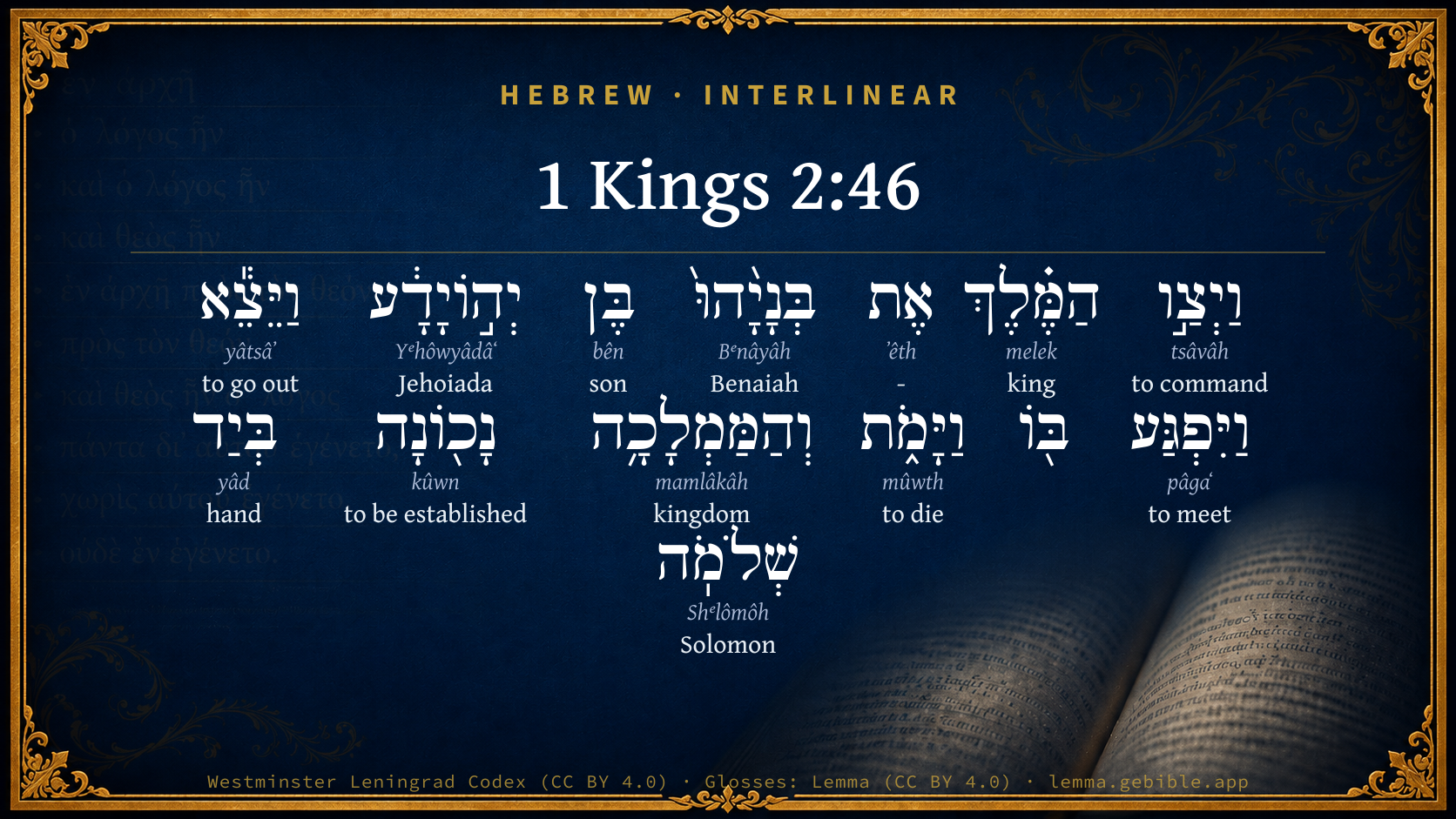
1 Kings 2:46

Hebrew (Westminster Leningrad Codex) 1 Kings 2:46 appears in the Hebrew Old Testament. The text above is from the Westminster Leningrad Codex. Each word links to its Strong’s number, a concise gloss, and parsing drawn from the Open Scriptures Hebrew Bible morphology. Click any word for its full Brown-Driver-Briggs (BDB) entry.
Download image
Cite this verse

1 Kings 2:46 (World English Bible). Public Domain. Lemma interlinear Bible study tool, https://lemma.gebible.app/v/1-kings/2/46.

Show BibTeX & RIS
BibTeX
RIS
English Translation
So the king commanded Benaiah the son of Jehoiada; and he went out, and fell on him, so that he died. The kingdom was established in the hand of Solomon.
World English Bible · Public Domain
Download a study sheet

One document with this verse’s original text, its word-by-word gloss line, the meaning frame, cross-references with their text, attributed commentary, and full source and license credits — printable, and it pastes into notes with its structure intact.

This verse Autodidact and up

Study sheet (.html) Plain text (.txt)

A passage Seminary Student

Up to 50 verses in one chapter. A passage sheet keeps up to 6 commentary sources and 12 cross-references per verse, in the order this page ranks them, and says so on the sheet whenever that leaves anything out. Ask for a single verse and you get the Autodidact verse sheet above.

Everything on this page stays free to read, with no account — the sheet is a download of what is already on screen, not access to it.

Want to remove ads? Support Godless Engineer
Compare translations 3

The same verse in 3 English versions, stacked beneath the original-language interlinear above. Click any original word for its lexicon entry.

Each is an independent rendering of the whole verse — the interlinear is not word-aligned to these translations.

Highlighted words mark where these versions differ — a whole-verse word diff, not a word-by-word alignment.

  • World English Bible Public Domain
    So the king commanded Benaiah the son of Jehoiada; and he went out, and fell on him, so that he died. The kingdom was established in the hand of Solomon.
  • King James Version Public Domain
    So the king commanded Benaiah the son of Jehoiada; which went out, and fell upon him, that he died. And the kingdom was established in the hand of Solomon.
  • unfoldingWord Literal Text CC BY-SA 4.0
    And the king commanded Benaiah, the son of Jehoiada, and he went out and attacked him, and he died. And the kingdom was established in the hand of Solomon.

unfoldingWord Literal Text — © unfoldingWord, licensed CC BY-SA 4.0. Word-aligned USFM3 via Door43 (git.door43.org/unfoldingWord/en_ult).

Versions to compare (up to 4)

3 of 4 selected

Show all 18 translations

Every available English version of this verse, each an independent rendering of the whole verse.

  • World English Bible Public Domain
    So the king commanded Benaiah the son of Jehoiada; and he went out, and fell on him, so that he died. The kingdom was established in the hand of Solomon.
  • Berean Standard Bible Public Domain
    Then the king commanded Benaiah son of Jehoiada, and he went out and struck Shimei down, and he died. Thus the kingdom was firmly established in the hand of Solomon.
  • Majority Standard Bible Public Domain
    Then the king commanded Benaiah son of Jehoiada, and he went out and struck Shimei down, and he died. Thus the kingdom was firmly established in the hand of Solomon.
  • King James Version Public Domain
    So the king commanded Benaiah the son of Jehoiada; which went out, and fell upon him, that he died. And the kingdom was established in the hand of Solomon.
  • American Standard Version (1901) Public Domain
    So the king commanded Benaiah the son of Jehoiada; and he went out, and fell upon him, so that he died. And the kingdom was established in the hand of Solomon.
  • Revised Version (1885) Public Domain
    So the king commanded Benaiah the son of Jehoiada; and he went out, and fell upon him, that he died. And the kingdom was established in the hand of Solomon.
  • Geneva Bible (1599) Public Domain
    So the King comanded Benaiah the sonne of Iehoiada: who went out and smote him that he dyed. And the kingdome was established in the hand of Salomon.
  • Douay-Rheims (1899) Public Domain
    So the king commanded Banaias the son of Joiada: and he went out and struck him, and he died.
  • Young's Literal Translation Public Domain
    And the king chargeth Benaiah son of Jehoiada, and he goeth out and falleth on him, and he dieth, and the kingdom is established in the hand of Solomon.
  • Literal Standard Version CC BY-SA 4.0
    And the king charges Benaiah son of Jehoiada, and he goes out and falls on him, and he dies, and the kingdom is established in the hand of Solomon.
  • Unlocked Literal Bible CC BY-SA 4.0
    Then the king gave a command to Benaiah son of Jehoiada. He went out and put Shimei to death. So the rule was well established in Solomon's hand.
  • unfoldingWord Literal Text CC BY-SA 4.0
    And the king commanded Benaiah, the son of Jehoiada, and he went out and attacked him, and he died. And the kingdom was established in the hand of Solomon.
  • Darby Bible Public Domain
    And the king commanded Benaiah the son of Jehoiada; who went out and fell upon him, and he died. And the kingdom was established in the hand of Solomon.
  • World Messianic Bible Public Domain
    So the king commanded Benaiah the son of Jehoiada; and he went out, and fell on him, so that he died. The kingdom was established in the hand of Solomon.
  • Webster's Bible Public Domain
    So the king commanded Benaiah the son of Jehoiada; who went out, and fell upon him, that he died. And the kingdom was established in the hand of Solomon.
  • Free Bible Version CC BY-SA 4.0
    The king ordered Benaiah, son of Jehoiada, to execute Shimei, so he went and killed Shimei. In this way Solomon's hold on the kingdom was made secure.
  • Bible in Basic English Public Domain
    So the king gave orders to Benaiah, the son of Jehoiada; and he went out and, falling on him, put him to death. And Solomon's authority over the kingdom was complete.
  • JPS Tanakh (1917) Public Domain
    So the king commanded Benaiah the son of Jehoiada; and he went out, and fell upon him, so that he died. And the kingdom was established in the hand of Solomon.

Literal Standard Version (2020), Covenant Press — licensed CC BY-SA 4.0. Text via the HelloAO Bible API (eBible.org). Unlocked Literal Bible (unfoldingWord) — licensed CC BY-SA 4.0. Text via the HelloAO Bible API (eBible.org). unfoldingWord Literal Text — © unfoldingWord, licensed CC BY-SA 4.0. Word-aligned USFM3 via Door43 (git.door43.org/unfoldingWord/en_ult). Free Bible Version, Dr. Jonathan Gallagher — licensed CC BY-SA 4.0. Text via the HelloAO Bible API (eBible.org).

Word by word

More ways to search: Search by grammar → Find every occurrence → Compare this word →

Practice this passage: Drill this verse → Learn its vocabulary →

בְּנָיָ֨הוּ֙
Bᵉnâyâh
H1141
“Benaiah”
Noun, Proper
Part of Speech
Noun
Type
Proper
Full BDB Definition

Origin: from H1129 and H3050

TWOT: None

Benaiah = "Jehovah has built" or " Yahweh has built up" - one of David's mighty warriors, son of Jehoiada the chief priest, a Levite, set by David over his bodyguard, later having remained faithful to Solomon during Adonijah's attempt on the crown, was raised into the place of Joab as commander-in-chief of the army - the Pirathonite, an Ephraimite, one of David's thirty mighty warriors, and the captain of the eleventh monthly course - a Simeonite, a prince of the families of Simeon - a Levite in the time of David who played with a psaltery on Alamoth - a priest in the time of David, appointed to blow the trumpet before the ark - a Levite of the sons of Asaph - a Levite in the time of Hezekiah - Four Israelites in the time of Ezra who had taken strange wives - the father of Pelatiah
  1. וַיְצַ֣ו tsâvâh H6680 “and · to command” Conjunction + Verb, Piel, Sequential Imperfect, 3rd Person, Masculine, Singular
  2. הַמֶּ֗לֶךְ melek H4428 “the · king” Particle, Definite Article + Noun, Common, Masculine, Singular, Absolute
  3. אֶת ʼêth H853 “-” Particle, Direct Object
  4. בֶּן bên H1121 “son of” Noun, Common, Masculine, Singular, Construct
  5. יְה֣וֹיָדָ֔ע Yᵉhôwyâdâʻ H3077 “Jehoiada” Noun, Proper
  6. וַיֵּצֵ֕א yâtsâʼ H3318 “and · to go out” Conjunction + Verb, Qal, Sequential Imperfect, 3rd Person, Masculine, Singular
  7. וַיִּפְגַּע pâgaʻ H6293 “and · to meet” Conjunction + Verb, Qal, Sequential Imperfect, 3rd Person, Masculine, Singular
  8. וַיָּמֹ֑ת mûwth H4191 “and · to die” Conjunction + Verb, Qal, Sequential Imperfect, 3rd Person, Masculine, Singular
  9. וְהַמַּמְלָכָ֥ה mamlâkâh H4467 “and · the · kingdom” Conjunction + Particle, Definite Article + Noun, Common, Feminine, Singular, Absolute
  10. נָכ֖וֹנָה kûwn H3559 “to be established” Verb, Niphal, Perfect, 3rd Person, Feminine, Singular
  11. בְּיַד yâd H3027 “in/at · hand of” Preposition + Noun, Common, Both, Singular, Construct
  12. שְׁלֹמֹֽה Shᵉlômôh H8010 “Solomon” Noun, Proper

About this verse

These counts appear in no published source. They are computed here, from the morphology-tagged text and Lemma’s own curated glosses. What Lemma adds →

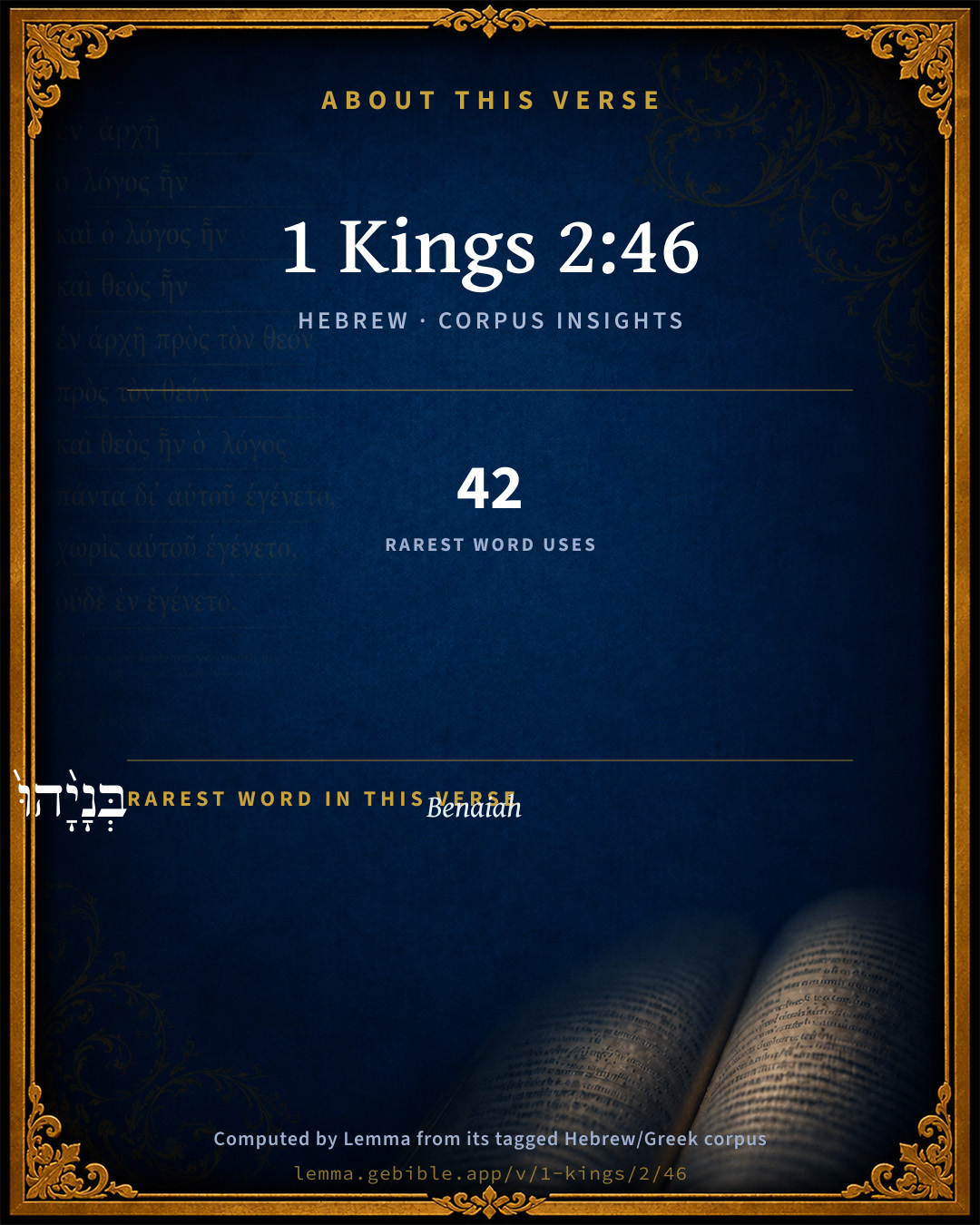
14
words
13
distinct lemmas
Historical
section

Shared distinctive vocabulary

בְּנָיָ֨הוּ֙ Benaiah H1141 occurs in 41 verses of the Hebrew Bible. Also found in:

Grammatical profile

  • 5 verbs
  • 7 nouns
  • 1 preposition
  • 1 particle

Verb forms

  • וַיְצַ֣ו Piel · Sequential Imperfect
  • וַיֵּצֵ֕א Qal · Sequential Imperfect
  • וַיִּפְגַּע Qal · Sequential Imperfect
  • וַיָּמֹ֑ת Qal · Sequential Imperfect
  • נָכ֖וֹנָה Niphal · Perfect

Cross-references

4

Topical passages linked to 1 Kings 2:46 in the Treasury of Scripture Knowledge — connected by theme and wording, ordered by reader-vote popularity; previews shown in the World English Bible.

  • 1 Kings 2:12 Solomon sat on the throne of David his father; and his kingdom was established greatly.
  • 2 Chronicles 1:1 Solomon the son of David was strengthened in his kingdom, and Yahweh his God was with him, and magnified him exceedingly.
  • 1 Kings 2:45 But king Solomon shall be blessed, and the throne of David shall be established before Yahweh forever.
  • Proverbs 29:4 The king by justice makes the land stable, But he who takes bribes tears it down.

Cross-references courtesy of OpenBible.info (CC BY 4.0).

Hebrew and Greek witnesses Masoretic Hebrew ↔ Greek Septuagint

The same verse in the two great witnesses to the Old Testament, shown verse-for-verse.

These are two independent witnesses, not word-aligned to each other, and the Septuagint is shown in lemma (dictionary) form.

Hebrew 1 Kings 2:46 Masoretic · Westminster Leningrad Codex

וַיְצַ֣ו הַמֶּ֗לֶךְ אֶת בְּנָיָ֨הוּ֙ בֶּן יְה֣וֹיָדָ֔ע וַיֵּצֵ֕א וַיִּפְגַּע בּ֖וֹ וַיָּמֹ֑ת וְהַמַּמְלָכָ֥ה נָכ֖וֹנָה בְּיַד שְׁלֹמֹֽה

So the king commanded Benaiah the son of Jehoiada; and he went out, and fell on him, so that he died. The kingdom was established in the hand of Solomon.

World English Bible · Public Domain

Greek LXX 1 Kings 2:46 Septuagint · lemma form

καί ἐντέλλομαι ὁ βασιλεύς σαλωμών ὁ βαναιας υἱός ιωδαε καί ἐκἔρχομαι καί ἀνααἱρέω αὐτός καί ἀποθνήσκω καί εἰμί ὁ βασιλεύς σαλωμών φρόνιμος σφόδρα καί σοφός καί ἰουδά καί ἰσραήλ πολύς σφόδρα ὡς ὁ ἄμμος ὁ ἐπί ὁ θάλασσα εἰς πλῆθος ἐσθίω καί πίνω καί χαίρω καί σαλωμών εἰμί ἄρχων ἐν πᾶς ὁ βασιλεία καί εἰμί προςφέρω δῶρον καί δουλεύω ὁ σαλωμών πᾶς ὁ ἡμέρα ὁ ζωή αὐτός καί σαλωμών ἄρχω δια ἀναοἴγω ὁ δυνάστευμα ὁ λίβανος καί αὐτός οἰκοδομέω ὁ θερμαι ἐν ὁ ἔρημος καί οὗτος ὁ ἄριστον ὁ σαλωμών τριάκοντα κόρος σεμίδαλις καί ἑξήκοντα κόρος ἄλευρον κοπανίζω δέκα μόσχος ἐκλεκτός καί εἴκοσι βοῦς νομάς καί ἑκατόν πρόβατον ἐκτός ἔλαφος καί δορκάς καί ὄρνις ἐκλεκτός νομάς ὅτι εἰμί ἄρχων ἐν πᾶς πέραν ὁ ποταμός ἀπό ραφι ἕως γάζα ἐν πᾶς ὁ βασιλεύς πέραν ὁ ποταμός καί εἰμί αὐτός εἰρήνη ἐκ πᾶς ὁ μέρος αὐτός κυκλόθεν καί καταοἰκέω ἰουδά καί ἰσραήλ πείθω ἕκαστος ὑπό ὁ ἄμπελος αὐτός καί ὑπό ὁ συκῆ αὐτός ἐσθίω καί πίνω ἀπό δαν καί ἕως βηρσαβεε πᾶς ὁ ἡμέρα σαλωμών καί οὗτος ὁ ἄρχων ὁ σαλωμών αζαριον υἱός σαδωκ ὁ ἱερεύς καί ορνιου υἱός ναθαν ἄρχων ὁ ἐπιἵστημι καί εδραμ ἐπί ὁ οἶκος αὐτός καί σουβα γραμματεύς καί βασα υἱός αχιθαλαμ ἀναμιμνήσκω καί αβι υἱός ιωαβ ἀρχιστράτηγος καί αχιρε υἱός εδραϊ ἐπί ὁ ἄρσις καί βαναιας υἱός ιωδαε ἐπί ὁ αὐλαρχία καί ἐπί ὁ πλινθεῖον καί ζαχουρ υἱός ναθαν ὁ σύμβουλος καί εἰμί ὁ σαλωμών τεσσαράκοντα χιλιάς τοκάς ἵππος εἰς ἅρμα καί δώδεκα χιλιάς ἱππεύς καί εἰμί ἄρχων ἐν πᾶς ὁ βασιλεύς ἀπό ὁ ποταμός καί ἕως γῆ ἀλλόφυλος καί ἕως ὅριον αἴγυπτος σαλωμών υἱός δαυίδ βασιλεύω ἐπί ἰσραήλ καί ἰουδά ἐν ἰερουσαλήμ

No English rendering of this Greek verse — the small residue in the structurally divergent books.

Hebrew: Westminster Leningrad Codex (CC BY 4.0). Greek: Septuagint (public domain); English from a public-domain English Septuagint. How the Septuagint differs from the Hebrew →

Targum (Aramaic paraphrase)

1

The Targum is the ancient Jewish Aramaic paraphrase of the Hebrew Scriptures — an interpretive translation, not the Hebrew text itself. Onkelos (literal) and Pseudo-Jonathan (expansive) render the Torah, and Jonathan the Prophets. Coverage is partial: where no permissively-licensed English translation exists for a verse, only the Aramaic is shown. This is verse-level text, not a word-by-word alignment to the Hebrew.

  1. Targum Jonathan Prophets (Joshua–Malachi)
    וּפַקֵיד מַלְכָּא יַת בְּנָיָהוּ בַר יְהוֹיָדָע וּנְפַק וְשַׁלִיט בֵּיהּ וְקַטְלֵיהּ וּמַלְכוּתָא אַתַּקָנַת בִּידָא דִשְׁלֹמֹה:

    (no public-domain English translation for this verse)

    Targum Jonathan — Aramaic: “Mikraot Gedolot” (public domain). English: “Sefaria Community Translation” (CC0 1.0 (public-domain dedication)); “London "Chaldee Paraphrase," 1871” (public domain). Text via Sefaria.

Commentary

Notes on 1 Kings 2:46 from classic Christian and Jewish commentators (each source and its license shown beneath its notes). The classic Christian expositions comment on the surrounding passage and are grouped to its opening verse, so a note may address several verses; the Jewish commentaries on the Tanakh (Rashi and others) are per-verse, so they appear only where the commentator wrote on this verse.

Lemma curates 59 commentaries, every one of them public domain or Creative Commons licensed, each selected and text-cleaned for this edition rather than reprinted as found. About our sources →

Trapp's Complete Commentary

John Trapp

1Ki 2:46 So the king commanded Benaiah the son of Jehoiada; which went out, and fell upon him, that he died. And the kingdom was established in the hand of Solomon.

Ver. 46. And the kingdom was established.] Hoc est, sine aemulis regnare coepit; the contrary faction was destroyed, and none left to oppose him.

John Trapp, A Commentary or Exposition upon All the Books of the Old and New Testament (1647–1656) — public domain. Text from a community e-Sword module.

Geneva Bible (1599)

Geneva Bible translators

Because all his enemies were destroyed.

Geneva Bible (1599) marginal notes — public domain. Text via Bolls.life.

Jamieson, Fausset & Brown

Robert Jamieson, A. R. Fausset & David Brown

the kingdom was established in the hand of Solomon--Now, by the death of Shimei, all the leaders of the rival factions had been cut off.

Next: 1 Kings Chapter 3

Jamieson, Fausset & Brown — Commentary Critical and Explanatory on the Whole Bible (1871) — public domain (CC PDM 1.0). Text via the HelloAO Bible API.

Adam Clarke's Commentary

Verse 46. And the kingdom was established] He had neither foes within nor without. He was either dreaded or loved universally. His own subjects were affectionately bound to him, and the surrounding nations did not think proper to make him their enemy.

As there are serious doubts relative to the dying charge of David as it relates to Shimei, most believing that, in opposition to his own oath, David desired that Solomon should put him to death; I shall here insert Dr. Kennicott's criticism on this part of the text: -

"David is here represented in our English version as finishing his life with giving a command to Solomon to kill Shimei, and to kill him on account of that very crime for which, as David here says, he had sworn to him by the Lord he would not put him to death. The behaviour thus imputed to the king and prophet, and which would be justly censurable if true, should be examined very carefully as to the ground it stands upon; and when the passage is duly considered, I presume it will appear highly probable that an injury has been here done to this illustrious character. The point to which I now beg the reader's attention is this: That it is not uncommon in the Hebrew language to omit the negative in a second part of the sentence, and to consider it as repeated, when it has been once expressed, and is followed by the connecting particle. And thus on Isa 13:22 the late learned annotator says: 'The negative is repeated or referred to by the conjunction vau, as in many other places.' So also Isa 23:4. The necessity of so very considerable an alteration as inserting the particle NOT, may be here confirmed by some other instances. Ps 1:5: The ungodly shall not stand in the judgment, NOR (the Hebrew is AND, signifying and not) sinners in the congregation of the righteous. Ps 9:18: The needy shall not alway be forgotten, (and then the negative, understood as repeated by the conjunction, now dropped,) the expectation of the poor shall (NOT) perish for ever. Ps 38:1: O Lord, rebuke me not in thy wrath; NEITHER (AND, for and not) chasten me in thy hot displeasure. Ps 75:5: Lift not up your horn on high, (and then the negative, understood as repeated by the conjunction, now dropped,) speak (NOT) with a stiff neck. Pr 24:12, (our version is this:) Doth not he, that pondereth the heart consider it? and he that keepeth the soul, doth (NOT) he know it? and shall (NOT) he render to every man according to his works? And Pr 30:3: I neither learned wisdom, NOR (AND, for and not) have the knowledge of the holy. If then there are in fact many such instances, the question is, Whether the negative here, expressed in the former part of David's command, may not be understood as to be repeated in the latter part; and if this may be, a strong reason will be added why it should be, so interpreted. The passage will run thus: 'Behold, thou hast with thee Shimei, who cursed me - but I swore to him by the Lord, saying, I will not put thee to death by the sword. Now, therefore, hold him NOT guiltless, (for thou art a wise man, and knowest what thou oughtest to do unto him,) but bring NOT down his hoar head to the grave with blood.' Now if the language itself will admit of this construction, the sense thus given to the sentence derives a very strong support from the context. For how did Solomon understand this charge? Did he kill Shimei in consequence of it? Certainly he did not; for after he had immediately commanded Joab to be slain, in obedience to his father, he sends for Shimei, and knowing that Shimei ought to be well watched, confines him to a particular spot in Jerusalem for the remainder of his life; 1Kg 2:36-42. See also Job 23:17; Job 30:20; Job 31:20." This is the best mode of interpreting this text.

Adam Clarke's Commentary on the Bible (1810–1826) — public domain. Text from a community e-Sword/MySword module.

The Cambridge Bible for Schools and Colleges

gen. ed. J. J. S. Perowne

46. which went out] Literally ‘and he went out,’ which reads rather better than the A.V.

in the hand of Solomon] The conspirators who might have been dangerous were all removed, and now, though still but a youth, Solomon had gained complete hold of the reins of government. Cf. 2Ch_1:1, where it is said that he ‘was strengthened in his kingdom, and the Lord his God was with him.’

The Vulgate joins on the last clause of this verse to the first verse of the next chapter; which seems to be a most natural connexion.

In the Chronicles no mention is made either of David’s dying injunctions to his son, nor of their execution. The compiler of that book appears designedly to have omitted all notice of the troubles under which David suffered, and so it does not fall within his plan to speak of the punishment of his adversaries. The religious zeal of Solomon, his wealth and wisdom, his abundant offerings and the building of the Temple were themes better suited to the time when the Chronicler compiled his narrative, and such matter therefore makes up the most part of his book.

The Cambridge Bible for Schools and Colleges (gen. ed. J. J. S. Perowne; Cambridge University Press, 1878–1918) — public domain. Text from a community e-Sword module.

Matthew Poole's English Annotations

Which went out; carrying Shimei along with him to the place of execution, which was not fit to be in the king’s presence.

The kingdom was established in the hand of Solomon; his secret and worst enemies being taken out of the way.

Matthew Poole's English Annotations on the Holy Bible (1683–1685) — public domain. Text from a community e-Sword/MySword module.

Whedon's Commentary on the Bible

Daniel D. Whedon

46. The kingdom was established in the hand of Solomon — By the utter crushing out of treason in the removal of those who alone were disposed to rebellion. Solomon might say from his own experience: “Take away the wicked from before the king, and his throne shall be established in righteousness.” Pro_25:5.

Daniel D. Whedon (gen. ed.), Commentary on the Old and New Testaments (1874–1909) — public domain. Text from a community e-Sword module.

The Pulpit Commentary

So the king commanded Ben-aiah the son of Jehoiada, which went out and fell upon him that he died. The execution of Shimei has, perhaps, on the whole given more offence than that of Joab or even Adonijah. He, at any rate, was not "a murderer whom vengeance suffereth not to live," nor had he taken any part in recent conspiracies. On the contrary, he seems to have lived quietly enough under the eye of the king. And it consequently has the appearance of cruelty and malevolence that Solomon should "press the letter of a compact against him," especially when, by returning to Jerusalem, he placed his life at Solomon"s mercy. But it is not difficult to offer a complete justification of Solomon"s action in this matter. In the first place, it is to be remembered that cruelty had no part in his character. In his long reign of forty years there are absolutely no evidences of a brutal and tyrannical disposition. There is a strong presumption, consequently, that he was not actuated by cruelty on this occasion, a presumption which finds support in the consideration that Solomon was much too sagacious to prejudice himself in popular estimation at the commencement of his reign by proceedings which would have the least suspicion of vindictiveness. And

(2) with this probability the facts of the case entirely agree. Shimei"s life, as we have seen, was forfeited to Jewish law. As he had so long been spared, however, the king gave him a gracious respite. The conditions imposed were not onerous. Shimei had but to keep his parole and he would live; to break it and he would assuredly die. He did break it; not without provocation, it may be, but he broke it, and broke too his solemn oath. It may be said it was hard he should lose his slaves, but better, surely, lose them than his life. Besides, there were other ways of recovering them; or, if he must pursue them in person, his proper course was evidently to ask the king"s permission. That he did not do so is in itself a suspicious circumstance, and Solomon might reasonably think that the flight of the slaves was but a feint, and that Shimei"s visit to a foreign court had really a political object. But, be that as it may, the king had protested unto him that if he went any whither, he should most certainly die. When he went, when he despised the royal command and disregarded his sacred oath, how was it possible for Solomon to break his word? To do so would have been inevitably to compromise himself with his subjects, and to forfeit their reverence and trust. Besides, there was a duty he owed to his dead father, and above all, one which he owed to the living God. He had now the opportunity for which his father bade him wait, of putting into force the provisions of the Mosaic law, of requiring the death of the blasphemer, of showing his subjects that the law could not be defied with impunity, that though vengeance was not executed speedily against evil works, still retribution was certain in the long run, and so of teaching them a much needed lesson of obedience and respect of authority. Every consideration, therefore, of justice, morality, filial piety, and religion warranted him in putting Shimei to death. Every imputation of weakness, irresolution, disregard of his plighted word, compromise of his royal dignity, and indifference to religion might justly have been levelled against him, had he interfered between Shimei and the sword of Justice.

The Pulpit Commentary (1880–1919), ed. H.D.M. Spence-Jones & Joseph S. Exell — public domain. Text from a community e-Sword module.

Rashi

Rabbi Shlomo Yitzchaki (Rashi)

The kingdom was thus established, etc. I.e., he was not punished for all these [actions].

Rashi on the Tanakh — English translations: “The Judaica Press complete Tanach with Rashi, translated by A. J. Rosenberg” (CC BY 4.0); “Pentateuch with Rashi's commentary by M. Rosenbaum and A.M. Silbermann, 1929-1934” (public domain); “The Metsudah Tanach series, Lakewood, N.J” (CC BY 4.0); and “The Book of Joshua, Metsudah Publications, 1997” (CC BY 4.0). Text via Sefaria.

Lesson kit

Teaching starters — assembled from the data on this page, not authored interpretation. Every prompt links to the verse data it draws on. Edit before teaching.

1 Kings, in the Historical, opens this verse with 14 words (13 distinct Hebrew lemmas). Its most distinctive word is Bᵉnâyâh (“Benaiah”). A historical commentator’s framing appears above. Read the whole chapter for the surrounding context.

Discussion questions

  1. How does “Benaiah” (Bᵉnâyâh) shape what this verse is saying?
  2. How does 2 Samuel 8:18, which shares the word «Benaiah», read alongside this verse?
  3. The translations on this page render this verse differently — a whole-verse word diff, not a word-by-word alignment. What might account for the different wordings?
  4. «וַיְצַ֣ו» is a Piel Sequential Imperfect verb. How does that grammatical form shape the action described?
  5. Compare how Trapp's Complete Commentary and Geneva Bible (1599) read this verse. Where do they agree or differ?

Things to notice

Reading settings

Reading text

Shown beneath each verse's original-language words.

Old Testament
Old Testament edition

Read the OT as the Masoretic Hebrew (MT) or the Greek Septuagint (LXX).

English shown for the Greek Septuagint (in the Hebrew ↔ Greek comparison).

Comparing translations? Open the Compare panel on any verse page to stack up to four side by side.