
Exodus 30:20

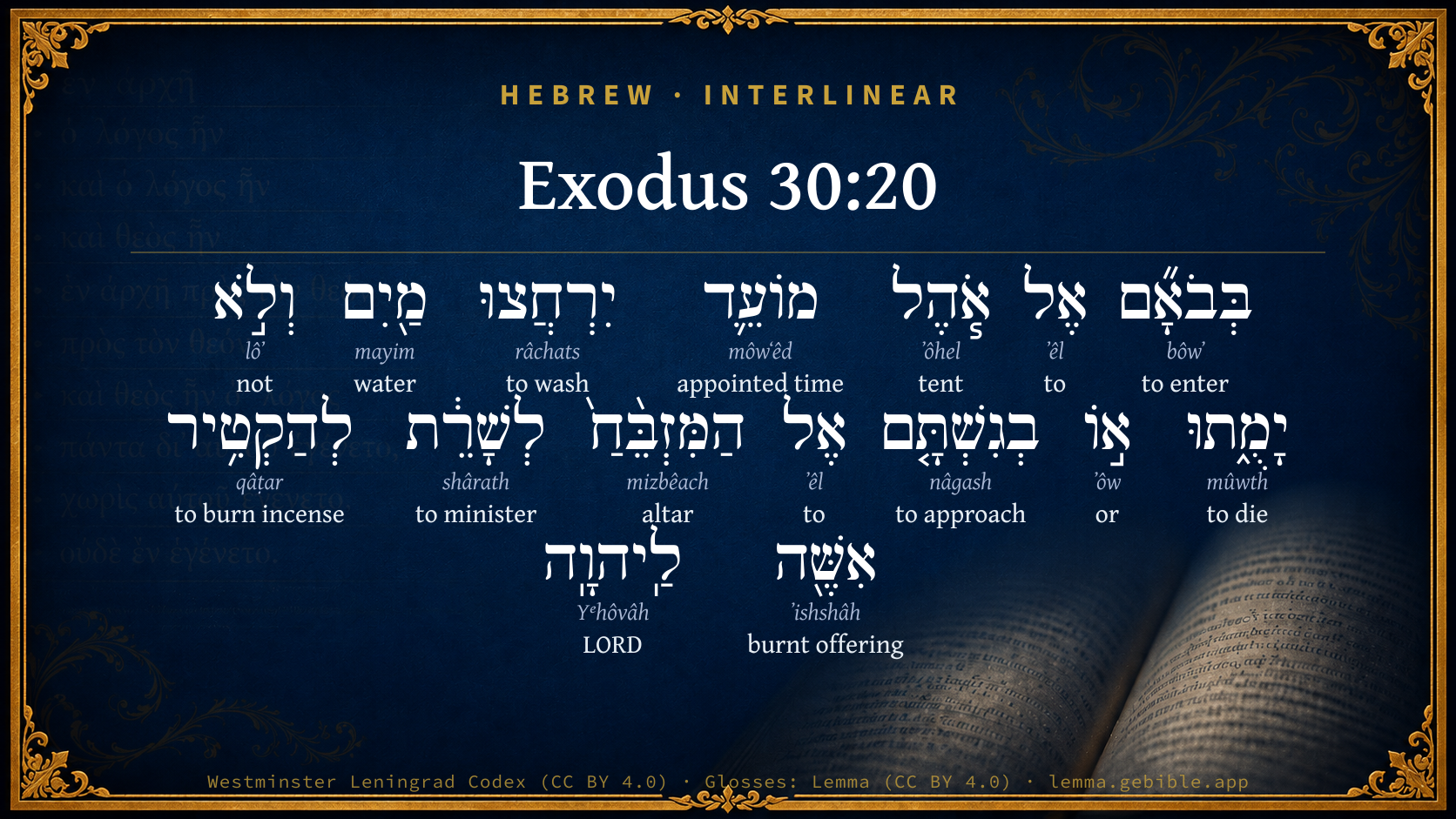
Hebrew (Westminster Leningrad Codex) Exodus 30:20 appears in the Hebrew Old Testament. The text above is from the Westminster Leningrad Codex. Each word links to its Strong’s number, a concise gloss, and parsing drawn from the Open Scriptures Hebrew Bible morphology. Click any word for its full Brown-Driver-Briggs (BDB) entry.
Download image
Cite this verse

Exodus 30:20 (World English Bible). Public Domain. Lemma interlinear Bible study tool, https://lemma.gebible.app/v/exodus/30/20.

Show BibTeX & RIS
BibTeX
RIS
English Translation
When they go into the tent of meeting, they shall wash with water, that they not die; or when they come near to the altar to minister, to burn an offering made by fire to Yahweh.
World English Bible · Public Domain
Download a study sheet

One document with this verse’s original text, its word-by-word gloss line, the meaning frame, cross-references with their text, attributed commentary, and full source and license credits — printable, and it pastes into notes with its structure intact.

This verse Autodidact and up

Study sheet (.html) Plain text (.txt)

A passage Seminary Student

Up to 50 verses in one chapter. A passage sheet keeps up to 6 commentary sources and 12 cross-references per verse, in the order this page ranks them, and says so on the sheet whenever that leaves anything out. Ask for a single verse and you get the Autodidact verse sheet above.

Everything on this page stays free to read, with no account — the sheet is a download of what is already on screen, not access to it.

Want to remove ads? Support Godless Engineer
Compare translations 3

The same verse in 3 English versions, stacked beneath the original-language interlinear above. Click any original word for its lexicon entry.

Each is an independent rendering of the whole verse — the interlinear is not word-aligned to these translations.

Highlighted words mark where these versions differ — a whole-verse word diff, not a word-by-word alignment.

  • World English Bible Public Domain
    When they go into the tent of meeting, they shall wash with water, that they not die; or when they come near to the altar to minister, to burn an offering made by fire to Yahweh.
  • King James Version Public Domain
    When they go into the tabernacle of the congregation, they shall wash with water, that they die not; or when they come near to the altar to minister, to burn offering made by fire unto the LORD:
  • unfoldingWord Literal Text CC BY-SA 4.0
    When they go into the tent of meeting, they shall wash with water, and they will not die. Also when they go near to the altar to serve by causing a fire offering to Yahweh to smoke,

unfoldingWord Literal Text — © unfoldingWord, licensed CC BY-SA 4.0. Word-aligned USFM3 via Door43 (git.door43.org/unfoldingWord/en_ult).

Versions to compare (up to 4)

3 of 4 selected

Show all 18 translations

Every available English version of this verse, each an independent rendering of the whole verse.

  • World English Bible Public Domain
    When they go into the tent of meeting, they shall wash with water, that they not die; or when they come near to the altar to minister, to burn an offering made by fire to Yahweh.
  • Berean Standard Bible Public Domain
    Whenever they enter the Tent of Meeting or approach the altar to minister by presenting an offering made by fire to the LORD, they must wash with water so that they will not die.
  • Majority Standard Bible Public Domain
    Whenever they enter the Tent of Meeting or approach the altar to minister by presenting a food offering to the LORD, they must wash with water so that they will not die.
  • King James Version Public Domain
    When they go into the tabernacle of the congregation, they shall wash with water, that they die not; or when they come near to the altar to minister, to burn offering made by fire unto the LORD:
  • American Standard Version (1901) Public Domain
    when they go into the tent of meeting, they shall wash with water, that they die not; or when they come near to the altar to minister, to burn an offering made by fire unto Jehovah.
  • Revised Version (1885) Public Domain
    when they go into the tent of meeting, they shall wash with water, that they die not; or when they come near to the altar to minister, to burn an offering made by fire unto the LORD:
  • Geneva Bible (1599) Public Domain
    When they go into the Tabernacle of the Congregation, or when they goe vnto the Altar to minister and to make the perfume of ye burnt offring to the Lord, they shall wash themselues with water, lest they die.
  • Douay-Rheims (1899) Public Domain
    When they are going into the tabernacle of the testimony, and when they are to come to the altar, to offer on it incense to the Lord,
  • Young's Literal Translation Public Domain
    in their going in unto the tent of meeting they wash `with' water, and die not; or in their drawing nigh unto the altar to minister, to perfume a fire-offering to Jehovah,
  • Literal Standard Version CC BY-SA 4.0
    they wash [with] water in their going into the Tent of Meeting, and do not die; or in their drawing near to the altar to minister, to make incense [as] a fire-offering to YHWH,
  • Unlocked Literal Bible CC BY-SA 4.0
    When they go into the tent of meeting or when they go near to the altar to serve me by burning an offering, they must wash with water so that they do not die.
  • unfoldingWord Literal Text CC BY-SA 4.0
    When they go into the tent of meeting, they shall wash with water, and they will not die. Also when they go near to the altar to serve by causing a fire offering to Yahweh to smoke,
  • Darby Bible Public Domain
    When they go into the tent of meeting, they shall wash with water, that they may not die; or when they come near to the altar to serve, to burn an offering by fire to Jehovah.
  • World Messianic Bible Public Domain
    When they go into the Tent of Meeting, they shall wash with water, that they don’t die; or when they come near to the altar to minister, to burn an offering made by fire to the LORD.
  • Webster's Bible Public Domain
    When they go into the tabernacle of the congregation, they shall wash with water, that they die not: or when they come near to the altar to minister, to burn offering made by fire to the LORD.
  • Free Bible Version CC BY-SA 4.0
    Whenever they enter the Tent of Meeting, they are to wash with water so that they will not die. When they approach the altar to present burnt offerings to the Lord,
  • Bible in Basic English Public Domain
    Whenever they go into the Tent of meeting they are to be washed with water, to keep them from death; and whenever they come near to do the work of the altar, or to make an offering by fire to the Lord,
  • JPS Tanakh (1917) Public Domain
    when they go into the tent of meeting, they shall wash with water, that they die not; or when they come near to the altar to minister, to cause an offering made by fire to smoke unto the LORD;

Literal Standard Version (2020), Covenant Press — licensed CC BY-SA 4.0. Text via the HelloAO Bible API (eBible.org). Unlocked Literal Bible (unfoldingWord) — licensed CC BY-SA 4.0. Text via the HelloAO Bible API (eBible.org). unfoldingWord Literal Text — © unfoldingWord, licensed CC BY-SA 4.0. Word-aligned USFM3 via Door43 (git.door43.org/unfoldingWord/en_ult). Free Bible Version, Dr. Jonathan Gallagher — licensed CC BY-SA 4.0. Text via the HelloAO Bible API (eBible.org).

Word by word

More ways to search: Search by grammar → Find every occurrence → Compare this word →

Practice this passage: Drill this verse → Learn its vocabulary →

אִשֶּׁ֖ה
ʼishshâh
H801
“burnt offering”
Noun, Common, Masculine, Singular, Absolute
Part of Speech
Noun
Type
Common
Gender
Masculine
Number
Singular
State
Absolute
Full BDB Definition

Origin: the same as H800 , but used in a liturgical sense

TWOT: 172a

burnt-offering, offering made by fire, fire offering
  1. בְּבֹאָ֞ם bôwʼ H935 “in/at · to enter · them” Preposition + Verb, Qal, Infinitive Construct + Suffix, Personal, 3rd Person, Masculine, Plural
  2. אֶל ʼêl H413 “to” Preposition
  3. אֹ֧הֶל ʼôhel H168 “tent of” Noun, Common, Masculine, Singular, Construct
  4. מוֹעֵ֛ד môwʻêd H4150 “appointed time” Noun, Common, Masculine, Singular, Absolute
  5. יִרְחֲצוּ râchats H7364 “to wash” Verb, Qal, Imperfect, 3rd Person, Masculine, Plural
  6. מַ֖יִם mayim H4325 “water(s)” Noun, Common, Masculine, Plural, Absolute
  7. וְלֹ֣א lôʼ H3808 “and · not” Conjunction + Particle, Negative
  8. יָמֻ֑תוּ mûwth H4191 “to die” Verb, Qal, Imperfect, 3rd Person, Masculine, Plural
  9. א֣וֹ ʼôw H176 “or” Conjunction
  10. בְגִשְׁתָּ֤ם nâgash H5066 “in/at · to approach · them” Preposition + Verb, Qal, Infinitive Construct + Suffix, Personal, 3rd Person, Masculine, Plural
  11. אֶל ʼêl H413 “to” Preposition
  12. הַמִּזְבֵּ֨חַ֙ mizbêach H4196 “the · altar” Particle, Definite Article + Noun, Common, Masculine, Singular, Absolute
  13. לְשָׁרֵ֔ת shârath H8334 “to minister” Preposition + Verb, Piel, Infinitive Construct
  14. לְהַקְטִ֥יר qâṭar H6999 “to burn incense” Preposition + Verb, Hiphil, Infinitive Construct
  15. לַֽיהוָֽה Yᵉhôvâh H3068 “to/for · LORD” Preposition + Noun, Proper

About this verse

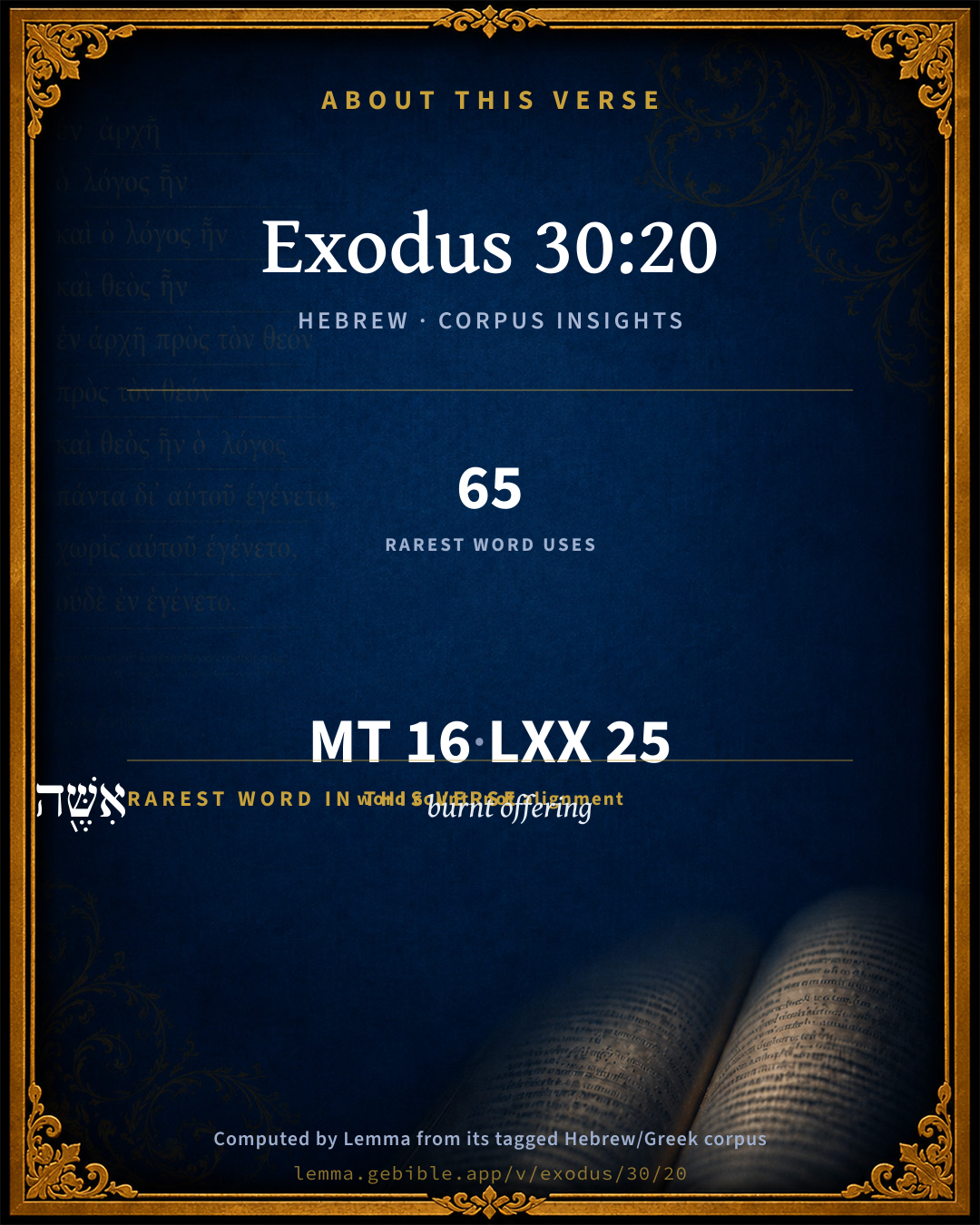
These counts appear in no published source. They are computed here, from the morphology-tagged text and Lemma’s own curated glosses. What Lemma adds →

16
words
15
distinct lemmas
Pentateuch
section

Grammatical profile

  • 6 verbs
  • 6 nouns
  • 2 prepositions
  • 1 conjunction
  • 1 particle

Verb forms

  • בְּבֹאָ֞ם Qal · Infinitive Construct
  • יִרְחֲצוּ Qal · Imperfect
  • יָמֻ֑תוּ Qal · Imperfect
  • בְגִשְׁתָּ֤ם Qal · Infinitive Construct
  • לְשָׁרֵ֔ת Piel · Infinitive Construct
  • לְהַקְטִ֥יר Hiphil · Infinitive Construct

Repetition

A word recurs within this verse — often emphatic in Hebrew:

  • אֶל to H413 ×2

Hebrew & Septuagint length

In English translation the verse runs 36 words from the Hebrew and 39 from the Septuagint (LXX English) — closely comparable.

A rough comparison of the two English renderings, which tokenize alike — not a word-level alignment.

Word counts can differ between the Hebrew and the Greek without any difference in meaning — e.g. the Hebrew direct-object marker אֵת has no separate Greek word, and Greek often adds the article ὁ.

In the original languages it is 16 Hebrew tokens and 25 Greek tokens — but the two are counted differently (Hebrew bundles its prefixes and suffixes into one token; the Greek is in lemma form), so that isn’t a like-for-like length.

Cross-references

9

Topical passages linked to Exodus 30:20 in the Treasury of Scripture Knowledge — connected by theme and wording, ordered by reader-vote popularity; previews shown in the World English Bible.

  • Exodus 12:15 Seven days shall you eat unleavened bread; even the first day you shall put away yeast out of your houses, for whoever eats leavened bread from the first day until the seventh day, that soul shall be cut off from Israel.
  • Leviticus 10:1–3 Nadab and Abihu, the sons of Aaron, each took his censer, and put fire in it, and laid incense on it, and offered strange fire before Yahweh, which he had not commanded them.
  • Leviticus 16:1–2 Yahweh spoke to Moses, after the death of the two sons of Aaron, when they drew near before Yahweh, and died;
  • 1 Samuel 6:19 He struck of the men of Beth-shemesh, because they had looked into the ark of Yahweh, he struck of the people fifty thousand seventy men; and the people mourned, because Yahweh had struck the people with a great slaughter.
  • 1 Chronicles 13:10 The anger of Yahweh was kindled against Uzza, and he struck him, because he put forth his hand to the ark; and there he died before God.
  • Psalms 89:7 A very awesome God in the council of the holy ones, To be feared above all those who are around him?
  • Acts 5:5 Ananias, hearing these words, fell down and died. Great fear came on all who heard these things.
  • Hebrews 12:28–29 Therefore, receiving a Kingdom that can't be shaken, let us have grace, through which we serve God acceptably, with reverence and awe,
  • Acts 5:10 She fell down immediately at his feet, and died. The young men came in and found her dead, and they carried her out and buried her by her husband.

Cross-references courtesy of OpenBible.info (CC BY 4.0).

Hebrew and Greek witnesses Masoretic Hebrew ↔ Greek Septuagint

The same verse in the two great witnesses to the Old Testament, shown verse-for-verse.

These are two independent witnesses, not word-aligned to each other, and the Septuagint is shown in lemma (dictionary) form.

Hebrew Exodus 30:20 Masoretic · Westminster Leningrad Codex

בְּבֹאָ֞ם אֶל אֹ֧הֶל מוֹעֵ֛ד יִרְחֲצוּ מַ֖יִם וְלֹ֣א יָמֻ֑תוּ א֣וֹ בְגִשְׁתָּ֤ם אֶל הַמִּזְבֵּ֨חַ֙ לְשָׁרֵ֔ת לְהַקְטִ֥יר אִשֶּׁ֖ה לַֽיהוָֽה

When they go into the tent of meeting, they shall wash with water, that they not die; or when they come near to the altar to minister, to burn an offering made by fire to Yahweh.

World English Bible · Public Domain

Greek LXX Exodus 30:20 Septuagint · lemma form

ὅταν εἰςπορεύομαι εἰς ὁ σκηνή ὁ μαρτύριον νίπτω ὕδωρ καί οὐ μή ἀποθνήσκω ἤ ὅταν προςπορεύομαι πρός ὁ θυσιαστήριον λειτουργέω καί ἀναφέρω ὁ ὁλοκαύτωμα κύριος

Whenever they shall go into the tabernacle of witness, they shall wash themselves with water, so they shall not die, whenever they advance to the altar to do service and to offer the whole burnt offerings to the Lord.

LXX2012 (modern English Septuagint) · Public Domain

Hebrew: Westminster Leningrad Codex (CC BY 4.0). Greek: Septuagint (public domain); English from LXX2012 (modern English Septuagint) (Public Domain). How the Septuagint differs from the Hebrew →

Targum (Aramaic paraphrase)

2

The Targum is the ancient Jewish Aramaic paraphrase of the Hebrew Scriptures — an interpretive translation, not the Hebrew text itself. Onkelos (literal) and Pseudo-Jonathan (expansive) render the Torah, and Jonathan the Prophets. Coverage is partial: where no permissively-licensed English translation exists for a verse, only the Aramaic is shown. This is verse-level text, not a word-by-word alignment to the Hebrew.

  1. Targum Onkelos Torah (Genesis–Deuteronomy)
    בְּמֵיעַלְהוֹן לְמַשְׁכַּן זִמְנָא יְקַדְשׁוּן מַיָא וְלָא יְמוּתוּן אוֹ בְמִקְרָבְהוֹן לְמַדְבְּחָא לְשַׁמָשָׁא לְאַסָקָא קֻרְבָּנָא קֳדָם יְיָ:

    (no public-domain English translation for this verse)

    Targum Onkelos — Aramaic: “Onkelos Genesis” (public domain); “Onkelos Exodus” (public domain); “Onkelos Leviticus” (public domain); “Onkelos Numbers” (public domain); “Onkelos Deuteronomy” (public domain). English: “Sefaria Community Translation” (CC0 1.0 (public-domain dedication)); “J.W. Etheridge. The Targums of Onkelos and Jonathan Ben Uzziel on the Pentateuch. London: Longmans, Green, 1862” (public domain). Text via Sefaria.

  2. Targum Pseudo-Jonathan Torah (Genesis–Deuteronomy)
    בִּזְמַן מֵיעַלְהוֹן לְמַשְׁכַּן זִימְנָא יְקַדְּשׁוּן מוֹי וְלָא יְמוּתוּן בְּאֵשָׁא מְצַלְהֲבָא אוֹ בְּמִקְרַבְהוֹן לְמַדְבְּחָא לְשַׁמָּשָׁא לְאַסָקָא קוּרְבָּנָא קֳדָם יְיָ

    at the time of their entering into the tabernacle of ordinance they shall sanctify with water, that they die not by the fiery flame ___

    Targum Pseudo-Jonathan — Aramaic: “Targum Jonathan on Genesis” (public domain); “Targum Jonathan on Exodus” (public domain); “Targum Jonathan on Leviticus” (public domain); “Targum Jonathan on Numbers” (public domain); “Targum Jonathan on Deuteronomy” (public domain). English: “The Targum of Jonathan ben Uzziel, trans. J. W. Etheridge, London, 1862” (public domain). Text via Sefaria.

Commentary

Notes on Exodus 30:20 from classic Christian and Jewish commentators (each source and its license shown beneath its notes). The classic Christian expositions comment on the surrounding passage and are grouped to its opening verse, so a note may address several verses; the Jewish commentaries on the Tanakh (Rashi and others) are per-verse, so they appear only where the commentator wrote on this verse.

Lemma curates 59 commentaries, every one of them public domain or Creative Commons licensed, each selected and text-cleaned for this edition rather than reprinted as found. About our sources →

Trapp's Complete Commentary

John Trapp

Exo 30:20 When they go into the tabernacle of the congregation, they shall wash with water, that they die not; or when they come near to the altar to minister, to burn offering made by fire unto the LORD:

Ver. 20. Wash with water.] "Wash their hands in innocency," before they "compass God’s altar." {Psa 26:6 Heb 10:22 Isa 52:11}

John Trapp, A Commentary or Exposition upon All the Books of the Old and New Testament (1647–1656) — public domain. Text from a community e-Sword module.

Adam Clarke's Commentary

Verse 20. They shall wash with water, that they die not] This was certainly an emblematical washing; and as the hands and the feet are particularly mentioned, it must refer to the purity of their whole conduct. Their hands - all their works, their feet - all their goings, must be washed - must be holiness unto the Lord. And this washing must be repeated every time they entered into the tabernacle, or when they came near to the altar to minister. This washing was needful because the priests all ministered barefoot; but it was equally so because of the guilt they might have contracted, for the washing was emblematical of the putting away of sin, or what St. Paul calls the laver of regeneration and the renewing of the Holy Ghost, (Tit 3:5), as the influences of the Spirit must be repeated for the purification of the soul, as frequently as any moral defilement has been contracted.

Adam Clarke's Commentary on the Bible (1810–1826) — public domain. Text from a community e-Sword/MySword module.

Ellicott's Commentary for English Readers

(20) That they die not.—Comp. Exo_28:35; Exo_28:43. It is not altogether easy to see why the death-penalty was threatened against neglect of certain ceremonial observances, and not of others. Ablution, however, was so easy, and probably so long-established a practice, that to omit it would imply intentional disrespect towards God.

A Bible Commentary for English Readers, edited by Charles John Ellicott (1878–1897) — public domain. Text from a community e-Sword module.

The Cambridge Bible for Schools and Colleges

gen. ed. J. J. S. Perowne

20. that they die not] cf. Exo_28:35, with the note.

The Cambridge Bible for Schools and Colleges (gen. ed. J. J. S. Perowne; Cambridge University Press, 1878–1918) — public domain. Text from a community e-Sword module.

John Gill's Exposition

When they go into the tabernacle of the congregation, they shall wash with water,.... The laver standing near the door of the tabernacle, they washed at it as soon as they entered; and no man, we are told (c), entered into the court before he washed, even though he was clean; though he had contracted no filthiness, and even though he had washed his hands and feet at home, he was obliged to do it when he went into the tabernacle, before he attempted to perform any service. This intimates to us the necessity as of pure hearts, so of pure hands, in order to compass the altar of God, to attend public worship, and particularly prayer, in which holy hands should be lifted up, Ti1 2:8,

that they die not: sin exposes to death, eternal death; that is the wages of it, and it is only the blood of Christ, and being washed in that, that can secure from it:

or when they come near to the altar to minister; to the altar of burnt offering to minister there, by laying on the wood and the pieces in order, and burning them on it, as follows:

to burn offering made by fire to the Lord; no man was fit for this service, or might be admitted to it, until he was washed; and it was usual among other nations to wash before they entered on religious service (d); even in the East Indies, the priests do not sacrifice to their idols before they wash in water that is about the temple (e); which seems to be a satanical imitation of this practice among the Jews.

(c) Misn. Yoma, c. 3. sect. 3. (d) Vid. Outram de Sacrificiis, l. 1. c. 6. sect. 14. (e) Vartoman. Navigat. l. 5. c. 23.

John Gill's Exposition of the Whole Bible (1746–1763) — public domain (CC PDM 1.0). Text via the HelloAO Bible API.

Matthew Poole's English Annotations

That they die not; for though the fault might seem small, yet the command was evident and easy, and therefore the disobedience was worse, arguing presumption, rebellion, and contempt. And God is more severe in the matters of his worship than in other cases.

Matthew Poole's English Annotations on the Holy Bible (1683–1685) — public domain. Text from a community e-Sword/MySword module.

The Pulpit Commentary

That they die not. Compare Exo_28:35, Exo_28:43. Contempt of the simple and easy regulation to wash at the laver would imply contempt of purity itself; and so an entire hypocrisy of life and character, than which nothing could be a greater offence to God.

The Pulpit Commentary (1880–1919), ed. H.D.M. Spence-Jones & Joseph S. Exell — public domain. Text from a community e-Sword module.

Rashi

Rabbi Shlomo Yitzchaki (Rashi)

בבאם אל אהל מועד WHEN THEY COME INTO THE APPOINTED TENT to burn incense in the morning and at evening, or to sprinkle of the blood of the bullock offered by the anointed High-Priest (Leviticus 4:5, 7) and of the he-goats offered as atonement for the sin of idolatry (all of which services were performed in the interior of the Sanctuary) (Zevachim 19b).

ולא ימתו THAT THEY DIE NOT — thus it follows that if they do not wash they will die: You may rightly draw this conclusion for in the Torah laws are sometimes stated only by implication: consequently from what is said here in the negative (that they die not) you may derive the positive (that they will die if they do not observe the law here laid down).

אל המזבח [OR WHEN THEY STEP] NEAR THE ALTAR — i. e. the outer altar, in which case there is no entering into the appointed tent but the service is performed in the court.

Rashi on the Tanakh — English translations: “The Judaica Press complete Tanach with Rashi, translated by A. J. Rosenberg” (CC BY 4.0); “Pentateuch with Rashi's commentary by M. Rosenbaum and A.M. Silbermann, 1929-1934” (public domain); “The Metsudah Tanach series, Lakewood, N.J” (CC BY 4.0); and “The Book of Joshua, Metsudah Publications, 1997” (CC BY 4.0). Text via Sefaria.

Lesson kit

Teaching starters — assembled from the data on this page, not authored interpretation. Every prompt links to the verse data it draws on. Edit before teaching.

Exodus, in the Pentateuch, opens this verse with 16 words (15 distinct Hebrew lemmas). Its most distinctive word is ʼishshâh (“burnt offering”). A historical commentator’s framing appears above. Read the whole chapter for the surrounding context.

Discussion questions

  1. What does “burnt offering” (ʼishshâh) contribute to the verse as a whole?
  2. How does Exodus 12:15, which shares this passage’s theme, read alongside this verse?
  3. What does the repetition of “to” (2× in this one verse) do in this verse?
  4. These translations render this verse differently; the difference is in the English rendering, not the original. What questions does that raise?
  5. «בְּבֹאָ֞ם» is a Qal Infinitive Construct verb. How does that grammatical form shape the action described?
  6. Compare how Trapp's Complete Commentary and Adam Clarke's Commentary read this verse. Where do they agree or differ?

Things to notice

Reading settings

Reading text

Shown beneath each verse's original-language words.

Old Testament
Old Testament edition

Read the OT as the Masoretic Hebrew (MT) or the Greek Septuagint (LXX).

English shown for the Greek Septuagint (in the Hebrew ↔ Greek comparison).

Comparing translations? Open the Compare panel on any verse page to stack up to four side by side.