Ezekiel 33:14

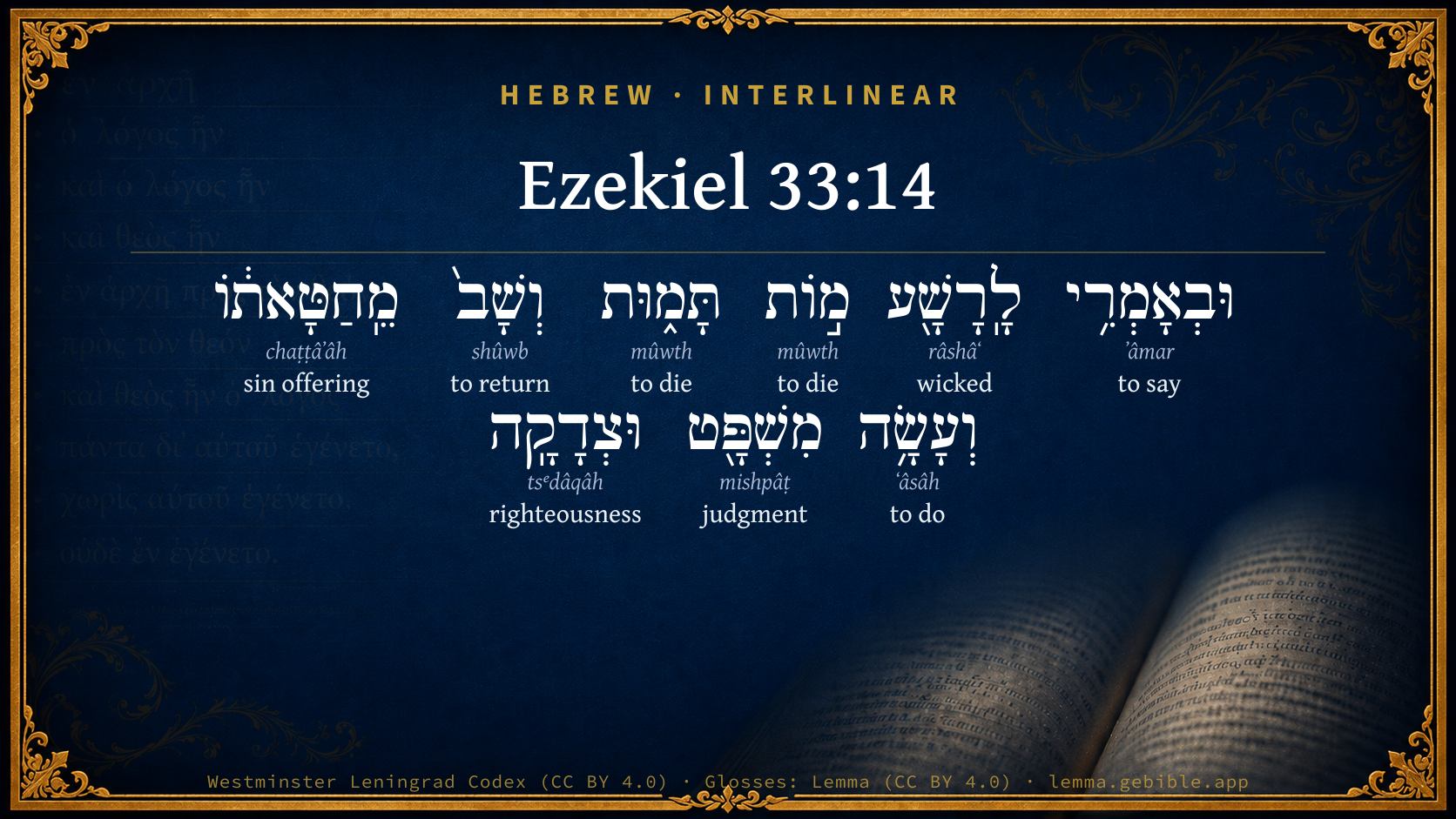
Hebrew (Westminster Leningrad Codex) Ezekiel 33:14 appears in the Hebrew Old Testament. The text above is from the Westminster Leningrad Codex. Each word links to its Strong’s number, a concise gloss, and parsing drawn from the Open Scriptures Hebrew Bible morphology. Click any word for its full Brown-Driver-Briggs (BDB) entry.
Download image
Cite this verse

Ezekiel 33:14 (World English Bible). Public Domain. Lemma interlinear Bible study tool, https://lemma.gebible.app/v/ezekiel/33/14.

Show BibTeX & RIS
BibTeX
RIS
English Translation
Again, when I say to the wicked, You shall surely die; if he turn from his sin, and do that which is lawful and right;
World English Bible · Public Domain
Download a study sheet

One document with this verse’s original text, its word-by-word gloss line, the meaning frame, cross-references with their text, attributed commentary, and full source and license credits — printable, and it pastes into notes with its structure intact.

This verse Autodidact and up

Study sheet (.html) Plain text (.txt)

A passage Seminary Student

Up to 50 verses in one chapter. A passage sheet keeps up to 6 commentary sources and 12 cross-references per verse, in the order this page ranks them, and says so on the sheet whenever that leaves anything out. Ask for a single verse and you get the Autodidact verse sheet above.

Everything on this page stays free to read, with no account — the sheet is a download of what is already on screen, not access to it.

Want to remove ads? Support Godless Engineer
Compare translations 3

The same verse in 3 English versions, stacked beneath the original-language interlinear above. Click any original word for its lexicon entry.

Each is an independent rendering of the whole verse — the interlinear is not word-aligned to these translations.

Highlighted words mark where these versions differ — a whole-verse word diff, not a word-by-word alignment.

  • World English Bible Public Domain
    Again, when I say to the wicked, You shall surely die; if he turn from his sin, and do that which is lawful and right;
  • King James Version Public Domain
    Again, when I say unto the wicked, Thou shalt surely die; if he turn from his sin, and do that which is lawful and right;
  • unfoldingWord Literal Text CC BY-SA 4.0
    So if I say to the wicked, “You will surely die,” but if he then repents from his sins and does what is just and right—

unfoldingWord Literal Text — © unfoldingWord, licensed CC BY-SA 4.0. Word-aligned USFM3 via Door43 (git.door43.org/unfoldingWord/en_ult).

Versions to compare (up to 4)

3 of 4 selected

Show all 18 translations

Every available English version of this verse, each an independent rendering of the whole verse.

  • World English Bible Public Domain
    Again, when I say to the wicked, You shall surely die; if he turn from his sin, and do that which is lawful and right;
  • Berean Standard Bible Public Domain
    But if I tell the wicked man, ‘You will surely die,’ and he turns from his sin and does what is just and right—
  • Majority Standard Bible Public Domain
    But if I tell the wicked man, ‘You will surely die,’ and he turns from his sin and does what is just and right—
  • King James Version Public Domain
    Again, when I say unto the wicked, Thou shalt surely die; if he turn from his sin, and do that which is lawful and right;
  • American Standard Version (1901) Public Domain
    Again, when I say unto the wicked, Thou shalt surely die; if he turn from his sin, and do that which is lawful and right;
  • Revised Version (1885) Public Domain
    Again, when I say unto the wicked, Thou shalt surely die; if he turn from his sin, and do that which is lawful and right;
  • Geneva Bible (1599) Public Domain
    Againe when I shall say vnto the wicked, thou shalt die the death, if he turne from his sinne, and doe that which is lawfull and right,
  • Douay-Rheims (1899) Public Domain
    And if I shall say to the wicked: Thou shalt surely die: and he do penance for his sin, and do judgment and justice,
  • Young's Literal Translation Public Domain
    And in My saying to the wicked: Thou surely diest, And -- he hath turned back from his sin, And hath done judgment and righteousness,
  • Literal Standard Version CC BY-SA 4.0
    And in My saying to the wicked: You surely die, || And—he has turned back from his sin, || And has done judgment and righteousness,
  • Unlocked Literal Bible CC BY-SA 4.0
    So if I say to the wicked, “You will surely die,” but if he then repents from his sins and does what is just and right—
  • unfoldingWord Literal Text CC BY-SA 4.0
    So if I say to the wicked, “You will surely die,” but if he then repents from his sins and does what is just and right—
  • Darby Bible Public Domain
    And when I say unto the wicked, Thou shalt certainly die, and he turneth from his sin, and doeth judgment and justice;
  • World Messianic Bible Public Domain
    Again, when I say to the wicked, “You will surely die,” if he turns from his sin and does that which is lawful and right,
  • Webster's Bible Public Domain
    Again, when I say to the wicked, Thou shalt surely die; if he shall turn from his sin, and do that which is lawful and right;
  • Free Bible Version CC BY-SA 4.0
    But if I tell a bad person, ‘You're going to die’ and they stop sinning and do what is good and right,
  • Bible in Basic English Public Domain
    And when I say to the evil-doer, Death will certainly be your fate; if he is turned from his sin and does what is ordered and right;
  • JPS Tanakh (1917) Public Domain
    Again, when I say unto the wicked: Thou shalt surely die; if he turn from his sin, and do that which is lawful and right;

Literal Standard Version (2020), Covenant Press — licensed CC BY-SA 4.0. Text via the HelloAO Bible API (eBible.org). Unlocked Literal Bible (unfoldingWord) — licensed CC BY-SA 4.0. Text via the HelloAO Bible API (eBible.org). unfoldingWord Literal Text — © unfoldingWord, licensed CC BY-SA 4.0. Word-aligned USFM3 via Door43 (git.door43.org/unfoldingWord/en_ult). Free Bible Version, Dr. Jonathan Gallagher — licensed CC BY-SA 4.0. Text via the HelloAO Bible API (eBible.org).

Word by word

More ways to search: Search by grammar → Find every occurrence → Compare this word →

Practice this passage: Drill this verse → Learn its vocabulary →

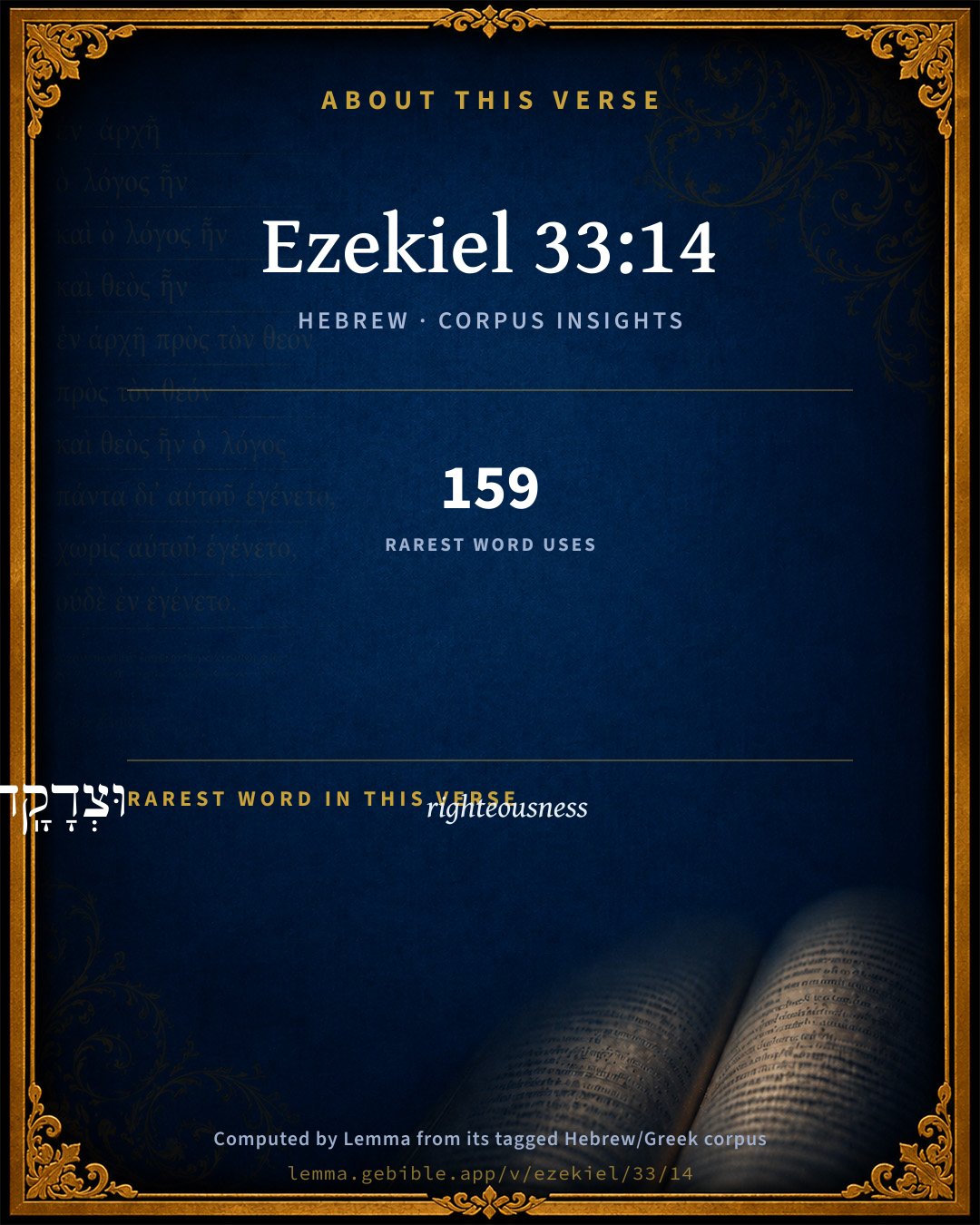
וּצְדָקָֽה
tsᵉdâqâh
H6666
“and · righteousness”
Conjunction + Noun, Common, Feminine, Singular, Absolute
Part of Speech
Conjunction + Noun
Type
Common
Gender
Feminine
Number
Singular
State
Absolute
Full BDB Definition

Origin: from H6663

TWOT: 1879b

justice, righteousness - righteousness (in government) - of judge, ruler, king - of law - of Davidic king Messiah - righteousness (of God's attribute) - righteousness (in a case or cause) - righteousness, truthfulness - righteousness (as ethically right) - righteousness (as vindicated), justification, salvation - of God - prosperity (of people) - righteous acts
  1. וּבְאָמְרִ֥י ʼâmar H559 “and · in/at · to say · me” Conjunction + Preposition + Verb, Qal, Infinitive Construct + Suffix, Personal, 1st Person, Common, Singular
  2. לָֽרָשָׁ֖ע râshâʻ H7563 “to/for the · wicked” Preposition, Determined + Adjective, Adjective, Masculine, Singular, Absolute
  3. מ֣וֹת mûwth H4191 “to die” Verb, Qal, Infinitive Absolute
  4. תָּמ֑וּת mûwth H4191 “to die” Verb, Qal, Imperfect, 2nd Person, Masculine, Singular
  5. וְשָׁב֙ shûwb H7725 “and · to return” Conjunction + Verb, Qal, Sequential Perfect, 3rd Person, Masculine, Singular
  6. מֵֽחַטָּאת֔וֹ chaṭṭâʼâh H2403 “from · sin offering · his” Preposition + Noun, Common, Feminine, Singular, Construct + Suffix, Personal, 3rd Person, Masculine, Singular
  7. וְעָשָׂ֥ה ʻâsâh H6213 “and · to do” Conjunction + Verb, Qal, Sequential Perfect, 3rd Person, Masculine, Singular
  8. מִשְׁפָּ֖ט mishpâṭ H4941 “judgment” Noun, Common, Masculine, Singular, Absolute

About this verse

These counts appear in no published source. They are computed here, from the morphology-tagged text and Lemma’s own curated glosses. What Lemma adds →

9
words
8
distinct lemmas
Prophets
section

Grammatical profile

  • 5 verbs
  • 3 nouns
  • 1 adjective

Verb forms

  • וּבְאָמְרִ֥י Qal · Infinitive Construct
  • מ֣וֹת Qal · Infinitive Absolute
  • תָּמ֑וּת Qal · Imperfect
  • וְשָׁב֙ Qal · Sequential Perfect
  • וְעָשָׂ֥ה Qal · Sequential Perfect

Repetition

A word recurs within this verse — often emphatic in Hebrew:

  • מ֣וֹת to die H4191 ×2

Hebrew & Septuagint length

In English translation the verse runs 25 words from the Hebrew and 23 from the Septuagint (LXX English) — closely comparable.

A rough comparison of the two English renderings, which tokenize alike — not a word-level alignment.

Word counts can differ between the Hebrew and the Greek without any difference in meaning — e.g. the Hebrew direct-object marker אֵת has no separate Greek word, and Greek often adds the article ὁ.

Cross-references

14

Topical passages linked to Ezekiel 33:14 in the Treasury of Scripture Knowledge — connected by theme and wording, ordered by reader-vote popularity; previews shown in the World English Bible.

  • Ezekiel 18:27 Again, when the wicked man turns away from his wickedness that he has committed, and does that which is lawful and right, he shall save his soul alive.
  • Isaiah 55:7 let the wicked forsake his way, and the unrighteous man his thoughts; and let him return to Yahweh, and he will have mercy on him; and to our God, for he will abundantly pardon.
  • Jeremiah 18:7–8 At what instant I shall speak concerning a nation, and concerning a kingdom, to pluck up and to break down and to destroy it;
  • Ezekiel 33:8 When I tell the wicked, O wicked man, you shall surely die, and you don't speak to warn the wicked from his way; that wicked man shall die in his iniquity, but his blood will I require at your hand.
  • Hosea 14:1 Israel, return to Yahweh your God; For you have fallen because of your sin.
  • Proverbs 28:13 He who conceals his sins doesn't prosper, But whoever confesses and renounces them finds mercy.
  • Micah 6:8 He has shown you, O man, what is good. What does Yahweh require of you, but to act justly, To love mercy, and to walk humbly with your God?
  • Isaiah 3:11 Woe to the wicked! Disaster is upon them; For the deeds of his hands will be paid back to him.
  • Jeremiah 4:1 If you will return, Israel, says Yahweh, if you will return to me, and if you will put away your abominations out of my sight; then you shall not be removed;
  • Ezekiel 3:18–19 When I tell the wicked, You shall surely die; and you give him no warning, nor speak to warn the wicked from his wicked way, to save his life; the same wicked man shall die in his iniquity; but his blood will I require at your hand.
  • Ezekiel 18:21 But if the wicked turn from all his sins that he has committed, and keep all my statutes, and do that which is lawful and right, he shall surely live, he shall not die.
  • Matthew 9:13 But you go and learn what this means: 'I desire mercy, and not sacrifice,' for I came not to call the righteous, but sinners to repentance."
  • Luke 13:3–5 I tell you, no, but, unless you repent, you will all perish in the same way.
  • Acts 3:19 "Repent therefore, and turn again, that your sins may be blotted out, so that there may come times of refreshing from the presence of the Lord,

Cross-references courtesy of OpenBible.info (CC BY 4.0).

Hebrew and Greek witnesses Masoretic Hebrew ↔ Greek Septuagint

The same verse in the two great witnesses to the Old Testament, shown verse-for-verse.

These are two independent witnesses, not word-aligned to each other, and the Septuagint is shown in lemma (dictionary) form.

Hebrew Ezekiel 33:14 Masoretic · Westminster Leningrad Codex

וּבְאָמְרִ֥י לָֽרָשָׁ֖ע מ֣וֹת תָּמ֑וּת וְשָׁב֙ מֵֽחַטָּאת֔וֹ וְעָשָׂ֥ה מִשְׁפָּ֖ט וּצְדָקָֽה

Again, when I say to the wicked, You shall surely die; if he turn from his sin, and do that which is lawful and right;

World English Bible · Public Domain

Greek LXX Ezekiel 33:14 Septuagint · lemma form

καί ἐν ὁ εἶπον ἐγώ ὁ ἀσεβής θάνατος θανατόω καί ἀποστρέφω ἀπό ὁ ἁμαρτία αὐτός καί ποιέω κρίμα καί δικαιοσύνη

And when I say to the ungodly, You shall surely die; and he shall turn from his sin, and do judgment and justice,

LXX2012 (modern English Septuagint) · Public Domain

Hebrew: Westminster Leningrad Codex (CC BY 4.0). Greek: Septuagint (public domain); English from LXX2012 (modern English Septuagint) (Public Domain). How the Septuagint differs from the Hebrew →

Targum (Aramaic paraphrase)

1

The Targum is the ancient Jewish Aramaic paraphrase of the Hebrew Scriptures — an interpretive translation, not the Hebrew text itself. Onkelos (literal) and Pseudo-Jonathan (expansive) render the Torah, and Jonathan the Prophets. Coverage is partial: where no permissively-licensed English translation exists for a verse, only the Aramaic is shown. This is verse-level text, not a word-by-word alignment to the Hebrew.

  1. Targum Jonathan Prophets (Joshua–Malachi)
    וּבִדְאֲמָרֵית לְרַשִׁיעָא מְמַת תְּמוּת וִיתוּב מֵחוֹבוֹהִי וְיַעְבֵיד דִין דִקְשׁוֹט וּזְכוּ:

    (no public-domain English translation for this verse)

    Targum Jonathan — Aramaic: “Mikraot Gedolot” (public domain). English: “Sefaria Community Translation” (CC0 1.0 (public-domain dedication)); “London "Chaldee Paraphrase," 1871” (public domain). Text via Sefaria.

Commentary

Notes on Ezekiel 33:14 from classic Christian and Jewish commentators (each source and its license shown beneath its notes). The classic Christian expositions comment on the surrounding passage and are grouped to its opening verse, so a note may address several verses; the Jewish commentaries on the Tanakh (Rashi and others) are per-verse, so they appear only where the commentator wrote on this verse.

Lemma curates 59 commentaries, every one of them public domain or Creative Commons licensed, each selected and text-cleaned for this edition rather than reprinted as found. About our sources →

Trapp's Complete Commentary

John Trapp

Eze 33:14 Again, when I say unto the wicked, Thou shalt surely die; if he turn from his sin, and do that which is lawful and right;

Ver. 14. Thou shalt surely die,] viz., Except thou repent; for that altereth the case. Penitence is almost as good as innocence.

If he turn from his sin and do.] These two parts make up true repentance.

John Trapp, A Commentary or Exposition upon All the Books of the Old and New Testament (1647–1656) — public domain. Text from a community e-Sword module.

Geneva Bible (1599)

Geneva Bible translators

Hereby he condemneth all them of hypocrisy, which pretend to forsake wickedness, and yet declare not themselves such by their fruits, that is, in obeying God’s commandments, and by godly life.

Geneva Bible (1599) marginal notes — public domain. Text via Bolls.life.

The Cambridge Bible for Schools and Colleges

gen. ed. J. J. S. Perowne

14. Cf. Eze_3:18, Eze_18:27.

that which is lawful] Lit. as marg., (just) judgment and justice.

The Cambridge Bible for Schools and Colleges (gen. ed. J. J. S. Perowne; Cambridge University Press, 1878–1918) — public domain. Text from a community e-Sword module.

John Gill's Exposition

If the wicked restore the pledge,.... His neighbour's raiment, which he has taken as a pledge for money lent him; and which, according to the law, was to be restored before sunset, Exo 22:26 which wicked men did not attend unto; but when such a man is brought to a sense of his wickedness, and repentance for it, as an evidence of it he would restore the pledge:

and give again that he had robbed; to him whom he had robbed; as a thief was obliged to do, four or five fold, according to the law, Exo 22:1, and which, when a man did voluntarily, from the convictions of his own mind, and not by force of the civil magistrate, it was a sign of true repentance; see Luk 19:8,

and walk in the statutes of life; the rule of life and conversation, and to the keeping of which the promise of long life is annexed; and which preserve persons from dying a shameful death by the hand of the civil magistrate; statutes, which, if a man do, he shall live in them; see Eze 20:11,

without committing iniquity; not living entirely without sin, which the best of men do not; but without committing grosser sins, as before; and without making a trade of sinning, and living in it:

he shall surely live, he shall not die; he shall live comfortably now, and happily hereafter; he shall live a spiritual life, and not die the second death.

John Gill's Exposition of the Whole Bible (1746–1763) — public domain (CC PDM 1.0). Text via the HelloAO Bible API.

Matthew Poole's English Annotations

See Eze 18:21.

Matthew Poole's English Annotations on the Holy Bible (1683–1685) — public domain. Text from a community e-Sword/MySword module.

The Pulpit Commentary

Vers. 14, 15. The efficacy of repentance.

If, on the one hand, the prophet was warned that some seemingly righteous, superficially good, would fail, he was encouraged, on the other hand, by the assurance that some wicked persons would, as the result of his admonitions, repent and convert, and would be brought to true and Divine life.

I THE SEAT OF REPENTANCE. This must be the spiritual nature. The promptings to a better life come from within, from better feelings and better convictions and purposes. Repentance is a change of mind, of heart.

II THE MANIFESTATIONS OF REPENTANCE. These will vary with the previous life, with the special circumstances, the opportunities and position of the convert. In Ver. 15 these practical proofs of repentance are mentioned, and these acts may be taken as examples of the modes in which true repentance will undoubtedly display itself.

III THE REWARD OF REPENTANCE.

1. The evil deeds of the former life shall not be remembered or imputed.

2. The sentence of death shall be cancelled.

3. The penitent and reformed shall live, i.e. in the life of God himself. T.

The Pulpit Commentary (1880–1919), ed. H.D.M. Spence-Jones & Joseph S. Exell — public domain. Text from a community e-Sword module.

unfoldingWord translationNotes

Door43 World Missions Community

General Information:

Yahweh continues giving Ezekiel his message to the Israelites.

to the wicked

The nominal adjective "the wicked" can be stated as "the wicked person." AT: "to the wicked person" (See: Nominal Adjectives)

if he restores the loan guarantee

"if he gives back the loan guarantee"

loan guarantee

something a person leaves with another person to show that he will keep his promise to pay back what he has borrowed

makes restitution for what he has stolen

"returns what he has stolen" or "pays back the value of what he stole"

walks in the statutes that give life

Acting or behaving in a certain way is spoken of as if it were walking. AT: "lives according to the laws that give life" (See: Metaphor)

will be called to mind for him

The phrase "call to mind" is an idiom that means to remember. The phrase "will be called" can be stated in active form. AT: "will I think about" or "will I recall" (See: Idiom and Active or Passive)

translationWords

just

walk

statute

unfoldingWord translationNotes — © Distant Shores Media and the Door43 World Missions Community, licensed CC BY-SA 4.0. Source: git.door43.org/Door43/en_tn.

Lesson kit

Teaching starters — assembled from the data on this page, not authored interpretation. Every prompt links to the verse data it draws on. Edit before teaching.

Ezekiel, in the Prophets, opens this verse with 9 words (8 distinct Hebrew lemmas). Its most distinctive word is tsᵉdâqâh (“righteousness”). A historical commentator’s framing appears above. Read the whole chapter for the surrounding context.

Discussion questions

  1. How does “righteousness” (tsᵉdâqâh) shape what this verse is saying?
  2. Ezekiel 18:27 shares this passage’s theme. How do the two illuminate each other?
  3. “to die” occurs 2× in this one verse. What is the effect of the repetition?
  4. The translations on this page render this verse differently — a whole-verse word diff, not a word-by-word alignment. What might account for the different wordings?
  5. The verb «וּבְאָמְרִ֥י» is Qal Infinitive Construct. How does its form color the action?
  6. Reading how Trapp's Complete Commentary and Geneva Bible (1599) read this verse, where do the two commentators agree and where do they part?

Things to notice

Reading settings

Reading text

Shown beneath each verse's original-language words.

Old Testament
Old Testament edition

Read the OT as the Masoretic Hebrew (MT) or the Greek Septuagint (LXX).

English shown for the Greek Septuagint (in the Hebrew ↔ Greek comparison).

Comparing translations? Open the Compare panel on any verse page to stack up to four side by side.