
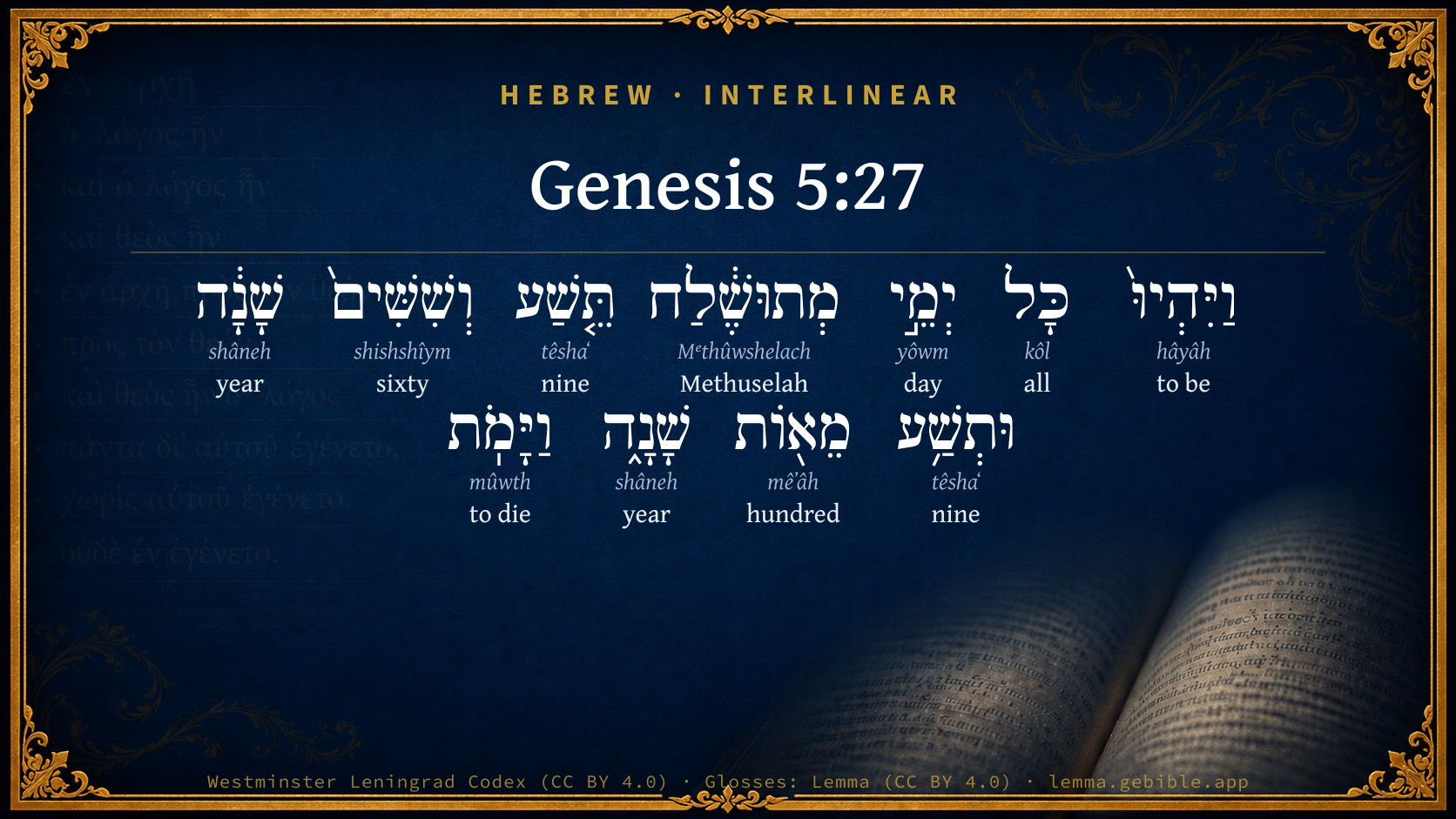
Genesis 5:27

Hebrew (Westminster Leningrad Codex) Genesis 5:27 appears in the Hebrew Old Testament. The text above is from the Westminster Leningrad Codex. Each word links to its Strong’s number, a concise gloss, and parsing drawn from the Open Scriptures Hebrew Bible morphology. Click any word for its full Brown-Driver-Briggs (BDB) entry.
Download image
Cite this verse

Genesis 5:27 (World English Bible). Public Domain. Lemma interlinear Bible study tool, https://lemma.gebible.app/v/genesis/5/27.

Show BibTeX & RIS
BibTeX
RIS
English Translation
All the days of Methuselah were nine hundred sixty-nine years, then he died.
World English Bible · Public Domain
Download a study sheet

One document with this verse’s original text, its word-by-word gloss line, the meaning frame, cross-references with their text, attributed commentary, and full source and license credits — printable, and it pastes into notes with its structure intact.

This verse Autodidact and up

Study sheet (.html) Plain text (.txt)

A passage Seminary Student

Up to 50 verses in one chapter. A passage sheet keeps up to 6 commentary sources and 12 cross-references per verse, in the order this page ranks them, and says so on the sheet whenever that leaves anything out. Ask for a single verse and you get the Autodidact verse sheet above.

Everything on this page stays free to read, with no account — the sheet is a download of what is already on screen, not access to it.

Want to remove ads? Support Godless Engineer
Compare translations 3

The same verse in 3 English versions, stacked beneath the original-language interlinear above. Click any original word for its lexicon entry.

Each is an independent rendering of the whole verse — the interlinear is not word-aligned to these translations.

Highlighted words mark where these versions differ — a whole-verse word diff, not a word-by-word alignment.

  • World English Bible Public Domain
    All the days of Methuselah were nine hundred sixty-nine years, then he died.
  • King James Version Public Domain
    And all the days of Methuselah were nine hundred sixty and nine years: and he died.
  • unfoldingWord Literal Text CC BY-SA 4.0
    So all the days of Methuselah were 969 years, and he died.

unfoldingWord Literal Text — © unfoldingWord, licensed CC BY-SA 4.0. Word-aligned USFM3 via Door43 (git.door43.org/unfoldingWord/en_ult).

Versions to compare (up to 4)

3 of 4 selected

Show all 18 translations

Every available English version of this verse, each an independent rendering of the whole verse.

  • World English Bible Public Domain
    All the days of Methuselah were nine hundred sixty-nine years, then he died.
  • Berean Standard Bible Public Domain
    So Methuselah lived a total of 969 years, and then he died.
  • Majority Standard Bible Public Domain
    So Methuselah lived a total of 969 years, and then he died.
  • King James Version Public Domain
    And all the days of Methuselah were nine hundred sixty and nine years: and he died.
  • American Standard Version (1901) Public Domain
    And all the days of Methuselah were nine hundred sixty and nine years: and he died.
  • Revised Version (1885) Public Domain
    And all the days of Methuselah were nine hundred sixty and nine years: and he died.
  • Geneva Bible (1599) Public Domain
    So al the dayes of Methushelah were nine hundreth sixtie and nine yeeres: and he died.
  • Douay-Rheims (1899) Public Domain
    And all the days of Mathusala were nine hundred and sixty-nine years, and he died.
  • Young's Literal Translation Public Domain
    And all the days of Methuselah are nine hundred and sixty and nine years, and he dieth.
  • Literal Standard Version CC BY-SA 4.0
    And all the days of Methuselah are nine hundred and sixty-nine years, and he dies.
  • Unlocked Literal Bible CC BY-SA 4.0
    Methuselah lived 969 years. Then he died.
  • unfoldingWord Literal Text CC BY-SA 4.0
    So all the days of Methuselah were 969 years, and he died.
  • Darby Bible Public Domain
    And all the days of Methushelah were nine hundred and sixty-nine years; and he died.
  • World Messianic Bible Public Domain
    All the days of Methuselah were nine hundred sixty-nine years, then he died.
  • Webster's Bible Public Domain
    And all the days of Methuselah were nine hundred sixty and nine years; and he died.
  • Free Bible Version CC BY-SA 4.0
    Methuselah lived a total of 969 years, and then he died.
  • Bible in Basic English Public Domain
    And all the years of Methuselah's life were nine hundred and sixty-nine: and he came to his end.
  • JPS Tanakh (1917) Public Domain
    And all the days of Methuselah were nine hundred sixty and nine years; and he died.

Literal Standard Version (2020), Covenant Press — licensed CC BY-SA 4.0. Text via the HelloAO Bible API (eBible.org). Unlocked Literal Bible (unfoldingWord) — licensed CC BY-SA 4.0. Text via the HelloAO Bible API (eBible.org). unfoldingWord Literal Text — © unfoldingWord, licensed CC BY-SA 4.0. Word-aligned USFM3 via Door43 (git.door43.org/unfoldingWord/en_ult). Free Bible Version, Dr. Jonathan Gallagher — licensed CC BY-SA 4.0. Text via the HelloAO Bible API (eBible.org).

Word by word

More ways to search: Search by grammar → Find every occurrence → Compare this word →

Practice this passage: Drill this verse → Learn its vocabulary →

מְתוּשֶׁ֔לַח
Mᵉthûwshelach
H4968
“Methuselah”
Noun, Proper
Part of Speech
Noun
Type
Proper
Full BDB Definition

Origin: from H4962 and H7973

TWOT: None

Methuselah = "man of the dart" - son of Enoch, 6th in descent from Seth, and father of Lamech
  1. וַיִּהְיוּ֙ hâyâh H1961 “and · to be” Conjunction + Verb, Qal, Sequential Imperfect, 3rd Person, Masculine, Plural
  2. כָּל kôl H3605 “all of” Noun, Common, Masculine, Singular, Construct
  3. יְמֵ֣י yôwm H3117 “days of” Noun, Common, Masculine, Plural, Construct
  4. תֵּ֤שַׁע têshaʻ H8672 “nine” Adjective, Cardinal number, Feminine, Singular, Absolute
  5. וְשִׁשִּׁים֙ shishshîym H8346 “and · sixty” Conjunction + Adjective, Cardinal number, Both, Plural, Absolute
  6. שָׁנָ֔ה shâneh H8141 “year” Noun, Common, Feminine, Singular, Absolute
  7. וּתְשַׁ֥ע têshaʻ H8672 “and · nine” Conjunction + Adjective, Cardinal number, Feminine, Singular, Absolute
  8. מֵא֖וֹת mêʼâh H3967 “hundred” Adjective, Cardinal number, Both, Plural, Absolute
  9. שָׁנָ֑ה shâneh H8141 “year” Noun, Common, Feminine, Singular, Absolute
  10. וַיָּמֹֽת mûwth H4191 “and · to die” Conjunction + Verb, Qal, Sequential Imperfect, 3rd Person, Masculine, Singular

About this verse

These counts appear in no published source. They are computed here, from the morphology-tagged text and Lemma’s own curated glosses. What Lemma adds →

11
words
9
distinct lemmas
Pentateuch
section

Notable vocabulary

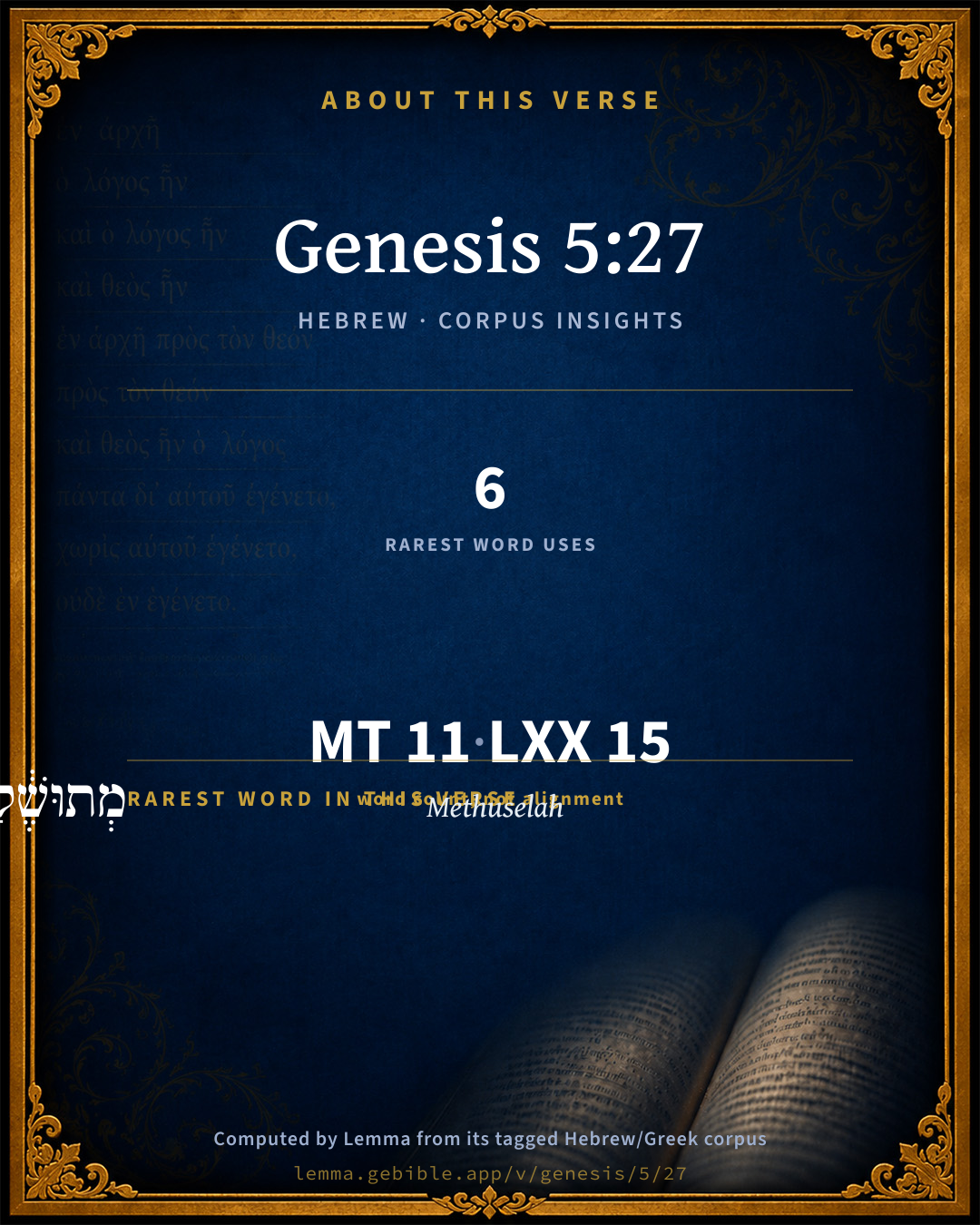
The rarest word here is מְתוּשֶׁ֔לַח Methuselah H4968 — appearing just 6 times in the whole Hebrew Bible.

Shared distinctive vocabulary

מְתוּשֶׁ֔לַח Methuselah H4968 occurs in 6 verses of the Hebrew Bible. Also found in:

Grammatical profile

  • 2 verbs
  • 5 nouns
  • 4 adjectives

Verb forms

  • וַיִּהְיוּ֙ Qal · Sequential Imperfect
  • וַיָּמֹֽת Qal · Sequential Imperfect

Repetition

Words recur within this verse — often emphatic in Hebrew:

  • תֵּ֤שַׁע nine H8672 ×2
  • שָׁנָ֔ה year H8141 ×2

Hebrew & Septuagint length

In English translation the verse runs 13 words from the Hebrew and 20 from the Septuagint (LXX English) — the Septuagint runs noticeably longer here. See the side-by-side →

A rough comparison of the two English renderings, which tokenize alike — not a word-level alignment.

Word counts can differ between the Hebrew and the Greek without any difference in meaning — e.g. the Hebrew direct-object marker אֵת has no separate Greek word, and Greek often adds the article ὁ.

In the original languages it is 11 Hebrew tokens and 15 Greek tokens — but the two are counted differently (Hebrew bundles its prefixes and suffixes into one token; the Greek is in lemma form), so that isn’t a like-for-like length.

Hebrew and Greek witnesses Masoretic Hebrew ↔ Greek Septuagint

The same verse in the two great witnesses to the Old Testament, shown verse-for-verse.

Here the Septuagint runs noticeably longer than the Hebrew — LXX2012 (modern English Septuagint) 20 words vs World English Bible 13. A rough length comparison of the two English translations, not a word-level alignment — read both below.

These are two independent witnesses, not word-aligned to each other, and the Septuagint is shown in lemma (dictionary) form.

Hebrew Genesis 5:27 Masoretic · Westminster Leningrad Codex

וַיִּהְיוּ֙ כָּל יְמֵ֣י מְתוּשֶׁ֔לַח תֵּ֤שַׁע וְשִׁשִּׁים֙ שָׁנָ֔ה וּתְשַׁ֥ע מֵא֖וֹת שָׁנָ֑ה וַיָּמֹֽת

All the days of Methuselah were nine hundred sixty-nine years, then he died.

World English Bible · Public Domain

Greek LXX Genesis 5:27 Septuagint · lemma form

καί γίγνομαι πᾶς ὁ ἡμέρα μαθουσαλα ὅς ζάω ἐννακόσιοι καί ἑξήκοντα ἐννέα ἔτος καί ἀποθνήσκω

And all the days of Mathusala which he lived, were nine hundred and sixty and nine years, and he died.

LXX2012 (modern English Septuagint) · Public Domain

Hebrew: Westminster Leningrad Codex (CC BY 4.0). Greek: Septuagint (public domain); English from LXX2012 (modern English Septuagint) (Public Domain). How the Septuagint differs from the Hebrew →

Targum (Aramaic paraphrase)

2

The Targum is the ancient Jewish Aramaic paraphrase of the Hebrew Scriptures — an interpretive translation, not the Hebrew text itself. Onkelos (literal) and Pseudo-Jonathan (expansive) render the Torah, and Jonathan the Prophets. Coverage is partial: where no permissively-licensed English translation exists for a verse, only the Aramaic is shown. This is verse-level text, not a word-by-word alignment to the Hebrew.

  1. Targum Onkelos Torah (Genesis–Deuteronomy)
    וַהֲווֹ כָּל יוֹמֵי מְתוּשֶׁלַח תְּשַׁע מְאָה וְשִׁתִּין וּתְשַׁע שְׁנִין וּמִית

    (no public-domain English translation for this verse)

    Targum Onkelos — Aramaic: “Onkelos Genesis” (public domain); “Onkelos Exodus” (public domain); “Onkelos Leviticus” (public domain); “Onkelos Numbers” (public domain); “Onkelos Deuteronomy” (public domain). English: “Sefaria Community Translation” (CC0 1.0 (public-domain dedication)); “J.W. Etheridge. The Targums of Onkelos and Jonathan Ben Uzziel on the Pentateuch. London: Longmans, Green, 1862” (public domain). Text via Sefaria.

  2. Targum Pseudo-Jonathan Torah (Genesis–Deuteronomy)
    וַהֲווֹ כָּל יוֹמֵי מְתוּשֶׁלַח תְּשַׁע מְאָה וְשִׁיתִּין וּתְשַׁע שְׁנִין וּמִית

    And all the days of Methushelach were nine hundred and sixty and nine years; and he died.

    Targum Pseudo-Jonathan — Aramaic: “Targum Jonathan on Genesis” (public domain); “Targum Jonathan on Exodus” (public domain); “Targum Jonathan on Leviticus” (public domain); “Targum Jonathan on Numbers” (public domain); “Targum Jonathan on Deuteronomy” (public domain). English: “The Targum of Jonathan ben Uzziel, trans. J. W. Etheridge, London, 1862” (public domain). Text via Sefaria.

Commentary

Notes on Genesis 5:27 from classic Christian and Jewish commentators (each source and its license shown beneath its notes). The classic Christian expositions comment on the surrounding passage and are grouped to its opening verse, so a note may address several verses; the Jewish commentaries on the Tanakh (Rashi and others) are per-verse, so they appear only where the commentator wrote on this verse.

Lemma curates 59 commentaries, every one of them public domain or Creative Commons licensed, each selected and text-cleaned for this edition rather than reprinted as found. About our sources →

Trapp's Complete Commentary

John Trapp

Gen 5:27 And all the days of Methuselah were nine hundred sixty and nine years: and he died.

Ver. 27. And all the days of Methuselah.] He lived longest of any, yet wanted thirty-one years of a thousand. Oecolampadius thinks there was a mystery in this, that they all died short of a thousand, which is a type of perfection; {a} to teach us, says he, that live we never so long here, and grow we never so fast in grace, we cannot possibly be perfect, till we get to heaven. Enoch lived long in a little time; and foreseeing the flood, named his son Methuselah; that is to say, he dies, and the dart (or flood) comes. And so it happened; for no sooner was his head laid, but in came the flood. “The righteous are taken away from the evil to come.” {Isa 57:1} And their death is a sad presage of an imminent calamity. Hippo could not be taken while Augustine lived, nor Heidelberg while Paraeus. Semen sanctum statumen terrae {b} {Isa 6:13} The holy seed upholdeth the state. Absque stationibus non staret mundus {c} “The innocent shall deliver the island, and it is delivered by the pureness of thy hands,” {Job 22:30} whereas, “one sinner destroyeth much good.” {Ecc 9:18} Ambrose is said to have been “the walls of Italy.” {d} Stilico the earl said, that his death did threaten destruction to that country.

“ Hic patria est, murique urbis stant pectore in uno .”{ e}

{a} Nemo patriarcharum mille annos complevit, quia numerus iste typum habeat perfectionis. Hic nulla perfectio pietatu . - Oecolampad.

{b} Junius.

{c} Tertul.

{d} Paulin. Nolan., in Vita Ambros .

{e} De Fablo Cunctatore , Sil.

John Trapp, A Commentary or Exposition upon All the Books of the Old and New Testament (1647–1656) — public domain. Text from a community e-Sword module.

The Biblical Illustrator

Joseph S. Exell

Gen_5:27

And all the days of Methuselah

The longest life and its lessons

In dwelling upon this text I shall--

I.

Take a simple survey of the age and manners of the antediluvian world. The youth of the world was the season of mans greatest age; perhaps, also, of mans greatest wickedness.

II. Draw some important lessons from this survey--

1. The agglomerative tendencies of human depravity.

2. The vanity of earthly things.

3. The power of an endless life.

4. The great natural wickedness of the heart.

5. That mere duration of years does not constitute a long life, but the fulfilment of lifes ends.

6. The danger of religious procrastination. (Dr. Cheever.)

The close of life

I. THE CLOSE OF LIFE IS ABSOLUTELY CERTAIN.

II. LIFE HAS COME TO A CLOSE WITH MEN THROUGH ALL GENERATIONS FROM THE EARLIEST TIMES.

III. LIFE COMES TO A CLOSE IN ALL PARTS OF THE WORLD. Some places are more salubrious than others.

IV. LIFE COMES TO A CLOSE AT ALL SEASONS OF THE YEAR.

V. LIFE CLOSES AT ALL PERIODS. Death is not peculiar to any age.

VI. LIFE CLOSES IN A VARIETY OF WAYS. How many perish in the battlefield, amid all the dreadful realities of war! Many are lost by shipwreck at sea. Many lose their lives by accident on land. Far from the land of his birth and friends, pursuing his philanthropic career, John Howard finished his labours and his life. Sublimely grand must have been the exit of Thomas Chalmers; but, like that of John Foster, no human eye was permitted to see it. It was a Sabbath evening when he retired to rest, in his most happy mood. In the morning he was found on his bedside in an attitude of repose. A peaceful smile, like a beam from the Sun of Righteousness, lingered about his face. His immortal part had soared upwards, escorted by a convoy of angels, to the better land. Thus widely diversified are the circumstances and modes of our departure. VII. THE CLOSE OF LIFE NEVER HAPPENS BY CHANCE. It is an event of Divine appointment.

VIII. THE CLOSE OF LIFE MAKES ALL THE ARTIFICIAL DISTINCTIONS OF LIFE VOID. Death, says Dr. Donne, comes equally to us all, and makes us all equal when it comes. The ashes of an oak in a chimney are no epitaph of that to tell me how high, or how large it was; it tells me not what flocks it sheltered whilst it stood, nor what men it hurt when it fell. The dust of great mens graves is speechless too; it says nothing, it distinguishes nothing. As soon the dust of a wretch whom thou wouldst not, as of a prince whom thou couldst not look upon, will trouble thine eyes if the wind blow it thither; and when a whirlwind hath blown the dust of the churchyard into the church, and the man sweeps out the dust of the church into the churchyard, who will undertake to sift those dusts again, and to pronounce: This is the patrician--this is the noble flour; and this the yeoman--this the plebeian bran!

IX. THE CLOSE OF LIFE IS OF INCONCEIVABLE IMPORTANCE. Our chances of preparation last while life lasts. Iris said that when Alexander encamped before a city, he used to set up a light, to give notice to those within that if they came forth to him while that light lasted, they should have quarter; but if they came not out within the given time they were to expect no mercy. Our light is burning now. It goes out when life departs. Death fixes all forever. It is this solemn fact--that death in shutting the gates of life upon us here, ushers us into the unchangeable hereafter--that accounts for the opposite experiences of men when they come to die. Voltaire said to his doctor--I am abandoned by God and man. I will give you half of what I am worth, if you will give me six months life. Sir, replied the doctor, you cannot live six weeks. Then, said the dying man, I shall go to hell; and soon after expired. I shall be glad to find a hole, said Hobbes, to creep out of the world at. How different the anticipations of good men! O Father of Thy beloved Son Jesus Christ! exclaimed the martyr Polycarp; I bless Thee that Thou hast counted me worthy to receive my portion in the number of martyrs. I have pain, said Richard Baxter, (there is no arguing against sense); but I have peace. Is this dying? said Dr. Goodwin. How have I dreaded as an enemy this smiling friend. The best of all is, God is with us, was John Wesleys shout of victory in the last hour. The victorys won forever, exclaimed Dr. Payson; I am going to bathe in an ocean of purity and benevolence and happiness to all eternity.

X. I HAVE NOW TO OBSERVE, THAT THE CLOSE OF LIFE MAY BE NEAR AT HAND. We know not the day nor the hour of the messengers arrival.

XI. MY LAST REMARK IS THAT THE CLOSE OF LIFE DEMANDS INSTANT PREPARATION. Mark what that preparation is. What you require to fit you for death is all the same as that which you require to fit you for life. (W. Walters.)

The Biblical Illustrator, edited by Joseph S. Exell (c. 1880s–1900s) — public domain. Text from a community e-Sword module.

Tyndale Open Study Notes

Tyndale Open Resources

5:27 969 years: This statement and the numbers given in 5:25, 28 and 7:6 mean that Methuselah died in the year of the flood.

Tyndale Open Study Notes — © Tyndale Open Resources, licensed CC BY-SA 4.0. Text via the HelloAO Bible API.

Adam Clarke's Commentary

Verse 27. The days of Methuselah were nine hundred sixty and nine years] This is the longest life mentioned in Scripture, and probably the longest ever lived; but we have not authority to say positively that it was the longest. Before the flood, and before artificial refinements were much known and cultivated, the life of man was greatly protracted, and yet of him who lived within thirty-one years of a thousand it is said he died; and the longest life is but as a moment when it is past. Though life is uncertain, precarious, and full of natural evils, yet it is a blessing in all its periods if devoted to the glory of God and the interest of the soul; for while it lasts we may more and more acquaint ourselves with God and be at peace, and thereby good shall come unto us; Job 22:21.

Adam Clarke's Commentary on the Bible (1810–1826) — public domain. Text from a community e-Sword/MySword module.

Matthew Poole's English Annotations

This was the longest time that any man lived. But it is observable that neither his nor any of the patriarch’s lives reached to a thousand years, which number hath some shadow of perfection.

He died but a little before the flood came, being taken away from the evil to come.

Matthew Poole's English Annotations on the Holy Bible (1683–1685) — public domain. Text from a community e-Sword/MySword module.

Whedon's Commentary on the Bible

Daniel D. Whedon

27. Methuselah — The etymology of this word is uncertain. Gesenius gives it man of the dart; it may also mean, he dieth, and sendeth forth, (that is, the deluge,) a prophetic name, given by his father, Enoch, when prophesying of God’s judgments, indicating that the deluge would take place at his death. He died in the year of the flood, having reached the greatest age recorded, nine hundred and sixty-nine years.

Daniel D. Whedon (gen. ed.), Commentary on the Old and New Testaments (1874–1909) — public domain. Text from a community e-Sword module.

Lesson kit

Teaching starters — assembled from the data on this page, not authored interpretation. Every prompt links to the verse data it draws on. Edit before teaching.

Genesis, in the Pentateuch, opens this verse with 11 words (9 distinct Hebrew lemmas). Its most distinctive word is Mᵉthûwshelach (“Methuselah”). The Greek Septuagint runs longer here. A historical commentator’s framing appears above. Read the whole chapter for the surrounding context.

Discussion questions

  1. What does “Methuselah” (Mᵉthûwshelach) contribute to the verse as a whole?
  2. Genesis 5:21 shares the word «Methuselah» with this verse. How do the two illuminate each other?
  3. “nine” occurs 2× in this one verse. What is the effect of the repetition?
  4. Compared with the Hebrew, the Septuagint runs longer here. What questions does that raise?
  5. These translations render this verse differently; the difference is in the English rendering, not the original. What questions does that raise?
  6. The verb «וַיִּהְיוּ֙» is Qal Sequential Imperfect. How does its form color the action?
  7. Reading how Trapp's Complete Commentary and The Biblical Illustrator read this verse, where do the two commentators agree and where do they part?

Things to notice

Reading settings

Reading text

Shown beneath each verse's original-language words.

Old Testament
Old Testament edition

Read the OT as the Masoretic Hebrew (MT) or the Greek Septuagint (LXX).

English shown for the Greek Septuagint (in the Hebrew ↔ Greek comparison).

Comparing translations? Open the Compare panel on any verse page to stack up to four side by side.