
Isaiah 66:24

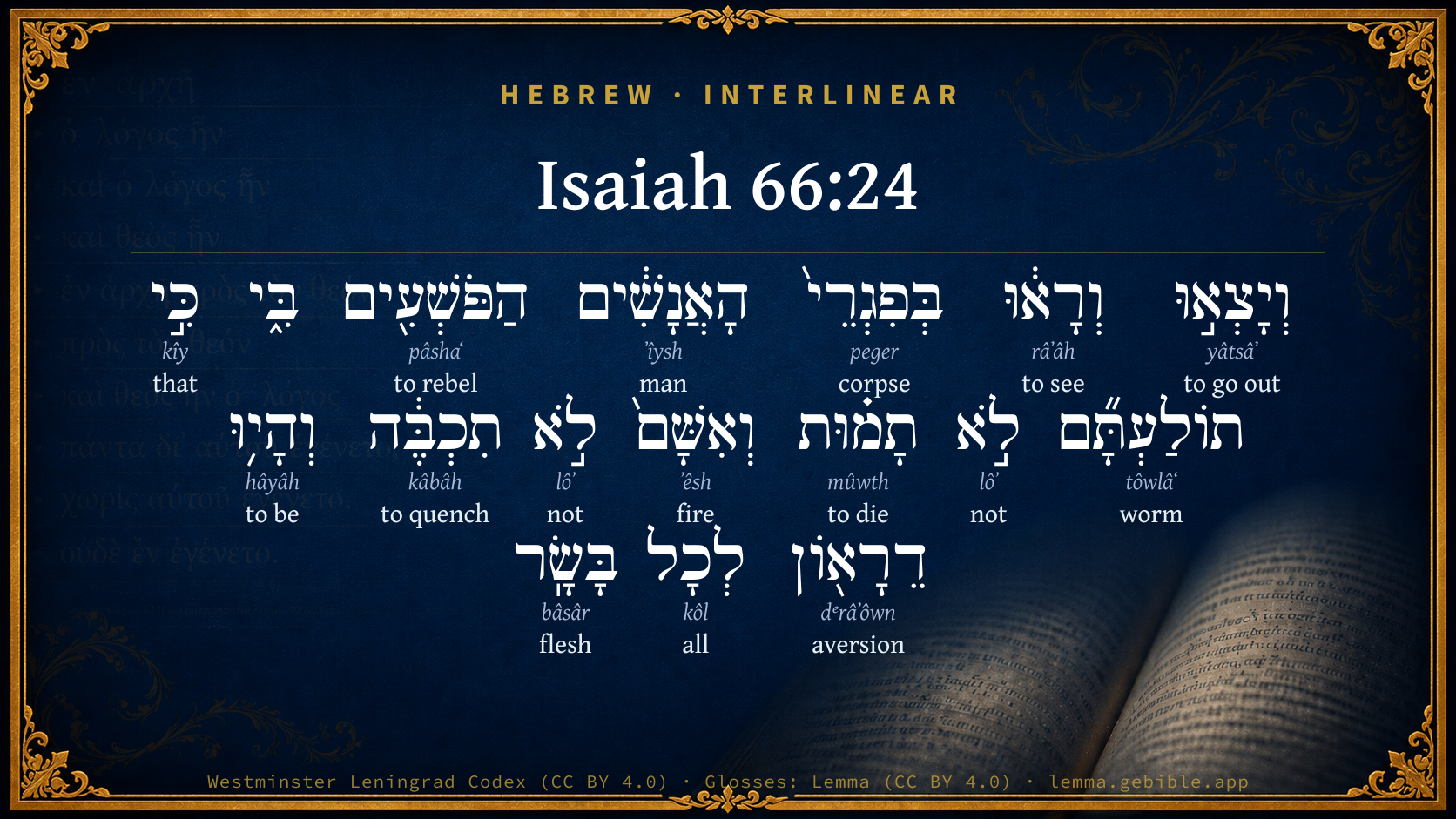
Hebrew (Westminster Leningrad Codex) Isaiah 66:24 appears in the Hebrew Old Testament. The text above is from the Westminster Leningrad Codex. Each word links to its Strong’s number, a concise gloss, and parsing drawn from the Open Scriptures Hebrew Bible morphology. Click any word for its full Brown-Driver-Briggs (BDB) entry.
Download image
Cite this verse

Isaiah 66:24 (World English Bible). Public Domain. Lemma interlinear Bible study tool, https://lemma.gebible.app/v/isaiah/66/24.

Show BibTeX & RIS
BibTeX
RIS
English Translation
They shall go forth, and look on the dead bodies of the men who have transgressed against me: for their worm shall not die, neither shall their fire be quenched; and they shall be an abhorring to all flesh.
World English Bible · Public Domain
Highlights
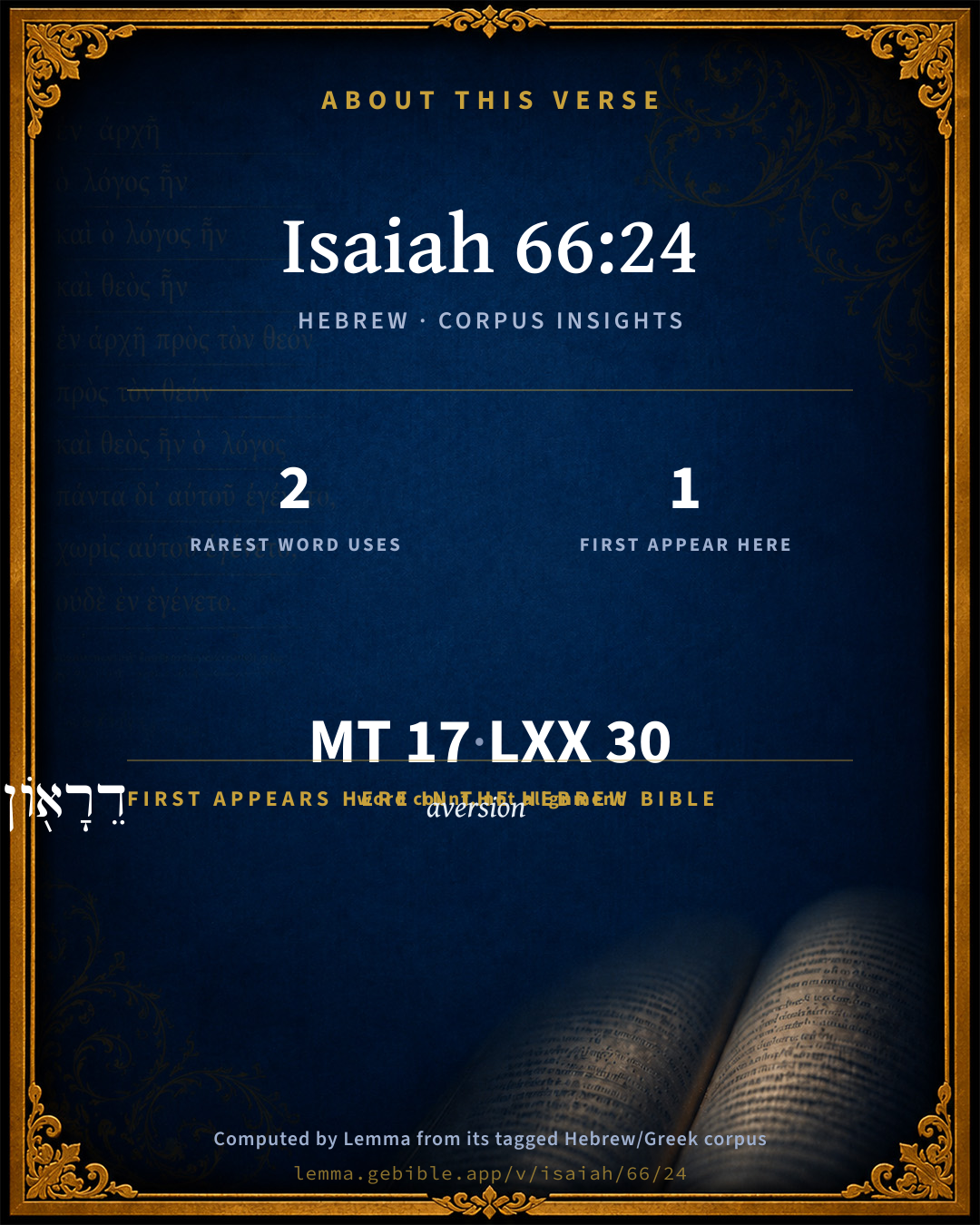
  • 1 first appearance in the Hebrew Bible
Full analysis ↓
Download a study sheet

One document with this verse’s original text, its word-by-word gloss line, the meaning frame, cross-references with their text, attributed commentary, and full source and license credits — printable, and it pastes into notes with its structure intact.

This verse Autodidact and up

Study sheet (.html) Plain text (.txt)

A passage Seminary Student

Up to 50 verses in one chapter. A passage sheet keeps up to 6 commentary sources and 12 cross-references per verse, in the order this page ranks them, and says so on the sheet whenever that leaves anything out. Ask for a single verse and you get the Autodidact verse sheet above.

Everything on this page stays free to read, with no account — the sheet is a download of what is already on screen, not access to it.

Want to remove ads? Support Godless Engineer
Compare translations 3

The same verse in 3 English versions, stacked beneath the original-language interlinear above. Click any original word for its lexicon entry.

Each is an independent rendering of the whole verse — the interlinear is not word-aligned to these translations.

Highlighted words mark where these versions differ — a whole-verse word diff, not a word-by-word alignment.

  • World English Bible Public Domain
    They shall go forth, and look on the dead bodies of the men who have transgressed against me: for their worm shall not die, neither shall their fire be quenched; and they shall be an abhorring to all flesh.
  • King James Version Public Domain
    And they shall go forth, and look upon the carcases of the men that have transgressed against me: for their worm shall not die, neither shall their fire be quenched; and they shall be an abhorring unto all flesh.
  • unfoldingWord Literal Text CC BY-SA 4.0
    “And they will go out and see the corpses of the men having rebelled against me, for their worm will not die and their fire will not go out, and they will be an abhorrence to all flesh.”

unfoldingWord Literal Text — © unfoldingWord, licensed CC BY-SA 4.0. Word-aligned USFM3 via Door43 (git.door43.org/unfoldingWord/en_ult).

Versions to compare (up to 4)

3 of 4 selected

Show all 18 translations

Every available English version of this verse, each an independent rendering of the whole verse.

  • World English Bible Public Domain
    They shall go forth, and look on the dead bodies of the men who have transgressed against me: for their worm shall not die, neither shall their fire be quenched; and they shall be an abhorring to all flesh.
  • Berean Standard Bible Public Domain
    “As they go forth, they will see the corpses of the men who have rebelled against Me; for their worm will never die, their fire will never be quenched, and they will be a horror to all mankind.”
  • Majority Standard Bible Public Domain
    “As they go forth, they will see the corpses of the men who have rebelled against Me; for their worm will never die, their fire will never be quenched, and they will be a horror to all mankind.”
  • King James Version Public Domain
    And they shall go forth, and look upon the carcases of the men that have transgressed against me: for their worm shall not die, neither shall their fire be quenched; and they shall be an abhorring unto all flesh.
  • American Standard Version (1901) Public Domain
    And they shall go forth, and look upon the dead bodies of the men that have transgressed against me: for their worm shall not die, neither shall their fire be quenched; and they shall be an abhorring unto all flesh.
  • Revised Version (1885) Public Domain
    And they shall go forth, and look upon the carcases of the men that have transgressed against me: for their worm shall not die, neither shall their fire be quenched; and they shall be an abhorring unto all flesh.
  • Geneva Bible (1599) Public Domain
    And they shall goe forth, and looke vpon the carkases of the men that haue transgressed against me: for their worme shall not dye, neither shall their fire be quenched, and they shalbe an abhorring vnto all flesh.
  • Douay-Rheims (1899) Public Domain
    And they shall go out, and see the carcasses of the men that have transgressed against me: their worm shah not die, and their fire shall not be quenched: and they shall be a loathsome sight to all flesh.
  • Young's Literal Translation Public Domain
    And they have gone forth, And looked on the carcases of the men Who are transgressing against me, For their worm dieth not, And their fire is not quenched, And they have been an abhorrence to all flesh!
  • Literal Standard Version CC BY-SA 4.0
    “And they have gone forth, || And looked on the carcasses of the men || Who are transgressing against Me, || For their worm does not die, || And their fire is not quenched, || And they have been an abhorrence to all flesh!”
  • Unlocked Literal Bible CC BY-SA 4.0
    They will go out and see the dead bodies of the men who have rebelled against me, for the worms that eat them will not die, and the fire that consumes them will not be quenched; and it will be an abhorrence to all flesh.”
  • unfoldingWord Literal Text CC BY-SA 4.0
    “And they will go out and see the corpses of the men having rebelled against me, for their worm will not die and their fire will not go out, and they will be an abhorrence to all flesh.”
  • Darby Bible Public Domain
    And they shall go forth, and look upon the carcases of the men that have transgressed against me: for their worm shall not die, neither shall their fire be quenched; and they shall be an abhorrence unto all flesh.
  • World Messianic Bible Public Domain
    “They will go out, and look at the dead bodies of the men who have transgressed against me; for their worm will not die, nor will their fire be quenched, and they will be loathsome to all mankind.”
  • Webster's Bible Public Domain
    And they shall go forth, and look upon the carcasses of the men that have transgressed against me: for their worm shall not die, neither shall their fire be quenched; and they shall be an abhorring to all flesh.
  • Free Bible Version CC BY-SA 4.0
    They will go out and see the dead bodies of those who rebelled against me. The worms that eat them won't die, the fire that burns them won't go out, and everyone who sees them will be horrified.
  • Bible in Basic English Public Domain
    And they will go out to see the dead bodies of the men who have done evil against me: for their worm will ever be living, and their fire will never be put out, and they will be a thing of fear to all flesh.
  • JPS Tanakh (1917) Public Domain
    And they shall go forth, and look upon the carcasses of the men that have rebelled against Me; for their worm shall not die, neither shall their fire be quenched; and they shall be an abhorring unto all flesh.

Literal Standard Version (2020), Covenant Press — licensed CC BY-SA 4.0. Text via the HelloAO Bible API (eBible.org). Unlocked Literal Bible (unfoldingWord) — licensed CC BY-SA 4.0. Text via the HelloAO Bible API (eBible.org). unfoldingWord Literal Text — © unfoldingWord, licensed CC BY-SA 4.0. Word-aligned USFM3 via Door43 (git.door43.org/unfoldingWord/en_ult). Free Bible Version, Dr. Jonathan Gallagher — licensed CC BY-SA 4.0. Text via the HelloAO Bible API (eBible.org).

Word by word

More ways to search: Search by grammar → Find every occurrence → Compare this word →

Practice this passage: Drill this verse → Learn its vocabulary →

דֵרָא֖וֹן
dᵉrâʼôwn
H1860
“aversion”
Noun, Common, Masculine, Singular, Absolute
Part of Speech
Noun
Type
Common
Gender
Masculine
Number
Singular
State
Absolute
Full BDB Definition

Origin: from an unused root (meaning to repulse)

TWOT: 450a

aversion, abhorrence
  1. וְיָצְא֣וּ yâtsâʼ H3318 “and · to go out” Conjunction + Verb, Qal, Sequential Perfect, 3rd Person, Common, Plural
  2. וְרָא֔וּ râʼâh H7200 “and · to see” Conjunction + Verb, Qal, Sequential Perfect, 3rd Person, Common, Plural
  3. בְּפִגְרֵי֙ peger H6297 “in/at · corpses of” Preposition + Noun, Common, Masculine, Plural, Construct
  4. הָאֲנָשִׁ֔ים ʼîysh H376 “the · men” Particle, Definite Article + Noun, Common, Masculine, Plural, Absolute
  5. הַפֹּשְׁעִ֖ים pâshaʻ H6586 “the · rebelling” Particle, Definite Article + Verb, Qal, Participle Active, Masculine, Plural, Absolute
  6. כִּ֣י kîy H3588 “that” Conjunction
  7. תוֹלַעְתָּ֞ם tôwlâʻ H8438 “worm · their” Noun, Common, Feminine, Singular, Construct + Suffix, Personal, 3rd Person, Masculine, Plural
  8. לֹ֣א lôʼ H3808 “not” Particle, Negative
  9. תָמ֗וּת mûwth H4191 “to die” Verb, Qal, Imperfect, 3rd Person, Feminine, Singular
  10. וְאִשָּׁם֙ ʼêsh H784 “and · fire · their” Conjunction + Noun, Common, Both, Singular, Construct + Suffix, Personal, 3rd Person, Masculine, Plural
  11. לֹ֣א lôʼ H3808 “not” Particle, Negative
  12. תִכְבֶּ֔ה kâbâh H3518 “to quench” Verb, Qal, Imperfect, 3rd Person, Feminine, Singular
  13. וְהָי֥וּ hâyâh H1961 “and · to be” Conjunction + Verb, Qal, Sequential Perfect, 3rd Person, Common, Plural
  14. לְכָל kôl H3605 “to/for · all of” Preposition + Noun, Common, Masculine, Singular, Construct
  15. בָּשָֽׂר bâsâr H1320 “flesh” Noun, Common, Masculine, Singular, Absolute

About this verse

These counts appear in no published source. They are computed here, from the morphology-tagged text and Lemma’s own curated glosses. What Lemma adds →

17
words
15
distinct lemmas
Prophets
section

Notable vocabulary

The rarest word here is דֵרָא֖וֹן aversion H1860 — appearing just 2 times in the whole Hebrew Bible.

First appearance in Scripture

This word makes its first canonical appearance in the Hebrew Bible here:

  • דֵרָא֖וֹן aversion H1860

Shared distinctive vocabulary

דֵרָא֖וֹן aversion H1860 occurs in 2 verses of the Hebrew Bible. Also found in:

Grammatical profile

  • 6 verbs
  • 7 nouns
  • 1 preposition
  • 1 conjunction
  • 2 particles

Verb forms

  • וְיָצְא֣וּ Qal · Sequential Perfect
  • וְרָא֔וּ Qal · Sequential Perfect
  • הַפֹּשְׁעִ֖ים Qal · Participle Active
  • תָמ֗וּת Qal · Imperfect
  • תִכְבֶּ֔ה Qal · Imperfect
  • וְהָי֥וּ Qal · Sequential Perfect

Repetition

A word recurs within this verse — often emphatic in Hebrew:

Hebrew & Septuagint length

In English translation the verse runs 39 words from the Hebrew and 39 from the Septuagint (LXX English) — the same length.

A rough comparison of the two English renderings, which tokenize alike — not a word-level alignment.

Word counts can differ between the Hebrew and the Greek without any difference in meaning — e.g. the Hebrew direct-object marker אֵת has no separate Greek word, and Greek often adds the article ὁ.

In the original languages it is 17 Hebrew tokens and 30 Greek tokens — but the two are counted differently (Hebrew bundles its prefixes and suffixes into one token; the Greek is in lemma form), so that isn’t a like-for-like length.

Cross-references

16

Topical passages linked to Isaiah 66:24 in the Treasury of Scripture Knowledge — connected by theme and wording, ordered by reader-vote popularity; previews shown in the World English Bible.

  • Isaiah 14:11 Your pomp is brought down to Sheol, [and] the noise of your viols: the worm is spread under you, and worms cover you.
  • Revelation 14:10–11 he also will drink of the wine of the wrath of God, which is prepared unmixed in the cup of his anger. He will be tormented with fire and sulfur in the presence of the holy angels, and in the presence of the Lamb.
  • Daniel 12:2 Many of those who sleep in the dust of the earth shall awake, some to everlasting life, and some to shame and everlasting contempt.
  • 1 Thessalonians 2:15–16 who killed both the Lord Jesus and their own prophets, and drove us out, and didn't please God, and are contrary to all men;
  • Revelation 21:8 But for the cowardly, unbelieving, sinners, abominable, murderers, sexually immoral, sorcerers, idolaters, and all liars, their part is in the lake that burns with fire and sulfur, which is the second death."
  • Psalms 58:10–11 The righteous shall rejoice when he sees the vengeance. He shall wash his feet in the blood of the wicked;
  • Mark 9:43–49 If your hand causes you to stumble, cut it off. It is better for you to enter into life maimed, rather than having your two hands to go into Gehenna, into the unquenchable fire,
  • Isaiah 34:10 It shall not be quenched night nor day; the smoke of it shall go up for ever; from generation to generation it shall lie waste; none shall pass through it forever and ever.
  • Isaiah 66:16 For by fire will Yahweh execute judgment, and by his sword, on all flesh; and the slain of Yahweh shall be many.
  • Zechariah 14:12 This will be the plague with which Yahweh will strike all the peoples who have warred against Jerusalem: their flesh will consume away while they stand on their feet, and their eyes will consume away in their sockets, and their tongue will consume away in their mouth.
  • Matthew 3:12 His winnowing fork is in his hand, and he will thoroughly cleanse his threshing floor. He will gather his wheat into the barn, but the chaff he will burn up with unquenchable fire."
  • Revelation 19:17–21 I saw an angel standing in the sun. He cried with a loud voice, saying to all the birds that fly in the sky, "Come! Be gathered together to the great supper of God,
  • Isaiah 1:31 The strong will be like tinder, And his work like a spark. They will both burn together, And no one will quench them."
  • Isaiah 65:15 You shall leave your name for a curse to my chosen; and the Lord Yahweh will kill you; and he will call his servants by another name:
  • Ezekiel 39:9–16 Those who dwell in the cities of Israel shall go forth, and shall make fires of the weapons and burn them, both the shields and the bucklers, the bows and the arrows, and the war clubs, and the spears, and they shall make fires of them seven years;
  • Zechariah 14:18–19 If the family of Egypt doesn't go up, and doesn't come, neither will it rain on them. This will be the plague with which Yahweh will strike the nations that don't go up to keep the feast of tents.

Cross-references courtesy of OpenBible.info (CC BY 4.0).

Hebrew and Greek witnesses Masoretic Hebrew ↔ Greek Septuagint

The same verse in the two great witnesses to the Old Testament, shown verse-for-verse.

These are two independent witnesses, not word-aligned to each other, and the Septuagint is shown in lemma (dictionary) form.

Hebrew Isaiah 66:24 Masoretic · Westminster Leningrad Codex

וְיָצְא֣וּ וְרָא֔וּ בְּפִגְרֵי֙ הָאֲנָשִׁ֔ים הַפֹּשְׁעִ֖ים בִּ֑י כִּ֣י תוֹלַעְתָּ֞ם לֹ֣א תָמ֗וּת וְאִשָּׁם֙ לֹ֣א תִכְבֶּ֔ה וְהָי֥וּ דֵרָא֖וֹן לְכָל בָּשָֽׂר

They shall go forth, and look on the dead bodies of the men who have transgressed against me: for their worm shall not die, neither shall their fire be quenched; and they shall be an abhorring to all flesh.

World English Bible · Public Domain

Greek LXX Isaiah 66:24 Septuagint · lemma form

καί ἐκἔρχομαι καί ὁράω ὁ κῶλον ὁ ἄνθρωπος ὁ παραβαίνω ἐν ἐγώ ὁ γάρ σκώληξ αὐτός οὐ τελευτάω καί ὁ πῦρ αὐτός οὐ σβέννυμι καί εἰμί εἰς ὅρασις πᾶς σάρξ

And they shall go forth, and see the carcasses of the men that have transgressed against me: for their worm shall not die, and their fire shall not be quenched; and they shall be a spectacle to all flesh.

LXX2012 (modern English Septuagint) · Public Domain

On this verse, Adam Clarke's Commentary discusses the Septuagint’s reading. Read the note in Commentary ↓

Hebrew: Westminster Leningrad Codex (CC BY 4.0). Greek: Septuagint (public domain); English from LXX2012 (modern English Septuagint) (Public Domain). How the Septuagint differs from the Hebrew →

Targum (Aramaic paraphrase)

1

The Targum is the ancient Jewish Aramaic paraphrase of the Hebrew Scriptures — an interpretive translation, not the Hebrew text itself. Onkelos (literal) and Pseudo-Jonathan (expansive) render the Torah, and Jonathan the Prophets. Coverage is partial: where no permissively-licensed English translation exists for a verse, only the Aramaic is shown. This is verse-level text, not a word-by-word alignment to the Hebrew.

  1. Targum Jonathan Prophets (Joshua–Malachi)
    וְיִפְקוּן וְיֶחְזוּן בְּפִגְרֵי גַבְרַיָא חַיָבַיָא דִמְרָדוּ בְמֵימְרִי אֲרֵי נִשְׁמַתְהוֹן לָא יְמוּתוּן וְאֶשְׁתְּהוֹן לָא תִטְפֵי וִיהוֹן מִתְדָנִין רַשִׁיעַיָא בְּגֵיהִנָם עַד דְיֵימְרוּן עֲלֵיהוֹן צַדִיקַיָא מִיסַת חֲזֵינָא:

    And they shall go forth, and look upon the carcases of the men, the sinners, who have rebelled against my WORD: for their souls shall not die, and their fire shall not be quenched; and the wicked shall be judged in hell, till the righteous shall say concerning them, we have seen enough.

    Targum Jonathan — Aramaic: “Mikraot Gedolot” (public domain). English: “Sefaria Community Translation” (CC0 1.0 (public-domain dedication)); “London "Chaldee Paraphrase," 1871” (public domain). Text via Sefaria.

Commentary

Notes on Isaiah 66:24 from classic Christian and Jewish commentators (each source and its license shown beneath its notes). The classic Christian expositions comment on the surrounding passage and are grouped to its opening verse, so a note may address several verses; the Jewish commentaries on the Tanakh (Rashi and others) are per-verse, so they appear only where the commentator wrote on this verse.

Lemma curates 59 commentaries, every one of them public domain or Creative Commons licensed, each selected and text-cleaned for this edition rather than reprinted as found. About our sources →

The Cambridge Bible for Schools and Colleges

gen. ed. J. J. S. Perowne

24. And they (the worshippers) shall go forth] to some place in the vicinity of Jerusalem, no doubt the Valley of Hinnom, Neh_11:30; cf. Jos_15:8; Jos_18:16; 2Ch_28:3; Jer_7:32; 2Ki_23:10. (See below.)

the men that rebelled against me] The apostates so often referred to in the last two chapters.

for their worm shall not die, &c.] (see below) Jdt_16:17; Sir_7:17; Mar_9:44 ff.

an abhorring] The Hebrew word (dçrâ’ôn) occurs again only in Dan_12:2.

This verse is the basis of the later Jewish conception of Gehenna as the place of everlasting punishment (see Salmond, Christian Doctrine of Immortality, pp. 355–360). Gehenna is the Hebrew Gê-Hinnôm (Valley of Hinnom), the place where of old human sacrifices were offered to Molech (Jer_7:31 f., et passim), and for this reason desecrated by king Josiah (2Ki_23:10). Afterwards it became a receptacle for filth and refuse, and Rabbinical tradition asserts that it was the custom to cast out unclean corpses there, to be burned or to undergo decomposition. This is in all probability the scene which had imprinted itself on the imagination of the writer, and which was afterwards projected into the unseen world as an image of endless retribution. The Talmudic theology locates the mouth of hell in the Valley of Hinnom. But how much of the later theology lies in this passage it is difficult to say. Nothing is expressly said of torment endured by the dead, but only of the loathsome spectacle they present to the living; although the former idea may be implied and is suggested by a comparison with ch. Isa_50:11. “If this passage is of too early a date, as Dillmann thinks, to admit of a reference to the horrors of the Valley of Gehinnom, the double figure of the worm and the fire may be due to the two ways of disposing of the dead, by interment and by cremation. The immediate object of the description of the worm as never dying and the fire as never being quenched, appears to be to mark the destination of those men as a perpetual witness to the consuming judgements of God, and one which all flesh may see. The incongruity of the idea of a fire burning a dead body and never going out, is supposed, however, to point to something more.… It may be that the dead body is poetically conceived to be conscious of the pains of the worm and the fire, as Dillmann supposes [cf. Job_14:22]. But even that goes beyond the immediate object, which is to present the men in question as a perpetual spectacle of shame to all beholders” (Salmond, l.c. p. 212). The view thus expressed is reasonable if the passage was written by the author of the preceding chapters. But there is much to be said for the opinion (of Duhm and Cheyne) that the last two verses are an appendix to the prophecy, written at a later time, so that the language may to some extent be saturated with the ideas which were afterwards associated with the word Gehenna.

In Heb. Bibles and MSS. part of Isa_66:23 is repeated (without the vowel signs) after Isa_66:24, in accordance with a Massoretic direction, so that the reading in the Synagogue might” close with words of comfort.” The same practice was followed in the reading of the “Twelve” (Minor) Prophets, Lamentations, and Ecclesiastes. see Ginsburg’s Introduction, p. 850.

The Cambridge Bible for Schools and Colleges (gen. ed. J. J. S. Perowne; Cambridge University Press, 1878–1918) — public domain. Text from a community e-Sword module.

Trapp's Complete Commentary

John Trapp

Isa 66:24 And they shall go forth, and look upon the carcases of the men that have transgressed against me: for their worm shall not die, neither shall their fire be quenched; and they shall be an abhorring unto all flesh.

Ver. 24. And they shall go forth and look upon the carcases.] Rhetoricians tell us that in the introduction to a discourse τα ηθη milder affections, suit best to insinuate; but in the conclusion τα παθη, passionate passages, such as may leave a sting behind them and stick by the hearers. This art the prophet here useth, for being now to period his prophecy, he giveth all sorts to know what they shall trust to. The godly shall go forth, i.e., salvi evadent, liberi abibunt; they shall have safety here, and salvation hereafter. "They shall also look upon the carcases," &c.; they shall be eye-witnesses of God’s exemplary judgments executed on the wicked, that would not have Christ to reign over them, {Rev 19:21} who shall be punished with everlasting destruction from the glory of the Lord and from the presence of his power. {2Th 1:9} This the righteous shall "see, and fear, and laugh at them," {Psa 52:6} giving God the glory of his justice and goodness. Some think they shall have at the last day a real sight of hell, and the damned there, {Rev 14:10} and this may very well be. Oh that wicked men would in their daily meditations take a turn or two in hell, and so be forewarned to flee from the wrath to come! Is it nothing to have the worm of conscience ever grabbing upon their entrails, and the fire of God’s vengeance feeding upon their souls and flesh throughout all eternity? Oh that sternity of extremity! Think of it seasonably and seriously, that ye never suffer it. The Jewish masters {a} have, in some copies, wholly left out this last verse, as in other copies they repeat - both here and in the end of Ecclesiastes, Lamentations, and Malachi - the last verse save one, which is more sweet and fuller of comfort; and that for this reason, that the reader may not be sent away sad, and so fall into desperation. But of that there is no such danger, since most people are over slight in their thoughts of hell torments, regarding them no more than they do a fire painted on the wall, or a serpent wrought in arras. And besides, non sinit in Gehennam incidere, Gehennae meminisse, saith Chrysostom: to remember hell, is a good means to preserve us from it. This verse hath sufficient authority from our Saviour’s citing of it. {Mar 9:44} {See Trapp on "Mar 9:44"} Plato {b} also - if that be anything - in his description of hell, which be calleth πυριφλεγετων, a fiery lake, saith the same as here - that their worm dieth not, neither is their fire quenched. He might possibly have read Isaiah as he had done Moses. It is thought, Laertius telleth us, that he travelled into Egypt, where he conversed with some Hebrews, and learned much of them. {c}

And they shall be an abhorring to all flesh,] i.e., All good men abominate them now as so many living ghosts, walking carcases, {Eph 2:2 Pro 29:27} and shall much more at the last day, when they shall arise again to everlasting shame and contempt. {Dan 12:2}

“ Scribendo haec studui bene de pietate mereri;

Sed quicquid potui, Gratia, Christe, tua est. ”

{a} Amama in Antibarb.

{b} In Phaed. p. 400.

{c} Inde dictus este, Moses Atticus.

John Trapp, A Commentary or Exposition upon All the Books of the Old and New Testament (1647–1656) — public domain. Text from a community e-Sword module.

The Biblical Illustrator

Joseph S. Exell

Isa_66:24

And they shall go forth

Transgressors punished

Those that transgressed or rebelled against the Lord are the obstinate idolaters referred to in chaps, 65.

, 66. Their carcasses lies spectacle to all who come up to worship at Jerusalem, subject to never-ending corruption and never-ending burning. According to the prophets conception, the scene takes place on the earth, in me vicinity of Jerusalem, probably in the Valley of Hinnom, but the language may have suggested a punishment by everlasting fire in the world to come. (A. B.Davidson, D. D.)

Gehenna

This verse is the basis of the later Jewish conception of Gehenna as the place of everlasting punishment (see Salmonds Christian Doctrine of Immortality). Gehenna is the Hebrew Ge-Hinnom (Valley of Hinnom), the place where, of old, human sacrifices were offered to Moloch, and for this reason desecrated by King Josiah (2Ki_23:10). Afterwards it became a receptacle for filth and refuse, and Rabbinical tradition asserts that it was the custom to cast out unclean corpses there, to be burned or to undergo decomposition. This is, in all probability, the scene which had imprinted itself on the imagination of the writer, and which was afterwards projected into the unseen world as an image of endless retribution. The Talmudic theology locates the mouth of hell in the Valley of Hinnom. (Prof. J. Skinner, D. D.)

The eternal imaged by the temporal

The prophet blends temporal and eternal This world and the next coalesce to his view. (F. Delitzsch, D. D.)

Hell

Hell is of both worlds, so that in the same essential sense, although in different degree, it may be said both of him who is still living but accursed, and of him who perished centuries ago, that his worm dieth not and his fire is not quenched. (J. A. Alexander.)

Doom following unfaithfulness and transgression

1. It is a terrible ending, but it is the same as upon the same floor Christ set to His teaching--the Gospel net cast wide, but only to draw in both good and bad upon a beach of judgment; the wedding feast thrown open and men compelled to come in, but among them a heart whom grace so great could not awe even to decency; Christs Gospel preached, His example evident, and Himself owned as Lord, and nevertheless some whom neither the hearing nor the seeing nor the owning with their lips did lift to unselfishness or stir to pity-. Therefore He who had cried, Come all unto Me, was compelled to close by saying to many, Depart.

2. It is a terrible ending: but one only too conceivable. For though God is love, man is free--free to turn from that love; free to be as though he had never felt it; free to put away from himself the highest, clearest, most urgent grace that God can show. But to do this is the judgment.

3. Lord, are there few that be saved? The Lord did not answer the question but by bidding the questioner take heed to himself Strive to enter in at the strait gate, (Prof. G. A. Smith, D. D.)

Eternal punishment

I. THE WICKEDNESS OF THE WICKED. II. ITS PUNISHMENT. Certain. Terrible. Without alleviation or hope.

III. THE PERPETUATION OF ITS MORAL LESSONS. (J. Lyth, D. D.)

The goodness and severity of God

The public reading of the synagogue repeats once more after Isa_66:24, on account of its terrible import, the encouraging words of Isa_66:23 in order to conclude with words of comfort.(F. Delitzsch, D. D.)

The Biblical Illustrator, edited by Joseph S. Exell (c. 1880s–1900s) — public domain. Text from a community e-Sword module.

Joseph Benson's Commentary

Isa 66:24. And they shall go forth — Namely, those who had joined themselves to the communion of the church spoken of in the preceding verses; and look upon the carcasses of the men that have sinned against me — Meaning chiefly the unbelieving Jews who rejected Christ and his gospel, including, however, all impenitent sinners, and especially all the enemies and persecutors of God’s truth and people. By looking upon their carcasses is meant beholding the dreadful vengeance taken on them. This is here represented in figurative language. The misery is described by an allusion to the frightful spectacle of a field of battle covered with the carcasses of the slain, which lie rotting upon the ground, full of worms, crawling about them, and feeding on them. It seems the Lord, by his prophet, first intends to set forth the dreadful temporal calamities that should come upon the Jews, in the destruction of their city and nation by the Romans; in which destruction, as has been intimated in the note on Isa 66:16, not less than between two and three millions, first and last, were cut off by the sword, famine, and pestilence. But when it is added, for their worm shall not die, neither shall their fire be quenched, it is certain the punishment of the wicked in the world to come is chiefly intended. These words, it is well known, are applied by our Saviour, (Mar 9:44,) to express the everlasting punishment of the wicked in Gehenna, or hell, so called, in allusion to the valley of Hinnom, the place where the idolatrous Jews celebrated that horrible rite of making their children pass through the fire, that is, of burning them in sacrifice to Moloch; concerning which place see note Isa 30:33. “Our Saviour,” says Bishop Lowth, expressed the state of the blessed by sensible images; such as paradise, Abraham’s bosom, or, which is the same thing, a place to recline next to Abraham at table, in the kingdom of heaven; (see Mat 8:11; Joh 13:23;) for we could not possibly have any conception of it, but by analogy from worldly objects: in like manner he expressed the place of torment under the image of Gehenna; and the punishment of the wicked by the worm, which there preyed on the carcasses, and the fire, which consumed the wretched victims. Marking, however, in the strongest manner, the difference between Gehenna and the invisible place of torment: namely, that in the former, the suffering is transient; the worm itself, that preys on the body, dies: whereas, in the figurative Gehenna, the instruments of punishment shall be everlasting, and the suffering without end; for there the worm dieth not, and the fire is not quenched. “These emblematical images, expressing heaven and hell, were in use among the Jews before our Saviour’s time; and in using them, he complied with their notions. Blessed is he that shall eat bread in the kingdom of God, says the Jew to our Saviour, Luk 14:15. And, in regard to Gehenna, the Chaldee paraphrast renders everlasting, or continual burnings, by the Gehenna of everlasting fire. And before this time the son of Sirach (Sir 7:17) had said, The vengeance of the ungodly is fire and worms. So likewise the author of the book of Judith, ‘Wo to the nation rising up against my kindred, the Lord Almighty will take vengeance on them in the day of judgment, putting fire and worms in their flesh:’ Jdt 16:17, manifestly referring to the same emblem.”

And they shall be an abhorring unto all flesh — Hebrew דראון, an execration, as Dr. Waterland renders it. “Christ the Lord,” says Vitringa, “in passing his judicial sentence on false Christians and wicked persons, will say, Go, ye cursed: or execrated, into eternal fire. That evil will be added to their state of pain, and a condemning conscience. Separated from the blessed and glorious communion of God and the saints, cast into the deepest state of misery, they will be exposed to the reproach, ignominy, contempt, and execration of angels and saints,” (say rather of devils and condemned spirits,) “suffering the punishment of their pride, arrogance, tyranny, cruelty, injustice, crimes, hatred of the truth, persecutions, by which things in this life, fighting against God, and afflicting his saints, they knowingly and willingly provoked his displeasure. These are the ends of the two opposite kinds of men, the pious and the ungodly, in which, after various preparatory judgments of God, the fates of all ages as well as our own fates, will be terminated, and in which this divine book of the great Prophet Isaiah also terminates. May our lot be with the saints, with those who reverence God and love the truth; with the humble, the meek, the merciful, and those that persevere in good works to the end of life, through the grace of our great Lord, Saviour, and Judge, Jesus Christ, who will distribute these blessings according to the will of his Father.”

This eminent divine concludes his very learned commentary on this incomparable prophecy with the following devout prayer and thanksgiving, with which the author of this work, adopting his words, also closes his observations thereon. “Influenced by which hope, and prostrate before his throne, I return, with the most profound humility, my sincerest thanks to God the Father, in his Son Jesus Christ, by the Spirit, for the grace and light wherewith he hath favoured me, his unworthy servant, during my comment on this book; earnestly requesting from his grace and mercy that, pardoning the errors into which I have ignorantly fallen, he would render this work, of whatever sort it is, conducive to the glory of his great name, the benefit of the church, and the consolation of the pious.” Amen!

Joseph Benson's Commentary on the Old and New Testaments (1811–1818) — public domain. Text from a community e-Sword module.

Keil & Delitzsch

C. F. Keil & F. Delitzsch

They who go on pilgrimage to Jerusalem every new moon and Sabbath, see there with their own eyes the terrible punishment of the rebellious. "And they go out and look at the corpses of the men that have rebelled against me, for their worm will not die and their fire will not be quenched, and they become an abomination to all flesh." They perfects are perf. cons. regulated by the foregoing יבוא. ויצאוּ (accented with pashta in our editions, but more correctly with munach) refers to their going out of the holy city. The prophet had predicted in Isa 66:18, that in the last times the whole multitude of the enemies of Jerusalem would be crowded together against it, in the hope of getting possession of it. This accounts for the fact that the neighbourhood of Jerusalem becomes such a scene of divine judgment. בּ ראה always denotes a fixed, lingering look directed to any object; here it is connected with the grateful feeling of satisfaction at the righteous acts of God and their own gracious deliverance. דראון, which only occurs again in Dan 12:2, is the strongest word for "abomination." It is very difficult to imagine the picture which floated before the prophet's mind. How is it possible that all flesh, i.e., all men of all nations, should find room in Jerusalem and the temple? Even if the city and temple should be enlarged, as Ezekiel and Zechariah predict, the thing itself still remains inconceivable. And again, how can corpses be eaten by worms at the same time as they are being burned, or how can they be the endless prey of worms and fire without disappearing altogether from the sight of man? It is perfectly obvious, that the thing itself, as here described, must appear monstrous and inconceivable, however we may suppose it to be realized. The prophet, by the very mode of description adopted by him, precludes the possibility of our conceiving of the thing here set forth as realized in any material form in this present state. He is speaking of the future state, but in figures drawn from the present world. The object of his prediction is no other than the new Jerusalem of the world to come, and the eternal torment of the damned; but the way in which he pictures it, forces us to translate it out of the figures drawn from this life into the realities of the life to come; as has already been done in the apocryphal books of Judith (16:17) and Wisdom (7:17), as well as in the New Testament, e.g., Mar 9:43., with evident reference to this passage. This is just the distinction between the Old Testament and the New, that the Old Testament brings down the life to come to the level of this life, whilst the New Testament lifts up this life to the level of the life to come; that the Old Testament depicts both this life and the life to come as an endless extension of this life, whilst the New Testament depicts is as a continuous line in two halves, the last point in this finite state being the first point of the infinite state beyond; that the Old Testament preserves the continuity of this life and the life to come by transferring the outer side, the form, the appearance of this life to the life to come, the New Testament by making the inner side, the nature, the reality of the life to come, the δυνάμεις με λλοντος αἰῶνος, immanent in this life. The new Jerusalem of our prophet has indeed a new heaven above it and a new earth under it, but it is only the old Jerusalem of earth lifted up to its highest glory and happiness; whereas the new Jerusalem of the Apocalypse comes down from heaven, and is therefore of heavenly nature. In the former dwells the Israel that has been brought back from captivity; in the latter, the risen church of those who are written in the book of life. And whilst our prophet transfers the place in which the rebellious are judged to the neighbourhood of Jerusalem itself; in the Apocalypse, the lake of fire in which the life of the ungodly is consumed, and the abode of God with men, are for ever separated. The Hinnom-valley outside Jerusalem has become Gehenna, and this is no longer within the precincts of the new Jerusalem, because there is no need of any such example to the righteous who are for ever perfect.

In the lessons prepared for the synagogue Isa 66:23 is repeated after Isa 66:24, on account of the terrible character of the latter, "so as to close with words of consolation."

(Note: Isaiah is therefore regarded as an exception to the rule, that the prophets close their orations ותנחומים שבח בדברי (b. Berachoth 31a), although, on the other hand, this exception is denied by some, on the ground that the words "they shall be an abhorring" apply to the Gentiles (j. Berachoth c. V. Anf. Midras Tillim on Psa 4:8).)

But the prophet, who has sealed the first two sections of these prophetic orations with the words, "there is no peace to the wicked," intentionally closes the third section with this terrible picture of their want of peace. The promises have gradually soared into the clear light of the eternal glory, to the new creation in eternity; and the threatenings have sunk down to the depth of eternal torment, which is the eternal foil of the eternal light. More than this we could not expect from our prophet. His threefold book is now concluded. It consists of twenty-seven orations. The central one of the whole, i.e., the fourteenth, is Isaiah 52:13-53:12; so that the cross forms the centre of this prophetic trilogy. Per crucem ad lucem is its watchword. The self-sacrifice of the Servant of Jehovah lays the foundation for a new Israel, a new human race, a new heaven and a new earth.

Keil & Delitzsch — Biblical Commentary on the Old Testament (1861–1891) — public domain (CC PDM 1.0). Text via the HelloAO Bible API. (Old Testament only.)

Tyndale Open Study Notes

Tyndale Open Resources

66:24 Isaiah gives a final warning of the severity of God’s judgment. The book begins and ends with the condemnation of those who have rebelled (see 1:2-4). • The judgment of God on wicked humans will generate utter horror because such people will have no hope and no relief from suffering (see also Matt 5:22; 25:41; Mark 9:47-48; Rev 20:11-15).

Tyndale Open Study Notes — © Tyndale Open Resources, licensed CC BY-SA 4.0. Text via the HelloAO Bible API.

Geneva Bible (1599)

Geneva Bible translators

Meaning, a continual torment of conscience, which shall ever gnaw them, and never suffer them to be at rest, Mark 9:44.

As he that declared the felicity that shall be within the Church for the comfort of the godly, so doth he show what horrible calamity shall come to the wicked, that are out of the Church.

This is the just recompense for the wicked, which contemning God and his word, shall be by God’s just judgment abhorred of all his creatures.

Geneva Bible (1599) marginal notes — public domain. Text via Bolls.life.

Jamieson, Fausset & Brown

Robert Jamieson, A. R. Fausset & David Brown

go forth, and look--as the Israelites looked at the carcasses of the Egyptians destroyed at the Red Sea (Exo 14:30; compare Isa 26:14-19; Psa 58:10; Psa 49:14; Mal 4:1-3).

carcasses, &c.-- (Isa 66:16), those slain by the Lord in the last great battle near Jerusalem (Zac 12:2-9; Zac 14:2-4); type of the final destruction of all sinners.

worm . . . not die-- (Mar 9:44, Mar 9:46, Mar 9:48). Image of hell, from bodies left unburied in the valley of Hinnom (whence comes Gehenna, or "hell"), south of Jerusalem, where a perpetual fire was kept to consume the refuse thrown there (Isa 30:33). It shall not be inconsistent with true love for the godly to look with satisfaction on God's vengeance on the wicked (Rev 14:10). May God bless this Commentary, and especially its solemn close, to His glory, and to the edification of the writer and the readers of it, for Jesus' sake!

Next: Jeremiah Introduction

Jamieson, Fausset & Brown — Commentary Critical and Explanatory on the Whole Bible (1871) — public domain (CC PDM 1.0). Text via the HelloAO Bible API.

Adam Clarke's Commentary

Verse 24. For their worm shall not die] These words of the prophet are applied by our blessed Saviour, Mr 9:44, to express the everlasting punishment of the wicked in Gehenna, or in hell. Gehenna, or the valley of Hinnom, was very near to Jerusalem to the south-east: it was the place where the idolatrous Jews celebrated that horrible rite of making their children pass through the fire, that is, of burning them in sacrifice to Moloch. To put a stop to this abominable practice, Josiah defiled, or desecrated, the place, by filling it with human bones, 2Kg 23:10; 2Kg 23:14; and probably it was the custom afterwards to throw out the carcasses of animals there, when it also became the common burying place for the poorer people of Jerusalem. Our Saviour expressed the state of the blessed by sensible images; such as paradise, Abraham's bosom, or, which is the same thing, a place to recline next to Abraham at table in the kingdom of heaven. See Mt 8:11. Coenabat Nerva cum paucis. Veiento proximus, atque etiam in sinu recumbebat. "The Emperor Nerva supped with few. Veiento was the first in his estimation, and even reclined in his bosom." Plin. Epist. iv. 22. Compare Joh 13:23; for we could not possibly have any conception of it but by analogy from worldly objects. In like manner he expressed the place of torment under the image of Gehenna; and the punishment of the wicked by the worm which there preyed on the carcasses, and the fire that consumed the wretched victims. Marking however, in the strongest manner, the difference between Gehenna and the invisible place of torment; namely, that in the former the suffering is transient:-the worm itself which preys upon the body, dies; and the fire which totally consumes it, is soon extinguished:-whereas in the figurative Gehenna the instruments of punishment shall be everlasting, and the suffering without end; "for there the worm dieth not, and the fire is not quenched."

These emblematical images, expressing heaven and hell, were in use among the Jews before our Saviour's time; and in using them he complied with their notions. "Blessed is he that shall eat bread in the kingdom of God," says the Jew to our Saviour, Lu 14:15. And in regard to Gehenna, the Chaldee paraphrase as I observed before on Isa 30:33, renders everlasting or continual burnings by "the Gehenna of everlasting fire." And before his time the son of Sirach, Sirach 7:17, had said, "The vengeance of the ungodly is fire and worms." So likewise the author of the book of Judith, Judith 16:17: "Wo to the nations rising up against my kindred: the Lord Almighty will take vengeance of them in the day of judgment, in putting fire and worms in their flesh;" manifestly referring to the same emblem. - L.

Kimchi's conclusion of his notes on this book is remarkable: -

"Blessed be God who hath created the mountains and the hills,

And hath endued me with strength to finish the book of

salvation:

He shall rejoice us with good tidings and reports;

He shall show us a token for good: -

And the end of his miracles he shall cause to approach us."

Several of the Versions have a peculiarity in their terminations: -

And they shall be to a satiety of sight to all flesh.

VULGATE.

And thei schul ben into fyllyng of sigt to all fleshe.

Old MS. BIBLE.

And they shall be as a vision to all flesh.

SEPTUAGINT.

And the wicked shall be punished in hell till the righteous

shall say, - It is enough.

CHALDEE.

They shall be an astonishment to all flesh;

So that they shall be a spectacle to all beings.

SYRIAC.

The end of the prophecy of Isaiah the prophet.

Praise to God who is truly praiseworthy.

ARABIC.

One of my old Hebrew MSS. after the twenty-first verse repeats the twenty-third: "And it shall come to pass that from one new moon to another, and from one Sabbath to another, shall all flesh come to worship before me, saith the Lord."

MASORETIC NOTES

Number of verses in this book, 1295.

Middle verse, - Isa 33:21.

Masoretic sections, 26.

חזק chazak, Be strong.

In the course of these notes the reader will have often observed two MSS. of the Septuagint referred to by Bp. Lowth, and marked I. B. II., I. D. II. They are both in the British Museum. The former contains the prophets, and was written about the tenth or eleventh century; and because it once belonged to Pachomius, patriarch of Constantinople, in the beginning of the sixteenth century, the bishop often quotes it by the title MS. Pachom. The other contains many of the historical books, beginning with Ruth, and ending with Ezra; and has also the Prophet Isaiah. This MS. consists of two parts, - one apparently written in the eleventh or twelfth century; the other, in the beginning of the fourteenth. Dr. Grabe and Dr. Woide, as well as Bp. Lowth, considered these MSS. of great value and authority.

It may be necessary to say something of the Hebrew MSS. which I have also frequently quoted. The collations of Kennicott and De Rossi have been long before the public, and to describe them would be useless. The collections of the latter Bp. Lowth had never seen, else he could have strengthened his authorities: these, for the first time, I have in the preceding notes incorporated with Bishop Lowth's references, and thus added double strength to the learned prelate's authorities. But of my own I should say something, as they form no part of the above collections; and yet are among the oldest MSS. known to exist. Independently of rolls, which contain only the Megillah, Esther, and the Pentateuch, they are ten in number, and formerly belonged to the Rev. Cornelius Schulting, a Protestant minister of Amsterdam. After his death in 1726, they were sold by public auction, and came into the possession of the Rev. John Van der Hagen, a reformed minister of the same place.

In 1733, Jo. Christ. Wolf described these MSS. in the fourth volume of his Bibliotheca Hebraea, p. 79. A few years ago I had the singular good fortune to purchase the whole of these at Utrecht; a collection of MSS., which Dr. Kennicott complains that he could not by any entreaties obtain the privilege of collating. These are his own words, - "Wolfius, (Bib. Heb. iv. 79-82,) memorat codices 10. olim penes Schultingium; quorum plurimi postea erant penes Rev. Joh. Van der Hagen. Usum Codd. Hagenianorum obtinere nulla potuit a me precatio." Dissert. Gener. p. 78. sub Cod. 84. Dr. Kennicott supposed that three of those MSS. had been collated for him: but in this I believe he was mistaken; as he was also in supposing that only the greater part of the ten MSS. of Schulting had fallen into the hands of Mr. Van der Hagen; for the fact is, the whole ten were purchased by Van der Hagen, and the same ten are now in my library, being precisely those described by Wolfius, as above. I have collated the Prophet Isaiah throughout, in two of the most ancient of these MSS.; and have added their testimony in many places to the various readings collected by Kennicott and De Rossi. The very bad state of my health, and particularly of my eyes, prevented a more extensive collation of these very ancient and invaluable MSS. Some of the oldest are without any date. They are marked with the ten first letters of the alphabet. Cod. C. was written A.D. 1076, - D. in 1286, - G. in 1215, - H. in 1309, - I. in 1136. In most of these there is an ample harvest of important various readings.

Bishop Lowth, in giving an account of his labours on this prophet, takes a general view of the difficulties and helps he met with in his work. This being of considerable importance, I shall lay an abstract of it before the reader, as a proper supplement to the preceding sheets. He observes: -

"The Masoretic punctuation, - by which the pronunciation of the language is given, and the forms of the several parts of speech, the construction of the words, the distribution and limits of the sentences, and the connexion of the several members, are fixed, - is in effect an interpretation of the Hebrew text made by the Jews of late ages, probably not earlier than the eight century; and may be considered as their translation of the Old Testament. Where the words unpointed are capable of various meanings, according as they may be variously pronounced and constructed, the Jews by their pointing have determined them to one meaning and construction; and the sense which they thus give is their sense of the passage, just as the rendering of a translator into another language is his sense. The points have been considered as part of the Hebrew text, and as giving the meaning of it on no less than Divine authority. Accordingly our public translations in the modern tongues, for the use of the Church among Protestants, and so likewise the modern Latin translations, are for the most part close copies of the Hebrew pointed text, and are in reality only versions at second hand, translations of the Jews' interpretation of the Old Testament.

"To what a length an opinion lightly taken up, and embraced with a full assent without due examination, may be carried, we may see in another example of much the same kind. The learned of the Church of Rome, who have taken the liberty of giving translations of Scripture in the modern languages, have for the most part subjected and devoted themselves to a prejudice equally groundless and absurd. The Council of Trent declared the Latin translation of the Scriptures, called the Vulgate, which had been for many ages in use in their Church, to be authentic; a very ambiguous term, which ought to have been more precisely defined than the fathers of this council chose to define it. Upon this ground many contended that the Vulgate Version was dictated by the Holy Spirit; at least was providentially guarded against all error; was consequently of Divine authority, and more to be regarded than even the original Hebrew and Greek texts.

"But a very fruitful source of error proceeded from the Jewish copyists consulting more the fair appearance of their copy than the correctness of it, by wilfully leaving mistakes uncorrected, lest by erasing they should diminish the beauty and the value of the transcript, (for instance, when they had written a word or part of a word wrong, and immediately saw their mistake, they left the mistake uncorrected, and wrote the word anew after it;) their scrupulous regard to the evenness and fulness of their lines, which induced them to cut off from the ends of lines a letter or letters for which there was not sufficient room, (for they never divided a word, so that the parts of it should belong to two lines,) and to add to the ends of lines letters wholly insignificant, by way of expletives to fill up a vacant space: their custom of writing part of a word at the end of a line, where there was not room for the whole, and then giving the whole word at the beginning of the next line.

"These circumstances considered, it would be the most astonishing of all miracles, if the Hebrew writings of the Old Testament had come down to us through their hands absolutely pure, and free from all mistakes whatsoever.

"The ancient VERSIONS, as the principal sources of emendation, and highly useful in rectifying as well as in explaining the Hebrew text, are contained in the London Polyglot.

"The Greek Version, commonly called the Septuagint, or of the seventy interpreters, probably made by different hands, (the number of them uncertain,) and at different times, as the exigence of the Jewish Church at Alexandria and in other parts of Egypt required, is of the first authority. and of the greatest use in correcting the Hebrew text, as being the most ancient of all; and as the copy from which it was translated appears to have been free from many errors which afterwards by degrees got into the text. But the Greek Version of Isaiah is not so old as that of the Pentateuch by a hundred years and more, having been made in all probability after the time of Antiochus Epiphanes, when the reading of the prophets in the Jewish synagogues began to be practised; and even after the building of Onias' temple to favour which there seems to have been some artifice employed in a certain passage of Isaiah (Isa 19:18) in this Version. And it unfortunately happens that Isaiah has had the hard fate to meet with a Greek translator very unworthy of him, there being hardly any book of the Old Testament so ill rendered in that Version as this of Isaiah.

"The Arabic Version is sometimes referred to as verifying the reading of the Septuagint, being, for the most part at least, taken from that Version.

"The Chaldee paraphrase of Jonathan ben Uzziel, made about or before the time of our Saviour, though it often wanders from the text in a wordy allegorical explanation, yet very frequently adheres to it closely, and gives a verbal rendering of it; and accordingly is sometimes of great use in ascertaining the true reading of the Hebrew text.

"The Syriac Version stands next in order of time, but is superior to the Chaldee in usefulness and authority, as well in ascertaining as in explaining the Hebrew text. It is a close translation of the Hebrew language into one of near affinity to it. It is supposed to have been made as early as the first century.

"The fragments of the three Greek Versions of Aquila, Symmachus, and Theodotion, all made in the second century, which are collected in the Hexapla of Montfaucon, are of considerable use for the same purpose.

"The Vulgate, being for the most part the translation of Jerome, made in the fourth century, is of service in the same way, in proportion to its antiquity.

"In referring to Dr. Kennicott's Collections, I have given the whole number of manuscripts or editions which concur in any particular reading; what proportion that number bears to the whole number of collated copies which contain the Book of Isaiah, may be seen by comparing it with the catalogue of copies collated, which is given at the end of that book in the doctor's edition of the Hebrew Bible.

"Among the manuscripts which have been collated, I consider those of the tenth, eleventh and twelfth centuries as ancient, comparatively and in respect of the rest. Therefore in quoting a number of manuscripts, where the variation is of some importance, I have added, that so many of that number are ancient, that is, are of the centuries above mentioned.

"The design of the notes is to give the reasons and authorities on which the translation is founded; to rectify or to explain the words of the text; to illustrate the ideas, the images, and the allusions of the prophet, by referring to objects, notions, and customs which peculiarly belong to his age and his country; and to point out the beauties of particular passages. If the reader would go deeper into the mystical sense, into theological, historical, and chronological disquisitions, there are many learned expositors to whom he may have recourse, who have written full commentaries on this prophet to which title the present work has no pretensions. The sublime and spiritual uses to be made of this peculiarly evangelical prophet, must be all founded on a faithful representation of the literal sense which his words contain. This is what I have endeavoured closely and exactly to express."

IN conclusion, it may be necessary to give some account of what I have ventured to superadd to the labours of this very learned prelate. After consulting the various commentators, who have spent much time and labour in their endeavours to illustrate this prophet, I found their interpretations of many of the most important prophecies strangely different, and often at variance. Former commentators have taken especial care to bring forth in the most prominent point of view all those passages which have been generally understood to refer to our blessed Lord, and the Christian dispensation. Later critics, especially those on the continent, have adopted the Jewish plan of interpretation, referring the parts belonging to the Messiah in his sufferings, c., to the prophet himself, or to the children of the captivity in their state of suffering and those passages which speak of the redemption of the world, and the glorious state of the Christian Church, they apply to the deliverance of the Israelites from the Babylonish captivity. It is really painful to see what labour and learning these critics spend to rob the prophet of his title of evangelical; and to show that even the sacred writers of the New Testament, in their application of select passages to our Lord, only followed the popular custom of accommodating passages of the Sacred Writings to occurrences and events, to which their leading circumstances bore some kind of resemblance, the application being only intended to convey the idea of similitude, and not of identity.

While I have cautiously handled those passages, the application of which was dubious, I have taker care to give my opinion with firmness on those which seem to have no other meaning than what they derive from their application to the great work of redemption by Jesus Christ, and the glory that should follow the outpouring of his Spirit. Many readers will no doubt suppose that I should have dwelt more on the spiritual parts of this inimitable book; but to this there would be scarcely any end. Who could exhaust the stores of this prophet! and if any thing were left unsaid, some would still be unsatisfied, to say nothing of the volume being thereby swollen beyond all reasonable bounds. I have marked enough for the reader's meditation; and have thrown out a sufficient number of hints to be improved by ministers of the word of God. To another class it may appear too critical; but this chiefly applies to the learned bishop, whose plan, as by far the best in my judgment, I have followed; and whose collection of various readings I felt it my duty to complete, a thing that none of his editors have attempted before. I have therefore added the various readings collected by De Rossi to those of Dr. Kennicott, which the bishop had cited as authorities, on which he built his alterations and critical conjectures.

Adam Clarke's Commentary on the Bible (1810–1826) — public domain. Text from a community e-Sword/MySword module.

Ellicott's Commentary for English Readers

(24) And they shall go forth . . .—As at the close of Isaiah 48, 57, each ending a great section of the volume, so here, the vision of restoration and blessedness is balanced by that of the righteous condemnation of the wicked. The outward imagery is suggested, as in Joe_3:12; Zec_14:12, by that of the great battle of the Lord (Isa_66:15-16). Those who are slain in that battle are thought of as filling the valleys round about Jerusalem, especially the valley of Jehoshaphat (“Jehovah judges “), devoured by worms, or given to the flames. Taken strictly, therefore, the words do not speak of the punishment of the souls of men after death, but of the defeat and destruction upon earth of the enemies of Jehovah. The words that tell us that “the worm shall not die” and that “the fire shall not be quenched” point, however, to something more than this, to be read between the lines. And so those words became the starting-point of the thoughts of later Judaism as to Gehenna (Sir_8:17; Jdt_16:17, and the Targum on this passage), of the words in which our Lord Himself gave utterance to what, at least, seemed to express those thoughts (Mar_9:44-48), of the dominant eschatology of Christendom. Even so taken, however, with this wider range, it is still a question whether the words are to be taken literally or figuratively (though this, perhaps, is hardly a question), whether the bodies, which represent souls, are thought of as not destroyed, but only tormented, or as consumed to nothing, by the fire and by the worm, whether those two agents represent sufferings of sense or spirit. The one aspect of the future life which they tend to exclude is that which presents the idea of a suffering that may be purifying. That idea is not without apparent support in other passages of Scripture (e.g., Rom_5:17-21; Rom_11:32; 1Pe_3:19; 1Pe_4:6); but we cannot say that it entered into the prophet’s thoughts here. What he emphasises is the eternal antagonism between the righteousness of God and man’s unrighteousness, and this involves the punishment of the latter as long as it exists. In any case there is a strange solemnity in this being the last word of the prophet’s book of revelation, even as there is a like awfulness in the picture of the final judgment, which appears in Mat_25:46, at all but the close of our Lord’s public teaching. Cheyne quotes a singular rubric of the Jewish ritual, that when this chapter, or Ecclesiastes 12, or Malachi 3, was read in the synagogue, the last verse but one should be repeated after the last, so that mercy might appear as in the end triumphant after and over judgment.

A Bible Commentary for English Readers, edited by Charles John Ellicott (1878–1897) — public domain. Text from a community e-Sword module.

John Gill's Exposition

And they shall go forth,.... That is, those constant and spiritual worshippers shall go forth from the holy mountain Jerusalem, the church of God, whither they are brought as an offering to the Lord, and where they worship him; for this is not to be understood of going out of Jerusalem literally, as Aben Ezra and Kimchi; or of their going out of their graves after the resurrection, as others; but either out of the Christian assemblies, or out of the houses of the saints, and the beloved city, when fire shall come down from heaven, and destroy the wicked, Rev 20:9,

and look upon the carcasses of the men that have transgressed against me. The Targum is,

"against my Word;''

against Christ, whose person they blasphemed, denying him to be God; whose office, as a Mediator and Saviour, they rejected; whose doctrines they contradicted; and whose ordinances they despised: these are not the carcasses of the camp of Gog and Magog, the Jews so call, as Kimchi interprets it; though it may have reference to the carcasses of Gog's army, the Turks, that will be slain in their attempt to recover Judea, Eze 38:1 or else the carcasses of those that will be slain at the battle at Armageddon, Rev 16:16 or the army of Gog and Magog, at the end of the thousand years, Rev 20:8. The Talmudists (t) observe from hence, that the wicked, even at the gate of hell, return not by repentance; for it is not said, that "have transgressed", but "that transgress"; for they transgress, and go on for ever; and so indeed the word may be rendered, "that transgress", or "are transgressing" (u); for they interpret it of the damned in hell, as many do; and of whom the following clauses may be understood:

for their worm shall not die; with which their carcasses shall be covered, they lying rotting above ground; or figuratively their consciences, and the horrors and terrors that shall seize them, which they will never get rid of. The Targum is,

"their souls shall not die;''

as they will not, though their bodies may; but will remain to suffer the wrath of God to all eternity: neither shall their fire be quenched; in hell, as Jarchi interprets it; those wicked men, the followers and worshippers of antichrist, will be cast into the lake which burns with fire and brimstone; they will for ever suffer the vengeance of eternal fire; and the smoke of their torment shall ascend for ever and ever, Rev 14:10,

and they shall be an abhorring unto all flesh; the true worshippers of God, Isa 66:23 to whom their carcasses will be loathsome, when they look upon them; and their souls abominable, because of their wicked actions; and who cannot but applaud the justice of God in their condemnation; and admire distinguishing grace and mercy, that has preserved them from the like ruin and destruction. The Targum is,

"and the ungodly shall be judged in hell, till the righteous shall say concerning them, we have seen enough;''

see Mar 9:44, where our Lord mentions and repeats some of the clauses of this, text, and applies them to the torments of hell.

(t) T. Bab. Erubim, fol. 19. 1. R. Hona in Midrash Tillim in Psal. i. 6. (u) "praevaricantium in me", Pagninus, Montanus; "qui transgressi sunt contra me", Piscator; "deficientium a me", Cocceius.

Next: Jeremiah Introduction

John Gill's Exposition of the Whole Bible (1746–1763) — public domain (CC PDM 1.0). Text via the HelloAO Bible API.

Albert Barnes' Notes on the Bible

And they shall go forth - The sense of this verse evidently is, that the pious and happy worshippers of God shall see the punishment which he will execute on his and their foes, or shall see them finally destroyed. It refers to the time when the kingdom of God shall be finally and perpetually established, and when all the mighty enemies of that kingdom shall be subdued and punished. The image is probably taken from a scene where a people whose lands have been desolated by mighty armies are permitted to go forth after a decisive battle to walk over the fields of the slain, and to see the dead and the putrifying bodies of their once formidable enemies.

And look upon the carcasses of the men - The dead bodies of the foes of God (see Isa 66:15-16).

For their worm shall not die - This image is evidently taken from the condition of unburied bodies, and especially on a battlefield. The Hebrew word (תולע tôlâ‛) properly refers to the worms which are generated in such corrupting bodies (see Exo 16:20; the notes at Isa 14:11). It is sometimes applied to the worm from which the crimson or deep scarlet color was obtained (the notes at Isa 1:18); but it more properly denotes that which is produced in putrid substances. This entire passage is applied by the Saviour to future punishment; and is the fearful image which he employs to denote the final suffering of the wicked in hell. My views on its meaning may be seen in the notes at Mar 9:44, Mar 9:46.

Neither shall their fire be quenched - The fire that shall consume them shall burn perpetually. This image is taken evidently from the fires kindled, especially in the valley of Hinnom, to consume puffed and decaying substances. That was a valley on the south side of Jerusalem, into which the filth of the city was thrown. It was the place where, formerly, an image of brass was raised to Moloch, and where children were offered in sacrifice 2Ki 16:3; 2Ch 28:3. See a description of this in the notes at Mat 5:22. This place was subsequently regarded as a place of special abomination by the Jews. The filth of the city was thrown there, and it became extremely offensive. The air was polluted and pestilential; the sight was terrific; and to preserve it in any manner pure, it was necessary to keep fires continually burning there. The extreme loathsomeness of the place, the filth and putrefaction, the corruption of the atmosphere, and the lurid fires blazing by day and by night, made it subsequently one of the most appalling and loathsome objects with which a Jew was acquainted.

It was called the gehenna of fire, and was the image which the Saviour often employed to denote the future punishment of the wicked. In that deep and loathsome vale it seems to have been the common expectation of the Jews that some great battle would be fought which would establish the supremacy of their nation over all others. Hence, the Chaldee renders this, ‘They shall go forth, and shall look upon the dead bodies of the sinners who have rebelled against my word; because their souls shall not die, and their fire shall not be extinguished; and the wicked shall be judged in Gehenna (בגיהנם begēyhı̂nâm from גי gay and הנם hinnôm, hence coming down into Greek as γέεννα geenna), until the righteous shall say, We have seen enough.’ It is, however, by no means certain that Isaiah refers here especially to the valley of Hinnom. The image in his mind is evidently that of a vast army slain, and left to putrify on the field unburied, and where fires would be kindled in part to consume the heaps of the slain, and in part to save the air from pestilential influences, All the enemies of God and his church would be like such a vast host strewed on the plains, and the perpetuity of his kingdom would be finally established.

And they shall be an abhorring - An object of loathing. So the Hebrew word דראון dêrâ'ôn, means. It is derived from דרא dârâ', an obsolete root, signifying, in Arabic, to thrust away, to repel. Jerome renders it, Ad satietatem visionis - understanding by it, that all flesh should look upon those dead bodies Until they were satisfied. The Septuagint, Εἰς ὅρασιν Eis horasin - ‘For a vision;’ or that all flesh might look upon them. It is evident that the Septuagint reads the word as if it were derived from the verb ראה râ'âh), “to see.”

Unto all flesh - (See Isa 66:23). The sense is, that so entire would be their overthrow, and such objects of loathing would they become, that all the friends of God would turn from them in abhorrence. All the enemies of God would be destroyed; the pure religion would triumph, and the people of God would be secure.

It may be made a question, perhaps, to what period this refers. The Saviour Mar 9:44, Mar 9:46, applied the language to the future punishment of the wicked, and no one, I think, can doubt that in Isaiah it includes that consummation of worldly affairs. The radical and essential idea in the prophet is, as it seems to me, that such would be the entire overthrow and punishment of the enemies of God; so condign their punishment; so deep their sufferings; so loathsome and hateful would they be when visited with the divine vengeance for their sins, that they would be an object of loathing and abhorrence. They would be swept off as unworthy to live with God, and they would be consigned to punishment - loathsome like that of ever gnawing worms on the carcasses of the slain, and interminable and dreadful like everconsuming and extinguishable fires.

This is the consummation of the series of bright visions that passed before the mind of Isaiah, and is an appropriate termination of this succession of wonderful revelations. Where could it more appropriately close than in the final triumph of the true religion, and in the complete and final destruction of all the enemies of Gods. The vision stretches on to the judgment, and is closed by a contemplation of those scenes which commence there, but which never end. The church is triumphant. Its conflicts cease. Its foes are slain. Its Redeemer is revealed; and its everlasting happiness is founded on a basis which can never be shaken.

Here I close my labors in endeavoring to elucidate the visions of this wonderful prophet. I thank God - the source of every right feeling and every holy desire, and the suggester of every plan that will in any way elucidate his word or promote his glory - that he ever inclined my heart to these studies. I thank him for the preservation of my life, and the continuance of my health, until I am permitted to bring this work to a close. I record, with grateful emotions, my deep conviction, that if in any way I have been enabled to explain that which was before dark; to illustrate that which was obscure; or to present any views which have not before occurred to those who may peruse this work, it is owing to the gracious influences of his Holy Spirit. And I desire to render thanks to the Great Source of light and truth, if I have been enabled to throw any light on the prophecies recorded here more than 2500 years ago; or to confirm the faith of any in the truth of the inspiration of the Bible by tracing the evidences of the fulfillment of those predictions.

And I now commend the work to the blessing of God, and devote it to the glory of his name and to the advancement of the Redeemer’s kingdom, with a humble prayer that it may be useful to other minds; but with the deep conviction, that whatever may be its effect on other minds, I have been abundantly compensated for all my labor in the contemplation of the inimitable beauties, and the sublime visions of Isaiah. thanks to God for this book; thanks for all its beauties, its consolations, its promises, its views of the Messiah, its predictions of the certain triumph of truth, and its glowing descriptions of the future conquest of the church, when God shall extend to it ‘peace like a river, and the glory of the Gentiles like a flowing stream.’ Come soon that blessed day, when ‘the ransomed of the Lord shall return to Zion, with songs and everlasting joy upon their heads’ Isa 35:10; when ‘the wilderness and the solitary place shall be glad, and the desert shall rejoice and blossom as the rose’ Isa 35:1; and when it shall be announced to the church, ‘thy sun shall no more go down; neither shall thy moon withdraw itself, for Yahweh shall be thine everlasting light, and the days of thy mourning shall be ended’ Isa 60:20.

May I be permitted to close my labors on this book in the beautiful language of Vitringa? ‘These words Isa 66:23-24 express the final doom of the two opposite classes of people, the righteous and the wicked, when, after various preparatory judgments of God, the fates of all ages, and our own also, shall be determined; with which also this divine book of Isaiah itself is terminated.

Be it our lot, with those who are holy; with those who fear God and love the truth; with the humble, meek, and merciful, and with those who persevere in every good work to the end of life, from the gracious sentence of our great Lord, Saviour, and Judge, Jesus Christ, to obtain, by the will of the Father, the same portion with them. In which hope, I also, now deeply affected, and prostrate before his throne, give humble thanks to God the Father, and his Son Christ Jesus, through the Spirit, for the grace and light with which he has endowed me, his unworthy servant, in commencing and completing the commentary on this book; entreating, with earnest prayer, of his grace and mercy, that, pardoning those errors into which erroneously I may have fallen, he will employ this work, such as it is, to the glory of his name, the use of the church, and the consolation of his people; and to Him be the glory throughout all ages.’

Albert Barnes' Notes on the Bible (1834–1885) — public domain. Text from a community e-Sword/MySword module.

Haydock's Catholic Bible Commentary

Men; rebellious Jews and persecutors, who perish miserably. --- Flesh. Josephus (Jewish Wars vi. 16.) describes the horrors of the last siege of Jerusalem. The prophet may allude to the fires kept up in the vale of Hinnon; (chap. xxx. 33.) and our Saviour applies this text to the damned, Mark ix. 43. All shall condemn them. (Calmet) Accedat lacrymis odium, dignusque puteris

Ut mala cum tuleris plurima, plura feras. (Ovid in Ibin.)

George Leo Haydock (1774–1849), Haydock's Catholic Family Bible and Commentary, 1859 edition — public domain. Excludes Psalms (Douay-Rheims chapter numbering differs from Protestant) and Deuterocanonical books (Catholic canon only).

Matthew Poole's English Annotations

Either the Gentiles, or the sincerer part of the Jews, shall go forth from their places, or from Jerusalem, or

go out of their graves, at the last day, and look upon the vengeance I have taken upon these vile idolaters and formalists, for their satisfaction, Psa 58:10; they shall see none of them alive, but they shall see their carcasses. For the worms that feed on their slain carcasses shall not suddenly die, and the enemy’s fire burning upon their habitations shall not go out till they be wholly consumed; and after this life, and at the day of judgment, they shall go into eternal torments; see Mar 9:44,46,48; where they will feel a worm of conscience that shall never die, and a fiery wrath of God upon their souls and bodies that shall never go out.

Matthew Poole's English Annotations on the Holy Bible (1683–1685) — public domain. Text from a community e-Sword/MySword module.

Whedon's Commentary on the Bible

Daniel D. Whedon

24. They shall go forth — The restored of the true Israel, embracing all devout Jews and converted Gentiles, constitute a vast host, enclosed within the walls of the typical, but now holy, Jerusalem. They have been collected from all regions of the earth. Already Jehovah has closed fiery judgment with apostate Israel, and has gathered the corpses of “the slain of the Lord” into the Hinnom valley (now called Gehenna) below, there to have unending consumption by unquenched fire and never-dying worm. The happy denizens of Jerusalem are called to go forth and survey the scene. The place, once by our prophet called Tophet, (Isa_30:33,) and more fully so called by Jeremiah, (Jer_7:30-33; Jer_19:6-15,) to which also our Lord alludes, (Mar_9:44; Mar_9:46; Mar_9:48,) was at one time the scene of Moloch worship; hence the name Tophet — a drum beaten to drown the cries of infants sacrificed to Moab’s god, Moloch. Hence, too, the whole imagery here, that of illustrating the horrors of doom befalling apostates from the true God, and the future punishment to all who incorrigibly are defiant of Jehovah to the last.

For purposes of Isaiah’s profound drama, herewith closed, this is a fitting and legitimate monumental scene; on this, want of space does not allow enlargement. It is, moreover, with some grotesqueness, a didactic scene. Prediction is in the scene, the object of which is, first, the New Jerusalem of the world to come; and second, the eternal misery of condemned ones. The picture is drawn in figures from the present world — figures from the present life adapted to the realities of the life to come. This, however, is just the distinction between the Old Testament and the New — the former bringing down the life to come to the end of this life, while the latter does just the opposite. (This thought is due to Delitzsch.) He says: “The New Jerusalem of our prophet has indeed a new heaven above it and a new earth under it, but it is only the old Jerusalem of earth lifted up to its highest glory and happiness; whereas the New Jerusalem of the Apocalypse comes down from heaven, and is therefore of a heavenly nature. In the former dwells the Israel that has been brought back from exile; in the latter, the risen Church of those who are written in the Book of Life. And whilst our prophet transfers the place in which the rebellious are judged to the neighbourhood of Jerusalem itself; in the Apocalypse the lake of fire in which the life of the ungodly is consumed, and the abode of God with men, are for ever separated. The Hinnom valley outside Jerusalem has become Gehenna, and this is no longer within the precincts of Jerusalem, because there is no need of any such example to the righteous who are for ever perfect.”

Daniel D. Whedon (gen. ed.), Commentary on the Old and New Testaments (1874–1909) — public domain. Text from a community e-Sword module.

The Pulpit Commentary

And they shall go forth, and look upon the carcases, etc. Here is more imagery, which it is impossible to understand literally. The carcases could not remain always to be looked at, nor while they remained could the sight of them be otherwise than loathsome to God"s redeemed saints. Again, they could not be at the same time burnt with fire and eaten by worms. "The prophet, by the very mode of description adopted by him, precludes the possibility of our conceiving of the thing set forth as realized in any material form in this present state. He is speaking of the future state, but in figures drawn from the present world" (Delitzsch). Does he mean more than this that the redeemed shall have in their thoughts, at any rate from time to time, the fact that, while they have by God"s great mercy been saved and brought into His kingdom, there are those who have not been saved, but lie for ever under the awful sentence of God"s wrath? This is a knowledge which the redeemed must have, and which may well produce a salutary effect on them, intensifying their gratitude and maintaining in them a spirit of reverent fear. Their worm shall not die, neither shall their fire be quenched. (comp. Mar_9:44, 46, 48) It cannot be by chance that the evangelical prophet concludes his glorious prophecy with this terrible note of warning. Either he was divinely directed thus to terminate his teaching, or he felt the need that there was of his emphasizing all the many warnings dispersed throughout his "book" by a final, never-to-be-forgotten picture. The undying worm and the quenchless fire images introduced by him became appropriated thenceforth to the final condition of impenitent sinners, (Jud_1:16:17; Ecc_7:17) and were even adopted by our Lord himself in the same connection (Mark 9). The incongruity of the two images shows that they are not to be understood literally; but both alike imply everlasting continuance, and are incompatible with either of the two modern heresies of universalism or annihilationism. They shall be an abhorring unto all flesh. (comp. Dan_12:2, where the word deraon is rendered "contempt The Jewish rabbis regarded it as anomalous that any portion of Scripture should conclude with words of ill omen. When, therefore, this chapter was read in the synagogue, or the last of Ecclesiastes, or Lamentations, or Malachi, they directed that after the reading of the last verse, the last verse but one should he repeated, to correct the sad impression that would otherwise have been left upon the mind. But Isaiah thought it salutary to leave this sad impression. (comp. Isa_48:22 Isa_57:21)

The Pulpit Commentary (1880–1919), ed. H.D.M. Spence-Jones & Joseph S. Exell — public domain. Text from a community e-Sword module.

J. A. Alexander on Isaiah

Joseph Addison Alexander

“And they shall go forth and gaze upon the carcasses of the men who revolted (or apostatized) from me, for their worm shall not die and their fire shall not be quenched, and they shall be a horror to all flesh.” The first verb may be construed indefinitely, ‘they’, (i.e., ‘men,’ without defining them; but in so vivid a description, it is certainly more natural to give the verbs a definite subject, and especially the one that had been previously introduced, viz. the worshippers assembled from all nations to do homage at Jerusalem). The grand theme of these prophecies, as we have seen, is the relation of God’s people to Himself and to the world, and in the latter stages of its history, to that race with which it was once outwardly identical. The great catastrophe with which the vision closes is the change of dispensations, comprehending the final abolition of the ceremonial law and its concomitants, the introduction of a spiritual worship and the consequent diffusion of the church, its vast enlargement by the introduction of all Gentile converts to complete equality of privilege and honour with the believing Jews, and the excision of the unbelieving Jews from all connection with the church or chosen people, which they once imagined to have no existence independent of themselves. The contrast between these two bodies, the rejected Jews and their believing brethren forming one great mass with the believing gentiles, is continued to the end, and presented for the last time in these two concluding verses, where the whole is condensed into a single vivid spectacle, of which the central figure is Jerusalem, and its walls the dividing line between the two contrasted objects. Within is the true Israel, without the false. Within, a great congregation, even "all flesh," come from the east and the west, and the north and the south, while the natural children of the kingdom are cast out (Mat 8:12). The end of the former is left to be imagined or inferred from other prophecies, but that of the latter is described, or suggested in a way more terrible than all description. In the valley of the son of Hinnom, under the very brow of Zion and Moriah, where the children were once sacrificed to Moloch, and where purifying fires were afterwards kept ever burning, the apostate Israel is finally exhibited, no longer living but committed to the flames of Tophet. To render our conceptions more intense, the worm is added to the flame, and both are represented as undying. That the contrast hitherto maintained may not be forgotten even in this closing scene, the men within the walls are seen by the light of those funereal fires coming forth and gazing at the ghastly scene, not with delight as some interpreters pretend, but, as the text expressly says, with horror. In its primary meaning, this is a prophecy of ruin to the unbelieving Jews, apostate Israel. But as the safety of the chosen remnant was to be partaken by all other true believers, so the ruin of the unbelieving Jew is to be shared by every other unbeliever. Thus the verse becomes descriptive of the final doom of the ungodly, without any deviation from its proper sense, or any supposition of a mere allusion or accommodation in the use of the same figures by our Lord Himself in reference to future torments. All that is requisite to reconcile and even to identify the two descriptions is the consideration that the state of ruin here described is final and continuous, however it may be divided, in the case of individuals, between the present life and that which is to come. Hell is of both worlds, so that in the same essential sense although in different degrees, it may be said both of him who is still living but accursed, and of him who perished centuries ago, that ‘his worm dieth not and his fire is not quenched.’

Joseph Addison Alexander, The Prophecies of Isaiah (1846–1847; New York: Scribner, 1870–1878) — public domain. Text from a community e-Sword module.

unfoldingWord translationNotes

Door43 World Missions Community

General Information:

Yahweh finishes speaking.

They will go out

Here "they" refers to all the people, the faithful Israelites and foreigners, who come to worship Yahweh.

the worms ... and the fire

Both clauses describe the same idea to emphasize Yahweh's punishment. (See: Parallelism)

the worms that eat them

The worms represent the horror of decay and rot that are Yahweh's punishment on the wicked. (See: Metonymy)

the fire that consumes

Fire also represents Yahweh's judgment. (See: Metonymy)

will not be quenched

This can be expressed positively. AT: "will burn forever" (See: Litotes)

all flesh

This expression represents all created living beings that shrink from the dead. (See: Metonymy)

translationWords

die

rebel

fire

consume

quench

flesh

unfoldingWord translationNotes — © Distant Shores Media and the Door43 World Missions Community, licensed CC BY-SA 4.0. Source: git.door43.org/Door43/en_tn.

Rashi

Rabbi Shlomo Yitzchaki (Rashi)

their worm The worm that consumes their flesh.

and their fire in Gehinnom.

and abhorring Heb. דֵרָאוֹן, an expression of contempt. Jonathan, however, renders it as two words: enough (דֵּי) seeing (רְאִיָה), until the righteous say about them, We have seen enough.

Rashi on the Tanakh — English translations: “The Judaica Press complete Tanach with Rashi, translated by A. J. Rosenberg” (CC BY 4.0); “Pentateuch with Rashi's commentary by M. Rosenbaum and A.M. Silbermann, 1929-1934” (public domain); “The Metsudah Tanach series, Lakewood, N.J” (CC BY 4.0); and “The Book of Joshua, Metsudah Publications, 1997” (CC BY 4.0). Text via Sefaria.

Ibn Ezra

Rabbi Abraham ibn Ezra

And look round Jerusalem, where Topheth is; from this verse all the learned gather that there will be a day of judgment in Jerusalem. Neither shall their fire be quenched. Many discover here an allusion to the fact, that the soul, when it leaves the body, remains within the sphere of fire, if it does not deserve to join the angels of the Lord. The ancients said, that this would take place after the resurrection of the dead, and supported this opinion by a reference to Daniel (12:12), who asserts, that all the wicked, when called to life again, will be to an everlasting abhorring. All this is quite true.

דראון Abhorring. According to some, it is composed of two words, די דאון much abhorring; as to דאון, comp. מוראה filthy (Zeph. 3:1); but this explanation is not admissible because of לדראון (Dan. 12:2).

END OF THE BOOK OF ISAIAH THE PROPHET.

Ibn Ezra on the Tanakh — English translations: “Sefaria Community Translation” (CC0 1.0 (public-domain dedication)); “Yalkut, Sifsei Chachomim Chumash, Metsudah Publications, 2009” (CC BY 4.0); and “Commentary of Ibn Ezra on Isaiah - trans. by M. Friedlander, 1873” (public domain). Text via Sefaria.

Lesson kit

Teaching starters — assembled from the data on this page, not authored interpretation. Every prompt links to the verse data it draws on. Edit before teaching.

Isaiah, in the Prophets, opens this verse with 17 words (15 distinct Hebrew lemmas). Its most distinctive word is dᵉrâʼôwn (“aversion”). A historical commentator’s framing appears above. Read the whole chapter for the surrounding context.

Discussion questions

  1. How does “aversion” (dᵉrâʼôwn) shape what this verse is saying?
  2. This is the first place “aversion” appears in Scripture (first appears here). What does its debut here establish?
  3. How does Daniel 12:2, which shares the word «aversion», read alongside this verse?
  4. What does the repetition of “not” (2× in this one verse) do in this verse?
  5. These translations render this verse differently. What is at stake in choosing one wording over another?
  6. «וְיָצְא֣וּ» is a Qal Sequential Perfect verb. How does that grammatical form shape the action described?
  7. Compare how The Cambridge Bible for Schools and Colleges and Trapp's Complete Commentary read this verse. Where do they agree or differ?

Things to notice

Reading settings

Reading text

Shown beneath each verse's original-language words.

Old Testament
Old Testament edition

Read the OT as the Masoretic Hebrew (MT) or the Greek Septuagint (LXX).

English shown for the Greek Septuagint (in the Hebrew ↔ Greek comparison).

Comparing translations? Open the Compare panel on any verse page to stack up to four side by side.