
Numbers 3:38

Hebrew (Westminster Leningrad Codex) Numbers 3:38 appears in the Hebrew Old Testament. The text above is from the Westminster Leningrad Codex. Each word links to its Strong’s number, a concise gloss, and parsing drawn from the Open Scriptures Hebrew Bible morphology. Click any word for its full Brown-Driver-Briggs (BDB) entry.
Download image
Cite this verse

Numbers 3:38 (World English Bible). Public Domain. Lemma interlinear Bible study tool, https://lemma.gebible.app/v/numbers/3/38.

Show BibTeX & RIS
BibTeX
RIS
English Translation
Those who encamp before the tabernacle eastward, in front of the Tent of Meeting toward the sunrise, shall be Moses, and Aaron and his sons, keeping the charge of the sanctuary for the charge of the children of Israel. The stranger who comes near shall be put to death.
World English Bible · Public Domain
Download a study sheet

One document with this verse’s original text, its word-by-word gloss line, the meaning frame, cross-references with their text, attributed commentary, and full source and license credits — printable, and it pastes into notes with its structure intact.

This verse Autodidact and up

Study sheet (.html) Plain text (.txt)

A passage Seminary Student

Up to 50 verses in one chapter. A passage sheet keeps up to 6 commentary sources and 12 cross-references per verse, in the order this page ranks them, and says so on the sheet whenever that leaves anything out. Ask for a single verse and you get the Autodidact verse sheet above.

Everything on this page stays free to read, with no account — the sheet is a download of what is already on screen, not access to it.

Want to remove ads? Support Godless Engineer
Compare translations 3

The same verse in 3 English versions, stacked beneath the original-language interlinear above. Click any original word for its lexicon entry.

Each is an independent rendering of the whole verse — the interlinear is not word-aligned to these translations.

Highlighted words mark where these versions differ — a whole-verse word diff, not a word-by-word alignment.

  • World English Bible Public Domain
    Those who encamp before the tabernacle eastward, in front of the Tent of Meeting toward the sunrise, shall be Moses, and Aaron and his sons, keeping the charge of the sanctuary for the charge of the children of Israel. The stranger who comes near shall be put to death.
  • King James Version Public Domain
    But those that encamp before the tabernacle toward the east, even before the tabernacle of the congregation eastward, shall be Moses, and Aaron and his sons, keeping the charge of the sanctuary for the charge of the children of Israel; and the stranger that cometh nigh shall be put to death.
  • unfoldingWord Literal Text CC BY-SA 4.0
    And the ones camping to the face of the Dwelling to the east, to the face of the tent of meeting toward the sunrise, Moses and Aaron and his sons, the keepers of the keeping of the holy place, according to the keeping of the sons of Israel. And the stranger who comes near shall be put to death.

unfoldingWord Literal Text — © unfoldingWord, licensed CC BY-SA 4.0. Word-aligned USFM3 via Door43 (git.door43.org/unfoldingWord/en_ult).

Versions to compare (up to 4)

3 of 4 selected

Show all 18 translations

Every available English version of this verse, each an independent rendering of the whole verse.

  • World English Bible Public Domain
    Those who encamp before the tabernacle eastward, in front of the Tent of Meeting toward the sunrise, shall be Moses, and Aaron and his sons, keeping the charge of the sanctuary for the charge of the children of Israel. The stranger who comes near shall be put to death.
  • Berean Standard Bible Public Domain
    Moses, Aaron, and Aaron’s sons were to camp to the east of the tabernacle, toward the sunrise, before the Tent of Meeting. They were to perform the duties of the sanctuary as a service on behalf of the Israelites; but any outsider who approached the sanctuary was to be put to death.
  • Majority Standard Bible Public Domain
    Moses, Aaron, and Aaron’s sons were to camp to the east of the tabernacle, toward the sunrise, before the Tent of Meeting. They were to perform the duties of the sanctuary as a service on behalf of the Israelites; but any outsider who approached the sanctuary was to be put to death.
  • King James Version Public Domain
    But those that encamp before the tabernacle toward the east, even before the tabernacle of the congregation eastward, shall be Moses, and Aaron and his sons, keeping the charge of the sanctuary for the charge of the children of Israel; and the stranger that cometh nigh shall be put to death.
  • American Standard Version (1901) Public Domain
    And those that encamp before the tabernacle eastward, before the tent of meeting toward the sunrising, shall be Moses, and Aaron and his sons, keeping the charge of the sanctuary for the charge of the children of Israel; and the stranger that cometh nigh shall be put to death.
  • Revised Version (1885) Public Domain
    And those that pitch before the tabernacle eastward, before the tent of meeting toward the sunrising, shall be Moses, and Aaron and his sons, keeping the charge of the sanctuary for the charge of the children of Israel; and the stranger that cometh nigh shall be put to death.
  • Geneva Bible (1599) Public Domain
    Also on the forefront of the Tabernacle toward the East, before the Tabernacle, I say, of the Congregation Eastwarde shall Moses and Aaron and his sonnes pitch, hauing the charge of the Sanctuarie, and the charge of the children of Israel: but the stranger that commeth neere, shall be slayne.
  • Douay-Rheims (1899) Public Domain
    Before the tabernacle of the covenant, that is to say on the east side, shall Moses and Aaron camp, with their sons, having the custody of the sanctuary, in the midst of the children of Israel. What stranger soever cometh unto it, shall be put to death.
  • Young's Literal Translation Public Domain
    And those encamping before the tabernacle eastward, before the tent of meeting, at the east, `are' Moses and Aaron, and his sons, keeping the charge of the sanctuary for the charge of the sons of Israel, and the stranger who cometh near is put to death.
  • Literal Standard Version CC BY-SA 4.0
    And those encamping before the Dwelling Place eastward, before the Tent of Meeting, at the east, [are] Moses and Aaron, and his sons, keeping the charge of the sanctuary for the charge of the sons of Israel, and the stranger who comes near is put to death.
  • Unlocked Literal Bible CC BY-SA 4.0
    Moses and Aaron and his sons must camp on the east side of the tabernacle, in front of the tent of meeting, toward the sunrise. They are responsible for the fulfillment of the duties of the sanctuary and the duties of the people of Israel. Any foreigner who approaches the sanctuary must be put to death.
  • unfoldingWord Literal Text CC BY-SA 4.0
    And the ones camping to the face of the Dwelling to the east, to the face of the tent of meeting toward the sunrise, Moses and Aaron and his sons, the keepers of the keeping of the holy place, according to the keeping of the sons of Israel. And the stranger who comes near shall be put to death.
  • Darby Bible Public Domain
    And those who encamped before the tabernacle eastward, before the tent of meeting toward the sunrising, were Moses, and Aaron and his sons, who kept the charge of the sanctuary for the charge of the children of Israel; and the stranger that cometh near shall be put to death.
  • World Messianic Bible Public Domain
    Those who encamp before the tabernacle eastward, in front of the Tent of Meeting toward the sunrise, shall be Moses, with Aaron and his sons, keeping the requirements of the sanctuary for the duty of the children of Israel. The outsider who comes near shall be put to death.
  • Webster's Bible Public Domain
    But those that encamp before the tabernacle towards the east, even before the tabernacle of the congregation eastward shall be Moses and Aaron, and his sons, keeping the charge of the sanctuary, for the charge of the children of Israel; and the stranger that cometh nigh shall be put to death.
  • Free Bible Version CC BY-SA 4.0
    The camp of Moses, Aaron, and Aaron's sons was to the east of the Tabernacle, in the direction of the sunrise, in front of the Tent of Meeting. They were responsible for the sanctuary on behalf of the Israelites. Anyone else who tried to act as a priest was to be executed.
  • Bible in Basic English Public Domain
    And those whose tents are to be placed on the east side of the House in front of the Tent of meeting, looking to the dawn, are Moses and Aaron and his sons, who will do the work of the holy place for the children of Israel; and any strange person who comes near will be put to death.
  • JPS Tanakh (1917) Public Domain
    And those that were to pitch before the tabernacle eastward, before the tent of meeting toward the sunrising, were Moses, and Aaron and his sons, keeping the charge of the sanctuary, even the charge for the children of Israel; and the common man that drew nigh was to be put to death.

Literal Standard Version (2020), Covenant Press — licensed CC BY-SA 4.0. Text via the HelloAO Bible API (eBible.org). Unlocked Literal Bible (unfoldingWord) — licensed CC BY-SA 4.0. Text via the HelloAO Bible API (eBible.org). unfoldingWord Literal Text — © unfoldingWord, licensed CC BY-SA 4.0. Word-aligned USFM3 via Door43 (git.door43.org/unfoldingWord/en_ult). Free Bible Version, Dr. Jonathan Gallagher — licensed CC BY-SA 4.0. Text via the HelloAO Bible API (eBible.org).

Word by word

More ways to search: Search by grammar → Find every occurrence → Compare this word →

Practice this passage: Drill this verse → Learn its vocabulary →

מִזְרָ֜חָה
mizrâch
H4217
“east · toward”
Noun, Common, Masculine, Singular, Absolute + Suffix, Demonstrative
Part of Speech
Noun
Type
Common
Gender
Masculine
Number
Singular
State
Absolute
Full BDB Definition

Origin: from H2224

TWOT: 580c

place of sunrise, east - sunrise, east (with 'sun') - the east (without 'sun') - to or toward the place of sunrise - to the east, eastward
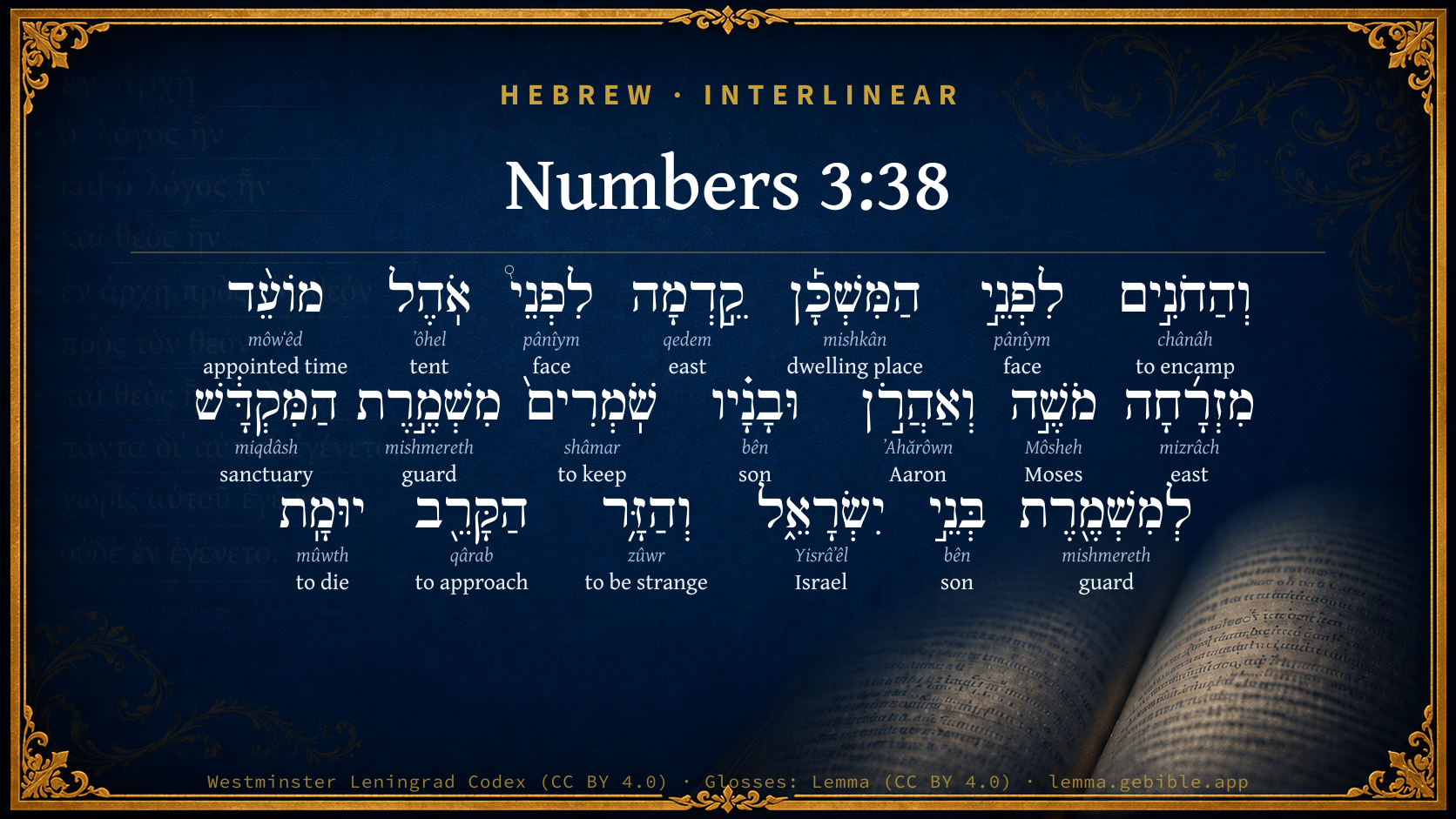
  1. וְהַחֹנִ֣ים chânâh H2583 “and · the · encamping” Conjunction + Particle, Definite Article + Verb, Qal, Participle Active, Masculine, Plural, Absolute
  2. לִפְנֵ֣י pânîym H6440 “to/for · face(s) of” Preposition + Noun, Common, Both, Plural, Construct
  3. הַמִּשְׁכָּ֡ן mishkân H4908 “the · dwelling place” Particle, Definite Article + Noun, Common, Masculine, Singular, Absolute
  4. קֵ֣דְמָה qedem H6924 “east · toward” Noun, Common, Masculine, Singular, Absolute + Suffix, Demonstrative
  5. לִפְנֵי֩ pânîym H6440 “to/for · face(s) of” Preposition + Noun, Common, Both, Plural, Construct
  6. אֹֽהֶל ʼôhel H168 “tent of” Noun, Common, Masculine, Singular, Construct
  7. מוֹעֵ֨ד môwʻêd H4150 “appointed time” Noun, Common, Masculine, Singular, Absolute
  8. מֹשֶׁ֣ה Môsheh H4872 “Moses” Noun, Proper
  9. וְאַהֲרֹ֣ן ʼAhărôwn H175 “and · Aaron” Conjunction + Noun, Proper
  10. וּבָנָ֗יו bên H1121 “and · sons · his” Conjunction + Noun, Common, Masculine, Plural, Construct + Suffix, Personal, 3rd Person, Masculine, Singular
  11. שֹֽׁמְרִים֙ shâmar H8104 “keeping” Verb, Qal, Participle Active, Masculine, Plural, Absolute
  12. מִשְׁמֶ֣רֶת mishmereth H4931 “guard of” Noun, Common, Feminine, Singular, Construct
  13. הַמִּקְדָּ֔שׁ miqdâsh H4720 “the · sanctuary” Particle, Definite Article + Noun, Common, Masculine, Singular, Absolute
  14. לְמִשְׁמֶ֖רֶת mishmereth H4931 “to/for · guard of” Preposition + Noun, Common, Feminine, Singular, Construct
  15. בְּנֵ֣י bên H1121 “sons of” Noun, Common, Masculine, Plural, Construct
  16. יִשְׂרָאֵ֑ל Yisrâʼêl H3478 “Israel” Noun, Proper
  17. וְהַזָּ֥ר zûwr H2114 “and · the · strange” Conjunction + Particle, Definite Article + Adjective, Adjective, Masculine, Singular, Absolute
  18. הַקָּרֵ֖ב qârab H7126 “the · approaching” Particle, Definite Article + Adjective, Adjective, Masculine, Singular, Absolute
  19. יוּמָֽת mûwth H4191 “to die” Verb, Hophal, Imperfect, 3rd Person, Masculine, Singular

About this verse

These counts appear in no published source. They are computed here, from the morphology-tagged text and Lemma’s own curated glosses. What Lemma adds →

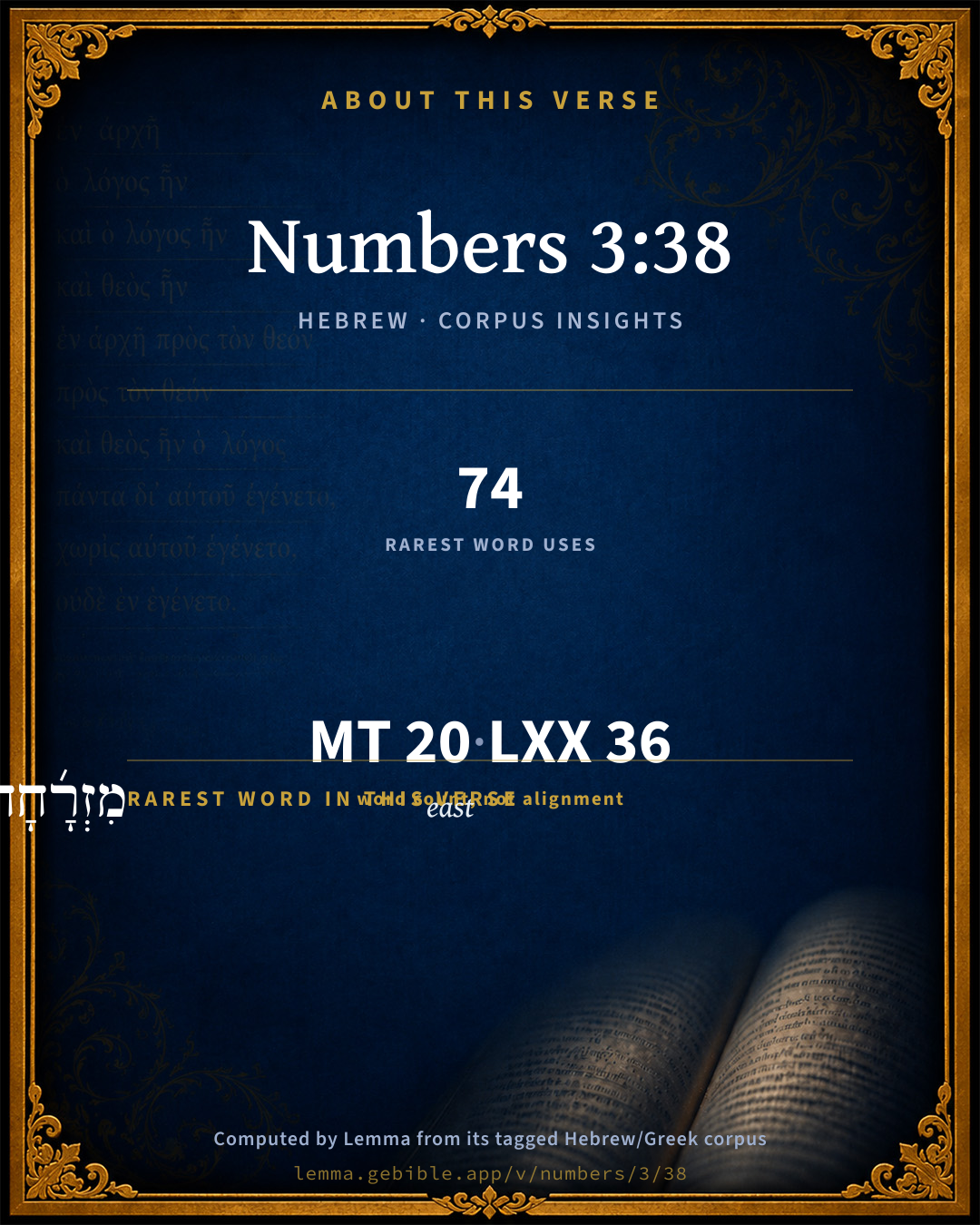
20
words
17
distinct lemmas
Pentateuch
section

Grammatical profile

  • 3 verbs
  • 15 nouns
  • 2 adjectives

Verb forms

  • וְהַחֹנִ֣ים Qal · Participle Active
  • שֹֽׁמְרִים֙ Qal · Participle Active
  • יוּמָֽת Hophal · Imperfect

Repetition

Words recur within this verse — often emphatic in Hebrew:

  • לִפְנֵ֣י face H6440 ×2
  • וּבָנָ֗יו son H1121 ×2
  • מִשְׁמֶ֣רֶת guard H4931 ×2

Hebrew & Septuagint length

In English translation the verse runs 49 words from the Hebrew and 42 from the Septuagint (LXX English) — closely comparable.

A rough comparison of the two English renderings, which tokenize alike — not a word-level alignment.

Word counts can differ between the Hebrew and the Greek without any difference in meaning — e.g. the Hebrew direct-object marker אֵת has no separate Greek word, and Greek often adds the article ὁ.

In the original languages it is 20 Hebrew tokens and 36 Greek tokens — but the two are counted differently (Hebrew bundles its prefixes and suffixes into one token; the Greek is in lemma form), so that isn’t a like-for-like length.

Cross-references

10

Topical passages linked to Numbers 3:38 in the Treasury of Scripture Knowledge — connected by theme and wording, ordered by reader-vote popularity; previews shown in the World English Bible.

  • Numbers 1:53 But the Levites shall encamp around the Tabernacle of the Testimony, that there may be no wrath on the congregation of the children of Israel: and the Levites shall be responsible for the Tabernacle of the Testimony."
  • Numbers 3:10 You shall appoint Aaron and his sons, and they shall keep their priesthood. The stranger who comes near shall be put to death."
  • Numbers 2:3 Those who encamp on the east side toward the sunrise shall be of the standard of the camp of Judah, according to their divisions: and the prince of the children of Judah shall be Nahshon the son of Amminadab.
  • Numbers 1:51 When the tabernacle is to move, the Levites shall take it down; and when the tabernacle is to be set up, the Levites shall set it up. The stranger who comes near shall be put to death.
  • Numbers 3:7–8 They shall keep his charge, and the charge of the whole congregation before the Tent of Meeting, to do the service of the tabernacle.
  • Numbers 3:23 The families of the Gershonites shall encamp behind the tabernacle westward.
  • Numbers 3:29 The families of the sons of Kohath shall encamp on the south side of the tabernacle.
  • Numbers 3:35 The prince of the fathers' house of the families of Merari was Zuriel the son of Abihail. They shall encamp on the north side of the tabernacle.
  • Numbers 18:1–5 Yahweh said to Aaron, You and your sons and your fathers' house with you shall bear the iniquity of the sanctuary; and you and your sons with you shall bear the iniquity of your priesthood.
  • 1 Chronicles 6:48–49 Their brothers the Levites were appointed for all the service of the tent of the house of God.

Cross-references courtesy of OpenBible.info (CC BY 4.0).

Hebrew and Greek witnesses Masoretic Hebrew ↔ Greek Septuagint

The same verse in the two great witnesses to the Old Testament, shown verse-for-verse.

These are two independent witnesses, not word-aligned to each other, and the Septuagint is shown in lemma (dictionary) form.

Hebrew Numbers 3:38 Masoretic · Westminster Leningrad Codex

וְהַחֹנִ֣ים לִפְנֵ֣י הַמִּשְׁכָּ֡ן קֵ֣דְמָה לִפְנֵי֩ אֹֽהֶל מוֹעֵ֨ד מִזְרָ֜חָה מֹשֶׁ֣ה וְאַהֲרֹ֣ן וּבָנָ֗יו שֹֽׁמְרִים֙ מִשְׁמֶ֣רֶת הַמִּקְדָּ֔שׁ לְמִשְׁמֶ֖רֶת בְּנֵ֣י יִשְׂרָאֵ֑ל וְהַזָּ֥ר הַקָּרֵ֖ב יוּמָֽת

Those who encamp before the tabernacle eastward, in front of the Tent of Meeting toward the sunrise, shall be Moses, and Aaron and his sons, keeping the charge of the sanctuary for the charge of the children of Israel. The stranger who comes near shall be put to death.

World English Bible · Public Domain

Greek LXX Numbers 3:38 Septuagint · lemma form

καί ὁ παρα ἐνβάλλω κατά πρόσωπον ὁ σκηνή ὁ μαρτύριον ἀπό ἀνατολή μωυσῆς καί ἀαρών καί ὁ υἱός αὐτός φυλάσσω ὁ φυλακή ὁ ἅγιος εἰς ὁ φυλακή ὁ υἱός ἰσραήλ καί ὁ ἀλλογενής ὁ ἅπτομαι ἀποθνήσκω

They that encamp before the tabernacle of witness on the east shall be Moses and Aaron and his sons, keeping the charges of the sanctuary according to the charges of the children of Israel; and the stranger that touches them, shall die.

LXX2012 (modern English Septuagint) · Public Domain

Hebrew: Westminster Leningrad Codex (CC BY 4.0). Greek: Septuagint (public domain); English from LXX2012 (modern English Septuagint) (Public Domain). How the Septuagint differs from the Hebrew →

Targum (Aramaic paraphrase)

2

The Targum is the ancient Jewish Aramaic paraphrase of the Hebrew Scriptures — an interpretive translation, not the Hebrew text itself. Onkelos (literal) and Pseudo-Jonathan (expansive) render the Torah, and Jonathan the Prophets. Coverage is partial: where no permissively-licensed English translation exists for a verse, only the Aramaic is shown. This is verse-level text, not a word-by-word alignment to the Hebrew.

  1. Targum Onkelos Torah (Genesis–Deuteronomy)
    וְדִי שְׁרַן קֳדָם מַשְׁכְּנָא קִדוּמָא קֳדָם מַשְׁכַּן זִמְנָא מַדִינְחָא משֶׁה וְאַהֲרֹן וּבְנוֹהִי נָטְרִין מַטְרַת מַקְדְשָׁא לְמַטְרַת בְּנֵי יִשְׂרָאֵל וְחִילוֹנַי דְיִקְרַב יִתְקְטֵל

    (no public-domain English translation for this verse)

    Targum Onkelos — Aramaic: “Onkelos Genesis” (public domain); “Onkelos Exodus” (public domain); “Onkelos Leviticus” (public domain); “Onkelos Numbers” (public domain); “Onkelos Deuteronomy” (public domain). English: “Sefaria Community Translation” (CC0 1.0 (public-domain dedication)); “J.W. Etheridge. The Targums of Onkelos and Jonathan Ben Uzziel on the Pentateuch. London: Longmans, Green, 1862” (public domain). Text via Sefaria.

  2. Targum Pseudo-Jonathan Torah (Genesis–Deuteronomy)
    וְדִישְׁרַן קֳדָם מַשְׁכַּן זִמְנָא מַדִינְחָא משֶׁה וְאַהֲרן וּבְנוֹי נַטְרִין מַטְרַת מַקְדְשָׁא לְמַטְרַת בְּנֵי יִשְרָאֵל וְחִילוֹנֵי דְיִקְרַב יִתְקְטֵיל בְּאֵשָׁא מְצַלְהֲבָא מִן קֳדָם יְיָ

    But they who encamp before the tabernacle of ordinance eastward (shall be) Mosheh and Aharon, and his sons; keeping charge of the sanctuary and of Israel; and the stranger who draweth near shall be slain by flaming fire from before the Lord.

    Targum Pseudo-Jonathan — Aramaic: “Targum Jonathan on Genesis” (public domain); “Targum Jonathan on Exodus” (public domain); “Targum Jonathan on Leviticus” (public domain); “Targum Jonathan on Numbers” (public domain); “Targum Jonathan on Deuteronomy” (public domain). English: “The Targum of Jonathan ben Uzziel, trans. J. W. Etheridge, London, 1862” (public domain). Text via Sefaria.

Commentary

Notes on Numbers 3:38 from classic Christian and Jewish commentators (each source and its license shown beneath its notes). The classic Christian expositions comment on the surrounding passage and are grouped to its opening verse, so a note may address several verses; the Jewish commentaries on the Tanakh (Rashi and others) are per-verse, so they appear only where the commentator wrote on this verse.

Lemma curates 59 commentaries, every one of them public domain or Creative Commons licensed, each selected and text-cleaned for this edition rather than reprinted as found. About our sources →

Joseph Benson's Commentary

Num 3:38. For the charge — Either in their stead, that charge which they were obliged to keep, if God had not committed it to those: or for their benefit; for their preservation, as the word may be rendered.

Joseph Benson's Commentary on the Old and New Testaments (1811–1818) — public domain. Text from a community e-Sword module.

Tyndale Open Study Notes

Tyndale Open Resources

3:38 The preeminent campsite east of the Tabernacle was reserved for . . . Moses, Aaron, and his priestly sons.

Tyndale Open Study Notes — © Tyndale Open Resources, licensed CC BY-SA 4.0. Text via the HelloAO Bible API.

Geneva Bible (1599)

Geneva Bible translators

That none should enter into the Tabernacle contrary to God’s appointment.

Geneva Bible (1599) marginal notes — public domain. Text via Bolls.life.

Jamieson, Fausset & Brown

Robert Jamieson, A. R. Fausset & David Brown

those that encamp, &c.--That being the entrance side, it was the post of honor, and consequently reserved to Moses and the priestly family. But the sons of Moses had no station here.

Jamieson, Fausset & Brown — Commentary Critical and Explanatory on the Whole Bible (1871) — public domain (CC PDM 1.0). Text via the HelloAO Bible API.

Ellicott's Commentary for English Readers

(38) Keeping the charge of the sanctuary . . . —The word mikdash (sanctuary) appears to be of a more comprehensive import than mishkan, the shittimwood building, or ohel, the tent which covered it, and it seems to include the court which surrounded the Tabernacle, as in Lev_12:4; Lev_21:12.

For the charge of the children of Israel—i.e., to attend to everything which was commanded the children of Israel.

A Bible Commentary for English Readers, edited by Charles John Ellicott (1878–1897) — public domain. Text from a community e-Sword module.

The Cambridge Bible for Schools and Colleges

gen. ed. J. J. S. Perowne

38. Moses] The mention of his name in a command given to him is strange. It would be still stranger if he were the writer of the passage.

the charge] i.e. that which has to be attended to.

for the charge of the children of Israel] An idiomatic use of ‘for’ confined to late writings. It is virtually equivalent to ‘and.’ (Cf. Num_3:26 ‘for all the service’ with Num_3:31; Num_3:36 ‘and all the service.’) That which had to be attended to for the laity was the offering of sacrifice on the altar in the court.

The Cambridge Bible for Schools and Colleges (gen. ed. J. J. S. Perowne; Cambridge University Press, 1878–1918) — public domain. Text from a community e-Sword module.

John Gill's Exposition

All that were numbered of the Levites, which Moses and Aaron,

numbered at the commandment of the Lord, throughout their families,.... Whence it appears, that Moses was not alone, but Aaron with him, in numbering the Levites, and that by the appointment of the Lord. The word "Aaron", in the Hebrew text, has a dot on every letter, for what reason it is not certain; the word itself is left out in the Samaritan and Syriac versions:

all the males, from a month old and upward, were twenty and two thousand; 22,000 men; but by putting the sums together they amount to three hundred more; for of the Gershonites there were 7,500, and of the Kohathites 8,600, and of the Merarites 6,200, in all 22,300; which difficulty some endeavour to remove by saying, as Aben Ezra observes, that the Scripture takes a short way, mentioning the thousands, and leaving out the hundreds but this, he says, is not right, nor is it the way of the Scripture in this chapter: and in an after account of the firstborn of the Israelites, not only the hundreds are mentioned, but the broken number of seventy three. Others think there is a corruption crept into the text somewhere in the particular numbers, through the inadvertency of some copyist; and suppose it to be in the number of the Kohathites, where they fancy six, is put instead of three: but there is no occasion to suppose either of these, for which there is no foundation, since the reason why three hundred are left out in the sum total may be, because there were so many firstborn among the Levites, and these could not be exchanged for the firstborn of the other tribes; they, as such, being the Lord's, and one firstborn could not redeem another; and so it is said in the Talmud (t), these three hundred were firstborn, and there is no firstborn redeems a firstborn, or frees from the redemption price of five shekels.

(t) T. Bab. Becoroth, fol. 5. 1.

John Gill's Exposition of the Whole Bible (1746–1763) — public domain (CC PDM 1.0). Text via the HelloAO Bible API.

Haydock's Catholic Bible Commentary

Sons, the children of Aaron. Those of Moses were among the Levites, 1 Paralipomenon xxiii. 13. They did not remain with their father. --- In the, &c. Hebrew, "to guard the," &c., in order to supply for the rest of the Israelites, ver. 9. (St. Augustine, q. 4.)

George Leo Haydock (1774–1849), Haydock's Catholic Family Bible and Commentary, 1859 edition — public domain. Excludes Psalms (Douay-Rheims chapter numbering differs from Protestant) and Deuterocanonical books (Catholic canon only).

Matthew Poole's English Annotations

For the charge of the children of Israel; either in their stead. that charge which they were obliged to keep either by themselves. or by others appointed by them, if God had not committed it to those; or for their good, and service, and benefit; for their preservation, as the word may be rendered.

Matthew Poole's English Annotations on the Holy Bible (1683–1685) — public domain. Text from a community e-Sword/MySword module.

The Pulpit Commentary

Before the tabernacle toward the east,... Moses, and Aaron and his sons. The most central and honourable place in the camp, and the most convenient for constant and direct access to the sanctuary. Moses held a wholly personal and exceptional position as king in Jeshurun; (Deu_33:5) Aaron was hereditary high priest. Between them they represented the union of royal and sacerdotal authority, which had many partial continuations in Jewish history, but was fully realized in Christ.

The Pulpit Commentary (1880–1919), ed. H.D.M. Spence-Jones & Joseph S. Exell — public domain. Text from a community e-Sword module.

John Wesley's Explanatory Notes

For the charge - Either in their stead, that charge which they were obliged to keep, if God had not committed it to those: or for their benefit; for their preservation, as the word may be rendered.

John Wesley, Explanatory Notes Upon the Whole Bible (1754–1765) — public domain. Text via the GEBible commentary corpus.

Keil & Delitzsch

C. F. Keil & F. Delitzsch

Moses and Aaron, with the sons of the latter (the priests), were to encamp in front, before the tabernacle, viz., on the eastern side, "as keepers of the charge of the sanctuary for the charge of the children of Israel," i.e., to attend to everything that was binding upon the children of Israel in relation to the care of the sanctuary, as no stranger was allowed to approach it on pain of death (see Num 1:51).

Num 3:39

The number of the Levites mustered, 22,000, does not agree with the numbers assigned to the three families, as 7500 + 8600 + 6200 = 22,300. But the total is correct; for, according to Num 3:46, the number of the first-born, 22,273, exceeded the total number of the Levites by 273. The attempt made by the Rabbins and others to reconcile the two, by supposing the 300 Levites in excess to be themselves first-born, who were omitted in the general muster, because they were not qualified to represent the first-born of the other tribes, is evidently forced and unsatisfactory. The whole account is so circumstantial, that such a fact as this would never have been omitted. We must rather assume that there is a copyist's error in the number of one of the Levitical families; possibly in Num 3:28 we should read שׁלשׁ for שׁשׁ (8300 for 8600). The puncta extraordinaria above ואהרן are intended to indicate that this word is either suspicious or spurious (see at Gen 33:5); and it is actually omitted in Sam., Syr., and 12 MSS, but without sufficient reason: for although the divine command to muster the Levites (Num 3:5 and Num 3:14) was addressed to Moses alone, yet if we compare Num 4:1, Num 4:34, Num 4:37, Num 4:41, Num 4:45, where the Levites qualified for service are said to have been mustered by Moses and Aaron, and still more Num 4:46, where the elders of Israel are said to have taken part in the numbering of the Levites as well as in that of the twelve tribes (Num 1:3-4), there can be no reason to doubt that Aaron also took part in the mustering of the whole of the Levites, for the purpose of adoption in the place of the first-born of Israel; and no suspicion attaches to this introduction of his name in Num 3:39, although it is not mentioned in Num 3:5, Num 3:11, Num 3:14, Num 3:40, and Num 3:44.

Keil & Delitzsch — Biblical Commentary on the Old Testament (1861–1891) — public domain (CC PDM 1.0). Text via the HelloAO Bible API. (Old Testament only.)

Kretzmann's Popular Commentary

Paul E. Kretzmann

final regulations

v. 38. But those that encamp before the Tabernacle toward the east, even before the Tabernacle of the Congregation eastward, for its entrance was on that side, shall be Moses, and Aaron and his sons, keeping the charge of the Sanctuary for the charge of the children of Israel, performing the duties of the priesthood for all the children of Israel; and the stranger that cometh nigh shall be put to death, v. 10.

v. 39. All that were numbered of the Levites which Moses and Aaron numbered at the commandment of the Lord, throughout their families, all the males from a month old and upward, were twenty and two thousand, in round numbers, the exact figure being 22,300, or the three hundred were subtracted, as the Jews say, because they themselves were first-born and could therefore not be used in a comparison with the other tribes.

v. 40. And the Lord said unto Moses, Number all the first-born of the males of the children of Israel from a month old and upward, and take the number of their names.

v. 41. And thou shalt take the Levites for Me (I am the Lord) instead of all the first-born among the children of Israel, as their substitutes in the service of the Sanctuary; and the cattle of the Levites instead of all the firstlings among the cattle of the children of Israel, to be consecrated to the Lord and by Him designated for the use of the Levites.

v. 42. And Moses numbered, as the Lord commanded him, all the first-born among the children of Israel.

v. 43. And all the first-born males by the number of names, from a month old and upward, of those that were numbered of them, were twenty and two thousand two hundred and threescore and thirteen (22,273).

v. 44. And the Lord spake unto Moses, saying,

v. 45. Take the Levites instead of all the first-born among the children of Israel and the cattle of the Levites instead of their cattle; and the Levites shall be Mine. I am the Lord.

v. 46. And for those that are to be redeemed of the two hundred and threescore and thirteen of the first-born of the children of Israel, which are more than the Levites;

v. 47. thou shalt even take five shekels apiece by the poll (about $3. 20), after the shekel of the Sanctuary shalt thou take them, this being the standard of weight; (the shekel is twenty gerahs;)

v. 48. and thou shalt give the money wherewith the odd, the surplus, number of them is to be redeemed unto Aaron and to his sons, as ransom money.

v. 49. And Moses took the redemption money of them that were over and above them that were redeemed by the Levites, the 22,000 that were ransomed by the equal number of the Levites;

v. 50. of the first-born of the children of Israel took he the money; a thousand three hundred and threescore and five shekels, after the shekel of the Sanctuary (1,365 shekels being about equal to $4,368);

v. 51. and Moses gave the money of them that were redeemed unto Aaron and to his sons, according to the word of the Lord, as the Lord commanded Moses. Although the men in the service of the ministry of the Word in the New Testament are supported by voluntary gifts, these gifts, for all of that, should not be less plentiful than were those under the Law.

Paul E. Kretzmann, Popular Commentary of the Bible (1921–1924) — public domain. Text from a community e-Sword module.

unfoldingWord translationNotes

Door43 World Missions Community

his sons

Here "his" refers to Aaron

toward the sunrise

This is the east side of the tabernacle. AT: "on the east side, where the sun rises" (See: Assumed Knowledge and Implicit Information)

for the fulfillment of the duties

The word "fulfilment" is an abstract noun that can be expressed as a verb. AT: "to perform the duties" (See: Abstract Nouns)

Any foreigner who approaches the sanctuary must be put to death

This can be stated in active form. AT: "You must kill any foreigner who approaches the sanctuary" or "Any foreigner who approaches the sanctuary must die" (See: Active or Passive)

twenty-two thousand men

"22,000 men" or "22,000 males" (See: Numbers)

translationWords

Moses

Aaron

tent of meeting

fulfill

sanctuary

Israel

alien

die

clan

Levi

Yahweh

command

unfoldingWord translationNotes — © Distant Shores Media and the Door43 World Missions Community, licensed CC BY-SA 4.0. Source: git.door43.org/Door43/en_tn.

Rashi

Rabbi Shlomo Yitzchaki (Rashi)

משה ואהרן ובניו [BUT THOSE THAT ENCAMP BEFORE THE DWELLING … SHALL BE] MOSES, AND AARON AND HIS SONS — and adjacent to him was the standard of the camp of Judah, and next to the latter were encamped Issachar and Zebulun — “Well is it with the righteous, well with his neighbour!” Because they (the sons of Judah, Issachar and Zebulun) were the neighbours of Moses who occupied himself with the Torah, they themselves became eminent scholars in the Law, as it is said, (Psalms 60:9) “Judah is my lawgiver”; (I Chronicles 12:32) “and of the children of Issachar which were men that had understanding of the times to know what Israel had to do [the heads of them were two hundred]” — i.e., two hundred heads of the Sanhedrin; and (Judges 5:14) “and out of Zebulun came those that handle the pen of the writer” (Midrash Tanchuma, Bamidbar 12).

Rashi on the Tanakh — English translations: “The Judaica Press complete Tanach with Rashi, translated by A. J. Rosenberg” (CC BY 4.0); “Pentateuch with Rashi's commentary by M. Rosenbaum and A.M. Silbermann, 1929-1934” (public domain); “The Metsudah Tanach series, Lakewood, N.J” (CC BY 4.0); and “The Book of Joshua, Metsudah Publications, 1997” (CC BY 4.0). Text via Sefaria.

Lesson kit

Teaching starters — assembled from the data on this page, not authored interpretation. Every prompt links to the verse data it draws on. Edit before teaching.

Numbers, in the Pentateuch, opens this verse with 20 words (17 distinct Hebrew lemmas). Its most distinctive word is mizrâch (“east”). A historical commentator’s framing appears above. Read the whole chapter for the surrounding context.

Discussion questions

  1. How does “east” (mizrâch) shape what this verse is saying?
  2. Numbers 1:53 shares this passage’s theme. How do the two illuminate each other?
  3. “face” occurs 2× in this one verse. What is the effect of the repetition?
  4. These translations render this verse differently. What is at stake in choosing one wording over another?
  5. The verb «וְהַחֹנִ֣ים» is Qal Participle Active. How does its form color the action?
  6. Reading how Joseph Benson's Commentary and Tyndale Open Study Notes read this verse, where do the two commentators agree and where do they part?

Things to notice

Reading settings

Reading text

Shown beneath each verse's original-language words.

Old Testament
Old Testament edition

Read the OT as the Masoretic Hebrew (MT) or the Greek Septuagint (LXX).

English shown for the Greek Septuagint (in the Hebrew ↔ Greek comparison).

Comparing translations? Open the Compare panel on any verse page to stack up to four side by side.