
Genesis 50:15

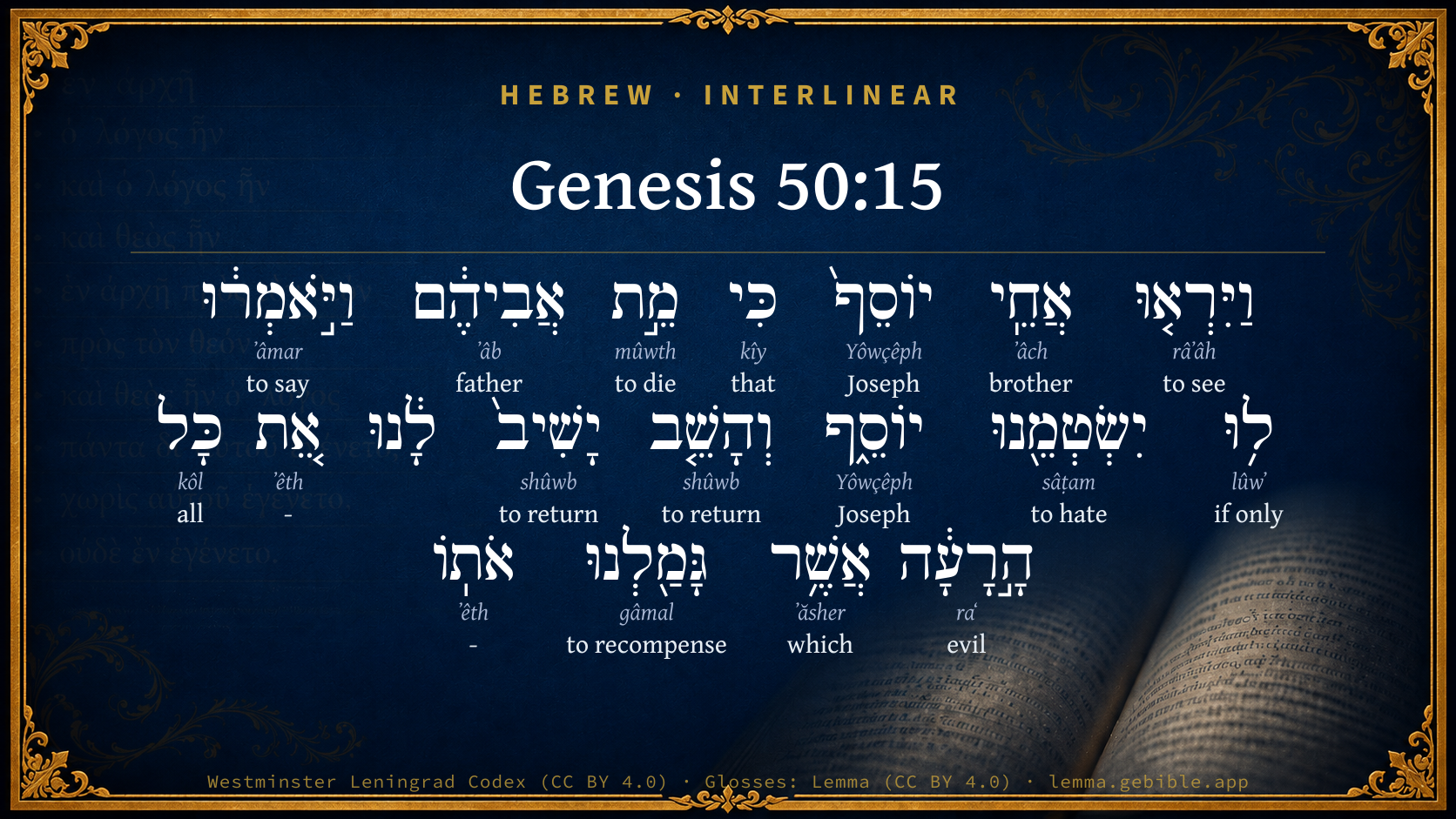
Hebrew (Westminster Leningrad Codex) Genesis 50:15 appears in the Hebrew Old Testament. The text above is from the Westminster Leningrad Codex. Each word links to its Strong’s number, a concise gloss, and parsing drawn from the Open Scriptures Hebrew Bible morphology. Click any word for its full Brown-Driver-Briggs (BDB) entry.
Download image
Cite this verse

Genesis 50:15 (World English Bible). Public Domain. Lemma interlinear Bible study tool, https://lemma.gebible.app/v/genesis/50/15.

Show BibTeX & RIS
BibTeX
RIS
English Translation
When Joseph's brothers saw that their father was dead, they said, "It may be that Joseph will hate us, and will fully pay us back for all of the evil which we did to him.
World English Bible · Public Domain
Download a study sheet

One document with this verse’s original text, its word-by-word gloss line, the meaning frame, cross-references with their text, attributed commentary, and full source and license credits — printable, and it pastes into notes with its structure intact.

This verse Autodidact and up

Study sheet (.html) Plain text (.txt)

A passage Seminary Student

Up to 50 verses in one chapter. A passage sheet keeps up to 6 commentary sources and 12 cross-references per verse, in the order this page ranks them, and says so on the sheet whenever that leaves anything out. Ask for a single verse and you get the Autodidact verse sheet above.

Everything on this page stays free to read, with no account — the sheet is a download of what is already on screen, not access to it.

Want to remove ads? Support Godless Engineer
Compare translations 3

The same verse in 3 English versions, stacked beneath the original-language interlinear above. Click any original word for its lexicon entry.

Each is an independent rendering of the whole verse — the interlinear is not word-aligned to these translations.

Highlighted words mark where these versions differ — a whole-verse word diff, not a word-by-word alignment.

  • World English Bible Public Domain
    When Joseph's brothers saw that their father was dead, they said, "It may be that Joseph will hate us, and will fully pay us back for all of the evil which we did to him.
  • King James Version Public Domain
    And when Joseph's brethren saw that their father was dead, they said, Joseph will peradventure hate us, and will certainly requite us all the evil which we did unto him.
  • unfoldingWord Literal Text CC BY-SA 4.0
    And the brothers of Joseph saw that their father was dead, and they said, “What if Joseph hates us? Then he will surely repay us all the evil that we did to him!”

unfoldingWord Literal Text — © unfoldingWord, licensed CC BY-SA 4.0. Word-aligned USFM3 via Door43 (git.door43.org/unfoldingWord/en_ult).

Versions to compare (up to 4)

3 of 4 selected

Show all 18 translations

Every available English version of this verse, each an independent rendering of the whole verse.

  • World English Bible Public Domain
    When Joseph's brothers saw that their father was dead, they said, "It may be that Joseph will hate us, and will fully pay us back for all of the evil which we did to him.
  • Berean Standard Bible Public Domain
    When Joseph’s brothers saw that their father was dead, they said, “What if Joseph bears a grudge? Then he will surely repay us for all the evil that we did to him.”
  • Majority Standard Bible Public Domain
    When Joseph’s brothers saw that their father was dead, they said, “What if Joseph bears a grudge? Then he will surely repay us for all the evil that we did to him.”
  • King James Version Public Domain
    And when Joseph's brethren saw that their father was dead, they said, Joseph will peradventure hate us, and will certainly requite us all the evil which we did unto him.
  • American Standard Version (1901) Public Domain
    And when Joseph's brethren saw that their father was dead, they said, It may be that Joseph will hate us, and will fully requite us all the evil which we did unto him.
  • Revised Version (1885) Public Domain
    And when Joseph’s brethren saw that their father was dead, they said, It may be that Joseph will hate us, and will fully requite us all the evil which we did unto him.
  • Geneva Bible (1599) Public Domain
    And when Iosephs brethren saw that their father was dead, they sayde, It may be that Ioseph will hate vs, and will pay vs againe all the euill, which we did vnto him.
  • Douay-Rheims (1899) Public Domain
    Now he being dead, his brethren were afraid, and talked one with another: Lest perhaps he should remember the wrong he suffered, and requite us all the evil that we did to him.
  • Young's Literal Translation Public Domain
    And the brethren of Joseph see that their father is dead, and say, `Peradventure Joseph doth hate us, and doth certainly return to us all the evil which we did with him.'
  • Literal Standard Version CC BY-SA 4.0
    And the brothers of Joseph see that their father is dead, and say, “Perhaps Joseph hates us, and certainly returns to us all the evil which we did with him.”
  • Unlocked Literal Bible CC BY-SA 4.0
    When Joseph's brothers saw that their father was dead, they said, “What if Joseph holds on to anger against us and wants to repay us in full for all the evil we did to him?”
  • unfoldingWord Literal Text CC BY-SA 4.0
    And the brothers of Joseph saw that their father was dead, and they said, “What if Joseph hates us? Then he will surely repay us all the evil that we did to him!”
  • Darby Bible Public Domain
    And when Joseph's brethren saw that their father was dead, they said, If now Joseph should be hostile to us, and should indeed requite us all the evil that we did to him!
  • World Messianic Bible Public Domain
    When Joseph’s brothers saw that their father was dead, they said, “It may be that Joseph will hate us, and will fully pay us back for all the evil which we did to him.”
  • Webster's Bible Public Domain
    And when Joseph's brethren saw that their father was dead, they said, Joseph will perhaps hate us, and will certainly requite us all the evil which we did to him.
  • Free Bible Version CC BY-SA 4.0
    However, now that their father was dead, Joseph's brothers became worried, saying, “Maybe Joseph is holding a grudge against us, and he'll pay us back for all the bad things we did to him.”
  • Bible in Basic English Public Domain
    Now after the death of their father, Joseph's brothers said to themselves, It may be that Joseph's heart will be turned against us, and he will give us punishment for all the evil which we did to him.
  • JPS Tanakh (1917) Public Domain
    And when Joseph's brethren saw that their father was dead, they said: 'It may be that Joseph will hate us, and will fully requite us all the evil which we did unto him.'

Literal Standard Version (2020), Covenant Press — licensed CC BY-SA 4.0. Text via the HelloAO Bible API (eBible.org). Unlocked Literal Bible (unfoldingWord) — licensed CC BY-SA 4.0. Text via the HelloAO Bible API (eBible.org). unfoldingWord Literal Text — © unfoldingWord, licensed CC BY-SA 4.0. Word-aligned USFM3 via Door43 (git.door43.org/unfoldingWord/en_ult). Free Bible Version, Dr. Jonathan Gallagher — licensed CC BY-SA 4.0. Text via the HelloAO Bible API (eBible.org).

Word by word

More ways to search: Search by grammar → Find every occurrence → Compare this word →

Practice this passage: Drill this verse → Learn its vocabulary →

יִשְׂטְמֵ֖נוּ
sâṭam
H7852
“to hate · us”
Verb, Qal, Imperfect, 3rd Person, Masculine, Singular + Suffix, Personal, 1st Person, Common, Plural
Part of Speech
Verb
Stem
Qal
Form
Imperfect
Person
3rd Person
Gender
Masculine
Number
Singular
Full BDB Definition

Origin: a primitive root

TWOT: 2251

to hate, oppose oneself to, bear a grudge, retain animosity against, cherish animosity against - (Qal) to cherish animosity against
  1. וַיִּרְא֤וּ râʼâh H7200 “and · to see” Conjunction + Verb, Qal, Sequential Imperfect, 3rd Person, Masculine, Plural
  2. אֲחֵֽי ʼâch H251 “brothers of” Noun, Common, Masculine, Plural, Construct
  3. יוֹסֵף֙ Yôwçêph H3130 “Joseph” Noun, Proper
  4. כִּי kîy H3588 “that” Conjunction
  5. מֵ֣ת mûwth H4191 “to die” Verb, Qal, Perfect, 3rd Person, Masculine, Singular
  6. אֲבִיהֶ֔ם ʼâb H1 “father · their” Noun, Common, Masculine, Singular, Construct + Suffix, Personal, 3rd Person, Masculine, Plural
  7. וַיֹּ֣אמְר֔וּ ʼâmar H559 “and · to say” Conjunction + Verb, Qal, Sequential Imperfect, 3rd Person, Masculine, Plural
  8. ל֥וּ lûwʼ H3863 “if only” Conjunction
  9. יוֹסֵ֑ף Yôwçêph H3130 “Joseph” Noun, Proper
  10. וְהָשֵׁ֤ב shûwb H7725 “and · to return” Conjunction + Verb, Hiphil, Infinitive Absolute
  11. יָשִׁיב֙ shûwb H7725 “to return” Verb, Hiphil, Imperfect, 3rd Person, Masculine, Singular
  12. אֵ֚ת ʼêth H853 “-” Particle, Direct Object
  13. כָּל kôl H3605 “all of” Noun, Common, Masculine, Singular, Construct
  14. הָ֣רָעָ֔ה raʻ H7451 “the · evil” Particle, Definite Article + Noun, Common, Feminine, Singular, Absolute
  15. אֲשֶׁ֥ר ʼăsher H834 “which” Particle, Relative
  16. גָּמַ֖לְנוּ gâmal H1580 “to recompense” Verb, Qal, Perfect, 1st Person, Common, Plural
  17. אֹתֽוֹ ʼêth H853 “- · him” Particle, Direct Object + Suffix, Personal, 3rd Person, Masculine, Singular

About this verse

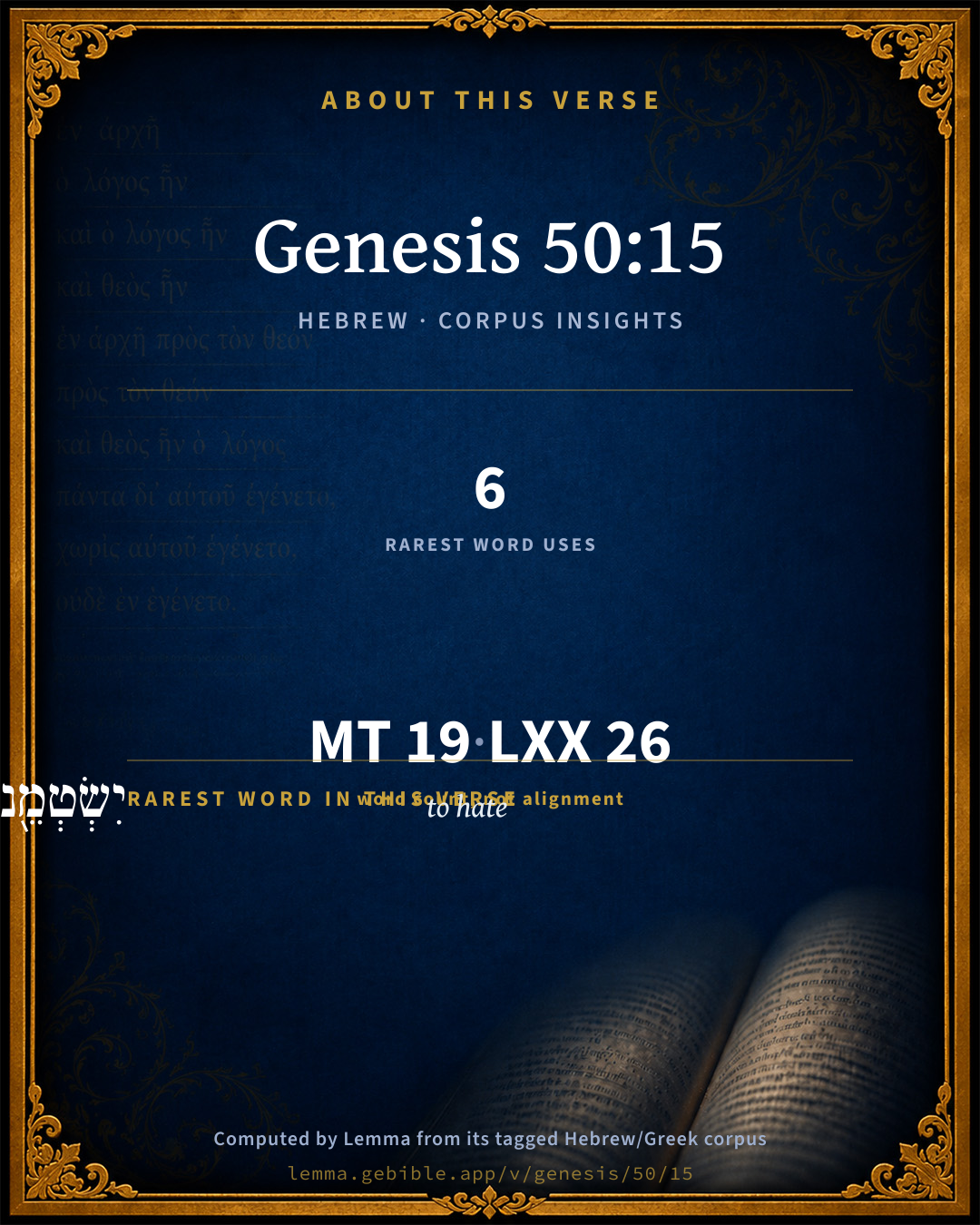
These counts appear in no published source. They are computed here, from the morphology-tagged text and Lemma’s own curated glosses. What Lemma adds →

19
words
15
distinct lemmas
Pentateuch
section

Notable vocabulary

The rarest word here is יִשְׂטְמֵ֖נוּ to hate H7852 — appearing just 6 times in the whole Hebrew Bible.

Shared distinctive vocabulary

יִשְׂטְמֵ֖נוּ to hate H7852 occurs in 6 verses of the Hebrew Bible. Also found in:

Grammatical profile

  • 7 verbs
  • 6 nouns
  • 1 preposition
  • 2 conjunctions
  • 3 particles

Verb forms

  • וַיִּרְא֤וּ Qal · Sequential Imperfect
  • מֵ֣ת Qal · Perfect
  • וַיֹּ֣אמְר֔וּ Qal · Sequential Imperfect
  • יִשְׂטְמֵ֖נוּ Qal · Imperfect
  • וְהָשֵׁ֤ב Hiphil · Infinitive Absolute
  • יָשִׁיב֙ Hiphil · Imperfect
  • גָּמַ֖לְנוּ Qal · Perfect

Repetition

Words recur within this verse — often emphatic in Hebrew:

  • יוֹסֵף֙ Joseph H3130 ×2
  • וְהָשֵׁ֤ב to return H7725 ×2

Hebrew & Septuagint length

In English translation the verse runs 35 words from the Hebrew and 40 from the Septuagint (LXX English) — closely comparable.

A rough comparison of the two English renderings, which tokenize alike — not a word-level alignment.

Word counts can differ between the Hebrew and the Greek without any difference in meaning — e.g. the Hebrew direct-object marker אֵת has no separate Greek word, and Greek often adds the article ὁ.

In the original languages it is 19 Hebrew tokens and 26 Greek tokens — but the two are counted differently (Hebrew bundles its prefixes and suffixes into one token; the Greek is in lemma form), so that isn’t a like-for-like length.

Cross-references

10

Topical passages linked to Genesis 50:15 in the Treasury of Scripture Knowledge — connected by theme and wording, ordered by reader-vote popularity; previews shown in the World English Bible.

  • Proverbs 28:1 The wicked flee when no one pursues; But the righteous are as bold as a lion.
  • Genesis 27:41–42 Esau hated Jacob because of the blessing with which his father blessed him. Esau said in his heart, "The days of mourning for my father are at hand. Then I will kill my brother Jacob."
  • Genesis 42:21–22 They said one to another, "We are most assuredly guilty concerning our brother, in that we saw the distress of his soul, when he begged us, and we wouldn't listen. Therefore this distress has come on us."
  • Leviticus 26:36 "'As for those of you who are left, I will send a faintness into their hearts in the lands of their enemies: and the sound of a driven leaf will put them to flight; and they shall flee, as one flees from the sword; and they will fall when no one pursues.
  • Job 15:21–22 A sound of terrors is in his ears; In prosperity the destroyer shall come on him.
  • Psalms 14:5 There they were in great fear, For God is in the generation of the righteous.
  • Psalms 53:5 There they were in great fear, where no fear was, For God has scattered the bones of him who encamps against you. You have put them to shame, Because God has rejected them.
  • Genesis 37:28 Midianites who were merchants passed by, and they drew and lifted up Joseph out of the pit, and sold Joseph to the Ishmaelites for twenty pieces of silver. They brought Joseph into Egypt.
  • Genesis 42:17 He put them all together into custody three days.
  • Romans 2:15 in that they show the work of the law written in their hearts, their conscience testifying with them, and their thoughts among themselves accusing or else excusing them)

Cross-references courtesy of OpenBible.info (CC BY 4.0).

Hebrew and Greek witnesses Masoretic Hebrew ↔ Greek Septuagint

The same verse in the two great witnesses to the Old Testament, shown verse-for-verse.

These are two independent witnesses, not word-aligned to each other, and the Septuagint is shown in lemma (dictionary) form.

Hebrew Genesis 50:15 Masoretic · Westminster Leningrad Codex

וַיִּרְא֤וּ אֲחֵֽי יוֹסֵף֙ כִּי מֵ֣ת אֲבִיהֶ֔ם וַיֹּ֣אמְר֔וּ ל֥וּ יִשְׂטְמֵ֖נוּ יוֹסֵ֑ף וְהָשֵׁ֤ב יָשִׁיב֙ לָ֔נוּ אֵ֚ת כָּל הָ֣רָעָ֔ה אֲשֶׁ֥ר גָּמַ֖לְנוּ אֹתֽוֹ

When Joseph's brothers saw that their father was dead, they said, "It may be that Joseph will hate us, and will fully pay us back for all of the evil which we did to him.

World English Bible · Public Domain

Greek LXX Genesis 50:15 Septuagint · lemma form

ὁράω δέ ὁ ἀδελφός ιωσηφ ὅτι θνήσκω ὁ πατήρ αὐτός εἶπον μήποτε μνησικακέω ἐγώ ιωσηφ καί ἀνταπόδομα ἀντι ἀποδίδωμι ἐγώ πᾶς ὁ κακός ὅς ἐνδεικνύω αὐτός

And when the brethren of Joseph saw that their father was dead, they said, Let us take heed, lest at any time Joseph remember evil against us, and recompense to us all the evils which we have done against him.

LXX2012 (modern English Septuagint) · Public Domain

On this verse, The Cambridge Bible for Schools and Colleges discusses the Septuagint’s reading. Read the note in Commentary ↓

Hebrew: Westminster Leningrad Codex (CC BY 4.0). Greek: Septuagint (public domain); English from LXX2012 (modern English Septuagint) (Public Domain). How the Septuagint differs from the Hebrew →

Targum (Aramaic paraphrase)

2

The Targum is the ancient Jewish Aramaic paraphrase of the Hebrew Scriptures — an interpretive translation, not the Hebrew text itself. Onkelos (literal) and Pseudo-Jonathan (expansive) render the Torah, and Jonathan the Prophets. Coverage is partial: where no permissively-licensed English translation exists for a verse, only the Aramaic is shown. This is verse-level text, not a word-by-word alignment to the Hebrew.

  1. Targum Onkelos Torah (Genesis–Deuteronomy)
    וַחֲזוֹ אֲחֵי יוֹסֵף אֲרֵי מִית אֲבוּהוֹן וַאֲמָרוּ דִּלְמָא יִטַּר לָנָא דְבָבוּ יוֹסֵף וְאֲתָבָא יָתֵיב לָנָא יָת כָּל בִּישְׁתָא דִי גְמַלְנָא יָתֵהּ

    (no public-domain English translation for this verse)

    Targum Onkelos — Aramaic: “Onkelos Genesis” (public domain); “Onkelos Exodus” (public domain); “Onkelos Leviticus” (public domain); “Onkelos Numbers” (public domain); “Onkelos Deuteronomy” (public domain). English: “Sefaria Community Translation” (CC0 1.0 (public-domain dedication)); “J.W. Etheridge. The Targums of Onkelos and Jonathan Ben Uzziel on the Pentateuch. London: Longmans, Green, 1862” (public domain). Text via Sefaria.

  2. Targum Pseudo-Jonathan Torah (Genesis–Deuteronomy)
    וְחָמוּ אֲחֵי יוֹסֵף אֲרוּם מַיִית אֲבוּהוֹן וְלָא הֲוָה מִסְתְּחַר עִמְהוֹן כַּחֲדָא לְמֵיכוּל לַחֲדָא וַאֲמַרוּ מַה דִילְמָא נָטַר לָנָא סָנָא יוֹסֵף וַאֲתָבָא יָתֵיב לָנָא יַת כָּל בִּישָׁא דִגְמַלְנָא יָתֵיהּ

    And Joseph's brethren saw that their father was dead, and that he (Joseph) did not return to eat together with them, and they said, Perhaps Joseph ill bring upon us all retaineth enmity against us, and will bring upon us all the evil that we did him.

    Targum Pseudo-Jonathan — Aramaic: “Targum Jonathan on Genesis” (public domain); “Targum Jonathan on Exodus” (public domain); “Targum Jonathan on Leviticus” (public domain); “Targum Jonathan on Numbers” (public domain); “Targum Jonathan on Deuteronomy” (public domain). English: “The Targum of Jonathan ben Uzziel, trans. J. W. Etheridge, London, 1862” (public domain). Text via Sefaria.

Commentary

Notes on Genesis 50:15 from classic Christian and Jewish commentators (each source and its license shown beneath its notes). The classic Christian expositions comment on the surrounding passage and are grouped to its opening verse, so a note may address several verses; the Jewish commentaries on the Tanakh (Rashi and others) are per-verse, so they appear only where the commentator wrote on this verse.

Lemma curates 59 commentaries, every one of them public domain or Creative Commons licensed, each selected and text-cleaned for this edition rather than reprinted as found. About our sources →

Matthew Henry's Commentary

We have here the settling of a good correspondence between Joseph and his brethren, now that their father was dead. Joseph was at court, in the royal city; his brethren were in Goshen, remote in the country; yet the keeping up of a good understanding, and a good affection, between them, would be both his honour and their interest. Note, When Providence has removed the parents by death, the best methods ought to be taken, not only for the preventing of quarrels among the children (which often happen about the dividing of the estate), but for the preserving of acquaintance and love, that unity may continue even when that centre of unity is taken away.

I. Joseph's brethren humbly make their court to him for his favour. 1. They began to be jealous of Joseph, not that he had given them any cause to be so, but the consciousness of guilt, and of their own inability in such a case to forgive and forget, made them suspicious of the sincerity and constancy of Joseph's favour (Gen 50:15): Joseph will peradventure hate us. While their father lived, they thought themselves safe under his shadow; but now that he was dead they feared the worst from Joseph. Note, A guilty conscience exposes men to continual frights, even where no fear is, and makes them suspicious of every body, as Cain, Gen 4:14. Those that would be fearless must keep themselves guiltless. If our heart reproach us not, then have we confidence both towards God and man. 2. They humbled themselves before him, confessed their fault, and begged his pardon. They did it by proxy (Gen 50:17); they did it in person, Gen 50:18. Now that the sun and moon had set, the eleven stars did homage to Joseph, for the further accomplishment of his dream. They speak of their former offence with fresh regret: Forgive the trespass. They throw themselves at Joseph's feet, and refer themselves to his mercy: We are thy servants. Thus we must bewail the sins we committed long ago, even those which we hope through grace are forgiven; and, when we pray to God for pardon, we must promise to be his servants. 3. They pleaded their relation to Jacob and to Jacob's God. (1.) To Jacob, urging that he directed them to make this submission, rather because he questioned whether they would do their duty in humbling themselves than because he questioned whether Joseph would do his duty in forgiving them; nor could he reasonably expect Joseph's kindness to them unless they thus qualified themselves for it (Gen 50:16): Thy father did command. Thus, in humbling ourselves to Christ by faith and repentance, we may plead that it is the command of his Father, and our Father, that we do so. (2.) To Jacob's God. They plead (Gen 50:17), We are theservants of the God of thy father; not only children of the same Jacob, but worshippers of the same Jehovah. Note, Though we must be ready to forgive all that are any way injurious to us, yet we must especially take heed of bearing malice towards any that are the servants of the God of our father: such we should always treat with a peculiar tenderness; for we and they have the same Master.

II. Joseph, with a great deal of compassion, confirms his reconciliation and affection to them; his compassion appears, Gen 50:17. He wept when they spoke to him. These were tears of sorrow for their suspicion of him, and tears of tenderness upon their submission. In his reply, 1. He directs them to look up to God in their repentance (Gen 50:19): Am I in the place of God? He, in his great humility, thought they showed him too much respect, as if all their happiness were bound up in his favour, and said to them, in effect, as Peter to Cornelius, "Stand up, I myself also am a man. Make your peace with God, and then you will find it an easy matter to make your peace with me." Note, When we ask forgiveness of those whom we have offended we must take heed of putting them in the place of God, by dreading their wrath and soliciting their favour more than God's. "Am I in the place of God, to whom alone vengeance belongs? No, I will leave you to his mercy." Those that avenge themselves step into the place of God, Rom 12:19. 2. He extenuates their fault, from the consideration of the great good which God wonderfully brought out of it, which, though it should not make them the less sorry for their sin, yet might make him the more willing to forgive it (Gen 50:20): You thought evil (to disappoint the dreams), but God meant it unto good, in order to the fulfilling of the dreams, and the making of Joseph a greater blessing to his family than otherwise he could have been. Note, When God makes use of men's agency for the performance of his counsels, it is common for him to mean one thing and them another, even the quite contrary, but God's counsel shall stand. See Isa 10:7. Again, God often brings good out of evil, and promotes the designs of his providence even by the sins of men; not that he is the author of sin, far be it from us to think so; but his infinite wisdom so overrules events, and directs the chain of them, that, in the issue, that ends in his praise which in its own nature had a direct tendency to his dishonour; as the putting of Christ to death, Act 2:23. This does not make sin the less sinful, nor sinners the less punishable, but it redounds greatly to the glory of God's wisdom. 3. He assures them of the continuance of his kindness to them: Fear not; I will nourish you, Gen 50:21. See what an excellent spirit Joseph was of, and learn of him to render good for evil. He did not tell them they were upon their good behaviour, and he would be kind to them if he saw they conducted themselves well; no, he would not thus hold them in suspense, nor seem jealous of them, though they had been suspicious of him: He comforted them, and, to banish all their fears, he spoke kindly to them. Note, Broken spirits must be bound up and encouraged. Those we love and forgive we must not only do well for but speak kindly to.

Matthew Henry's Commentary on the Whole Bible (1708–1710) — public domain (CC PDM 1.0). Text via the HelloAO Bible API.

Trapp's Complete Commentary

John Trapp

Gen 50:15 And when Joseph’s brethren saw that their father was dead, they said, Joseph will peradventure hate us, and will certainly requite us all the evil which we did unto him.

Ver. 15. Joseph will peradventure hate us.] An ill conscience, we are sure, still haunts them as a hell-hag, and fills them with unquestionable conviction and horror. Better be langold [tied] to a lion than to an unquiet conscience. {See Trapp on "Gen 4:14"} {See Trapp on "Gen 42:21"} Such take no more rest than one upon a rack or bed of thorns. There were not many to kill Cain besides his father and his mother, and yet he cries, "Every one that finds me," &c.

John Trapp, A Commentary or Exposition upon All the Books of the Old and New Testament (1647–1656) — public domain. Text from a community e-Sword module.

The Biblical Illustrator

Joseph S. Exell

Gen_50:15-19

Forgive

The message of his brethren to Joseph:

The death of great characters being often followed by great changes; conscious guilt being always alive to fear; and the chasm which succeeds a funeral, inviting a flood of foreboding apprehensions, they find out a new source of trouble.

But how can they disclose their suspicions? To have done it personally would have been too much for either him or them to bear, let him take it as he might. So they sent messengers unto him, to sound him. We know not who they were; but if Benjamin were one of them, it was no more than might be expected. Mark the delicacy and exquisite tenderness of the message. Nothing is said of their suspicions, only that the petition implies them; yet it is expressed in such a manner as cannot offend, but must needs melt the heart of Joseph, even though he had been possessed of less affection than he was.

1. They introduce themselves as acting under the direction of a mediator, and this mediator was none other than their deceased father. He commanded us, say they, before he died, that we should say thus and thus. And was it possible for Joseph to be offended with them for obeying his orders? But stop a moment. May we not make a similar use of what our Saviour said to us before He died? He commanded us to say, Our Father--forgive us our debts. Can we not make the same use of this as Jacobssons did of their fathers commandment?

2. They present the petition as coming from their father: Forgive, I pray thee, the trespass of thy brethren, and their sin; for they did unto thee evil. And was it possible to refuse complying with his fathers desire? The intercessor, it is to be observed, does not go about to extenuate the sin of the offenders, but frankly acknowledges it, and that, if justice were to take its course, they must be punished. Neither does he plead their subsequent repentance as the ground of pardon, but requests that it may be done for his sake, or on account of the love which the offended bore to him.

3. They unite their own confession and petition to that of their father. Moreover, though they must make no merit of anything pertaining to themselves, yet if there be a character which the offended party is known to esteem above all others, and they be conscious of sustaining that character, it will be no presumption to make mention of it. And this is what they do, and that in a manner which must make a deep impression upon a heart like that of Joseph. And now, we pray thee, forgive the trespass of the servants of the God of thy father. It were sufficient to have gained their point, even though Joseph had been reluctant, to have pleaded their being children of the same father, and that father making it, as it were, his dying request; but the consideration of their being the servants of his fathers God was overcoming. But this is not all: they go in person, and fall before his face, and offer to be his servants. This extreme abasement on their part seems to have given a kind of gentle indignancy to Josephs feelings. His mind revolted at it. It seemed to him too much. Fear not, saith he: for am I in the place of God? As if he should say, It may belong to God to take vengeance; but for a sinful worm of the dust, who himself needs forgiveness, to do so, were highly presumptuous: you have therefore nothing to fear from me. What farther forgiveness you need, seek it of Him. (A. Fuller.)

The Biblical Illustrator, edited by Joseph S. Exell (c. 1880s–1900s) — public domain. Text from a community e-Sword module.

Joseph Benson's Commentary

Gen 50:15-16. Joseph will peradventure hate us — While their father lived, they thought themselves safe under his shadow; but now he was dead, they feared the worst. A guilty conscience exposeth men to continual frights; those that would be fearless must keep themselves guiltless. Thy father did command — Thus, in humbling ourselves to Christ by faith and repentance, we may plead that it is the command of his Father and our Father we should do so.

Joseph Benson's Commentary on the Old and New Testaments (1811–1818) — public domain. Text from a community e-Sword module.

The Pulpit Commentary

CHAPTER 50:15-26

And when (literally and) Joseph"s brethren saw that their father was dead, they (literally, and they) said, Joseph will peradventure hate us, literally, If Joseph hated us, or pursued us hostilely (sc. what would become of us?), Wl with the imperfect or future setting forth a possible but undesirable contingency (vide Ewald"s "Hebrew Syntax," Gesenius, "Lexicon," sub voce)and will certainly requite us (literally, if returning he caused to return upon us) all the evil which we did unto him. "What then?" is the natural conclusion of the sentence. "We must be utterly undone.

Vers. 15-26.

The last of the house of Jacob.

I JOSEPH AND HIS BRETHREN (vers. 15-18).

1. The unworthy suspicion. After Jacob"s death, Joseph"s brethren began to fear lest he should seek to revenge himself on account of his early injuries. It was perhaps natural that such an apprehension should arise within their breasts, considering the enormity of the wickedness of which they had been guilty; but remembering all the tokens of Joseph"s love which already they had received, it was surely unkind to Joseph to suffer such a thought for even a moment to find a lodgment in their breasts.

2. The friendly embassage. Deputing Benjamin, it is thought, to be the bearer of their wishes, they instructed him to remind Joseph of their dead father"s desire that he should forgive the evil he had suffered at their hands, and to solicit an express assurance from his own lips that it was so.

3. The voluntary humiliation. Whether they allowed their messenger to return or followed close upon his heels cannot be certainly concluded. But they appear to have resorted in a body to Joseph"s palace, and placed themselves unconditionally in his power: "Behold, we be thy servants," meaning, "Do with us what seemeth good in thy sight.

4. The generous assurance. As they desired, he explicitly declared, though with tears at their unkindness, that they had no cause whatever to anticipate his anger, that he was not in God"s place that he should seek to punish them for a sin which had turned out so providentially for good, and that on the contrary he would continue to nourish them and their little ones so long as they remained in Egypt.

II JOSEPH AND HIS CHILDREN"S CHILDREN.

1. The children of Ephraim. He lived long enough to see the children of Ephraim"s grandchildren born into this sinful world, and then he died at the good old age of 110 years.

2. The children of Manasseh. He saw the offspring of Manasseh"s son born, and either adopted into his own family, or brought up in his own house.

III JOSEPH AND THE HOUSE OF ISRAEL.

1. Josephs premonition of approaching death. "Joseph said unto his brethren, i.e. the descendants of his brethren, his actual brethren having in all probability predeceased him, die." Along with this Joseph recalled to their minds the sacred promise that God would eventually visit them and cause them to return to their own land. It is well when death approaches to remember God"s promises. The thoughts of God are very suitable for dying hours.

2. Josephs preparation for death. He took an oath of the children of Israel that they would carry up his bones to Canaan, in this following the example and imitating the faith of his revered father Jacob.

3. Joseph s falling asleep in death. "Joseph died, the son of a hundred and ten years." He had lived a shorter life than any of the four great preceding patriarchs; but his life had been eminently honored and useful, and his death, we may be sure, would be beautifully calm and peaceful.

4. Josephs body after death. It was embalmed, and the mummy put into a coffin for better preservation, until the time approached when it could be taken for consignment to the holy land.

Learn

1. How difficult it is to shake oneself free from the evil consequences of sin, even after it has been forgiven.

2. How painful to a loving heart it is to be suspected of cherishing a feeling of revenge.

3. How generously God sometimes rewards his servants on earth, by permitting them to see children"s children, born and brought up, and sometimes also brought into the family of his Church.

4. How peacefully a child of God can die; and

5. How hopefully he ought to look forward to the resurrection

The Pulpit Commentary (1880–1919), ed. H.D.M. Spence-Jones & Joseph S. Exell — public domain. Text from a community e-Sword module.

Tyndale Open Study Notes

Tyndale Open Resources

50:15-18 The brothers pleaded for Joseph’s forgiveness, referring to themselves as Joseph’s slaves (cp. 37:7; 44:16, 33). The brothers were afraid that Joseph’s earlier reconciliation with them had been motivated only by his desire to see his father again. With neither Jacob nor Pharaoh to restrain him, they feared that he might now take revenge on them. But Joseph . . . wept because they still feared reprisal.

Tyndale Open Study Notes — © Tyndale Open Resources, licensed CC BY-SA 4.0. Text via the HelloAO Bible API.

Geneva Bible (1599)

Geneva Bible translators

An evil conscience is never fully at rest.

Geneva Bible (1599) marginal notes — public domain. Text via Bolls.life.

Jamieson, Fausset & Brown

Robert Jamieson, A. R. Fausset & David Brown

When Joseph's brethren saw that their father was dead, they said, Joseph will peradventure hate us, &c.--Joseph was deeply affected by this communication. He gave them the strongest assurances of his forgiveness and thereby gave both a beautiful trait of his own pious character, as well as appeared an eminent type of the Saviour.

Jamieson, Fausset & Brown — Commentary Critical and Explanatory on the Whole Bible (1871) — public domain (CC PDM 1.0). Text via the HelloAO Bible API.

Adam Clarke's Commentary

Verse 15. Saw that their father was dead] This at once argues both a sense of guilt in their own consciences, and a want of confidence in their brother. They might have supposed that hitherto he had forborne to punish them merely on their father's account; but now that he was dead, and Joseph having them completely in his power, they imagined that he would take vengeance on them for their former conduct towards him.

Thus conscience records criminality; and, by giving birth to continual fears and doubtfulness, destroys all peace of mind, security, and confidence. On this subject an elegant poet has spoken with his usual point and discernment: -

Exemplo quodcumque malo committitur, ipsi

Displicet auctori. Prima est haec ultio, quod se

Judice nemo nocens absolvitur, improba quamvis

Gratia fallaci Praetoris vicerit urna.

JUV. Sat. xiii. 1, c.

Happily metaphrased by Mr. Dryden: -

He that commits a fault shall quickly find

The pressing guilt lies heavy on his mind.

Though bribes, or favour shall assert his cause,

Pronounce him guiltless, and elude the laws,

None quits himself his own impartial thought

Will damn, and conscience will record the fault.

This, first, the wicked feels.

We have seen this in the preceding history often exemplified in the case of Joseph's brethren.

Adam Clarke's Commentary on the Bible (1810–1826) — public domain. Text from a community e-Sword/MySword module.

John Calvin's Commentaries

15. And when, Joseph’s brethren saw that their father was dead. Moses here relates, that the sons of Jacob, after the death of their father, were apprehensive lest Joseph should take vengeance for the injury they had done him. And whence this fear, but because they form their judgment of him according to their own disposition? That they had found him so placable they do not attribute to true piety towards God, nor do they account it a special gift of the Spirit: but rather, they imagine that, out of respect to his father alone, he had hitherto been so far restrained, as barely to postpone his revenge. But, by such perverse judgment, they do a great injury to one who, by the liberality of his treatment, had borne them witness that his mind was free from all hatred and malevolence. Part of the injurious surmise reflected even upon God, whose special grace had shone forth in the moderation of Joseph. Hence, however, we gather, that guilty consciences are so disturbed by blind and unreasonable fears, that they stumble in broad day-light. Joseph had absolved his brethren from the crime they had committed against him; but they are so agitated by guilty compunctions, that they voluntarily become their own tormentors. And they have not themselves to thank, that they did not bring down upon themselves the very punishment which had been remitted; because the mind of Joseph might well have been wounded by their distrust. For, what could they mean by still malignantly suspecting him to whose compassion they had again and again owed their lives? Yet I do not doubt, that long ago they had repented of their wickedness, but, perhaps, because they had not yet been sufficiently purified, the Lord suffered them to be tortured with anxiety and trouble: first, to make them a proof to others, that an evil conscience is its own tormentor, and, then, to humble them under a renewed sense of their own guilt; for, when they regard themselves as obnoxious to their brother’s judgment, they cannot forget, unless they are worse than senseless, the celestial tribunal of God. What Solomon says, we see daily fulfilled, that the wicked flee when no man pursueth; (Proverbs 28:1;) but, in this way, God compels the fugitives to give up their account. They would desire, in their supine torpor, to deceive both God and men; and they bring upon their minds, as far as they are able, the callousness of obstinacy: in the mean time, whether they will or no, they are made to tremble at the sound of a falling leaf, lest their carnal security should obliterate their sense of the judgment of God. (Leviticus 26:36.) Nothing is more desirable than a tranquil mind. While God deprives the wicked of this singular benefit, which is desired by all, he invites us to cultivate integrity. But especially, seeing that the patriarchs, who were already affected with penitence for their wickedness, are yet thus severely awakened, a long time afterwards, let none of us yield to self-indulgence; but let each diligently examine himself, lest hypocrisy should inwardly cherish the secret stings of the wrath of God; and may that happy peace, which can find no place in a double heart, shine within our thoroughly purified breasts. For this due reward of their neglect remains for all those who do not draw nigh to God sincerely and with all their heart, that they are compelled to stand before the judgment-seat of mortal man. Wherefore, there is no other method which can free us from disquietude, but that of returning into favor with God. Whosoever shall despise this remedy, shall be afraid not only of man, but also of a shadow, or a breath of wind.

John Calvin's Commentaries (1540-1563) — public domain. Text from the Calvin Translation Society English edition (1840s-50s) via the Christian Classics Ethereal Library (ccel.org). Calvin's coverage is partial (roughly two-thirds of the Bible); uncommented books and verses are honest gaps, never fabricated. The 19th-century editor's footnotes and remarks are omitted so the notes are faithfully Calvin's own voice.

Ellicott's Commentary for English Readers

(15) Joseph will peradventure . . . —Heb., What if Joseph should hate us, &c. They had not seen any change in his treatment of him, but if it were the case that he cherished feelings of revenge, they felt that they were now in his power.

A Bible Commentary for English Readers, edited by Charles John Ellicott (1878–1897) — public domain. Text from a community e-Sword module.

The Cambridge Bible for Schools and Colleges

gen. ed. J. J. S. Perowne

14–21. Joseph and his Brethren

15. It may be … hate us] Lit. “supposing Joseph were to hate us.” LXX μή ποτε μνησικακήσῃ ἡμῖν Ἰωσήφ. Joseph’s brethren fear lest, Jacob being dead, Joseph will no longer restrain his desire for revenge.

requite] Their conscience cannot leave them alone. Cf. their fear in Gen_42:28, Gen_44:16, Gen_45:3.

The Cambridge Bible for Schools and Colleges (gen. ed. J. J. S. Perowne; Cambridge University Press, 1878–1918) — public domain. Text from a community e-Sword module.

John Gill's Exposition

And they sent a messenger unto Joseph,.... Not Bilhah, as the Targums of Jonathan and Jerusalem, nor her sons, Dan and Naphtali, as Jarchi, grounding it on Gen 37:1 though it is not improbable that some from among themselves were deputed, who were most interested in Joseph; since it is not very likely they would commit such an affair to a stranger or to a servant; and the most proper persons to be sent on such an errand seem to be Judah and Benjamin, the latter as having had no concern in the affair of selling him, and was his own brother by father and mother's side, and very dear to him; and the former, because he saved his life, when the rest, excepting Reuben, were for shedding his blood, and had endeared himself also to Joseph, by his tender concern both for his father and his brother Benjamin; however, they thought fit first to sound Joseph by a messenger, how he stood affected to them, before they appeared in a body in person, to whom they gave a charge, as the words may be rendered, "they commanded unto Joseph" (t); that is, they commanded those that were deputed by them to him:

saying, thy father did command before he died; some think, this was no better than a lie, which their fear prompted them to; and that they framed the following story, the more to work upon the mind of Joseph, and dispose it in their favour; seeing it is a question whether Jacob ever knew anything of the affair of their ill usage to Joseph; since otherwise it would have been, in all likelihood, taken notice of in his last dying words, as well as the affair of Reuben, and that of Simeon and Levi; and besides, had he been apprised of it, he knew such was the clemency and generosity of Joseph, that he had nothing to fear from him, nor could he entertain any suspicion of a malevolent disposition in him towards his brethren, or that he would ever use them ill for former offences:

saying, as follows:

(t) "et mandaverunt ad Joseph", Montanus; "nuntio misso", Pagninus; "aliquos ad Josephum", Junius & Tremellius, Piscator.

John Gill's Exposition of the Whole Bible (1746–1763) — public domain (CC PDM 1.0). Text via the HelloAO Bible API.

Whedon's Commentary on the Bible

Daniel D. Whedon

15. Joseph will peradventure hate us — The Hebrew here is a conditional, unfinished sentence: If Joseph should hate us, and return with intensity (verb in inf. absolute to express idea of intensity or emphasis) to us all the evil which we have done him — what could we do? How helpless our condition! The whole is equivalent to an exclamation of alarm: What if Joseph should hate us, etc? The deep consciousness of guilt prompted the words.

Daniel D. Whedon (gen. ed.), Commentary on the Old and New Testaments (1874–1909) — public domain. Text from a community e-Sword module.

John Wesley's Explanatory Notes

Joseph will peradventure hate us - While their father lived, they thought themselves safe under his shadow; but now he was dead, they feared the worst. A guilty conscience exposeth men to continual frights; those that would be fearless must keep themselves guiltless.

John Wesley, Explanatory Notes Upon the Whole Bible (1754–1765) — public domain. Text via the GEBible commentary corpus.

Keil & Delitzsch

C. F. Keil & F. Delitzsch

After their father's death, Joseph's brethren were filled with alarm, and said, "If Joseph now should punish us and requite all the evil that we have done to him," sc., what would become of us! The sentence contains an aposiopesis, like Psa 27:13; and לוּ with the imperfect presupposes a condition, being used "in cases which are not desired, and for the present not real, though perhaps possible" (Ew. 358). The brethren therefore deputed one of their number (possibly Benjamin) to Joseph, and instructed him to appeal to the wish expressed by their father before his death, and to implore forgiveness: "O pardon the misdeed of thy brethren and their sin, that they have done thee evil; and now grant forgiveness to the misdeed of the servants of the God of thy father." The ground of their plea is contained in ועתּה "and now," sc., as we request it by the desire and direction of our father, and in the epithet applied to themselves, "servants of the God of thy father." There is no reason whatever for regarding the appeal to their father's wish as a mere pretence. The fact that no reference was made by Jacob in his blessing to their sin against Joseph, merely proved that he as their father had forgiven the sin of his sons, since the grace of God had made their misdeed the means of Israel's salvation; but it by no means proves that he could not have instructed his sons humbly to beg for forgiveness from Joseph, even though Joseph had hitherto shown them only goodness and love. How far Joseph was from thinking of ultimate retribution and revenge, is evident from the reception which he gave to their request (Gen 50:17): "Joseph wept at their address to him." viz., at the fact that they could impute anything so bad to him; and when they came themselves, and threw themselves as servants at his feet, he said to them (Gen 50:19), "Fear not, for am I in the place of God?" i.e., am I in a position to interfere of my own accord with the purposes of God, and not rather bound to submit to them myself? "Ye had indeed evil against me in your mind, but God had it in mind for good (to turn this evil into good), to do (עשׂה like ואה Gen 48:11), as is now evident (lit., as has occurred this day, cf. Deu 2:30; Deu 4:20, etc.), to preserve alive a great nation (cf. Gen 45:7). And now fear not, I shall provide for you and your families." Thus he quieted them by his affectionate words.

Keil & Delitzsch — Biblical Commentary on the Old Testament (1861–1891) — public domain (CC PDM 1.0). Text via the HelloAO Bible API. (Old Testament only.)

Kretzmann's Popular Commentary

Paul E. Kretzmann

Joseph Reassures his Brothers

v. 15. And when Joseph’s brethren saw that their father was dead, they said, Joseph will peradventure hate us, and will certainly requite us all the evil which we did unto him. They thought that it had been only for the sake of his aged father that Joseph had refrained from taking revenge upon them for the wrong which they had done, that the enmity which he had concealed for so long a time would now cause him to pay them back in kind.

v. 16. And they sent a messenger unto Joseph, they commanded or instructed some one to bring him a message, saying, Thy father did command before he died, saying,

v. 17. So shall ye say unto Joseph, Forgive, I pray thee now, the trespass of thy brethren and their sin, for they did unto thee evil. So the sons’ fear of Joseph’s revenge had caused them to make a full confession to their father and to ask his advice in this difficult matter. Their repentance, their conversion, was now an accomplished fact: they had made a full and free confession. And now, we pray thee, forgive the trespass of the servants of the God of thy father. Thus the brothers received perfect assurance of the forgiveness of their sin, for it is by confessing and forsaking sins that mercy is obtained. And Joseph wept when they spake unto him, it grieved him to think that they believed him capable of such meanness, but he wept also tears of joy over this evidence of complete repentance.

v. 18. And his brethren also went and fell down before his face; and they said, Behold, we be thy servants. They freely offered what they had formerly resented with indignation.

v. 19. And Joseph said unto them, Fear not; for am I in the place of God, to judge, to condemn, and to punish? God had brought matters to pass in this manner, and it was not for Joseph to change God’s purposes.

v. 20. But as for you, ye thought evil against me; but God meant it unto good, to bring to pass, as it is this day, to save much people alive. Their evil intentions the Lord had not only frustrated, but had turned them for the best, as they plainly saw before their eyes, their own lives being saved as a consequence of the Lord’s providence.

v. 21. Now, therefore, fear ye not; I will nourish you and your little ones. His kind favor would be with them as heretofore. And he comforted them, and spake kindly unto them, thus giving an example of true forgiveness for all times; for this is the disposition which all Christians should foster most diligently.

Paul E. Kretzmann, Popular Commentary of the Bible (1921–1924) — public domain. Text from a community e-Sword module.

unfoldingWord translationNotes

Door43 World Missions Community

What if Joseph holds on to anger against us

Here anger is spoken of as if it was something physical that Joseph could hold in his hands. AT: "What if Joseph is actually still angry with us" (See: Metaphor)

wants to repay us in full for all the evil we did to him

Avenging oneself against someone who harmed him is spoken of as if the person were paying they other person what they are owed. AT: "wants revenge for the evil thing we did to him" (See: Metaphor)

Your father gave instructions before he died, saying, 'Tell Joseph this, "Please forgive the transgression of your brothers and their sin when they did evil to you."'

This has a two level quotation and a three level quotation. They can be stated as indirect quotations. AT: "Your father instructed us before he died to tell you to forgive us for the evil thing we did to you" (See: Quotes Within Quotes and Direct and Indirect Quotations)

Your father gave instructions before he died, saying

Jacob was the father of all the brothers. Here they say "your father" to emphasize that Joseph needs to pay attention to what his father said. AT: "Before our father died he said"

and their sin when they did evil to you

"for the wicked things they did to you"

Now

This does not mean "at this moment," but is used to draw attention to the important point that follows.

please forgive the servants of the God of your father

The brothers are referring to themselves as "the servants of the God of your father." This can be stated in first person. AT: "please forgive us, the servants of the God of our father" (See: First, Second, or Third Person)

Joseph wept when they spoke to him

"Joseph wept when he heard this message"

translationWords

forgive

God

unfoldingWord translationNotes — © Distant Shores Media and the Door43 World Missions Community, licensed CC BY-SA 4.0. Source: git.door43.org/Door43/en_tn.

Rashi

Rabbi Shlomo Yitzchaki (Rashi)

ויראו אחי יוסף כי מת אביהם AND WHEN JOSEPH S BRETHREN SAW THAT THEIR FATHER WAS DEAD — What is the meaning of “and they saw”? They could perceive that he was dead through the conduct of Joseph. Previously they used to dine at Joseph’s table and he used to receive them with open arms out of respect to his father; after Jacob’s death, however, he no longer treated them in a friendly manner (Tanchuma Yashan 2:1:2; Genesis Rabbah 100:8).

לו ישטמנו means PERHAPS HE WILL HATE US. The word has many different meanings. There are examples of לו used to denote a petition, having the meaning of “Oh that!” as for instance: (Genesis 30:34) “Would (לו) it might be according to thy word”; (Genesis 23:13) “Oh that thou wouldst (לו) only hear me”; (Joshua 7:7) “Would that (לו) we had been content”; (Numbers 14:2) “Would that (לו) we had died”.,There are examples of לו used in the sense of “if” and “אולי” as, (Deuteronomy 32:29) “If (לו) they were wise [they would understand this]”; (Isaiah 48:18) “If (לוא) thou wouldst hearken to my commandments, [then would thy peace be as a river]”; (2 Samuel 18:12) “If (לו) I would receive [a thousand pieces of silver] in my hands, [yet would I not put forth my hand etc.]”. There is an example of לו used in the sense of “perhaps”, — in our verse — “Perhaps he will hate us”, but there is no other example of its usage in this sense in Scripture. Here it corresponds in sense with the word אולי, “perhaps”, as for example in (Genesis 24:5) “אולי the woman will not be willing to follow me” which means “perhaps she will not etc.” As a matter of fact אולי has all the meanings of לו, for there are examples of אולי denoting a petition as for instance (2 Samuel 16:12) “Perhaps (אולי) the Lord will look upon mine eye”, (where the context shows that this involves a kind of petition that God should do this); (Joshua 14:12) “Perhaps (אולי) the Lord will be with me [and I shall drive them out]”, (involving also a petition that God should do this), where אולי has a similar meaning to לו in (Genesis 30:34) “Would (לו) it might be according to thy word”. Then again the word אולי has the meaning of “if”; for example, (Genesis 18:24) “Perhaps (אולי) there are fifty righteous [wilt Thou destroy etc.]” (which is equivalent to “if there are fifty… wilt thou destroy?”.)

Rashi on the Tanakh — English translations: “The Judaica Press complete Tanach with Rashi, translated by A. J. Rosenberg” (CC BY 4.0); “Pentateuch with Rashi's commentary by M. Rosenbaum and A.M. Silbermann, 1929-1934” (public domain); “The Metsudah Tanach series, Lakewood, N.J” (CC BY 4.0); and “The Book of Joshua, Metsudah Publications, 1997” (CC BY 4.0). Text via Sefaria.

Lesson kit

Teaching starters — assembled from the data on this page, not authored interpretation. Every prompt links to the verse data it draws on. Edit before teaching.

Genesis, in the Pentateuch, opens this verse with 19 words (15 distinct Hebrew lemmas). Its most distinctive word is sâṭam (“to hate”). A historical commentator’s framing appears above. Read the whole chapter for the surrounding context.

Discussion questions

  1. The word sâṭam carries the sense “to hate.” How does it shape the verse?
  2. How does Genesis 27:41, which shares the word «to hate», read alongside this verse?
  3. What does the repetition of “Joseph” (2× in this one verse) do in this verse?
  4. These translations render this verse differently; the difference is in the English rendering, not the original. What questions does that raise?
  5. «וַיִּרְא֤וּ» is a Qal Sequential Imperfect verb. How does that grammatical form shape the action described?
  6. Compare how Matthew Henry's Commentary and Trapp's Complete Commentary read this verse. Where do they agree or differ?

Things to notice

Reading settings

Reading text

Shown beneath each verse's original-language words.

Old Testament
Old Testament edition

Read the OT as the Masoretic Hebrew (MT) or the Greek Septuagint (LXX).

English shown for the Greek Septuagint (in the Hebrew ↔ Greek comparison).

Comparing translations? Open the Compare panel on any verse page to stack up to four side by side.