
Numbers 1:51

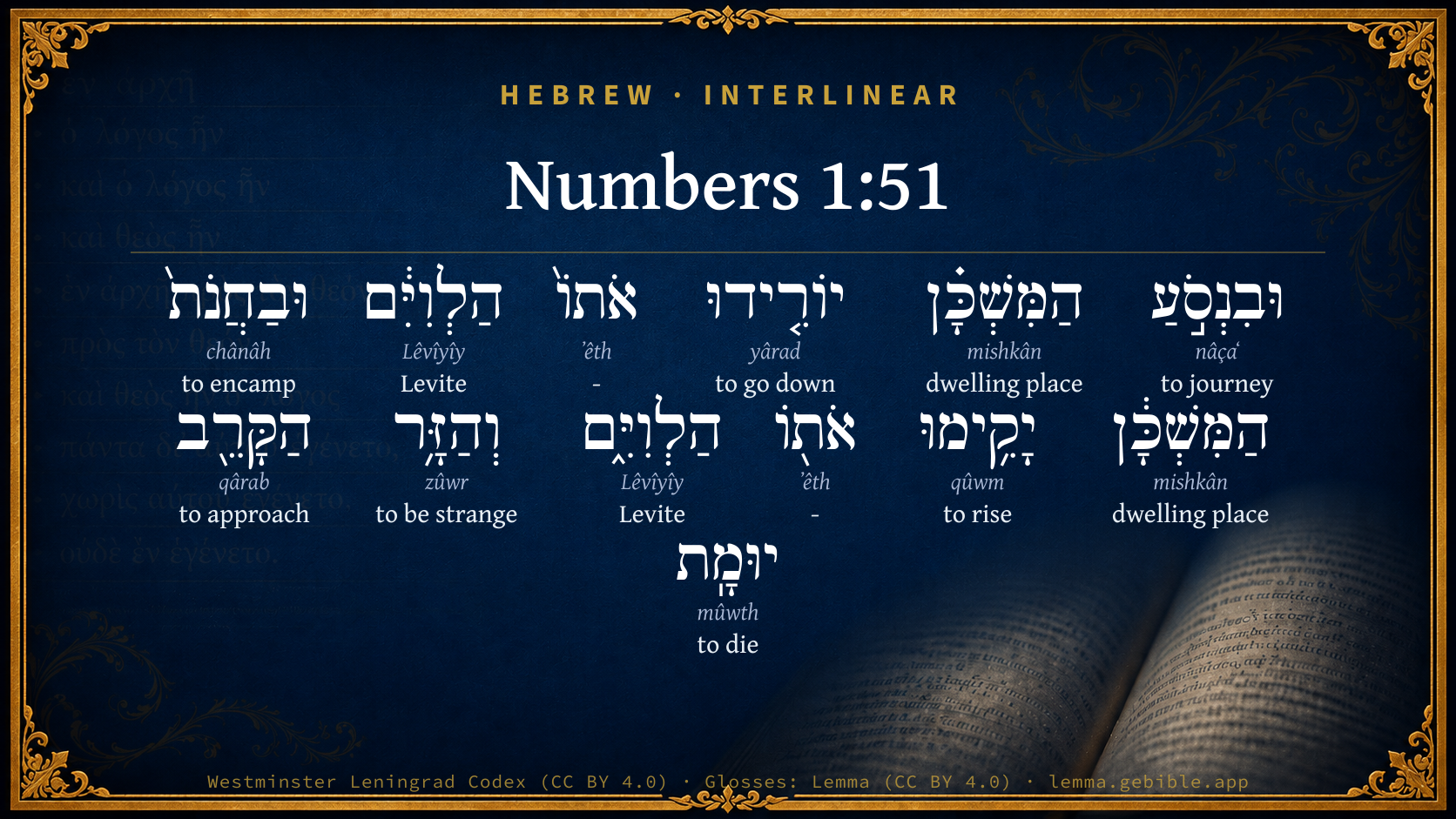
Hebrew (Westminster Leningrad Codex) Numbers 1:51 appears in the Hebrew Old Testament. The text above is from the Westminster Leningrad Codex. Each word links to its Strong’s number, a concise gloss, and parsing drawn from the Open Scriptures Hebrew Bible morphology. Click any word for its full Brown-Driver-Briggs (BDB) entry.
Download image
Cite this verse

Numbers 1:51 (World English Bible). Public Domain. Lemma interlinear Bible study tool, https://lemma.gebible.app/v/numbers/1/51.

Show BibTeX & RIS
BibTeX
RIS
English Translation
When the tabernacle is to move, the Levites shall take it down; and when the tabernacle is to be set up, the Levites shall set it up. The stranger who comes near shall be put to death.
World English Bible · Public Domain
Download a study sheet

One document with this verse’s original text, its word-by-word gloss line, the meaning frame, cross-references with their text, attributed commentary, and full source and license credits — printable, and it pastes into notes with its structure intact.

This verse Autodidact and up

Study sheet (.html) Plain text (.txt)

A passage Seminary Student

Up to 50 verses in one chapter. A passage sheet keeps up to 6 commentary sources and 12 cross-references per verse, in the order this page ranks them, and says so on the sheet whenever that leaves anything out. Ask for a single verse and you get the Autodidact verse sheet above.

Everything on this page stays free to read, with no account — the sheet is a download of what is already on screen, not access to it.

Want to remove ads? Support Godless Engineer
Compare translations 3

The same verse in 3 English versions, stacked beneath the original-language interlinear above. Click any original word for its lexicon entry.

Each is an independent rendering of the whole verse — the interlinear is not word-aligned to these translations.

Highlighted words mark where these versions differ — a whole-verse word diff, not a word-by-word alignment.

  • World English Bible Public Domain
    When the tabernacle is to move, the Levites shall take it down; and when the tabernacle is to be set up, the Levites shall set it up. The stranger who comes near shall be put to death.
  • King James Version Public Domain
    And when the tabernacle setteth forward, the Levites shall take it down: and when the tabernacle is to be pitched, the Levites shall set it up: and the stranger that cometh nigh shall be put to death.
  • unfoldingWord Literal Text CC BY-SA 4.0
    And when the Dwelling sets out, the Levites shall take it down, and when the Dwelling camps, the Levites shall raise it up. And the stranger who comes near shall be put to death.

unfoldingWord Literal Text — © unfoldingWord, licensed CC BY-SA 4.0. Word-aligned USFM3 via Door43 (git.door43.org/unfoldingWord/en_ult).

Versions to compare (up to 4)

3 of 4 selected

Show all 18 translations

Every available English version of this verse, each an independent rendering of the whole verse.

  • World English Bible Public Domain
    When the tabernacle is to move, the Levites shall take it down; and when the tabernacle is to be set up, the Levites shall set it up. The stranger who comes near shall be put to death.
  • Berean Standard Bible Public Domain
    Whenever the tabernacle is to move, the Levites are to take it down, and whenever it is to be pitched, the Levites are to set it up. Any outsider who goes near it must be put to death.
  • Majority Standard Bible Public Domain
    Whenever the tabernacle is to move, the Levites are to take it down, and whenever it is to be pitched, the Levites are to set it up. Any outsider who goes near it must be put to death.
  • King James Version Public Domain
    And when the tabernacle setteth forward, the Levites shall take it down: and when the tabernacle is to be pitched, the Levites shall set it up: and the stranger that cometh nigh shall be put to death.
  • American Standard Version (1901) Public Domain
    And when the tabernacle setteth forward, the Levites shall take it down; and when the tabernacle is to be pitched, the Levites shall set it up: and the stranger that cometh nigh shall be put to death.
  • Revised Version (1885) Public Domain
    And when the tabernacle setteth forward, the Levites shall take it down: and when the tabernacle is to be pitched, the Levites shall set it up: and the stranger that cometh nigh shall be put to death.
  • Geneva Bible (1599) Public Domain
    And when the Tabernacle goeth forth, the Leuites shall take it downe: and when the Tabernacle is to be pitched, ye Leuites shall set it vp: for the stranger that commeth neere, shalbe slaine.
  • Douay-Rheims (1899) Public Domain
    When you are to go forward, the Levites shall take down the tabernacle: when you are to camp, they shall set it up. What stranger soever cometh to it, shall be slain.
  • Young's Literal Translation Public Domain
    `And in the journeying of the tabernacle, the Levites take it down, and in the encamping of the tabernacle, the Levites raise it up; and the stranger who is coming near is put to death.'
  • Literal Standard Version CC BY-SA 4.0
    And in the journeying of the Dwelling Place, the Levites take it down, and in the encamping of the Dwelling Place, the Levites raise it up; and the stranger who is coming near is put to death.”
  • Unlocked Literal Bible CC BY-SA 4.0
    When the tabernacle is to move to another place, the Levites must take it down. When the tabernacle is to be set up, the Levites must set it up. Any stranger who comes near the tabernacle must be killed.
  • unfoldingWord Literal Text CC BY-SA 4.0
    And when the Dwelling sets out, the Levites shall take it down, and when the Dwelling camps, the Levites shall raise it up. And the stranger who comes near shall be put to death.
  • Darby Bible Public Domain
    and when the tabernacle setteth forward, the Levites shall take it down; and when the tabernacle encampeth, the Levites shall set it up; and the stranger that cometh near shall be put to death.
  • World Messianic Bible Public Domain
    When the tabernacle is to move, the Levites shall take it down; and when the tabernacle is to be set up, the Levites shall set it up. The stranger who comes near shall be put to death.
  • Webster's Bible Public Domain
    And when the tabernacle moveth forward, the Levites shall take it down; and when the tabernacle is to be pitched, the Levites shall set it up: and the stranger that cometh nigh shall be put to death.
  • Free Bible Version CC BY-SA 4.0
    When it's time to move the Tabernacle, the Levites shall take it down, and when it's time to make camp, the Levites shall put it up. Any outsider who goes near it must be put to death.
  • Bible in Basic English Public Domain
    And when the Tent of meeting goes forward, the Levites are to take it down; and when it is to be put up, they are to do it: any strange person who comes near it is to be put to death.
  • JPS Tanakh (1917) Public Domain
    And when the tabernacle setteth forward, the Levites shall take it down; and when the tabernacle is to be pitched, the Levites shall set it up; and the common man that draweth nigh shall be put to death.

Literal Standard Version (2020), Covenant Press — licensed CC BY-SA 4.0. Text via the HelloAO Bible API (eBible.org). Unlocked Literal Bible (unfoldingWord) — licensed CC BY-SA 4.0. Text via the HelloAO Bible API (eBible.org). unfoldingWord Literal Text — © unfoldingWord, licensed CC BY-SA 4.0. Word-aligned USFM3 via Door43 (git.door43.org/unfoldingWord/en_ult). Free Bible Version, Dr. Jonathan Gallagher — licensed CC BY-SA 4.0. Text via the HelloAO Bible API (eBible.org).

Word by word

More ways to search: Search by grammar → Find every occurrence → Compare this word →

Practice this passage: Drill this verse → Learn its vocabulary →

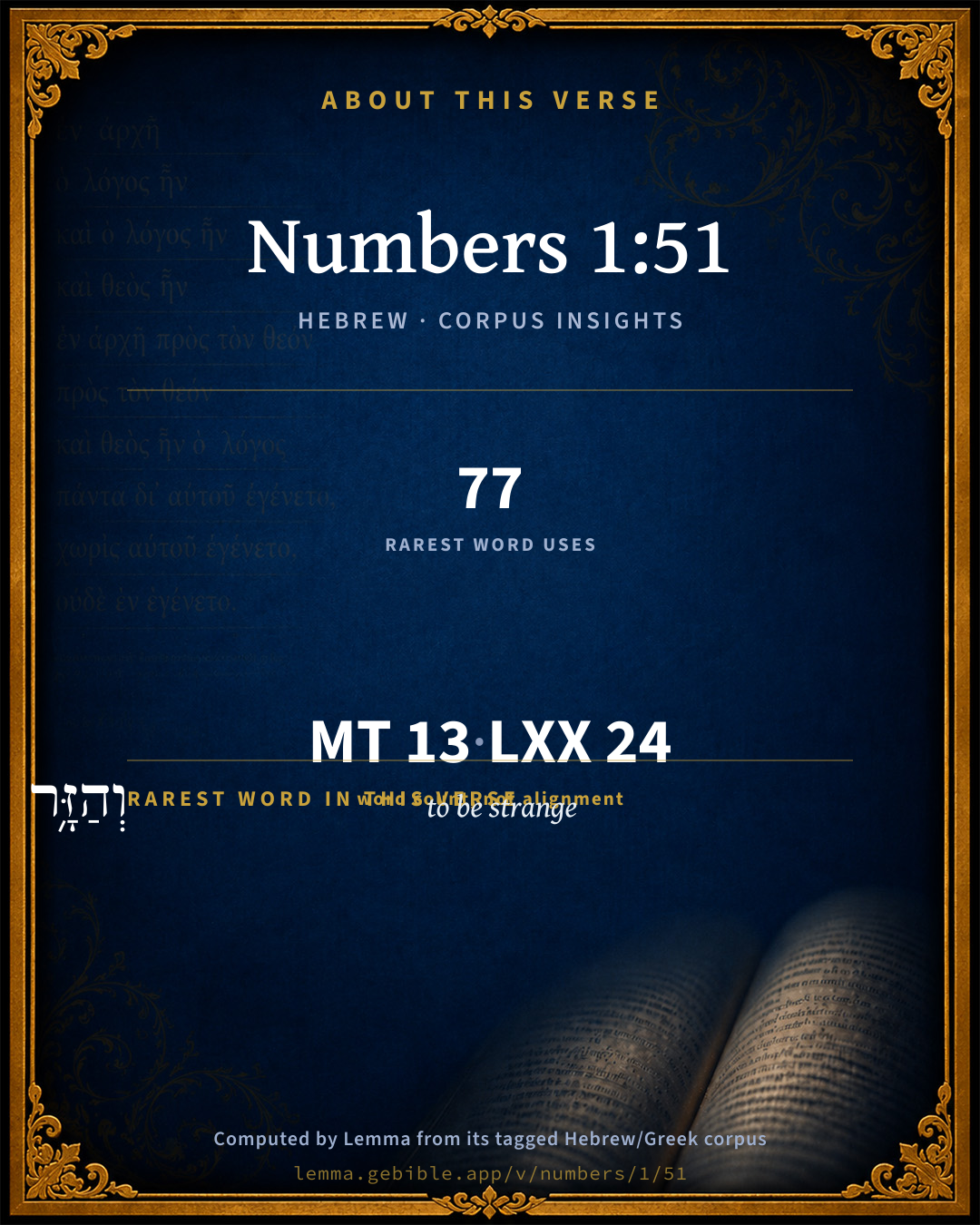
וְהַזָּ֥ר
zûwr
H2114
“and · the · strange”
Conjunction + Particle, Definite Article + Adjective, Adjective, Masculine, Singular, Absolute
Part of Speech
Conjunction + Particle + Adjective
Type
Adjective
Gender
Masculine
Number
Singular
State
Absolute
Full BDB Definition

Origin: a primitive root

TWOT: 541

to be strange, be a stranger - (Qal) - to become estranged - strange, another, stranger, foreigner, an enemy (participle) - loathsome (of breath) (participle) - strange woman, prostitute, harlot (metonymy) - (Niphal) to be estranged - (Hophal) to be a stranger, be one alienated
  1. וּבִנְסֹ֣עַ nâçaʻ H5265 “and · in/at · to journey” Conjunction + Preposition + Verb, Qal, Infinitive Construct
  2. הַמִּשְׁכָּ֗ן mishkân H4908 “the · dwelling place” Particle, Definite Article + Noun, Common, Masculine, Singular, Absolute
  3. יוֹרִ֤ידוּ yârad H3381 “to go down” Verb, Hiphil, Imperfect, 3rd Person, Masculine, Plural
  4. אֹתוֹ֙ ʼêth H853 “- · him” Particle, Direct Object + Suffix, Personal, 3rd Person, Masculine, Singular
  5. הַלְוִיִּ֔ם Lêvîyîy H3881 “the · Levites” Particle, Definite Article + Noun, Gentilic, Masculine, Plural, Absolute
  6. וּבַחֲנֹת֙ chânâh H2583 “and · in/at · to encamp” Conjunction + Preposition + Verb, Qal, Infinitive Construct
  7. הַמִּשְׁכָּ֔ן mishkân H4908 “the · dwelling place” Particle, Definite Article + Noun, Common, Masculine, Singular, Absolute
  8. יָקִ֥ימוּ qûwm H6965 “to rise” Verb, Hiphil, Imperfect, 3rd Person, Masculine, Plural
  9. אֹת֖וֹ ʼêth H853 “- · him” Particle, Direct Object + Suffix, Personal, 3rd Person, Masculine, Singular
  10. הַלְוִיִּ֑ם Lêvîyîy H3881 “the · Levites” Particle, Definite Article + Noun, Gentilic, Masculine, Plural, Absolute
  11. הַקָּרֵ֖ב qârab H7126 “the · approaching” Particle, Definite Article + Adjective, Adjective, Masculine, Singular, Absolute
  12. יוּמָֽת mûwth H4191 “to die” Verb, Hophal, Imperfect, 3rd Person, Masculine, Singular

About this verse

These counts appear in no published source. They are computed here, from the morphology-tagged text and Lemma’s own curated glosses. What Lemma adds →

13
words
10
distinct lemmas
Pentateuch
section

Grammatical profile

  • 5 verbs
  • 4 nouns
  • 2 adjectives
  • 2 particles

Verb forms

  • וּבִנְסֹ֣עַ Qal · Infinitive Construct
  • יוֹרִ֤ידוּ Hiphil · Imperfect
  • וּבַחֲנֹת֙ Qal · Infinitive Construct
  • יָקִ֥ימוּ Hiphil · Imperfect
  • יוּמָֽת Hophal · Imperfect

Repetition

Words recur within this verse — often emphatic in Hebrew:

  • הַמִּשְׁכָּ֗ן dwelling place H4908 ×2
  • הַלְוִיִּ֔ם Levite H3881 ×2

Hebrew & Septuagint length

In English translation the verse runs 37 words from the Hebrew and 31 from the Septuagint (LXX English) — closely comparable.

A rough comparison of the two English renderings, which tokenize alike — not a word-level alignment.

Word counts can differ between the Hebrew and the Greek without any difference in meaning — e.g. the Hebrew direct-object marker אֵת has no separate Greek word, and Greek often adds the article ὁ.

In the original languages it is 13 Hebrew tokens and 24 Greek tokens — but the two are counted differently (Hebrew bundles its prefixes and suffixes into one token; the Greek is in lemma form), so that isn’t a like-for-like length.

Cross-references

10

Topical passages linked to Numbers 1:51 in the Treasury of Scripture Knowledge — connected by theme and wording, ordered by reader-vote popularity; previews shown in the World English Bible.

  • Numbers 3:38 Those who encamp before the tabernacle eastward, in front of the Tent of Meeting toward the sunrise, shall be Moses, and Aaron and his sons, keeping the charge of the sanctuary for the charge of the children of Israel. The stranger who comes near shall be put to death.
  • Numbers 3:10 You shall appoint Aaron and his sons, and they shall keep their priesthood. The stranger who comes near shall be put to death."
  • Numbers 18:22 Henceforth the children of Israel shall not come near the tent of meeting, lest they bear sin, and die.
  • 1 Samuel 6:19 He struck of the men of Beth-shemesh, because they had looked into the ark of Yahweh, he struck of the people fifty thousand seventy men; and the people mourned, because Yahweh had struck the people with a great slaughter.
  • 2 Samuel 6:7 The anger of Yahweh was kindled against Uzzah; and God struck him there for his error; and there he died by the ark of God.
  • Leviticus 22:10–13 "'No stranger shall eat of the holy thing: a foreigner living with the priests, or a hired servant, shall not eat of the holy thing.
  • Numbers 4:1–33 Yahweh spoke to Moses and to Aaron, saying,
  • Numbers 10:11 It happened in the second year, in the second month, on the twentieth day of the month, that the cloud was taken up from over the tent of the testimony.
  • Numbers 10:17–21 The tent was taken down; and the sons of Gershon and the sons of Merari, who bore the tent, set forward.
  • Numbers 16:40 to be a memorial to the children of Israel, to the end that no stranger, who isn't of the seed of Aaron, comes near to burn incense before Yahweh; that he not be as Korah, and as his company: as Yahweh spoke to him by Moses.

Cross-references courtesy of OpenBible.info (CC BY 4.0).

Hebrew and Greek witnesses Masoretic Hebrew ↔ Greek Septuagint

The same verse in the two great witnesses to the Old Testament, shown verse-for-verse.

These are two independent witnesses, not word-aligned to each other, and the Septuagint is shown in lemma (dictionary) form.

Hebrew Numbers 1:51 Masoretic · Westminster Leningrad Codex

וּבִנְסֹ֣עַ הַמִּשְׁכָּ֗ן יוֹרִ֤ידוּ אֹתוֹ֙ הַלְוִיִּ֔ם וּבַחֲנֹת֙ הַמִּשְׁכָּ֔ן יָקִ֥ימוּ אֹת֖וֹ הַלְוִיִּ֑ם וְהַזָּ֥ר הַקָּרֵ֖ב יוּמָֽת

When the tabernacle is to move, the Levites shall take it down; and when the tabernacle is to be set up, the Levites shall set it up. The stranger who comes near shall be put to death.

World English Bible · Public Domain

Greek LXX Numbers 1:51 Septuagint · lemma form

καί ἐν ὁ ἐκαἴρω ὁ σκηνή κατααἱρέω αὐτός ὁ λευίτης καί ἐν ὁ παρα ἐνβάλλω ὁ σκηνή ἀναἵστημι καί ὁ ἀλλογενής ὁ προςπορεύομαι ἀποθνήσκω

And in removing the tabernacle, the Levites shall take it down, and in pitching the tabernacle they shall set it up: and let the stranger that advances to touch it die.

LXX2012 (modern English Septuagint) · Public Domain

Hebrew: Westminster Leningrad Codex (CC BY 4.0). Greek: Septuagint (public domain); English from LXX2012 (modern English Septuagint) (Public Domain). How the Septuagint differs from the Hebrew →

Targum (Aramaic paraphrase)

2

The Targum is the ancient Jewish Aramaic paraphrase of the Hebrew Scriptures — an interpretive translation, not the Hebrew text itself. Onkelos (literal) and Pseudo-Jonathan (expansive) render the Torah, and Jonathan the Prophets. Coverage is partial: where no permissively-licensed English translation exists for a verse, only the Aramaic is shown. This is verse-level text, not a word-by-word alignment to the Hebrew.

  1. Targum Onkelos Torah (Genesis–Deuteronomy)
    וּבְמֵטַל מַשְׁכְּנָא יְפַרְקוּן יָתֵהּ לֵוָאֵי וּבְמִשְׁרֵי מַשְׁכְּנָא יְקִימוּן יָתֵהּ לֵוָאֵי וְחִלוֹנַי דְיִקְרַב יִתְקְטֵל

    (no public-domain English translation for this verse)

    Targum Onkelos — Aramaic: “Onkelos Genesis” (public domain); “Onkelos Exodus” (public domain); “Onkelos Leviticus” (public domain); “Onkelos Numbers” (public domain); “Onkelos Deuteronomy” (public domain). English: “Sefaria Community Translation” (CC0 1.0 (public-domain dedication)); “J.W. Etheridge. The Targums of Onkelos and Jonathan Ben Uzziel on the Pentateuch. London: Longmans, Green, 1862” (public domain). Text via Sefaria.

  2. Targum Pseudo-Jonathan Torah (Genesis–Deuteronomy)
    וּבְמֵיטַל מַשְׁכְּנָא יִפְרְקוּן יָתֵיהּ לֵיוָאֵי וּבְמֵישְׁרֵי מַשְׁכְּנָא יְקִימוּן יָתֵיהּ לֵיוָאֵי וְחִילוֹנַי דְיִקְרַב יִתְקְטֵיל בְּאֵישָׁא מְצַלְהֲבָא מִן קֳדָם יְיָ

    And when the tabernacle is to go forward, the Levites shall take it apart; and when the tabernacle is to be stationary, the Levites are to uprear it: the common person who draweth near will be slain by a flaming fire from before the Lord.

    Targum Pseudo-Jonathan — Aramaic: “Targum Jonathan on Genesis” (public domain); “Targum Jonathan on Exodus” (public domain); “Targum Jonathan on Leviticus” (public domain); “Targum Jonathan on Numbers” (public domain); “Targum Jonathan on Deuteronomy” (public domain). English: “The Targum of Jonathan ben Uzziel, trans. J. W. Etheridge, London, 1862” (public domain). Text via Sefaria.

Commentary

Notes on Numbers 1:51 from classic Christian and Jewish commentators (each source and its license shown beneath its notes). The classic Christian expositions comment on the surrounding passage and are grouped to its opening verse, so a note may address several verses; the Jewish commentaries on the Tanakh (Rashi and others) are per-verse, so they appear only where the commentator wrote on this verse.

Lemma curates 59 commentaries, every one of them public domain or Creative Commons licensed, each selected and text-cleaned for this edition rather than reprinted as found. About our sources →

Geneva Bible (1599)

Geneva Bible translators

Whosoever is not of the tribe of Levi.

Geneva Bible (1599) marginal notes — public domain. Text via Bolls.life.

Ellicott's Commentary for English Readers

(51) And the stranger that cometh nigh shall be put to death.—The word zar (stranger) here denotes one who was not of the tribe of Levi (Lev_22:10; Lev_22:12).

A Bible Commentary for English Readers, edited by Charles John Ellicott (1878–1897) — public domain. Text from a community e-Sword module.

The Cambridge Bible for Schools and Colleges

gen. ed. J. J. S. Perowne

51. the stranger] Not a ‘foreigner,’ but one who does not belong to the particular class mentioned in the context—here and in Num_18:4, the Levites; in Num_3:10; Num_3:38, Num_18:7, the priests.

The Cambridge Bible for Schools and Colleges (gen. ed. J. J. S. Perowne; Cambridge University Press, 1878–1918) — public domain. Text from a community e-Sword module.

John Gill's Exposition

And when the tabernacle setteth forward,.... Or was about to set forward; that is, the congregation were about to journey, and take the tabernacle with them, as they always did, when and wherever they journeyed:

the Levites shall take it down; unpin it, take the boards and pillars out of their sockets, and the bars out of their places, and the whole into pieces, in order to be put into wagons prepared to carry them, of which mention is made in a following chapter:

and when the tabernacle is pitched, the Levites shall set it up; at whatsoever place the congregation encamped and took up their abode for any time: the tabernacle was pitched in the manner as tents are, when the Levites put the several parts together, laid the sockets, put in the boards and the bars, and also the pillars of the court and elsewhere, and hung the hangings upon them; and set the candlestick, tables, altars, ark, and all the vessels of the sanctuary in their proper places:

and the stranger that cometh nigh; to meddle with or touch the above things, to assist in taking down or setting up the tabernacle, or bearing any of the vessels of it: by a stranger is meant, not one of another nation, nor a proselyte, whether of the gate or of righteousness; but, as Aben Ezra interprets it, one that is a stranger from the sons of Levi, who is not of that tribe, even though an Israelite:

shall be put to death; either the sanhedrim or court of judicature shall condemn and put him to death, as the same writer observes; or he shall die by the hand of heaven, as Jarchi; that is, by the immediate hand of God, or with flaming fire from before the Lord, as the Targum of Jonathan; as Uzzah was smote, and died by the ark of God for touching it, Sa2 5:6.

John Gill's Exposition of the Whole Bible (1746–1763) — public domain (CC PDM 1.0). Text via the HelloAO Bible API.

Haydock's Catholic Bible Commentary

Stranger, even of any other tribe. (St. Augustine, q. 3.) (Worthington)

George Leo Haydock (1774–1849), Haydock's Catholic Family Bible and Commentary, 1859 edition — public domain. Excludes Psalms (Douay-Rheims chapter numbering differs from Protestant) and Deuterocanonical books (Catholic canon only).

Matthew Poole's English Annotations

The

stranger elsewhere is one of another nation, here one of another tribe, one no Levite. That cometh nigh, so as to do the offices mentioned Num 1:50.

Matthew Poole's English Annotations on the Holy Bible (1683–1685) — public domain. Text from a community e-Sword/MySword module.

Whedon's Commentary on the Bible

Daniel D. Whedon

51. The stranger that cometh nigh — Every non-Levite is prohibited from intrusion upon the sacred precincts. So, also, with respect to the priestly office, every Levite not an Aaronic priest is a stranger. The profaned censers used by Korah the Levite, and his host of princes, were made into plates for the covering of the altar, “to be a memorial (warning) unto the children of Israel, that no stranger, which is not of the seed of Aaron, come near to offer incense before the Lord.” Num_16:36-40.

Shall be put to death — We find no directions to the Hebrew judiciary in such a case, and no instance of the infliction of the death penalty for this sacrilege by the human magistrate, but a record of the special interposition of Jehovah in the case of Nadab and Abihu, (Lev_10:1-2,) supposed to have been drunk, because of the prohibition of wine immediately subjoined, (Lev_10:8-10,) and also of Uzzah, 1Ch_13:10. Hence we infer that this crime was punished by the immediate stroke of the Divine hand only. To the objection that this punishment was too severe and too summary, we reply that it was designed to teach the holiness of God in an impressive manner. We know too little of the Divine government to criticise its acts.

Daniel D. Whedon (gen. ed.), Commentary on the Old and New Testaments (1874–1909) — public domain. Text from a community e-Sword module.

The Pulpit Commentary

The stranger. The word appears to mean here any unauthorized person. (see Num_16:40) This is the first intimation given of the extreme and awful sanctity of the tabernacle, as the tent of the Divine Presence. It is, however, quite of a piece with the anxious warnings against intrusion upon the holy mount at the time of the giving of the law. (Exo_19:21, sq. ) The great necessity for Israel was that he should understand and believe that the Lord before whom he had trembled at Sinai was really in the midst of him in all his travail and his danger. This could only be impressed upon his dull mind and hard heart by surrounding the presence chamber of Jehovah with awful sanctities and terrors. At a subsequent period, when the religious reverence here thrown around the tabernacle had been transferred to, or rather concentrated upon, the ark alone, Uzzah was actually smitten for breaking this law. (1Ch_13:10) The tumult raised against St. Paul (Act_21:27, sq. ) was justified by a supposed violation of the same.

The Pulpit Commentary (1880–1919), ed. H.D.M. Spence-Jones & Joseph S. Exell — public domain. Text from a community e-Sword module.

John Wesley's Explanatory Notes

That cometh nigh - The stranger elsewhere is one of another nation, here one of another tribe. So as to do the offices mentioned, ver. 50.

John Wesley, Explanatory Notes Upon the Whole Bible (1754–1765) — public domain. Text via the GEBible commentary corpus.

unfoldingWord translationNotes

Door43 World Missions Community

When the tabernacle is to be set up

This can be stated in active form. AT: "When it is time to set up the tabernacle" (See: Active or Passive)

Any stranger ... must be killed

This can be stated in active form. AT: "Any stranger ... must die" or "You must kill any stranger who comes near the tabernacle" (See: Active or Passive)

the banner

a large flag

his armed group

"his military division"

translationWords

Israel

tent

unfoldingWord translationNotes — © Distant Shores Media and the Door43 World Missions Community, licensed CC BY-SA 4.0. Source: git.door43.org/Door43/en_tn.

Rashi

Rabbi Shlomo Yitzchaki (Rashi)

יורידו אתו [AND WHEN THE DWELLING SETTETH FORWARD] THE LEVITES SHALL TAKE IT DOWN — Understand יורידו as the Targum does: they shall take it apart. Whenever they were about to set out on a journey in the wilderness from one station to another (cf. Rashi Exodus 40:38) they took the structure apart (lit., they took it apart from its state of being put up) and carried it to the place where the cloud afterwards abode, and there they encamped and erected it (the Tabernacle).

והזר הקרב AND THE LAYMAN THAT COMETH NIGH to this service of theirs,

יומת SHALL BE PUT TO DEATH by heaven (not by sentence of the court) (cf. Sanhedrin 84a).

Rashi on the Tanakh — English translations: “The Judaica Press complete Tanach with Rashi, translated by A. J. Rosenberg” (CC BY 4.0); “Pentateuch with Rashi's commentary by M. Rosenbaum and A.M. Silbermann, 1929-1934” (public domain); “The Metsudah Tanach series, Lakewood, N.J” (CC BY 4.0); and “The Book of Joshua, Metsudah Publications, 1997” (CC BY 4.0). Text via Sefaria.

Lesson kit

Teaching starters — assembled from the data on this page, not authored interpretation. Every prompt links to the verse data it draws on. Edit before teaching.

Numbers, in the Pentateuch, opens this verse with 13 words (10 distinct Hebrew lemmas). Its most distinctive word is zûwr (“to be strange”). A historical commentator’s framing appears above. Read the whole chapter for the surrounding context.

Discussion questions

  1. The word zûwr carries the sense “to be strange.” How does it shape the verse?
  2. How does Numbers 3:38, which shares this passage’s theme, read alongside this verse?
  3. What does the repetition of “dwelling place” (2× in this one verse) do in this verse?
  4. These translations render this verse differently; the difference is in the English rendering, not the original. What questions does that raise?
  5. «וּבִנְסֹ֣עַ» is a Qal Infinitive Construct verb. How does that grammatical form shape the action described?
  6. Compare how Geneva Bible (1599) and Ellicott's Commentary for English Readers read this verse. Where do they agree or differ?

Things to notice

Reading settings

Reading text

Shown beneath each verse's original-language words.

Old Testament
Old Testament edition

Read the OT as the Masoretic Hebrew (MT) or the Greek Septuagint (LXX).

English shown for the Greek Septuagint (in the Hebrew ↔ Greek comparison).

Comparing translations? Open the Compare panel on any verse page to stack up to four side by side.