
Exodus 35:2

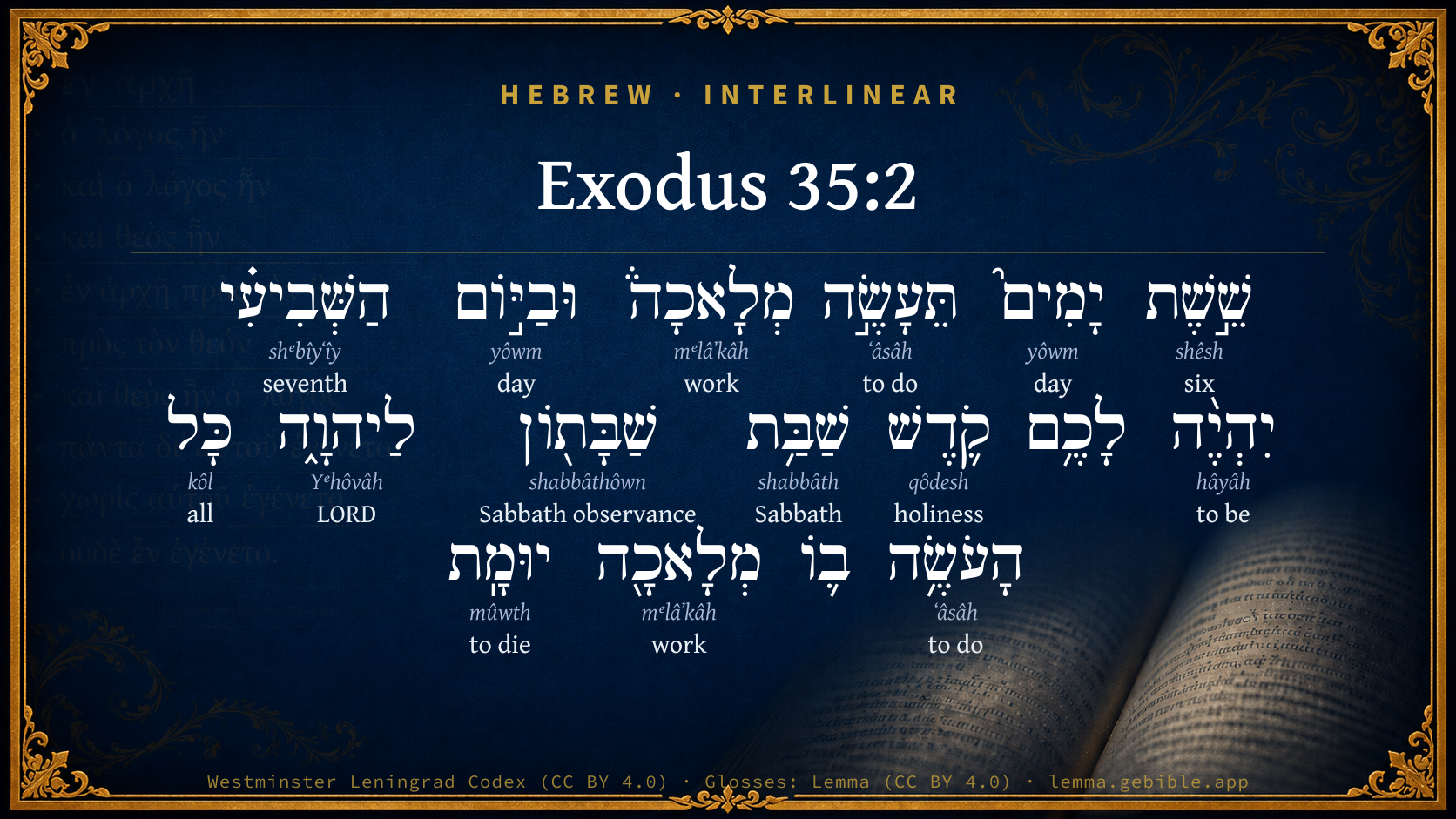
Hebrew (Westminster Leningrad Codex) Exodus 35:2 appears in the Hebrew Old Testament. The text above is from the Westminster Leningrad Codex. Each word links to its Strong’s number, a concise gloss, and parsing drawn from the Open Scriptures Hebrew Bible morphology. Click any word for its full Brown-Driver-Briggs (BDB) entry.
Download image
Cite this verse

Exodus 35:2 (World English Bible). Public Domain. Lemma interlinear Bible study tool, https://lemma.gebible.app/v/exodus/35/2.

Show BibTeX & RIS
BibTeX
RIS
English Translation
'Six days shall work be done, but on the seventh day there shall be a holy day for you, a Sabbath of solemn rest to Yahweh: whoever does any work in it shall be put to death.
World English Bible · Public Domain
Download a study sheet

One document with this verse’s original text, its word-by-word gloss line, the meaning frame, cross-references with their text, attributed commentary, and full source and license credits — printable, and it pastes into notes with its structure intact.

This verse Autodidact and up

Study sheet (.html) Plain text (.txt)

A passage Seminary Student

Up to 50 verses in one chapter. A passage sheet keeps up to 6 commentary sources and 12 cross-references per verse, in the order this page ranks them, and says so on the sheet whenever that leaves anything out. Ask for a single verse and you get the Autodidact verse sheet above.

Everything on this page stays free to read, with no account — the sheet is a download of what is already on screen, not access to it.

Want to remove ads? Support Godless Engineer
Compare translations 3

The same verse in 3 English versions, stacked beneath the original-language interlinear above. Click any original word for its lexicon entry.

Each is an independent rendering of the whole verse — the interlinear is not word-aligned to these translations.

Highlighted words mark where these versions differ — a whole-verse word diff, not a word-by-word alignment.

  • World English Bible Public Domain
    'Six days shall work be done, but on the seventh day there shall be a holy day for you, a Sabbath of solemn rest to Yahweh: whoever does any work in it shall be put to death.
  • King James Version Public Domain
    Six days shall work be done, but on the seventh day there shall be to you an holy day, a sabbath of rest to the LORD: whosoever doeth work therein shall be put to death.
  • unfoldingWord Literal Text CC BY-SA 4.0
    Six days shall work be done, but on the seventh day shall be for you a holy Sabbath of rest to Yahweh. Every doer of work on it shall be put to death.

unfoldingWord Literal Text — © unfoldingWord, licensed CC BY-SA 4.0. Word-aligned USFM3 via Door43 (git.door43.org/unfoldingWord/en_ult).

Versions to compare (up to 4)

3 of 4 selected

Show all 18 translations

Every available English version of this verse, each an independent rendering of the whole verse.

  • World English Bible Public Domain
    'Six days shall work be done, but on the seventh day there shall be a holy day for you, a Sabbath of solemn rest to Yahweh: whoever does any work in it shall be put to death.
  • Berean Standard Bible Public Domain
    For six days work may be done, but the seventh day shall be your holy day, a Sabbath of complete rest to the LORD. Whoever does any work on that day must be put to death.
  • Majority Standard Bible Public Domain
    For six days work may be done, but the seventh day shall be your holy day, a Sabbath of complete rest to the LORD. Whoever does any work on that day must be put to death.
  • King James Version Public Domain
    Six days shall work be done, but on the seventh day there shall be to you an holy day, a sabbath of rest to the LORD: whosoever doeth work therein shall be put to death.
  • American Standard Version (1901) Public Domain
    Six days shall work be done; but on the seventh day there shall be to you a holy day, a sabbath of solemn rest to Jehovah: whosoever doeth any work therein shall be put to death.
  • Revised Version (1885) Public Domain
    Six days shall work be done, but on the seventh day there shall be to you an holy day, a sabbath of solemn rest to the LORD: whosoever doeth any work therein shall be put to death.
  • Geneva Bible (1599) Public Domain
    Six dayes thou shalt work, but the seuenth day shall bee vnto you the holy Sabbath of rest vnto the Lord: whosoeuer doth any worke therein, shall die.
  • Douay-Rheims (1899) Public Domain
    Six days you shall do work: the seventh day shall be holy unto you, the sabbath, and the rest of the Lord: he that shall do any work on it, shall be put to death.
  • Young's Literal Translation Public Domain
    Six days is work done, and on the seventh day there is to you a holy `day', a sabbath of rest to Jehovah; any who doeth work in it is put to death;
  • Literal Standard Version CC BY-SA 4.0
    [For] six days work is done, and on the seventh day there is a holy [day] for you, a Sabbath of rest to YHWH; any who does work in it is put to death;
  • Unlocked Literal Bible CC BY-SA 4.0
    On six days work may be done, but for you, the seventh day must be a holy day, a Sabbath day of complete rest, holy to Yahweh. Whoever does any work on that day must be put to death.
  • unfoldingWord Literal Text CC BY-SA 4.0
    Six days shall work be done, but on the seventh day shall be for you a holy Sabbath of rest to Yahweh. Every doer of work on it shall be put to death.
  • Darby Bible Public Domain
    Six days shall work be done, but on the seventh day there shall be to you a holy day, a sabbath of rest to Jehovah: whoever does work on it shall be put to death.
  • World Messianic Bible Public Domain
    ‘Six days shall work be done, but on the seventh day there shall be a holy day for you, a Sabbath of solemn rest to the LORD: whoever does any work in it shall be put to death.
  • Webster's Bible Public Domain
    Six days shall work be done; but on the seventh day there shall be to you a holy day, a sabbath of rest to the LORD: whoever doth work therein shall be put to death.
  • Free Bible Version CC BY-SA 4.0
    Six days you can work, but the seventh day is to be a holy Sabbath of rest to the Lord. Anyone who does any work on the Sabbath day must be killed.
  • Bible in Basic English Public Domain
    Six days let work be done, but the seventh day is to be a holy day to you, a Sabbath of rest to the Lord; whoever does any work on that day is to be put to death.
  • JPS Tanakh (1917) Public Domain
    Six days shall work be done, but on the seventh day there shall be to you a holy day, a sabbath of solemn rest to the LORD; whosoever doeth any work therein shall be put to death.

Literal Standard Version (2020), Covenant Press — licensed CC BY-SA 4.0. Text via the HelloAO Bible API (eBible.org). Unlocked Literal Bible (unfoldingWord) — licensed CC BY-SA 4.0. Text via the HelloAO Bible API (eBible.org). unfoldingWord Literal Text — © unfoldingWord, licensed CC BY-SA 4.0. Word-aligned USFM3 via Door43 (git.door43.org/unfoldingWord/en_ult). Free Bible Version, Dr. Jonathan Gallagher — licensed CC BY-SA 4.0. Text via the HelloAO Bible API (eBible.org).

Word by word

More ways to search: Search by grammar → Find every occurrence → Compare this word →

Practice this passage: Drill this verse → Learn its vocabulary →

שַׁבָּת֖וֹן
shabbâthôwn
H7677
“Sabbath observance”
Noun, Common, Masculine, Singular, Absolute
Part of Speech
Noun
Type
Common
Gender
Masculine
Number
Singular
State
Absolute
Full BDB Definition

Origin: from H7676

TWOT: 2323d

Sabbath observance, sabbatism - of weekly sabbath - day of atonement - sabbatical year - of Feast of Trumpets - of the 1st and last days of the Feast of Tabernacles
  1. שֵׁ֣שֶׁת shêsh H8337 “six” Adjective, Cardinal number, Masculine, Singular, Construct
  2. יָמִים֮ yôwm H3117 “days” Noun, Common, Masculine, Plural, Absolute
  3. תֵּעָשֶׂ֣ה ʻâsâh H6213 “to do” Verb, Niphal, Imperfect, 3rd Person, Feminine, Singular
  4. מְלָאכָה֒ mᵉlâʼkâh H4399 “work” Noun, Common, Feminine, Singular, Absolute
  5. וּבַיּ֣וֹם yôwm H3117 “and · in/at the · day” Conjunction + Preposition, Determined + Noun, Common, Masculine, Singular, Absolute
  6. הַשְּׁבִיעִ֗י shᵉbîyʻîy H7637 “the · seventh” Particle, Definite Article + Adjective, Ordinal number, Masculine, Singular, Absolute
  7. יִהְיֶ֨ה hâyâh H1961 “to be” Verb, Qal, Imperfect, 3rd Person, Masculine, Singular
  8. קֹ֛דֶשׁ qôdesh H6944 “holiness” Noun, Common, Masculine, Singular, Absolute
  9. שַׁבַּ֥ת shabbâth H7676 “Sabbath of” Noun, Common, Both, Singular, Construct
  10. לַיהוָ֑ה Yᵉhôvâh H3068 “to/for · LORD” Preposition + Noun, Proper
  11. כָּל kôl H3605 “all of” Noun, Common, Masculine, Singular, Construct
  12. הָעֹשֶׂ֥ה ʻâsâh H6213 “the · doing” Particle, Definite Article + Verb, Qal, Participle Active, Masculine, Singular, Absolute
  13. מְלָאכָ֖ה mᵉlâʼkâh H4399 “work” Noun, Common, Feminine, Singular, Absolute
  14. יוּמָֽת mûwth H4191 “to die” Verb, Hophal, Imperfect, 3rd Person, Masculine, Singular

About this verse

These counts appear in no published source. They are computed here, from the morphology-tagged text and Lemma’s own curated glosses. What Lemma adds →

17
words
12
distinct lemmas
Pentateuch
section

Notable vocabulary

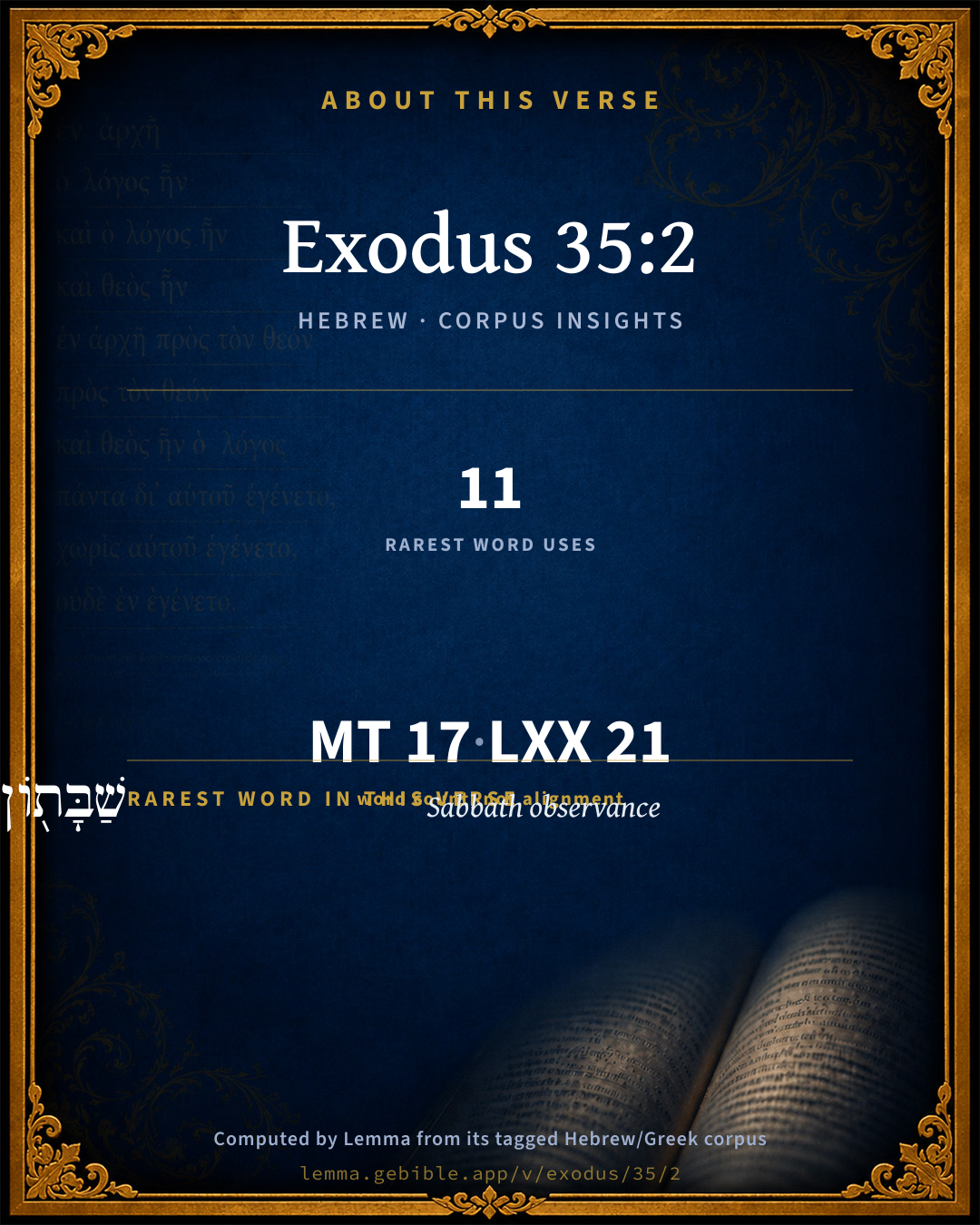
The rarest word here is שַׁבָּת֖וֹן Sabbath observance H7677 — appearing just 11 times in the whole Hebrew Bible.

Shared distinctive vocabulary

שַׁבָּת֖וֹן Sabbath observance H7677 occurs in 10 verses of the Hebrew Bible. Also found in:

Grammatical profile

  • 4 verbs
  • 9 nouns
  • 2 adjectives
  • 2 prepositions

Verb forms

  • תֵּעָשֶׂ֣ה Niphal · Imperfect
  • יִהְיֶ֨ה Qal · Imperfect
  • הָעֹשֶׂ֥ה Qal · Participle Active
  • יוּמָֽת Hophal · Imperfect

Repetition

Words recur within this verse — often emphatic in Hebrew:

  • יָמִים֮ day H3117 ×2
  • תֵּעָשֶׂ֣ה to do H6213 ×2
  • מְלָאכָה֒ work H4399 ×2

Hebrew & Septuagint length

In English translation the verse runs 37 words from the Hebrew and 30 from the Septuagint (LXX English) — closely comparable.

A rough comparison of the two English renderings, which tokenize alike — not a word-level alignment.

Word counts can differ between the Hebrew and the Greek without any difference in meaning — e.g. the Hebrew direct-object marker אֵת has no separate Greek word, and Greek often adds the article ὁ.

In the original languages it is 17 Hebrew tokens and 21 Greek tokens — but the two are counted differently (Hebrew bundles its prefixes and suffixes into one token; the Greek is in lemma form), so that isn’t a like-for-like length.

Cross-references

11

Topical passages linked to Exodus 35:2 in the Treasury of Scripture Knowledge — connected by theme and wording, ordered by reader-vote popularity; previews shown in the World English Bible.

  • Leviticus 23:3 "'Six days shall work be done: but on the seventh day is a Sabbath of solemn rest, a holy convocation; you shall do no manner of work. It is a Sabbath to Yahweh in all your dwellings.
  • Luke 13:14–15 The ruler of the synagogue, being indignant because Jesus had healed on the Sabbath, said to the multitude, "There are six days in which men ought to work. Therefore come on those days and be healed, and not on the Sabbath day!"
  • Exodus 20:9–10 You shall labor six days, and do all your work,
  • Exodus 34:21 Six days you shall work, but on the seventh day you shall rest: in plowing time and in harvest you shall rest.
  • Numbers 15:32–36 While the children of Israel were in the wilderness, they found a man gathering sticks on the Sabbath day.
  • Exodus 23:12 "Six days you shall do your work, and on the seventh day you shall rest, that your ox and your donkey may have rest, and the son of your handmaid, and the alien may be refreshed.
  • Exodus 31:13–16 "Speak also to the children of Israel, saying, 'Most assuredly you shall keep my Sabbaths: for it is a sign between me and you throughout your generations; that you may know that I am Yahweh who sanctifies you.
  • Hebrews 10:28–29 A man who disregards Moses' law dies without compassion on the word of two or three witnesses.
  • Deuteronomy 5:12–15 "Observe the Sabbath day, to keep it holy, as Yahweh your God commanded you.
  • John 5:16 For this cause the Jews persecuted Jesus, and sought to kill him, because he did these things on the Sabbath.
  • Hebrews 2:2–3 For if the word spoken through angels proved steadfast, and every transgression and disobedience received a just recompense;

Cross-references courtesy of OpenBible.info (CC BY 4.0).

Hebrew and Greek witnesses Masoretic Hebrew ↔ Greek Septuagint

The same verse in the two great witnesses to the Old Testament, shown verse-for-verse.

These are two independent witnesses, not word-aligned to each other, and the Septuagint is shown in lemma (dictionary) form.

Hebrew Exodus 35:2 Masoretic · Westminster Leningrad Codex

שֵׁ֣שֶׁת יָמִים֮ תֵּעָשֶׂ֣ה מְלָאכָה֒ וּבַיּ֣וֹם הַשְּׁבִיעִ֗י יִהְיֶ֨ה לָכֶ֥ם קֹ֛דֶשׁ שַׁבַּ֥ת שַׁבָּת֖וֹן לַיהוָ֑ה כָּל הָעֹשֶׂ֥ה ב֛וֹ מְלָאכָ֖ה יוּמָֽת

'Six days shall work be done, but on the seventh day there shall be a holy day for you, a Sabbath of solemn rest to Yahweh: whoever does any work in it shall be put to death.

World English Bible · Public Domain

Greek LXX Exodus 35:2 Septuagint · lemma form

ἕξ ἡμέρα ποιέω ἔργον ὁ δέ ἡμέρα ὁ ἕβδομος κατάπαυσις ἅγιος σάββατον ἀνάπαυσις κύριος πᾶς ὁ ποιέω ἔργον ἐν αὐτός τελευτάω

Six days shall you perform works, but on the seventh day shall be rest—a holy sabbath—a rest for the Lord: every one that does work on it, let him die.

LXX2012 (modern English Septuagint) · Public Domain

Hebrew: Westminster Leningrad Codex (CC BY 4.0). Greek: Septuagint (public domain); English from LXX2012 (modern English Septuagint) (Public Domain). How the Septuagint differs from the Hebrew →

Targum (Aramaic paraphrase)

2

The Targum is the ancient Jewish Aramaic paraphrase of the Hebrew Scriptures — an interpretive translation, not the Hebrew text itself. Onkelos (literal) and Pseudo-Jonathan (expansive) render the Torah, and Jonathan the Prophets. Coverage is partial: where no permissively-licensed English translation exists for a verse, only the Aramaic is shown. This is verse-level text, not a word-by-word alignment to the Hebrew.

  1. Targum Onkelos Torah (Genesis–Deuteronomy)
    שִׁתָּא יוֹמִין תִּתְעֲבֵד עִבִדְתָּא וּבְיוֹמָא שְׁבִיעָאָה יְהֵי לְכוֹן קוּדְשָׁא שַׁבָּא שַׁבְּתָא קֳדָם יְיָ כָּל דְיַעֲבֵד בֵּה עִבִדְתָּא יִתְקְטֵל:

    (no public-domain English translation for this verse)

    Targum Onkelos — Aramaic: “Onkelos Genesis” (public domain); “Onkelos Exodus” (public domain); “Onkelos Leviticus” (public domain); “Onkelos Numbers” (public domain); “Onkelos Deuteronomy” (public domain). English: “Sefaria Community Translation” (CC0 1.0 (public-domain dedication)); “J.W. Etheridge. The Targums of Onkelos and Jonathan Ben Uzziel on the Pentateuch. London: Longmans, Green, 1862” (public domain). Text via Sefaria.

  2. Targum Pseudo-Jonathan Torah (Genesis–Deuteronomy)
    שִׁיתָּא יוֹמִין תִּתְעֲבֵיד עִיבִידְתָּא וּבְיוֹמָא שְׁבִיעָאָה יְהֵי לְכוֹן קוּדְשָׁא שַׁבְּתָא נְיָיחָא קֳדָם יְיָ כָּל דְּיַעֲבֵיד עִיבִידְתָּא בְּיוֹמָא דְשַׁבַּתָּא אִתְקְטָלָא יִתְקְטֵיל בְּמַטְלִית אַבְנִין

    Six days thou shalt do work, and on the seventh day there shall be to you the holy Sabbath of repose before the Lord. Whoever doeth work on the Sabbath day, dying he shall die by the casting of stones.

    Targum Pseudo-Jonathan — Aramaic: “Targum Jonathan on Genesis” (public domain); “Targum Jonathan on Exodus” (public domain); “Targum Jonathan on Leviticus” (public domain); “Targum Jonathan on Numbers” (public domain); “Targum Jonathan on Deuteronomy” (public domain). English: “The Targum of Jonathan ben Uzziel, trans. J. W. Etheridge, London, 1862” (public domain). Text via Sefaria.

Commentary

Notes on Exodus 35:2 from classic Christian and Jewish commentators (each source and its license shown beneath its notes). The classic Christian expositions comment on the surrounding passage and are grouped to its opening verse, so a note may address several verses; the Jewish commentaries on the Tanakh (Rashi and others) are per-verse, so they appear only where the commentator wrote on this verse.

Lemma curates 59 commentaries, every one of them public domain or Creative Commons licensed, each selected and text-cleaned for this edition rather than reprinted as found. About our sources →

Trapp's Complete Commentary

John Trapp

Exo 35:2 Six days shall work be done, but on the seventh day there shall be to you an holy day, a sabbath of rest to the LORD: whosoever doeth work therein shall be put to death.

Ver. 2. Six days shall work be done.] This duty is so oft inculcated, to show the necessity, excellency, difficulty of well doing it.

John Trapp, A Commentary or Exposition upon All the Books of the Old and New Testament (1647–1656) — public domain. Text from a community e-Sword module.

Joseph Benson's Commentary

Exo 35:2. Six days shall work be done — Work for the tabernacle, but on the seventh day they must not strike a stroke, no, not at the tabernacle work; the honour of the sabbath was above that of the sanctuary.

Joseph Benson's Commentary on the Old and New Testaments (1811–1818) — public domain. Text from a community e-Sword module.

Geneva Bible (1599)

Geneva Bible translators

Wherein ye shall rest from all bodily work.

Geneva Bible (1599) marginal notes — public domain. Text via Bolls.life.

The Cambridge Bible for Schools and Colleges

gen. ed. J. J. S. Perowne

2. an holy day] Heb. holiness (without ‘day’). Probably ḳôdesh has been accidentally transposed; and we should read, as in Exo_31:15, a sabbath of entire rest, holy to Jehovah. For ‘entire rest,’ see on Exo_16:23.

The Cambridge Bible for Schools and Colleges (gen. ed. J. J. S. Perowne; Cambridge University Press, 1878–1918) — public domain. Text from a community e-Sword module.

John Gill's Exposition

Six days shall work be done,.... Or "may be done" (u); everyone might do what work he pleased, or the business of his calling, on the six days of the weeks; he had liberty granted him of God, and might make use of it for the advantage of himself and his family; unless this can be thought to have a peculiar respect, as this repetition and renewal of this law seems to have, to the building of the tabernacle; and so is an order for working at it closely and constantly all the six days of the week, and in things belonging to it, until the whole was finished:

but on the seventh day there shall be to you an holy day; or "holiness" (w); wholly holy, and be separated and devoted to holy service and religious duties, abstaining from all manner of work, even from the work of the tabernacle; for though that was designed for the worship of God, and required dispatch, yet the sabbath was not to be violated on account of it: and, as Jarchi observes, this admonition concerning the sabbath was given previous to the command of building the tabernacle; to show that that did not drive away the sabbath, or that the sabbath was not to give way to it, or to be broken for the sake of it, it being

a sabbath of rest to the Lord; in which the Israelites were to rest from bodily labour, and spend the day in the service of God, and to his honour and glory:

whosoever doeth work therein: even though it might be in anything belonging to the tabernacle:

shall be put to death; the Targum of Jonathan adds, by casting stones, stoning being the punishment of sabbath breakers, Num 15:35.

(u) "fiat", Piscator. (w) "sanctitas", Pagninus, Montanus, Vatablus, Drusius.

John Gill's Exposition of the Whole Bible (1746–1763) — public domain (CC PDM 1.0). Text via the HelloAO Bible API.

Albert Barnes' Notes on the Bible

See Exo 31:12.

Albert Barnes' Notes on the Bible (1834–1885) — public domain. Text from a community e-Sword/MySword module.

Haydock's Catholic Bible Commentary

Sabbath. The frequent repetition of this precept, cannot escape the notice of the attentive reader. The sabbath was a distinctive mark of the Jews, and was generally observed by them with the utmost care, and even with scrupulosity. (Haydock) --- They were not allowed to do on it any thing that had the appearance of servility, if it could be avoided without serious inconveniences. But in any urgent necessity of the sick, &c., they might provide meat, and do other work, that could not be done before. They might also repel an enemy, water cattle, &c. Though a mere rest be positively ordered, the design of it shewed that the day was to be spent in religious duties, reading the Bible, &c. Josephus assures us, many were so diligent herein, as to know almost the whole law by heart. (Tirinus)

George Leo Haydock (1774–1849), Haydock's Catholic Family Bible and Commentary, 1859 edition — public domain. Excludes Psalms (Douay-Rheims chapter numbering differs from Protestant) and Deuterocanonical books (Catholic canon only).

Matthew Poole's English Annotations

This command of the sabbath is repeated here, as also Exo 31:13, together with the instructions for the building of the tabernacle, and its utensils, to show that they were made for no other use than the service of God, which was to be performed, as every day, so in an eminent and peculiar manner upon the sabbath day, and to teach them the absolute necessity of minding that precept in and above all their ceremonial observations.

Matthew Poole's English Annotations on the Holy Bible (1683–1685) — public domain. Text from a community e-Sword/MySword module.

Whedon's Commentary on the Bible

Daniel D. Whedon

2. The seventh day… a sabbath of rest — The purpose of this repetition of the sabbath law was probably to prevent any attempt to carry forward the work of the tabernacle on the holy day. See note on Exo_31:13.

Daniel D. Whedon (gen. ed.), Commentary on the Old and New Testaments (1874–1909) — public domain. Text from a community e-Sword module.

The Pulpit Commentary

Verse 2 is almost a repetition of Exo_31:15.

The Pulpit Commentary (1880–1919), ed. H.D.M. Spence-Jones & Joseph S. Exell — public domain. Text from a community e-Sword module.

John Wesley's Explanatory Notes

Six days shall work be done - Work for the tabernacle, but on the seventh day - You must not strike a stroke, no not at the tabernacle-work; the honour of the sabbath was above that of the sanctuary.

John Wesley, Explanatory Notes Upon the Whole Bible (1754–1765) — public domain. Text via the GEBible commentary corpus.

Rashi

Rabbi Shlomo Yitzchaki (Rashi)

ששת ימים SIX DAYS [MAY WORK BE DONE] — He intentionally mentioned to them the prohibition in reference to the Sabbath before the command about the building of the Tabernacle in order to intimate that it does not set aside (supersede) the Sabbath (cf. Mekhilta).

Rashi on the Tanakh — English translations: “The Judaica Press complete Tanach with Rashi, translated by A. J. Rosenberg” (CC BY 4.0); “Pentateuch with Rashi's commentary by M. Rosenbaum and A.M. Silbermann, 1929-1934” (public domain); “The Metsudah Tanach series, Lakewood, N.J” (CC BY 4.0); and “The Book of Joshua, Metsudah Publications, 1997” (CC BY 4.0). Text via Sefaria.

Lesson kit

Teaching starters — assembled from the data on this page, not authored interpretation. Every prompt links to the verse data it draws on. Edit before teaching.

Exodus, in the Pentateuch, opens this verse with 17 words (12 distinct Hebrew lemmas). Its most distinctive word is shabbâthôwn (“Sabbath observance”). A historical commentator’s framing appears above. Read the whole chapter for the surrounding context.

Discussion questions

  1. What does “Sabbath observance” (shabbâthôwn) contribute to the verse as a whole?
  2. Exodus 16:23 shares the word «Sabbath observance» with this verse. How do the two illuminate each other?
  3. “day” occurs 2× in this one verse. What is the effect of the repetition?
  4. The translations on this page render this verse differently — a whole-verse word diff, not a word-by-word alignment. What might account for the different wordings?
  5. The verb «תֵּעָשֶׂ֣ה» is Niphal Imperfect. How does its form color the action?
  6. Reading how Trapp's Complete Commentary and Joseph Benson's Commentary read this verse, where do the two commentators agree and where do they part?

Things to notice

Reading settings

Reading text

Shown beneath each verse's original-language words.

Old Testament
Old Testament edition

Read the OT as the Masoretic Hebrew (MT) or the Greek Septuagint (LXX).

English shown for the Greek Septuagint (in the Hebrew ↔ Greek comparison).

Comparing translations? Open the Compare panel on any verse page to stack up to four side by side.