
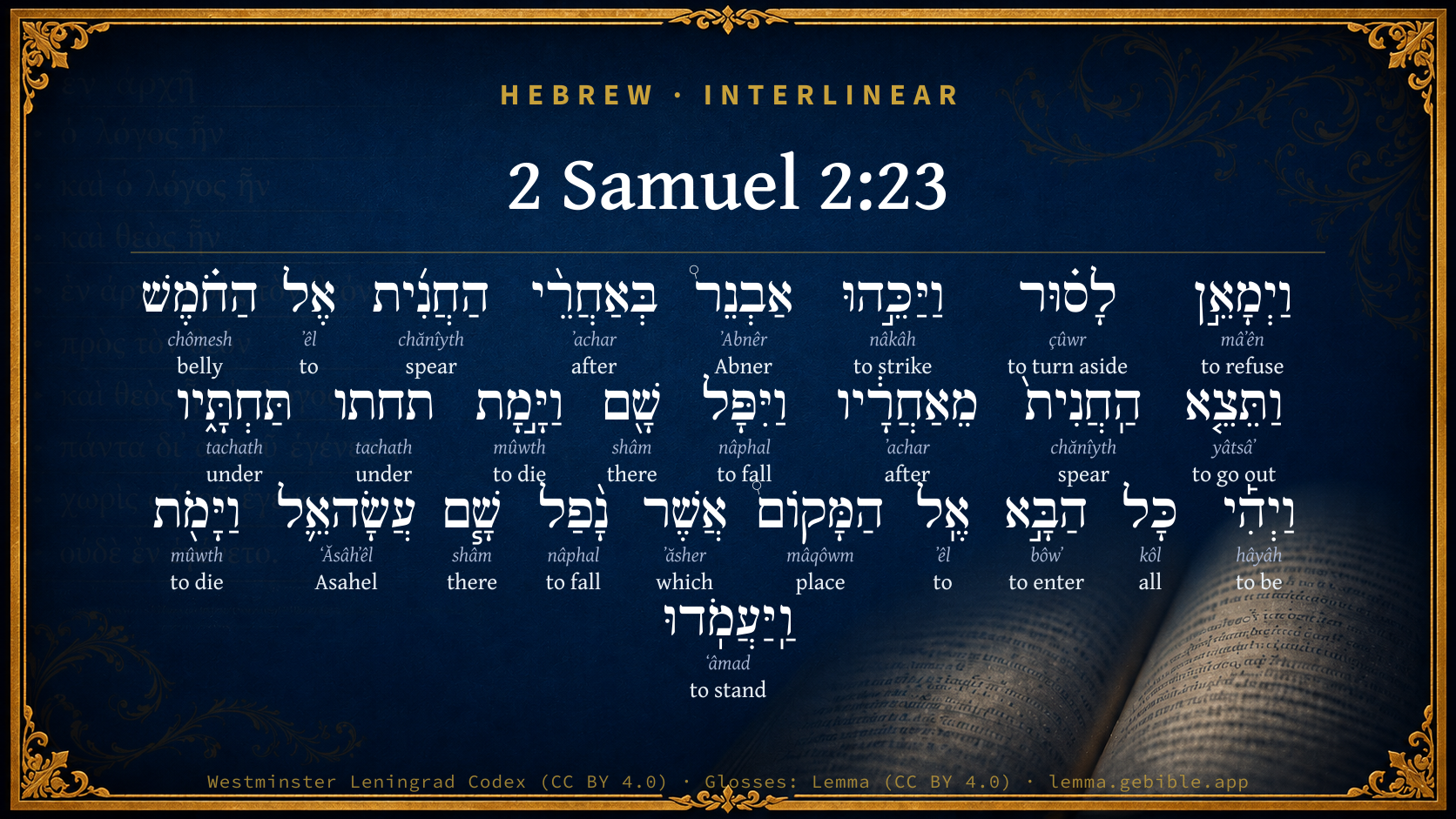
2 Samuel 2:23

Hebrew (Westminster Leningrad Codex) 2 Samuel 2:23 appears in the Hebrew Old Testament. The text above is from the Westminster Leningrad Codex. Each word links to its Strong’s number, a concise gloss, and parsing drawn from the Open Scriptures Hebrew Bible morphology. Click any word for its full Brown-Driver-Briggs (BDB) entry.
Download image
Cite this verse

2 Samuel 2:23 (World English Bible). Public Domain. Lemma interlinear Bible study tool, https://lemma.gebible.app/v/2-samuel/2/23.

Show BibTeX & RIS
BibTeX
RIS
English Translation
However he refused to turn aside: therefore Abner with the hinder end of the spear struck him in the body, so that the spear came out behind him; and he fell down there, and died in the same place: and it happened, that as many as came to the place where Asahel fell down and died stood still.
World English Bible · Public Domain
Highlights
  • 1 first appearance in the Hebrew Bible
Full analysis ↓
Download a study sheet

One document with this verse’s original text, its word-by-word gloss line, the meaning frame, cross-references with their text, attributed commentary, and full source and license credits — printable, and it pastes into notes with its structure intact.

This verse Autodidact and up

Study sheet (.html) Plain text (.txt)

A passage Seminary Student

Up to 50 verses in one chapter. A passage sheet keeps up to 6 commentary sources and 12 cross-references per verse, in the order this page ranks them, and says so on the sheet whenever that leaves anything out. Ask for a single verse and you get the Autodidact verse sheet above.

Everything on this page stays free to read, with no account — the sheet is a download of what is already on screen, not access to it.

Want to remove ads? Support Godless Engineer
Compare translations 3

The same verse in 3 English versions, stacked beneath the original-language interlinear above. Click any original word for its lexicon entry.

Each is an independent rendering of the whole verse — the interlinear is not word-aligned to these translations.

Highlighted words mark where these versions differ — a whole-verse word diff, not a word-by-word alignment.

  • World English Bible Public Domain
    However he refused to turn aside: therefore Abner with the hinder end of the spear struck him in the body, so that the spear came out behind him; and he fell down there, and died in the same place: and it happened, that as many as came to the place where Asahel fell down and died stood still.
  • King James Version Public Domain
    Howbeit he refused to turn aside: wherefore Abner with the hinder end of the spear smote him under the fifth rib, that the spear came out behind him; and he fell down there, and died in the same place: and it came to pass, that as many as came to the place where Asahel fell down and died stood still.
  • unfoldingWord Literal Text CC BY-SA 4.0
    But he refused to turn aside, so Abner struck him with the back end of the spear in the stomach, and the spear came out from his back. And he fell there, and he died under him. And it happened, every one coming to the place where Asahel fell there and died, that they stood.

unfoldingWord Literal Text — © unfoldingWord, licensed CC BY-SA 4.0. Word-aligned USFM3 via Door43 (git.door43.org/unfoldingWord/en_ult).

Versions to compare (up to 4)

3 of 4 selected

Show all 18 translations

Every available English version of this verse, each an independent rendering of the whole verse.

  • World English Bible Public Domain
    However he refused to turn aside: therefore Abner with the hinder end of the spear struck him in the body, so that the spear came out behind him; and he fell down there, and died in the same place: and it happened, that as many as came to the place where Asahel fell down and died stood still.
  • Berean Standard Bible Public Domain
    But Asahel refused to turn away; so Abner thrust the butt of his spear into his stomach, and it came out his back, and he fell dead on the spot. And every man paused when he came to the place where Asahel had fallen and died.
  • Majority Standard Bible Public Domain
    But Asahel refused to turn away. So Abner thrust the butt of his spear into his stomach, and it came out his back, and he fell dead on the spot. And every man paused when he came to the place where Asahel had fallen and died.
  • King James Version Public Domain
    Howbeit he refused to turn aside: wherefore Abner with the hinder end of the spear smote him under the fifth rib, that the spear came out behind him; and he fell down there, and died in the same place: and it came to pass, that as many as came to the place where Asahel fell down and died stood still.
  • American Standard Version (1901) Public Domain
    Howbeit he refused to turn aside: wherefore Abner with the hinder end of the spear smote him in the body, so that the spear came out behind him; and he fell down there, and died in the same place: and it came to pass, that as many as came to the place where Asahel fell down and died stood still.
  • Revised Version (1885) Public Domain
    Howbeit he refused to turn aside: wherefore Abner with the hinder end of the spear smote him in the belly, that the spear came out behind him; and he fell down there, and died in the same place: and it came to pass, that as many as came to the place where Asahel fell down and died stood still.
  • Geneva Bible (1599) Public Domain
    And when he woulde not depart, Abner with the hinder ende of the speare smote him vnder the fift ryb, that the speare came out behind him: and he fell downe there, and dyed in his place. And as many as came to the place where Asahel fell downe and dyed, stoode still.
  • Douay-Rheims (1899) Public Domain
    But he refused to hearken to him, and would not turn aside: wherefore Abner struck him with his spear with a back stroke in the groin, and thrust him through, and he died upon the spot: and all that came to the place where Asael fell down and died stood still.
  • Young's Literal Translation Public Domain
    And he refuseth to turn aside, and Abner smiteth him with the hinder part of the spear unto the fifth `rib', and the spear cometh out from behind him, and he falleth there, and dieth under it; and it cometh to pass, every one who hath come unto the place where Asahel hath fallen and dieth -- they stand still.
  • Literal Standard Version CC BY-SA 4.0
    And he refuses to turn aside, and Abner strikes him with the back part of the spear to the fifth [rib], and the spear comes out from behind him, and he falls there, and dies under it; and it comes to pass, everyone who has come to the place where Asahel has fallen and dies—they stand still.
  • Unlocked Literal Bible CC BY-SA 4.0
    But Asahel refused to turn aside, and so Abner stabbed him in the body with the blunt end of his spear, so that the spear came out the other side. Asahel fell down and died there. So it came about that anyone who arrived at the place where Asahel fell down and died, he stopped and stood still.
  • unfoldingWord Literal Text CC BY-SA 4.0
    But he refused to turn aside, so Abner struck him with the back end of the spear in the stomach, and the spear came out from his back. And he fell there, and he died under him. And it happened, every one coming to the place where Asahel fell there and died, that they stood.
  • Darby Bible Public Domain
    But he refused to turn aside; therefore Abner with the hinder end of the spear smote him in the belly, so that the spear came out behind him; and he fell down there, and died in the same place. And it came to pass, that as many as came to the place where Asahel fell down and died stood still.
  • World Messianic Bible Public Domain
    However, he refused to turn away. Therefore Abner with the back end of the spear struck him in the body, so that the spear came out behind him; and he fell down there and died in the same place. As many as came to the place where Asahel fell down and died stood still.
  • Webster's Bible Public Domain
    But he refused to turn aside: wherefore Abner with the hinder end of the spear smote him under the fifth rib, that the spear came out behind him; and he fell down there, and died in the same place: and it came to pass, that as many as came to the place where Asahel fell down and died, stood still.
  • Free Bible Version CC BY-SA 4.0
    But Asahel wouldn't stop chasing him, so Abner drove the handle of his spear into his belly. It came out the back, and he fell down dead right there. Everyone who passed by stopped at the place where Asahel had fallen and died.
  • Bible in Basic English Public Domain
    But still he did not go to one side: so Abner gave him a back blow in the stomach with his spear, so that the spear came out at his back; and he went down on the earth, wounded to death: and all those who came to the place where Asahel went down dead, came to a stop.
  • JPS Tanakh (1917) Public Domain
    Howbeit he refused to turn aside; wherefore Abner with the hinder end of the spear smote him in the groin, that the spear came out behind him; and he fell down there, and died in the same place; and it came to pass, that as many as came to the place where Asahel fell down and died stood still.

Literal Standard Version (2020), Covenant Press — licensed CC BY-SA 4.0. Text via the HelloAO Bible API (eBible.org). Unlocked Literal Bible (unfoldingWord) — licensed CC BY-SA 4.0. Text via the HelloAO Bible API (eBible.org). unfoldingWord Literal Text — © unfoldingWord, licensed CC BY-SA 4.0. Word-aligned USFM3 via Door43 (git.door43.org/unfoldingWord/en_ult). Free Bible Version, Dr. Jonathan Gallagher — licensed CC BY-SA 4.0. Text via the HelloAO Bible API (eBible.org).

Word by word

More ways to search: Search by grammar → Find every occurrence → Compare this word →

Practice this passage: Drill this verse → Learn its vocabulary →

הַחֹ֗מֶשׁ
chômesh
H2570
“the · belly”
Particle, Definite Article + Noun, Common, Masculine, Singular, Absolute
Part of Speech
Particle + Noun
Type
Common
Gender
Masculine
Number
Singular
State
Absolute
Full BDB Definition

Origin: from an unused root probably meaning, to be stout

TWOT: TWOT- 687a

belly, abdomen, fifth ribs
  1. וַיְמָאֵ֣ן mâʼên H3985 “and · to refuse” Conjunction + Verb, Piel, Sequential Imperfect, 3rd Person, Masculine, Singular
  2. לָס֗וּר çûwr H5493 “to turn aside” Preposition + Verb, Qal, Infinitive Construct
  3. וַיַּכֵּ֣הוּ nâkâh H5221 “and · to strike · him” Conjunction + Verb, Hiphil, Sequential Imperfect, 3rd Person, Masculine, Singular + Suffix, Personal, 3rd Person, Masculine, Singular
  4. אַבְנֵר֩ ʼAbnêr H74 “Abner” Noun, Proper
  5. בְּאַחֲרֵ֨י ʼachar H310 “in/at · after of” Preposition + Noun, Common, Masculine, Plural, Construct
  6. הַחֲנִ֜ית chănîyth H2595 “the · spear” Particle, Definite Article + Noun, Common, Feminine, Singular, Absolute
  7. אֶל ʼêl H413 “to” Preposition
  8. וַתֵּצֵ֤א yâtsâʼ H3318 “and · to go out” Conjunction + Verb, Qal, Sequential Imperfect, 3rd Person, Feminine, Singular
  9. הַֽחֲנִית֙ chănîyth H2595 “the · spear” Particle, Definite Article + Noun, Common, Feminine, Singular, Absolute
  10. מֵאַחֲרָ֔יו ʼachar H310 “from · after · him” Preposition + Preposition + Suffix, Personal, 3rd Person, Masculine, Singular
  11. וַיִּפָּל nâphal H5307 “and · to fall” Conjunction + Verb, Qal, Sequential Imperfect, 3rd Person, Masculine, Singular
  12. שָׁ֖ם shâm H8033 “there” Adverb
  13. וַיָּ֣מָת mûwth H4191 “and · to die” Conjunction + Verb, Qal, Sequential Imperfect, 3rd Person, Masculine, Singular
  14. תחתו tachath H8478 “under · him” Preposition + Suffix, Personal, 3rd Person, Masculine, Singular
  15. תַּחְתָּ֑יו tachath H8478 “under · him” Preposition + Suffix, Personal, 3rd Person, Masculine, Singular
  16. וַיְהִ֡י hâyâh H1961 “and · to be” Conjunction + Verb, Qal, Sequential Imperfect, 3rd Person, Masculine, Singular
  17. כָּל kôl H3605 “all of” Noun, Common, Masculine, Singular, Construct
  18. הַבָּ֣א bôwʼ H935 “the · entering” Particle, Definite Article + Verb, Qal, Participle Active, Masculine, Singular, Absolute
  19. אֶֽל ʼêl H413 “to” Preposition
  20. הַמָּקוֹם֩ mâqôwm H4725 “the · place” Particle, Definite Article + Noun, Common, Masculine, Singular, Absolute
  21. אֲשֶׁר ʼăsher H834 “which” Particle, Relative
  22. נָ֨פַל nâphal H5307 “to fall” Verb, Qal, Perfect, 3rd Person, Masculine, Singular
  23. שָׁ֧ם shâm H8033 “there” Adverb
  24. עֲשָׂהאֵ֛ל ʻĂsâhʼêl H6214 “Asahel” Noun, Proper
  25. וַיָּמֹ֖ת mûwth H4191 “and · to die” Conjunction + Verb, Qal, Sequential Imperfect, 3rd Person, Masculine, Singular
  26. וַֽיַּעֲמֹֽדוּ ʻâmad H5975 “and · to stand” Conjunction + Verb, Qal, Sequential Imperfect, 3rd Person, Masculine, Plural

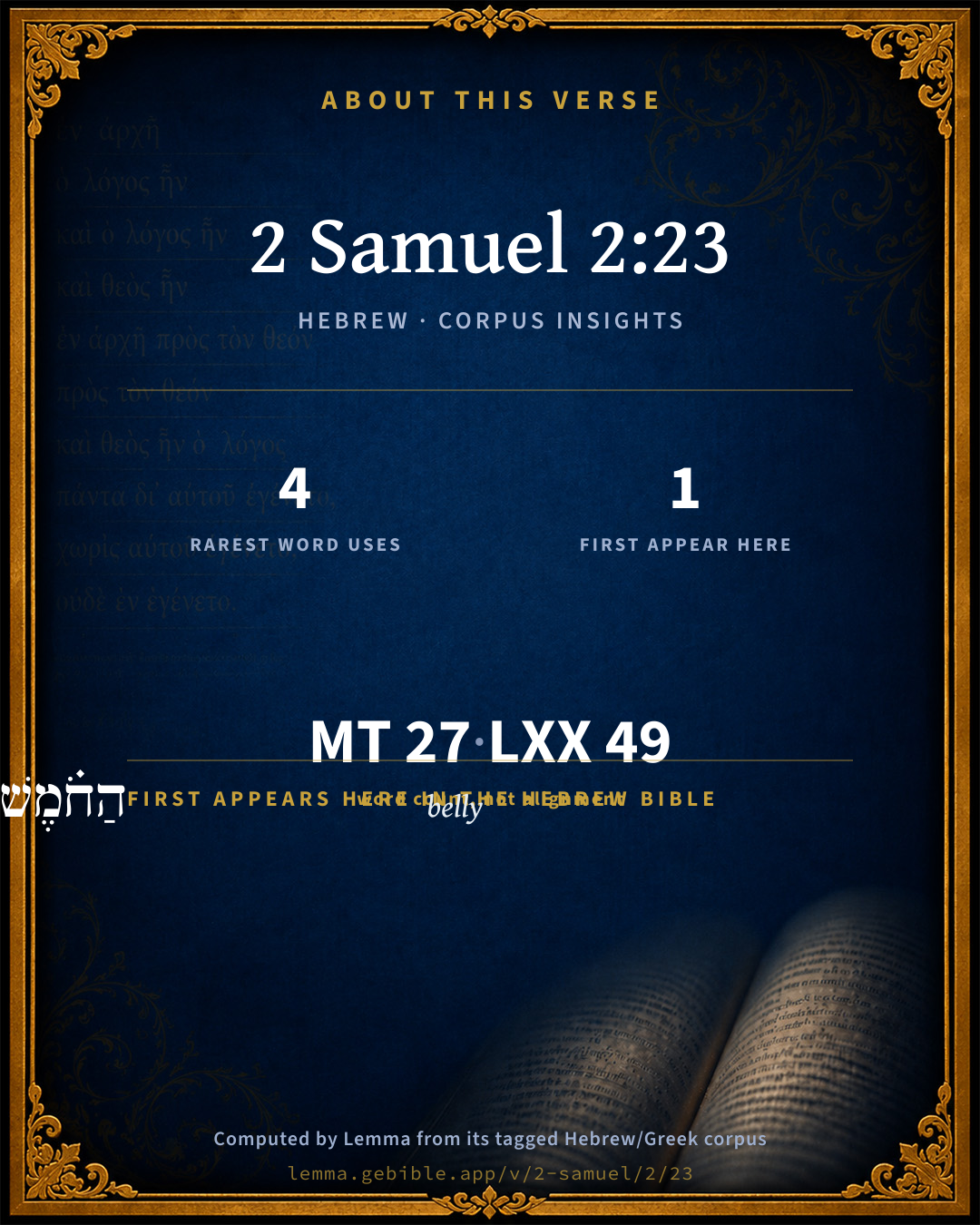
About this verse

These counts appear in no published source. They are computed here, from the morphology-tagged text and Lemma’s own curated glosses. What Lemma adds →

27
words
20
distinct lemmas
Historical
section

Notable vocabulary

The rarest word here is הַחֹ֗מֶשׁ belly H2570 — appearing just 4 times in the whole Hebrew Bible.

First appearance in Scripture

This word makes its first canonical appearance in the Hebrew Bible here:

  • הַחֹ֗מֶשׁ belly H2570

Shared distinctive vocabulary

הַחֹ֗מֶשׁ belly H2570 occurs in 4 verses of the Hebrew Bible. Also found in:

Grammatical profile

  • 11 verbs
  • 8 nouns
  • 5 prepositions
  • 2 adverbs
  • 1 particle

Verb forms

  • וַיְמָאֵ֣ן Piel · Sequential Imperfect
  • לָס֗וּר Qal · Infinitive Construct
  • וַיַּכֵּ֣הוּ Hiphil · Sequential Imperfect
  • וַתֵּצֵ֤א Qal · Sequential Imperfect
  • וַיִּפָּל Qal · Sequential Imperfect
  • וַיָּ֣מָת Qal · Sequential Imperfect
  • וַיְהִ֡י Qal · Sequential Imperfect
  • הַבָּ֣א Qal · Participle Active
  • נָ֨פַל Qal · Perfect
  • וַיָּמֹ֖ת Qal · Sequential Imperfect
  • וַֽיַּעֲמֹֽדוּ Qal · Sequential Imperfect

Repetition

Words recur within this verse — often emphatic in Hebrew:

  • בְּאַחֲרֵ֨י after H310 ×2
  • הַחֲנִ֜ית spear H2595 ×2
  • וַיִּפָּל to fall H5307 ×2
  • שָׁ֖ם there H8033 ×2
  • וַיָּ֣מָת to die H4191 ×2
  • תחתו under H8478 ×2
  • אֶל to H413 ×2

Hebrew & Septuagint length

In English translation the verse runs 58 words from the Hebrew and 66 from the Septuagint (LXX English) — closely comparable.

A rough comparison of the two English renderings, which tokenize alike — not a word-level alignment.

Word counts can differ between the Hebrew and the Greek without any difference in meaning — e.g. the Hebrew direct-object marker אֵת has no separate Greek word, and Greek often adds the article ὁ.

In the original languages it is 27 Hebrew tokens and 49 Greek tokens — but the two are counted differently (Hebrew bundles its prefixes and suffixes into one token; the Greek is in lemma form), so that isn’t a like-for-like length.

Cross-references

5

Topical passages linked to 2 Samuel 2:23 in the Treasury of Scripture Knowledge — connected by theme and wording, ordered by reader-vote popularity; previews shown in the World English Bible.

  • 2 Samuel 3:27 When Abner was returned to Hebron, Joab took him aside into the midst of the gate to speak with him quietly, and struck him there in the body, so that he died, for the blood of Asahel his brother.
  • 2 Samuel 4:6 They came there into the midst of the house, as though they would have fetched wheat; and they struck him in the body: and Rechab and Baanah his brother escaped.
  • 2 Samuel 5:6 The king and his men went to Jerusalem against the Jebusites, the inhabitants of the land, who spoke to David, saying, Except you take away the blind and the lame, you shall not come in here; thinking, David can't come in here.
  • 2 Samuel 20:10 But Amasa took no heed to the sword that was in Joab's hand: so he struck him therewith in the body, and shed out his bowels to the ground, and didn't strike him again; and he died. Joab and Abishai his brother pursued after Sheba the son of Bichri.
  • 2 Samuel 20:12–13 Amasa lay wallowing in his blood in the midst of the highway. When the man saw that all the people stood still, he carried Amasa out of the highway into the field, and cast a garment over him, when he saw that everyone who came by him stood still.

Cross-references courtesy of OpenBible.info (CC BY 4.0).

Hebrew and Greek witnesses Masoretic Hebrew ↔ Greek Septuagint

The same verse in the two great witnesses to the Old Testament, shown verse-for-verse.

These are two independent witnesses, not word-aligned to each other, and the Septuagint is shown in lemma (dictionary) form.

Hebrew 2 Samuel 2:23 Masoretic · Westminster Leningrad Codex

וַיְמָאֵ֣ן לָס֗וּר וַיַּכֵּ֣הוּ אַבְנֵר֩ בְּאַחֲרֵ֨י הַחֲנִ֜ית אֶל הַחֹ֗מֶשׁ וַתֵּצֵ֤א הַֽחֲנִית֙ מֵאַחֲרָ֔יו וַיִּפָּל שָׁ֖ם וַיָּ֣מָת תחתו תַּחְתָּ֑יו וַיְהִ֡י כָּל הַבָּ֣א אֶֽל הַמָּקוֹם֩ אֲשֶׁר נָ֨פַל שָׁ֧ם עֲשָׂהאֵ֛ל וַיָּמֹ֖ת וַֽיַּעֲמֹֽדוּ

However he refused to turn aside: therefore Abner with the hinder end of the spear struck him in the body, so that the spear came out behind him; and he fell down there, and died in the same place: and it happened, that as many as came to the place where Asahel fell down and died stood still.

World English Bible · Public Domain

Greek LXX 2 Samuel 2:23 Septuagint · lemma form

καί οὐ βούλομαι ὁ ἀποἵστημι καί τύπτω αὐτός αβεννηρ ἐν ὁ ὀπίσω ὁ δόρυ ἐπί ὁ ψόαν καί δια ἐκἔρχομαι ὁ δόρυ ἐκ ὁ ὀπίσω αὐτός καί πίπτω ἐκεῖ καί ἀποθνήσκω ὑποκάτω αὐτός καί γίγνομαι πᾶς ὁ ἔρχομαι ἕως ὁ τόπος ὅς πίπτω ἐκεῖ ασαηλ καί ἀποθνήσκω καί ὑποἵστημι

And what does this mean? return to Joab your brother? But he would not stand aloof; and Abenner smites him with the hinder end of the spear on the loins, and the spear went out behind him, and he falls there and dies on the spot: and it came to pass that every one that came to the place where Asael fell and died, stood still.

LXX2012 (modern English Septuagint) · Public Domain

On this verse, Haydock's Catholic Bible Commentary discusses the Septuagint’s reading. Read the note in Commentary ↓

Hebrew: Westminster Leningrad Codex (CC BY 4.0). Greek: Septuagint (public domain); English from LXX2012 (modern English Septuagint) (Public Domain). How the Septuagint differs from the Hebrew →

Targum (Aramaic paraphrase)

1

The Targum is the ancient Jewish Aramaic paraphrase of the Hebrew Scriptures — an interpretive translation, not the Hebrew text itself. Onkelos (literal) and Pseudo-Jonathan (expansive) render the Torah, and Jonathan the Prophets. Coverage is partial: where no permissively-licensed English translation exists for a verse, only the Aramaic is shown. This is verse-level text, not a word-by-word alignment to the Hebrew.

  1. Targum Jonathan Prophets (Joshua–Malachi)
    וְלָא אָבָא לְמֵיזַר וּמְחָהִי אַבְנֵר בַּאֲחוֹרֵי מוּרְנִיתָא בִּסְטַר יַרְכֵיהּ וּנְפָקַת מוּרְנִיתָא מֵאֲחוֹרוֹהִי וּנְפַל תַּמָן וּמִית בְּאַתְרֵיהּ וַהֲוָה כָּל דְאָתֵי לְאַתְרָא דִנְפַל תַּמָן עֲשָׂהאֵל וּמִית וְקַיְמִין:

    (no public-domain English translation for this verse)

    Targum Jonathan — Aramaic: “Mikraot Gedolot” (public domain). English: “Sefaria Community Translation” (CC0 1.0 (public-domain dedication)); “London "Chaldee Paraphrase," 1871” (public domain). Text via Sefaria.

Commentary

Notes on 2 Samuel 2:23 from classic Christian and Jewish commentators (each source and its license shown beneath its notes). The classic Christian expositions comment on the surrounding passage and are grouped to its opening verse, so a note may address several verses; the Jewish commentaries on the Tanakh (Rashi and others) are per-verse, so they appear only where the commentator wrote on this verse.

Lemma curates 59 commentaries, every one of them public domain or Creative Commons licensed, each selected and text-cleaned for this edition rather than reprinted as found. About our sources →

Trapp's Complete Commentary

John Trapp

2Sa 2:23 Howbeit he refused to turn aside: wherefore Abner with the hinder end of the spear smote him under the fifth [rib], that the spear came out behind him; and he fell down there, and died in the same place: and it came to pass, [that] as many as came to the place where Asahel fell down and died stood still.

Ver. 23. Under the fifth rib.] {a} Where the liver and gall are, a sure killing place; for a punishment of his pertinacy, and too eager pursuit of a yielding enemy.

{a} In inguine. - Vulg.

John Trapp, A Commentary or Exposition upon All the Books of the Old and New Testament (1647–1656) — public domain. Text from a community e-Sword module.

Joseph Benson's Commentary

2Sa 2:23. He fell down there and died — So Asahel’s swiftness, which he presumed on so much, only forwarded his fate: with it he ran upon his death, instead of running from it. As many as came to the place stood still — Ceased from the pursuit; fearing, perhaps, the same fate if they followed further; or staying out of respect to Asahel, that his body might not be exposed to any indignity.

Joseph Benson's Commentary on the Old and New Testaments (1811–1818) — public domain. Text from a community e-Sword module.

Geneva Bible (1599)

Geneva Bible translators

Some read, in those parts, whereas the lively parts lie: as the heart, the lungs, the liver, the milt, and the gall.

Geneva Bible (1599) marginal notes — public domain. Text via Bolls.life.

The Cambridge Bible for Schools and Colleges

gen. ed. J. J. S. Perowne

23. with the hinder end of the spear] Abner defended himself in this way with a view to disable rather than kill Asahel. But the butt-end of the spear, pointed or shod with iron to be stuck in the ground (1Sa_26:7; Hom. Il. X. 153), dealt a fatal blow.

under the fifth rib] The E. V. follows the Jewish commentators in thus rendering a word which occurs in three other passages of this book (2Sa_3:27, 2Sa_4:6, 2Sa_20:10) and nowhere else. In the belly is however the more probable meaning.

stood still] Riveted to the spot with awe and grief, mourning the untimely fate of the young hero. Cp. ch. 2Sa_20:12.

The Cambridge Bible for Schools and Colleges (gen. ed. J. J. S. Perowne; Cambridge University Press, 1878–1918) — public domain. Text from a community e-Sword module.

John Gill's Exposition

Howbeit, he refused to turn aside,.... Determined on making him his captive if possible.

Wherefore Abner, with the hinder end of the spear; he had in his hand, which seems to have had a pike at both ends; so that with the hinder end of it, next to Asahel, he thrust it at him, without turning to him: and

smote him under the fifth rib; the place where hang the gall and liver, as the Jewish commentators from their Talmud (i) observe. There are twelve ribs, seven of which are called true ones, and five spurious; if this was the fifth of the seven, the spear must pierce the breast (k), and strike the seat of life, the heart and lungs; if the fifth from the eighth and first of the spurious ones, then wounding the hypochondria, it must pass to the vital bowels of the abdomen, which seems to be the case here (l): according to some (m) this is meant of the inferior ribs, which we call the short ribs, and any of these five are called the fifth rib; and Abner must strike him in the right side, because he was behind him, and which stroke must be deadly, because he struck him through the liver:

that the spear came out behind him: the thrust was so violent that the spear went through him, and came out at his back:

and he fell down and died in the same place; he fell at once, and died on the spot immediately:

and it came to pass, that as many as came to the place where Asahel fell down and died stood still; that is, such of David's men who were in the pursuit after the Israelites, when they came to the spot, and saw Asahel dead, they had no power to proceed in the pursuit, being so troubled and grieved at the death of him.

(i) T. Bab. Sanhedrin, fol. 49. 1. (k) "Transadigit costas, et crates pectoris ensom". Virgil. Aeneod. l. 12. ver. 506. (l) Vid. Scheuchzer. Physic. Sacr. vol. 3. p. 501. (m) Weemse's Portrait of Man, p. 24.

John Gill's Exposition of the Whole Bible (1746–1763) — public domain (CC PDM 1.0). Text via the HelloAO Bible API.

Albert Barnes' Notes on the Bible

With the hinder end ... - i. e. the wooden end, which was more or less pointed to enable the owner to stick it in the ground 1Sa 26:7.

The fifth rib - The word so rendered here (and in marginal references) means the abdomen, and is not etymologically connected with the Hebrew for five, as the translation “fifth rib” supposes, but with a verb meaning to be fat, or strong.

Albert Barnes' Notes on the Bible (1834–1885) — public domain. Text from a community e-Sword/MySword module.

Haydock's Catholic Bible Commentary

Stroke, (aversa.) Hebrew, "with the hinder end of the spear, under the fifth rib." Septuagint, "in the loin."

George Leo Haydock (1774–1849), Haydock's Catholic Family Bible and Commentary, 1859 edition — public domain. Excludes Psalms (Douay-Rheims chapter numbering differs from Protestant) and Deuterocanonical books (Catholic canon only).

Matthew Poole's English Annotations

The hinder end of the spear was sharp-pointed, after the manner.

Under the fifth rib; the seat of the liver and bowels, where wounds are mortal.

In the same place; upon the spot, not being able to go one step further.

Matthew Poole's English Annotations on the Holy Bible (1683–1685) — public domain. Text from a community e-Sword/MySword module.

Whedon's Commentary on the Bible

Daniel D. Whedon

23. He refused to turn aside — He believed that he could conquer Abner, and he was unwilling to lose the opportunity of gaining that honour.

The hinder end of the spear — Which was sharpened, so as to stick in the ground when not in use. 1Sa_26:7.

Under the fifth rib — Rather, in the abdomen. The Hebrew word comes from the root חמשׂ, to be fat.

Stood still — Horror stricken at the bloody sight.

Daniel D. Whedon (gen. ed.), Commentary on the Old and New Testaments (1874–1909) — public domain. Text from a community e-Sword module.

The Pulpit Commentary

The fifth rib. This rendering here and in other places arises from the derivation of the word from the numeral five, but this notion has long been abandoned, and the word is now known to be formed from a verb signifying "to be fat or stout." Really it means the abdomen, and is so translated in the LXX and Vulgate, while the Syriac gives only the general sense, and renders "the breast." In the same place; Hebrew, under him; that is, immediately. So violent was the blow that Asahel dropped down dead without a struggle. So tragic was his fate, and so great the affection of David"s men for the young warrior, that the pursuit ceased, and all, as they came up, remained standing by the side of the corpse.

The Pulpit Commentary (1880–1919), ed. H.D.M. Spence-Jones & Joseph S. Exell — public domain. Text from a community e-Sword module.

John Wesley's Explanatory Notes

And died - So Asahel's swiftness, which he presumed on so much, only forwarded his fate! With it he ran upon his death, instead of running from it.

John Wesley, Explanatory Notes Upon the Whole Bible (1754–1765) — public domain. Text via the GEBible commentary corpus.

Keil & Delitzsch

C. F. Keil & F. Delitzsch

But when he still refused to depart in spite of this warning, Abner wounded him in the abdomen with the hinder part, i.e., the lower end of the spear, so that the spear came out behind, and Asahel fell dead upon the spot. The lower end of the spear appears to have been pointed, that it might be stuck into the ground (vid., Sa1 26:7); and this will explain the fact that the spear passed through the body. The fate of the young hero excited such sympathy, that all who came to the place where he had fallen stood still to mourn his loss (cf. Sa2 20:12).

Keil & Delitzsch — Biblical Commentary on the Old Testament (1861–1891) — public domain (CC PDM 1.0). Text via the HelloAO Bible API. (Old Testament only.)

Rashi

Rabbi Shlomo Yitzchaki (Rashi)

Into the fifth rib. As [if to say] the fifth rib, the place where the bile and the liver are set. [But] Yonasan translated [this to mean] "on the side of his thigh,"

And died in his place. And died in his place.

Rashi on the Tanakh — English translations: “The Judaica Press complete Tanach with Rashi, translated by A. J. Rosenberg” (CC BY 4.0); “Pentateuch with Rashi's commentary by M. Rosenbaum and A.M. Silbermann, 1929-1934” (public domain); “The Metsudah Tanach series, Lakewood, N.J” (CC BY 4.0); and “The Book of Joshua, Metsudah Publications, 1997” (CC BY 4.0). Text via Sefaria.

Lesson kit

Teaching starters — assembled from the data on this page, not authored interpretation. Every prompt links to the verse data it draws on. Edit before teaching.

2 Samuel, in the Historical, opens this verse with 27 words (20 distinct Hebrew lemmas). Its most distinctive word is chômesh (“belly”). A historical commentator’s framing appears above. Read the whole chapter for the surrounding context.

Discussion questions

  1. What does “belly” (chômesh) contribute to the verse as a whole?
  2. The word “belly” first appears here in Scripture. What is being introduced at this debut?
  3. 2 Samuel 3:27 shares the word «belly» with this verse. How do the two illuminate each other?
  4. “after” occurs 2× in this one verse. What is the effect of the repetition?
  5. The translations on this page render this verse differently — a whole-verse word diff, not a word-by-word alignment. What might account for the different wordings?
  6. The verb «וַיְמָאֵ֣ן» is Piel Sequential Imperfect. How does its form color the action?
  7. Reading how Trapp's Complete Commentary and Joseph Benson's Commentary read this verse, where do the two commentators agree and where do they part?

Things to notice

Reading settings

Reading text

Shown beneath each verse's original-language words.

Old Testament
Old Testament edition

Read the OT as the Masoretic Hebrew (MT) or the Greek Septuagint (LXX).

English shown for the Greek Septuagint (in the Hebrew ↔ Greek comparison).

Comparing translations? Open the Compare panel on any verse page to stack up to four side by side.