
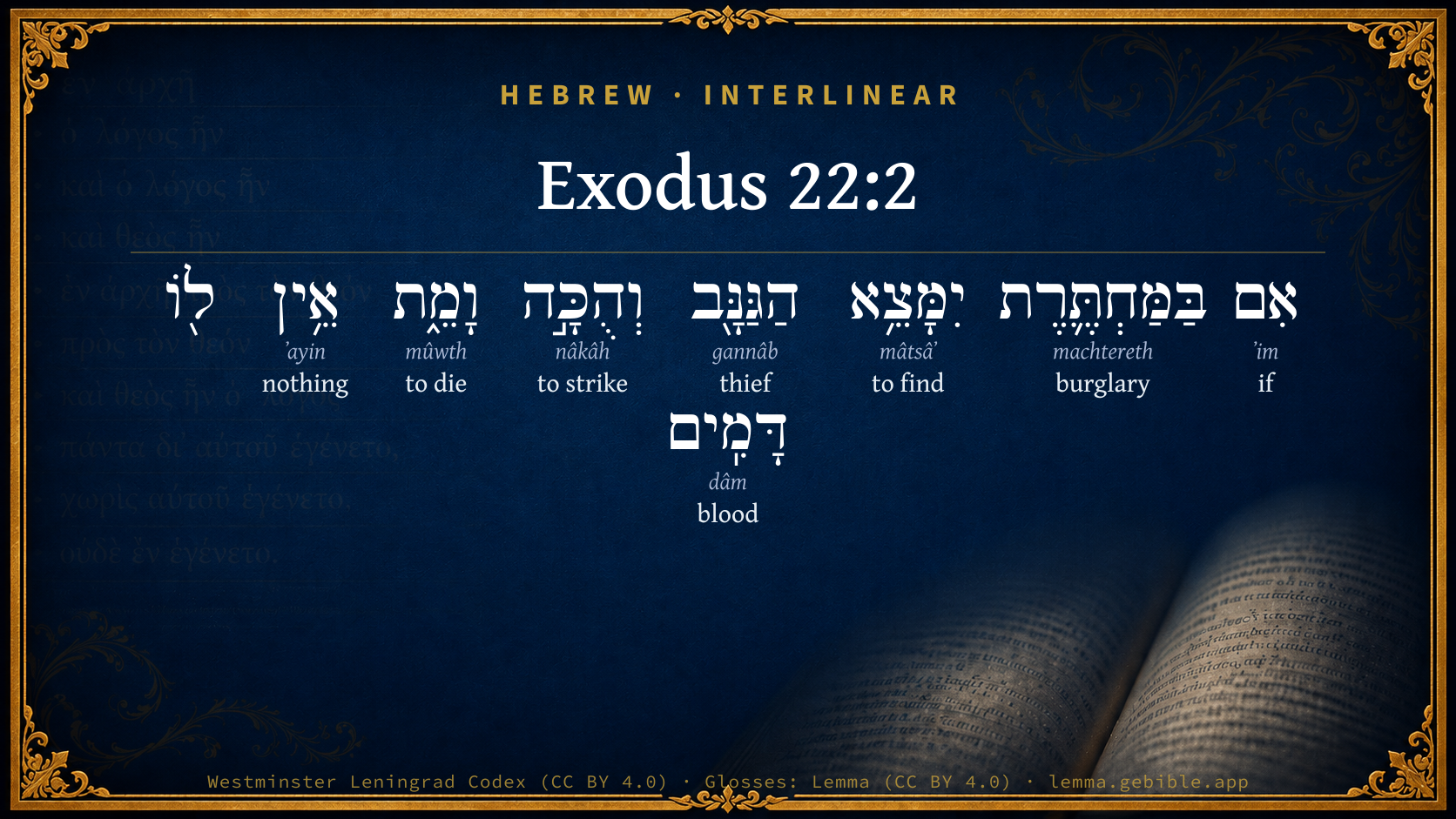
Exodus 22:2

Hebrew (Westminster Leningrad Codex) Exodus 22:2 appears in the Hebrew Old Testament. The text above is from the Westminster Leningrad Codex. Each word links to its Strong’s number, a concise gloss, and parsing drawn from the Open Scriptures Hebrew Bible morphology. Click any word for its full Brown-Driver-Briggs (BDB) entry.
Download image
Cite this verse

Exodus 22:2 (World English Bible). Public Domain. Lemma interlinear Bible study tool, https://lemma.gebible.app/v/exodus/22/2.

Show BibTeX & RIS
BibTeX
RIS
English Translation
If the thief is found breaking in, and is struck so that he dies, there shall be no guilt of bloodshed for him.
World English Bible · Public Domain
Highlights
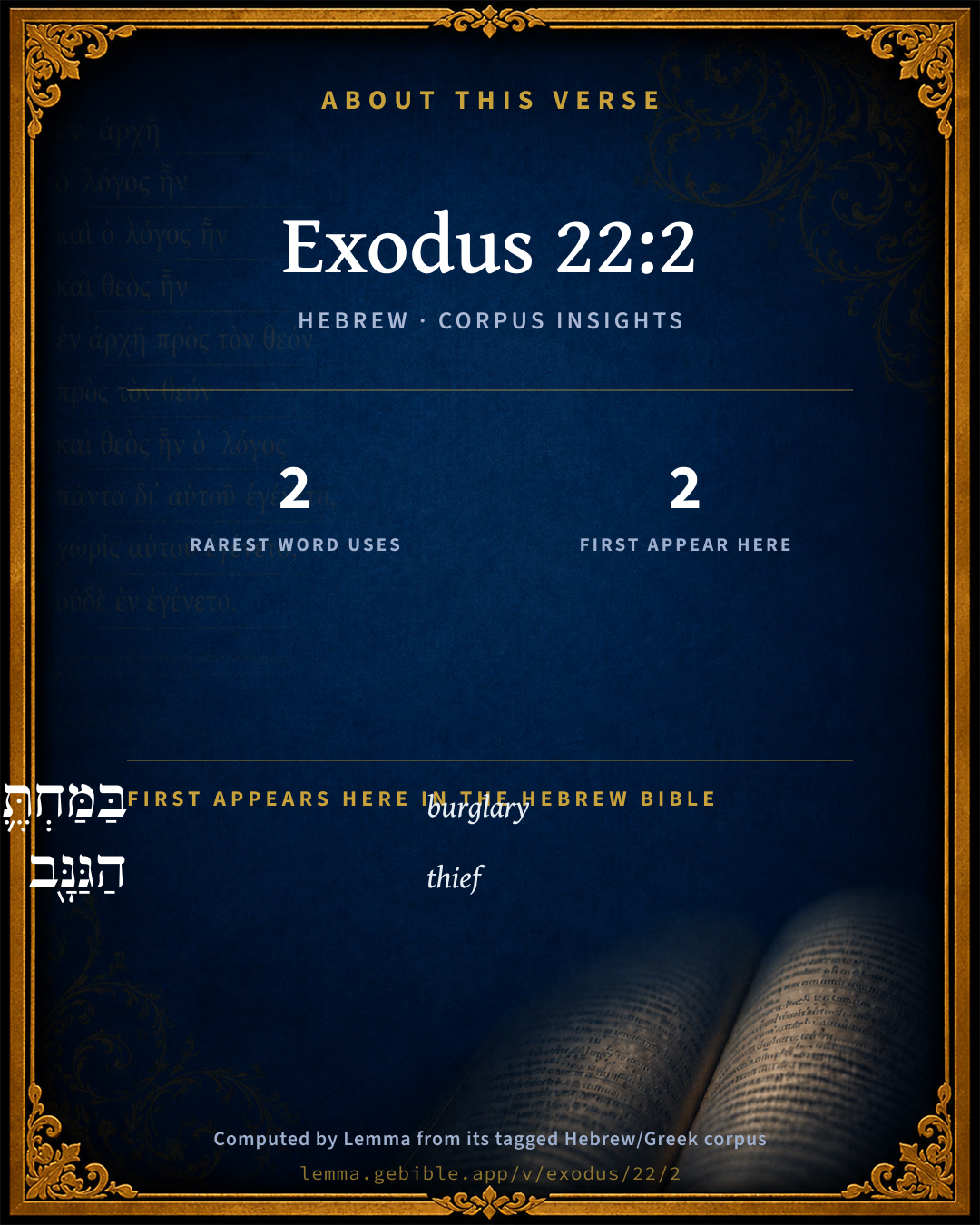
  • 2 first appearances in the Hebrew Bible
Full analysis ↓
Download a study sheet

One document with this verse’s original text, its word-by-word gloss line, the meaning frame, cross-references with their text, attributed commentary, and full source and license credits — printable, and it pastes into notes with its structure intact.

This verse Autodidact and up

Study sheet (.html) Plain text (.txt)

A passage Seminary Student

Up to 50 verses in one chapter. A passage sheet keeps up to 6 commentary sources and 12 cross-references per verse, in the order this page ranks them, and says so on the sheet whenever that leaves anything out. Ask for a single verse and you get the Autodidact verse sheet above.

Everything on this page stays free to read, with no account — the sheet is a download of what is already on screen, not access to it.

Want to remove ads? Support Godless Engineer
Compare translations 3

The same verse in 3 English versions, stacked beneath the original-language interlinear above. Click any original word for its lexicon entry.

Each is an independent rendering of the whole verse — the interlinear is not word-aligned to these translations.

Highlighted words mark where these versions differ — a whole-verse word diff, not a word-by-word alignment.

  • World English Bible Public Domain
    If the thief is found breaking in, and is struck so that he dies, there shall be no guilt of bloodshed for him.
  • King James Version Public Domain
    If a thief be found breaking up, and be smitten that he die, there shall no blood be shed for him.
  • unfoldingWord Literal Text CC BY-SA 4.0
    If a thief is found while breaking in, and he is struck and he dies, there is no bloodguilt for him.

unfoldingWord Literal Text — © unfoldingWord, licensed CC BY-SA 4.0. Word-aligned USFM3 via Door43 (git.door43.org/unfoldingWord/en_ult).

Versions to compare (up to 4)

3 of 4 selected

Show all 18 translations

Every available English version of this verse, each an independent rendering of the whole verse.

  • World English Bible Public Domain
    If the thief is found breaking in, and is struck so that he dies, there shall be no guilt of bloodshed for him.
  • Berean Standard Bible Public Domain
    If a thief is caught breaking in and is beaten to death, no one shall be guilty of bloodshed.
  • Majority Standard Bible Public Domain
    If a thief is caught breaking in and is beaten to death, no one shall be guilty of bloodshed.
  • King James Version Public Domain
    If a thief be found breaking up, and be smitten that he die, there shall no blood be shed for him.
  • American Standard Version (1901) Public Domain
    If the thief be found breaking in, and be smitten so that he dieth, there shall be no bloodguiltiness for him.
  • Revised Version (1885) Public Domain
    If the thief be found breaking in, and be smitten that he die, there shall be no bloodguiltiness for him.
  • Geneva Bible (1599) Public Domain
    If a thiefe bee founde breaking vp, and be smitten that he dye, no blood shall be shed for him.
  • Douay-Rheims (1899) Public Domain
    If a thief be found breaking open a house or undermining it, and be wounded so as to die: he that slew him shall not be guilty of blood.
  • Young's Literal Translation Public Domain
    `If in the breaking through, the thief is found, and he hath been smitten, and hath died, there is no blood for him;
  • Literal Standard Version CC BY-SA 4.0
    If in the breaking through, the thief is found, and he has been struck and has died, there is no blood for him;
  • Unlocked Literal Bible CC BY-SA 4.0
    If a thief is found breaking in, and if he is struck so that he dies, in that case no guilt for murder will attach to anyone on his account.
  • unfoldingWord Literal Text CC BY-SA 4.0
    If a thief is found while breaking in, and he is struck and he dies, there is no bloodguilt for him.
  • Darby Bible Public Domain
    If the thief be encountered breaking in, and be smitten so that he die, there shall be no blood-guiltiness for him.
  • World Messianic Bible Public Domain
    If the thief is found breaking in, and is struck so that he dies, there shall be no guilt of bloodshed for him.
  • Webster's Bible Public Domain
    If a thief shall be found breaking through, and be smitten that he die, there shall no blood be shed for him.
  • Free Bible Version CC BY-SA 4.0
    If a thief is discovered breaking into someone's house and is beaten to death, no one shall be guilty of murder.
  • Bible in Basic English Public Domain
    If a thief is taken in the act of forcing his way into a house, and his death is caused by a blow, the owner of the house is not responsible for his blood.
  • JPS Tanakh (1917) Public Domain
    (22-1) If a thief be found breaking in, and be smitten so that he dieth, there shall be no bloodguiltiness for him.

Literal Standard Version (2020), Covenant Press — licensed CC BY-SA 4.0. Text via the HelloAO Bible API (eBible.org). Unlocked Literal Bible (unfoldingWord) — licensed CC BY-SA 4.0. Text via the HelloAO Bible API (eBible.org). unfoldingWord Literal Text — © unfoldingWord, licensed CC BY-SA 4.0. Word-aligned USFM3 via Door43 (git.door43.org/unfoldingWord/en_ult). Free Bible Version, Dr. Jonathan Gallagher — licensed CC BY-SA 4.0. Text via the HelloAO Bible API (eBible.org).

Word by word

More ways to search: Search by grammar → Find every occurrence → Compare this word →

Practice this passage: Drill this verse → Learn its vocabulary →

About this verse

These counts appear in no published source. They are computed here, from the morphology-tagged text and Lemma’s own curated glosses. What Lemma adds →

9
words
8
distinct lemmas
Pentateuch
section

Notable vocabulary

The rarest word here is בַּמַּחְתֶּ֛רֶת burglary H4290 — appearing just 2 times in the whole Hebrew Bible.

First appearance in Scripture

These words make their first canonical appearance in the Hebrew Bible here:

  • בַּמַּחְתֶּ֛רֶת burglary H4290
  • הַגַּנָּ֖ב thief H1590

Shared distinctive vocabulary

בַּמַּחְתֶּ֛רֶת burglary H4290 occurs in 2 verses of the Hebrew Bible. Also found in:

Grammatical profile

  • 3 verbs
  • 3 nouns
  • 1 preposition
  • 1 conjunction
  • 1 particle

Verb forms

  • יִמָּצֵ֥א Niphal · Imperfect
  • וְהֻכָּ֣ה Hophal · Perfect
  • וָמֵ֑ת Qal · Perfect

Hebrew & Septuagint length

In English translation the verse runs 23 words from the Hebrew and 25 from the Septuagint (LXX English) — closely comparable.

A rough comparison of the two English renderings, which tokenize alike — not a word-level alignment.

Word counts can differ between the Hebrew and the Greek without any difference in meaning — e.g. the Hebrew direct-object marker אֵת has no separate Greek word, and Greek often adds the article ὁ.

Cross-references

8

Topical passages linked to Exodus 22:2 in the Treasury of Scripture Knowledge — connected by theme and wording, ordered by reader-vote popularity; previews shown in the World English Bible.

  • Matthew 24:43 But know this, that if the master of the house had known in what watch of the night the thief was coming, he would have watched, and would not have allowed his house to be broken into.
  • Numbers 35:27 and the avenger of blood find him outside of the border of his city of refuge, and the avenger of blood kill the manslayer; he shall not be guilty of blood,
  • Matthew 6:19–20 "Don't lay up treasures for yourselves on the earth, where moth and rust consume, and where thieves break through and steal;
  • Job 24:14 The murderer rises with the light. He kills the poor and needy. In the night he is like a thief.
  • Job 30:5 They are driven forth from the midst of men; They cry after them as after a thief;
  • Hosea 7:1 When I would heal Israel, Then the iniquity of Ephraim is uncovered, Also the wickedness of Samaria; For they commit falsehood, And the thief enters in, And the gang of robbers ravages outside.
  • Joel 2:9 They rush on the city. They run on the wall. They climb up into the houses. They enter in at the windows like thieves.
  • 1 Thessalonians 5:2 For you yourselves know well that the day of the Lord comes like a thief in the night.

Cross-references courtesy of OpenBible.info (CC BY 4.0).

Hebrew and Greek witnesses Masoretic Hebrew ↔ Greek Septuagint

The same verse in the two great witnesses to the Old Testament, shown verse-for-verse.

These are two independent witnesses, not word-aligned to each other, and the Septuagint is shown in lemma (dictionary) form.

Hebrew Exodus 22:2 Masoretic · Westminster Leningrad Codex

אִם בַּמַּחְתֶּ֛רֶת יִמָּצֵ֥א הַגַּנָּ֖ב וְהֻכָּ֣ה וָמֵ֑ת אֵ֥ין ל֖וֹ דָּמִֽים

If the thief is found breaking in, and is struck so that he dies, there shall be no guilt of bloodshed for him.

World English Bible · Public Domain

Greek LXX Exodus 22:2 Septuagint · lemma form

ἐάν δέ ἀνατέλλω ὁ ἥλιος ἐπί αὐτός ἔνοχος εἰμί ἀντι ἀποθνήσκω ἐάν δέ μή ὑποἄρχω αὐτός πιπράσκω ἀντί ὁ κλέμμα

And if the thief be found in the breach made by himself and be struck and die, there shall not be blood shed for him.

LXX2012 (modern English Septuagint) · Public Domain

Hebrew: Westminster Leningrad Codex (CC BY 4.0). Greek: Septuagint (public domain); English from LXX2012 (modern English Septuagint) (Public Domain). How the Septuagint differs from the Hebrew →

Targum (Aramaic paraphrase)

2

The Targum is the ancient Jewish Aramaic paraphrase of the Hebrew Scriptures — an interpretive translation, not the Hebrew text itself. Onkelos (literal) and Pseudo-Jonathan (expansive) render the Torah, and Jonathan the Prophets. Coverage is partial: where no permissively-licensed English translation exists for a verse, only the Aramaic is shown. This is verse-level text, not a word-by-word alignment to the Hebrew.

  1. Targum Onkelos Torah (Genesis–Deuteronomy)
    אִם עֵינָא דְסַהֲדַיָא נְפָלַת עֲלוֹהִי דְמָא לֵהּ שַׁלָמָא יְשַׁלֵם אִם לֵית לֵהּ וְיִזְדַבַּן בִּגְנֻבְתֵּהּ:

    (no public-domain English translation for this verse)

    Targum Onkelos — Aramaic: “Onkelos Genesis” (public domain); “Onkelos Exodus” (public domain); “Onkelos Leviticus” (public domain); “Onkelos Numbers” (public domain); “Onkelos Deuteronomy” (public domain). English: “Sefaria Community Translation” (CC0 1.0 (public-domain dedication)); “J.W. Etheridge. The Targums of Onkelos and Jonathan Ben Uzziel on the Pentateuch. London: Longmans, Green, 1862” (public domain). Text via Sefaria.

  2. Targum Pseudo-Jonathan Torah (Genesis–Deuteronomy)
    אִין בָּרִיר פִּתְגָּמָא כְשִׁמְשָׁא דְּלָא לְמִיקְטוֹל נְפַשׁ עָאל וְקַטְלֵיהּ חוֹבַת שְׁפִיכוּת אֲדַם זַכְּאַי עֲלוֹי וְאִין אִישְׁתְּזִיב מִן יְדוֹי שַׁלָמָא יְשַׁלֵם אִין לֵית לֵיהּ מַה דִּמְשַׁלֵם וְיִזְדַּבֵּן לֵיהּ בֵּית דִּינָא מִן גְּנִיבוּתֵיהּ וְעַד שַׁתָּא דִשְׁמִיטְתָא

    If the thing be as clear as the sun that he was not entering to destroy life, and one hath killed him, the guilt of the shedding of innocent blood is upon him; and if spared from his hand, restoring he shall restore. If he have not wherewith to restore, the beth din shall sell him for his theft until the year of release.

    Targum Pseudo-Jonathan — Aramaic: “Targum Jonathan on Genesis” (public domain); “Targum Jonathan on Exodus” (public domain); “Targum Jonathan on Leviticus” (public domain); “Targum Jonathan on Numbers” (public domain); “Targum Jonathan on Deuteronomy” (public domain). English: “The Targum of Jonathan ben Uzziel, trans. J. W. Etheridge, London, 1862” (public domain). Text via Sefaria.

Commentary

Notes on Exodus 22:2 from classic Christian and Jewish commentators (each source and its license shown beneath its notes). The classic Christian expositions comment on the surrounding passage and are grouped to its opening verse, so a note may address several verses; the Jewish commentaries on the Tanakh (Rashi and others) are per-verse, so they appear only where the commentator wrote on this verse.

Lemma curates 59 commentaries, every one of them public domain or Creative Commons licensed, each selected and text-cleaned for this edition rather than reprinted as found. About our sources →

Trapp's Complete Commentary

John Trapp

Exo 22:2 If a thief be found breaking up, and be smitten that he die, [there shall] no blood [be shed] for him.

Ver. 2. If a thief be found.] So, if an adulteress be taken, - as she was in Joh 8:4, - επαυτοφωρω, in the very act.

John Trapp, A Commentary or Exposition upon All the Books of the Old and New Testament (1647–1656) — public domain. Text from a community e-Sword module.

Joseph Benson's Commentary

Exo 22:2. If a thief broke into a house in the night, and was killed in the doing it, his blood was upon his own head; but if it were in the day-time that the thief was killed, he that killed him was accountable for it, unless it were in the necessary defence of his own life.

Joseph Benson's Commentary on the Old and New Testaments (1811–1818) — public domain. Text from a community e-Sword module.

Geneva Bible (1599)

Geneva Bible translators

Breaking an house to enter in, or undermining.

Geneva Bible (1599) marginal notes — public domain. Text via Bolls.life.

Adam Clarke's Commentary

Verse 2. If a thief be found] If a thief was found breaking into a house in the night season, he might be killed; but not if the sun had risen, for then he might be known and taken, and the restitution made which is mentioned in the succeeding verse. So by the law of England it is a burglary to break and enter a house by night; and "anciently the day was accounted to begin only from sunrising, and to end immediately upon sunset: but it is now generally agreed that if there be daylight enough begun or left, either by the light of the sun or twilight, whereby the countenance of a person may reasonably be discerned, it is no burglary; but that this does not extend to moonlight, for then many midnight burglaries would go unpunished. And besides, the malignity of the offence does not so properly arise, as Mr. Justice Blackstone observes, from its being done in the dark, as at the dead of night when all the creation except beasts of prey are at rest; when sleep has disarmed the owner, and rendered his castle defenceless." - East's Pleas of the Crown, vol. ii., p. 509.

Adam Clarke's Commentary on the Bible (1810–1826) — public domain. Text from a community e-Sword/MySword module.

Ellicott's Commentary for English Readers

(2) If a thief be found breaking up.—Rather, breaking in: i.e., making forcible entry into a dwelling-house. Most codes agree with the Mosaic in allowing the inmates of the house to resist such an attempt if made at night, and to shed the blood of the burglar, if necessary. He may be considered as having dissolved the “social compact,” and converted himself from a fellow-citizen into a public enemy. A murderous intent on his part may be suspected.

A Bible Commentary for English Readers, edited by Charles John Ellicott (1878–1897) — public domain. Text from a community e-Sword module.

The Cambridge Bible for Schools and Colleges

gen. ed. J. J. S. Perowne

2–3a. A thief caught breaking in by night may be killed without any guilt being incurred by his death, but not if the act take place by day. In the dark the householder would probably not be able to recognize the burglar, so as to bring him to justice, nor would he know whether he might not intend murder: a mortal blow, given in defence of his life and property, would therefore be excusable under the circumstances: but no such excuse could be made for it in the light of day. A thief might also be killed in the night with impunity by Athenian law (Dem. Timocr., § 113, p. 736; cf. Plato, Legg. ix. 874 b), and by the law of the XII. Tables (viii. 12) ‘si nox furtum factum sit, si im (eum) occisit, iure caesus esto.’ Ḥamm. § 21 is not really parallel: see Cook, p.213.

2. breaking in] digging through: cf. Jer_2:34, Job_24:16, Mat_6:19 RVm. Still the usual method of housebreakers in Syria: see Trumbull, The Threshold Covenant (1896), p. 260 f.

for him] i.e. for the householder, if he kills him in the darkness. For the expression, cf. Num_35:27 RVm. (אין לו דם); and for ‘blood’ (marg.), implying ‘bloodguiltiness,’ Psa_51:14. Elsewhere blood is said to be ‘upon’ a person, Deu_19:10.

3a. upon him] i.e. upon the thief.

for him] the householder, as v. 2.

3b. If the text is correct, we must understand tacitly after v. 3a, ‘[He ought not therefore to be killed;] he should make restitution, &c.’ This however is a good deal to supply: both v. 2 and v. 3a start distinctly from the supposition that the thief is slain; and the ox, ass or sheep, of v. 4, are hardly likely to have been found in the house that was ‘dug’ into, v. 2. Hence there is great probability in Budde’s view that vv. 2, 3a are out of place; and that vv. 3b, 4 form really the sequel to v. 1, stating what is to be done in the two other alternative cases, (1) if the thief have nothing, (2) if the stolen animal be found in his possession alive. Render then (directly following v. 1): (v. 3b) ‘he shall surely make restitution [the word rendered ‘pay’ in vv. 1, 4]: if he have nothing, then he shall be sold,’ &c. (to the end of v. 4).

for his theft] i.e. not ‘as a punishment for his act of stealing,’ but ‘as compensation for the thing stolen.’ ‘According to Jos. Ant. xvi. 1. 1 a thief sold under these circumstances was not sold to a foreigner, and became free in the 7th year (ch. Exo_21:2)’ (Kn.).

The Cambridge Bible for Schools and Colleges (gen. ed. J. J. S. Perowne; Cambridge University Press, 1878–1918) — public domain. Text from a community e-Sword module.

John Gill's Exposition

If a thief be found breaking up,.... An house, in order to steal money, jewels, household goods, &c. or breaking through any fence, hedge, or wall of any enclosure, where oxen, or sheep, or any other creatures are, in order to take them away: the Targum of Jonathan is,"if in the hole of a wall (or window of it) a thief be found;''that is, in the night, as appears from the following verse, "if the sun", &c. to which this is opposed, as Aben Ezra observes; some render it, with a digging instrument (x); and it is a Jewish canon (y), that"if anyone enter with a digging instrument: he is condemned on account of his end;''his design, which is apparent by the instrument found upon him; for, as Maimonides (z) observes,"it is well known, that if anyone enters with a digging instrument, that he intends, if the master of the house opposes him to deliver his goods out of his power, that he will kill him, and therefore it is lawful to kill him; but it does not signify whether he enters with a digging instrument, either by the way of the court, or roof;"

and be smitten that he die be knocked down with a club, by the master of the house, or any of his servants, or be run through with a sword, or be struck with any other weapon, to hinder him from entrance and carrying off any of the goods of the house, and the blow be mortal: there shall no blood be shed for him: as for a man that is murdered; for to kill a man when breaking into a house, and, by all appearance, with an intention to commit murder, if resisted, in defence of a man's self, his life and property, was not to be reckoned murder, and so not punishable with death: or, "no blood" shall be "unto him" (a); shall be imputed to him, the man that kills the thief shall not be chargeable with his blood, or suffer for shedding it; because his own life was risked, and it being at such a time, could call none to his assistance, nor easily discern the person, nor could know well where and whom he struck.

(x) "cum perfossorio", Pagninus; "cum instrumento perfosserio", Tigurine version. (y) Misn. Sanhedrin, c. 8. sect. 6. (z) Comment. in ib. (a) "non ei sanguines", Montanus, Vatablus, Drusius.

John Gill's Exposition of the Whole Bible (1746–1763) — public domain (CC PDM 1.0). Text via the HelloAO Bible API.

Albert Barnes' Notes on the Bible

If a thief, in breaking into a dwelling in the night, was slain, the person who slew him did not incur the guilt of blood; but if the same occurred in daylight, the slayer was guilty in accordance with Exo 21:12. The distinction may have been based on the fact that in the light of day there was a fair chance of identifying and apprehending the thief.

Albert Barnes' Notes on the Bible (1834–1885) — public domain. Text from a community e-Sword/MySword module.

Haydock's Catholic Bible Commentary

Blood. The reason is, because it could not easily be known whether the thief had not a design upon the life of the people in the house; and therefore, the law gave them authority to defend themselves. But they were not authorized to kill the thief designedly. the laws of Athens and of Rome, permitted nocturnal robbers to be slain, at least when they came armed. (Plato, de leg. ix. &c.) To defend our goods or honour, by killing the aggressor, is contrary to justice and reason. (Calmet)

George Leo Haydock (1774–1849), Haydock's Catholic Family Bible and Commentary, 1859 edition — public domain. Excludes Psalms (Douay-Rheims chapter numbering differs from Protestant) and Deuterocanonical books (Catholic canon only).

Matthew Poole's English Annotations

Breaking up, to wit, an house, which the Chaldee here adds, and by night, as appears from the next verse.

For him, i.e. for the thief, though he be killed by a man in his own defence. Because in that case the thief might be presumed to have a worse design, and the owner of the house could neither expect or have the help of others to secure him from the intended violence, nor guide his blows with that discretion and moderation which in the day-time he might use.

Matthew Poole's English Annotations on the Holy Bible (1683–1685) — public domain. Text from a community e-Sword/MySword module.

Whedon's Commentary on the Bible

Daniel D. Whedon

2. No blood… for him — The thief who breaks into a house in the nighttime is commonly none too good to commit the foulest deeds. There would be no telling all his purposes; and, if slain in the act of such a crime the slayer was not to be looked upon as guilty of murder.

Daniel D. Whedon (gen. ed.), Commentary on the Old and New Testaments (1874–1909) — public domain. Text from a community e-Sword module.

The Pulpit Commentary

If a thief be found breaking up. Rather, "Breaking ini.e. , making forcible entry into a house. The ordinary mode of "breaking in" seems to have been by a breach in the wall. Hence the word here used, which is derived from khathar, "to dig." There shall no blood be shed for him. Rather, "the blood-feud shall not lie upon himi.e. , the avenger of blood shall not be entitled to proceed against his slayer. The principle here laid down has had the sanction of Solon, of the Roman law, and of the law of England. It rests upon the probability that those who break into a house by night bare a murderous intent, or at least have the design, if occasion arise, to commit murder.

The Pulpit Commentary (1880–1919), ed. H.D.M. Spence-Jones & Joseph S. Exell — public domain. Text from a community e-Sword module.

Rashi

Rabbi Shlomo Yitzchaki (Rashi)

אם זרחה השמש עליו IF THE SUN SHONE UPON HIM — This is only a metaphorical expression signifying: if the fact is clear to you that he is peaceably disposed towards you. The simile is: just as the sun brings peace (happiness) to the world so if it is evident to you that he did not come with the intention of killing, even if the owner of the property would resist him (Sanhedrin 72a), as, for instance, when a father breaks in to steal the money of his son, for it is certain that the father cherishes feelings of pity for his child and the matter of taking human life is not in his thoughts at all, — then

דמים לו, then he is to be regarded as a living man (cf. Rashi’s explanation of אין לו דמים v. 1.), and it is murder if the householder kills him.

שלם ישלם means the thief shall only restore the money he has stolen but is not subject to the death penalty. Onkelos who renders אם זרחה השמש עליו by, “If the eye of witnesses fall upon him” chose a different way of explaining the verse, namely, that if witnesses surprise him before the householder appears, and when the householder is going towards him they warn him not to kill him (the thief), then דמים לו, he is punishable if he kills him; for since there are people watching him the thief surely has no thought of taking human life and will not kill the owner of the property.

Rashi on the Tanakh — English translations: “The Judaica Press complete Tanach with Rashi, translated by A. J. Rosenberg” (CC BY 4.0); “Pentateuch with Rashi's commentary by M. Rosenbaum and A.M. Silbermann, 1929-1934” (public domain); “The Metsudah Tanach series, Lakewood, N.J” (CC BY 4.0); and “The Book of Joshua, Metsudah Publications, 1997” (CC BY 4.0). Text via Sefaria.

Ramban (Nachmanides)

Rabbi Moshe ben Nachman (Ramban / Nachmanides)

IF THE SUN HAS RISEN UPON HIM.. 2. If the sun be risen upon him ‘damim lo’ (there shall be guilt of blood incurred for him). He shall make restitution; if he have nothing, then he shall be sold for his theft. “This is nothing but a metaphorical expression, [for did the sun rise upon him alone? Does it not rise upon the whole world? It means etc.] But Onkelos who rendered the phrase if the sun has risen upon him as: ‘if the eye of the witnesses fell upon him’ chose a different way of interpreting the verse, which is as follows: if the witnesses found the thief before the householder came, and when the householder came to resist the thief, they warned him not to kill the thief, then damim lo, he is liable if he killed him, for since there were witnesses watching him, the thief had no thought of taking human life, and he would not have killed the householder.” Thus is Rashi’s language.But I wonder! When He said above [in Verse 1], there shall be no guilt of blood incurred for him, thereby acquitting the householder for the murder of the thief, it must surely be speaking of a case where the witnesses warned him not to kill him, for no murderer is ever liable to death without prior warning. And if you say then that in stating: there shall be no guilt of blood incurred for him, Heaven permitted the thief’s blood to be shed, that is to say, it is permissible to kill him — that is not true! particular verse. For while the law itself is true [that the owner is permitted to kill him], but here the verse speaks of a case where he has already killed him! So how can you say that the intent of the verse is to give him permission to kill him, when he has already killed him! Moreover, since damim lo [in Verse 2] declares the householder culpable both by the court and at the hand of Heaven, then ein lo damim [in the preceeding verse, stating the opposite case], must as a counterpart free him from both, and the way Rashi interpreted Onkelos ein lo damim frees him only from punishment at the hand of Heaven! In other words, Verse 2 must be a case where there were witnesses, as is indicated by the phrase if the sun be risen upon him, as Rashi understands Onkelos. In contrast Verse 1 speaks of a case where there were no witnesses, and hence it cannot refer at all to freeing him from the death by the court, for the court can never act anyway without witnesses; but instead it refers only to freeing him from death by the hand of Heaven. But in that case, the ein lo damim [of Verse 1] and damim lo [of Verse 2] are not in exact contrast: ein lo damim frees him only from punishment by Heaven, and damim lo holds him guilty in both! (Mizrachi). Rather etc. Rather, the first verse acquits the householder under all circumstances from the hand of Heaven, [where he had no prior warning], and from the court if he had prior warning, and the second verse [dealing as it does with another set of circumstances], holds him guilty by the law of both. Perhaps the Rabbi’s intention [i.e., Rashi’s intention in interpreting Onkelos’ translation], was to say that if the witnesses found the thief before the householder came, and recognized him, and the thief knew of their presence, then the thief no longer could have intended to take human life, since he saw that the witnesses recognized him and knew that if he would kill, the witnesses would come to court and have him put to death. And this is the reason for the expression, if the sun has risen upon him, for at night, seeing that the witnesses did not recognize him, he would kill the householder and escape.In my opinion Onkelos intended to say that if the thief has left the break-through, and the householder comes to court to say that he has witnesses that he was found breaking through, damim lo [literally: “he has blood”] as other living people do, and it is not permissible to kill him, and if the householder did kill him, he is to be put to death; but the thief is to pay if he took anything from there. Scripture uses the expression, if the sun be risen upon him because it speaks of the usual manner, for those who break into homes generally do so at night when no one recognizes them, and the one who kills them there is free and may do so with impunity. But if the thief stayed there until the sun had risen upon him, and then left in a stealthy manner and ran for his life, then if the householder comes to bring a charge against him with the help of witnesses, he [i.e., the thief] is not liable to death, neither by the hands of the court nor by the householder. If this is so, then — according to the opinion of the Sage who says that a thief who broke into a house and took some of its vessels and went out, is free from paying for them, because he acquired them with “blood” — we must say that the second half of the verse which states, he shall make restitution; if he have nothing, then he shall be sold for his theft, refers back to a previous verse [i.e., Verse 37 in the preceeding chapter]: if a man steal an ox etc. A similar case is the verse, And also unto thy bondwoman thou shalt do likewise. The plain meaning of the verse is known to be as follows: If a thief dug through into a home at dark, and was found there at night, he may be killed; but if the sun shone upon the thief and someone saw him and recognized him, he may not be killed, but he must pay for what he stole and took from there at daytime. The meaning of the term hashemesh (the sun) is “in the sight of those who saw him.” Similarly, in the sight of this sun means “openly.” The reason for this law is as we have mentioned, that one who comes at night will kill the householder, [and therefore the householder may kill him], whilst one who comes at daytime will flee from him [once he is recognized].

Ramban (Nachmanides) on the Tanakh — English translation: “Commentary on the Torah by Ramban (Nachmanides). Translated and annotated by Charles B. Chavel. New York, Shilo Pub. House, 1971-1976” (CC BY 4.0). Text via Sefaria.

Sforno

Rabbi Ovadia Sforno

He shall be sold for his theft. This penalty is necessary lest the poor, who lack the means to pay the ordinary penalty, take to stealing for lack of a deterrent.

Sforno on the Tanakh — English translation: “Yalkut, Sifsei Chachomim Chumash, Metsudah Publications, 2009” (CC BY 4.0). Text via Sefaria.

Lesson kit

Teaching starters — assembled from the data on this page, not authored interpretation. Every prompt links to the verse data it draws on. Edit before teaching.

Exodus, in the Pentateuch, opens this verse with 9 words (8 distinct Hebrew lemmas). Its most distinctive word is machtereth (“burglary”). A historical commentator’s framing appears above. Read the whole chapter for the surrounding context.

Discussion questions

  1. What does “burglary” (machtereth) contribute to the verse as a whole?
  2. 2 words here appear for the first time in Scripture. What is being introduced at this debut?
  3. Jeremiah 2:34 shares the word «burglary» with this verse. How do the two illuminate each other?
  4. These translations render this verse differently; the difference is in the English rendering, not the original. What questions does that raise?
  5. The verb «יִמָּצֵ֥א» is Niphal Imperfect. How does its form color the action?
  6. Reading how Trapp's Complete Commentary and Joseph Benson's Commentary read this verse, where do the two commentators agree and where do they part?

Things to notice

Reading settings

Reading text

Shown beneath each verse's original-language words.

Old Testament
Old Testament edition

Read the OT as the Masoretic Hebrew (MT) or the Greek Septuagint (LXX).

English shown for the Greek Septuagint (in the Hebrew ↔ Greek comparison).

Comparing translations? Open the Compare panel on any verse page to stack up to four side by side.