
1 Kings 11:40

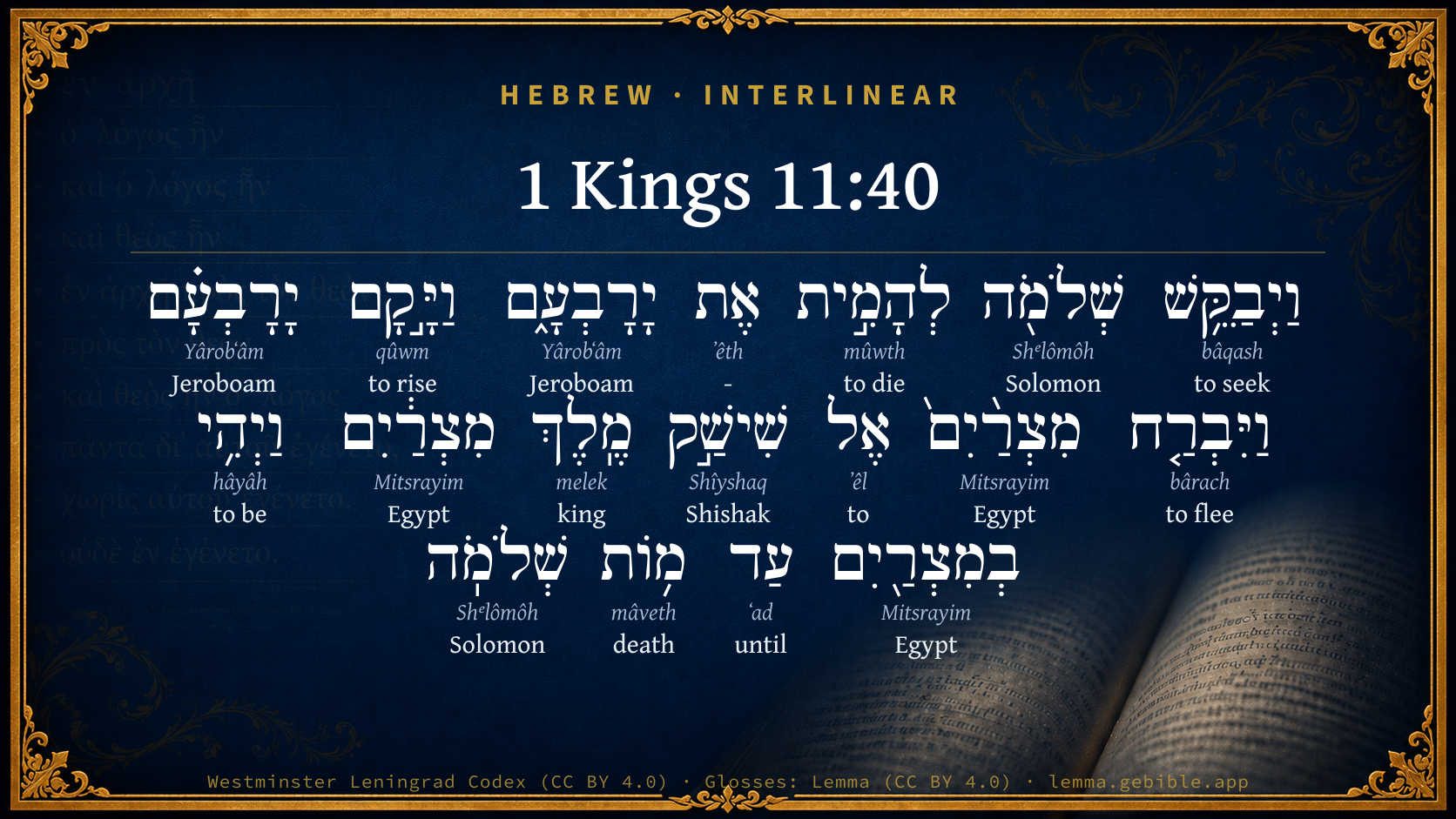
Hebrew (Westminster Leningrad Codex) 1 Kings 11:40 appears in the Hebrew Old Testament. The text above is from the Westminster Leningrad Codex. Each word links to its Strong’s number, a concise gloss, and parsing drawn from the Open Scriptures Hebrew Bible morphology. Click any word for its full Brown-Driver-Briggs (BDB) entry.
Download image
Cite this verse

1 Kings 11:40 (World English Bible). Public Domain. Lemma interlinear Bible study tool, https://lemma.gebible.app/v/1-kings/11/40.

Show BibTeX & RIS
BibTeX
RIS
English Translation
Solomon sought therefore to kill Jeroboam; but Jeroboam arose, and fled into Egypt, to Shishak king of Egypt, and was in Egypt until the death of Solomon.
World English Bible · Public Domain
Highlights
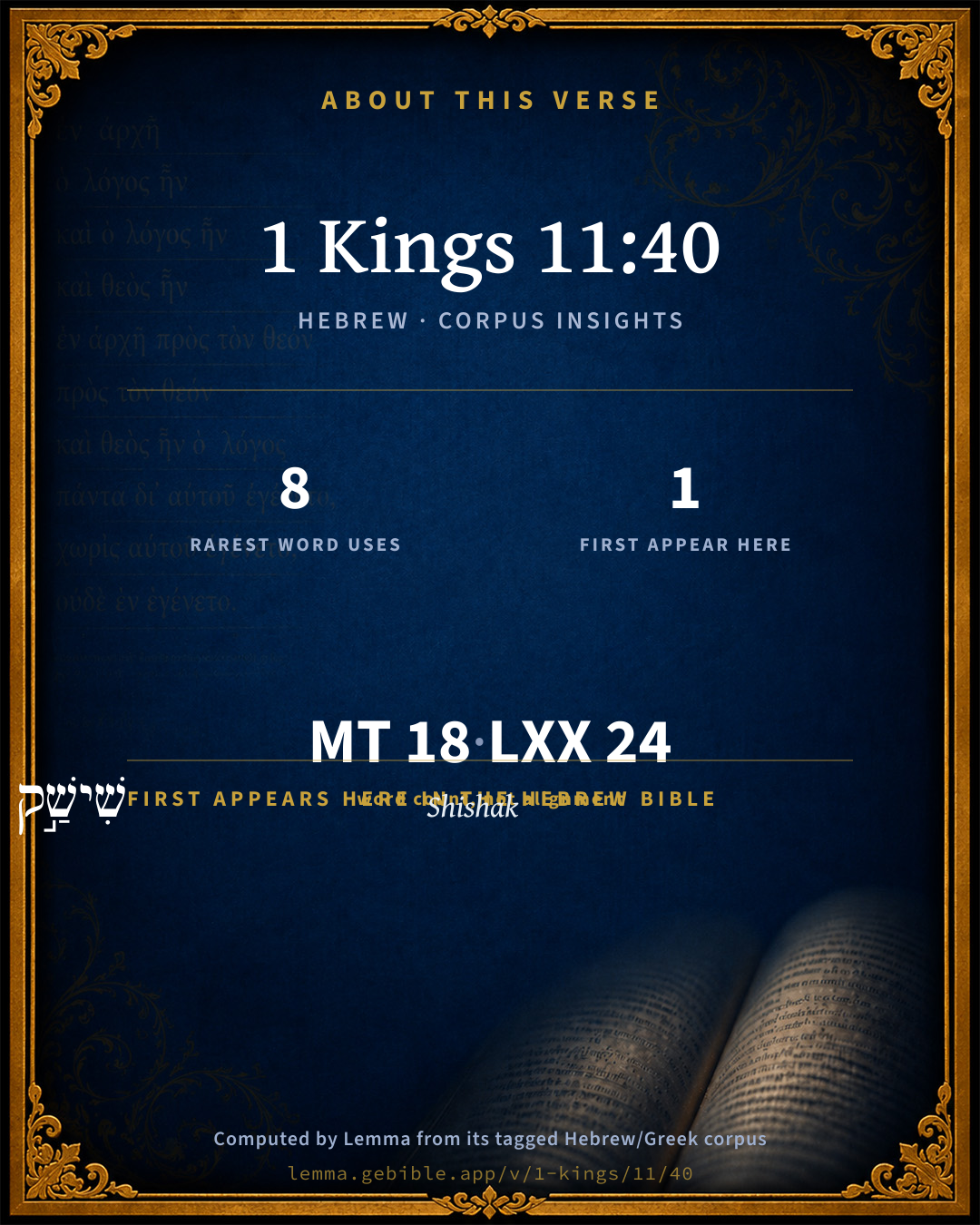
  • 1 first appearance in the Hebrew Bible
Full analysis ↓
Download a study sheet

One document with this verse’s original text, its word-by-word gloss line, the meaning frame, cross-references with their text, attributed commentary, and full source and license credits — printable, and it pastes into notes with its structure intact.

This verse Autodidact and up

Study sheet (.html) Plain text (.txt)

A passage Seminary Student

Up to 50 verses in one chapter. A passage sheet keeps up to 6 commentary sources and 12 cross-references per verse, in the order this page ranks them, and says so on the sheet whenever that leaves anything out. Ask for a single verse and you get the Autodidact verse sheet above.

Everything on this page stays free to read, with no account — the sheet is a download of what is already on screen, not access to it.

Want to remove ads? Support Godless Engineer
Compare translations 3

The same verse in 3 English versions, stacked beneath the original-language interlinear above. Click any original word for its lexicon entry.

Each is an independent rendering of the whole verse — the interlinear is not word-aligned to these translations.

Highlighted words mark where these versions differ — a whole-verse word diff, not a word-by-word alignment.

  • World English Bible Public Domain
    Solomon sought therefore to kill Jeroboam; but Jeroboam arose, and fled into Egypt, to Shishak king of Egypt, and was in Egypt until the death of Solomon.
  • King James Version Public Domain
    Solomon sought therefore to kill Jeroboam. And Jeroboam arose, and fled into Egypt, unto Shishak king of Egypt, and was in Egypt until the death of Solomon.
  • unfoldingWord Literal Text CC BY-SA 4.0
    And Solomon sought to kill Jeroboam. But Jeroboam arose and fled to Egypt, to Shishak, the king of Egypt. And he was in Egypt until the death of Solomon.

unfoldingWord Literal Text — © unfoldingWord, licensed CC BY-SA 4.0. Word-aligned USFM3 via Door43 (git.door43.org/unfoldingWord/en_ult).

Versions to compare (up to 4)

3 of 4 selected

Show all 18 translations

Every available English version of this verse, each an independent rendering of the whole verse.

  • World English Bible Public Domain
    Solomon sought therefore to kill Jeroboam; but Jeroboam arose, and fled into Egypt, to Shishak king of Egypt, and was in Egypt until the death of Solomon.
  • Berean Standard Bible Public Domain
    Solomon therefore sought to kill Jeroboam. But Jeroboam arose and fled to Egypt, to Shishak king of Egypt, where he remained until the death of Solomon.
  • Majority Standard Bible Public Domain
    Solomon therefore sought to kill Jeroboam. But Jeroboam arose and fled to Egypt, to Shishak king of Egypt, where he remained until the death of Solomon.
  • King James Version Public Domain
    Solomon sought therefore to kill Jeroboam. And Jeroboam arose, and fled into Egypt, unto Shishak king of Egypt, and was in Egypt until the death of Solomon.
  • American Standard Version (1901) Public Domain
    Solomon sought therefore to kill Jeroboam; but Jeroboam arose, and fled into Egypt, unto Shishak king of Egypt, and was in Egypt until the death of Solomon.
  • Revised Version (1885) Public Domain
    Solomon sought therefore to kill Jeroboam: but Jeroboam arose, and fled into Egypt, unto Shishak king of Egypt, and was in Egypt until the death of Solomon.
  • Geneva Bible (1599) Public Domain
    Salomon sought therefore to kill Ieroboam, and Ieroboam arose, and fled into Egypt vnto Shishak King of Egypt, and was in Egypt vntil the death of Salomon.
  • Douay-Rheims (1899) Public Domain
    Solomon therefore sought to kill Jeroboam: but he arose, and fled into Egypt to Sesac the king of Egypt, and was in Egypt till the death of Solomon.
  • Young's Literal Translation Public Domain
    And Solomon seeketh to put Jeroboam to death, and Jeroboam riseth and fleeth to Egypt, unto Shishak king of Egypt, and he is in Egypt till the death of Solomon.
  • Literal Standard Version CC BY-SA 4.0
    And Solomon seeks to put Jeroboam to death, and Jeroboam rises and flees to Egypt, to Shishak king of Egypt, and he is in Egypt until the death of Solomon.
  • Unlocked Literal Bible CC BY-SA 4.0
    So Solomon tried to kill Jeroboam. But Jeroboam got up and fled into Egypt, to Shishak king of Egypt, and he remained in Egypt until the death of Solomon.
  • unfoldingWord Literal Text CC BY-SA 4.0
    And Solomon sought to kill Jeroboam. But Jeroboam arose and fled to Egypt, to Shishak, the king of Egypt. And he was in Egypt until the death of Solomon.
  • Darby Bible Public Domain
    And Solomon sought to kill Jeroboam; and Jeroboam arose and fled into Egypt, to Shishak king of Egypt; and he was in Egypt until the death of Solomon.
  • World Messianic Bible Public Domain
    Therefore Solomon sought to kill Jeroboam, but Jeroboam arose and fled into Egypt, to Shishak king of Egypt, and was in Egypt until the death of Solomon.
  • Webster's Bible Public Domain
    Solomon sought therefore to kill Jeroboam. And Jeroboam arose, and fled into Egypt, to Shishak king of Egypt, and was in Egypt until the death of Solomon.
  • Free Bible Version CC BY-SA 4.0
    So Solomon tried to kill Jeroboam. But Jeroboam ran away to Egypt, to Shishak king of Egypt. He remained there until Solomon's death.
  • Bible in Basic English Public Domain
    And Solomon was looking for a chance to put Jeroboam to death; but he went in flight to Egypt, to Shishak, king of Egypt, and was in Egypt till the death of Solomon.
  • JPS Tanakh (1917) Public Domain
    Solomon sought therefore to kill Jeroboam; but Jeroboam arose, and fled into Egypt, unto Shishak king of Egypt, and was in Egypt until the death of Solomon.

Literal Standard Version (2020), Covenant Press — licensed CC BY-SA 4.0. Text via the HelloAO Bible API (eBible.org). Unlocked Literal Bible (unfoldingWord) — licensed CC BY-SA 4.0. Text via the HelloAO Bible API (eBible.org). unfoldingWord Literal Text — © unfoldingWord, licensed CC BY-SA 4.0. Word-aligned USFM3 via Door43 (git.door43.org/unfoldingWord/en_ult). Free Bible Version, Dr. Jonathan Gallagher — licensed CC BY-SA 4.0. Text via the HelloAO Bible API (eBible.org).

Word by word

More ways to search: Search by grammar → Find every occurrence → Compare this word →

Practice this passage: Drill this verse → Learn its vocabulary →

שִׁישַׁ֣ק
Shîyshaq
H7895
“Shishak”
Noun, Proper
Part of Speech
Noun
Type
Proper
Full BDB Definition

Origin: of Egyptian derivation

TWOT: None

Shishak = "greedy of fine linen" - king of Egypt, Sheshonk I, 1st king of the Bubastite 22nd dynasty; ruled in Egypt during the reigns of Solomon and Rehoboam and attacked the southern kingdom under Rehoboam and apparently made it tributary
  1. וַיְבַקֵּ֥שׁ bâqash H1245 “and · to seek” Conjunction + Verb, Piel, Sequential Imperfect, 3rd Person, Masculine, Singular
  2. שְׁלֹמֹ֖ה Shᵉlômôh H8010 “Solomon” Noun, Proper
  3. לְהָמִ֣ית mûwth H4191 “to die” Preposition + Verb, Hiphil, Infinitive Construct
  4. אֶת ʼêth H853 “-” Particle, Direct Object
  5. יָרָבְעָ֑ם Yârobʻâm H3379 “Jeroboam” Noun, Proper
  6. וַיָּ֣קָם qûwm H6965 “and · to rise” Conjunction + Verb, Qal, Sequential Imperfect, 3rd Person, Masculine, Singular
  7. יָרָבְעָ֗ם Yârobʻâm H3379 “Jeroboam” Noun, Proper
  8. וַיִּבְרַ֤ח bârach H1272 “and · to flee” Conjunction + Verb, Qal, Sequential Imperfect, 3rd Person, Masculine, Singular
  9. מִצְרַ֨יִם֙ Mitsrayim H4714 “Egypt” Noun, Proper
  10. אֶל ʼêl H413 “to” Preposition
  11. מֶֽלֶךְ melek H4428 “king of” Noun, Common, Masculine, Singular, Construct
  12. מִצְרַ֔יִם Mitsrayim H4714 “Egypt” Noun, Proper
  13. וַיְהִ֥י hâyâh H1961 “and · to be” Conjunction + Verb, Qal, Sequential Imperfect, 3rd Person, Masculine, Singular
  14. בְמִצְרַ֖יִם Mitsrayim H4714 “in/at · Egypt” Preposition + Noun, Proper
  15. עַד ʻad H5704 “until” Preposition
  16. מ֥וֹת mâveth H4194 “death of” Noun, Common, Masculine, Singular, Construct
  17. שְׁלֹמֹֽה Shᵉlômôh H8010 “Solomon” Noun, Proper

About this verse

These counts appear in no published source. They are computed here, from the morphology-tagged text and Lemma’s own curated glosses. What Lemma adds →

18
words
14
distinct lemmas
Historical
section

Notable vocabulary

The rarest word here is שִׁישַׁ֣ק Shishak H7895 — appearing just 8 times in the whole Hebrew Bible.

First appearance in Scripture

This word makes its first canonical appearance in the Hebrew Bible here:

  • שִׁישַׁ֣ק Shishak H7895

Shared distinctive vocabulary

שִׁישַׁ֣ק Shishak H7895 occurs in 6 verses of the Hebrew Bible. Also found in:

Grammatical profile

  • 5 verbs
  • 10 nouns
  • 2 prepositions
  • 1 particle

Verb forms

  • וַיְבַקֵּ֥שׁ Piel · Sequential Imperfect
  • לְהָמִ֣ית Hiphil · Infinitive Construct
  • וַיָּ֣קָם Qal · Sequential Imperfect
  • וַיִּבְרַ֤ח Qal · Sequential Imperfect
  • וַיְהִ֥י Qal · Sequential Imperfect

Repetition

Words recur within this verse — often emphatic in Hebrew:

  • מִצְרַ֨יִם֙ Egypt H4714 ×3
  • שְׁלֹמֹ֖ה Solomon H8010 ×2
  • יָרָבְעָ֑ם Jeroboam H3379 ×2

Hebrew & Septuagint length

In English translation the verse runs 27 words from the Hebrew and 26 from the Septuagint (LXX English) — closely comparable.

A rough comparison of the two English renderings, which tokenize alike — not a word-level alignment.

Word counts can differ between the Hebrew and the Greek without any difference in meaning — e.g. the Hebrew direct-object marker אֵת has no separate Greek word, and Greek often adds the article ὁ.

In the original languages it is 18 Hebrew tokens and 24 Greek tokens — but the two are counted differently (Hebrew bundles its prefixes and suffixes into one token; the Greek is in lemma form), so that isn’t a like-for-like length.

Cross-references

7

Topical passages linked to 1 Kings 11:40 in the Treasury of Scripture Knowledge — connected by theme and wording, ordered by reader-vote popularity; previews shown in the World English Bible.

  • 2 Chronicles 12:2–9 It happened in the fifth year of king Rehoboam, that Shishak king of Egypt came up against Jerusalem, because they had trespassed against Yahweh,
  • 1 Kings 14:25–26 It happened in the fifth year of king Rehoboam, that Shishak king of Egypt came up against Jerusalem;
  • 2 Chronicles 16:10 Then Asa was angry with the seer, and put him in the prison-house; for he was in a rage with him because of this thing. Asa oppressed some of the people at the same time.
  • Proverbs 21:30 There is no wisdom nor understanding Nor counsel against Yahweh.
  • Isaiah 14:24–27 Yahweh of Hosts has sworn, saying, Surely, as I have thought, so shall it happen; and as I have purposed, so shall it stand:
  • Isaiah 46:10 declaring the end from the beginning, and from ancient times things that are not [yet] done; saying, My counsel shall stand, and I will do all my pleasure;
  • Lamentations 3:37 Who is he who says, and it comes to pass, when the Lord doesn't command it?

Cross-references courtesy of OpenBible.info (CC BY 4.0).

Hebrew and Greek witnesses Masoretic Hebrew ↔ Greek Septuagint

The same verse in the two great witnesses to the Old Testament, shown verse-for-verse.

These are two independent witnesses, not word-aligned to each other, and the Septuagint is shown in lemma (dictionary) form.

Hebrew 1 Kings 11:40 Masoretic · Westminster Leningrad Codex

וַיְבַקֵּ֥שׁ שְׁלֹמֹ֖ה לְהָמִ֣ית אֶת יָרָבְעָ֑ם וַיָּ֣קָם יָרָבְעָ֗ם וַיִּבְרַ֤ח מִצְרַ֨יִם֙ אֶל שִׁישַׁ֣ק מֶֽלֶךְ מִצְרַ֔יִם וַיְהִ֥י בְמִצְרַ֖יִם עַד מ֥וֹת שְׁלֹמֹֽה

Solomon sought therefore to kill Jeroboam; but Jeroboam arose, and fled into Egypt, to Shishak king of Egypt, and was in Egypt until the death of Solomon.

World English Bible · Public Domain

Greek LXX 1 Kings 11:40 Septuagint · lemma form

καί ζητέω σαλωμών θανατόω ὁ ιεροβοαμ καί ἀναἵστημι καί ἀποδιδράσκω εἰς αἴγυπτος πρός σουσακιμ βασιλεύς αἴγυπτος καί εἰμί ἐν αἴγυπτος ἕως ὅς ἀποθνήσκω σαλωμών

And Solomon sought to kill Jeroboam: but he arose and fled into Egypt, to Susakim king of Egypt, and he was in Egypt until Solomon died.

LXX2012 (modern English Septuagint) · Public Domain

On this verse, Ellicott's Commentary for English Readers discusses the Septuagint’s reading. Read the note in Commentary ↓

Hebrew: Westminster Leningrad Codex (CC BY 4.0). Greek: Septuagint (public domain); English from LXX2012 (modern English Septuagint) (Public Domain). How the Septuagint differs from the Hebrew →

Targum (Aramaic paraphrase)

1

The Targum is the ancient Jewish Aramaic paraphrase of the Hebrew Scriptures — an interpretive translation, not the Hebrew text itself. Onkelos (literal) and Pseudo-Jonathan (expansive) render the Torah, and Jonathan the Prophets. Coverage is partial: where no permissively-licensed English translation exists for a verse, only the Aramaic is shown. This is verse-level text, not a word-by-word alignment to the Hebrew.

  1. Targum Jonathan Prophets (Joshua–Malachi)
    וּבְעָא שְׁלֹמֹה לְמִקְטַל יַת יָרָבְעָם וְקָם יָרָבְעָם וַעֲרַק לְמִצְרַיִם לְוַת שִׁישַׁק מַלְכָּא דְמִצְרַיִם וַהֲוָה בְּמִצְרָיִם עַד דְמִית שְׁלֹמֹה:

    (no public-domain English translation for this verse)

    Targum Jonathan — Aramaic: “Mikraot Gedolot” (public domain). English: “Sefaria Community Translation” (CC0 1.0 (public-domain dedication)); “London "Chaldee Paraphrase," 1871” (public domain). Text via Sefaria.

Commentary

Notes on 1 Kings 11:40 from classic Christian and Jewish commentators (each source and its license shown beneath its notes). The classic Christian expositions comment on the surrounding passage and are grouped to its opening verse, so a note may address several verses; the Jewish commentaries on the Tanakh (Rashi and others) are per-verse, so they appear only where the commentator wrote on this verse.

Lemma curates 59 commentaries, every one of them public domain or Creative Commons licensed, each selected and text-cleaned for this edition rather than reprinted as found. About our sources →

Trapp's Complete Commentary

John Trapp

1Ki 11:40 Solomon sought therefore to kill Jeroboam. And Jeroboam arose, and fled into Egypt, unto Shishak king of Egypt, and was in Egypt until the death of Solomon.

Ver. 40. Solomon sought therefore to kill Jeroboam.] And with him Ahijah also, as saith the Chaldee Paraphrast, whereupon they both fled into Egypt

Unto Shishak king of Egypt.] Who might haply be offended with Solomon for taking so many wives besides his sister.

John Trapp, A Commentary or Exposition upon All the Books of the Old and New Testament (1647–1656) — public domain. Text from a community e-Sword module.

Joseph Benson's Commentary

1Ki 11:40. Solomon sought therefore to kill Jeroboam — How Solomon came to know what was secretly transacted between Ahijah and Jeroboam alone, is a great question: perhaps the prophet made no scruple to report what he had delivered in the name of the Lord. Or, Jeroboam himself, being puffed up with the expectation of ascending the throne, could not conceal it, nor keep his own counsel, but told the matter to some of his confidants, who spread it abroad. But that Solomon should ever entertain a thought of endeavouring to defeat the purpose of God, is astonishing indeed! Jeroboam arose and fled — unto Shishak king of Egypt — Solomon’s brother-in-law, as is probable, who yet might be jealous of him, or alienated from him, because he had taken so many other wives to his sister; or might cast a greedy eye upon the great riches which Solomon had amassed together, and upon which, presently after Solomon’s death, he laid violent hands, 2Ch 12:9. We may observe here that all the kings of Egypt, from the time of Abraham, are in the sacred history called by the name of Pharaoh, unless Rameses (mentioned Genesis 47.) be the name of a king, not of a country; so that this is the first we meet with called by his proper name, different from the rest of the Pharaohs. The opinion is pretty general that this was the great king, called by the Greeks Sesostris, who, having subdued Ethiopia, extended his conquests into Asia, as far as the Assyrians and Medes, as Josephus tells us, who calls him Sethosis.

Joseph Benson's Commentary on the Old and New Testaments (1811–1818) — public domain. Text from a community e-Sword module.

Tyndale Open Study Notes

Tyndale Open Resources

11:40 Solomon, probably aware of impending difficulty, tried to kill Jeroboam. • King Shishak of Egypt later invaded Judah during the reign of Solomon’s son Rehoboam (14:25-26).

Tyndale Open Study Notes — © Tyndale Open Resources, licensed CC BY-SA 4.0. Text via the HelloAO Bible API.

Jamieson, Fausset & Brown

Robert Jamieson, A. R. Fausset & David Brown

Shishak--He harbored and encouraged the rebellious refugee, and was of a different dynasty from the father-in-law of Solomon.

Next: 1 Kings Chapter 12

Jamieson, Fausset & Brown — Commentary Critical and Explanatory on the Whole Bible (1871) — public domain (CC PDM 1.0). Text via the HelloAO Bible API.

Adam Clarke's Commentary

Verse 40. Sought - to kill Jeroboam.] He thought by this means to prevent the punishment due to his crimes.

Unto Shishak king of Egypt] This is the first time we meet with the proper name of an Egyptian king, Pharaoh being the common name for all the sovereigns of that country. Some suppose that this Shishak was the Sesostris so renowned for his wars and his conquests. But it is likely that this king lived long before Solomon's time.

Adam Clarke's Commentary on the Bible (1810–1826) — public domain. Text from a community e-Sword/MySword module.

Ellicott's Commentary for English Readers

(40) Solomon sought therefore to kill Jeroboam.—The knowledge of the promise in itself would be sufficient to excite the jealousy of the old king, and incite him to endeavour to falsify it by the death of Jeroboam. But from 1Ki_11:26 it may be inferred that Jeroboam, characteristically enough, had not patience to wait for its fulfilment, and that he sought in some way by overt act to clutch, or prepare to clutch, at royalty. The addition to the LXX. describes him, before his flight into Egypt, as collecting three hundred chariots, and assuming royal pretensions, taking advantage of his presidency over “the house of Joseph.”

Shishak king of Egypt.—The Shishak of the Old Testament is certainly to be identified with the Sheshenk of the Egyptian monuments, the Sesonchis or Sesonchosis of the Greek historians; and the identification is an important point in the Biblical chronology, for the accession of Sheshenk is fixed by the Egyptian traditions at about B.C. 980. It is a curious proof of historical accuracy that the generic name Pharaoh is not given to Shishak here. For it appears that he was not of the old royal line, but the founder of a new dynasty (the 23rd), called the Bubastite dynasty, in which several names are believed to have a Semitic origin, arguing foreign extraction; and in one genealogical table his ancestors appear not to have been of royal rank. It seems that he united (perhaps by marriage) the lines of the two dynasties which previously ruled feebly in Upper and Lower Egypt, and so inaugurated a new era of prosperity and conquest. His invasion of Judah in the fifth year of Rehoboam (see 1Ki_14:25) is chronicled in the monuments as belonging to the twentieth year of his own reign. He was, therefore, king for the last fifteen years of Solomon’s reign; and his favourable reception of the rebel Jeroboam indicates a natural change of attitude towards the Israelite power. The LXX. addition describes Jeroboam (in a passage clearly suggested by what is recorded in 1Ki_11:19-20 about Hadad) as receiving from Shishak “Ano, the elder sister of Thekemina (Tahpenes), his queen,” which involves an anachronism, for Tahpenes belonged to an earlier Pharaoh. But the whole history implies a close political alliance of Shishak with Jeroboam, both as an exile and as a king.

A Bible Commentary for English Readers, edited by Charles John Ellicott (1878–1897) — public domain. Text from a community e-Sword module.

The Cambridge Bible for Schools and Colleges

gen. ed. J. J. S. Perowne

40. Solomon sought therefore to kill Jeroboam] No doubt the aspirations of Jeroboam, and the prophetic act and words of Ahijah would come to the king’s ears, and make him anxious to remove a rival who had such special encouragement to prosecute his designs.

unto Shishak king of Egypt] This is the first Egyptian king whose name, as distinguished from his title, is recorded in the Old Testament. He has been identified with Sesonchosis, who is mentioned by Manetho as the first king of the twenty-second dynasty. He appears to have come to the throne about 988 B. C. i.e. in the 27th year of Solomon, though some calculations place him a little later. He is mentioned again (1Ki_14:25) as coming up against Jerusalem in the reign of Rehoboam, and taking away much treasure from the temple and the king’s house.

41–43. Solomon’s death and burial (2Ch_9:29-31)

The Cambridge Bible for Schools and Colleges (gen. ed. J. J. S. Perowne; Cambridge University Press, 1878–1918) — public domain. Text from a community e-Sword module.

Albert Barnes' Notes on the Bible

Compare 1Ki 11:26. The announcement of Ahijah was followed within a little while by rebellion on the part of Jeroboam. As Solomon’s luster faded, as his oppression became greater and its objects more selfish, and as a prospect of deliverance arose from the personal qualities of Jeroboam 1Ki 11:28, the tribe of Ephraim to which he belonged, again aspired after its old position (see Jos 17:14 note). Jeroboam, active, energetic, and ambitious, placed himself at their head. The step proved premature. The power of Solomon was too firmly fixed to be shaken; and the hopes of the Ephraimites had to be deferred until a fitter season.

The “exact” date of Jeroboam’s flight into Egypt cannot be fixed. It was certainly not earlier than Solomon’s twenty-fourth year, since it was after the building of Millo 1Ki 11:27. But it may have been several years later.

Shishak - This king is the first Pharaoh mentioned in Scripture who can be certainly identified with any known Egyptian monarch. He is the Sheshonk (Sheshonk I) of the monuments, and the Sesonchosis of Manetho. The Egyptian date for his accession is 980 or 983 B.C., which synchronizes, according to the ordinary Hebrew reckoning, with Solomon’s 32nd or 35th year. Sheshonk I has left a record of his expedition against Judah, which accords well with what is related of Shishak 1Ki 14:25-26; 2Ch 12:2-4.

Albert Barnes' Notes on the Bible (1834–1885) — public domain. Text from a community e-Sword/MySword module.

Haydock's Catholic Bible Commentary

Therefore, being apprized of what had passed, as well as to prevent the farther attempts of Jeroboam. (Haydock) --- Sesac. He is the first, whose proper name is given in Scripture. Whether he was of the same family, as the Pharao, whose daughter Solomon had married, cannot be ascertained. Marsham makes Sesac the same with the renowned Sesostris, the Sethosis of Manetho. But Usher thinks that Sesostris reigned immediately after the Israelites left Egypt; while Pezron, &c., suppose that Amenoplis, who was drowned, was even his grandson. (Calmet)

George Leo Haydock (1774–1849), Haydock's Catholic Family Bible and Commentary, 1859 edition — public domain. Excludes Psalms (Douay-Rheims chapter numbering differs from Protestant) and Deuterocanonical books (Catholic canon only).

Matthew Poole's English Annotations

This might come to the ears of Solomon, either,

1. By Jeroboam himself, who might speak of this, either out of vain-glory and ostentation, or with design to prepare the people for his purpose. Or,

2. By the servants. See Poole "1Ki 11:29".

Shishak king of Egypt; who was either,

1. Solomon’s brother-in-law, who yet might be jealous of, him, or alienated from him, because he had taken so many other wives to his sister, as is here noted, 1Ki 11:1; or might cast a greedy eye upon the great riches and glorious things which Solomon had amassed together, and upon which, presently after Solomon’s death, he laid violent hands, 2Ch 12:9. All this was known to Jeroboam, who therefore durst put himself into Shishak’s protection; especially, considering how little such relations commonly signify in the affairs of princes; and withal, being made confident by God’s promise of the kingdom. Or,

2. One of another line or house, to whom that crown might descend for want of issue.

Matthew Poole's English Annotations on the Holy Bible (1683–1685) — public domain. Text from a community e-Sword/MySword module.

Whedon's Commentary on the Bible

Daniel D. Whedon

40. Solomon sought… to kill Jeroboam — He probably not only heard of Ahijah’s prophecy, but also saw in the youthful Ephraimite an insubordinate spirit and disposition to usurp his throne. Solomon’s relations to Jeroboam were strikingly similar to those of Saul to David. Solomon, like Saul, drew down upon himself by disobedience the anger of Heaven; and to him, as to Saul, the word of the Lord announced judgments that darkened all his future. Like Saul, he knew, and sought to kill, his rival. The beginning of his reign, like that of Saul’s, was popular and auspicious, but its end was sad and dark. But Jeroboam, unlike David, who would not lift up his hand against the Lord’s anointed, was ambitious to reign, and acted not with modesty and prudence towards his king.

Shishak — This is the first instance in sacred history where the name of an Egyptian king is given as other than the common title Pharaoh, and it becomes therefore important in adjusting Egyptian and Hebrew chronology. The fact that he received and entertained the enemy and rival of Solomon clearly indicates that he was not the king whose daughter Solomon had married, (1Ki_3:1,) and of this it is a noticeable confirmation that in Manetho’s table, where he is called Sesonchis, his name stands at the head of a new dynasty. On the Egyptian monuments his name is written Sheshonk. He was probably a usurper, who succeeded in dethroning the Pharaoh with whom Solomon had formed such a close alliance, and would therefore be no friend of Israel. See more at 1Ki_14:25-28.

Daniel D. Whedon (gen. ed.), Commentary on the Old and New Testaments (1874–1909) — public domain. Text from a community e-Sword module.

The Pulpit Commentary

Solomon sought the efore to kill Jeroboam. It is often assumed that Solomon"s attempt on Jeroboam"s life was the result of the prophecy of Ahijah. And our translation with its "therefore" favours this view. The Hebrews, however, has simply and Solomon sought," etc. And these words connect themselves with ver. 26, "even he lifted up his hand," etc. With ver. 27 a parenthesis begins, explaining how it came about that Jeroboam rebelled. It is implied distinctly that it was because of Ahijah"s prophecy. That prophecy, however, was in no sense a justification of treason or attack on Jeroboam"s part. The fact that God had revealed His purposes was no reason why Jeroboam should forestall them. David knew and others knew that he was destined to be king, but he piously left it for God, in His own time and way, to place him on the throne. And Jeroboam"s rebellion is the more inexcusable, because Ahijah had expressly stated that Solomon was to retain the kingdom during his lifetime. However "he lifted up his hand;" there was some overt act of rebellion, and Solomon, because of this, and not because of the prophecy (of which, indeed, he may never have heard), sought to slay him. Nor was the king without justification in so doing. Treason must be promptly suppressed, and treason against a benefactor (see ver. 28) is doubly hateful. And Jeroboam arose, and fled into Egypt cf. verse 17, and Mat_2:13. It was the natural place of refuge, unto Shishak, king of Egypt Shishak is beyond doubt the Sheshonk I of the monuments, and is the first of the Pharaohs who can be identified with certainty (see Dict. Bib. 3, p. 1288). The date of his accession appears to be somewhere between 988 and 980 B.C. As to his invasion of Palestine, see on, 1Ki_14:25. His reception of Jeroboam almost proves that there has been a change of dynasty, and that the new Pharaoh was no friend to Solomon and was in Egypt until the death of Solomon. (Compare again Mat_2:15)

Vers. 40-43.

Solomon"s End.

There is peculiar interest attaching to the earlier and later days of men who have made a figure in history. Here we have the brief record of the end of a character famed for wisdom above all mere men, upon which we have sadly to meditate that

I HE SANK UNDER A DENSE CLOUD.

1. His morning was very bright.

(1) From his youth he was beloved of God. In token of this he received from God the name Jedidiah. (2Sa_12:24, 2Sa_12:25) Could any distinction be more glorious? Let the young among us aspire to this distinction.

(2) When he came to the throne this name was changed to Solomon, the Peaceable. The wars of his father David were everywhere so triumphant, that no adversary now appeared. (1Ki_5:4) The love of God brings peace.

(3) He was zealous and faithful in building the temple of the Lord, which he devoted to God in a noble dedicatory prayer, and had an answer in the descent of the holy fire upon the sacrifices, and in the Shekinah taking possession of the house. Those who are beloved of God and rejoice in His peace are fit agents for the building of the spiritual temple of the Lord.

(4) He was blessed by God with extraordinary wisdom, not only in the arts of government, but also in various walks of learning. (1Ki_3:8-10 1Ki_4:33) The profoundest philosophers have been godly men. The boast of sceptics to the contrary is not sustained by fact.

(5) He was inspired by God to contribute books to the sacred Scriptures. The Chaldaisms which occur in the Ecclesiastes are not sufficient to wrest the authorship of that book from Solomon, to whom the Jews have ever ascribed it; for these it may have acquired in passing through the hands of Ezra.

2. But his evening was very black.

(1) His reign extended over forty years, and a considerable portion of that period he was under bad influences. Pharaoh"s daughter is though to have been a proselyte to Judaism, but of this there is no proof.

(2) This foreign marriage was followed by about seven hundred more. These were distinguished as princesses (ver. 3). Not that they were daughters of kings, but wives of Solomon, of the second order, Pharaoh"s daughter being queen. Beside these were the three hundred concubines. Such a harem, in its number alone, was a plain violation of the law. (Deu_17:17) But he was still further guilty in making alliances with heathen women (Exo_34:16; Deu_7:3, Deu_7:4)

(3) The very evils predicted happened to Solomon; through these he was drawn into the grossest idolatry (vers. 5-8).

(4) The last act recorded of him was that of seeking to kill Jeroboam, who to avoid his resentment took refuge with Shishak, king of Egypt. Shishak was brother-in-law to Hadad, the Edomite adversary of Solomon, but not the father of Solomon"s wife, as some have supposed. If, as the narrative suggests, this design upon the life of Jeroboam was in consequence of his knowledge of the prophecy of Ahijah, it was an evidence of extreme wickedness, for it was fighting against God. It was the very sin of Saul against his father David. And in this purpose he seems to have persisted to his death; for Jeroboam remained in Egypt until that event. How fearful are the evils of apostasy! How admonitory!

II BUT IS THERE NO SUNSHINE IN THE CLOUD? Some think they see it

1. In the promise of God to David.

(1) The promise referred to is recorded 2Sa_7:12-17. But was not Solomon, who was chastened with the rod of men by Hadad, Rezon, and Jeroboam, the subject of the mercy of God, in that his family was continued in the throne of Judah? In this he was distinguished from Saul, whose succession was cut off.

(2) Unless this answer can be shown to be insufficient, the Calvinistic argument based upon this text for the infallible final perseverance of the saints is simply a begging of the question.

2. In the Divine approval of the reign of Solomon.

(1) The passage relied upon in this statement is 2Ch_11:17. But when the commencement of the rule of Rehoboam in Judah, for three years, is commended as according to the example of David and Solomon, the allusion, as far as Solomon is concerned at least, was to the manner in which he commenced his reign.

(2) This is sufficient for the consistency of the text. To make it prove more would make it prove too much by committing God to the approval of what He has elsewhere explicitly condemned.

(3) Rehoboam, who as king of Judah, like his father Solomon, began his reign well, fell into the snare of Solomon in multiplying wives. (see 2Ch_11:21)

3. In his authorship of the Ecclesiastes.

(1) The argument is that upon the message of God, by Ahijah, as is supposed (vers. 9-13), Solomon repented, and afterwards wrote this book, in which he confesses the vanity of his past life.

(2) But the theory of his repentance upon that occasion ill consorts with the history of his seeking the life of Jeroboam, because he was destined to give effect to the burden of that message. True repentance will bear meet. (Mat_3:8)

(3) The Ecclesiastes was more probably written before than after the apostasy of Solomon. The allusions to his experiences as "king over Israel in Jerusalem" may have been prophetic anticipations, which may explain the past tense, "was king," which is agreeable to the prophetic style. When all has been said that can be alleged to encourage hope in Solomon"s end, the doubt is grave enough to instruct us that we must not presume upon God"s mercy, and sin. Let us rather hope in His mercy, repent, and sin no more. Praise God for the Great Atonement! M.

The Pulpit Commentary (1880–1919), ed. H.D.M. Spence-Jones & Joseph S. Exell — public domain. Text from a community e-Sword module.

John Wesley's Explanatory Notes

Solomon - To whose ears this had come. Shishak - Solomon's brother-in-law, who yet might be jealous of him, or alienated from him, because he had taken so many other wives to his sister, might cast a greedy eye upon the great riches which Solomon had amassed together, and upon which, presently after Solomon's death, he laid violent hands, 2 Chron. xii, 9.

John Wesley, Explanatory Notes Upon the Whole Bible (1754–1765) — public domain. Text via the GEBible commentary corpus.

unfoldingWord translationNotes

Door43 World Missions Community

Shishak

This is the name of a man. (See: How to Translate Names)

translationWords

Jeroboam

Egypt

die

unfoldingWord translationNotes — © Distant Shores Media and the Door43 World Missions Community, licensed CC BY-SA 4.0. Source: git.door43.org/Door43/en_tn.

Lesson kit

Teaching starters — assembled from the data on this page, not authored interpretation. Every prompt links to the verse data it draws on. Edit before teaching.

1 Kings, in the Historical, opens this verse with 18 words (14 distinct Hebrew lemmas). Its most distinctive word is Shîyshaq (“Shishak”). A historical commentator’s framing appears above. Read the whole chapter for the surrounding context.

Discussion questions

  1. What does “Shishak” (Shîyshaq) contribute to the verse as a whole?
  2. This is the first place “Shishak” appears in Scripture (first appears here). What does its debut here establish?
  3. How does 1 Kings 14:25, which shares the word «Shishak», read alongside this verse?
  4. What does the repetition of “Egypt” (3× in this one verse) do in this verse?
  5. These translations render this verse differently. What is at stake in choosing one wording over another?
  6. «וַיְבַקֵּ֥שׁ» is a Piel Sequential Imperfect verb. How does that grammatical form shape the action described?
  7. Compare how Trapp's Complete Commentary and Joseph Benson's Commentary read this verse. Where do they agree or differ?

Things to notice

Reading settings

Reading text

Shown beneath each verse's original-language words.

Old Testament
Old Testament edition

Read the OT as the Masoretic Hebrew (MT) or the Greek Septuagint (LXX).

English shown for the Greek Septuagint (in the Hebrew ↔ Greek comparison).

Comparing translations? Open the Compare panel on any verse page to stack up to four side by side.