Jeremiah 20:17

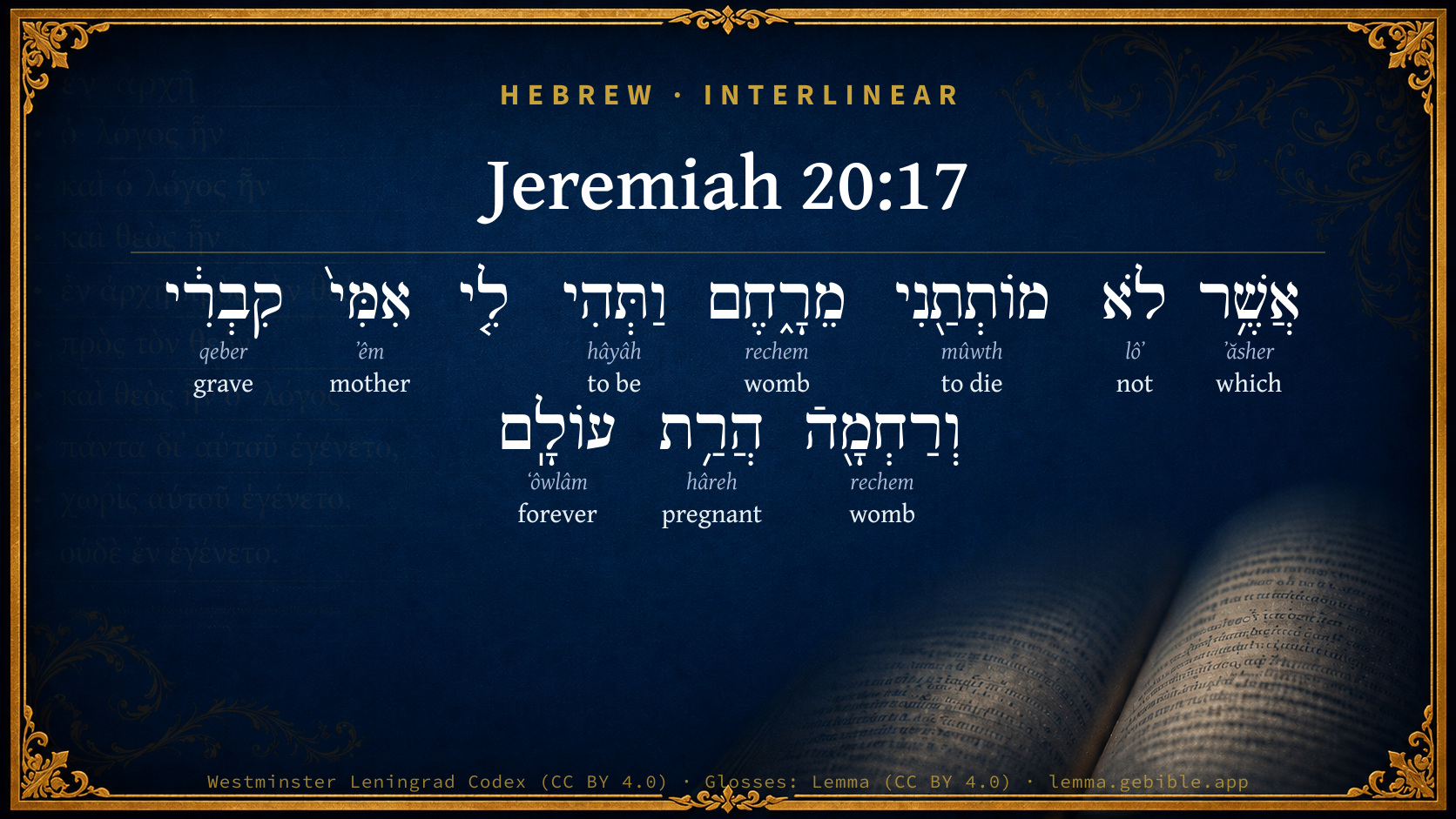
Hebrew (Westminster Leningrad Codex) Jeremiah 20:17 appears in the Hebrew Old Testament. The text above is from the Westminster Leningrad Codex. Each word links to its Strong’s number, a concise gloss, and parsing drawn from the Open Scriptures Hebrew Bible morphology. Click any word for its full Brown-Driver-Briggs (BDB) entry.
Download image
Cite this verse

Jeremiah 20:17 (World English Bible). Public Domain. Lemma interlinear Bible study tool, https://lemma.gebible.app/v/jeremiah/20/17.

Show BibTeX & RIS
BibTeX
RIS
English Translation
because he didn't kill me from the womb; and so my mother would have been my grave, and her womb always great.
World English Bible · Public Domain
Download a study sheet

One document with this verse’s original text, its word-by-word gloss line, the meaning frame, cross-references with their text, attributed commentary, and full source and license credits — printable, and it pastes into notes with its structure intact.

This verse Autodidact and up

Study sheet (.html) Plain text (.txt)

A passage Seminary Student

Up to 50 verses in one chapter. A passage sheet keeps up to 6 commentary sources and 12 cross-references per verse, in the order this page ranks them, and says so on the sheet whenever that leaves anything out. Ask for a single verse and you get the Autodidact verse sheet above.

Everything on this page stays free to read, with no account — the sheet is a download of what is already on screen, not access to it.

Want to remove ads? Support Godless Engineer
Compare translations 3

The same verse in 3 English versions, stacked beneath the original-language interlinear above. Click any original word for its lexicon entry.

Each is an independent rendering of the whole verse — the interlinear is not word-aligned to these translations.

Highlighted words mark where these versions differ — a whole-verse word diff, not a word-by-word alignment.

  • World English Bible Public Domain
    because he didn't kill me from the womb; and so my mother would have been my grave, and her womb always great.
  • King James Version Public Domain
    Because he slew me not from the womb; or that my mother might have been my grave, and her womb to be always great with me.
  • unfoldingWord Literal Text CC BY-SA 4.0
    because he did not put me to death from the womb, so that my mother would have been my grave and her womb pregnant forever.

unfoldingWord Literal Text — © unfoldingWord, licensed CC BY-SA 4.0. Word-aligned USFM3 via Door43 (git.door43.org/unfoldingWord/en_ult).

Versions to compare (up to 4)

3 of 4 selected

Show all 18 translations

Every available English version of this verse, each an independent rendering of the whole verse.

  • World English Bible Public Domain
    because he didn't kill me from the womb; and so my mother would have been my grave, and her womb always great.
  • Berean Standard Bible Public Domain
    because he did not kill me in the womb so that my mother might have been my grave, and her womb forever enlarged.
  • Majority Standard Bible Public Domain
    because he did not kill me in the womb so that my mother might have been my grave, and her womb forever enlarged.
  • King James Version Public Domain
    Because he slew me not from the womb; or that my mother might have been my grave, and her womb to be always great with me.
  • American Standard Version (1901) Public Domain
    because he slew me not from the womb; and so my mother would have been my grave, and her womb always great.
  • Revised Version (1885) Public Domain
    because he slew me not from the womb; and so my mother should have been my grave, and her womb always great.
  • Geneva Bible (1599) Public Domain
    Because he hath not slaine me, euen from the wombe, or that my mother might haue bene my graue, or her wobe a perpetual conception.
  • Douay-Rheims (1899) Public Domain
    Who slew me not from the womb, that my mother might have been my grave, and her womb an everlasting conception.
  • Young's Literal Translation Public Domain
    Because he hath not put me to death from the womb, And my mother is to me -- my grave, And her womb a pregnancy age-during.
  • Literal Standard Version CC BY-SA 4.0
    Because he has not put me to death from the womb, || And my mother is to me—my grave, || And her womb [is] a perpetual pregnancy.
  • Unlocked Literal Bible CC BY-SA 4.0
    because he did not kill me in the womb, making my mother to be my tomb, a womb that was pregnant forever.
  • unfoldingWord Literal Text CC BY-SA 4.0
    because he did not put me to death from the womb, so that my mother would have been my grave and her womb pregnant forever.
  • Darby Bible Public Domain
    because he slew me not from the womb. Or would that my mother had been my grave, and her womb always great [with me]!
  • World Messianic Bible Public Domain
    because he didn’t kill me from the womb. So my mother would have been my grave, and her womb always great.
  • Webster's Bible Public Domain
    Because he slew me not at my birth; or that my mother might have been my grave, and she had not been delivered.
  • Free Bible Version CC BY-SA 4.0
    because he should have killed me in the womb so that my mother would have been my grave, remaining pregnant forever.
  • Bible in Basic English Public Domain
    Because he did not put me to death before my birth took place: so my mother's body would have been my last resting-place, and she would have been with child for ever.
  • JPS Tanakh (1917) Public Domain
    Because He slew me not from the womb; and so my mother would have been my grave, and her womb always great.

Literal Standard Version (2020), Covenant Press — licensed CC BY-SA 4.0. Text via the HelloAO Bible API (eBible.org). Unlocked Literal Bible (unfoldingWord) — licensed CC BY-SA 4.0. Text via the HelloAO Bible API (eBible.org). unfoldingWord Literal Text — © unfoldingWord, licensed CC BY-SA 4.0. Word-aligned USFM3 via Door43 (git.door43.org/unfoldingWord/en_ult). Free Bible Version, Dr. Jonathan Gallagher — licensed CC BY-SA 4.0. Text via the HelloAO Bible API (eBible.org).

Word by word

More ways to search: Search by grammar → Find every occurrence → Compare this word →

Practice this passage: Drill this verse → Learn its vocabulary →

הֲרַ֥ת
hâreh
H2030
“pregnant of”
Adjective, Adjective, Feminine, Singular, Construct
Part of Speech
Adjective
Type
Adjective
Gender
Feminine
Number
Singular
State
Construct
Full BDB Definition

Origin: from H2029

TWOT: 515a

pregnant
  1. אֲשֶׁ֥ר ʼăsher H834 “which” Particle, Relative
  2. לֹא lôʼ H3808 “not” Particle, Negative
  3. מוֹתְתַ֖נִי mûwth H4191 “to die · me” Verb, Polel, Perfect, 3rd Person, Masculine, Singular + Suffix, Personal, 1st Person, Common, Singular
  4. מֵרָ֑חֶם rechem H7358 “from · womb” Preposition + Noun, Common, Masculine, Singular, Absolute
  5. וַתְּהִי hâyâh H1961 “and · to be” Conjunction + Verb, Qal, Sequential Imperfect, 3rd Person, Feminine, Singular
  6. אִמִּי֙ ʼêm H517 “mother · my” Noun, Common, Feminine, Singular, Construct + Suffix, Personal, 1st Person, Common, Singular
  7. קִבְרִ֔י qeber H6913 “grave · my” Noun, Common, Masculine, Singular, Construct + Suffix, Personal, 1st Person, Common, Singular
  8. וְרַחְמָ֖הֿ rechem H7358 “and · womb · her” Conjunction + Noun, Common, Masculine, Singular, Construct + Suffix, Personal, 3rd Person, Feminine, Singular
  9. עוֹלָֽם ʻôwlâm H5769 “forever” Noun, Common, Masculine, Singular, Absolute

About this verse

These counts appear in no published source. They are computed here, from the morphology-tagged text and Lemma’s own curated glosses. What Lemma adds →

11
words
9
distinct lemmas
Prophets
section

Notable vocabulary

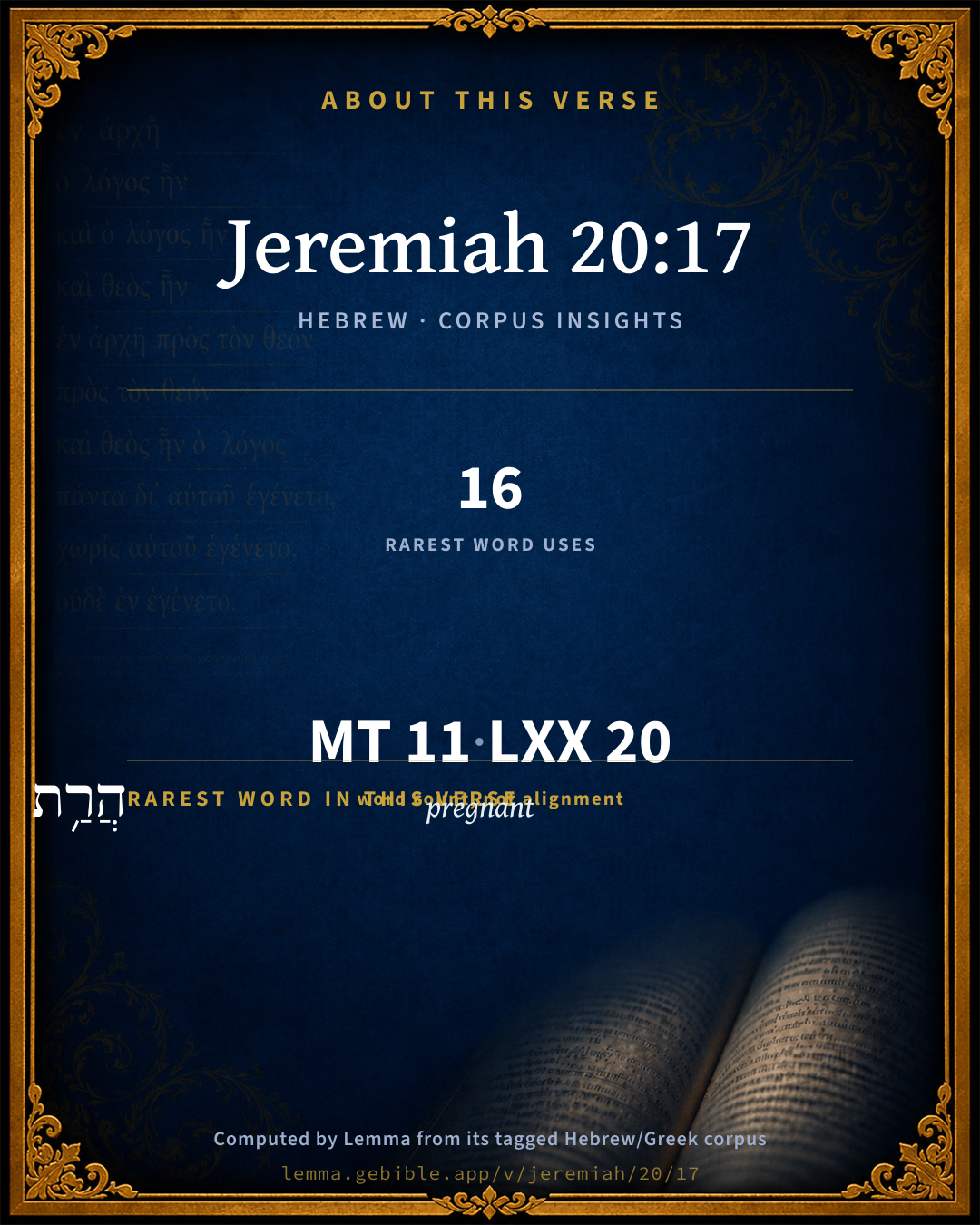
The rarest word here is הֲרַ֥ת pregnant H2030 — appearing just 16 times in the whole Hebrew Bible.

Shared distinctive vocabulary

הֲרַ֥ת pregnant H2030 occurs in 16 verses of the Hebrew Bible. Also found in:

Grammatical profile

  • 2 verbs
  • 5 nouns
  • 1 adjective
  • 1 preposition
  • 2 particles

Verb forms

  • מוֹתְתַ֖נִי Polel · Perfect
  • וַתְּהִי Qal · Sequential Imperfect

Repetition

A word recurs within this verse — often emphatic in Hebrew:

  • מֵרָ֑חֶם womb H7358 ×2

Hebrew & Septuagint length

In the original languages it is 11 Hebrew tokens and 20 Greek tokens — but the two are counted differently (Hebrew bundles its prefixes and suffixes into one token; the Greek is in lemma form), so that isn’t a like-for-like length.

Cross-references

4

Topical passages linked to Jeremiah 20:17 in the Treasury of Scripture Knowledge — connected by theme and wording, ordered by reader-vote popularity; previews shown in the World English Bible.

  • Job 3:10–11 Because it didn't shut up the doors of my mother's womb, Nor did it hide trouble from my eyes.
  • Job 10:18–19 "'Why, then, have you brought me forth out of the womb? I wish I had given up the spirit, and no eye had seen me.
  • Job 3:16 Or as a hidden untimely birth I had not been, As infants who never saw light.
  • Ecclesiastes 6:3 If a man fathers a hundred children, and lives many years, so that the days of his years are many, but his soul is not filled with good, and moreover he has no burial; I say, that an untimely birth is better than he:

Cross-references courtesy of OpenBible.info (CC BY 4.0).

Hebrew and Greek witnesses Masoretic Hebrew ↔ Greek Septuagint

The same verse in the two great witnesses to the Old Testament, shown verse-for-verse.

These are two independent witnesses, not word-aligned to each other, and the Septuagint is shown in lemma (dictionary) form.

Hebrew Jeremiah 20:17 Masoretic · Westminster Leningrad Codex

אֲשֶׁ֥ר לֹא מוֹתְתַ֖נִי מֵרָ֑חֶם וַתְּהִי לִ֤י אִמִּי֙ קִבְרִ֔י וְרַחְמָ֖הֿ הֲרַ֥ת עוֹלָֽם

because he didn't kill me from the womb; and so my mother would have been my grave, and her womb always great.

World English Bible · Public Domain

Greek LXX Structure differs

In the Septuagint, Jeremiah is about an eighth shorter than the Hebrew and arranges its material differently — the Oracles Against the Nations (Hebrew chapters 46–51) appear in the middle of the Greek book, after 25:13. Because the chapter and verse boundaries do not line up, a verse-for-verse comparison with the Hebrew is not shown.

A verse-for-verse comparison isn’t shown here because the chapters and verses don’t line up. Switch to the LXX edition with the MT / LXX toggle above to read the Greek directly.

On this verse, The Cambridge Bible for Schools and Colleges discusses the Septuagint’s reading. Read the note in Commentary ↓

Hebrew: Westminster Leningrad Codex (CC BY 4.0). Greek: Septuagint (public domain); English from a public-domain English Septuagint. How the Septuagint differs from the Hebrew →

Targum (Aramaic paraphrase)

1

The Targum is the ancient Jewish Aramaic paraphrase of the Hebrew Scriptures — an interpretive translation, not the Hebrew text itself. Onkelos (literal) and Pseudo-Jonathan (expansive) render the Torah, and Jonathan the Prophets. Coverage is partial: where no permissively-licensed English translation exists for a verse, only the Aramaic is shown. This is verse-level text, not a word-by-word alignment to the Hebrew.

  1. Targum Jonathan Prophets (Joshua–Malachi)
    לְוֵי דְלָא אֲמִיר עֲלֵי דְמֵיתֵית מִמְעִין וַהֲוָת לִי פּוֹן אִמִי קִבְרִי וַהֲוֵית כִּדְלָא הֲוֵית:

    (no public-domain English translation for this verse)

    Targum Jonathan — Aramaic: “Mikraot Gedolot” (public domain). English: “Sefaria Community Translation” (CC0 1.0 (public-domain dedication)); “London "Chaldee Paraphrase," 1871” (public domain). Text via Sefaria.

Commentary

Notes on Jeremiah 20:17 from classic Christian and Jewish commentators (each source and its license shown beneath its notes). The classic Christian expositions comment on the surrounding passage and are grouped to its opening verse, so a note may address several verses; the Jewish commentaries on the Tanakh (Rashi and others) are per-verse, so they appear only where the commentator wrote on this verse.

Lemma curates 59 commentaries, every one of them public domain or Creative Commons licensed, each selected and text-cleaned for this edition rather than reprinted as found. About our sources →

Trapp's Complete Commentary

John Trapp

Jer 20:17 Because he slew me not from the womb; or that my mother might have been my grave, and her womb [to be] always great [with me].

Ver. 17. Because he slew me not, &c.] Why, but is not life a mercy? A living dog better than a dead lion. See on Job 3:10; Job 10:18-19.

John Trapp, A Commentary or Exposition upon All the Books of the Old and New Testament (1647–1656) — public domain. Text from a community e-Sword module.

Tyndale Open Study Notes

Tyndale Open Resources

20:17-18 Jeremiah saw no meaning to his life.

Tyndale Open Study Notes — © Tyndale Open Resources, licensed CC BY-SA 4.0. Text via the HelloAO Bible API.

Geneva Bible (1599)

Geneva Bible translators

Meaning, that the fruit thereof might never come to profit.

Geneva Bible (1599) marginal notes — public domain. Text via Bolls.life.

Jamieson, Fausset & Brown

Robert Jamieson, A. R. Fausset & David Brown

he--"that man" (Jer 20:15-16).

from the womb--that is, at that time while I was still in the womb.

Written probably when, after having repulsed the Egyptians who brought succors to the Jews (Jer 37:5-8; Kg2 24:7), the Chaldees were a second time advancing against Jerusalem, but were not yet closely besieging it (Jer 21:4, Jer 21:13) [ROSENMULLER]. This chapter probably ought to be placed between the thirty-seventh and thirty-eight chapters; since what the "princes," in Jer 38:2, represent Jeremiah as having said, is exactly what we find in Jer 21:9. Moreover, the same persons as here (Jer 21:1) are mentioned in Jer 37:3; Jer 38:1, namely, Pashur and Zephaniah. What is here more fully related is there simply referred to in the historical narrative. Compare Jer 52:24; Kg2 25:18 [MAURER].

Next: Jeremiah Chapter 21

Jamieson, Fausset & Brown — Commentary Critical and Explanatory on the Whole Bible (1871) — public domain (CC PDM 1.0). Text via the HelloAO Bible API.

John Calvin's Commentaries

After having denounced his imprecations on his birth-day, and on the messenger who had wished to convey joy to his father, Jeremiah now expostulates with God. It hence appears how great was his madness; for thus must we speak. But if Jeremiah spared not God, how should he spare a mortal man? There is then no doubt but that he raged furiously against God, for his expostulation is that of a man wholly desperate; he asks, why he was not slain from the womb, as though he did not regard it as a kindness that he came alive into light. But this life, though exposed to many sorrows, ought yet to be counted as an evidence of God’s inestimable favor. As the Prophet, then, not only despised this goodness of God, but contended with God himself, because he had been created a man and brought into light, how great was his ingratitude!

John Calvin's Commentaries (1540-1563) — public domain. Text from the Calvin Translation Society English edition (1840s-50s) via the Christian Classics Ethereal Library (ccel.org). Calvin's coverage is partial (roughly two-thirds of the Bible); uncommented books and verses are honest gaps, never fabricated. The 19th-century editor's footnotes and remarks are omitted so the notes are faithfully Calvin's own voice.

Ellicott's Commentary for English Readers

(17) Because he slew me not . . .—The wish that he had never been born is uttered by the prophet in strange, bold language. It would have been better that the messenger that told that he was born had slain him before his birth, that his mother’s womb had been his grave, that she had never had strength to bring him forth. Thought, structure, even grammar are, in their abruptness and irregularities, alike significant of intense emotion.

A Bible Commentary for English Readers, edited by Charles John Ellicott (1878–1897) — public domain. Text from a community e-Sword module.

The Cambridge Bible for Schools and Colleges

gen. ed. J. J. S. Perowne

17. from] better (with LXX), as shewn by the context, in. The consonants which represent the two prepositions were written similarly in Hebrew MSS.

The Cambridge Bible for Schools and Colleges (gen. ed. J. J. S. Perowne; Cambridge University Press, 1878–1918) — public domain. Text from a community e-Sword module.

John Gill's Exposition

Because he slew me not from the womb,.... As soon as he came out of it; that is, as soon as he was born; either because God slew him not so soon, as Kimchi; or the angel of death, as Jarchi: or rather the man that carried the tidings of his birth to his father, who is all along spoken of in the two former verses; he curses him for not doing that, which, had he done, would have been exceeding criminal in him indeed; for not committing murder, even for not murdering an innocent babe;

or that my mother might have been my grave; he wishes he had died in her womb, and had never been brought forth; and so that had been his grave, where he should have been at ease and safety:

and her womb to be always great with me; or, "her womb an everlasting conception" (m); his wish was, that she had been always conceiving, or ever big with child of him, but never bring forth; which was a more cruel and unnatural wish than the former concerning the man, the carrier of the tidings of his birth; since this was wishing a perpetual, painful, and intolerable evil to his own mother.

(m) "et ejus uterus, conceptus perpetuus", Munster; "et vulva ejus, conceptio perpetua", Pagninus, "et vulva ejus praegnans perpetuo", Vatablus.

John Gill's Exposition of the Whole Bible (1746–1763) — public domain (CC PDM 1.0). Text via the HelloAO Bible API.

Haydock's Catholic Bible Commentary

Who. Septuagint, "because he (the Lord.; Du Hamel; Tirinus) slew me not in my mother’s womb." (Haydock) --- Syriac, Grotius, &c., explain the Hebrew in the same sense, though it may also agree with the Vulgate, from the womb, or as soon as I was born. O that I had never seen the light! (Calmet) --- He abstracts from the effects of original sin. (Tirinus) --- It is better not to exist than to be in constant misery, Matthew xxvi. (St. Jerome) (Worthington) --- The prophet bewailed the abuse which was made of God’s word, by unbelievers, ver. 8. (Haydock)

George Leo Haydock (1774–1849), Haydock's Catholic Family Bible and Commentary, 1859 edition — public domain. Excludes Psalms (Douay-Rheims chapter numbering differs from Protestant) and Deuterocanonical books (Catholic canon only).

Matthew Poole's English Annotations

These various expressions do only let us see to what a tide passion swelled in this good man’s heart, and teach us how much need we have to pray to be delivered from our own passions. Jeremiah’s leaving these things recorded by himself, is one instance of what is brought as a rational argument to prove that only men wrote the Scriptures by inspiration from God, they would never else have recorded their own gross failings, men commonly writing for their own honour, not to their own defamation.

Matthew Poole's English Annotations on the Holy Bible (1683–1685) — public domain. Text from a community e-Sword/MySword module.

Rashi

Rabbi Shlomo Yitzchaki (Rashi)

That he did not put me to death I.e., that the angel of death did not put me to death from the womb, and this is one of the verses with brief language.

a perpetual pregnancy a pregnancy of eternity.

Rashi on the Tanakh — English translations: “The Judaica Press complete Tanach with Rashi, translated by A. J. Rosenberg” (CC BY 4.0); “Pentateuch with Rashi's commentary by M. Rosenbaum and A.M. Silbermann, 1929-1934” (public domain); “The Metsudah Tanach series, Lakewood, N.J” (CC BY 4.0); and “The Book of Joshua, Metsudah Publications, 1997” (CC BY 4.0). Text via Sefaria.

Lesson kit

Teaching starters — assembled from the data on this page, not authored interpretation. Every prompt links to the verse data it draws on. Edit before teaching.

Jeremiah, in the Prophets, opens this verse with 11 words (9 distinct Hebrew lemmas). Its most distinctive word is hâreh (“pregnant”). A historical commentator’s framing appears above. Read the whole chapter for the surrounding context.

Discussion questions

  1. How does “pregnant” (hâreh) shape what this verse is saying?
  2. How does Genesis 16:11, which shares the word «pregnant», read alongside this verse?
  3. What does the repetition of “womb” (2× in this one verse) do in this verse?
  4. The translations on this page render this verse differently — a whole-verse word diff, not a word-by-word alignment. What might account for the different wordings?
  5. «מוֹתְתַ֖נִי» is a Polel Perfect verb. How does that grammatical form shape the action described?
  6. Compare how Trapp's Complete Commentary and Tyndale Open Study Notes read this verse. Where do they agree or differ?

Things to notice

Reading settings

Reading text

Shown beneath each verse's original-language words.

Old Testament
Old Testament edition

Read the OT as the Masoretic Hebrew (MT) or the Greek Septuagint (LXX).

English shown for the Greek Septuagint (in the Hebrew ↔ Greek comparison).

Comparing translations? Open the Compare panel on any verse page to stack up to four side by side.