
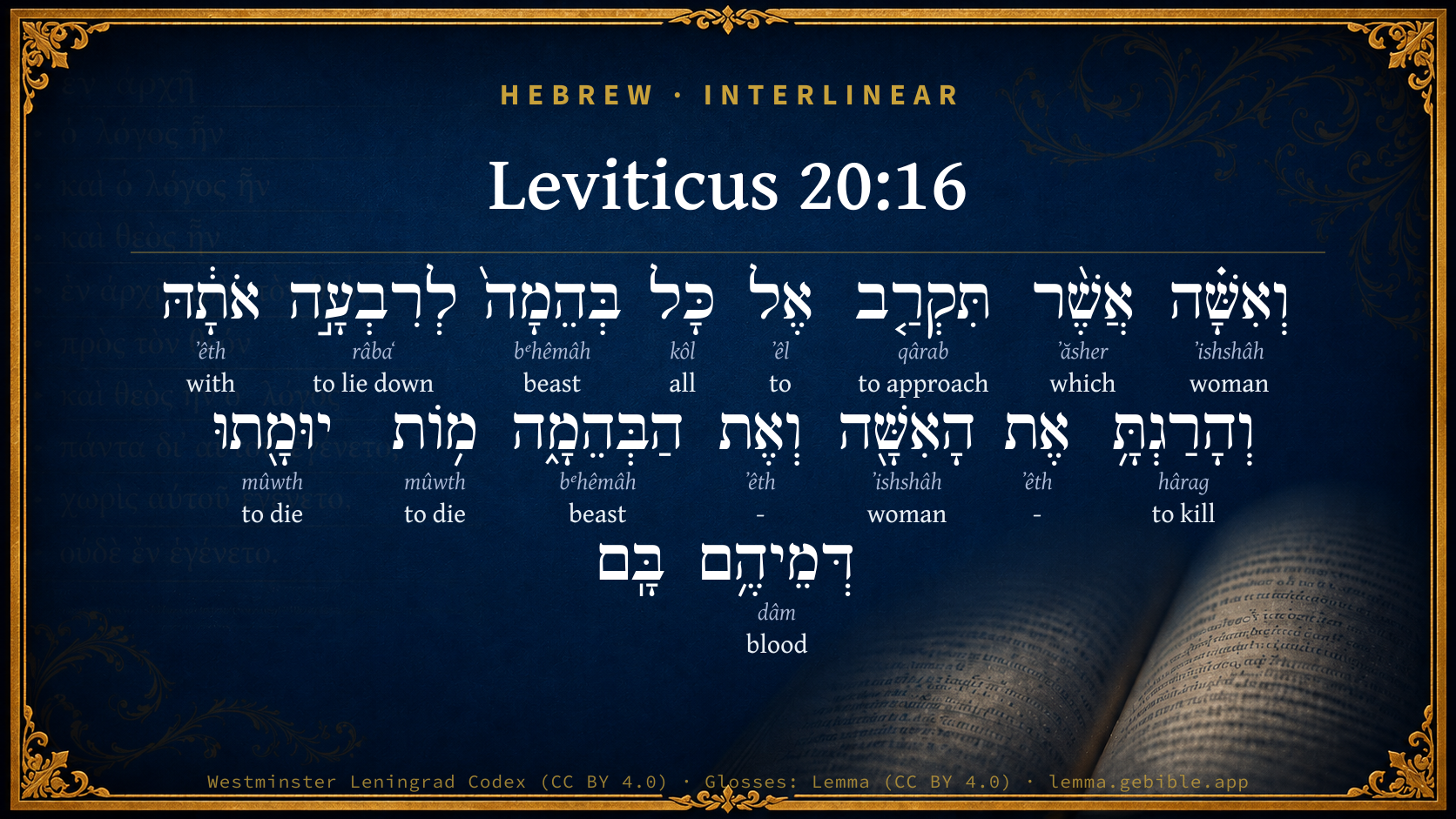
Leviticus 20:16

Hebrew (Westminster Leningrad Codex) Leviticus 20:16 appears in the Hebrew Old Testament. The text above is from the Westminster Leningrad Codex. Each word links to its Strong’s number, a concise gloss, and parsing drawn from the Open Scriptures Hebrew Bible morphology. Click any word for its full Brown-Driver-Briggs (BDB) entry.
Download image
Cite this verse

Leviticus 20:16 (World English Bible). Public Domain. Lemma interlinear Bible study tool, https://lemma.gebible.app/v/leviticus/20/16.

Show BibTeX & RIS
BibTeX
RIS
English Translation
"'If a woman approaches any animal, and lies down with it, you shall kill the woman, and the animal: they shall surely be put to death; their blood shall be upon them.
World English Bible · Public Domain
Download a study sheet

One document with this verse’s original text, its word-by-word gloss line, the meaning frame, cross-references with their text, attributed commentary, and full source and license credits — printable, and it pastes into notes with its structure intact.

This verse Autodidact and up

Study sheet (.html) Plain text (.txt)

A passage Seminary Student

Up to 50 verses in one chapter. A passage sheet keeps up to 6 commentary sources and 12 cross-references per verse, in the order this page ranks them, and says so on the sheet whenever that leaves anything out. Ask for a single verse and you get the Autodidact verse sheet above.

Everything on this page stays free to read, with no account — the sheet is a download of what is already on screen, not access to it.

Want to remove ads? Support Godless Engineer
Compare translations 3

The same verse in 3 English versions, stacked beneath the original-language interlinear above. Click any original word for its lexicon entry.

Each is an independent rendering of the whole verse — the interlinear is not word-aligned to these translations.

Highlighted words mark where these versions differ — a whole-verse word diff, not a word-by-word alignment.

  • World English Bible Public Domain
    "'If a woman approaches any animal, and lies down with it, you shall kill the woman, and the animal: they shall surely be put to death; their blood shall be upon them.
  • King James Version Public Domain
    And if a woman approach unto any beast, and lie down thereto, thou shalt kill the woman, and the beast: they shall surely be put to death; their blood shall be upon them.
  • unfoldingWord Literal Text CC BY-SA 4.0
    And a woman who draws near to any livestock to mate with it—then you shall kill the woman and the livestock. Dying, they must be executed; their blood on them.

unfoldingWord Literal Text — © unfoldingWord, licensed CC BY-SA 4.0. Word-aligned USFM3 via Door43 (git.door43.org/unfoldingWord/en_ult).

Versions to compare (up to 4)

3 of 4 selected

Show all 18 translations

Every available English version of this verse, each an independent rendering of the whole verse.

  • World English Bible Public Domain
    "'If a woman approaches any animal, and lies down with it, you shall kill the woman, and the animal: they shall surely be put to death; their blood shall be upon them.
  • Berean Standard Bible Public Domain
    If a woman approaches any animal to mate with it, you must kill both the woman and the animal. They must surely be put to death; their blood is upon them.
  • Majority Standard Bible Public Domain
    If a woman approaches any animal to mate with it, you must kill both the woman and the animal. They must surely be put to death; their blood is upon them.
  • King James Version Public Domain
    And if a woman approach unto any beast, and lie down thereto, thou shalt kill the woman, and the beast: they shall surely be put to death; their blood shall be upon them.
  • American Standard Version (1901) Public Domain
    And if a woman approach unto any beast, and lie down thereto, thou shalt kill the woman, and the beast: they shall surely be put to death; their blood shall be upon them.
  • Revised Version (1885) Public Domain
    And if a woman approach unto any beast, and lie down thereto, thou shalt kill the woman, and the beast: they shall surely be put to death; their blood shall be upon them.
  • Geneva Bible (1599) Public Domain
    And if a woman come to any beast, and lye therewith, then thou shalt kill the woman and the beast: they shall die the death, their blood shalbe vpon them.
  • Douay-Rheims (1899) Public Domain
    The woman that shall lie under any beast, shall be killed together with the same: their blood be upon them.
  • Young's Literal Translation Public Domain
    `And a woman who draweth near unto any beast to lie with it -- thou hast even slain the woman and the beast; they are certainly put to death; their blood `is' on them.
  • Literal Standard Version CC BY-SA 4.0
    And a woman who draws near to any beast to mate with it—you have even slain the woman and the beast; they are certainly put to death; their blood [is] on them.
  • Unlocked Literal Bible CC BY-SA 4.0
    If a woman approaches any animal to sleep with it, you must kill the woman and the animal. They must certainly be put to death. They are guilty and deserve to die.
  • unfoldingWord Literal Text CC BY-SA 4.0
    And a woman who draws near to any livestock to mate with it—then you shall kill the woman and the livestock. Dying, they must be executed; their blood on them.
  • Darby Bible Public Domain
    And if a woman approach unto any beast to gender therewith, thou shalt kill the woman and the beast: they shall certainly be put to death; their blood is upon them.
  • World Messianic Bible Public Domain
    “‘If a woman approaches any animal and lies with it, you shall kill the woman and the animal. They shall surely be put to death. Their blood shall be upon them.
  • Webster's Bible Public Domain
    And if a woman shall approach to any beast, and lie down thereto, thou shalt kill the woman and the beast; they shall surely be put to death; their blood shall be upon them.
  • Free Bible Version CC BY-SA 4.0
    A woman who gives herself to an animal to have sex with it must be executed, along with the animal. They must both be killed; they bear the responsibility for their punishment.
  • Bible in Basic English Public Domain
    And if a woman goes near a beast and has sex relations with it, you will put an end to the woman and the beast: their blood will be on them.
  • JPS Tanakh (1917) Public Domain
    And if a woman approach unto any beast, and lie down thereto, thou shalt kill the woman, and the beast: they shall surely be put to death; their blood shall be upon them.

Literal Standard Version (2020), Covenant Press — licensed CC BY-SA 4.0. Text via the HelloAO Bible API (eBible.org). Unlocked Literal Bible (unfoldingWord) — licensed CC BY-SA 4.0. Text via the HelloAO Bible API (eBible.org). unfoldingWord Literal Text — © unfoldingWord, licensed CC BY-SA 4.0. Word-aligned USFM3 via Door43 (git.door43.org/unfoldingWord/en_ult). Free Bible Version, Dr. Jonathan Gallagher — licensed CC BY-SA 4.0. Text via the HelloAO Bible API (eBible.org).

Word by word

More ways to search: Search by grammar → Find every occurrence → Compare this word →

Practice this passage: Drill this verse → Learn its vocabulary →

לְרִבְעָ֣ה
râbaʻ
H7250
“to lie down”
Preposition + Verb, Qal, Infinitive Construct
Part of Speech
Preposition + Verb
Stem
Qal
Form
Infinitive Construct
Full BDB Definition

Origin: a primitive root

TWOT: 2108

to lie stretched out, lie down - (Qal) - to lie down - for repose - for copulation (of woman with beast) - (Hiphil) to cause to lay down (of cattle breeding)
  1. וְאִשָּׁ֗ה ʼishshâh H802 “and · woman” Conjunction + Noun, Common, Feminine, Singular, Absolute
  2. אֲשֶׁ֨ר ʼăsher H834 “which” Particle, Relative
  3. תִּקְרַ֤ב qârab H7126 “to approach” Verb, Qal, Imperfect, 3rd Person, Feminine, Singular
  4. אֶל ʼêl H413 “to” Preposition
  5. כָּל kôl H3605 “all of” Noun, Common, Masculine, Singular, Construct
  6. בְּהֵמָה֙ bᵉhêmâh H929 “beast” Noun, Common, Feminine, Singular, Absolute
  7. אֹתָ֔הּ ʼêth H854 “with · her” Preposition + Suffix, Personal, 3rd Person, Feminine, Singular
  8. וְהָרַגְתָּ֥ hârag H2026 “and · to kill” Conjunction + Verb, Qal, Sequential Perfect, 2nd Person, Masculine, Singular
  9. אֶת ʼêth H853 “-” Particle, Direct Object
  10. הָאִשָּׁ֖ה ʼishshâh H802 “the · woman” Particle, Definite Article + Noun, Common, Feminine, Singular, Absolute
  11. וְאֶת ʼêth H853 “and · -” Conjunction + Particle, Direct Object
  12. הַבְּהֵמָ֑ה bᵉhêmâh H929 “the · beast” Particle, Definite Article + Noun, Common, Feminine, Singular, Absolute
  13. מ֥וֹת mûwth H4191 “to die” Verb, Qal, Infinitive Absolute
  14. יוּמָ֖תוּ mûwth H4191 “to die” Verb, Hophal, Imperfect, 3rd Person, Masculine, Plural
  15. דְּמֵיהֶ֥ם dâm H1818 “blood · their” Noun, Common, Masculine, Plural, Construct + Suffix, Personal, 3rd Person, Masculine, Plural

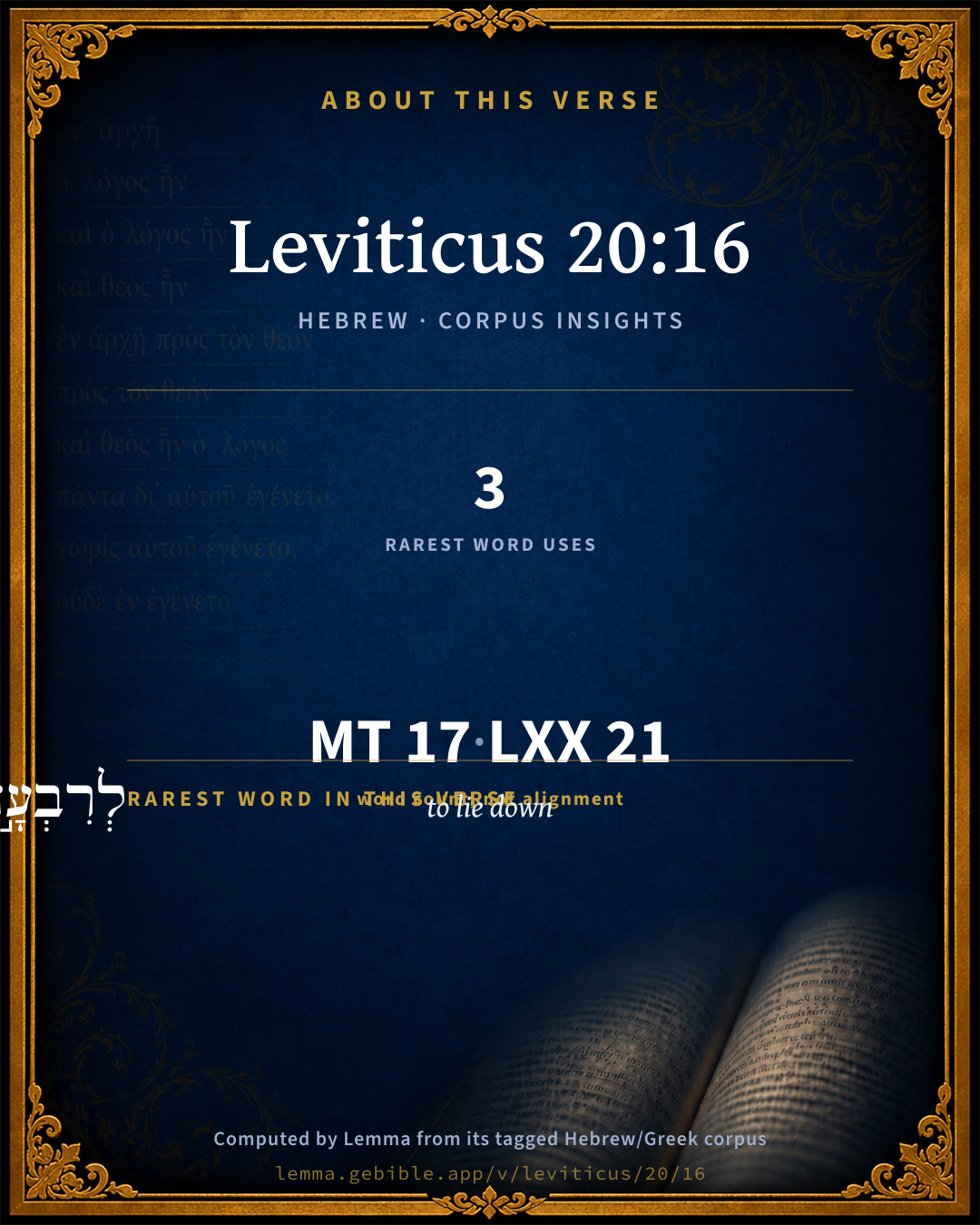
About this verse

These counts appear in no published source. They are computed here, from the morphology-tagged text and Lemma’s own curated glosses. What Lemma adds →

17
words
12
distinct lemmas
Pentateuch
section

Notable vocabulary

The rarest word here is לְרִבְעָ֣ה to lie down H7250 — appearing just 3 times in the whole Hebrew Bible.

Shared distinctive vocabulary

לְרִבְעָ֣ה to lie down H7250 occurs in 3 verses of the Hebrew Bible. Also found in:

Grammatical profile

  • 5 verbs
  • 6 nouns
  • 3 prepositions
  • 3 particles

Verb forms

  • תִּקְרַ֤ב Qal · Imperfect
  • לְרִבְעָ֣ה Qal · Infinitive Construct
  • וְהָרַגְתָּ֥ Qal · Sequential Perfect
  • מ֥וֹת Qal · Infinitive Absolute
  • יוּמָ֖תוּ Hophal · Imperfect

Repetition

Words recur within this verse — often emphatic in Hebrew:

  • וְאִשָּׁ֗ה woman H802 ×2
  • בְּהֵמָה֙ beast H929 ×2
  • מ֥וֹת to die H4191 ×2

Hebrew & Septuagint length

In English translation the verse runs 32 words from the Hebrew and 30 from the Septuagint (LXX English) — closely comparable.

A rough comparison of the two English renderings, which tokenize alike — not a word-level alignment.

Word counts can differ between the Hebrew and the Greek without any difference in meaning — e.g. the Hebrew direct-object marker אֵת has no separate Greek word, and Greek often adds the article ὁ.

In the original languages it is 17 Hebrew tokens and 21 Greek tokens — but the two are counted differently (Hebrew bundles its prefixes and suffixes into one token; the Greek is in lemma form), so that isn’t a like-for-like length.

Cross-references

4

Topical passages linked to Leviticus 20:16 in the Treasury of Scripture Knowledge — connected by theme and wording, ordered by reader-vote popularity; previews shown in the World English Bible.

  • Exodus 19:13 No hand shall touch him, but he shall surely be stoned or shot through; whether it is animal or man, he shall not live.' When the trumpet sounds long, they shall come up to the mountain."
  • Exodus 21:32 If the bull gores a man-servant or a maid-servant, thirty shekels of silver shall be given to their master, and the ox shall be stoned.
  • Hebrews 12:20 for they could not stand that which was commanded, "If even an animal touches the mountain, it shall be stoned;"
  • Exodus 21:28 "If a bull gores a man or a woman to death, the bull shall surely be stoned, and its flesh shall not be eaten; but the owner of the bull shall not be held responsible.

Cross-references courtesy of OpenBible.info (CC BY 4.0).

Hebrew and Greek witnesses Masoretic Hebrew ↔ Greek Septuagint

The same verse in the two great witnesses to the Old Testament, shown verse-for-verse.

These are two independent witnesses, not word-aligned to each other, and the Septuagint is shown in lemma (dictionary) form.

Hebrew Leviticus 20:16 Masoretic · Westminster Leningrad Codex

וְאִשָּׁ֗ה אֲשֶׁ֨ר תִּקְרַ֤ב אֶל כָּל בְּהֵמָה֙ לְרִבְעָ֣ה אֹתָ֔הּ וְהָרַגְתָּ֥ אֶת הָאִשָּׁ֖ה וְאֶת הַבְּהֵמָ֑ה מ֥וֹת יוּמָ֖תוּ דְּמֵיהֶ֥ם בָּֽם

"'If a woman approaches any animal, and lies down with it, you shall kill the woman, and the animal: they shall surely be put to death; their blood shall be upon them.

World English Bible · Public Domain

Greek LXX Leviticus 20:16 Septuagint · lemma form

καί γυνή ὅστις προςἔρχομαι πρός πᾶς κτῆνος βιβάζω αὐτός ὑπό αὐτός ἀποκτείνω ὁ γυνή καί ὁ κτῆνος θάνατος θανατόω ἔνοχος εἰμί

And whatever woman shall approach any beast, so as to have connexion with it, you⌃ shall kill the woman and the beast: let them die the death, they are guilty.

LXX2012 (modern English Septuagint) · Public Domain

Hebrew: Westminster Leningrad Codex (CC BY 4.0). Greek: Septuagint (public domain); English from LXX2012 (modern English Septuagint) (Public Domain). How the Septuagint differs from the Hebrew →

Targum (Aramaic paraphrase)

2

The Targum is the ancient Jewish Aramaic paraphrase of the Hebrew Scriptures — an interpretive translation, not the Hebrew text itself. Onkelos (literal) and Pseudo-Jonathan (expansive) render the Torah, and Jonathan the Prophets. Coverage is partial: where no permissively-licensed English translation exists for a verse, only the Aramaic is shown. This is verse-level text, not a word-by-word alignment to the Hebrew.

  1. Targum Onkelos Torah (Genesis–Deuteronomy)
    וְאִתְּתָא דִי תִקְרַב לְכָל בְּעִירָא לְמִשְׁלַט בַּהּ וְתִקְטוֹל יָת אִתְּתָא וְיָת בְּעִירָא אִתְקְטָלָא יִתְקַטְלוּן קְטָלָא חַיָבִין

    (no public-domain English translation for this verse)

    Targum Onkelos — Aramaic: “Onkelos Genesis” (public domain); “Onkelos Exodus” (public domain); “Onkelos Leviticus” (public domain); “Onkelos Numbers” (public domain); “Onkelos Deuteronomy” (public domain). English: “Sefaria Community Translation” (CC0 1.0 (public-domain dedication)); “J.W. Etheridge. The Targums of Onkelos and Jonathan Ben Uzziel on the Pentateuch. London: Longmans, Green, 1862” (public domain). Text via Sefaria.

  2. Targum Pseudo-Jonathan Torah (Genesis–Deuteronomy)
    וְאִתְּתָא דִי תִקְרַב לְצֵיד כָּל בְּעִירָא לְמִתְהַנְיָא מִינָהּ וְתִקְטְלוּן יַת אִיתְּתָא בְּאַטְלוּת אַבְנִין וְיַת בְּעִירָא בְּקוֹלְפֵי אִתְקְטָלָא יִתְקַטְלוּן דִין קְטוֹל חַיָיבִין

    And if a woman approacheth the side of any beast that it may have to do with her, they shall be slain; the woman by the casting of stones, and the beast by the slaughter of spikes, they shall die; for they are deserving of death.

    Targum Pseudo-Jonathan — Aramaic: “Targum Jonathan on Genesis” (public domain); “Targum Jonathan on Exodus” (public domain); “Targum Jonathan on Leviticus” (public domain); “Targum Jonathan on Numbers” (public domain); “Targum Jonathan on Deuteronomy” (public domain). English: “The Targum of Jonathan ben Uzziel, trans. J. W. Etheridge, London, 1862” (public domain). Text via Sefaria.

Commentary

Notes on Leviticus 20:16 from classic Christian and Jewish commentators (each source and its license shown beneath its notes). The classic Christian expositions comment on the surrounding passage and are grouped to its opening verse, so a note may address several verses; the Jewish commentaries on the Tanakh (Rashi and others) are per-verse, so they appear only where the commentator wrote on this verse.

Lemma curates 59 commentaries, every one of them public domain or Creative Commons licensed, each selected and text-cleaned for this edition rather than reprinted as found. About our sources →

Trapp's Complete Commentary

John Trapp

Lev 20:16 And if a woman approach unto any beast, and lie down thereto, thou shalt kill the woman, and the beast: they shall surely be put to death; their blood [shall be] upon them.

Ver. 16. And the beast.] Lest the sight of such a beast should bring that loathsome sin to remembrance.

John Trapp, A Commentary or Exposition upon All the Books of the Old and New Testament (1647–1656) — public domain. Text from a community e-Sword module.

Adam Clarke's Commentary

Verse 16. If a woman approach unto any beast] We have the authority of one of the most eminent historians in the world, Herodotus, to say that this was a crime not unknown in Egypt; yea, that a case of this nature actually took place while he was there. Εγενετο δ' εν τῳ νο μῳ τουτῳ επ' εμευ τουτο το τερας, Γυναικι Τραγος εμισγετο αναφανδον. Τουτο ες επιδειξιν ανθρωπων απικετο. - Herod. in Euterp., p. 108. Edit. Gale, Lond. 1679.

"In this district, within my own recollection, this portentous business took place: a goat coupled so publicly with a woman that every person knew it," c. After this, need we wonder that God should have made laws of this nature, when it appears these abominations were not only practised among the Egyptians, but were parts of a superstitious religious system? This one observation will account for many of those strange prohibitions which we find in the Mosaic law others, the reasons of which are not so plain, we should see the propriety of equally, had we ampler historic records of the customs that existed in that country.

Adam Clarke's Commentary on the Bible (1810–1826) — public domain. Text from a community e-Sword/MySword module.

John Gill's Exposition

And if a woman approach unto any beast, and lie down thereto,.... In order that the beast may lie with her, and solicit it to commit such an action with her, see Lev 18:23,

thou shall kill the woman and the beast: the woman by stoning, and the beast with clubs, as the Targum of Jonathan; and this for the same reasons as before, as well as to prevent monstrous births:

they shall surely be put to death; both the one and the other, and not spared:

their blood shall be upon them; they are guilty of a capital crime, a crime which deserves death; this must be understood of the man that lies with a beast, and of the woman; for as for the beast itself, as it is not capable of sinning, so not of guilt, in a proper sense.

John Gill's Exposition of the Whole Bible (1746–1763) — public domain (CC PDM 1.0). Text via the HelloAO Bible API.

Haydock's Catholic Bible Commentary

Them. This monstrous abomination, teras, as Herodotus, an eye-witness calls it, was not unknown to the Egyptians. Gunaiki tragos emisgeto; (B. ii. 46,) nor to other nations. (Apul. Met. 10.)

George Leo Haydock (1774–1849), Haydock's Catholic Family Bible and Commentary, 1859 edition — public domain. Excludes Psalms (Douay-Rheims chapter numbering differs from Protestant) and Deuterocanonical books (Catholic canon only).

Lesson kit

Teaching starters — assembled from the data on this page, not authored interpretation. Every prompt links to the verse data it draws on. Edit before teaching.

Leviticus, in the Pentateuch, opens this verse with 17 words (12 distinct Hebrew lemmas). Its most distinctive word is râbaʻ (“to lie down”). A historical commentator’s framing appears above. Read the whole chapter for the surrounding context.

Discussion questions

  1. How does “to lie down” (râbaʻ) shape what this verse is saying?
  2. How does Leviticus 18:23, which shares the word «to lie down», read alongside this verse?
  3. What does the repetition of “woman” (2× in this one verse) do in this verse?
  4. These translations render this verse differently; the difference is in the English rendering, not the original. What questions does that raise?
  5. «תִּקְרַ֤ב» is a Qal Imperfect verb. How does that grammatical form shape the action described?
  6. Compare how Trapp's Complete Commentary and Adam Clarke's Commentary read this verse. Where do they agree or differ?

Things to notice

Reading settings

Reading text

Shown beneath each verse's original-language words.

Old Testament
Old Testament edition

Read the OT as the Masoretic Hebrew (MT) or the Greek Septuagint (LXX).

English shown for the Greek Septuagint (in the Hebrew ↔ Greek comparison).

Comparing translations? Open the Compare panel on any verse page to stack up to four side by side.