
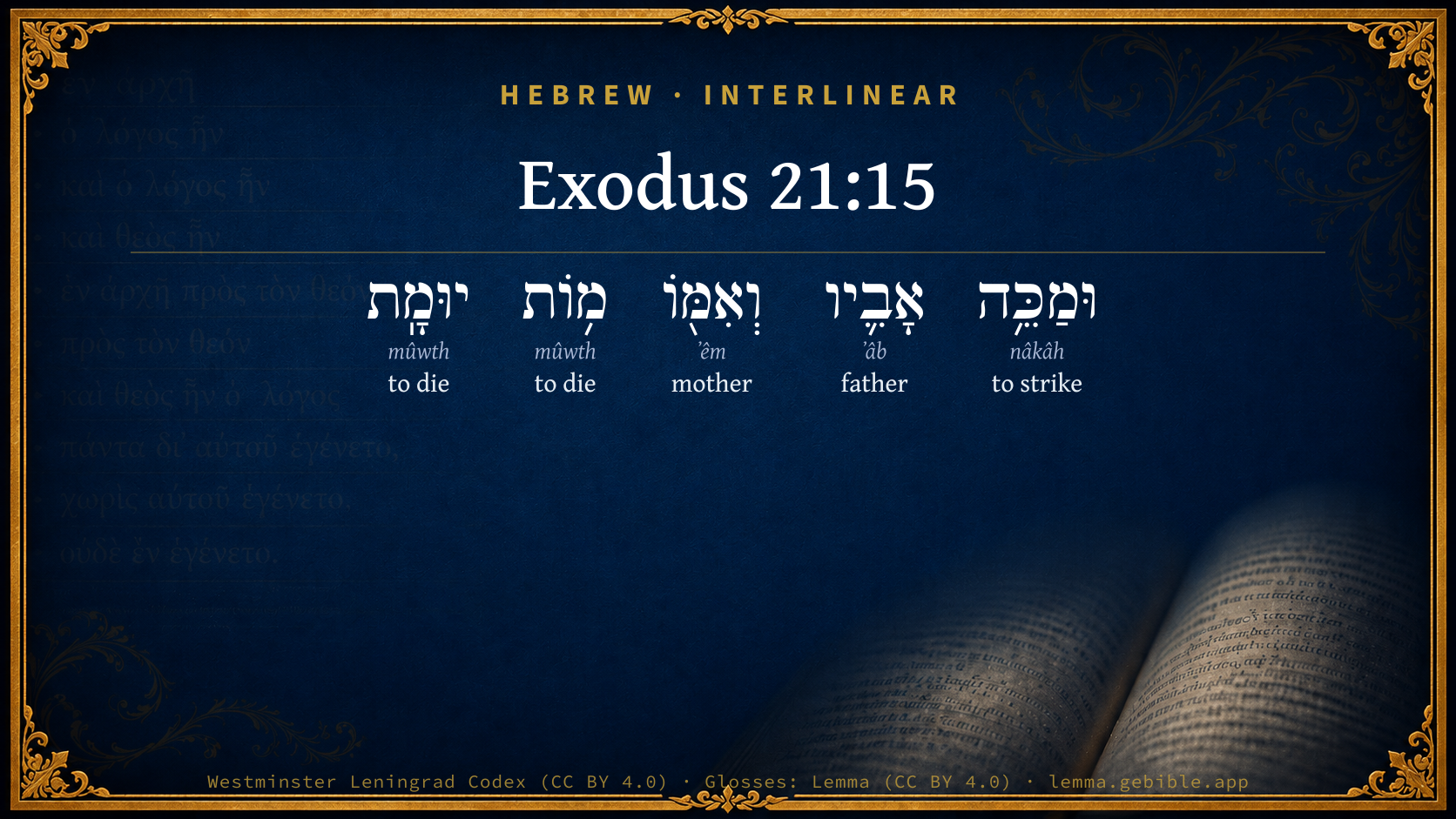
Exodus 21:15

Hebrew (Westminster Leningrad Codex) Exodus 21:15 appears in the Hebrew Old Testament. The text above is from the Westminster Leningrad Codex. Each word links to its Strong’s number, a concise gloss, and parsing drawn from the Open Scriptures Hebrew Bible morphology. Click any word for its full Brown-Driver-Briggs (BDB) entry.
Download image
Cite this verse

Exodus 21:15 (World English Bible). Public Domain. Lemma interlinear Bible study tool, https://lemma.gebible.app/v/exodus/21/15.

Show BibTeX & RIS
BibTeX
RIS
English Translation
"Anyone who attacks his father or his mother shall be surely put to death.
World English Bible · Public Domain
Download a study sheet

One document with this verse’s original text, its word-by-word gloss line, the meaning frame, cross-references with their text, attributed commentary, and full source and license credits — printable, and it pastes into notes with its structure intact.

This verse Autodidact and up

Study sheet (.html) Plain text (.txt)

A passage Seminary Student

Up to 50 verses in one chapter. A passage sheet keeps up to 6 commentary sources and 12 cross-references per verse, in the order this page ranks them, and says so on the sheet whenever that leaves anything out. Ask for a single verse and you get the Autodidact verse sheet above.

Everything on this page stays free to read, with no account — the sheet is a download of what is already on screen, not access to it.

Want to remove ads? Support Godless Engineer
Compare translations 3

The same verse in 3 English versions, stacked beneath the original-language interlinear above. Click any original word for its lexicon entry.

Each is an independent rendering of the whole verse — the interlinear is not word-aligned to these translations.

Highlighted words mark where these versions differ — a whole-verse word diff, not a word-by-word alignment.

  • World English Bible Public Domain
    "Anyone who attacks his father or his mother shall be surely put to death.
  • King James Version Public Domain
    And he that smiteth his father, or his mother, shall be surely put to death.
  • unfoldingWord Literal Text CC BY-SA 4.0
    Whoever hits his father or his mother shall surely be put to death.

unfoldingWord Literal Text — © unfoldingWord, licensed CC BY-SA 4.0. Word-aligned USFM3 via Door43 (git.door43.org/unfoldingWord/en_ult).

Versions to compare (up to 4)

3 of 4 selected

Show all 18 translations

Every available English version of this verse, each an independent rendering of the whole verse.

  • World English Bible Public Domain
    "Anyone who attacks his father or his mother shall be surely put to death.
  • Berean Standard Bible Public Domain
    Whoever strikes his father or mother must surely be put to death.
  • Majority Standard Bible Public Domain
    Whoever strikes his father or mother must surely be put to death.
  • King James Version Public Domain
    And he that smiteth his father, or his mother, shall be surely put to death.
  • American Standard Version (1901) Public Domain
    And he that smiteth his father, or his mother, shall be surely put to death.
  • Revised Version (1885) Public Domain
    And he that smiteth his father, or his mother, shall be surely put to death.
  • Geneva Bible (1599) Public Domain
    Also hee that smiteth his father or his mother, shall die the death.
  • Douay-Rheims (1899) Public Domain
    He that striketh his father or mother, shall be put to death.
  • Young's Literal Translation Public Domain
    `And he who smiteth his father or his mother is certainly put to death.
  • Literal Standard Version CC BY-SA 4.0
    And he who strikes his father or his mother is certainly put to death.
  • Unlocked Literal Bible CC BY-SA 4.0
    Whoever hits his father or mother must surely be put to death.
  • unfoldingWord Literal Text CC BY-SA 4.0
    Whoever hits his father or his mother shall surely be put to death.
  • Darby Bible Public Domain
    And he that striketh his father, or his mother, shall certainly be put to death.
  • World Messianic Bible Public Domain
    “Anyone who attacks his father or his mother shall be surely put to death.
  • Webster's Bible Public Domain
    And he that smiteth his father, or his mother, shall be surely put to death.
  • Free Bible Version CC BY-SA 4.0
    Anyone who hits their father or mother must be executed.
  • Bible in Basic English Public Domain
    Any man who gives a blow to his father or his mother is certainly to be put to death.
  • JPS Tanakh (1917) Public Domain
    And he that smiteth his father, or his mother, shall be surely put to death.

Literal Standard Version (2020), Covenant Press — licensed CC BY-SA 4.0. Text via the HelloAO Bible API (eBible.org). Unlocked Literal Bible (unfoldingWord) — licensed CC BY-SA 4.0. Text via the HelloAO Bible API (eBible.org). unfoldingWord Literal Text — © unfoldingWord, licensed CC BY-SA 4.0. Word-aligned USFM3 via Door43 (git.door43.org/unfoldingWord/en_ult). Free Bible Version, Dr. Jonathan Gallagher — licensed CC BY-SA 4.0. Text via the HelloAO Bible API (eBible.org).

Word by word

More ways to search: Search by grammar → Find every occurrence → Compare this word →

Practice this passage: Drill this verse → Learn its vocabulary →

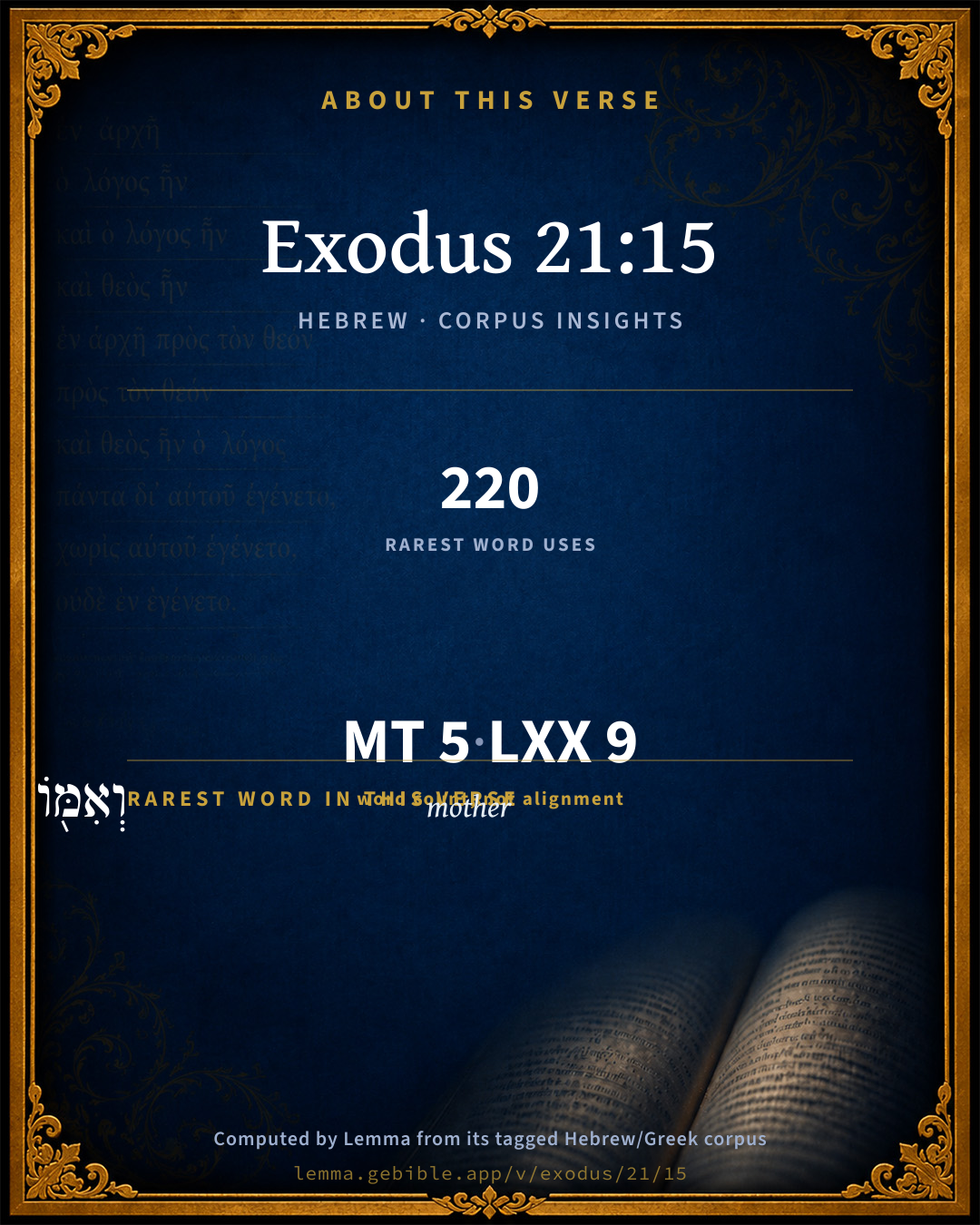
About this verse

These counts appear in no published source. They are computed here, from the morphology-tagged text and Lemma’s own curated glosses. What Lemma adds →

5
words
4
distinct lemmas
Pentateuch
section

Grammatical profile

  • 3 verbs
  • 2 nouns

Verb forms

  • וּמַכֵּ֥ה Hiphil · Participle Active
  • מ֥וֹת Qal · Infinitive Absolute
  • יוּמָֽת Hophal · Imperfect

Repetition

A word recurs within this verse — often emphatic in Hebrew:

  • מ֥וֹת to die H4191 ×2

Hebrew & Septuagint length

In English translation the verse runs 14 words from the Hebrew and 14 from the Septuagint (LXX English) — the same length.

A rough comparison of the two English renderings, which tokenize alike — not a word-level alignment.

Word counts can differ between the Hebrew and the Greek without any difference in meaning — e.g. the Hebrew direct-object marker אֵת has no separate Greek word, and Greek often adds the article ὁ.

In the original languages it is 5 Hebrew tokens and 9 Greek tokens — but the two are counted differently (Hebrew bundles its prefixes and suffixes into one token; the Greek is in lemma form), so that isn’t a like-for-like length.

Cross-references

5

Topical passages linked to Exodus 21:15 in the Treasury of Scripture Knowledge — connected by theme and wording, ordered by reader-vote popularity; previews shown in the World English Bible.

  • Deuteronomy 21:18–21 If a man have a stubborn and rebellious son, who will not obey the voice of his father, or the voice of his mother, and, though they chasten him, will not listen to them;
  • Deuteronomy 27:24 Cursed be he who strikes his neighbor in secret. All the people shall say, Amen.
  • Proverbs 30:11 There is a generation that curses their father, And doesn't bless their mother.
  • Proverbs 30:17 The eye that mocks at his father, And scorns obedience to his mother: The ravens of the valley shall pick it out, The young eagles shall eat it.
  • 1 Timothy 1:9 as knowing this, that law is not made for a righteous man, but for the lawless and insubordinate, for the ungodly and sinners, for the unholy and profane, for murderers of fathers and murderers of mothers, for manslayers,

Cross-references courtesy of OpenBible.info (CC BY 4.0).

Hebrew and Greek witnesses Masoretic Hebrew ↔ Greek Septuagint

The same verse in the two great witnesses to the Old Testament, shown verse-for-verse.

These are two independent witnesses, not word-aligned to each other, and the Septuagint is shown in lemma (dictionary) form.

Hebrew Exodus 21:15 Masoretic · Westminster Leningrad Codex

וּמַכֵּ֥ה אָבִ֛יו וְאִמּ֖וֹ מ֥וֹת יוּמָֽת

"Anyone who attacks his father or his mother shall be surely put to death.

World English Bible · Public Domain

Greek LXX Exodus 21:15 Septuagint · lemma form

ὅς τύπτω πατήρ αὐτός ἤ μήτηρ αὐτός θάνατος θανατόω

Whoever smites his father or his mother, let him be certainly put to death.

LXX2012 (modern English Septuagint) · Public Domain

Hebrew: Westminster Leningrad Codex (CC BY 4.0). Greek: Septuagint (public domain); English from LXX2012 (modern English Septuagint) (Public Domain). How the Septuagint differs from the Hebrew →

Targum (Aramaic paraphrase)

2

The Targum is the ancient Jewish Aramaic paraphrase of the Hebrew Scriptures — an interpretive translation, not the Hebrew text itself. Onkelos (literal) and Pseudo-Jonathan (expansive) render the Torah, and Jonathan the Prophets. Coverage is partial: where no permissively-licensed English translation exists for a verse, only the Aramaic is shown. This is verse-level text, not a word-by-word alignment to the Hebrew.

  1. Targum Onkelos Torah (Genesis–Deuteronomy)
    וּדְיִמְחֵי אֲבוּהִי וְאִמֵהּ אִתְקְטָלָא יִתְקְטֵל:

    (no public-domain English translation for this verse)

    Targum Onkelos — Aramaic: “Onkelos Genesis” (public domain); “Onkelos Exodus” (public domain); “Onkelos Leviticus” (public domain); “Onkelos Numbers” (public domain); “Onkelos Deuteronomy” (public domain). English: “Sefaria Community Translation” (CC0 1.0 (public-domain dedication)); “J.W. Etheridge. The Targums of Onkelos and Jonathan Ben Uzziel on the Pentateuch. London: Longmans, Green, 1862” (public domain). Text via Sefaria.

  2. Targum Pseudo-Jonathan Torah (Genesis–Deuteronomy)
    וּדְחַבֵּל בְּאָבוֹי וּבְאִימֵיהּ אִתְקְטָלָא יִתְקְטֵיל בְּשִׁינוּקָא דְסוּדְרָא

    And he who woundeth his father or his mother shall die by strangling.

    Targum Pseudo-Jonathan — Aramaic: “Targum Jonathan on Genesis” (public domain); “Targum Jonathan on Exodus” (public domain); “Targum Jonathan on Leviticus” (public domain); “Targum Jonathan on Numbers” (public domain); “Targum Jonathan on Deuteronomy” (public domain). English: “The Targum of Jonathan ben Uzziel, trans. J. W. Etheridge, London, 1862” (public domain). Text via Sefaria.

Commentary

Notes on Exodus 21:15 from classic Christian and Jewish commentators (each source and its license shown beneath its notes). The classic Christian expositions comment on the surrounding passage and are grouped to its opening verse, so a note may address several verses; the Jewish commentaries on the Tanakh (Rashi and others) are per-verse, so they appear only where the commentator wrote on this verse.

Lemma curates 59 commentaries, every one of them public domain or Creative Commons licensed, each selected and text-cleaned for this edition rather than reprinted as found. About our sources →

Trapp's Complete Commentary

John Trapp

Exo 21:15 And he that smiteth his father, or his mother, shall be surely put to death.

Ver. 15. He that smiteth.] By the law of God, of nature, and of nations, such a man should die. And herein, I think, our laws are defective: albeit, I am not of Carolostadius’s mind, who, if Melancthon misreport him not, held that these judicial laws set down by Moses should be still of force, and these only, in Christian commonwealths, and all other civil and municipal laws abolished. Our English Alfred I cannot but commend for his piety, in that he began his common laws with the ten commandments. {a}

{a} Lombard.

John Trapp, A Commentary or Exposition upon All the Books of the Old and New Testament (1647–1656) — public domain. Text from a community e-Sword module.

The Biblical Illustrator

Joseph S. Exell

Exo_21:15

He that smiteth his father.

Gods indignation against the unfilial spirit

I. The unfilial spirit in two aspects.

1. He that smiteth his father or his mother.

(1) A child may smite his parent literally, as in the case of those brutes we read of in the newspapers every week.

(2) A child may smite his parents authority by rebellion in thought, word, or deed; e.g., Absalom.

(3) A child may smite his parents wealth by extravagance or carelessness.

(4) A child may smite his parents character by an incautious revelation of domestic secrets.

(5) A child may smite his parents health, and, by misconduct, bring their grey hairs with sorrow to the grave; e.g., Josephs brethren.

(6) A child may smite his parents heart, and break it by disobedience and wilfulness; e.g., sons of Eli.

2. He that curseth (lit. revileth)

his father or his mother.

(1) A child may revile his parents by an assertion of personal independence.

(2) A child may revile his parents by speaking of them in a careless and irreverent way.

(3) A child may revile his parents by speaking to them in a familiar or impertinent way.

(4) A child may revile his parents by treating their counsels with contempt; and

(5) Alas! a child may revile his parents by cursing them to their face.

II. The uniform punishment of the unfilial spirit. Shall surely be put to death. The letter of this condemnation is now repealed, but its spirit lives on through the ages.

1. An unfilial child dies to the respect of civilised society.

2. An unfilial child is morally dead. If the sign of the moral life is love of the brethren, how dead must he be in whom filial respect and love is extinct!

3. An unfilial child, inasmuch as he breaks a moral law, and a law that partakes of the qualities of both tables and combines them, dies in a more terrible sense. The soul that sinneth it shall die. (J. W. Burn.)

Filial impiety

The books tell us of an old man whose son dragged him, by his hoary locks, to the threshold of his door, when the father said: Now stop, my son, that is as far as I dragged my father by his hair, There is still a God that judgeth in the earth. He makes Himself known by the judgments which He executeth. Who has ever seen any one a loser by filial piety, or a gainer by the want of it? There still lives a man who, in a passion, cursed his own father, and then struck him several times with a horsewhip. Judgment against this evil work was not executed speedily. Time rolled on, but no ingenuous repentance followed. After some time the cruel son was blasting rock in a well. The fuse caught fire, and he was blown up with the loss of both his eyes, and his right hand, with which he had struck his father. Soon after this sad occurrence he was received in the year 1868 as a pauper at the county workhouse. He has habitually been restless and miserable. He is happy nowhere. He has gone to another county and to another workhouse. But he is well known as a very wretched man. By the law of Moses, cursing father or mother was punished with death. No reason for the law is given, but the atrocious nature of the act. What fearful force is in such words as these: Whoso curseth his father or his mother, his lamp shall be put out in obscure darkness. The eye that mocketh at his father, the ravens of the valley shall pick it out, and the young eagles shall eat it (Pro_20:20; Pro_30:17). (W. S. Plumer.)

Cruelty to a mother

A young man, of whom I once heard, was often spoken to and often prayed for by his mother, until he said to her, Mother, if you dont give up that praying for me, I will run away to sea. He ran away. Before he went, his mother packed his box. She put the writing paper at the top, and all she begged of him was, My boy, when you are far away from me, write to me. I will write to you; but send me an answer. He went away; he stayed three years, and never sent a single syllable to that loving mother, who oftentimes was kneeling by her bedside praying for that runaway boy. At last he went back to the old village to see how she was. As he walked down the street his heart misgave him. He walked up the path to the house, he knocked at the door; it was opened by a person whom he did not know. He asked for Mrs. So-and-so. How is she? The woman looked blank at him. He said, Is not she here? Oh, said the woman, you mean the old woman who used to live here. She died eight months ago of a broken heart. She had a bad son, who went away to sea and left her, and she wrote to him, and he never wrote back again. He turned away and went into the village churchyard. He looked at the graves, he found the one he sought, and threw himself down upon it, saying, Oh, mother, I never meant it, I never meant it! But he did it. (Dr. Morgan.)

The Biblical Illustrator, edited by Joseph S. Exell (c. 1880s–1900s) — public domain. Text from a community e-Sword module.

Joseph Benson's Commentary

Exo 21:15. He that smiteth his father, &c. — So sacred and inviolable is that reverence which children owe to their parents, that, by the law of God, it was death not only to strike them, but even to curse or outrageously revile them, Exo 21:17, and Mat 15:4. The reason of this law is, that such crimes are a sign of most audacious wickedness. It appears, however, from Deu 21:18, that children were not to be put to death for the first offence of this kind, but if, after repeated admonitions from their parents, they still persisted in their undutiful carriage, without hope of reformation, then, upon the accusation of their parents, they were to be put to death.

Joseph Benson's Commentary on the Old and New Testaments (1811–1818) — public domain. Text from a community e-Sword module.

Adam Clarke's Commentary

Verse 15. That smiteth his father, or his mother] As such a case argued peculiar depravity, therefore no mercy was to be shown to the culprit.

Adam Clarke's Commentary on the Bible (1810–1826) — public domain. Text from a community e-Sword/MySword module.

Ellicott's Commentary for English Readers

(15-17) And he that smiteth his father . . .-With homicide are conjoined some other offences, regarded as of a heinous character, and made punishable by death: viz. (1), striking a parent; (2) kidnapping; and (3) cursing a parent. The immediate sequence of these crimes upon murder, and their punishment by the same penalty, marks strongly God’s abhorrence of them. The parent is viewed as God’s representative, and to smite him is to offer God an insult in his person. To curse him implies, if possible, a greater want of reverence; and, since curses can only be effectual as appeals to God, it is an attempt to enlist God on our side against His representative. Kidnapping is a crime against the person only a very little short of murder, since it is to deprive a man of that which gives life its chief value—liberty. Many a man would prefer death to slavery; and to almost all the passing into the slave condition would be a calamity of the most terrible kind, Involving life-long misery. Its suddenness and unexpectedness, when the result of kidnapping, would augment its grievousness, and render it the most crushing of all misfortunes. Joseph’s history shows us how easy it was to sell a free man as a slave, and obtain his immediate removal into a distant country (Gen_37:25-28). The Egyptian annals tell us of bloody wars carried on for kidnapping purposes (Lenormant, Histoire Ancienne, vol. i., pp. 423, 424). In the classical times and countries, the slaves offered for sale in the markets had usually been obtained in this way. The stringent law of the Mosaic code (Exo_21:16) was greatly needed to check an atrocious crime very widely committed.

A Bible Commentary for English Readers, edited by Charles John Ellicott (1878–1897) — public domain. Text from a community e-Sword module.

The Cambridge Bible for Schools and Colleges

gen. ed. J. J. S. Perowne

15. Striking a parent. Notice that the mother is placed on an equality with the father.

smiteth] simply, without killing: the murder of a parent would fall under the general rule of v. 12. The severity of the penalty was in accordance with the high respect paid to both parents in ancient Israel: see Exo_20:12, and cf. Deu_21:18-21. Hạmmurabi (§ 195) ordained that if a son struck his father—no mention is made of his mother—his hands should be cut off. The older Sumerian laws said1[188]: ‘If a son has said to his father, Thou art not my father [i.e. repudiated him], he may brand him, lay fetters upon him, and sell him. If a son has said to his mother, Thou art not my mother, one shall brand his forehead, drive him round the city, and expel him from the house.’ At Athens γονέων κάκωσις (‘maltreatment of parents’) was actionable, and might be punished with ἀτιμία, or loss of civil rights (Andoc. de Myst. § 74, cf. Demosth. adv. Timocr. §§ 103, 105, p. 732 f.); and Plato (Legg. ix. 881 b–d), if any one struck a parent, would have any one who witnessed the act, and failed to interfere, severely punished, and the offender himself condemned to perpetual exile, or death if he ever returned home. Solon (Cic. Rosc. 25) is said to have made no mention of such a crime, on the ground that he considered its occurrence impossible (Kn.).

[188] Winckler, Gesetze Hamm. (1904), p. 85; Pinches, op cit. [p. 212 n.], p. 190 f.

The Cambridge Bible for Schools and Colleges (gen. ed. J. J. S. Perowne; Cambridge University Press, 1878–1918) — public domain. Text from a community e-Sword module.

John Gill's Exposition

And he that smiteth his father or his mother,.... With his fist, or with a stick, or cane, or such thing, though they died not with the blow, yet it occasioned any wound, or caused a bruise, or the part smitten black and blue, or left any print of the blow; for, as Jarchi says, the party was not guilty, less by smiting there was a bruise, or weal, made, or any mark or scar: but if so it was, then he

shall be surely put to death; the Targum of Jonathan adds, with the suffocation of a napkin; and so Jarchi says with strangling; the manner of which was this, the person was sunk into a dunghill up to his knees, and two persons girt his neck with a napkin or towel until he expired. This crime was made capital, to show the heinousness of it, how detestable it was to God, and in order to deter from it.

John Gill's Exposition of the Whole Bible (1746–1763) — public domain (CC PDM 1.0). Text via the HelloAO Bible API.

Albert Barnes' Notes on the Bible

The following offences were to be punished with death:

Striking a parent, compare Deu 27:16.

Cursing a parent, compare the marginal references.

Kidnapping, whether with a view to retain the person stolen, or to sell him, compare the marginal references.

Albert Barnes' Notes on the Bible (1834–1885) — public domain. Text from a community e-Sword/MySword module.

Haydock's Catholic Bible Commentary

Striketh, even though death should not ensue. But some require a grevious wound, and that the son should be twice admonished, Deuteronomy xxi. 18. Parricide seemed a crime so shocking and unnatural, that neither Moses nor Solon made any express law against it.

George Leo Haydock (1774–1849), Haydock's Catholic Family Bible and Commentary, 1859 edition — public domain. Excludes Psalms (Douay-Rheims chapter numbering differs from Protestant) and Deuterocanonical books (Catholic canon only).

Matthew Poole's English Annotations

He that smiteth; either,

1. So as is before mentioned, Exo 21:12, so as they die. And to smite sometimes signifies to kill, as Gen 4:15; 2Ki 14:5, compared with 2Ch 25:3. And this may be here added by way of distinction: q.d. That killing of another man which is punished with death, must be done presumptuously; but the killing of parents, though not done presumptuously, is a capital crime. Or,

2. The mere smiting of them, to wit, wilfully and dangerously. Nor will any think this law too severe, that considers that this is an act full of horrid impiety against God, who hath so expressly and emphatically commanded children to honour their parents; of highest and most unnatural ingratitude, and utterly destructive to human society.

Matthew Poole's English Annotations on the Holy Bible (1683–1685) — public domain. Text from a community e-Sword/MySword module.

The Pulpit Commentary

Vers. 15-17. Other capital offences. The unsystematic character of the arrangement in this chapter is remarkably shown by this interruption of the consideration of different sorts of homicide, in order to introduce offences of quite a different character, and those not very closely allied to each othere.g. ,

1. Striking a parent;

2. Kidnapping;

3. Cursing a parent.

He that smiteth his father, etc. To "smite" here is simply to "strike to offer the indignity of a blow not to kill, which had already been made capital (ver. 12), not in the case of parents only, but in every case. The severity of the law is very remarkable, and strongly emphasises the dignity and authority of parents. There is no parallel to it in any other known code, though of course the patria potestas of the Roman father gave him the power of punishing a son who had struck him, capitally.

Vers. 15-17. Injuries to parents.

The command to honour father and mother, (Exo_20:12) which is enough for the conscience, and which, if obeyed, would render all further laws upon the subject unnecessary, is here reinforced by two important enactments, intended to restrain those who do not scruple to disobey mere moral laws. The penalty of death is affixed to two crimes:

1. Smiting a parent;

2. Cursing a parent.

I SMITING A PARENT. When it is considered that our parents represent God to us, that they are in a real sense authors of our being, that they protect and sustain us for years during which we could do nothing for ourselves, and that nature has implanted in our minds an instinctive reverence for them, the punishment of parent-strikers by death will not seem strange or excessive. A son must have become very hardened in guilt, very reckless, very heartless, very brutal, who can bring himself to lift a hand against a father, not to say a mother. There is as much moral guilt in a light blow dealt to one whom we are bound to love, honour, and protect from hurt, as in the utmost violence done to a stranger. However, according to the Talmud, it was not every light blow that was actually punished with death, but only a blow which caused a wound; and, of course, the punishment was only inflicted upon the complaint of the party aggrieved, who would be unlikely to take proceedings, unless the assault was of grave character. Probably the law had very seldom to be enforced.

What it did was to invest parents with a sacred and awful character in their children"s eyes, and to induce them to submit to chastisement without resistance.

II CURSING A PARENT. To curse a parent is almost as unnatural as to strike one. ALL cursing is unsuitable to such a being as man so full of faults himself, so liable to misjudge the character and conduct of others; but to curse those to whom we owe our existence is simply horrible. The sin is akin to blasphemy, and is awarded the same punishment. At the present day, when the Mosaic law is no longer in force, and when on this point no echoes of the Mosaic legislation are to be traced in existing codes, it is specially incumbent on conscientious persons to observe the spirit of the Mosaic enactments, and (as it were) make a Christian use of them.

(1) "Smite not a parent," said the law, "or die the death." "Grieve not a parent" is the Christian paraphrase. "Grieve him not by disobedience, by idleness, by extravagance, by misconduct of any kind. Do not discredit his bringing up by misbehaviour. Do not stab his. heart by ingratitude. Do not wither up his nature by unkindness." A child may easily, without lifting a finger, "bring down the grey hairs" of his father "with sorrow to the grave." He may "smite" him in half-a-dozen ways without touching him. Let Christian men beware of such "smiting" of their parents, and dread the "eternal death" which may follow in the place of Moses" temporal death.

(2) "Curse not a parent," said the law again. We do not now, unless we part with religion altogether, curse any one. But we too often break the spirit of this law, notwithstanding. We speak slightingly of our parents; we join in disrespectful comments on their manners or behaviour; we use language to them, face to face, which is wanting in reverence and unsuitable. If we would act in the spirit of the law, "curse not a parent," we must avoid all disrespectful words, all disrespectful thoughts towards them or concerning them; we must give them the honour due to parents; we must seriously consider their counsels, and as a general rule follow their advice. As temporal death was awarded to those who "cursed" parents by the Jewish law, (Exo_21:17) so eternal death will be the portion of such as are determinately "disobedient to parents" under the Christian dispensation.

The Pulpit Commentary (1880–1919), ed. H.D.M. Spence-Jones & Joseph S. Exell — public domain. Text from a community e-Sword module.

unfoldingWord translationNotes

Door43 World Missions Community

Whoever hits his father or mother must surely be put to death

This can be stated in active form. AT: "If anyone hits his father or mother, you must surely put him to death" or "You must surely kill anyone who hits his father or mother" (See: Active or Passive)

must surely

"must certainly"

in his hand

The hand here is a metonym for the power or control that a person exercises using the hand. AT: "under his control" or "with him"

that kidnapper must be put to death

This can be stated in active form. AT: "you must kill that kidnapper" (See: Active or Passive)

Whoever curses his father or his mother must surely be put to death

This can be stated in active form. AT: "you must surely kill anyone who curses his father or his mother" (See: Active or Passive)

translationWords

curse

unfoldingWord translationNotes — © Distant Shores Media and the Door43 World Missions Community, licensed CC BY-SA 4.0. Source: git.door43.org/Door43/en_tn.

Rashi

Rabbi Shlomo Yitzchaki (Rashi)

ומכה אביו ואמו AND HE THAT SMITETH HIS FATHER OR HIS MOTHER [SHALL SURELY BE PUT TO DEATH] — Because Scripture has taught us that he who inflicts a wound upon his fellow-man is liable for damages (cf. Rashi on Exodus 21:24) but is not subject to death, it was compelled to state that he who inflicts a wound on his father or his mother is subject to the death penalty (Mekhilta). He is, however, not punishable with death except for a blow which causes a wound (Sanhedrin 85b).

אביו ואמו means either his father or his mother (Mekhilta).

מות יומת SHALL BE PUT TO DEATH — by strangulation (Mekhilta).

Rashi on the Tanakh — English translations: “The Judaica Press complete Tanach with Rashi, translated by A. J. Rosenberg” (CC BY 4.0); “Pentateuch with Rashi's commentary by M. Rosenbaum and A.M. Silbermann, 1929-1934” (public domain); “The Metsudah Tanach series, Lakewood, N.J” (CC BY 4.0); and “The Book of Joshua, Metsudah Publications, 1997” (CC BY 4.0). Text via Sefaria.

Ramban (Nachmanides)

Rabbi Moshe ben Nachman (Ramban / Nachmanides)

AND HE THAT SMITETH HIS FATHER, OR HIS MOTHER, SHALL SURELY BE PUT TO DEATH. Our Sages have already taught that his death is by strangulation. This is why He placed next to it, And he that stealeth a man, and selleth him, for he too is punished by the same death. He separated it from the later verse, And he that curseth his father or his mother, because his death is by stoning, as it is said concerning him, he hath cursed his father or his mother; his blood shall be upon him, and whenever such an expression [his blood be upon him] is used about someone, his death is by stoning, this being derived from that which is written, They shall stone them with stones; their blood shall be upon them., Verse 27. The reason why He was more severe as to the manner of death of the one who curses his mother or father than as to the manner of death of one who smites them, is because the sin of cursing is more common, for when the fool gets angry he frets himself and curses by his king and father and mother the whole day, and a crime that is frequently committed needs a greater punishment [than one rarely committed]. Or it may be that cursing involves a greater sin, because he uses the Name of G-d, and therefore he has to be punished for his sin against his father and mother, and also for taking G-d’s Name in transgression and sin. Now the Gaon Rav Saadia, Note 229. said, that the reason why He placed the matter of stealing a human being between that of smiting one’s parents and cursing them, is because most people are kidnapped when they are young, and they grow up in a strange place unaware of who their parents are, and thus they may come to smite them or to curse them [not knowing that they are their parents]; therefore it is fitting that the thief too be punished by death as they are, since he is responsible for the punishment that is visited upon the child [who smites or curses either of his parents, and for that reason the verse dealing with the thief’s punishment is mentioned between those dealing with smiting one’s parents and cursing them].

Ramban (Nachmanides) on the Tanakh — English translation: “Commentary on the Torah by Ramban (Nachmanides). Translated and annotated by Charles B. Chavel. New York, Shilo Pub. House, 1971-1976” (CC BY 4.0). Text via Sefaria.

Lesson kit

Teaching starters — assembled from the data on this page, not authored interpretation. Every prompt links to the verse data it draws on. Edit before teaching.

Exodus, in the Pentateuch, opens this verse with 5 words (4 distinct Hebrew lemmas). Its most distinctive word is ʼêm (“mother”). A historical commentator’s framing appears above. Read the whole chapter for the surrounding context.

Discussion questions

  1. How does “mother” (ʼêm) shape what this verse is saying?
  2. How does Deuteronomy 21:18–21, which shares this passage’s theme, read alongside this verse?
  3. What does the repetition of “to die” (2× in this one verse) do in this verse?
  4. These translations render this verse differently; the difference is in the English rendering, not the original. What questions does that raise?
  5. «וּמַכֵּ֥ה» is a Hiphil Participle Active verb. How does that grammatical form shape the action described?
  6. Compare how Trapp's Complete Commentary and The Biblical Illustrator read this verse. Where do they agree or differ?

Things to notice

Reading settings

Reading text

Shown beneath each verse's original-language words.

Old Testament
Old Testament edition

Read the OT as the Masoretic Hebrew (MT) or the Greek Septuagint (LXX).

English shown for the Greek Septuagint (in the Hebrew ↔ Greek comparison).

Comparing translations? Open the Compare panel on any verse page to stack up to four side by side.