Leviticus 22:9

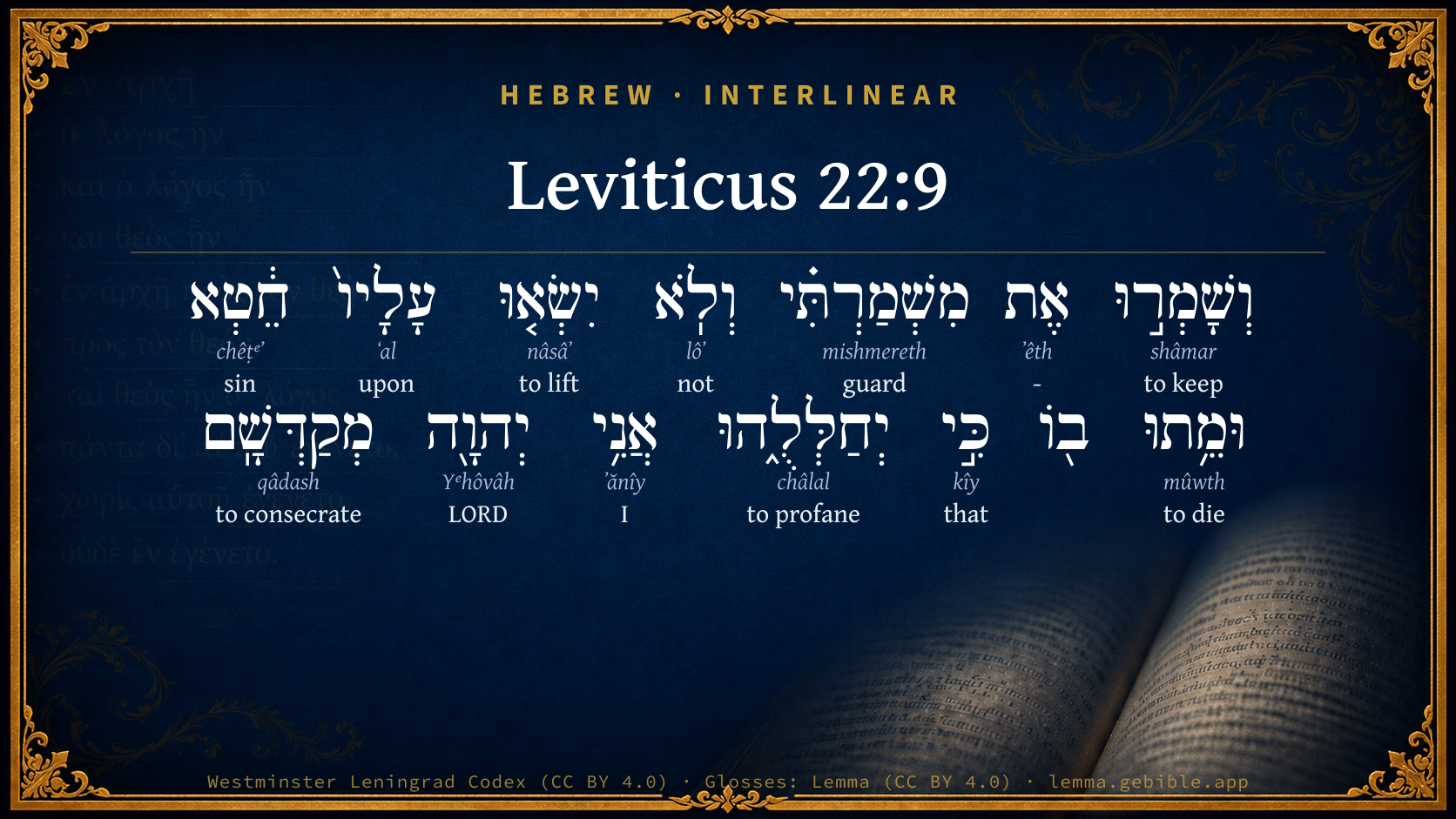
Hebrew (Westminster Leningrad Codex) Leviticus 22:9 appears in the Hebrew Old Testament. The text above is from the Westminster Leningrad Codex. Each word links to its Strong’s number, a concise gloss, and parsing drawn from the Open Scriptures Hebrew Bible morphology. Click any word for its full Brown-Driver-Briggs (BDB) entry.
Download image
Cite this verse

Leviticus 22:9 (World English Bible). Public Domain. Lemma interlinear Bible study tool, https://lemma.gebible.app/v/leviticus/22/9.

Show BibTeX & RIS
BibTeX
RIS
English Translation
"'They shall therefore keep my charge, lest they bear sin for it, and die therein, if they profane it. I am Yahweh who sanctifies them.
World English Bible · Public Domain
Download a study sheet

One document with this verse’s original text, its word-by-word gloss line, the meaning frame, cross-references with their text, attributed commentary, and full source and license credits — printable, and it pastes into notes with its structure intact.

This verse Autodidact and up

Study sheet (.html) Plain text (.txt)

A passage Seminary Student

Up to 50 verses in one chapter. A passage sheet keeps up to 6 commentary sources and 12 cross-references per verse, in the order this page ranks them, and says so on the sheet whenever that leaves anything out. Ask for a single verse and you get the Autodidact verse sheet above.

Everything on this page stays free to read, with no account — the sheet is a download of what is already on screen, not access to it.

Want to remove ads? Support Godless Engineer
Compare translations 3

The same verse in 3 English versions, stacked beneath the original-language interlinear above. Click any original word for its lexicon entry.

Each is an independent rendering of the whole verse — the interlinear is not word-aligned to these translations.

Highlighted words mark where these versions differ — a whole-verse word diff, not a word-by-word alignment.

  • World English Bible Public Domain
    "'They shall therefore keep my charge, lest they bear sin for it, and die therein, if they profane it. I am Yahweh who sanctifies them.
  • King James Version Public Domain
    They shall therefore keep mine ordinance, lest they bear sin for it, and die therefore, if they profane it: I the LORD do sanctify them.
  • unfoldingWord Literal Text CC BY-SA 4.0
    And they shall keep my watch, and they shall not bear sin with regard to it and die by it, because they profaned it. I Yahweh, the one making them holy.

unfoldingWord Literal Text — © unfoldingWord, licensed CC BY-SA 4.0. Word-aligned USFM3 via Door43 (git.door43.org/unfoldingWord/en_ult).

Versions to compare (up to 4)

3 of 4 selected

Show all 18 translations

Every available English version of this verse, each an independent rendering of the whole verse.

  • World English Bible Public Domain
    "'They shall therefore keep my charge, lest they bear sin for it, and die therein, if they profane it. I am Yahweh who sanctifies them.
  • Berean Standard Bible Public Domain
    The priests must keep My charge, lest they bear the guilt and die because they profane it. I am the LORD who sanctifies them.
  • Majority Standard Bible Public Domain
    The priests must keep My charge, lest they bear the guilt and die because they profane it. I am the LORD who sanctifies them.
  • King James Version Public Domain
    They shall therefore keep mine ordinance, lest they bear sin for it, and die therefore, if they profane it: I the LORD do sanctify them.
  • American Standard Version (1901) Public Domain
    They shall therefore keep my charge, lest they bear sin for it, and die therein, if they profane it: I am Jehovah who sanctifieth them.
  • Revised Version (1885) Public Domain
    They shall therefore keep my charge, lest they bear sin for it, and die therein, if they profane it: I am the LORD which sanctify them.
  • Geneva Bible (1599) Public Domain
    Let them keepe therefore mine ordinance, least they beare their sinne for it, and die for it, if they defile it: I the Lord sanctifie them.
  • Douay-Rheims (1899) Public Domain
    Let them keep my precepts, that they may not fall into sin, and die in the sanctuary, when they shall have defiled it. I am the Lord who sanctify them.
  • Young's Literal Translation Public Domain
    `And they have kept My charge, and bear no sin for it, that they have died for it when they pollute it; I `am' Jehovah sanctifying them.
  • Literal Standard Version CC BY-SA 4.0
    And they have kept My charge, and bear no sin for it, that they have died for it when they defile it; I [am] YHWH sanctifying them.
  • Unlocked Literal Bible CC BY-SA 4.0
    The priests must follow my instructions, or they will be guilty of sin and could die for profaning me. I am Yahweh who makes them holy.
  • unfoldingWord Literal Text CC BY-SA 4.0
    And they shall keep my watch, and they shall not bear sin with regard to it and die by it, because they profaned it. I Yahweh, the one making them holy.
  • Darby Bible Public Domain
    And they shall keep my charge, lest they bear sin for it, and die by it, if they profane it: I am Jehovah who do hallow them.
  • World Messianic Bible Public Domain
    “‘They shall therefore follow my commandment, lest they bear sin for it and die in it, if they profane it. I am the LORD who sanctifies them.
  • Webster's Bible Public Domain
    They shall therefore keep my ordinance, lest they bear sin for it, and die therefore, if they profane it: I the LORD do sanctify them.
  • Free Bible Version CC BY-SA 4.0
    The priests must do as I demand, so that they don't become guilty and die because they have not done so, treating my requirements with contempt. I am the Lord who makes them holy.
  • Bible in Basic English Public Domain
    So then, let them keep what I have put into their care, for fear that sin may come on them because of it, so causing their death because they have made it common: I am the Lord, who make them holy.
  • JPS Tanakh (1917) Public Domain
    They shall therefore keep My charge, lest they bear sin for it, and die therein, if they profane it: I am the LORD who sanctify them.

Literal Standard Version (2020), Covenant Press — licensed CC BY-SA 4.0. Text via the HelloAO Bible API (eBible.org). Unlocked Literal Bible (unfoldingWord) — licensed CC BY-SA 4.0. Text via the HelloAO Bible API (eBible.org). unfoldingWord Literal Text — © unfoldingWord, licensed CC BY-SA 4.0. Word-aligned USFM3 via Door43 (git.door43.org/unfoldingWord/en_ult). Free Bible Version, Dr. Jonathan Gallagher — licensed CC BY-SA 4.0. Text via the HelloAO Bible API (eBible.org).

Word by word

More ways to search: Search by grammar → Find every occurrence → Compare this word →

Practice this passage: Drill this verse → Learn its vocabulary →

חֵ֔טְא
chêṭᵉʼ
H2399
“sin”
Noun, Common, Masculine, Singular, Absolute
Part of Speech
Noun
Type
Common
Gender
Masculine
Number
Singular
State
Absolute
Full BDB Definition

Origin: from H2398

TWOT: 638a

sin - sin - guilt for sin - punishment for sin
  1. וְשָׁמְר֣וּ shâmar H8104 “and · to keep” Conjunction + Verb, Qal, Sequential Perfect, 3rd Person, Common, Plural
  2. אֶת ʼêth H853 “-” Particle, Direct Object
  3. מִשְׁמַרְתִּ֗י mishmereth H4931 “guard · my” Noun, Common, Feminine, Singular, Construct + Suffix, Personal, 1st Person, Common, Singular
  4. וְלֹֽא lôʼ H3808 “and · not” Conjunction + Particle, Negative
  5. יִשְׂא֤וּ nâsâʼ H5375 “to lift” Verb, Qal, Imperfect, 3rd Person, Masculine, Plural
  6. עָלָיו֙ ʻal H5921 “upon · him” Preposition + Suffix, Personal, 3rd Person, Masculine, Singular
  7. וּמֵ֥תוּ mûwth H4191 “and · to die” Conjunction + Verb, Qal, Sequential Perfect, 3rd Person, Common, Plural
  8. כִּ֣י kîy H3588 “that” Conjunction
  9. יְחַלְּלֻ֑הוּ châlal H2490 “to profane · him” Verb, Piel, Imperfect, 3rd Person, Masculine, Plural + Suffix, Personal, 3rd Person, Masculine, Singular
  10. אֲנִ֥י ʼănîy H589 “I” Pronoun, Personal, 1st Person, Common, Singular
  11. יְהוָ֖ה Yᵉhôvâh H3068 “LORD” Noun, Proper
  12. מְקַדְּשָֽׁם qâdash H6942 “consecrating · them” Verb, Piel, Participle Active, Masculine, Singular, Construct + Suffix, Personal, 3rd Person, Masculine, Plural

About this verse

These counts appear in no published source. They are computed here, from the morphology-tagged text and Lemma’s own curated glosses. What Lemma adds →

14
words
13
distinct lemmas
Pentateuch
section

Shared distinctive vocabulary

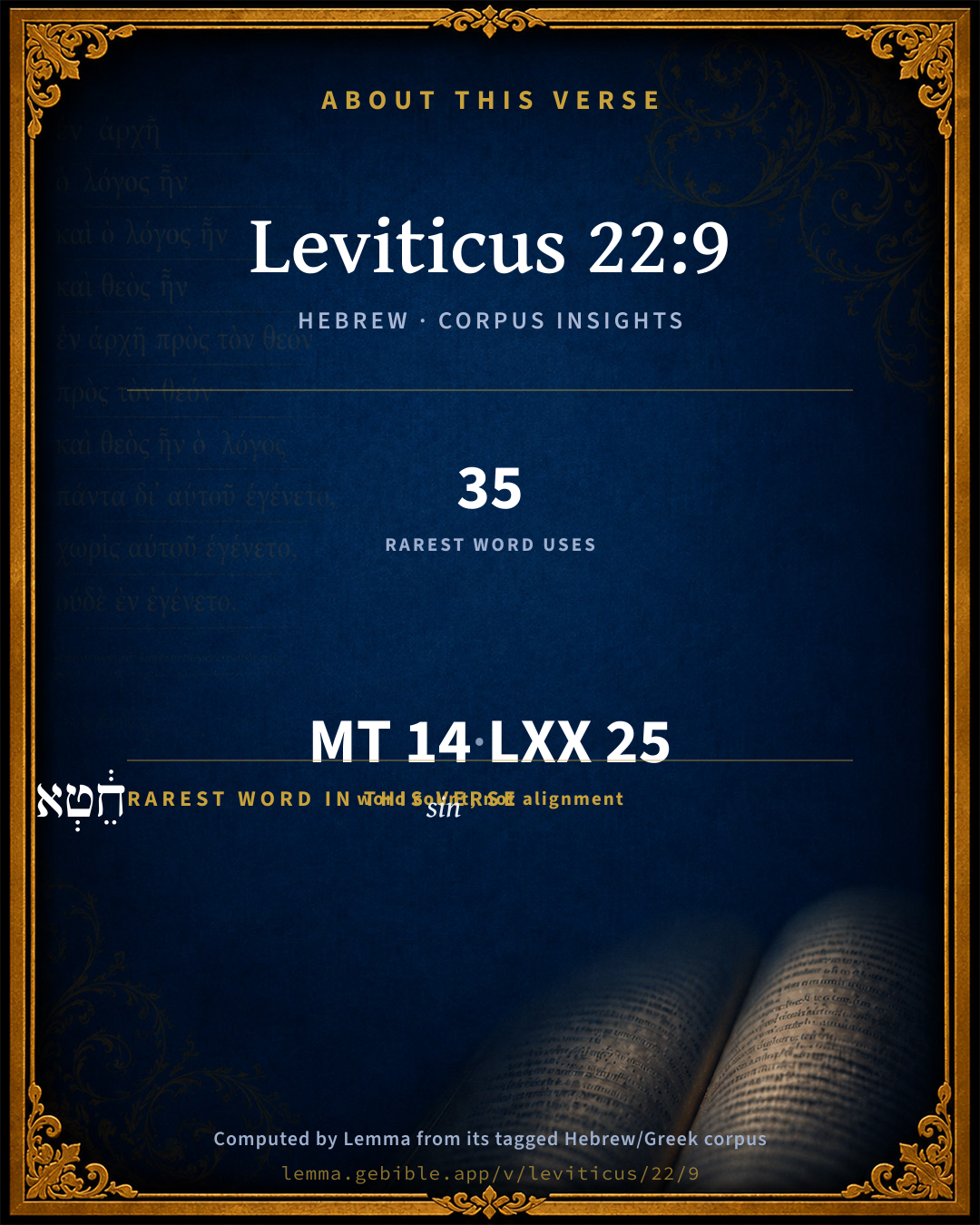
חֵ֔טְא sin H2399 occurs in 34 verses of the Hebrew Bible. Also found in:

Grammatical profile

  • 5 verbs
  • 3 nouns
  • 1 pronoun
  • 2 prepositions
  • 1 conjunction
  • 2 particles

Verb forms

  • וְשָׁמְר֣וּ Qal · Sequential Perfect
  • יִשְׂא֤וּ Qal · Imperfect
  • וּמֵ֥תוּ Qal · Sequential Perfect
  • יְחַלְּלֻ֑הוּ Piel · Imperfect
  • מְקַדְּשָֽׁם Piel · Participle Active

Hebrew & Septuagint length

In English translation the verse runs 25 words from the Hebrew and 33 from the Septuagint (LXX English) — closely comparable.

A rough comparison of the two English renderings, which tokenize alike — not a word-level alignment.

Word counts can differ between the Hebrew and the Greek without any difference in meaning — e.g. the Hebrew direct-object marker אֵת has no separate Greek word, and Greek often adds the article ὁ.

In the original languages it is 14 Hebrew tokens and 25 Greek tokens — but the two are counted differently (Hebrew bundles its prefixes and suffixes into one token; the Greek is in lemma form), so that isn’t a like-for-like length.

Cross-references

6

Topical passages linked to Leviticus 22:9 in the Treasury of Scripture Knowledge — connected by theme and wording, ordered by reader-vote popularity; previews shown in the World English Bible.

  • Exodus 28:43 They shall be on Aaron, and on his sons, when they go in to the tent of meeting, or when they come near to the altar to minister in the holy place; that they don't bear iniquity, and die: it shall be a statute forever to him and to his descendants after him.
  • Numbers 18:22 Henceforth the children of Israel shall not come near the tent of meeting, lest they bear sin, and die.
  • Numbers 18:32 You shall bear no sin by reason of it, when you have heaved from it the best of it: and you shall not profane the holy things of the children of Israel, that you not die.
  • Leviticus 10:1–2 Nadab and Abihu, the sons of Aaron, each took his censer, and put fire in it, and laid incense on it, and offered strange fire before Yahweh, which he had not commanded them.
  • Leviticus 16:2 and Yahweh said to Moses, "Tell Aaron your brother, not to come at all times into the Most Holy Place within the veil, before the mercy seat which is on the ark; lest he die: for I will appear in the cloud on the mercy seat.
  • Leviticus 22:16 and so cause them to bear the iniquity that brings guilt, when they eat their holy things: for I am Yahweh who sanctifies them.'"

Cross-references courtesy of OpenBible.info (CC BY 4.0).

Hebrew and Greek witnesses Masoretic Hebrew ↔ Greek Septuagint

The same verse in the two great witnesses to the Old Testament, shown verse-for-verse.

These are two independent witnesses, not word-aligned to each other, and the Septuagint is shown in lemma (dictionary) form.

Hebrew Leviticus 22:9 Masoretic · Westminster Leningrad Codex

וְשָׁמְר֣וּ אֶת מִשְׁמַרְתִּ֗י וְלֹֽא יִשְׂא֤וּ עָלָיו֙ חֵ֔טְא וּמֵ֥תוּ ב֖וֹ כִּ֣י יְחַלְּלֻ֑הוּ אֲנִ֥י יְהוָ֖ה מְקַדְּשָֽׁם

"'They shall therefore keep my charge, lest they bear sin for it, and die therein, if they profane it. I am Yahweh who sanctifies them.

World English Bible · Public Domain

Greek LXX Leviticus 22:9 Septuagint · lemma form

καί φυλάσσω ὁ φύλαγμα ἐγώ ἵνα μή λαμβάνω διά αὐτός ἁμαρτία καί ἀποθνήσκω διά αὐτός ἐάν βεβηλόω αὐτός ἐγώ κύριος ὁ θεός ὁ ἁγιάζω αὐτός

And they shall keep my ordinances, that they do not bear iniquity because of them, and die because of them, if they shall profane them: I am the Lord God that sanctifies them.

LXX2012 (modern English Septuagint) · Public Domain

Hebrew: Westminster Leningrad Codex (CC BY 4.0). Greek: Septuagint (public domain); English from LXX2012 (modern English Septuagint) (Public Domain). How the Septuagint differs from the Hebrew →

Targum (Aramaic paraphrase)

2

The Targum is the ancient Jewish Aramaic paraphrase of the Hebrew Scriptures — an interpretive translation, not the Hebrew text itself. Onkelos (literal) and Pseudo-Jonathan (expansive) render the Torah, and Jonathan the Prophets. Coverage is partial: where no permissively-licensed English translation exists for a verse, only the Aramaic is shown. This is verse-level text, not a word-by-word alignment to the Hebrew.

  1. Targum Onkelos Torah (Genesis–Deuteronomy)
    וְיִטְרוּן יָת מַטְּרַת מֵימְרִי וְלָא יְקַבְּלוּן עֲלוֹהִי חוֹבָא וִימוּתוּן בֵּהּ אֲרֵי יְחַלֻנֵהּ אֲנָא יְיָ מְקַדִשְׁהוֹן

    (no public-domain English translation for this verse)

    Targum Onkelos — Aramaic: “Onkelos Genesis” (public domain); “Onkelos Exodus” (public domain); “Onkelos Leviticus” (public domain); “Onkelos Numbers” (public domain); “Onkelos Deuteronomy” (public domain). English: “Sefaria Community Translation” (CC0 1.0 (public-domain dedication)); “J.W. Etheridge. The Targums of Onkelos and Jonathan Ben Uzziel on the Pentateuch. London: Longmans, Green, 1862” (public domain). Text via Sefaria.

  2. Targum Pseudo-Jonathan Torah (Genesis–Deuteronomy)
    וְיִטְרוּן בְּנֵי יִשְרָאֵל יַת מַטְרַת מֵימְרִי וְלָא יְקַבְּלוּן עֲלוֹי חוֹבָא וְלָא יְמוּתוּן בֵּיהּ בְּאֵישָׁא מְצַלְהֲבָא אֲרוּם יִפְסוּנֵיהּ אֲנָא יְיָ מְקַדִשְׁהוֹן

    But the sons of Israel shall observe the keeping of My Word, that they may not bring sin upon themselves, nor die for it by the flaming fire; because they have profaned it: I am the Lord who sanctify them.

    Targum Pseudo-Jonathan — Aramaic: “Targum Jonathan on Genesis” (public domain); “Targum Jonathan on Exodus” (public domain); “Targum Jonathan on Leviticus” (public domain); “Targum Jonathan on Numbers” (public domain); “Targum Jonathan on Deuteronomy” (public domain). English: “The Targum of Jonathan ben Uzziel, trans. J. W. Etheridge, London, 1862” (public domain). Text via Sefaria.

Commentary

Notes on Leviticus 22:9 from classic Christian and Jewish commentators (each source and its license shown beneath its notes). The classic Christian expositions comment on the surrounding passage and are grouped to its opening verse, so a note may address several verses; the Jewish commentaries on the Tanakh (Rashi and others) are per-verse, so they appear only where the commentator wrote on this verse.

Lemma curates 59 commentaries, every one of them public domain or Creative Commons licensed, each selected and text-cleaned for this edition rather than reprinted as found. About our sources →

Trapp's Complete Commentary

John Trapp

Lev 22:9 They shall therefore keep mine ordinance, lest they bear sin for it, and die therefore, if they profane it: I the LORD do sanctify them.

Ver. 9. And die therefore.] It is no dallying with God. Either do it we must, or die for it.

John Trapp, A Commentary or Exposition upon All the Books of the Old and New Testament (1647–1656) — public domain. Text from a community e-Sword module.

Joseph Benson's Commentary

Lev 22:9. Lest they bear sin — Incur guilt and punishment. For it — For the neglect or violation of it.

Joseph Benson's Commentary on the Old and New Testaments (1811–1818) — public domain. Text from a community e-Sword module.

Tyndale Open Study Notes

Tyndale Open Resources

22:9 will die for violating my instructions: As in 10:1-3. The temptation to offer improper offerings persisted throughout Israel’s history until after the Exile (Mal 1:6-9).

Tyndale Open Study Notes — © Tyndale Open Resources, licensed CC BY-SA 4.0. Text via the HelloAO Bible API.

John Gill's Exposition

They shall therefore keep mine ordinance,.... The observance of my word, as the Targums of Onkelos and Jonathan, of his word of command; either respecting the not eating of such creatures that died of themselves, or were torn by beasts; or else the not eating holy things in uncleanness, so Jarchi and Gersom; but Aben Ezra thinks the sanctuary is referred to, which was to be kept by the priests, and which seems to agree with what follows:

lest they bear sin for it: the sanctuary, by neglecting it, and so be charged with the guilt of sin, and be obliged to bear the punishment of it:

and die therefore if they profane it; by going into it in their uncleanness, and eating of the most holy things there when in such circumstances, and die by the hand of God, as Jarchi and Ben Gersom interpret it, as Nadab and Abihu did, and even in like manner, by fire, Lev 10:1; and so the Targum of Jonathan,"lest they die by flaming fire:"

I the Lord do sanctify them; the priests, who were separated from others, and devoted to his service, and therefore ought to be holy; or the holy things separated for the use of the priests, but not to be eaten in their uncleanness; the Arabic version renders it, "do sanctify that", the sanctuary, and therefore it should not be profaned, but be kept pure and holy.

John Gill's Exposition of the Whole Bible (1746–1763) — public domain (CC PDM 1.0). Text via the HelloAO Bible API.

Haydock's Catholic Bible Commentary

In the sanctuary, is not found in Hebrew which is difficult to explain. "They shall observe my precepts, (or "watches," entering upon the ministry at 17; Josephus; Menochius) and not bear sin for it, and die in it, because they have profaned it;" which it, may be understood either of the consecrated food, (ver. 7,) or of the sanctuary. (Calmet)

George Leo Haydock (1774–1849), Haydock's Catholic Family Bible and Commentary, 1859 edition — public domain. Excludes Psalms (Douay-Rheims chapter numbering differs from Protestant) and Deuterocanonical books (Catholic canon only).

Matthew Poole's English Annotations

Mine ordinance; either this ordinance here treated of concerning abstaining from holy things when they are unclean; or more generally, that great ordinance whereby I have made them the guardians of holy places and things, to keep them from all defilement by themselves or others. Heb. my watch, i.e. the watch or guard which I have commanded them to keep.

Lest they bear sin, i.e. incur guilt and punishment. For it, i.e. for the neglect or violation of it.

If they profane it, i.e. their charge, or God’s ordinance about it.

Matthew Poole's English Annotations on the Holy Bible (1683–1685) — public domain. Text from a community e-Sword/MySword module.

Whedon's Commentary on the Bible

Daniel D. Whedon

9. Lest they bear sin — That is, the punishment of sin. See Lev_10:17; Num_9:13, notes, in the Levitical law, the boundary between ceremonial and moral impurity is very narrow. Act_21:25.

Daniel D. Whedon (gen. ed.), Commentary on the Old and New Testaments (1874–1909) — public domain. Text from a community e-Sword module.

John Wesley's Explanatory Notes

Lest they bear sin - Incur guilt and punishment. For it - For the neglect or violation of it.

John Wesley, Explanatory Notes Upon the Whole Bible (1754–1765) — public domain. Text via the GEBible commentary corpus.

Rashi

Rabbi Shlomo Yitzchaki (Rashi)

ושמרו את משמרתי THEY SHALL THEREFORE KEEP MY CHARGE — not to eat the heave-offering (as mentioned in v. 7) whilst they are in a state of bodily uncleanness (Sanhedrin 83a).

ומתו בו LEST THEY DIE THEREBY — This phrase teaches us that this means death through Heaven (not through the sentence of the court) (cf. Sanhedrin 83a).

Rashi on the Tanakh — English translations: “The Judaica Press complete Tanach with Rashi, translated by A. J. Rosenberg” (CC BY 4.0); “Pentateuch with Rashi's commentary by M. Rosenbaum and A.M. Silbermann, 1929-1934” (public domain); “The Metsudah Tanach series, Lakewood, N.J” (CC BY 4.0); and “The Book of Joshua, Metsudah Publications, 1997” (CC BY 4.0). Text via Sefaria.

Lesson kit

Teaching starters — assembled from the data on this page, not authored interpretation. Every prompt links to the verse data it draws on. Edit before teaching.

Leviticus, in the Pentateuch, opens this verse with 14 words (13 distinct Hebrew lemmas). Its most distinctive word is chêṭᵉʼ (“sin”). A historical commentator’s framing appears above. Read the whole chapter for the surrounding context.

Discussion questions

  1. The word chêṭᵉʼ carries the sense “sin.” How does it shape the verse?
  2. How does Genesis 41:9, which shares the word «sin», read alongside this verse?
  3. The translations on this page render this verse differently — a whole-verse word diff, not a word-by-word alignment. What might account for the different wordings?
  4. «וְשָׁמְר֣וּ» is a Qal Sequential Perfect verb. How does that grammatical form shape the action described?
  5. Compare how Trapp's Complete Commentary and Joseph Benson's Commentary read this verse. Where do they agree or differ?

Things to notice

Reading settings

Reading text

Shown beneath each verse's original-language words.

Old Testament
Old Testament edition

Read the OT as the Masoretic Hebrew (MT) or the Greek Septuagint (LXX).

English shown for the Greek Septuagint (in the Hebrew ↔ Greek comparison).

Comparing translations? Open the Compare panel on any verse page to stack up to four side by side.