
Genesis 26:9

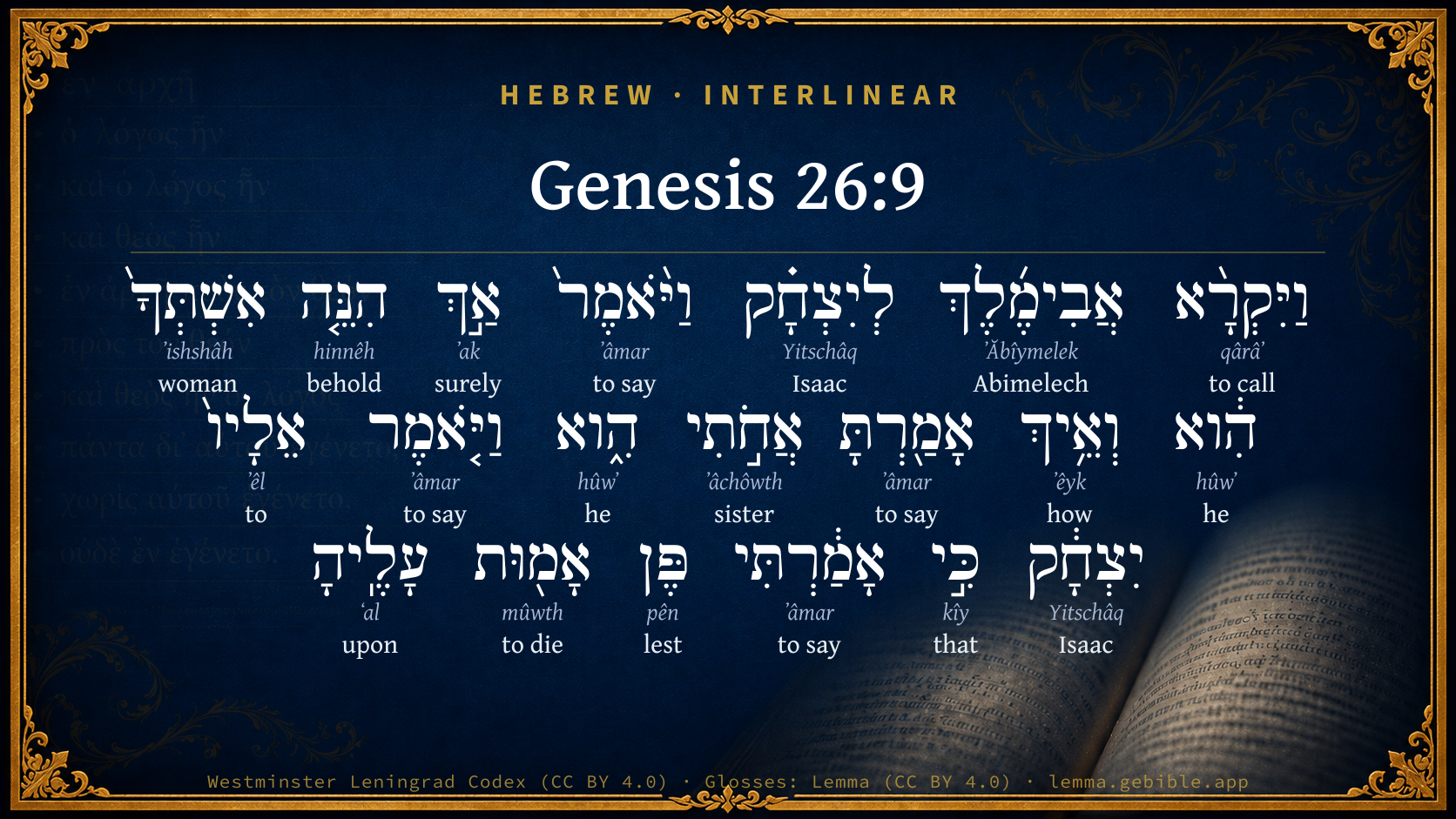
Hebrew (Westminster Leningrad Codex) Genesis 26:9 appears in the Hebrew Old Testament. The text above is from the Westminster Leningrad Codex. Each word links to its Strong’s number, a concise gloss, and parsing drawn from the Open Scriptures Hebrew Bible morphology. Click any word for its full Brown-Driver-Briggs (BDB) entry.
Download image
Cite this verse

Genesis 26:9 (World English Bible). Public Domain. Lemma interlinear Bible study tool, https://lemma.gebible.app/v/genesis/26/9.

Show BibTeX & RIS
BibTeX
RIS
English Translation
Abimelech called Isaac, and said, "Behold, surely she is your wife. Why did you say, 'She is my sister?'" Isaac said to him, "Because I said, 'Lest I die because of her.'"
World English Bible · Public Domain
Highlights
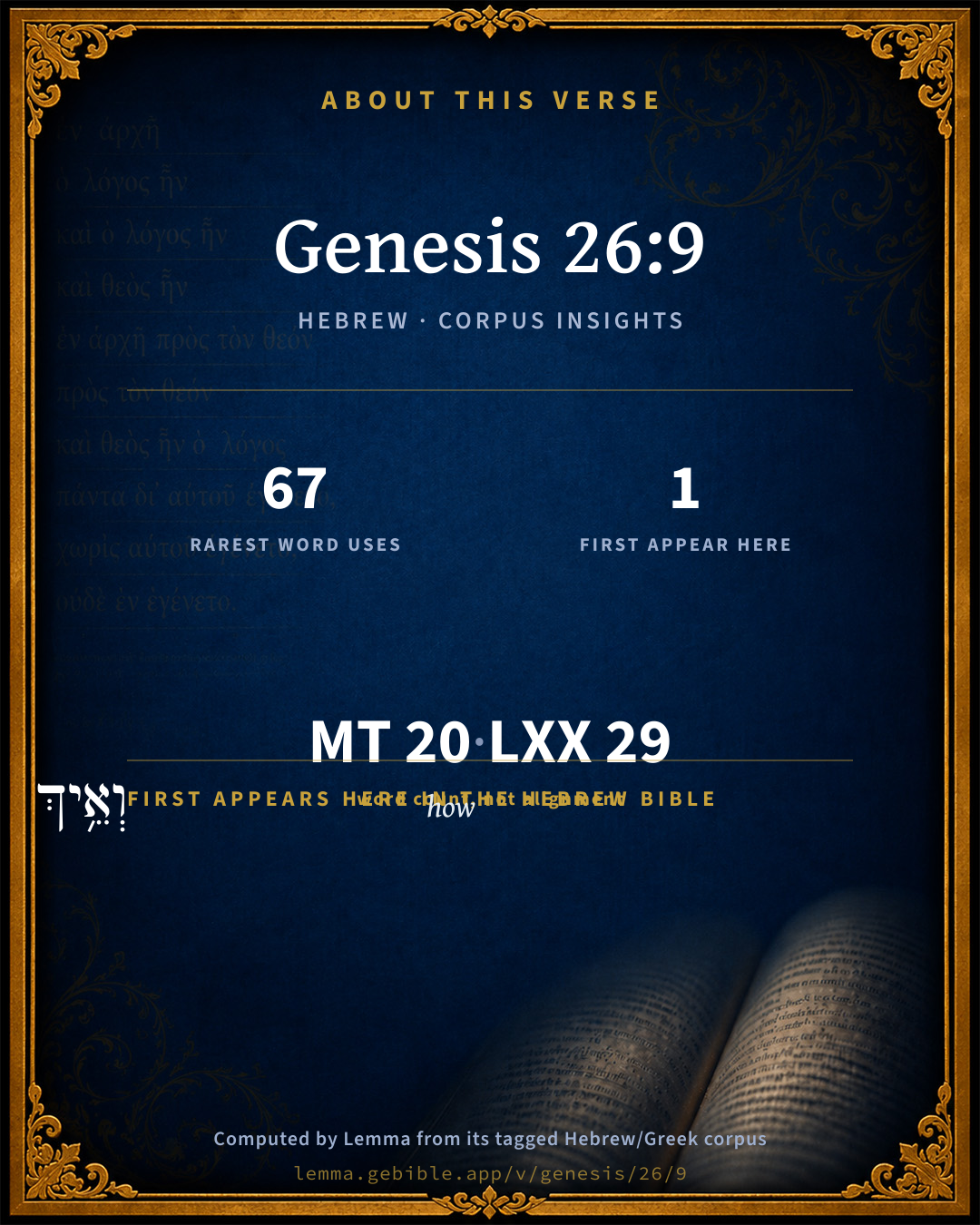
  • 1 first appearance in the Hebrew Bible
Full analysis ↓
Download a study sheet

One document with this verse’s original text, its word-by-word gloss line, the meaning frame, cross-references with their text, attributed commentary, and full source and license credits — printable, and it pastes into notes with its structure intact.

This verse Autodidact and up

Study sheet (.html) Plain text (.txt)

A passage Seminary Student

Up to 50 verses in one chapter. A passage sheet keeps up to 6 commentary sources and 12 cross-references per verse, in the order this page ranks them, and says so on the sheet whenever that leaves anything out. Ask for a single verse and you get the Autodidact verse sheet above.

Everything on this page stays free to read, with no account — the sheet is a download of what is already on screen, not access to it.

Want to remove ads? Support Godless Engineer
Compare translations 3

The same verse in 3 English versions, stacked beneath the original-language interlinear above. Click any original word for its lexicon entry.

Each is an independent rendering of the whole verse — the interlinear is not word-aligned to these translations.

Highlighted words mark where these versions differ — a whole-verse word diff, not a word-by-word alignment.

  • World English Bible Public Domain
    Abimelech called Isaac, and said, "Behold, surely she is your wife. Why did you say, 'She is my sister?'" Isaac said to him, "Because I said, 'Lest I die because of her.'"
  • King James Version Public Domain
    And Abimelech called Isaac, and said, Behold, of a surety she is thy wife; and how saidst thou, She is my sister? And Isaac said unto him, Because I said, Lest I die for her.
  • unfoldingWord Literal Text CC BY-SA 4.0
    So Abimelech called for Isaac and said, “Behold, she really your wife! So how could you say, ‘She my sister’?” And Isaac said to him, “Because I said, ‘I might die because of her.’”

unfoldingWord Literal Text — © unfoldingWord, licensed CC BY-SA 4.0. Word-aligned USFM3 via Door43 (git.door43.org/unfoldingWord/en_ult).

Versions to compare (up to 4)

3 of 4 selected

Show all 18 translations

Every available English version of this verse, each an independent rendering of the whole verse.

  • World English Bible Public Domain
    Abimelech called Isaac, and said, "Behold, surely she is your wife. Why did you say, 'She is my sister?'" Isaac said to him, "Because I said, 'Lest I die because of her.'"
  • Berean Standard Bible Public Domain
    Abimelech sent for Isaac and said, “So she is really your wife! How could you say, ‘She is my sister’?” Isaac replied, “Because I thought I might die on account of her.”
  • Majority Standard Bible Public Domain
    Abimelech sent for Isaac and said, “So she is really your wife! How could you say, ‘She is my sister’?” Isaac replied, “Because I thought I might die on account of her.”
  • King James Version Public Domain
    And Abimelech called Isaac, and said, Behold, of a surety she is thy wife; and how saidst thou, She is my sister? And Isaac said unto him, Because I said, Lest I die for her.
  • American Standard Version (1901) Public Domain
    And Abimelech called Isaac, and said, Behold, of a surety she is thy wife. And how saidst thou, She is my sister? And Isaac said unto him, Because I said, Lest I die because of her.
  • Revised Version (1885) Public Domain
    And Abimelech called Isaac, and said, Behold, of a surety she is thy wife: and how saidst thou, She is my sister? And Isaac said unto him, Because I said, Lest I die for her.
  • Geneva Bible (1599) Public Domain
    Then Abimelech called Izhak, and sayde, Loe, shee is of a suertie thy wife, and why saydest thou, She is my sister? To whom Izhak answered, Because I thought this, It may be that I shall dye for her.
  • Douay-Rheims (1899) Public Domain
    And calling for him, he said: It is evident she is thy wife: why didst thou feign her to be thy sister? He answered: I feared lest I should die for her sake.
  • Young's Literal Translation Public Domain
    And Abimelech calleth for Isaac, and saith, `Lo, she `is' surely thy wife; and how hast thou said, She `is' my sister?' and Isaac saith unto him, `Because I said, Lest I die for her.'
  • Literal Standard Version CC BY-SA 4.0
    And Abimelech calls for Isaac and says, “Behold, she [is] surely your wife; and how could you have said, She [is] my sister?” And Isaac says to him, “Because I said, Lest I die for her.”
  • Unlocked Literal Bible CC BY-SA 4.0
    Abimelech called Isaac to him and said, “Look, certainly she is your wife. Why did you say, 'She is my sister'?” Isaac said to him, “Because I thought someone might kill me to get her.”
  • unfoldingWord Literal Text CC BY-SA 4.0
    So Abimelech called for Isaac and said, “Behold, she really your wife! So how could you say, ‘She my sister’?” And Isaac said to him, “Because I said, ‘I might die because of her.’”
  • Darby Bible Public Domain
    Then Abimelech called Isaac, and said, Behold, she is certainly thy wife; and how saidst thou, She is my sister? and Isaac said to him, Because I said, Lest I die on account of her.
  • World Messianic Bible Public Domain
    Abimelech called Isaac, and said, “Behold, surely she is your wife. Why did you say, ‘She is my sister’?” Isaac said to him, “Because I said, ‘Lest I die because of her.’”
  • Webster's Bible Public Domain
    And Abimelech called Isaac, and said, Behold, surely she is thy wife: and how saidst thou, She is my sister? and Isaac said to him, Because I said, Lest I should die on her account.
  • Free Bible Version CC BY-SA 4.0
    Abimelech sent for Isaac and complained. “From what I saw she's clearly your wife!” he said. “Why on earth did you say, ‘She's my sister’?” “Because I thought I'd be killed because of her,” Isaac replied.
  • Bible in Basic English Public Domain
    And he said to Isaac, It is clear that she is your wife: why then did you say, She is my sister? And Isaac said, For fear that I might be put to death because of her.
  • JPS Tanakh (1917) Public Domain
    And Abimelech called Isaac, and said: 'Behold, of a surety she is thy wife; and how saidst thou: She is my sister?' And Isaac said unto him: 'Because I said: Lest I die because of her.'

Literal Standard Version (2020), Covenant Press — licensed CC BY-SA 4.0. Text via the HelloAO Bible API (eBible.org). Unlocked Literal Bible (unfoldingWord) — licensed CC BY-SA 4.0. Text via the HelloAO Bible API (eBible.org). unfoldingWord Literal Text — © unfoldingWord, licensed CC BY-SA 4.0. Word-aligned USFM3 via Door43 (git.door43.org/unfoldingWord/en_ult). Free Bible Version, Dr. Jonathan Gallagher — licensed CC BY-SA 4.0. Text via the HelloAO Bible API (eBible.org).

Word by word

More ways to search: Search by grammar → Find every occurrence → Compare this word →

Practice this passage: Drill this verse → Learn its vocabulary →

אֲבִימֶ֜לֶךְ
ʼĂbîymelek
H40
“Abimelech”
Noun, Proper
Part of Speech
Noun
Type
Proper
Full BDB Definition

Origin: from H1 and H4428

TWOT: None

Abimelech = "Melek is father" or " my father is king" - king of Gerar in Abraham's time - king of Gath in David's time; maybe title of Philistine kings - son of Gideon by a concubine - priest, son of Abiathar
  1. וַיִּקְרָ֨א qârâʼ H7121 “and · to call” Conjunction + Verb, Qal, Sequential Imperfect, 3rd Person, Masculine, Singular
  2. לְיִצְחָ֗ק Yitschâq H3327 “to/for · Isaac” Preposition + Noun, Proper
  3. וַיֹּ֨אמֶר֙ ʼâmar H559 “and · to say” Conjunction + Verb, Qal, Sequential Imperfect, 3rd Person, Masculine, Singular
  4. אַ֣ךְ ʼak H389 “surely” Particle, Accusative
  5. הִנֵּ֤ה hinnêh H2009 “behold” Particle, Demonstrative
  6. אִשְׁתְּךָ֙ ʼishshâh H802 “woman · your” Noun, Common, Feminine, Singular, Construct + Suffix, Personal, 2nd Person, Masculine, Singular
  7. הִ֔וא hûwʼ H1931 “he” Pronoun, Personal, 3rd Person, Feminine, Singular
  8. וְאֵ֥יךְ ʼêyk H349 “and · how” Conjunction + Particle, Interrogative
  9. אָמַ֖רְתָּ ʼâmar H559 “to say” Verb, Qal, Perfect, 2nd Person, Masculine, Singular
  10. אֲחֹ֣תִי ʼâchôwth H269 “sister · my” Noun, Common, Feminine, Singular, Construct + Suffix, Personal, 1st Person, Common, Singular
  11. הִ֑וא hûwʼ H1931 “he” Pronoun, Personal, 3rd Person, Feminine, Singular
  12. וַיֹּ֤אמֶר ʼâmar H559 “and · to say” Conjunction + Verb, Qal, Sequential Imperfect, 3rd Person, Masculine, Singular
  13. אֵלָיו֙ ʼêl H413 “to · him” Preposition + Suffix, Personal, 3rd Person, Masculine, Singular
  14. יִצְחָ֔ק Yitschâq H3327 “Isaac” Noun, Proper
  15. כִּ֣י kîy H3588 “that” Conjunction
  16. אָמַ֔רְתִּי ʼâmar H559 “to say” Verb, Qal, Perfect, 1st Person, Common, Singular
  17. פֶּן pên H6435 “lest” Conjunction
  18. אָמ֖וּת mûwth H4191 “to die” Verb, Qal, Imperfect, 1st Person, Common, Singular
  19. עָלֶֽיהָ ʻal H5921 “upon · her” Preposition + Suffix, Personal, 3rd Person, Feminine, Singular

About this verse

These counts appear in no published source. They are computed here, from the morphology-tagged text and Lemma’s own curated glosses. What Lemma adds →

20
words
15
distinct lemmas
Pentateuch
section

First appearance in Scripture

This word makes its first canonical appearance in the Hebrew Bible here:

  • וְאֵ֥יךְ how H349

Grammatical profile

  • 6 verbs
  • 5 nouns
  • 2 pronouns
  • 2 prepositions
  • 2 conjunctions
  • 3 particles

Verb forms

  • וַיִּקְרָ֨א Qal · Sequential Imperfect
  • וַיֹּ֨אמֶר֙ Qal · Sequential Imperfect
  • אָמַ֖רְתָּ Qal · Perfect
  • וַיֹּ֤אמֶר Qal · Sequential Imperfect
  • אָמַ֔רְתִּי Qal · Perfect
  • אָמ֖וּת Qal · Imperfect

Repetition

Words recur within this verse — often emphatic in Hebrew:

  • וַיֹּ֨אמֶר֙ to say H559 ×4
  • לְיִצְחָ֗ק Isaac H3327 ×2
  • הִ֔וא he H1931 ×2

Hebrew & Septuagint length

In English translation the verse runs 32 words from the Hebrew and 41 from the Septuagint (LXX English) — closely comparable.

A rough comparison of the two English renderings, which tokenize alike — not a word-level alignment.

Word counts can differ between the Hebrew and the Greek without any difference in meaning — e.g. the Hebrew direct-object marker אֵת has no separate Greek word, and Greek often adds the article ὁ.

In the original languages it is 20 Hebrew tokens and 29 Greek tokens — but the two are counted differently (Hebrew bundles its prefixes and suffixes into one token; the Greek is in lemma form), so that isn’t a like-for-like length.

Hebrew and Greek witnesses Masoretic Hebrew ↔ Greek Septuagint

The same verse in the two great witnesses to the Old Testament, shown verse-for-verse.

These are two independent witnesses, not word-aligned to each other, and the Septuagint is shown in lemma (dictionary) form.

Hebrew Genesis 26:9 Masoretic · Westminster Leningrad Codex

וַיִּקְרָ֨א אֲבִימֶ֜לֶךְ לְיִצְחָ֗ק וַיֹּ֨אמֶר֙ אַ֣ךְ הִנֵּ֤ה אִשְׁתְּךָ֙ הִ֔וא וְאֵ֥יךְ אָמַ֖רְתָּ אֲחֹ֣תִי הִ֑וא וַיֹּ֤אמֶר אֵלָיו֙ יִצְחָ֔ק כִּ֣י אָמַ֔רְתִּי פֶּן אָמ֖וּת עָלֶֽיהָ

Abimelech called Isaac, and said, "Behold, surely she is your wife. Why did you say, 'She is my sister?'" Isaac said to him, "Because I said, 'Lest I die because of her.'"

World English Bible · Public Domain

Greek LXX Genesis 26:9 Septuagint · lemma form

καλέω δέ αβιμελεχ ὁ ισαακ καί εἶπον αὐτός ἄρα γέ γυνή σύ εἰμί τίς ὅτι εἶπον ἀδελφή ἐγώ εἰμί εἶπον δέ αὐτός ισαακ εἶπον γάρ μήποτε ἀποθνήσκω διά αὐτός

And Abimelech called Isaac, and said to him, Is she then your wife? why have you said, She is my sister? And Isaac said to him, I did so, for I said, Lest at any time I die on her account.

LXX2012 (modern English Septuagint) · Public Domain

Hebrew: Westminster Leningrad Codex (CC BY 4.0). Greek: Septuagint (public domain); English from LXX2012 (modern English Septuagint) (Public Domain). How the Septuagint differs from the Hebrew →

Targum (Aramaic paraphrase)

2

The Targum is the ancient Jewish Aramaic paraphrase of the Hebrew Scriptures — an interpretive translation, not the Hebrew text itself. Onkelos (literal) and Pseudo-Jonathan (expansive) render the Torah, and Jonathan the Prophets. Coverage is partial: where no permissively-licensed English translation exists for a verse, only the Aramaic is shown. This is verse-level text, not a word-by-word alignment to the Hebrew.

  1. Targum Onkelos Torah (Genesis–Deuteronomy)
    וּקְרָא אֲבִימֶלֶךְ לְיִצְחָק וַאֲמַר בְּרַם הָא אִתְּתָךְ הִיא וְאֶכְדֵּין אֲמַרְתָּ אֲחָתִי הִיא וַאֲמַר לֵהּ יִצְחָק אֲרֵי אֲמָרִית דִּלְמָא אֵימוּת עֲלַהּ

    (no public-domain English translation for this verse)

    Targum Onkelos — Aramaic: “Onkelos Genesis” (public domain); “Onkelos Exodus” (public domain); “Onkelos Leviticus” (public domain); “Onkelos Numbers” (public domain); “Onkelos Deuteronomy” (public domain). English: “Sefaria Community Translation” (CC0 1.0 (public-domain dedication)); “J.W. Etheridge. The Targums of Onkelos and Jonathan Ben Uzziel on the Pentateuch. London: Longmans, Green, 1862” (public domain). Text via Sefaria.

  2. Targum Pseudo-Jonathan Torah (Genesis–Deuteronomy)
    וּקְרָא אֲבִימֶלֶךְ לְיִצְחָק וַאֲמַר בְּרַם הָא אִנְתְּתָךְ הִיא וְהֵיכְדֵין אָמַרְתְּ אֲחָתִי הִיא וַאֲמַר לֵיהּ יִצְחָק אֲרוּם אֲמָרִית בִּלְבָבִי דִלְמָא אִתְקְטֵיל בְּגִינָהּ

    And Abimelek called Izhak, and said, Nevertheless she is thy wife; and why hast thou said, She is my sister? And Izhak answered him, Because I said in my heart, Lest they kill me on her account.

    Targum Pseudo-Jonathan — Aramaic: “Targum Jonathan on Genesis” (public domain); “Targum Jonathan on Exodus” (public domain); “Targum Jonathan on Leviticus” (public domain); “Targum Jonathan on Numbers” (public domain); “Targum Jonathan on Deuteronomy” (public domain). English: “The Targum of Jonathan ben Uzziel, trans. J. W. Etheridge, London, 1862” (public domain). Text via Sefaria.

Commentary

Notes on Genesis 26:9 from classic Christian and Jewish commentators (each source and its license shown beneath its notes). The classic Christian expositions comment on the surrounding passage and are grouped to its opening verse, so a note may address several verses; the Jewish commentaries on the Tanakh (Rashi and others) are per-verse, so they appear only where the commentator wrote on this verse.

Lemma curates 59 commentaries, every one of them public domain or Creative Commons licensed, each selected and text-cleaned for this edition rather than reprinted as found. About our sources →

Trapp's Complete Commentary

John Trapp

Gen 26:9 And Abimelech called Isaac, and said, Behold, of a surety she [is] thy wife: and how saidst thou, She [is] my sister? And Isaac said unto him, Because I said, Lest I die for her.

Ver. 9. Lest I die for her.] {See Trapp on "Gen 20:11"} {See Trapp on "Gen 11:29"}

John Trapp, A Commentary or Exposition upon All the Books of the Old and New Testament (1647–1656) — public domain. Text from a community e-Sword module.

John Gill's Exposition

And Abimelech said, what is this thou hast done unto us?.... By entertaining suspicions and jealousies of us as bad men, and by exposing us to the temptation of committing iniquity; why hast thou dealt thus with us, and what have we done, or is in our character, that thou shouldest act after this manner?

one of the people might lightly have lien with thy wife; it is much one or other had not before this time, not looking upon it criminal to have to do with a single woman, when they would not have meddled with another man's wife, Jarchi interprets this of Abimelech himself; and so the Targum of Jonathan, who perhaps had been thinking of taking her to his bed; and was "within a little" (c), as the word for "lightly" may be rendered, of accomplishing his design:

and thou shouldest have brought guiltiness upon us: been the occasion of their committing the sin of adultery, which was heinous in the eyes of Heathens, and of bringing on them the punishment due thereunto.

(c) "parum abfuit", Junius & Tremellius, Piscator, Schmidt.

John Gill's Exposition of the Whole Bible (1746–1763) — public domain (CC PDM 1.0). Text via the HelloAO Bible API.

The Pulpit Commentary

And Abimelech called Isaac, and said, Behold, of a surety she is thy wife: and how saidst thou, She is my sister? And Isaac said unto him, Because I said (sc. in my heart, or to myself), Lest I die for her.

The Pulpit Commentary (1880–1919), ed. H.D.M. Spence-Jones & Joseph S. Exell — public domain. Text from a community e-Sword module.

unfoldingWord translationNotes

Door43 World Missions Community

Abimelech called Isaac to him

Abimelech probably sent someone to tell Isaac that Abimelech wanted to see him. AT: "Abimelech sent someone to bring Isaac to him" (See: Metonymy)

Why did you say, 'She is my sister'?

This is a quotation within a quotation. It can be stated as an indirect quotation. AT: "Why did you say that she is your sister?" (See: Quotes Within Quotes and Direct and Indirect Quotations)

to get her

"so he could take her"

What is this you have done to us?

Abimelech used this question to scold Isaac. AT: "You should not have done this to us!" (See: Rhetorical Question)

you would have brought guilt upon us

This speaks about causing someone to be guilty as if "guilt" were an object that is placed on someone. AT: "you would have caused us to be guilty of taking a man's wife" (See: Metaphor)

upon us

Here "us" refers to Abimelech and his people. (See: Exclusive and Inclusive "We")

Whoever touches this man

Here "touches" means to touch in a harmful way. AT: "Whoever harms this man" (See: Idiom)

will surely be put to death

Abimelech may have intended to tell someone to kill anyone who might harm Isaac or Rebekah. This can be stated in active form. AT: "I will put him to death" or "I will order my men to kill him" (See: Active or Passive)

translationWords

Abimelech

Isaac

had relations with

guilt

unfoldingWord translationNotes — © Distant Shores Media and the Door43 World Missions Community, licensed CC BY-SA 4.0. Source: git.door43.org/Door43/en_tn.

Radak

Rabbi David Kimhi (Radak)

ויקרא...אך הנה אשתך, the word אך in this verse means the same as the word אבל, “but, however.” It also appears in this sense in Exodus 31,13 אך את שבתותי תשמורו, “but you must observe My Sabbath days,” (even when engaged in building the Tabernacle) In Exodus 21,22, when speaking about someone dying as a result of an injury deliberately inflicted upon him, the Torah writes אך אם יום או יומים יעמוד, “but if the victim can stand on his feet for a day or two days, etc.” (his death is not directly attributable to the injury described). In our verse, Avimelech challenges Yitzchok who had presented his wife as being his sister by saying: “but I have seen with my own eyes that she is your wife!” He used the fact that he had observed Yitzchok being intimate with Rivkah as proof that therefore she must be his wife, as no one sleeps with a woman who is not his wife.

ואיך אמרת, the Avimelech mentioned in our chapter here was not the same one that lived in the days of Avraham. Had he been the same it is inconceivable that he could have asked Yitzchok such a question. He had, after all, had experience with Sarah and Avraham concerning the same subject. The Kings of the Philistines generally assumed the title “Avimelech,” just as the Kings of Egypt generally assumed the title “Pharaoh.”

Radak on the Tanakh — English translations: “Sefaria Community Translation” (CC0 1.0 (public-domain dedication)); “Eliyahu Munk, HaChut Hameshulash” (CC BY 4.0); “Rabbi Mike Feuer, Jerusalem Anthology” (CC BY 4.0); and “R. David Kimhi on the first book of Psalms, Translated by R.G. Finch, London, 1919” (public domain). Text via Sefaria.

Lesson kit

Teaching starters — assembled from the data on this page, not authored interpretation. Every prompt links to the verse data it draws on. Edit before teaching.

Genesis, in the Pentateuch, opens this verse with 20 words (15 distinct Hebrew lemmas). Its most distinctive word is ʼĂbîymelek (“Abimelech”). A historical commentator’s framing appears above. Read the whole chapter for the surrounding context.

Discussion questions

  1. The word ʼĂbîymelek carries the sense “Abimelech.” How does it shape the verse?
  2. This is the first place “how” appears in Scripture (first appears here). What does its debut here establish?
  3. What does the repetition of “to say” (4× in this one verse) do in this verse?
  4. The translations on this page render this verse differently — a whole-verse word diff, not a word-by-word alignment. What might account for the different wordings?
  5. «וַיִּקְרָ֨א» is a Qal Sequential Imperfect verb. How does that grammatical form shape the action described?
  6. Compare how Trapp's Complete Commentary and John Gill's Exposition read this verse. Where do they agree or differ?

Things to notice

Reading settings

Reading text

Shown beneath each verse's original-language words.

Old Testament
Old Testament edition

Read the OT as the Masoretic Hebrew (MT) or the Greek Septuagint (LXX).

English shown for the Greek Septuagint (in the Hebrew ↔ Greek comparison).

Comparing translations? Open the Compare panel on any verse page to stack up to four side by side.