
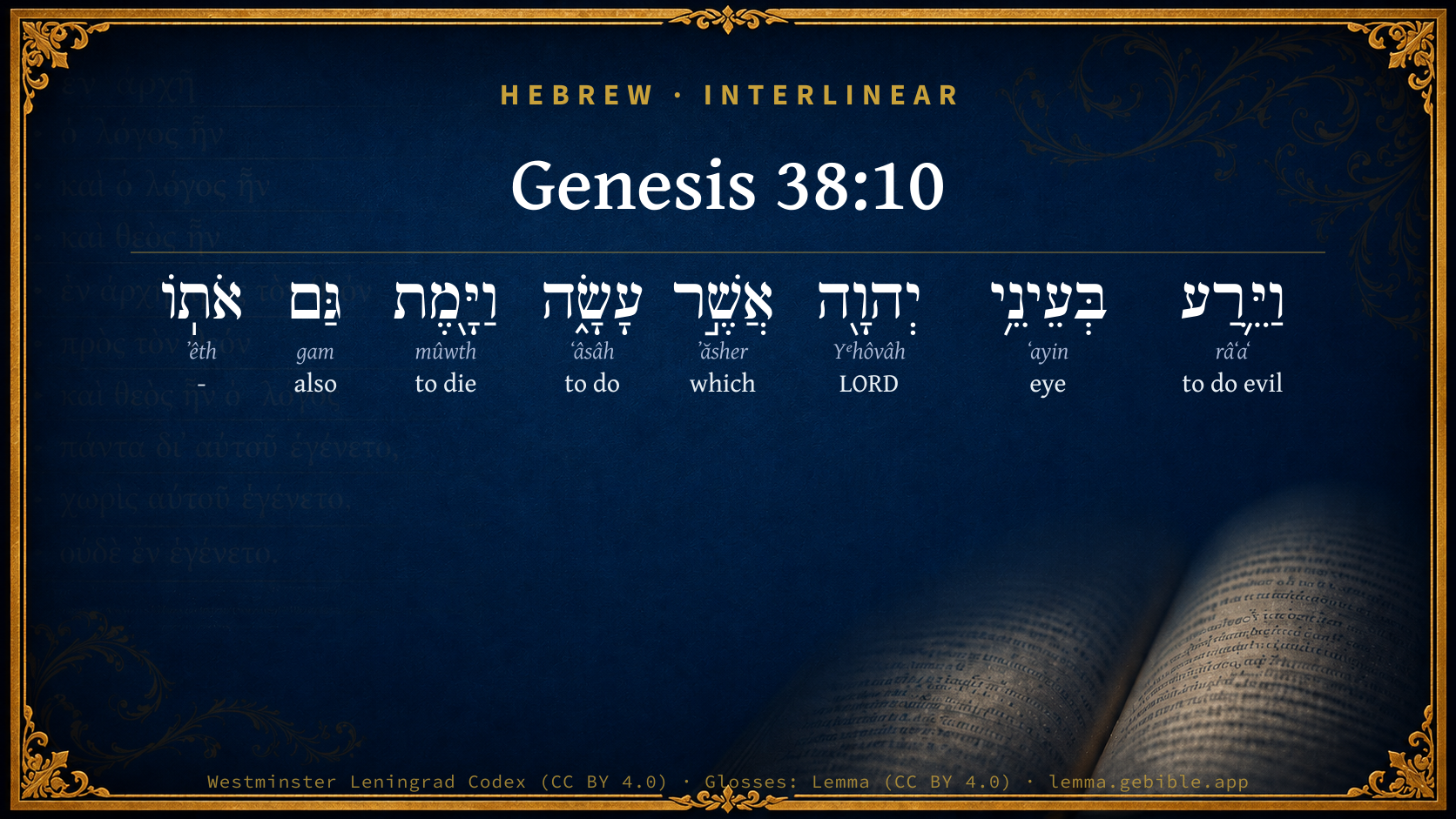
Genesis 38:10

Hebrew (Westminster Leningrad Codex) Genesis 38:10 appears in the Hebrew Old Testament. The text above is from the Westminster Leningrad Codex. Each word links to its Strong’s number, a concise gloss, and parsing drawn from the Open Scriptures Hebrew Bible morphology. Click any word for its full Brown-Driver-Briggs (BDB) entry.
Download image
Cite this verse

Genesis 38:10 (World English Bible). Public Domain. Lemma interlinear Bible study tool, https://lemma.gebible.app/v/genesis/38/10.

Show BibTeX & RIS
BibTeX
RIS
English Translation
The thing which he did was evil in the sight of Yahweh, and he killed him also.
World English Bible · Public Domain
Download a study sheet

One document with this verse’s original text, its word-by-word gloss line, the meaning frame, cross-references with their text, attributed commentary, and full source and license credits — printable, and it pastes into notes with its structure intact.

This verse Autodidact and up

Study sheet (.html) Plain text (.txt)

A passage Seminary Student

Up to 50 verses in one chapter. A passage sheet keeps up to 6 commentary sources and 12 cross-references per verse, in the order this page ranks them, and says so on the sheet whenever that leaves anything out. Ask for a single verse and you get the Autodidact verse sheet above.

Everything on this page stays free to read, with no account — the sheet is a download of what is already on screen, not access to it.

Want to remove ads? Support Godless Engineer
Compare translations 3

The same verse in 3 English versions, stacked beneath the original-language interlinear above. Click any original word for its lexicon entry.

Each is an independent rendering of the whole verse — the interlinear is not word-aligned to these translations.

Highlighted words mark where these versions differ — a whole-verse word diff, not a word-by-word alignment.

  • World English Bible Public Domain
    The thing which he did was evil in the sight of Yahweh, and he killed him also.
  • King James Version Public Domain
    And the thing which he did displeased the LORD: wherefore he slew him also.
  • unfoldingWord Literal Text CC BY-SA 4.0
    And what he did was evil in the eyes of Yahweh, so he killed him also.

unfoldingWord Literal Text — © unfoldingWord, licensed CC BY-SA 4.0. Word-aligned USFM3 via Door43 (git.door43.org/unfoldingWord/en_ult).

Versions to compare (up to 4)

3 of 4 selected

Show all 18 translations

Every available English version of this verse, each an independent rendering of the whole verse.

  • World English Bible Public Domain
    The thing which he did was evil in the sight of Yahweh, and he killed him also.
  • Berean Standard Bible Public Domain
    What he did was wicked in the sight of the LORD, so He put Onan to death as well.
  • Majority Standard Bible Public Domain
    What he did was wicked in the sight of the LORD, so He put Onan to death as well.
  • King James Version Public Domain
    And the thing which he did displeased the LORD: wherefore he slew him also.
  • American Standard Version (1901) Public Domain
    And the thing which he did was evil in the sight of Jehovah: and he slew him also.
  • Revised Version (1885) Public Domain
    And the thing which he did was evil in the sight of the LORD: and he slew him also.
  • Geneva Bible (1599) Public Domain
    And it was wicked in the eyes of the Lord, which he did: wherefore he slewe him also.
  • Douay-Rheims (1899) Public Domain
    And therefore the Lord slew him, be- cause he did a detestable thing.
  • Young's Literal Translation Public Domain
    and that which he hath done is evil in the eyes of Jehovah, and He putteth him also to death.
  • Literal Standard Version CC BY-SA 4.0
    and that which he has done is evil in the eyes of YHWH, and He puts him also to death.
  • Unlocked Literal Bible CC BY-SA 4.0
    What he did was evil in the sight of Yahweh. Yahweh killed him also.
  • unfoldingWord Literal Text CC BY-SA 4.0
    And what he did was evil in the eyes of Yahweh, so he killed him also.
  • Darby Bible Public Domain
    And the thing which he did was evil in the sight of Jehovah, and he slew him also.
  • World Messianic Bible Public Domain
    The thing which he did was evil in the LORD’s sight, and he killed him also.
  • Webster's Bible Public Domain
    And the thing which he did displeased the LORD: wherefore he slew him also.
  • Free Bible Version CC BY-SA 4.0
    But what he did was evil in the Lord's sight, so he also put Onan to death.
  • Bible in Basic English Public Domain
    And what he did was evil in the eyes of the Lord, so that he put him to death, like his brother.
  • JPS Tanakh (1917) Public Domain
    And the thing which he did was evil in the sight of the LORD; and He slew him also.

Literal Standard Version (2020), Covenant Press — licensed CC BY-SA 4.0. Text via the HelloAO Bible API (eBible.org). Unlocked Literal Bible (unfoldingWord) — licensed CC BY-SA 4.0. Text via the HelloAO Bible API (eBible.org). unfoldingWord Literal Text — © unfoldingWord, licensed CC BY-SA 4.0. Word-aligned USFM3 via Door43 (git.door43.org/unfoldingWord/en_ult). Free Bible Version, Dr. Jonathan Gallagher — licensed CC BY-SA 4.0. Text via the HelloAO Bible API (eBible.org).

Word by word

More ways to search: Search by grammar → Find every occurrence → Compare this word →

Practice this passage: Drill this verse → Learn its vocabulary →

וַיֵּ֛רַע
râʻaʻ
H7489
“and · to do evil”
Conjunction + Verb, Qal, Sequential Imperfect, 3rd Person, Masculine, Singular
Part of Speech
Conjunction + Verb
Stem
Qal
Form
Sequential Imperfect
Person
3rd Person
Gender
Masculine
Number
Singular
Full BDB Definition

Origin: a primitive root

TWOT: 2191 , 2192

to be bad, be evil - (Qal) - to be displeasing - to be sad - to be injurious, be evil - to be wicked, be evil (ethically) - (Hiphil) - to do an injury or hurt - to do evil or wickedly - mischief (participle) - to break, shatter - (Qal) - to break - broken (participle) - to be broken - (Hithpolel) to be broken, be broken in pieces, be broken asunder
  1. בְּעֵינֵ֥י ʻayin H5869 “in/at · eyes of” Preposition + Noun, Common, Both, Dual, Construct
  2. יְהוָ֖ה Yᵉhôvâh H3068 “LORD” Noun, Proper
  3. אֲשֶׁ֣ר ʼăsher H834 “which” Particle, Relative
  4. עָשָׂ֑ה ʻâsâh H6213 “to do” Verb, Qal, Perfect, 3rd Person, Masculine, Singular
  5. וַיָּ֖מֶת mûwth H4191 “and · to die” Conjunction + Verb, Hiphil, Sequential Imperfect, 3rd Person, Masculine, Singular
  6. גַּם gam H1571 “also” Particle, Accusative
  7. אֹתֽוֹ ʼêth H853 “- · him” Particle, Direct Object + Suffix, Personal, 3rd Person, Masculine, Singular

About this verse

These counts appear in no published source. They are computed here, from the morphology-tagged text and Lemma’s own curated glosses. What Lemma adds →

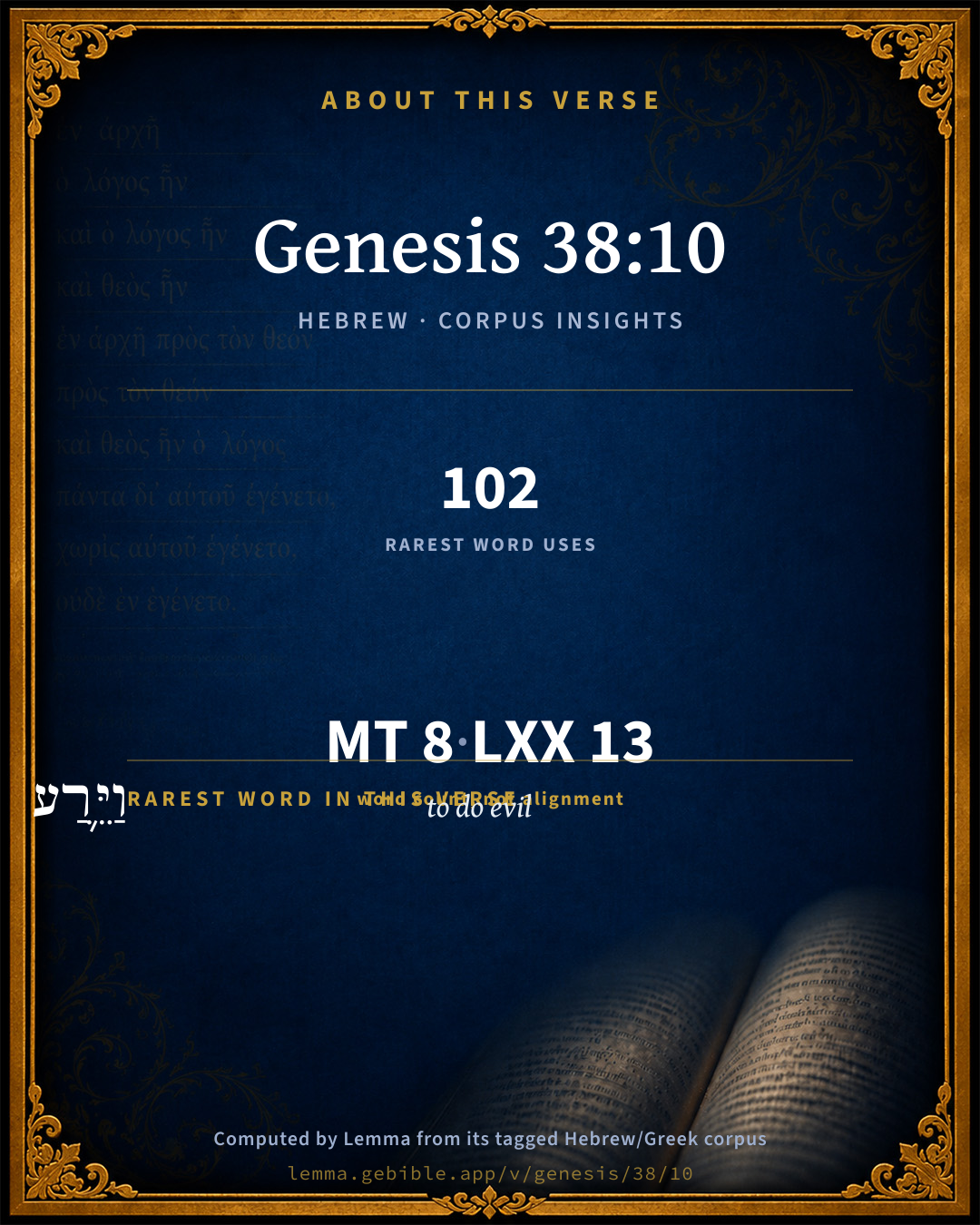
8
words
8
distinct lemmas
Pentateuch
section

Grammatical profile

  • 3 verbs
  • 2 nouns
  • 3 particles

Verb forms

  • וַיֵּ֛רַע Qal · Sequential Imperfect
  • עָשָׂ֑ה Qal · Perfect
  • וַיָּ֖מֶת Hiphil · Sequential Imperfect

Hebrew & Septuagint length

In English translation the verse runs 17 words from the Hebrew and 13 from the Septuagint (LXX English) — closely comparable.

A rough comparison of the two English renderings, which tokenize alike — not a word-level alignment.

Word counts can differ between the Hebrew and the Greek without any difference in meaning — e.g. the Hebrew direct-object marker אֵת has no separate Greek word, and Greek often adds the article ὁ.

In the original languages it is 8 Hebrew tokens and 13 Greek tokens — but the two are counted differently (Hebrew bundles its prefixes and suffixes into one token; the Greek is in lemma form), so that isn’t a like-for-like length.

Cross-references

10

Topical passages linked to Genesis 38:10 in the Treasury of Scripture Knowledge — connected by theme and wording, ordered by reader-vote popularity; previews shown in the World English Bible.

  • Genesis 46:12 The sons of Judah: Er, Onan, Shelah, Perez, and Zerah; but Er and Onan died in the land of Canaan. The sons of Perez were Hezron and Hamul.
  • Numbers 11:1 The people were as murmurers, [speaking] evil in the ears of Yahweh: and when Yahweh heard it, his anger was kindled; and the fire of Yahweh burnt among them, and devoured in the uttermost part of the camp.
  • Numbers 26:19 The sons of Judah: Er and Onan; and Er and Onan died in the land of Canaan.
  • 1 Chronicles 21:7 God was displeased with this thing; therefore he struck Israel.
  • Proverbs 14:32 The wicked is brought down in his calamity, But in death, the righteous has a refuge.
  • 2 Samuel 11:27 When the mourning was past, David sent and took her home to his house, and she became his wife, and bore him a son. But the thing that David had done displeased Yahweh.
  • Proverbs 24:18 Lest Yahweh see it, and it displease him, And he turn away his wrath from him.
  • Jeremiah 44:4 However I sent to you all my servants the prophets, rising up early and sending them, saying, Oh, don't do this abominable thing that I hate.
  • Haggai 1:13 Then Haggai, Yahweh's messenger, spoke in Yahweh's message to the people, saying, "I am with you," says Yahweh.
  • Numbers 22:34 Balaam said to the angel of Yahweh, I have sinned; for I didn't know that you stood in the way against me: now therefore, if it displease you, I will get me back again.

Cross-references courtesy of OpenBible.info (CC BY 4.0).

Hebrew and Greek witnesses Masoretic Hebrew ↔ Greek Septuagint

The same verse in the two great witnesses to the Old Testament, shown verse-for-verse.

These are two independent witnesses, not word-aligned to each other, and the Septuagint is shown in lemma (dictionary) form.

Hebrew Genesis 38:10 Masoretic · Westminster Leningrad Codex

וַיֵּ֛רַע בְּעֵינֵ֥י יְהוָ֖ה אֲשֶׁ֣ר עָשָׂ֑ה וַיָּ֖מֶת גַּם אֹתֽוֹ

The thing which he did was evil in the sight of Yahweh, and he killed him also.

World English Bible · Public Domain

Greek LXX Genesis 38:10 Septuagint · lemma form

πονηρός δέ φαίνω ἐναντίον ὁ θεός ὅτι ποιέω οὗτος καί θανατόω καί οὗτος

And his doing this appeared evil before God; and he killed him also.

LXX2012 (modern English Septuagint) · Public Domain

Hebrew: Westminster Leningrad Codex (CC BY 4.0). Greek: Septuagint (public domain); English from LXX2012 (modern English Septuagint) (Public Domain). How the Septuagint differs from the Hebrew →

Targum (Aramaic paraphrase)

2

The Targum is the ancient Jewish Aramaic paraphrase of the Hebrew Scriptures — an interpretive translation, not the Hebrew text itself. Onkelos (literal) and Pseudo-Jonathan (expansive) render the Torah, and Jonathan the Prophets. Coverage is partial: where no permissively-licensed English translation exists for a verse, only the Aramaic is shown. This is verse-level text, not a word-by-word alignment to the Hebrew.

  1. Targum Onkelos Torah (Genesis–Deuteronomy)
    וּבְאֵישׁ קֳדָם יְיָ דִּי עֲבָד וַאֲמִית אַף יָתֵהּ

    (no public-domain English translation for this verse)

    Targum Onkelos — Aramaic: “Onkelos Genesis” (public domain); “Onkelos Exodus” (public domain); “Onkelos Leviticus” (public domain); “Onkelos Numbers” (public domain); “Onkelos Deuteronomy” (public domain). English: “Sefaria Community Translation” (CC0 1.0 (public-domain dedication)); “J.W. Etheridge. The Targums of Onkelos and Jonathan Ben Uzziel on the Pentateuch. London: Longmans, Green, 1862” (public domain). Text via Sefaria.

  2. Targum Pseudo-Jonathan Torah (Genesis–Deuteronomy)
    וּבְאֵשׁ קֳדָם יְיָ מַה דְעָבַד וּקְטַע אוּף יַת יוֹמוֹי

    And what he did was evil before the Lord and he cut off his days also.

    Targum Pseudo-Jonathan — Aramaic: “Targum Jonathan on Genesis” (public domain); “Targum Jonathan on Exodus” (public domain); “Targum Jonathan on Leviticus” (public domain); “Targum Jonathan on Numbers” (public domain); “Targum Jonathan on Deuteronomy” (public domain). English: “The Targum of Jonathan ben Uzziel, trans. J. W. Etheridge, London, 1862” (public domain). Text via Sefaria.

Commentary

Notes on Genesis 38:10 from classic Christian and Jewish commentators (each source and its license shown beneath its notes). The classic Christian expositions comment on the surrounding passage and are grouped to its opening verse, so a note may address several verses; the Jewish commentaries on the Tanakh (Rashi and others) are per-verse, so they appear only where the commentator wrote on this verse.

Lemma curates 59 commentaries, every one of them public domain or Creative Commons licensed, each selected and text-cleaned for this edition rather than reprinted as found. About our sources →

Trapp's Complete Commentary

John Trapp

Gen 38:10 And the thing which he did displeased the LORD: wherefore he slew him also.

Ver. 10. Wherefore he slew him.] God oft punisheth the abuse of the marriage bed, either with untimely death - it was well said of one, {a} that Venus provides not for those that are already born, but for those that shall be born - or else with no children, misshapen children, idiots, or prodigiously wicked children, &c. Cavete let this consideration be as the angel standing with a drawn sword over Balaam’s shoulders.

{a} Cuffe’s Differ. of Ages, 106.

John Trapp, A Commentary or Exposition upon All the Books of the Old and New Testament (1647–1656) — public domain. Text from a community e-Sword module.

Adam Clarke's Commentary

Verse 10. Wherefore he slew him also.] The sin of Onan has generally been supposed to be self-pollution; but this is certainly a mistake; his crime was his refusal to raise up seed to his brother, and rather than do it, by the act mentioned above, he rendered himself incapable of it. We find from this history that long be fore the Mosaic law it was an established custom, probably founded on a Divine precept, that if a man died childless his brother was to take his wife, and the children produced by this second marriage were considered as the children of the first husband, and in consequence inherited his possessions.

Adam Clarke's Commentary on the Bible (1810–1826) — public domain. Text from a community e-Sword/MySword module.

John Calvin's Commentaries

10. And the thing which he did displeased the LORD. Less neatly the Jews speak about this matter. I will contend myself with briefly mentioning this, as far as the sense of shame allows to discuss it. It is a horrible thing to pour out seed besides the intercourse of man and woman. Deliberately avoiding the intercourse, so that the seed drops on the ground, is double horrible. For this means that one quenches the hope of his family, and kills the son, which could be expected, before he is born. This wickedness is now as severely as is possible condemned by the Spirit, through Moses, that Onan, as it were, through a violent and untimely birth, tore away the seed of his brother out the womb, and as cruel as shamefully has thrown on the earth. Moreover he thus has, as much as was in his power, tried to destroy a part of the human race. When a woman in some way drives away the seed out the womb, through aids, then this is rightly seen as an unforgivable crime. Onan was guilty of a similar crime, by defiling the earth with his seed, so that Tamar would not receive a future inheritor.

John Calvin's Commentaries (1540-1563) — public domain. Text from the Calvin Translation Society English edition (1840s-50s) via the Christian Classics Ethereal Library (ccel.org). Calvin's coverage is partial (roughly two-thirds of the Bible); uncommented books and verses are honest gaps, never fabricated. The 19th-century editor's footnotes and remarks are omitted so the notes are faithfully Calvin's own voice.

John Gill's Exposition

Then said Judah to Tamar his daughter in law,.... After the death of his two sons, who had successively married her:

remain a widow at thy father's house till Shelah my son be grown: who was his third and youngest son, though perhaps not more than a year younger than Onan; but he might not choose he should marry so soon as his brethren had done, for a reason following: according to the custom and law of marrying a brother's wife, who died without issue, she in course was to be the wife of Shelah; since if there were ever so many brothers, they all married such an one in turn, until there was issue by one of them, see Mat 22:25; as Judah knew this, he pretended at least to give her to his son for wife, only would have it put off till he was at age of maturity, or was more grown; and therefore desires her to keep herself unmarried to any other person until that time; and advises her to go to her father's house, and continue there, which he did to prevent any intrigues between them, lest his son should be tempted to marry her sooner than it was his will, and she should solicit him to it:

for he said; not to Tamar, but within himself:

lest peradventure he die also as his brethren did; by which it seems, that he was ignorant of the true cause of their death, but thought it was either owing to their marrying too young, or to something in the woman unfortunate and unhappy; and he might not really intend he should marry her at all, only made use of an excuse for the present:

and Tamar went and dwelt in her father's house; she had dwelt in Judah's house in the time of her two husbands, but now by his advice she removed to her own father's house; which very probably was in the same place, and her father yet living, who received her, and with whom she continued, see Lev 22:13.

John Gill's Exposition of the Whole Bible (1746–1763) — public domain (CC PDM 1.0). Text via the HelloAO Bible API.

Haydock's Catholic Bible Commentary

Slew him, perhaps by the hand of evil angels, Psalm lxxvii. 49. Asmodeus, &c., who slew the libidinous husbands of Sara. (Tobias iii. 7.) (Menochius) --- If an exemplary vengeance were oftener taken of the perpetrators of such a detestable thing, this abominable and unnatural vice would sooner perhaps be eradicated. (Haydock)

George Leo Haydock (1774–1849), Haydock's Catholic Family Bible and Commentary, 1859 edition — public domain. Excludes Psalms (Douay-Rheims chapter numbering differs from Protestant) and Deuterocanonical books (Catholic canon only).

Matthew Poole's English Annotations

Displeased the Lord; an expression noting a more than ordinary offence against God, as 2Sa 11:27. This just but dreadful severity of God is noted both for the terror of such-like transgressors, and to provoke love and thankfulness to God in those whom he useth more indulgently.

Matthew Poole's English Annotations on the Holy Bible (1683–1685) — public domain. Text from a community e-Sword/MySword module.

Radak

Rabbi David Kimhi (Radak)

גם אותו, both brothers had been guilty of the same sin.

Radak on the Tanakh — English translations: “Sefaria Community Translation” (CC0 1.0 (public-domain dedication)); “Eliyahu Munk, HaChut Hameshulash” (CC BY 4.0); “Rabbi Mike Feuer, Jerusalem Anthology” (CC BY 4.0); and “R. David Kimhi on the first book of Psalms, Translated by R.G. Finch, London, 1919” (public domain). Text via Sefaria.

Lesson kit

Teaching starters — assembled from the data on this page, not authored interpretation. Every prompt links to the verse data it draws on. Edit before teaching.

Genesis, in the Pentateuch, opens this verse with 8 words (8 distinct Hebrew lemmas). Its most distinctive word is râʻaʻ (“to do evil”). A historical commentator’s framing appears above. Read the whole chapter for the surrounding context.

Discussion questions

  1. How does “to do evil” (râʻaʻ) shape what this verse is saying?
  2. Genesis 46:12 shares this passage’s theme. How do the two illuminate each other?
  3. These translations render this verse differently. What is at stake in choosing one wording over another?
  4. The verb «וַיֵּ֛רַע» is Qal Sequential Imperfect. How does its form color the action?
  5. Reading how Trapp's Complete Commentary and Adam Clarke's Commentary read this verse, where do the two commentators agree and where do they part?

Things to notice

Reading settings

Reading text

Shown beneath each verse's original-language words.

Old Testament
Old Testament edition

Read the OT as the Masoretic Hebrew (MT) or the Greek Septuagint (LXX).

English shown for the Greek Septuagint (in the Hebrew ↔ Greek comparison).

Comparing translations? Open the Compare panel on any verse page to stack up to four side by side.