
Exodus 7:21

Hebrew (Westminster Leningrad Codex) Exodus 7:21 appears in the Hebrew Old Testament. The text above is from the Westminster Leningrad Codex. Each word links to its Strong’s number, a concise gloss, and parsing drawn from the Open Scriptures Hebrew Bible morphology. Click any word for its full Brown-Driver-Briggs (BDB) entry.
Download image
Cite this verse

Exodus 7:21 (World English Bible). Public Domain. Lemma interlinear Bible study tool, https://lemma.gebible.app/v/exodus/7/21.

Show BibTeX & RIS
BibTeX
RIS
English Translation
The fish that were in the river died; and the river became foul, and the Egyptians couldn't drink water from the river; and the blood was throughout all the land of Egypt.
World English Bible · Public Domain
Download a study sheet

One document with this verse’s original text, its word-by-word gloss line, the meaning frame, cross-references with their text, attributed commentary, and full source and license credits — printable, and it pastes into notes with its structure intact.

This verse Autodidact and up

Study sheet (.html) Plain text (.txt)

A passage Seminary Student

Up to 50 verses in one chapter. A passage sheet keeps up to 6 commentary sources and 12 cross-references per verse, in the order this page ranks them, and says so on the sheet whenever that leaves anything out. Ask for a single verse and you get the Autodidact verse sheet above.

Everything on this page stays free to read, with no account — the sheet is a download of what is already on screen, not access to it.

Want to remove ads? Support Godless Engineer
Compare translations 3

The same verse in 3 English versions, stacked beneath the original-language interlinear above. Click any original word for its lexicon entry.

Each is an independent rendering of the whole verse — the interlinear is not word-aligned to these translations.

Highlighted words mark where these versions differ — a whole-verse word diff, not a word-by-word alignment.

  • World English Bible Public Domain
    The fish that were in the river died; and the river became foul, and the Egyptians couldn't drink water from the river; and the blood was throughout all the land of Egypt.
  • King James Version Public Domain
    And the fish that was in the river died; and the river stank, and the Egyptians could not drink of the water of the river; and there was blood throughout all the land of Egypt.
  • unfoldingWord Literal Text CC BY-SA 4.0
    And the fish that were in the river died, and the river stank, so the Egyptians were not able to drink water from the river. And the blood was in all the land of Egypt.

unfoldingWord Literal Text — © unfoldingWord, licensed CC BY-SA 4.0. Word-aligned USFM3 via Door43 (git.door43.org/unfoldingWord/en_ult).

Versions to compare (up to 4)

3 of 4 selected

Show all 18 translations

Every available English version of this verse, each an independent rendering of the whole verse.

  • World English Bible Public Domain
    The fish that were in the river died; and the river became foul, and the Egyptians couldn't drink water from the river; and the blood was throughout all the land of Egypt.
  • Berean Standard Bible Public Domain
    The fish in the Nile died, and the river smelled so bad that the Egyptians could not drink its water. And there was blood throughout the land of Egypt.
  • Majority Standard Bible Public Domain
    The fish in the Nile died, and the river smelled so bad that the Egyptians could not drink its water. And there was blood throughout the land of Egypt.
  • King James Version Public Domain
    And the fish that was in the river died; and the river stank, and the Egyptians could not drink of the water of the river; and there was blood throughout all the land of Egypt.
  • American Standard Version (1901) Public Domain
    And the fish that were in the river died; and the river became foul, and the Egyptians could not drink water from the river; and the blood was throughout all the land of Egypt.
  • Revised Version (1885) Public Domain
    And the fish that was in the river died; and the river stank, and the Egyptians could not drink water from the river; and the blood was throughout all the land of Egypt.
  • Geneva Bible (1599) Public Domain
    And the fish that was in the ryuer dyed, and the riuer stanke: so that the Egyptians could not drinke of the water of the riuer: and there was blood throughout all the lande of Egypt.
  • Douay-Rheims (1899) Public Domain
    And the fishes that were in the river died: and the river corrupted, and the Egyptians could not drink the water of the river, and there was blood in all the land of Egypt.
  • Young's Literal Translation Public Domain
    and the fish which `is' in the River hath died, and the River stinketh, and the Egyptians have not been able to drink water from the River; and the blood is in all the land of Egypt.
  • Literal Standard Version CC BY-SA 4.0
    and the fish which [is] in the River has died, and the River stinks, and the Egyptians have not been able to drink water from the River; and the blood is in all the land of Egypt.
  • Unlocked Literal Bible CC BY-SA 4.0
    The fish in the river died, and the river began to stink. The Egyptians could not drink water from the river, and the blood was everywhere in the land of Egypt.
  • unfoldingWord Literal Text CC BY-SA 4.0
    And the fish that were in the river died, and the river stank, so the Egyptians were not able to drink water from the river. And the blood was in all the land of Egypt.
  • Darby Bible Public Domain
    And the fish that was in the river died; and the river stank, and the Egyptians could not drink the water of the river; and the blood was throughout the land of Egypt.
  • World Messianic Bible Public Domain
    The fish that were in the river died. The river became foul. The Egyptians couldn’t drink water from the river. The blood was throughout all the land of Egypt.
  • Webster's Bible Public Domain
    And the fish that was in the river died; and the river was offensive in smell, and the Egyptians could not drink of the water of the river; and there was blood throughout all the land of Egypt.
  • Free Bible Version CC BY-SA 4.0
    The fish in the Nile died, and the river smelled so awful that the Egyptians could not drink its water. There was blood through all of Egypt!
  • Bible in Basic English Public Domain
    And the fish in the Nile came to destruction, and a bad smell went up from the river, and the Egyptians were not able to make use of the water of the Nile for drinking; and there was blood through all the land of Egypt.
  • JPS Tanakh (1917) Public Domain
    And the fish that were in the river died; and the river became foul, and the Egyptians could not drink water from the river; and the blood was throughout all the land of Egypt.

Literal Standard Version (2020), Covenant Press — licensed CC BY-SA 4.0. Text via the HelloAO Bible API (eBible.org). Unlocked Literal Bible (unfoldingWord) — licensed CC BY-SA 4.0. Text via the HelloAO Bible API (eBible.org). unfoldingWord Literal Text — © unfoldingWord, licensed CC BY-SA 4.0. Word-aligned USFM3 via Door43 (git.door43.org/unfoldingWord/en_ult). Free Bible Version, Dr. Jonathan Gallagher — licensed CC BY-SA 4.0. Text via the HelloAO Bible API (eBible.org).

Word by word

More ways to search: Search by grammar → Find every occurrence → Compare this word →

Practice this passage: Drill this verse → Learn its vocabulary →

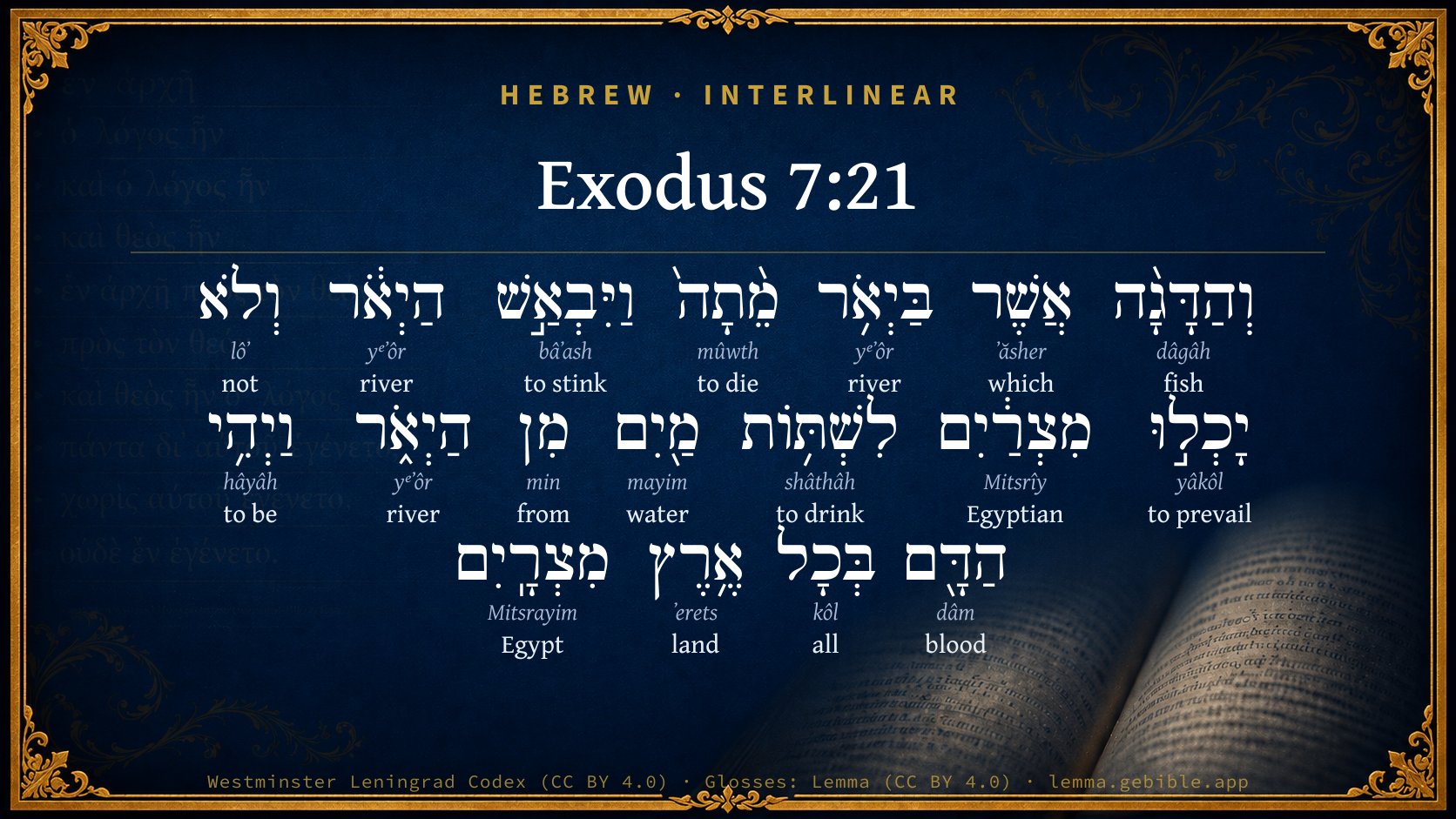
וְהַדָּגָ֨ה
dâgâh
H1710
“and · the · fish”
Conjunction + Particle, Definite Article + Noun, Common, Feminine, Singular, Absolute
Part of Speech
Conjunction + Particle + Noun
Type
Common
Gender
Feminine
Number
Singular
State
Absolute
Full BDB Definition

Origin: from H1709

TWOT: 401b

fish
  1. אֲשֶׁר ʼăsher H834 “which” Particle, Relative
  2. בַּיְאֹ֥ר yᵉʼôr H2975 “in/at the · river” Preposition, Determined + Noun, Proper
  3. מֵ֨תָה֙ mûwth H4191 “to die” Verb, Qal, Perfect, 3rd Person, Feminine, Singular
  4. וַיִּבְאַ֣שׁ bâʼash H887 “and · to stink” Conjunction + Verb, Qal, Sequential Imperfect, 3rd Person, Masculine, Singular
  5. הַיְאֹ֔ר yᵉʼôr H2975 “the · river” Particle, Definite Article + Noun, Proper
  6. וְלֹא lôʼ H3808 “and · not” Conjunction + Particle, Negative
  7. יָכְל֣וּ yâkôl H3201 “to prevail” Verb, Qal, Perfect, 3rd Person, Common, Plural
  8. מִצְרַ֔יִם Mitsrîy H4713 “Egyptian” Noun, Proper
  9. לִשְׁתּ֥וֹת shâthâh H8354 “to drink” Preposition + Verb, Qal, Infinitive Construct
  10. מַ֖יִם mayim H4325 “water(s)” Noun, Common, Masculine, Plural, Absolute
  11. מִן min H4480 “from” Preposition
  12. הַיְאֹ֑ר yᵉʼôr H2975 “the · river” Particle, Definite Article + Noun, Proper
  13. וַיְהִ֥י hâyâh H1961 “and · to be” Conjunction + Verb, Qal, Sequential Imperfect, 3rd Person, Masculine, Singular
  14. הַדָּ֖ם dâm H1818 “the · blood” Particle, Definite Article + Noun, Common, Masculine, Singular, Absolute
  15. בְּכָל kôl H3605 “in/at · all of” Preposition + Noun, Common, Masculine, Singular, Construct
  16. אֶ֥רֶץ ʼerets H776 “land of” Noun, Common, Both, Singular, Construct
  17. מִצְרָֽיִם Mitsrayim H4714 “Egypt” Noun, Proper

About this verse

These counts appear in no published source. They are computed here, from the morphology-tagged text and Lemma’s own curated glosses. What Lemma adds →

18
words
16
distinct lemmas
Pentateuch
section

Notable vocabulary

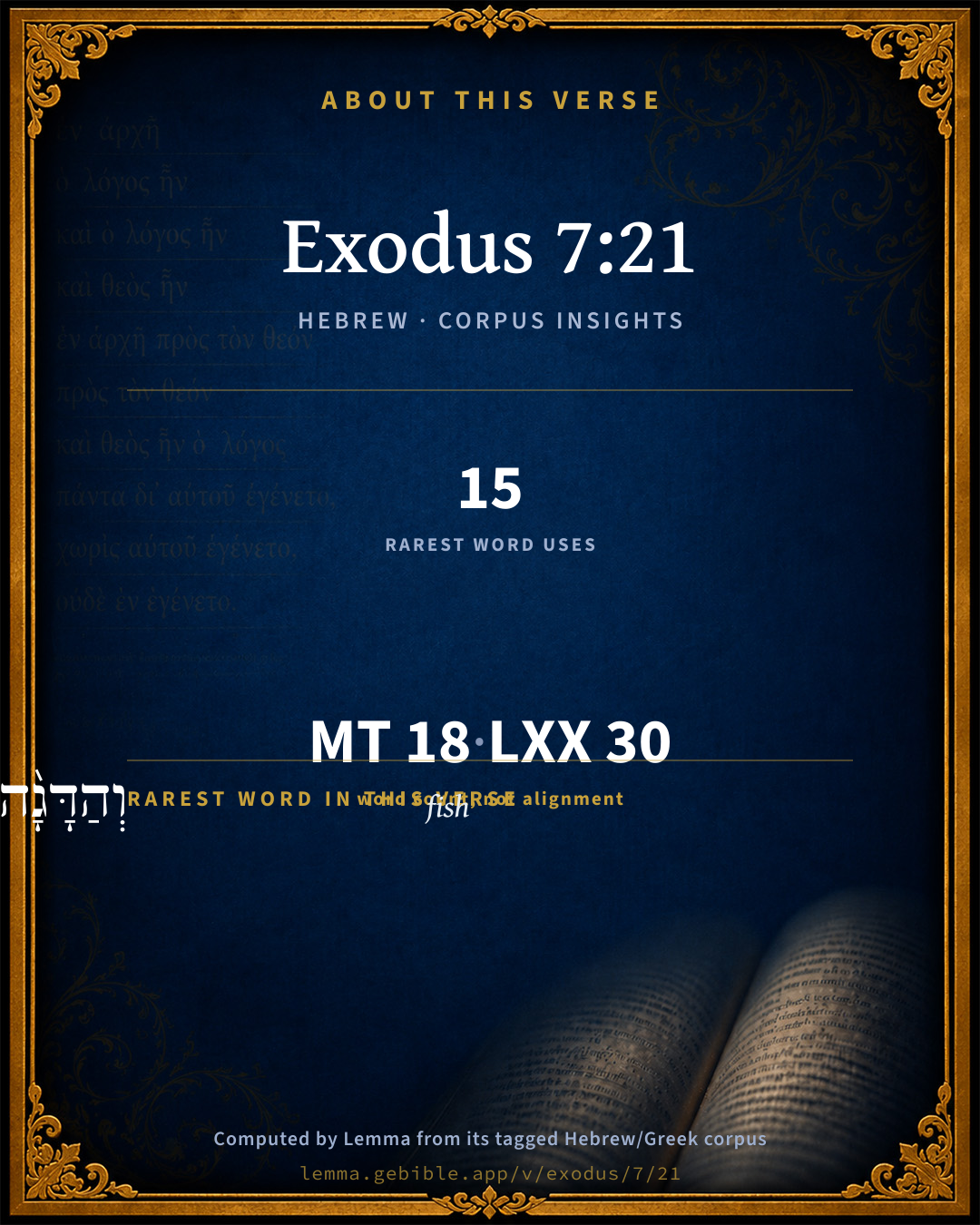
The rarest word here is וְהַדָּגָ֨ה fish H1710 — appearing just 15 times in the whole Hebrew Bible.

Shared distinctive vocabulary

וְהַדָּגָ֨ה fish H1710 occurs in 13 verses of the Hebrew Bible. Also found in:

Grammatical profile

  • 5 verbs
  • 10 nouns
  • 1 preposition
  • 2 particles

Verb forms

  • מֵ֨תָה֙ Qal · Perfect
  • וַיִּבְאַ֣שׁ Qal · Sequential Imperfect
  • יָכְל֣וּ Qal · Perfect
  • לִשְׁתּ֥וֹת Qal · Infinitive Construct
  • וַיְהִ֥י Qal · Sequential Imperfect

Repetition

A word recurs within this verse — often emphatic in Hebrew:

  • בַּיְאֹ֥ר river H2975 ×3

Hebrew & Septuagint length

In English translation the verse runs 32 words from the Hebrew and 32 from the Septuagint (LXX English) — the same length.

A rough comparison of the two English renderings, which tokenize alike — not a word-level alignment.

Word counts can differ between the Hebrew and the Greek without any difference in meaning — e.g. the Hebrew direct-object marker אֵת has no separate Greek word, and Greek often adds the article ὁ.

In the original languages it is 18 Hebrew tokens and 30 Greek tokens — but the two are counted differently (Hebrew bundles its prefixes and suffixes into one token; the Greek is in lemma form), so that isn’t a like-for-like length.

Cross-references

2

Topical passages linked to Exodus 7:21 in the Treasury of Scripture Knowledge — connected by theme and wording, ordered by reader-vote popularity; previews shown in the World English Bible.

  • Exodus 7:18 The fish that are in the river shall die, and the river shall become foul; and the Egyptians shall loathe to drink water from the river."'"
  • Revelation 8:9 and one third of the living creatures which were in the sea died. One third of the ships were destroyed.

Cross-references courtesy of OpenBible.info (CC BY 4.0).

Hebrew and Greek witnesses Masoretic Hebrew ↔ Greek Septuagint

The same verse in the two great witnesses to the Old Testament, shown verse-for-verse.

These are two independent witnesses, not word-aligned to each other, and the Septuagint is shown in lemma (dictionary) form.

Hebrew Exodus 7:21 Masoretic · Westminster Leningrad Codex

וְהַדָּגָ֨ה אֲשֶׁר בַּיְאֹ֥ר מֵ֨תָה֙ וַיִּבְאַ֣שׁ הַיְאֹ֔ר וְלֹא יָכְל֣וּ מִצְרַ֔יִם לִשְׁתּ֥וֹת מַ֖יִם מִן הַיְאֹ֑ר וַיְהִ֥י הַדָּ֖ם בְּכָל אֶ֥רֶץ מִצְרָֽיִם

The fish that were in the river died; and the river became foul, and the Egyptians couldn't drink water from the river; and the blood was throughout all the land of Egypt.

World English Bible · Public Domain

Greek LXX Exodus 7:21 Septuagint · lemma form

καί ὁ ἰχθύς ὁ ἐν ὁ ποταμός τελευτάω καί ἐπιὄζω ὁ ποταμός καί οὐ δύναμαι ὁ αἰγύπτιος πίνω ὕδωρ ἐκ ὁ ποταμός καί εἰμί ὁ αἷμα ἐν πᾶς γῆ αἴγυπτος

And the fish in the river died, and the river stank thereupon; and the Egyptians could not drink water from the river, and the blood was in all the land of Egypt.

LXX2012 (modern English Septuagint) · Public Domain

Hebrew: Westminster Leningrad Codex (CC BY 4.0). Greek: Septuagint (public domain); English from LXX2012 (modern English Septuagint) (Public Domain). How the Septuagint differs from the Hebrew →

Targum (Aramaic paraphrase)

2

The Targum is the ancient Jewish Aramaic paraphrase of the Hebrew Scriptures — an interpretive translation, not the Hebrew text itself. Onkelos (literal) and Pseudo-Jonathan (expansive) render the Torah, and Jonathan the Prophets. Coverage is partial: where no permissively-licensed English translation exists for a verse, only the Aramaic is shown. This is verse-level text, not a word-by-word alignment to the Hebrew.

  1. Targum Onkelos Torah (Genesis–Deuteronomy)
    וְנוּנֵי דִי בְנַהֲרָא מִיתוּ וּסְרִי נַהֲרָא וְלָא יְכִילוּ מִצְרָאֵי לְמִשְׁתֵּי מַיָא מִן נַהֲרָא וַהֲוָה דְמָא בְּכָל אַרְעָא דְמִצְרָיִם:

    (no public-domain English translation for this verse)

    Targum Onkelos — Aramaic: “Onkelos Genesis” (public domain); “Onkelos Exodus” (public domain); “Onkelos Leviticus” (public domain); “Onkelos Numbers” (public domain); “Onkelos Deuteronomy” (public domain). English: “Sefaria Community Translation” (CC0 1.0 (public-domain dedication)); “J.W. Etheridge. The Targums of Onkelos and Jonathan Ben Uzziel on the Pentateuch. London: Longmans, Green, 1862” (public domain). Text via Sefaria.

  2. Targum Pseudo-Jonathan Torah (Genesis–Deuteronomy)
    וְנוּנֵי דִי בְנַהֲרָא מִיתוּ וּסְרִי נַהֲרָא וְלָא יָכִילוּ מִצְרָאֵי לְמִשְׁתֵּי מוֹי מִן נַהֲרָא וַהֲוַת מְחַת דְמָא בְּכָל אַרְעָא דְמִצְרַיִם

    and the fish that were in the river died; and the river became foul, and the Mizraee could not drink of the waters, of the river and the plague of blood was in all the land of Mizraim.

    Targum Pseudo-Jonathan — Aramaic: “Targum Jonathan on Genesis” (public domain); “Targum Jonathan on Exodus” (public domain); “Targum Jonathan on Leviticus” (public domain); “Targum Jonathan on Numbers” (public domain); “Targum Jonathan on Deuteronomy” (public domain). English: “The Targum of Jonathan ben Uzziel, trans. J. W. Etheridge, London, 1862” (public domain). Text via Sefaria.

Commentary

Notes on Exodus 7:21 from classic Christian and Jewish commentators (each source and its license shown beneath its notes). The classic Christian expositions comment on the surrounding passage and are grouped to its opening verse, so a note may address several verses; the Jewish commentaries on the Tanakh (Rashi and others) are per-verse, so they appear only where the commentator wrote on this verse.

Lemma curates 59 commentaries, every one of them public domain or Creative Commons licensed, each selected and text-cleaned for this edition rather than reprinted as found. About our sources →

Trapp's Complete Commentary

John Trapp

Exo 7:21 And the fish that [was] in the river died; and the river stank, and the Egyptians could not drink of the water of the river; and there was blood throughout all the land of Egypt.

Ver. 21. And the fish.] That was their common food. {Num 11:5} The flesh of many beasts, they, through superstition, would not eat of, as one well noteth from Exo 8:26.

John Trapp, A Commentary or Exposition upon All the Books of the Old and New Testament (1647–1656) — public domain. Text from a community e-Sword module.

Geneva Bible (1599)

Geneva Bible translators

To signify that it was a true miracle, and that God plagued them in that which was most necessary for the preservation of life.

Geneva Bible (1599) marginal notes — public domain. Text via Bolls.life.

Ellicott's Commentary for English Readers

(21) The Egyptians could not drink.—Previously they had “lotlhed to drink” (Exo_7:18), but apparently had drunk. Now they could do so no longer—the draught was too nauseous.

A Bible Commentary for English Readers, edited by Charles John Ellicott (1878–1897) — public domain. Text from a community e-Sword module.

The Cambridge Bible for Schools and Colleges

gen. ed. J. J. S. Perowne

21a. How the fish died, and the river stank, in agreement with v. 18 (J).

21b. How there was blood in all the land of Egypt, in agreement with v. 19 (P).

The Cambridge Bible for Schools and Colleges (gen. ed. J. J. S. Perowne; Cambridge University Press, 1878–1918) — public domain. Text from a community e-Sword module.

John Gill's Exposition

And the fish that was in the river died,.... Which was a full proof that the conversion of it into blood was real; for had it been only in appearance, or the water of the river had only the colour of blood, and looked like it, but was not really so, it would not have affected the fishes, they would have lived as well as before; and this plague was the greater affliction to the Egyptians, not as it affected their drink but their food, fish Num 11:5 being what the common people chiefly lived upon; see Gill on Isa 19:8 and the river stunk; the blood into which it was turned being corrupted through the heat of the sun, and the dead fishes swimming upon it being putrefied:

and the Egyptians could not drink of the water of the river; and they had no other water to drink of (k); for rain seldom fell in Egypt, though sometimes it did in some places; see Gill on Zac 14:18. The water of the river Nile was not only their common drink, but it was exceeding pleasant, and therefore the loss of it was the greater; it was so remarkable for the sweetness and delicacy of its taste, that in the time of Pescennius Niger, when his soldiers murmured for want of wine, he is reported to have answered them,"what! crave you wine, and have the water of the Nile to drink?''which Mr. Maillett, who lived sixteen years consul for the French nation at Grand Cairo, confirms, and says, that it is grown to be a common proverb, that whoever has once tasted it will ever after pine for it (l); with this compare Jer 2:18,

and there was blood throughout all the land of Egypt; in the river, wherever it flowed, in all its streams and channels, and wherever any water was collected out of it, or fetched from it, let it be in what reservoir it would. This is the first plague executed on the Egyptians, and a very righteous one by the law of retaliation for shedding the blood of innocent babes, through casting them into this river; and this will be the second and third vials of God's wrath, which will be poured on antichrist, or mystical Egypt, who will have blood given to drink because worthy, see Rev 16:3. Artapanus (m), an Heathen writer, bears testimony to this miracle, though he does not so fully and clearly express it as it was; he says,"a little after, that is, after the former miracle of the rod turned into a serpent, the Nile, that river whose swelling waves overflow all Egypt, was smitten with the rod; and the water being gathered and stagnated, boiled up, and not only the fishes were destroyed, but the people perished through thirst.''

(k) Vid. Plin. Nat. Hist. l. 6. c. 29. (l) See the Bishop of Clogher's Chronology of the Hebrew Bible, p. 287. (m) Apud Euseb Praepar. Evangel. l. 9. c. 27. p. 435.

John Gill's Exposition of the Whole Bible (1746–1763) — public domain (CC PDM 1.0). Text via the HelloAO Bible API.

Albert Barnes' Notes on the Bible

The fish ... - The Egyptians subsisted to a great extent on the fish of the Nile, though salt-water fish were regarded as impure. A mortality among the fish was a plague that was much dreaded.

Albert Barnes' Notes on the Bible (1834–1885) — public domain. Text from a community e-Sword/MySword module.

Haydock's Catholic Bible Commentary

All the land, even in that of Gessen, which belonged to the Egyptians; while the Hebrews had good water. (Menochius)

George Leo Haydock (1774–1849), Haydock's Catholic Family Bible and Commentary, 1859 edition — public domain. Excludes Psalms (Douay-Rheims chapter numbering differs from Protestant) and Deuterocanonical books (Catholic canon only).

The Pulpit Commentary

The fish that was in the river died. It is most natural to understand "all the fish." There was blood, etc. Literally, "and the blood was throughout all the land of Egypt." The exact intention of the phrase is doubtful, since undoubtedly "in numberless instances, the Hebrew terms which imply universality must be understood in a limited sense (Cook). "All the land" may mean no more than "all the Delta."

The Pulpit Commentary (1880–1919), ed. H.D.M. Spence-Jones & Joseph S. Exell — public domain. Text from a community e-Sword module.

Lesson kit

Teaching starters — assembled from the data on this page, not authored interpretation. Every prompt links to the verse data it draws on. Edit before teaching.

Exodus, in the Pentateuch, opens this verse with 18 words (16 distinct Hebrew lemmas). Its most distinctive word is dâgâh (“fish”). A historical commentator’s framing appears above. Read the whole chapter for the surrounding context.

Discussion questions

  1. How does “fish” (dâgâh) shape what this verse is saying?
  2. Genesis 1:26 shares the word «fish» with this verse. How do the two illuminate each other?
  3. “river” occurs 3× in this one verse. What is the effect of the repetition?
  4. These translations render this verse differently; the difference is in the English rendering, not the original. What questions does that raise?
  5. The verb «מֵ֨תָה֙» is Qal Perfect. How does its form color the action?
  6. Reading how Trapp's Complete Commentary and Geneva Bible (1599) read this verse, where do the two commentators agree and where do they part?

Things to notice

Reading settings

Reading text

Shown beneath each verse's original-language words.

Old Testament
Old Testament edition

Read the OT as the Masoretic Hebrew (MT) or the Greek Septuagint (LXX).

English shown for the Greek Septuagint (in the Hebrew ↔ Greek comparison).

Comparing translations? Open the Compare panel on any verse page to stack up to four side by side.