
Leviticus 24:16

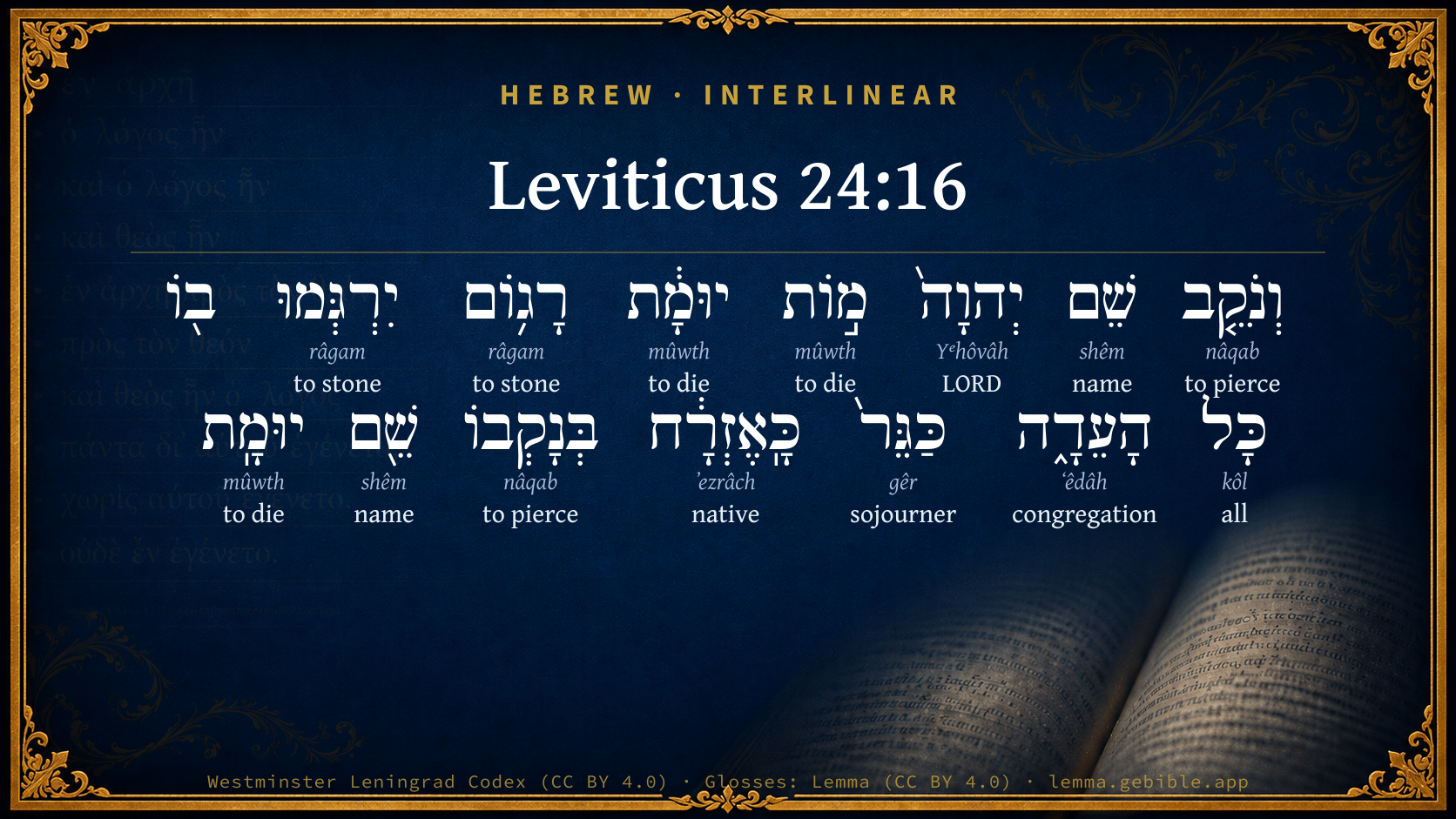
Hebrew (Westminster Leningrad Codex) Leviticus 24:16 appears in the Hebrew Old Testament. The text above is from the Westminster Leningrad Codex. Each word links to its Strong’s number, a concise gloss, and parsing drawn from the Open Scriptures Hebrew Bible morphology. Click any word for its full Brown-Driver-Briggs (BDB) entry.
Download image
Cite this verse

Leviticus 24:16 (World English Bible). Public Domain. Lemma interlinear Bible study tool, https://lemma.gebible.app/v/leviticus/24/16.

Show BibTeX & RIS
BibTeX
RIS
English Translation
He who blasphemes the name of Yahweh, he shall surely be put to death; all the congregation shall certainly stone him: the foreigner as well as the native-born, when he blasphemes the Name, shall be put to death.
World English Bible · Public Domain
Download a study sheet

One document with this verse’s original text, its word-by-word gloss line, the meaning frame, cross-references with their text, attributed commentary, and full source and license credits — printable, and it pastes into notes with its structure intact.

This verse Autodidact and up

Study sheet (.html) Plain text (.txt)

A passage Seminary Student

Up to 50 verses in one chapter. A passage sheet keeps up to 6 commentary sources and 12 cross-references per verse, in the order this page ranks them, and says so on the sheet whenever that leaves anything out. Ask for a single verse and you get the Autodidact verse sheet above.

Everything on this page stays free to read, with no account — the sheet is a download of what is already on screen, not access to it.

Want to remove ads? Support Godless Engineer
Compare translations 3

The same verse in 3 English versions, stacked beneath the original-language interlinear above. Click any original word for its lexicon entry.

Each is an independent rendering of the whole verse — the interlinear is not word-aligned to these translations.

Highlighted words mark where these versions differ — a whole-verse word diff, not a word-by-word alignment.

  • World English Bible Public Domain
    He who blasphemes the name of Yahweh, he shall surely be put to death; all the congregation shall certainly stone him: the foreigner as well as the native-born, when he blasphemes the Name, shall be put to death.
  • King James Version Public Domain
    And he that blasphemeth the name of the LORD, he shall surely be put to death, and all the congregation shall certainly stone him: as well the stranger, as he that is born in the land, when he blasphemeth the name of the Lord, shall be put to death.
  • unfoldingWord Literal Text CC BY-SA 4.0
    And the blasphemer the name of Yahweh—dying, he shall be executed. Stoning, all the congregation shall stone him. As the sojourner, as the native-born, when he blasphemes the Name, he shall be executed.

unfoldingWord Literal Text — © unfoldingWord, licensed CC BY-SA 4.0. Word-aligned USFM3 via Door43 (git.door43.org/unfoldingWord/en_ult).

Versions to compare (up to 4)

3 of 4 selected

Show all 18 translations

Every available English version of this verse, each an independent rendering of the whole verse.

  • World English Bible Public Domain
    He who blasphemes the name of Yahweh, he shall surely be put to death; all the congregation shall certainly stone him: the foreigner as well as the native-born, when he blasphemes the Name, shall be put to death.
  • Berean Standard Bible Public Domain
    Whoever blasphemes the name of the LORD must surely be put to death; the whole assembly must surely stone him, whether he is a foreign resident or native; if he blasphemes the Name, he must be put to death.
  • Majority Standard Bible Public Domain
    Whoever blasphemes the name of the LORD must surely be put to death; the whole assembly must surely stone him, whether he is a foreign resident or native; if he blasphemes the Name, he must be put to death.
  • King James Version Public Domain
    And he that blasphemeth the name of the LORD, he shall surely be put to death, and all the congregation shall certainly stone him: as well the stranger, as he that is born in the land, when he blasphemeth the name of the Lord, shall be put to death.
  • American Standard Version (1901) Public Domain
    And he that blasphemeth the name of Jehovah, he shall surely be put to death; all the congregation shall certainly stone him: as well the sojourner, as the home-born, when he blasphemeth the name `of Jehovah', shall be put to death.
  • Revised Version (1885) Public Domain
    And he that blasphemeth the name of the LORD, he shall surely be put to death; all the congregation shall certainly stone him: as well the stranger, as the homeborn, when he blasphemeth the name of the LORD, shall be put to death.
  • Geneva Bible (1599) Public Domain
    And he that blasphemeth the name of the Lord, shalbe put to death: all the Congregation shall stone him to death: aswell the stranger, as he that is borne in the lande: when he blasphemeth the name of the Lord, let him beslaine.
  • Douay-Rheims (1899) Public Domain
    And he that blasphemeth the name of the Lord, dying let him die: all the multitude shall stone him, whether he be a native or a stranger. He that blasphemeth the name of the Lord, dying let him die.
  • Young's Literal Translation Public Domain
    and he who is execrating the name of Jehovah is certainly put to death; all the company do certainly cast stones at him; as a sojourner so a native, in his execrating the Name, is put to death.
  • Literal Standard Version CC BY-SA 4.0
    and he who is execrating the Name of YHWH is certainly put to death; all the congregation certainly casts stones at him; as a sojourner so a native, in his execrating the Name, he is put to death.
  • Unlocked Literal Bible CC BY-SA 4.0
    He who blasphemes the name of Yahweh must surely be put to death. All the assembly must certainly stone him, whether he is a foreigner or a native-born Israelite. If anyone blasphemes the name of Yahweh, he must be put to death.
  • unfoldingWord Literal Text CC BY-SA 4.0
    And the blasphemer the name of Yahweh—dying, he shall be executed. Stoning, all the congregation shall stone him. As the sojourner, as the native-born, when he blasphemes the Name, he shall be executed.
  • Darby Bible Public Domain
    And he that blasphemeth the name of Jehovah shall certainly be put to death; all the assembly shall certainly stone him; as well the stranger as he that is home-born, when he blasphemeth the Name, shall be put to death.
  • World Messianic Bible Public Domain
    He who blasphemes the LORD’s name, he shall surely be put to death. All the congregation shall certainly stone him. The foreigner as well as the native-born shall be put to death when he blasphemes the Name.
  • Webster's Bible Public Domain
    And he that blasphemeth the name of the LORD, he shall surely be put to death, and all the congregation shall certainly stone him: as well the stranger, as he that is born in the land, when he blasphemeth the name of the LORD, shall be put to death.
  • Free Bible Version CC BY-SA 4.0
    Anyone who curses the name of the Lord must be executed. All of you must stone them to death, whether they are a foreigner who lives with you or an Israelite. If they curse my name, they must be executed.
  • Bible in Basic English Public Domain
    And he who says evil against the name of the Lord will certainly be put to death; he will be stoned by all the people; the man who is not of your nation and one who is an Israelite by birth, whoever says evil against the holy Name is to be put to death.
  • JPS Tanakh (1917) Public Domain
    And he that blasphemeth the name of the LORD, he shall surely be put to death; all the congregation shall certainly stone him; as well the stranger, as the home-born, when he blasphemeth the Name, shall be put to death.

Literal Standard Version (2020), Covenant Press — licensed CC BY-SA 4.0. Text via the HelloAO Bible API (eBible.org). Unlocked Literal Bible (unfoldingWord) — licensed CC BY-SA 4.0. Text via the HelloAO Bible API (eBible.org). unfoldingWord Literal Text — © unfoldingWord, licensed CC BY-SA 4.0. Word-aligned USFM3 via Door43 (git.door43.org/unfoldingWord/en_ult). Free Bible Version, Dr. Jonathan Gallagher — licensed CC BY-SA 4.0. Text via the HelloAO Bible API (eBible.org).

Word by word

More ways to search: Search by grammar → Find every occurrence → Compare this word →

Practice this passage: Drill this verse → Learn its vocabulary →

רָג֥וֹם
râgam
H7275
“to stone”
Verb, Qal, Infinitive Absolute
Part of Speech
Verb
Stem
Qal
Form
Infinitive Absolute
Full BDB Definition

Origin: a primitive root [compare H7263 , H7321 , H7551 ]

TWOT: 2114

to stone, slay or kill by stoning - (Qal) to stone
  1. וְנֹקֵ֤ב nâqab H5344 “and · piercing” Conjunction + Verb, Qal, Participle Active, Masculine, Singular, Absolute
  2. שֵׁם shêm H8034 “name of” Noun, Common, Masculine, Singular, Construct
  3. יְהוָה֙ Yᵉhôvâh H3068 “LORD” Noun, Proper
  4. מ֣וֹת mûwth H4191 “to die” Verb, Qal, Infinitive Absolute
  5. יוּמָ֔ת mûwth H4191 “to die” Verb, Hophal, Imperfect, 3rd Person, Masculine, Singular
  6. יִרְגְּמוּ râgam H7275 “to stone” Verb, Qal, Imperfect, 3rd Person, Masculine, Plural
  7. כָּל kôl H3605 “all of” Noun, Common, Masculine, Singular, Construct
  8. הָעֵדָ֑ה ʻêdâh H5712 “the · congregation” Particle, Definite Article + Noun, Common, Feminine, Singular, Absolute
  9. כַּגֵּר֙ gêr H1616 “like/as the · sojourner” Preposition, Determined + Noun, Common, Masculine, Singular, Absolute
  10. כָּֽאֶזְרָ֔ח ʼezrâch H249 “like/as the · native” Preposition, Determined + Noun, Common, Masculine, Singular, Absolute
  11. בְּנָקְבוֹ nâqab H5344 “in/at · to pierce · him” Preposition + Verb, Qal, Infinitive Construct + Suffix, Personal, 3rd Person, Masculine, Singular
  12. שֵׁ֖ם shêm H8034 “name” Noun, Common, Masculine, Singular, Absolute
  13. יוּמָֽת mûwth H4191 “to die” Verb, Hophal, Imperfect, 3rd Person, Masculine, Singular

About this verse

These counts appear in no published source. They are computed here, from the morphology-tagged text and Lemma’s own curated glosses. What Lemma adds →

15
words
9
distinct lemmas
Pentateuch
section

Notable vocabulary

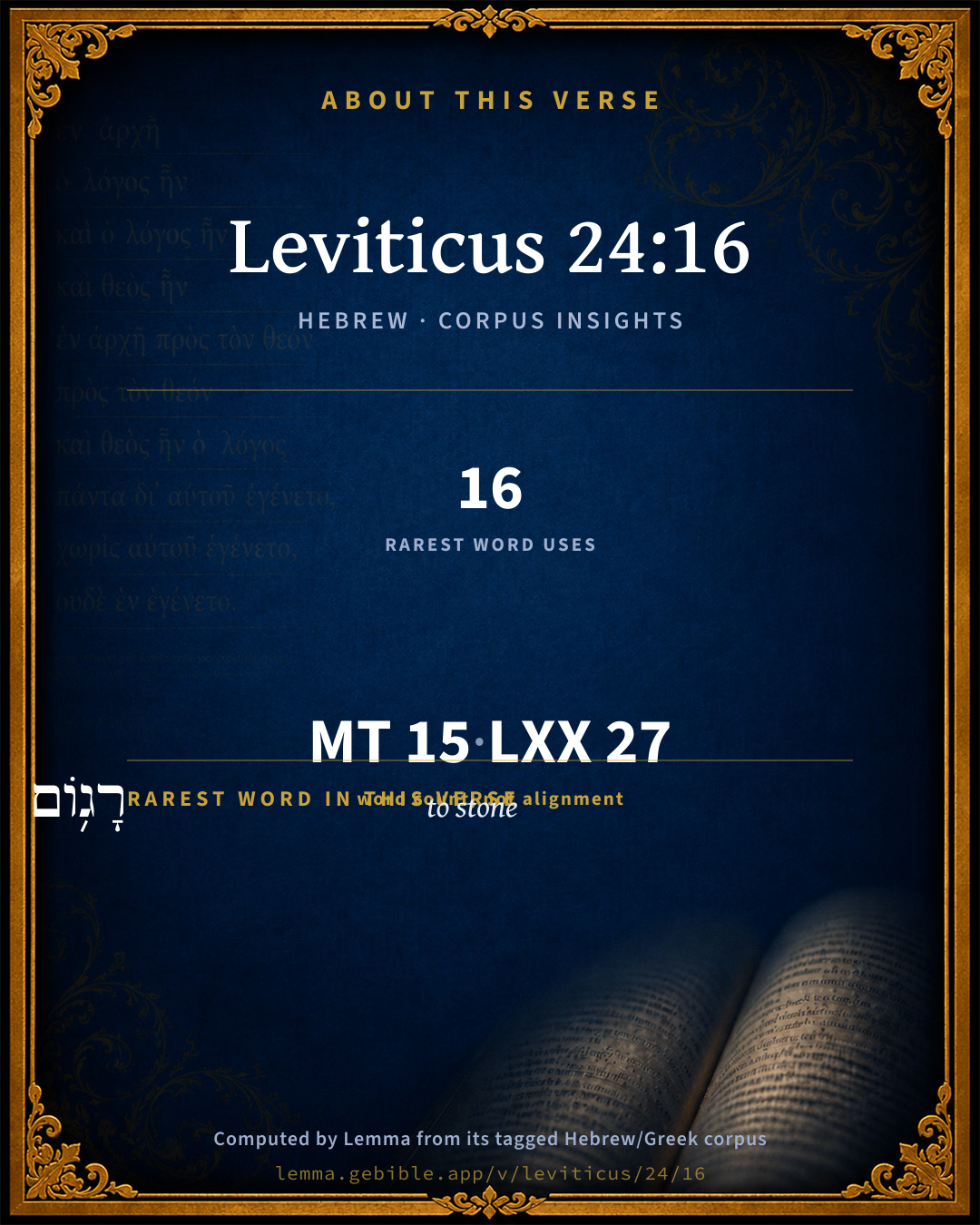
The rarest word here is רָג֥וֹם to stone H7275 — appearing just 16 times in the whole Hebrew Bible.

Shared distinctive vocabulary

רָג֥וֹם to stone H7275 occurs in 15 verses of the Hebrew Bible. Also found in:

Grammatical profile

  • 7 verbs
  • 7 nouns
  • 1 preposition

Verb forms

  • וְנֹקֵ֤ב Qal · Participle Active
  • מ֣וֹת Qal · Infinitive Absolute
  • יוּמָ֔ת Hophal · Imperfect
  • רָג֥וֹם Qal · Infinitive Absolute
  • יִרְגְּמוּ Qal · Imperfect
  • בְּנָקְבוֹ Qal · Infinitive Construct
  • יוּמָֽת Hophal · Imperfect

Repetition

Words recur within this verse — often emphatic in Hebrew:

  • מ֣וֹת to die H4191 ×3
  • וְנֹקֵ֤ב to pierce H5344 ×2
  • שֵׁם name H8034 ×2
  • רָג֥וֹם to stone H7275 ×2

Hebrew & Septuagint length

In English translation the verse runs 38 words from the Hebrew and 42 from the Septuagint (LXX English) — closely comparable.

A rough comparison of the two English renderings, which tokenize alike — not a word-level alignment.

Word counts can differ between the Hebrew and the Greek without any difference in meaning — e.g. the Hebrew direct-object marker אֵת has no separate Greek word, and Greek often adds the article ὁ.

In the original languages it is 15 Hebrew tokens and 27 Greek tokens — but the two are counted differently (Hebrew bundles its prefixes and suffixes into one token; the Greek is in lemma form), so that isn’t a like-for-like length.

Cross-references

13

Topical passages linked to Leviticus 24:16 in the Treasury of Scripture Knowledge — connected by theme and wording, ordered by reader-vote popularity; previews shown in the World English Bible.

  • Matthew 12:31 Therefore I tell you, every sin and blasphemy will be forgiven men, but the blasphemy against the Spirit will not be forgiven men.
  • John 10:33–36 The Jews answered him, "We don't stone you for a good work, but for blasphemy: because you, being a man, make yourself God."
  • James 2:7 Don't they blaspheme the honorable name by which you are called?
  • Mark 3:28–29 Most assuredly I tell you, all of the children of men's sins will be forgiven them, including their blasphemies with which they may blaspheme;
  • 1 Timothy 1:13 although I was before a blasphemer, a persecutor, and insolent. However, I obtained mercy, because I did it ignorantly in unbelief.
  • Exodus 20:7 "You shall not take the name of Yahweh your God in vain, for Yahweh will not hold him guiltless who takes his name in vain.
  • 1 Kings 21:10–13 and set two men, base fellows, before him, and let them testify against him, saying, You did curse God and the king. Then carry him out, and stone him to death.
  • Psalms 74:10 How long, God, shall the adversary reproach? Shall the enemy blaspheme your name forever?
  • Psalms 74:18 Remember this, that the enemy has mocked you, Yahweh. Foolish people have blasphemed your name.
  • Psalms 139:20 For they speak against you wickedly. Your enemies take your name in vain.
  • Matthew 26:66 What do you think?" They answered, "He is worthy of death!"
  • John 8:58–59 Jesus said to them, "Most assuredly, I tell you, before Abraham came into existence, I AM."
  • Acts 26:11 Punishing them often in all the synagogues, I tried to make them blaspheme. Being exceedingly enraged against them, I persecuted them even to foreign cities.

Cross-references courtesy of OpenBible.info (CC BY 4.0).

Hebrew and Greek witnesses Masoretic Hebrew ↔ Greek Septuagint

The same verse in the two great witnesses to the Old Testament, shown verse-for-verse.

These are two independent witnesses, not word-aligned to each other, and the Septuagint is shown in lemma (dictionary) form.

Hebrew Leviticus 24:16 Masoretic · Westminster Leningrad Codex

וְנֹקֵ֤ב שֵׁם יְהוָה֙ מ֣וֹת יוּמָ֔ת רָג֥וֹם יִרְגְּמוּ ב֖וֹ כָּל הָעֵדָ֑ה כַּגֵּר֙ כָּֽאֶזְרָ֔ח בְּנָקְבוֹ שֵׁ֖ם יוּמָֽת

He who blasphemes the name of Yahweh, he shall surely be put to death; all the congregation shall certainly stone him: the foreigner as well as the native-born, when he blasphemes the Name, shall be put to death.

World English Bible · Public Domain

Greek LXX Leviticus 24:16 Septuagint · lemma form

ὀνομάζω δέ ὁ ὄνομα κύριος θάνατος θανατόω λίθος λιθοβολέω αὐτός πᾶς συναγωγή ἰσραήλ ἐάν τε προσήλυτος ἐάν τε αὐτόχθων ἐν ὁ ὀνομάζω αὐτός ὁ ὄνομα κύριος τελευτάω

And he that names the name of the Lord, let him die the death: let all the congregation of Israel stone him with stones; whether he be a stranger or a native, let him die for naming the name of the Lord.

LXX2012 (modern English Septuagint) · Public Domain

Hebrew: Westminster Leningrad Codex (CC BY 4.0). Greek: Septuagint (public domain); English from LXX2012 (modern English Septuagint) (Public Domain). How the Septuagint differs from the Hebrew →

Targum (Aramaic paraphrase)

2

The Targum is the ancient Jewish Aramaic paraphrase of the Hebrew Scriptures — an interpretive translation, not the Hebrew text itself. Onkelos (literal) and Pseudo-Jonathan (expansive) render the Torah, and Jonathan the Prophets. Coverage is partial: where no permissively-licensed English translation exists for a verse, only the Aramaic is shown. This is verse-level text, not a word-by-word alignment to the Hebrew.

  1. Targum Onkelos Torah (Genesis–Deuteronomy)
    וְדִי פָרֵשׁ שְׁמָא דַיְיָ אִתְקְטָּלָא יִתְקְטֵל מִרְגַם יִרְגְמוּן בֵּהּ כָּל כְּנִשְׁתָּא כְּגִיוֹרָא כְּיַצִיבָא בְּפָרָשׁוּתֵהּ שְׁמָא יִתְקְטֵל

    (no public-domain English translation for this verse)

    Targum Onkelos — Aramaic: “Onkelos Genesis” (public domain); “Onkelos Exodus” (public domain); “Onkelos Leviticus” (public domain); “Onkelos Numbers” (public domain); “Onkelos Deuteronomy” (public domain). English: “Sefaria Community Translation” (CC0 1.0 (public-domain dedication)); “J.W. Etheridge. The Targums of Onkelos and Jonathan Ben Uzziel on the Pentateuch. London: Longmans, Green, 1862” (public domain). Text via Sefaria.

  2. Targum Pseudo-Jonathan Torah (Genesis–Deuteronomy)
    בְּרַם מַאן דִמְפָרֵשׁ וּמְחַרֵף שְׁמָא דַיְיָ אִתְקְטָלָא יִתְקְטֵיל אַטְלָא יְאַטְלוּן יָתֵיהּ אַבְנִין כָּל כְּנִישְׁתָּא כְּגִיוֹרָא כְּיַצִיבָא בִּזְמַן דְיֶחֱרַף שְׁמָא דִמְיַיחֵד יִתְקְטֵיל

    Whosoever expresseth and revileth the Name of the Lord shall verily be put to death; all the congregation shall cast stones upon him, whether he be a sojourner or native-born, when he hath blasphemed the Name that is Alone, he shall die.

    Targum Pseudo-Jonathan — Aramaic: “Targum Jonathan on Genesis” (public domain); “Targum Jonathan on Exodus” (public domain); “Targum Jonathan on Leviticus” (public domain); “Targum Jonathan on Numbers” (public domain); “Targum Jonathan on Deuteronomy” (public domain). English: “The Targum of Jonathan ben Uzziel, trans. J. W. Etheridge, London, 1862” (public domain). Text via Sefaria.

Commentary

Notes on Leviticus 24:16 from classic Christian and Jewish commentators (each source and its license shown beneath its notes). The classic Christian expositions comment on the surrounding passage and are grouped to its opening verse, so a note may address several verses; the Jewish commentaries on the Tanakh (Rashi and others) are per-verse, so they appear only where the commentator wrote on this verse.

Lemma curates 59 commentaries, every one of them public domain or Creative Commons licensed, each selected and text-cleaned for this edition rather than reprinted as found. About our sources →

Trapp's Complete Commentary

John Trapp

Lev 24:16 And he that blasphemeth the name of the LORD, he shall surely be put to death, [and] all the congregation shall certainly stone him: as well the stranger, as he that is born in the land, when he blasphemeth the name [of the LORD], shall be put to death.

Ver. 16. And he that blasphemeth.] Swearers and blasphemers toss God’s name to and fro with such impiety and profaneness, as if their speech could have no grace but in his disgrace: as if Augustus Caesar were dealing with some god Neptune; or the three sons trying their archery at their father’s heart, to see who can shoot nearest. {a}

Shall surely be put to death.] Though he be never so much provoked by others, as this blasphemer was; that shall no whit excuse him.

{a} Lonicer, Theat. Hist.

John Trapp, A Commentary or Exposition upon All the Books of the Old and New Testament (1647–1656) — public domain. Text from a community e-Sword module.

Matthew Poole's English Annotations

He that blasphemeth the name of the Lord: this some make a distinct sin from cursing his God, mentioned Lev 24:15, but the difference they make seems arbitrary, and without evidence from reason, or the use of the words. And therefore this may be a repetition of the same sin in other words, which is common. And as this law is laid down in more general terms, Lev 24:15, so both the sin and the punishment are more particularly expressed, Lev 24:16. Or the first part of Lev 24:16 be an application of the former rule to the present case. And as for him that blasphemeth, &c., or is blaspheming, &c. in the present tense, which is fitly used concerning words just now uttered, and scarce yet out of their ears, he shall, &c. And so the following words,

as well the stranger, & c., may be a repetition and amplification of the former law.

All the congregation shall stone him, to show their zeal for God, and to beget in them the greater dread and abhorrency of blasphemy.

Matthew Poole's English Annotations on the Holy Bible (1683–1685) — public domain. Text from a community e-Sword/MySword module.

Jamieson, Fausset & Brown

Robert Jamieson, A. R. Fausset & David Brown

as well the stranger, as he that is born in the land, when he blasphemeth the name of the Lord, shall be put to death--Although strangers were not obliged to be circumcised, yet by joining the Israelitish camp, they became amenable to the law, especially that which related to blasphemy.

Jamieson, Fausset & Brown — Commentary Critical and Explanatory on the Whole Bible (1871) — public domain (CC PDM 1.0). Text via the HelloAO Bible API.

Adam Clarke's Commentary

Verse 16. Blasphemeth the name of the Lord] ונקב שם יהוה venokeb shem Yehovah, he who pierces, transfixes, or, as some translate it, expounds, the name of Jehovah; See Clarke on Le 24:10. This being the name by which especially the Divine Essence was pointed out, it should be held peculiarly sacred. We have already seen that the Jews never pronounce this name, and so long has it been disused among them that the true pronunciation is now totally lost; See Clarke on Ex 6:3.

Adam Clarke's Commentary on the Bible (1810–1826) — public domain. Text from a community e-Sword/MySword module.

Ellicott's Commentary for English Readers

(16) And he that blasphemeth the name of the Lord.—Better, And he that curseth the name of the Lord. The case is, however, different when it is the God of Israel. It is henceforth to be the law that whosoever curses Jehovah is to suffer death by lapidation, which is to be inflicted upon the criminal by the Jewish community.

As well the stranger as he that is born in the land.—This law is applicable alike to the proselyte and to the Gentile, who does not even profess to believe in Jehovah.

When he blasphemeth the name of the Lord.—Better, when he curseth the Name. Here again the expression “Name” has, out of reverence, been substituted for Jehovah. (See Lev_24:11.)

A Bible Commentary for English Readers, edited by Charles John Ellicott (1878–1897) — public domain. Text from a community e-Sword module.

The Cambridge Bible for Schools and Colleges

gen. ed. J. J. S. Perowne

16. all … stone him] probably to be attributed to P or Rp[72], as the original word for ‘congregation’ is not found elsewhere in H.

[72] A Reviser, who, probably after that collection had been combined with the Priestly Code, introduced further elements from that Code.

The occurrence just related having brought about the enactment of a law dealing with the particular case of blasphemy, an occasion is thus offered for adding penalties for other transgressions. For the death penalty as prescribed in this v. for smiting a man mortally, cp. Exo_21:12-14.

The Cambridge Bible for Schools and Colleges (gen. ed. J. J. S. Perowne; Cambridge University Press, 1878–1918) — public domain. Text from a community e-Sword module.

John Gill's Exposition

And he that blasphemeth the name of the Lord,.... Or, "but he that blasphemeth", &c. from whence the Jews gather, that the name Jehovah must be expressed, or it is no blasphemy; so Jarchi; but it is not bare using or expressing the word Jehovah that is blasphemy, but speaking ill and contemptuously of God, with respect to any of his names, titles, and epithets, or of any of his perfections, ways, and works:

he shall surely be put to death; no mercy shall be shown him, no reprieve or pardon granted him: hence it is said (f), there is no atonement for it, by repentance, or chastisements, or the day of atonement: so blasphemy against the Holy Ghost is not forgiven, neither in this world nor in that which is to come, Mat 12:31,

and all the congregation shall certainly stone him; shall have no pity on him, nor spare him, but stone him till he dies:

as well the stranger as he that is born in the land, when he blasphemeth the name of the Lord, shall be put to death; even a proselyte of the gate, a Gentile that sojourned among them, uncircumcised, and did not profess the Jewish religion, as well as a proselyte of righteousness, and an Israelite born; yet, if he blasphemed the God of Israel, was to lose his life without any mercy shown him.

(f) R. Alphes, par. 1. Yoma, c. 1. fol. 261. 1.

John Gill's Exposition of the Whole Bible (1746–1763) — public domain (CC PDM 1.0). Text via the HelloAO Bible API.

Albert Barnes' Notes on the Bible

Stranger - i. e. foreigner. See Lev 16:29 note.

Albert Barnes' Notes on the Bible (1834–1885) — public domain. Text from a community e-Sword/MySword module.

John Wesley's Explanatory Notes

He that blasphemeth the name of the Lord - This is a repetition of the same sin in other words, which is common. As this law is laid down in general terms, ver. 15, so both the sin and the punishment are particularly expressed, ver. 16. All the congregation - To shew their zeal for God, and to beget in them the greater dread and abhorrence of blasphemy.

John Wesley, Explanatory Notes Upon the Whole Bible (1754–1765) — public domain. Text via the GEBible commentary corpus.

Rashi

Rabbi Shlomo Yitzchaki (Rashi)

ונקב שם AND HE THAT UTTERETH BLASPHEMOUSLY THE NAME [OF THE LORD SHALL SURELY BE PUT TO DEATH] — He is not liable to the death-penalty at the hand of the judges unless he utters the Divine Tetragrammaton blasphemously, but not if he execrateth the Lord by only mention of one of the substitutes for the Divine name (e. g., רחום, חנון, אל etc.), (cf. Sifra, Emor, Chapter 19 5; Sanhedrin 56a).

ונקב here is an expression denoting “cursing”, like (Numbers 23:8) “How shall I curse (אקב) [when God hath not cursed]” (Sanhedrin 56a).

Rashi on the Tanakh — English translations: “The Judaica Press complete Tanach with Rashi, translated by A. J. Rosenberg” (CC BY 4.0); “Pentateuch with Rashi's commentary by M. Rosenbaum and A.M. Silbermann, 1929-1934” (public domain); “The Metsudah Tanach series, Lakewood, N.J” (CC BY 4.0); and “The Book of Joshua, Metsudah Publications, 1997” (CC BY 4.0). Text via Sefaria.

Ibn Ezra

Rabbi Abraham ibn Ezra

The entire congregation. These are the great of the land, who are the Torah giants of Israel. There are those who say (v. 15), “Who shall blaspheme his God [shall bear his sin]” — [this is a case in which he blasphemed] in secrecy. The correct explanation is that the term “Elokim (God)” is an adjective; the angels are called elohim, as well as judges. Who can know what is in the heart of the curser [when he curses using the name Elokim]? [Therefore he is not put to death]. However, [he is liable the death penalty] when he clearly pronounces the honorable Name [the ineffable Name of Hashem] which is not an adjective and cannot be mixed up with any other name besides Hashem Himself. And this is the way the verse is explained: If at the time he curses he will pronounce clearly the Name he will be put to death: “When he clearly articulates the Name,” as the son of the Egyptian did, and for the sake of Hashem’s honor the Name was not mentioned [again in this phrase].

Ibn Ezra on the Tanakh — English translations: “Sefaria Community Translation” (CC0 1.0 (public-domain dedication)); “Yalkut, Sifsei Chachomim Chumash, Metsudah Publications, 2009” (CC BY 4.0); and “Commentary of Ibn Ezra on Isaiah - trans. by M. Friedlander, 1873” (public domain). Text via Sefaria.

Lesson kit

Teaching starters — assembled from the data on this page, not authored interpretation. Every prompt links to the verse data it draws on. Edit before teaching.

Leviticus, in the Pentateuch, opens this verse with 15 words (9 distinct Hebrew lemmas). Its most distinctive word is râgam (“to stone”). A historical commentator’s framing appears above. Read the whole chapter for the surrounding context.

Discussion questions

  1. What does “to stone” (râgam) contribute to the verse as a whole?
  2. How does Leviticus 20:2, which shares the word «to stone», read alongside this verse?
  3. What does the repetition of “to die” (3× in this one verse) do in this verse?
  4. The translations on this page render this verse differently — a whole-verse word diff, not a word-by-word alignment. What might account for the different wordings?
  5. «וְנֹקֵ֤ב» is a Qal Participle Active verb. How does that grammatical form shape the action described?
  6. Compare how Trapp's Complete Commentary and Matthew Poole's English Annotations read this verse. Where do they agree or differ?

Things to notice

Reading settings

Reading text

Shown beneath each verse's original-language words.

Old Testament
Old Testament edition

Read the OT as the Masoretic Hebrew (MT) or the Greek Septuagint (LXX).

English shown for the Greek Septuagint (in the Hebrew ↔ Greek comparison).

Comparing translations? Open the Compare panel on any verse page to stack up to four side by side.