
Ezekiel 3:18

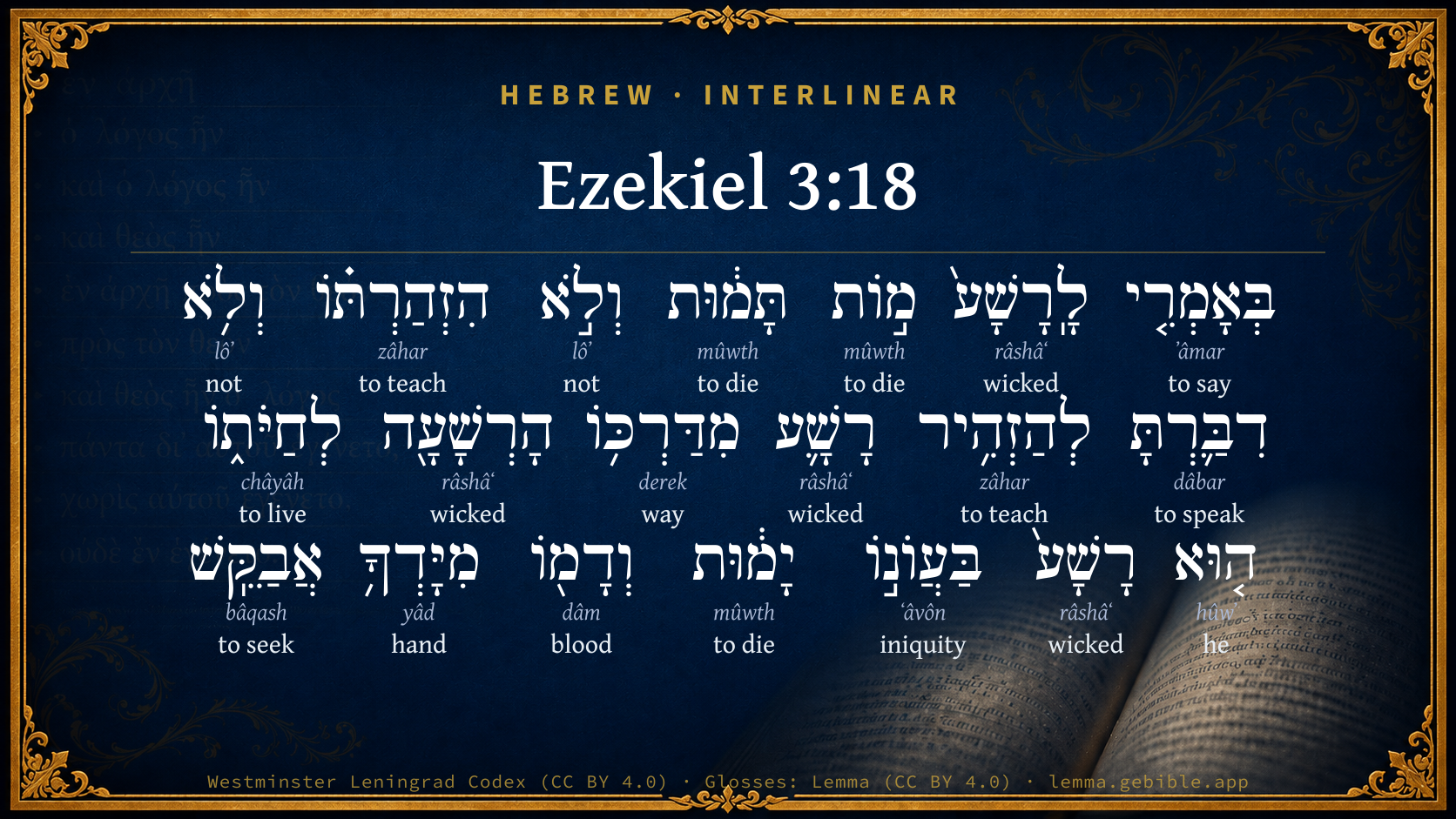
Hebrew (Westminster Leningrad Codex) Ezekiel 3:18 appears in the Hebrew Old Testament. The text above is from the Westminster Leningrad Codex. Each word links to its Strong’s number, a concise gloss, and parsing drawn from the Open Scriptures Hebrew Bible morphology. Click any word for its full Brown-Driver-Briggs (BDB) entry.
Download image
Cite this verse

Ezekiel 3:18 (World English Bible). Public Domain. Lemma interlinear Bible study tool, https://lemma.gebible.app/v/ezekiel/3/18.

Show BibTeX & RIS
BibTeX
RIS
English Translation
When I tell the wicked, You shall surely die; and you give him no warning, nor speak to warn the wicked from his wicked way, to save his life; the same wicked man shall die in his iniquity; but his blood will I require at your hand.
World English Bible · Public Domain
Download a study sheet

One document with this verse’s original text, its word-by-word gloss line, the meaning frame, cross-references with their text, attributed commentary, and full source and license credits — printable, and it pastes into notes with its structure intact.

This verse Autodidact and up

Study sheet (.html) Plain text (.txt)

A passage Seminary Student

Up to 50 verses in one chapter. A passage sheet keeps up to 6 commentary sources and 12 cross-references per verse, in the order this page ranks them, and says so on the sheet whenever that leaves anything out. Ask for a single verse and you get the Autodidact verse sheet above.

Everything on this page stays free to read, with no account — the sheet is a download of what is already on screen, not access to it.

Want to remove ads? Support Godless Engineer
Compare translations 3

The same verse in 3 English versions, stacked beneath the original-language interlinear above. Click any original word for its lexicon entry.

Each is an independent rendering of the whole verse — the interlinear is not word-aligned to these translations.

Highlighted words mark where these versions differ — a whole-verse word diff, not a word-by-word alignment.

  • World English Bible Public Domain
    When I tell the wicked, You shall surely die; and you give him no warning, nor speak to warn the wicked from his wicked way, to save his life; the same wicked man shall die in his iniquity; but his blood will I require at your hand.
  • King James Version Public Domain
    When I say unto the wicked, Thou shalt surely die; and thou givest him not warning, nor speakest to warn the wicked from his wicked way, to save his life; the same wicked man shall die in his iniquity; but his blood will I require at thine hand.
  • unfoldingWord Literal Text CC BY-SA 4.0
    When I say to the wicked, ‘You will surely die’ and you do not warn him or speak a warning to the wicked about his evil deeds so he might live—the wicked one will die for his sin, but I will require his blood from your hand.

unfoldingWord Literal Text — © unfoldingWord, licensed CC BY-SA 4.0. Word-aligned USFM3 via Door43 (git.door43.org/unfoldingWord/en_ult).

Versions to compare (up to 4)

3 of 4 selected

Show all 18 translations

Every available English version of this verse, each an independent rendering of the whole verse.

  • World English Bible Public Domain
    When I tell the wicked, You shall surely die; and you give him no warning, nor speak to warn the wicked from his wicked way, to save his life; the same wicked man shall die in his iniquity; but his blood will I require at your hand.
  • Berean Standard Bible Public Domain
    If I say to the wicked man, ‘You will surely die,’ but you do not warn him or speak out to warn him from his wicked way to save his life, that wicked man will die in his iniquity, and I will hold you responsible for his blood.
  • Majority Standard Bible Public Domain
    If I say to the wicked man, ‘You will surely die,’ but you do not warn him or speak out to warn him from his wicked way to save his life, that wicked man will die in his iniquity, and I will hold you responsible for his blood.
  • King James Version Public Domain
    When I say unto the wicked, Thou shalt surely die; and thou givest him not warning, nor speakest to warn the wicked from his wicked way, to save his life; the same wicked man shall die in his iniquity; but his blood will I require at thine hand.
  • American Standard Version (1901) Public Domain
    When I say unto the wicked, Thou shalt surely die; and thou givest him not warning, nor speakest to warn the wicked from his wicked way, to save his life; the same wicked man shall die in his iniquity; but his blood will I require at thy hand.
  • Revised Version (1885) Public Domain
    When I say unto the wicked, Thou shalt surely die; and thou givest him not warning, nor speakest to warn the wicked from his wicked way, to save his life; the same wicked man shall die in his iniquity; but his blood wilt I require at thine hand.
  • Geneva Bible (1599) Public Domain
    When I shall say vnto the wicked, Thou shalt surely die, and thou giuest not him warning, nor speakest to admonish the wicked of his wicked way, that he may liue, the same wicked man shall die in his iniquitie: but his blood will I require at thine hande.
  • Douay-Rheims (1899) Public Domain
    If, when I say to the wicked, Thou shalt surely die: thou declare it not to him, nor speak to him, that he may be converted from his wicked way, and live: the same wicked man shall die in his iniquity, but I will require his blood at thy hand.
  • Young's Literal Translation Public Domain
    In My saying to the wicked: Thou dost surely die; and thou hast not warned him, nor hast spoken to warn the wicked from his wicked way, so that he doth live; he -- the wicked -- in his iniquity dieth, and his blood from thy hand I require.
  • Literal Standard Version CC BY-SA 4.0
    In My saying to the wicked: You surely die; and you have not warned him, nor have spoken to warn the wicked from his wicked way, so that he lives; he—the wicked—dies in his iniquity, and I require his blood from your hand.
  • Unlocked Literal Bible CC BY-SA 4.0
    When I say to the wicked, 'You will surely die' and you do not warn him or speak a warning to the wicked about his evil deeds so he might live—the wicked one will die for his sin, but I will require his blood from your hand.
  • unfoldingWord Literal Text CC BY-SA 4.0
    When I say to the wicked, ‘You will surely die’ and you do not warn him or speak a warning to the wicked about his evil deeds so he might live—the wicked one will die for his sin, but I will require his blood from your hand.
  • Darby Bible Public Domain
    When I say unto the wicked, Thou shalt certainly die; and thou givest him not warning, nor speakest to warn the wicked from his wicked way, that he may live: the same wicked [man] shall die in his iniquity; but his blood will I require at thy hand.
  • World Messianic Bible Public Domain
    When I tell the wicked, ‘You will surely die;’ and you give him no warning, nor speak to warn the wicked from his wicked way, to save his life, that wicked man will die in his iniquity; but I will require his blood at your hand.
  • Webster's Bible Public Domain
    When I say to the wicked, Thou shalt surely die; and thou givest him not warning, nor speakest to warn the wicked from his wicked way, to save his life; the same wicked man shall die in his iniquity; but his blood will I require at thy hand.
  • Free Bible Version CC BY-SA 4.0
    For example, if I give a warning to someone who's wicked, saying, ‘You are going to die for sure,’ but you don't warn them, if you don't speak out to warn them to stop their wicked ways so they can go on living, then that wicked person will die in their sins, and I will hold you responsible for their death.
  • Bible in Basic English Public Domain
    When I say to the evil-doer, Death will certainly be your fate; and you give him no word of it and say nothing to make clear to the evil-doer the danger of his evil way, so that he may be safe; that same evil man will come to death in his evil-doing; but I will make you responsible for his blood.
  • JPS Tanakh (1917) Public Domain
    When I say unto the wicked: Thou shalt surely die; and thou givest him not warning, nor speakest to warn the wicked from his wicked way, to save his life; the same wicked man shall die in his iniquity, but his blood will I require at thy hand.

Literal Standard Version (2020), Covenant Press — licensed CC BY-SA 4.0. Text via the HelloAO Bible API (eBible.org). Unlocked Literal Bible (unfoldingWord) — licensed CC BY-SA 4.0. Text via the HelloAO Bible API (eBible.org). unfoldingWord Literal Text — © unfoldingWord, licensed CC BY-SA 4.0. Word-aligned USFM3 via Door43 (git.door43.org/unfoldingWord/en_ult). Free Bible Version, Dr. Jonathan Gallagher — licensed CC BY-SA 4.0. Text via the HelloAO Bible API (eBible.org).

Word by word

More ways to search: Search by grammar → Find every occurrence → Compare this word →

Practice this passage: Drill this verse → Learn its vocabulary →

הִזְהַרְתּ֗וֹ
zâhar
H2094
“to teach · him”
Verb, Hiphil, Perfect, 2nd Person, Masculine, Singular + Suffix, Personal, 3rd Person, Masculine, Singular
Part of Speech
Verb
Stem
Hiphil
Form
Perfect
Person
2nd Person
Gender
Masculine
Number
Singular
Full BDB Definition

Origin: a primitive root

TWOT: 531 , 532

to admonish, warn, teach, shine, send out light, be light, be shining - (Niphal) to be taught, be admonished - (Hiphil) - to teach, warn - to shine, send out light (figuratively)
  1. בְּאָמְרִ֤י ʼâmar H559 “in/at · to say · me” Preposition + Verb, Qal, Infinitive Construct + Suffix, Personal, 1st Person, Common, Singular
  2. לָֽרָשָׁע֙ râshâʻ H7563 “to/for the · wicked” Preposition, Determined + Adjective, Adjective, Masculine, Singular, Absolute
  3. מ֣וֹת mûwth H4191 “to die” Verb, Qal, Infinitive Absolute
  4. תָּמ֔וּת mûwth H4191 “to die” Verb, Qal, Imperfect, 2nd Person, Masculine, Singular
  5. וְלֹ֣א lôʼ H3808 “and · not” Conjunction + Particle, Negative
  6. וְלֹ֥א lôʼ H3808 “and · not” Conjunction + Particle, Negative
  7. דִבַּ֛רְתָּ dâbar H1696 “to speak” Verb, Piel, Perfect, 2nd Person, Masculine, Singular
  8. לְהַזְהִ֥יר zâhar H2094 “to teach” Preposition + Verb, Hiphil, Infinitive Construct
  9. רָשָׁ֛ע râshâʻ H7563 “wicked” Adjective, Adjective, Masculine, Singular, Absolute
  10. מִדַּרְכּ֥וֹ derek H1870 “from · way · his” Preposition + Noun, Common, Both, Singular, Construct + Suffix, Personal, 3rd Person, Masculine, Singular
  11. הָרְשָׁעָ֖ה râshâʻ H7563 “the · wicked” Particle, Definite Article + Adjective, Adjective, Feminine, Singular, Absolute
  12. לְחַיֹּת֑וֹ châyâh H2421 “to live · him” Preposition + Verb, Piel, Infinitive Construct + Suffix, Personal, 3rd Person, Masculine, Singular
  13. ה֤וּא hûwʼ H1931 “he” Pronoun, Personal, 3rd Person, Masculine, Singular
  14. רָשָׁע֙ râshâʻ H7563 “wicked” Adjective, Adjective, Masculine, Singular, Absolute
  15. בַּעֲוֺנ֣וֹ ʻâvôn H5771 “in/at · iniquity · his” Preposition + Noun, Common, Both, Singular, Construct + Suffix, Personal, 3rd Person, Masculine, Singular
  16. יָמ֔וּת mûwth H4191 “to die” Verb, Qal, Imperfect, 3rd Person, Masculine, Singular
  17. וְדָמ֖וֹ dâm H1818 “and · blood · his” Conjunction + Noun, Common, Masculine, Singular, Construct + Suffix, Personal, 3rd Person, Masculine, Singular
  18. מִיָּדְךָ֥ yâd H3027 “from · hand · your” Preposition + Noun, Common, Both, Singular, Construct + Suffix, Personal, 2nd Person, Masculine, Singular
  19. אֲבַקֵּֽשׁ bâqash H1245 “to seek” Verb, Piel, Imperfect, 1st Person, Common, Singular

About this verse

These counts appear in no published source. They are computed here, from the morphology-tagged text and Lemma’s own curated glosses. What Lemma adds →

20
words
13
distinct lemmas
Prophets
section

Notable vocabulary

The rarest word here is הִזְהַרְתּ֗וֹ to teach H2094 — appearing just 23 times in the whole Hebrew Bible.

Shared distinctive vocabulary

הִזְהַרְתּ֗וֹ to teach H2094 occurs in 19 verses of the Hebrew Bible. Also found in:

Grammatical profile

  • 9 verbs
  • 4 nouns
  • 4 adjectives
  • 1 pronoun
  • 2 particles

Verb forms

  • בְּאָמְרִ֤י Qal · Infinitive Construct
  • מ֣וֹת Qal · Infinitive Absolute
  • תָּמ֔וּת Qal · Imperfect
  • הִזְהַרְתּ֗וֹ Hiphil · Perfect
  • דִבַּ֛רְתָּ Piel · Perfect
  • לְהַזְהִ֥יר Hiphil · Infinitive Construct
  • לְחַיֹּת֑וֹ Piel · Infinitive Construct
  • יָמ֔וּת Qal · Imperfect
  • אֲבַקֵּֽשׁ Piel · Imperfect

Repetition

Words recur within this verse — often emphatic in Hebrew:

  • לָֽרָשָׁע֙ wicked H7563 ×4
  • מ֣וֹת to die H4191 ×3
  • הִזְהַרְתּ֗וֹ to teach H2094 ×2
  • וְלֹ֣א not H3808 ×2

Hebrew & Septuagint length

In English translation the verse runs 47 words from the Hebrew and 48 from the Septuagint (LXX English) — closely comparable.

A rough comparison of the two English renderings, which tokenize alike — not a word-level alignment.

Word counts can differ between the Hebrew and the Greek without any difference in meaning — e.g. the Hebrew direct-object marker אֵת has no separate Greek word, and Greek often adds the article ὁ.

Cross-references

29

Topical passages linked to Ezekiel 3:18 in the Treasury of Scripture Knowledge — connected by theme and wording, ordered by reader-vote popularity; previews shown in the World English Bible.

  • Ezekiel 33:6 But if the watchman sees the sword come, and doesn't blow the trumpet, and the people aren't warned, and the sword comes, and take any person from among them; he is taken away in his iniquity, but his blood will I require at the watchman's hand.
  • James 5:19–20 Brothers, if any among you wanders from the truth, and someone turns him back,
  • Ezekiel 3:20 Again, when a righteous man does turn from his righteousness, and commit iniquity, and I lay a stumbling block before him, he shall die: because you have not given him warning, he shall die in his sin, and his righteous deeds which he has done shall not be remembered; but his blood will I require at your hand.
  • Acts 20:26–27 Therefore I testify to you this day that I am clean from the blood of all men,
  • Ezekiel 33:8–10 When I tell the wicked, O wicked man, you shall surely die, and you don't speak to warn the wicked from his way; that wicked man shall die in his iniquity, but his blood will I require at your hand.
  • Luke 13:5 I tell you, no, but, unless you repent, you will all perish in the same way."
  • Acts 2:40 With many other words he testified, and exhorted them, saying, "Save yourselves from this crooked generation!"
  • 1 Timothy 4:16 Pay attention to yourself, and to your teaching. Continue in these things, for in doing this you will save both yourself and those who hear you.
  • Ezekiel 18:20 The soul who sins, he shall die: the son shall not bear the iniquity of the father, neither shall the father bear the iniquity of the son; the righteousness of the righteous shall be on him, and the wickedness of the wicked shall be on him.
  • John 8:21 Jesus said therefore again to them, "I am going away, and you will seek me, and you will die in your sins. Where I go, you can't come."
  • Ephesians 5:5–6 Know this for sure, that no sexually immoral person, nor unclean person, nor covetous man, who is an idolater, has any inheritance in the Kingdom of Christ and God.
  • Proverbs 14:32 The wicked is brought down in his calamity, But in death, the righteous has a refuge.
  • Ezekiel 18:4 Behold, all souls are mine; as the soul of the father, so also the soul of the son is mine: the soul who sins, he shall die.
  • Ezekiel 34:10 Thus says the Lord Yahweh: Behold, I am against the shepherds; and I will require my sheep at their hand, and cause them to cease from feeding the sheep; neither shall the shepherds feed themselves any more; and I will deliver my sheep from their mouth, that they may not be food for them.
  • John 8:24 I said therefore to you that you will die in your sins; for unless you believe that I am he, you will die in your sins."
  • Genesis 2:17 but of the tree of the knowledge of good and evil, you shall not eat of it: for in the day that you eat of it you will surely die."
  • Genesis 9:5–6 I will surely require your blood of your lives. At the hand of every animal I will require it. At the hand of man, even at the hand of every man's brother, I will require the life of man.
  • 2 Kings 1:4 Now therefore thus says Yahweh, You shall not come down from the bed where you are gone up, but shall surely die. Elijah departed.
  • Isaiah 3:11 Woe to the wicked! Disaster is upon them; For the deeds of his hands will be paid back to him.
  • Ezekiel 18:13 has given forth on interest, and has taken increase; shall he then live? he shall not live: he has done all these abominations; he shall surely die; his blood shall be on him.
  • Luke 11:50–51 that the blood of all the prophets, which was shed from the foundation of the world, may be required of this generation;
  • Luke 13:3 I tell you, no, but, unless you repent, you will all perish in the same way.
  • Acts 3:19 "Repent therefore, and turn again, that your sins may be blotted out, so that there may come times of refreshing from the presence of the Lord,
  • 1 Timothy 5:22 Lay hands hastily on no one, neither be a participant in other men's sins. Keep yourself pure.
  • 2 Samuel 4:11 How much more, when wicked men have slain a righteous person in his own house on his bed, shall I not now require his blood of your hand, and take you away from the earth?
  • Ezekiel 18:30–32 Therefore I will judge you, house of Israel, everyone according to his ways, says the Lord Yahweh. Return you, and turn yourselves from all your transgressions; so iniquity shall not be your ruin.
  • Genesis 3:3–4 but of the fruit of the tree which is in the midst of the garden, God has said, 'You shall not eat of it, neither shall you touch it, lest you die.'"
  • Genesis 42:22 Reuben answered them, saying, "Didn't I tell you, saying, 'Don't sin against the child,' and you wouldn't listen? Therefore also, behold, his blood is required."
  • Numbers 26:65 For Yahweh had said of them, They shall surely die in the wilderness. There was not left a man of them, save Caleb the son of Jephunneh, and Joshua the son of Nun.

Cross-references courtesy of OpenBible.info (CC BY 4.0).

Hebrew and Greek witnesses Masoretic Hebrew ↔ Greek Septuagint

The same verse in the two great witnesses to the Old Testament, shown verse-for-verse.

These are two independent witnesses, not word-aligned to each other, and the Septuagint is shown in lemma (dictionary) form.

Hebrew Ezekiel 3:18 Masoretic · Westminster Leningrad Codex

בְּאָמְרִ֤י לָֽרָשָׁע֙ מ֣וֹת תָּמ֔וּת וְלֹ֣א הִזְהַרְתּ֗וֹ וְלֹ֥א דִבַּ֛רְתָּ לְהַזְהִ֥יר רָשָׁ֛ע מִדַּרְכּ֥וֹ הָרְשָׁעָ֖ה לְחַיֹּת֑וֹ ה֤וּא רָשָׁע֙ בַּעֲוֺנ֣וֹ יָמ֔וּת וְדָמ֖וֹ מִיָּדְךָ֥ אֲבַקֵּֽשׁ

When I tell the wicked, You shall surely die; and you give him no warning, nor speak to warn the wicked from his wicked way, to save his life; the same wicked man shall die in his iniquity; but his blood will I require at your hand.

World English Bible · Public Domain

Greek LXX Ezekiel 3:18 Septuagint · lemma form

ἐν ὁ λέγω ἐγώ ὁ ἄνομος θάνατος θανατόω καί οὐ διαστέλλω αὐτός οὐδέ λαλέω ὁ διαστέλλω ὁ ἄνομος ἀποστρέφω ἀπό ὁ ὁδός αὐτός ὁ ζάω αὐτός ὁ ἄνομος ἐκεῖνος ὁ ἀδικία αὐτός ἀποθνήσκω καί ὁ αἷμα αὐτός ἐκ χείρ σύ ἐκζητέω

When I say to the wicked, You shall surely die; and you have not warned him, to give warning to the wicked, to turn from his ways, that he should live; that wicked man shall die in his iniquity; but his blood will I require at your hand.

LXX2012 (modern English Septuagint) · Public Domain

Hebrew: Westminster Leningrad Codex (CC BY 4.0). Greek: Septuagint (public domain); English from LXX2012 (modern English Septuagint) (Public Domain). How the Septuagint differs from the Hebrew →

Targum (Aramaic paraphrase)

1

The Targum is the ancient Jewish Aramaic paraphrase of the Hebrew Scriptures — an interpretive translation, not the Hebrew text itself. Onkelos (literal) and Pseudo-Jonathan (expansive) render the Torah, and Jonathan the Prophets. Coverage is partial: where no permissively-licensed English translation exists for a verse, only the Aramaic is shown. This is verse-level text, not a word-by-word alignment to the Hebrew.

  1. Targum Jonathan Prophets (Joshua–Malachi)
    כַּד אֲמָרֵית לְרַשִׁיעָא מֵימַת תְּמוּת וְלָא אַזְהַרְתֵּיהּ וְלָא מַלֵילְתָּא לְאַזְהָרָה רַשִׁיעָא מֵאוֹרְחֵיהּ דְרִשְׁעָא לְקַיָמוּתֵהּ הוּא רַשִׁיעָא בְּחוֹבֵיהּ יְמוּת וּדְמֵיהּ מִן יְדָךְ אֶתְּבַע:

    (no public-domain English translation for this verse)

    Targum Jonathan — Aramaic: “Mikraot Gedolot” (public domain). English: “Sefaria Community Translation” (CC0 1.0 (public-domain dedication)); “London "Chaldee Paraphrase," 1871” (public domain). Text via Sefaria.

Commentary

Notes on Ezekiel 3:18 from classic Christian and Jewish commentators (each source and its license shown beneath its notes). The classic Christian expositions comment on the surrounding passage and are grouped to its opening verse, so a note may address several verses; the Jewish commentaries on the Tanakh (Rashi and others) are per-verse, so they appear only where the commentator wrote on this verse.

Lemma curates 59 commentaries, every one of them public domain or Creative Commons licensed, each selected and text-cleaned for this edition rather than reprinted as found. About our sources →

John Calvin's Commentaries

The Prophet is now taught how difficult and dangerous an office he has now to undertake. God had previously laid it down as a law that he should utter nothing of himself: now he adds, that, the watchman is so set over the people that he must render an account of the diligence with which he goes through his watches. It is just as if it had been said that souls were committed to his care and fidelity, so that if they should perish he must undergo punishment before God. But it is better to explain the words — if when I say to the impious, “Thou shalt surely die,” and thou dost not admonish him, and he perish, then from thee will I require his blood In the first place, God confirms what we saw yesterday, that it is not. permitted to any mortal to condemn or absolve at his own discretion. When, therefore, God sends forth his servants, he does not resign that power, for still the supreme authority remains with himself: because there is one lawgiver, as James says, who can save and destroy. (James 4:12; Ezekiel 13:19.) And elsewhere Ezekiel reproves the false prophets, because they keep alive the souls which were dying, and slay the souls not devoted to death. For we know that proud men always tyrannize over the conscience when they take upon themselves the prophetic name, and substitute themselves in the place of God, as their practice is in the Papacy. For the Pope indeed pretends that he does nothing in his own proper name, but meanwhile he claims the prerogative of God, and sits in the temple as an idol, because nothing is more peculiar to God than ruling our minds with celestial doctrine; but the Papists themselves heap on their own comments, and so it comes to pass that they miserably distort and drown their own consciences even to utter destruction. They enact laws according to their pleasure, then they always add the condition, that they must be kept under pain of eternal damnation, or of mortal sin, as they say. This place, then, must be diligently marked, where God claims to himself alone the power and right of condemning: if, says he, when I say to the impious. From this we infer, that all those are sacrilegious who bind consciences with their own laws, decrees, and enactments, enforcing one thing and forbidding another, because they take away from God what here he wishes to be assigned to him, for it is his office alone to pronounce sentence, for Prophets are only his heralds.

Meanwhile those fanatics are to be rejected, who, under pretext of this place, wish to give license to sin, and assert there is no difference between good and evil, because it is not our duty to condemn. For, properly speaking, we do not assume anything to ourselves when we recite what has proceeded from the mouth of God. God condemns adulterers, thieves, drunkards, murderers, enviers, slanderers, oppressors: if one inveigh against an adulterer, another a thief, a third a drunkard, shall we say that they take upon themselves more than they ought? By no means, because they do not pronounce of themselves as we have said, but God has said it, and they are but witnesses and messengers of his sentence. Yet this moderation must be maintained, not to condemn any one through moroseness, since many immediately abominate whatever displeases them, and cannot be induced to use diligent inquiry. Inquiry, therefore, should precede our sentences; but when God has spoken, then we must follow the rule which was given to the Prophet, if thou hast not admonished him, and spoken for his admonition Here the character which was imposed upon Ezekiel is referred to: for the same duty does not devolve upon private individuals who do not bear the prophetic name. For we must remark that this is not a general declaration which concerns all men at large, but it concerns a Prophet who had already been called to be a watchman: for unless those who sustain such a burden admonish mankind, no excuse remains for them but the necessity of sending an account to God for those who are lost. And the repetition shows that this ought not to be done as a matter of course, but that Prophets ought to be anxious and even zealous in recalling sinners. This clause was clear enough: if thou dost not admonish the wicked after I have spoken: but it is added, and hast not spoken for his admonition This sentence seems to be repeated in vain, but God signifies that. unless the Prophet admonishes sinners, he is not absolved, because he spoke once in passing and uttered but a single word. We should remember that sinners ought to be continually reproved that they may return to the right way. And this is the tendency of Paul’s doctrine to Timothy:

“be instant in season and out of season.” (2 Timothy 4:2.)

For if it had been sufficient to reprove sinners mildly, and afterwards to spare them, Paul would have been content with that courtesy, but he says, we must be urgent on every occasion. The minister of the Church then must not cease to repeat these admonitions, as Paul says elsewhere to the Philippians —

“I am not weary of repeating the same things to you.” (Philippians 3:18.)

And we know what he professes in the Acts. (Acts 20:31.) I have not ceased day and night, publicly and privately, to admonish each of you. That perseverance then which Paul shows that he used is here enjoined on all the Prophets and servants of God.

He says, to urge him to turn from his evil way, that is, to be cautious; as it was said yesterday, זהר, zeher, means to be cautious; here it is taken actively — unless thou hast spoken, that thou mayest teach him to be cautious, or to return from his evil way Here it may be asked, why does God touch only on one side of the teaching, and omit the chief point? For why was the law given? and why were Prophets called forth, unless to collect the people for God? Here we must exercise the obedience of faith, since we know that God regards nothing as more important than uniting miserable men in the hope of eternal life. This is the chief end of the law and the gospel, that men being reconciled to God, may worship him as a Father. Chastisements, threats, and terrors follow afterwards, of which now there is only the mention; but we must consider the condition of the people, as we have already seen it; for at that time the prevalence of impiety, and contempt of God, and of all kinds of wickedness, was so great, that the Prophet could not address the people mildly and softly. Since, indeed, that passage of Paul must be remembered, (1 Corinthians 4:21,) what will ye? how shall I come to you? with a rod, or in the spirit of mildness? When he gives the Corinthians the choice, whether they wish him to come in a spirit of tenderness, or armed with a rod for their chastisement — and why? For when they were self-satisfied with their sins, Paul could not, according to his custom, treat them as sons, nor deal freely with them, but he was compelled to assume, as it were, another character, and to use pure austerity and rigor. Such, then, were the Israelites, and hence we cannot feel surprise that God should lay aside his pity, his promises of favor, and whatever is sweet and pleasant to men; for they were not in a fit state to hear the paternal voice of God, unless previously subdued; and this could not be done without violence, because of their exceeding perverseness.

Hence we must remark, that the more displeasing the Prophets’ embassy, the greater need they had of excitements; because, if the grace of God only is to be set before a people, and the hope of eternal life to be held out to them, since there is nothing in such teaching which greatly offends them, or embitters their feelings, hence it is easy to offer freely messages of this kind. But when men are to be summoned, or rather dragged, to the tribunal of God, when they are to be frightened by the fear of eternal death, when the minister, in the armory of God, as Paul says, (2 Corinthians 10:5-7,) brings his vengeance before mankind, because offense is thus stirred up, and this sometimes instigates men to fury, because, they cannot bear thus to be pressed home with the word of God; hence it is necessary that Prophets themselves should be animated, lest they fail, or even hesitate in their duty. Now, therefore, we understand why God speaks only of his own threats and terrors, for he mingles no taste of pity, because, in truth, the Israelites were not capable of profiting by any mildness, so that the Prophet would never have dared to discharge his duty so courageously unless this threat had been added. In other places we shall see the Prophet as God’s ambassador, for reconciling the miserable exiles to God; for he will bring forward many testimonies concerning the reign of Christ, and the restoration of the Church, and will herald the mercy and pardon of God; but before he can utter any message of grace, he must himself contend with the extreme obstinacy of the people. Hence it is, therefore, that God only can say, that the impious must be admonished, that they may return from their impiety

It is added, to give them life; and this may seem absurd, because all hope of repentance was taken away beforehand; they are a rebellious house and a bitter one, thou wilt not profit them. (Ezekiel 2:5, 6, 8.) But it now seems that the fruit of his labor is promised, when mention is made of the life of those who, when admonished, shall repent. But in the first place we must remember, that some individuals always are curable, even if the whole body of the people appears desperate. For God, when he previously said that all the Israelites were rebellious and intractable, referred to the body at large, but as he is accustomed to preserve some small seed, there were a few remaining in that people who might be converted by the Prophet’s labor. This is one point. Besides, we must remember, even if no success from labor appears, yet it ought to satisfy us, just as if we had succeeded better and according to our wishes. For example, suppose our duty to be with the impious multitude, where-ever we turn our eyes contempt of God meets us, and even such wickedness, that we seem to lose all our pains. But yet, whilst the sin of the people affords us only materials for despair, we ought, nevertheless, to pursue our course, just as if the seed sown were producing fruit. Although, therefore, Ezekiel had heard from God’s mouth that the people would be rebellious, yet he ought to spend his labors for God quite as much as if he either perceived or hoped for some good result. In the meantime, what I have touched upon must be borne in mind, namely, that God always has some seed as a remnant, although the people as a whole may be lapsed into impiety.

It is now added, the impious man shall die in his impiety, but I will require his blood at thy hand. God here says, that he had called his servant under this condition, that he must render an account if any one perished through his fault. This place, although I have lately touched upon the subject, shows how dangerous an office those sustain who are called to the duty of teaching. Nothing is more precious to God than souls which he has created after his own image, and of which he is both the Redeemer and Father. Since, therefore, our souls and their salvation are so dear to God, hence we infer, how anxiously Prophets and all pastors ought to discharge their duties; for it is just as if God were to commit souls to their care, under this condition of rendering an account of each. Nor is it sufficient to admonish one and another, for unless they had endeavored to recall all from destruction to life and salvation, we hear what God here pronounces. Hence, also, Paul uses this expression, woe is me if I preach not the gospel, for a necessity is laid upon me. (1 Corinthians 9:16.) In fine, that the Prophet may be roused to undertake his office, God here announces that certain penalties hang over him, unless he diligently endeavor to recall all wanderers into the way of salvation. But, because men think that their ignorance will prove a sufficient defense, this cavil is removed, because God says they shall perish, although they were not admonished. This exception is added advisedly, that men may not flatter themselves, and throw the blame upon their pastors, if they perish in error. Although, therefore, any one has not been admonished, yet he shall die, and although the pastor shall render an account of his negligence, and shall spare himself while doing so, yet he shall have no excuse before God. Now we perceive that negligence in Prophets and pastors is allied to perfidy, when they knowingly and willingly permit souls to perish through their own silence: meanwhile, it is not surprising if God adjudges to death those who are not admonished: for their conscience is a sufficient accuser, and however they may now defend their error and ignorance, it is certain that they perish of their own accord. Afterwards it follows —

John Calvin's Commentaries (1540-1563) — public domain. Text from the Calvin Translation Society English edition (1840s-50s) via the Christian Classics Ethereal Library (ccel.org). Calvin's coverage is partial (roughly two-thirds of the Bible); uncommented books and verses are honest gaps, never fabricated. The 19th-century editor's footnotes and remarks are omitted so the notes are faithfully Calvin's own voice.

Trapp's Complete Commentary

John Trapp

Eze 3:18 When I say unto the wicked, Thou shalt surely die; and thou givest him not warning, nor speakest to warn the wicked from his wicked way, to save his life; the same wicked [man] shall die in his iniquity; but his blood will I require at thine hand.

Ver. 18. When I say to the wicked, Thou shalt surely die.] When I bid thee tell the wicked from me, it shall be ill with him; for "the reward of his hands shall be given," {Isa 3:11} even "death the wages of sin," {Rom 6:23} death of all sorts, which is the just hire of the least sin: woe then to the wicked, say.

And thou givest him not warning.] Heb., Non expolieris; Gr., Non distinxeris; if thou do not distinctly and clearly warn him, seeking to rub off his rust, and to make his soul clear and circumspect. {as Psa 19:12 Ecc 4:13}

To save his life.] That "iniquity may not be his ruin." Sin hales hell at the heels of it.

But his blood will I require at thine hand.] These are fulmina, non verba, not words, but thunderbolts, saith Erasmus. This sentence sounding much in his ears made Augustine constant and instant in preaching, and warning the people of their danger. Bernard {a} also, for the same reason, thus bespeaketh his hearers: If I deal not freely and faithfully with you, it will be to your loss, and mine own danger. Timeo itaque damnum vestrum: timeo damnationem meam, si tacuero.

{a} Lib. iii. De Verb. Dom., Serm. 12.

John Trapp, A Commentary or Exposition upon All the Books of the Old and New Testament (1647–1656) — public domain. Text from a community e-Sword module.

The Biblical Illustrator

Joseph S. Exell

Eze_3:18-19

His blood will I require at thine hand.

Blood guiltiness

Public sentiment in New York has been aroused against a poor brakeman on the New York Central railroad because he failed to give the danger signal to the St. Louis express. He was sent with a red lantern to wave down the approaching train, but, instead of doing so, he went into a depot and sat down by the fire. As the express thundered by he asked, Whats that? and, when told, he disappeared in the darkness and has not yet been found by the police. The express dashed into the train on the track and killed twelve persons. Everybody feels that such neglect was criminal, and yet how about us who believe that our friends are going headlong to ruin and we have not warned them of their danger?

The Biblical Illustrator, edited by Joseph S. Exell (c. 1880s–1900s) — public domain. Text from a community e-Sword module.

Jamieson, Fausset & Brown

Robert Jamieson, A. R. Fausset & David Brown

warning . . . speakest to warn--The repetition implies that it is not enough to warn once in passing, but that the warning is to be inculcated continually (Ti2 4:2, "in season, out of season"; Act 20:31, "night and day with tears").

save--Eze 2:5 had seemingly taken away all hope of salvation; but the reference there was to the mass of the people whose case was hopeless; a few individuals, however, were reclaimable.

die in . . . iniquity-- (Joh 8:21, Joh 8:24). Men are not to flatter themselves that their ignorance, owing to the negligence of their teachers, will save them (Rom 2:12, "As many as have sinned without law, shall also perish without law").

Jamieson, Fausset & Brown — Commentary Critical and Explanatory on the Whole Bible (1871) — public domain (CC PDM 1.0). Text via the HelloAO Bible API.

Adam Clarke's Commentary

Verse 18. Thou shalt surely die] That is, If he turn not from his wickedness, and thou givest him not warning, as above, he shalt die in his iniquity, which he should not have committed; but his blood will I require at thy hand-I will visit thy soul for the loss of his. O how awful is this! Hear it, ye priests, ye preachers, ye ministers of the Gospel; ye, especially, who have entered into the ministry for a living, ye who gather a congregation to yourselves that ye may feed upon their fat, and clothe yourselves with their wool; in whose parishes and in whose congregations souls are dying unconverted from day to day, who have never been solemnly warned by you, and to whom you have never shown the way of salvation, probably because ye know nothing of it yourselves! O what a perdition awaits you! To have the blood of every soul that has died in your parishes or in your congregations unconverted laid at your door! To suffer a common damnation for every soul that perishes through your neglect! How many loads of endless wo must such have to bear! Ye take your tithes, your stipends, or your rents, to the last grain, and the last penny; while the souls over whom you made yourselves watchmen have perished, and are perishing, through your neglect. O worthless and hapless men! better for you had ye never been born! Vain is your boast of apostolical authority, while ye do not the work of apostles! Vain your boast of orthodoxy, while ye neither show nor know the way of salvation! Vain your pretensions to a Divine call, when ye do not the work of evangelists! The state of the most wretched of the human race is enviable to that of such ministers, pastors, teachers, and preachers.

But let not this discourage the faithful minister who teaches every man, and warns every man, in all wisdom, that he may present every man perfect to Christ Jesus. If after such teaching and warning they will sin on, and die in their sins, their blood will be upon themselves; but thou, O man of God, hast delivered thine own soul.

Adam Clarke's Commentary on the Bible (1810–1826) — public domain. Text from a community e-Sword/MySword module.

The Cambridge Bible for Schools and Colleges

gen. ed. J. J. S. Perowne

18. When I say unto the wicked] The watchman spies danger approaching, so the prophet receives intimation from the Lord (Eze_3:17). This intimation given to the prophet is represented as a threat spoken directly to the wicked. If the prophet as a watchman perceive this danger of death to the wicked and fails to warn him, the wicked shall die for his own sin indeed, but his blood will be upon the watchman. He that fails to save life kills; and blood will be required of him, of every man’s hand the blood of his brother. Pro_24:11-12, “Deliver them that are carried away unto death … If thou sayest, Behold, we knew not this, Doth not he that weigheth the hearts consider it?”

in his iniquity] Perhaps: through his iniquity. It is of the nature of sin that it is made the instrument of its own punishment, Job_8:4. “Warning” will naturally be of many kinds, suitable to those warned; some may be deterred and others allured from their evil.

The Cambridge Bible for Schools and Colleges (gen. ed. J. J. S. Perowne; Cambridge University Press, 1878–1918) — public domain. Text from a community e-Sword module.

John Gill's Exposition

When I say unto the wicked, thou shalt surely die,.... Not only a corporeal but an eternal death for this is what the law threatens with, and there the Lord says this; and this is the wages, end, and issue of sin, if grace prevent not:

and thou givest him not warning; of the evil nature of sin, and of the danger it exposes to:

nor speakest to warn the wicked from his wicked way; to abstain from it, and live another course of life:

to save his life; for such warning, caution, exhortation, and doctrine, may be a means of converting a sinner from the evil of his way, and of saving a soul from death, Ti1 4:16;

the same wicked man shall die in his iniquity; with the pollution and guilt of sin upon him, and so be punished for it; see Joh 8:24;

but his blood will I require at thine hands; thou shalt be answerable for him; his death shall be laid to thy charge, and thou shalt be chastised for thy negligence; see Act 20:26.

John Gill's Exposition of the Whole Bible (1746–1763) — public domain (CC PDM 1.0). Text via the HelloAO Bible API.

Albert Barnes' Notes on the Bible

This passage anticipates the great moral principle of divine government Ezek. 18 that each man is individually responsible for his own actions, and will be judged according to these and these alone.

Eze 3:20

I lay a stumblingblock before him - I bring him to trial by placing difficulties and temptations in his way (compare Eze 7:19; Eze 44:12 margin; Eze 14:3-4). It is true that God tempts no man in order to his destruction, but in the course of His Providence He permits men to be tried in order that their faith may be approved, and in this trial some who seem to be righteous fall.

Because thou ... his blood ... - So far as the prophet was concerned, the neglect of his duty is reckoned as the cause of the seemingly righteous man’s fall.

His righteousness ... - Or, righteousnesses, i. e. acts of righteousness. The “righteous” man here is one, who had hitherto done the “acts of righteousness” prescribed by the Law, but when trial came was shown to lack the “principle of righteousness.”

Eze 3:21

The repetition of the word “righteous” is to be noted. There seems to be an intimation that sin is alien to the character of a “righteous” man. Compare 1Jo 3:7-9.

Albert Barnes' Notes on the Bible (1834–1885) — public domain. Text from a community e-Sword/MySword module.

Matthew Poole's English Annotations

When I say, either by the, menaces of my law, or by motion of my Spirit stirring thee up to reprove and warn.

The wicked; any wicked one whatever, rich or poor, mean or mighty.

Thou shalt surely die; such courses will certainly end in death, and in damnation if not left.

Givest him not warning; frequently, and with repeated monitions, as the word signifies, and as the apostle, Act 20:31. This to those that will hearken.

Nor speakest; some will profanely scoff and deride, yet speak to warn them, till it do appear they are such as will turn again and rent you. Or else it is the same thing repeated.

From his way; men must be told of their own sins; these are their dangers. To save his life; that thou mayst preserve his life, his soul, and recall him at once from sin and death.

Shall die in his iniquity; the man who is not warned by thee will certainly die in his sin, the sinner’s ignorance will not be sufficient to prevent his death, but thy not admonishing him will involve thee also in guilt and death. I will punish thee, who possibly mightest have saved by warning, however oughtest to have warned.

Matthew Poole's English Annotations on the Holy Bible (1683–1685) — public domain. Text from a community e-Sword/MySword module.

Whedon's Commentary on the Bible

Daniel D. Whedon

18. In his iniquity — Perhaps, through his iniquity. “It is of the nature of sin that it is made the instrument of its own punishment (Job_8:4).” — Davidson.

Daniel D. Whedon (gen. ed.), Commentary on the Old and New Testaments (1874–1909) — public domain. Text from a community e-Sword module.

The Pulpit Commentary

Thou givest him not warning, etc. The word, as in the parallels already referral to, is characteristic of Ezekiel, almost indeed, peculiar to him. Psa_19:11 may be noted as another instance of its use. When the watchman saw danger coming, he was to blow the trumpet. (Eze_33:3-6) The prophet was to speak his warnings. Thou shalt surely die; literally, dying thou shalt die. Were the words of Gen_2:17 in the prophet"s mind? To save his life; literally, for his life, or that he may live. Shall die in his iniquity. Do the words refer only to physical death coming as the punishment of iniquity? or do they point onward further to the judgment that follows death, the loss of the inheritance of eternal life which belongs to those whose names are written in the book of life? Looking to the tremendous responsibility implied in the words, we can hardly, I think, in spite of the questions which have been raised as to the belief of the Hebrews in the immortality of the soul, hesitate to accept the latter meaning. Ezekiel anticipates the teaching of Php_4:3; Rev_3:5 Rev_13:8, if, indeed, that meaning was not already familiar to him in Exo_32:32, Exo_32:33. For "in" his iniquity we may, perhaps, read "because of." The negligence of the watchman does not avail to procure a full pardon for the evil doer. The degree in which it may extenuate his guilt depends on conditions known to God, but not to us. In any case, as in our Lord"s words, (Luk_12:47, Luk_12:48) a man"s knowledge and opportunities are the measure of his responsibility. But the unfaithful watchman has his responsibility. It is as though the blood of the sinner had been shed. His guilt may be described in the same words as that of Cain. (Gen_9:5) Compare St. Paul"s words in Act_18:6 and 20:26 as echoes of Ezekiel"s thought.

The Pulpit Commentary (1880–1919), ed. H.D.M. Spence-Jones & Joseph S. Exell — public domain. Text from a community e-Sword module.

Lesson kit

Teaching starters — assembled from the data on this page, not authored interpretation. Every prompt links to the verse data it draws on. Edit before teaching.

Ezekiel, in the Prophets, opens this verse with 20 words (13 distinct Hebrew lemmas). Its most distinctive word is zâhar (“to teach”). A historical commentator’s framing appears above. Read the whole chapter for the surrounding context.

Discussion questions

  1. The word zâhar carries the sense “to teach.” How does it shape the verse?
  2. How does Exodus 18:20, which shares the word «to teach», read alongside this verse?
  3. What does the repetition of “wicked” (4× in this one verse) do in this verse?
  4. The translations on this page render this verse differently — a whole-verse word diff, not a word-by-word alignment. What might account for the different wordings?
  5. «בְּאָמְרִ֤י» is a Qal Infinitive Construct verb. How does that grammatical form shape the action described?
  6. Compare how John Calvin's Commentaries and Trapp's Complete Commentary read this verse. Where do they agree or differ?

Things to notice

Reading settings

Reading text

Shown beneath each verse's original-language words.

Old Testament
Old Testament edition

Read the OT as the Masoretic Hebrew (MT) or the Greek Septuagint (LXX).

English shown for the Greek Septuagint (in the Hebrew ↔ Greek comparison).

Comparing translations? Open the Compare panel on any verse page to stack up to four side by side.