Numbers 21:6

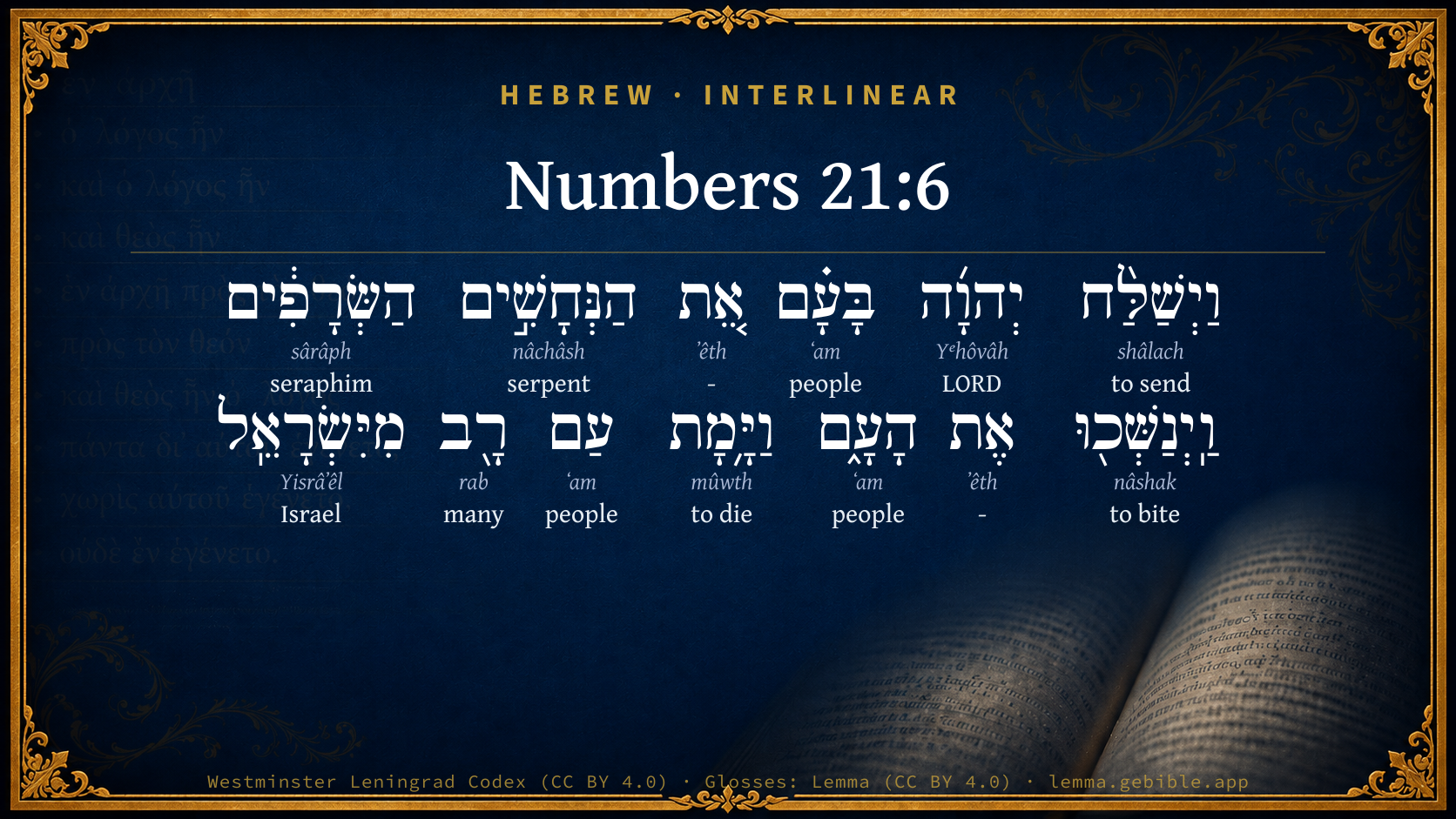
Hebrew (Westminster Leningrad Codex) Numbers 21:6 appears in the Hebrew Old Testament. The text above is from the Westminster Leningrad Codex. Each word links to its Strong’s number, a concise gloss, and parsing drawn from the Open Scriptures Hebrew Bible morphology. Click any word for its full Brown-Driver-Briggs (BDB) entry.
Download image
Cite this verse

Numbers 21:6 (World English Bible). Public Domain. Lemma interlinear Bible study tool, https://lemma.gebible.app/v/numbers/21/6.

Show BibTeX & RIS
BibTeX
RIS
English Translation
Yahweh sent fiery serpents among the people, and they bit the people; and much people of Israel died.
World English Bible · Public Domain
Highlights
  • 1 first appearance in the Hebrew Bible
Full analysis ↓
Download a study sheet

One document with this verse’s original text, its word-by-word gloss line, the meaning frame, cross-references with their text, attributed commentary, and full source and license credits — printable, and it pastes into notes with its structure intact.

This verse Autodidact and up

Study sheet (.html) Plain text (.txt)

A passage Seminary Student

Up to 50 verses in one chapter. A passage sheet keeps up to 6 commentary sources and 12 cross-references per verse, in the order this page ranks them, and says so on the sheet whenever that leaves anything out. Ask for a single verse and you get the Autodidact verse sheet above.

Everything on this page stays free to read, with no account — the sheet is a download of what is already on screen, not access to it.

Want to remove ads? Support Godless Engineer
Compare translations 3

The same verse in 3 English versions, stacked beneath the original-language interlinear above. Click any original word for its lexicon entry.

Each is an independent rendering of the whole verse — the interlinear is not word-aligned to these translations.

Highlighted words mark where these versions differ — a whole-verse word diff, not a word-by-word alignment.

  • World English Bible Public Domain
    Yahweh sent fiery serpents among the people, and they bit the people; and much people of Israel died.
  • King James Version Public Domain
    And the LORD sent fiery serpents among the people, and they bit the people; and much people of Israel died.
  • unfoldingWord Literal Text CC BY-SA 4.0
    And Yahweh sent among the people the serpents, the fiery ones, and they bit the people, and many people from Israel died.

unfoldingWord Literal Text — © unfoldingWord, licensed CC BY-SA 4.0. Word-aligned USFM3 via Door43 (git.door43.org/unfoldingWord/en_ult).

Versions to compare (up to 4)

3 of 4 selected

Show all 18 translations

Every available English version of this verse, each an independent rendering of the whole verse.

  • World English Bible Public Domain
    Yahweh sent fiery serpents among the people, and they bit the people; and much people of Israel died.
  • Berean Standard Bible Public Domain
    So the LORD sent venomous snakes among the people, and many of the Israelites were bitten and died.
  • Majority Standard Bible Public Domain
    So the LORD sent venomous snakes among the people, and many of the Israelites were bitten and died.
  • King James Version Public Domain
    And the LORD sent fiery serpents among the people, and they bit the people; and much people of Israel died.
  • American Standard Version (1901) Public Domain
    And Jehovah sent fiery serpents among the people, and they bit the people; and much people of Israel died.
  • Revised Version (1885) Public Domain
    And the LORD sent fiery serpents among the people, and they bit the people; and much people of Israel died.
  • Geneva Bible (1599) Public Domain
    Wherefore the Lord sent fierie serpents among ye people, which stung the people: so that many of the people of Israel died.
  • Douay-Rheims (1899) Public Domain
    Wherefore the Lord sent among the people fiery serpents, which bit them and killed many of them.
  • Young's Literal Translation Public Domain
    And Jehovah sendeth among the people the burning serpents, and they bite the people, and much people of Israel die;
  • Literal Standard Version CC BY-SA 4.0
    And YHWH sends the burning serpents among the people, and they bite the people, and many people of Israel die;
  • Unlocked Literal Bible CC BY-SA 4.0
    Then Yahweh sent poisonous snakes among the people. The snakes bit the people; many people died.
  • unfoldingWord Literal Text CC BY-SA 4.0
    And Yahweh sent among the people the serpents, the fiery ones, and they bit the people, and many people from Israel died.
  • Darby Bible Public Domain
    Then Jehovah sent fiery serpents among the people, which bit the people; and much people of Israel died.
  • World Messianic Bible Public Domain
    The LORD sent venomous snakes among the people, and they bit the people. Many people of Israel died.
  • Webster's Bible Public Domain
    And the LORD sent fiery serpents among the people, and they bit the people; and many people of Israel died.
  • Free Bible Version CC BY-SA 4.0
    So the Lord sent poisonous snakes to attack them, and many Israelites were bitten and died.
  • Bible in Basic English Public Domain
    Then the Lord sent poison-snakes among the people; and their bites were a cause of death to numbers of the people of Israel.
  • JPS Tanakh (1917) Public Domain
    And the LORD sent fiery serpents among the people, and they bit the people; and much people of Israel died.

Literal Standard Version (2020), Covenant Press — licensed CC BY-SA 4.0. Text via the HelloAO Bible API (eBible.org). Unlocked Literal Bible (unfoldingWord) — licensed CC BY-SA 4.0. Text via the HelloAO Bible API (eBible.org). unfoldingWord Literal Text — © unfoldingWord, licensed CC BY-SA 4.0. Word-aligned USFM3 via Door43 (git.door43.org/unfoldingWord/en_ult). Free Bible Version, Dr. Jonathan Gallagher — licensed CC BY-SA 4.0. Text via the HelloAO Bible API (eBible.org).

Word by word

More ways to search: Search by grammar → Find every occurrence → Compare this word →

Practice this passage: Drill this verse → Learn its vocabulary →

הַשְּׂרָפִ֔ים
sârâph
H8314
“the · seraphim”
Particle, Definite Article + Noun, Common, Masculine, Plural, Absolute
Part of Speech
Particle + Noun
Type
Common
Gender
Masculine
Number
Plural
State
Absolute
Full BDB Definition

Origin: from H8313

TWOT: 2292a , 2292b

serpent, fiery serpent - poisonous serpent (fiery from burning effect of poison) - seraph, seraphim - majestic beings with 6 wings, human hands or voices in attendance upon God
  1. וַיְשַׁלַּ֨ח shâlach H7971 “and · to send” Conjunction + Verb, Piel, Sequential Imperfect, 3rd Person, Masculine, Singular
  2. יְהוָ֜ה Yᵉhôvâh H3068 “LORD” Noun, Proper
  3. בָּעָ֗ם ʻam H5971 “in/at the · people” Preposition, Determined + Noun, Common, Masculine, Singular, Absolute
  4. אֵ֚ת ʼêth H853 “-” Particle, Direct Object
  5. הַנְּחָשִׁ֣ים nâchâsh H5175 “the · serpents” Particle, Definite Article + Noun, Common, Masculine, Plural, Absolute
  6. וַֽיְנַשְּׁכ֖וּ nâshak H5391 “and · to bite” Conjunction + Verb, Piel, Sequential Imperfect, 3rd Person, Masculine, Plural
  7. אֶת ʼêth H853 “-” Particle, Direct Object
  8. הָעָ֑ם ʻam H5971 “the · people” Particle, Definite Article + Noun, Common, Masculine, Singular, Absolute
  9. וַיָּ֥מָת mûwth H4191 “and · to die” Conjunction + Verb, Qal, Sequential Imperfect, 3rd Person, Masculine, Singular
  10. עַם ʻam H5971 “people” Noun, Common, Masculine, Singular, Absolute
  11. רָ֖ב rab H7227 “many” Adjective, Adjective, Masculine, Singular, Absolute
  12. מִיִּשְׂרָאֵֽל Yisrâʼêl H3478 “from · Israel” Preposition + Noun, Proper

About this verse

These counts appear in no published source. They are computed here, from the morphology-tagged text and Lemma’s own curated glosses. What Lemma adds →

13
words
10
distinct lemmas
Pentateuch
section

Notable vocabulary

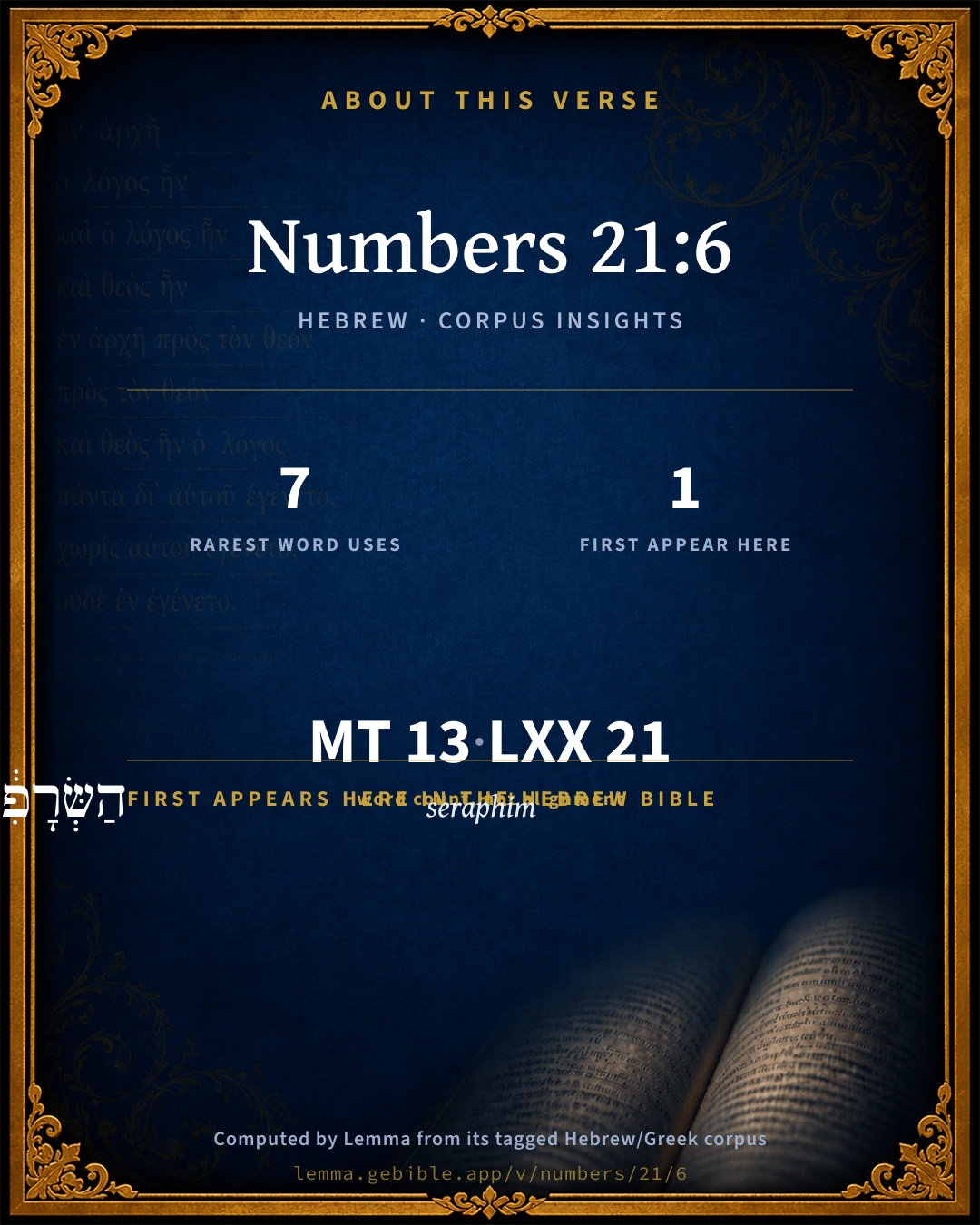
The rarest word here is הַשְּׂרָפִ֔ים seraphim H8314 — appearing just 7 times in the whole Hebrew Bible.

First appearance in Scripture

This word makes its first canonical appearance in the Hebrew Bible here:

  • הַשְּׂרָפִ֔ים seraphim H8314

Shared distinctive vocabulary

הַשְּׂרָפִ֔ים seraphim H8314 occurs in 7 verses of the Hebrew Bible. Also found in:

Grammatical profile

  • 3 verbs
  • 7 nouns
  • 1 adjective
  • 2 particles

Verb forms

  • וַיְשַׁלַּ֨ח Piel · Sequential Imperfect
  • וַֽיְנַשְּׁכ֖וּ Piel · Sequential Imperfect
  • וַיָּ֥מָת Qal · Sequential Imperfect

Repetition

A word recurs within this verse — often emphatic in Hebrew:

  • בָּעָ֗ם people H5971 ×3

Hebrew & Septuagint length

In English translation the verse runs 18 words from the Hebrew and 23 from the Septuagint (LXX English) — closely comparable.

A rough comparison of the two English renderings, which tokenize alike — not a word-level alignment.

Word counts can differ between the Hebrew and the Greek without any difference in meaning — e.g. the Hebrew direct-object marker אֵת has no separate Greek word, and Greek often adds the article ὁ.

In the original languages it is 13 Hebrew tokens and 21 Greek tokens — but the two are counted differently (Hebrew bundles its prefixes and suffixes into one token; the Greek is in lemma form), so that isn’t a like-for-like length.

Cross-references

7

Topical passages linked to Numbers 21:6 in the Treasury of Scripture Knowledge — connected by theme and wording, ordered by reader-vote popularity; previews shown in the World English Bible.

  • 1 Corinthians 10:9 Neither let us test the Lord, as some of them tested, and perished by the serpents.
  • Jeremiah 8:17 For, behold, I will send serpents, adders, among you, which will not be charmed; and they shall bite you, says Yahweh.
  • Deuteronomy 8:15 who led you through the great and terrible wilderness, [in which were] fiery serpents and scorpions, and thirsty ground where was no water; who brought you forth water out of the rock of flint;
  • Amos 9:3–4 Though they hide themselves in the top of Carmel, I will search and take them out there; and though they be hid from my sight in the bottom of the sea, there I will command the serpent, and it will bite them.
  • Isaiah 30:6 The burden of the animals of the South. Through the land of trouble and anguish, from whence come the lioness and the lion, the viper and fiery flying serpent, they carry their riches on the shoulders of young donkeys, and their treasures on the humps of camels, to a people that shall not profit [them].
  • Isaiah 14:29 Don't rejoice, O Philistia, all of you, because the rod that struck you is broken; for out of the serpent's root shall come forth an adder, and his fruit shall be a fiery flying serpent.
  • Genesis 3:14–15 Yahweh God said to the serpent, "Because you have done this, cursed are you above all cattle, and above every animal of the field. On your belly shall you go, and you shall eat dust all the days of your life.

Cross-references courtesy of OpenBible.info (CC BY 4.0).

Hebrew and Greek witnesses Masoretic Hebrew ↔ Greek Septuagint

The same verse in the two great witnesses to the Old Testament, shown verse-for-verse.

These are two independent witnesses, not word-aligned to each other, and the Septuagint is shown in lemma (dictionary) form.

Hebrew Numbers 21:6 Masoretic · Westminster Leningrad Codex

וַיְשַׁלַּ֨ח יְהוָ֜ה בָּעָ֗ם אֵ֚ת הַנְּחָשִׁ֣ים הַשְּׂרָפִ֔ים וַֽיְנַשְּׁכ֖וּ אֶת הָעָ֑ם וַיָּ֥מָת עַם רָ֖ב מִיִּשְׂרָאֵֽל

Yahweh sent fiery serpents among the people, and they bit the people; and much people of Israel died.

World English Bible · Public Domain

Greek LXX Numbers 21:6 Septuagint · lemma form

καί ἀποστέλλω κύριος εἰς ὁ λαός ὁ ὄφις ὁ θανατόω καί δάκνω ὁ λαός καί ἀποθνήσκω λαός πολύς ὁ υἱός ἰσραήλ

And the Lord sent among the people deadly serpents, and they bit the people, and much people of the children of Israel died.

LXX2012 (modern English Septuagint) · Public Domain

On this verse, Whedon's Commentary on the Bible discusses the Septuagint’s reading. Read the note in Commentary ↓

Hebrew: Westminster Leningrad Codex (CC BY 4.0). Greek: Septuagint (public domain); English from LXX2012 (modern English Septuagint) (Public Domain). How the Septuagint differs from the Hebrew →

Targum (Aramaic paraphrase)

2

The Targum is the ancient Jewish Aramaic paraphrase of the Hebrew Scriptures — an interpretive translation, not the Hebrew text itself. Onkelos (literal) and Pseudo-Jonathan (expansive) render the Torah, and Jonathan the Prophets. Coverage is partial: where no permissively-licensed English translation exists for a verse, only the Aramaic is shown. This is verse-level text, not a word-by-word alignment to the Hebrew.

  1. Targum Onkelos Torah (Genesis–Deuteronomy)
    וְגָרֵי יְיָ בְּעַמָא יָת חִיוַן קָלָן וּנְכִיתוּ יָת עַמָא וּמִית עַם סַגִי מִיִשְׂרָאֵל

    (no public-domain English translation for this verse)

    Targum Onkelos — Aramaic: “Onkelos Genesis” (public domain); “Onkelos Exodus” (public domain); “Onkelos Leviticus” (public domain); “Onkelos Numbers” (public domain); “Onkelos Deuteronomy” (public domain). English: “Sefaria Community Translation” (CC0 1.0 (public-domain dedication)); “J.W. Etheridge. The Targums of Onkelos and Jonathan Ben Uzziel on the Pentateuch. London: Longmans, Green, 1862” (public domain). Text via Sefaria.

  2. Targum Pseudo-Jonathan Torah (Genesis–Deuteronomy)
    בְּרַת קָלָא נַפְלַת מִן שְׁמֵי מְרוֹמָא וְכֵן אָמְרַת אִיתוּן חָמוּן כָּל בְּנֵי נְשָׁא כָּל טַבְיָין דַעֲבָדִית לְעַמָא אַסֵיקִית יַתְהוֹן פְּרִיקִין מִמִצְרַיִם אָחֵיתִית לְהוֹן מַנָא מִן שְׁמַיָא וּכְדוּן חָזְרוּ וְאִתְרַעֲמוּ עֲלוֹי וְהָא חִיוְיָא דְגָזְרִית עֲלוֹי מִן יוֹמֵי שֵׁירוּי עַלְמָא עָפָר יֶהֱוֵי מְזוֹנֵיהּ וְלָא אִתְרְעַם עִלַוַי וְעַמִי אִתְרַעֲמוּ עַל מְזוֹנֵיהוֹן וּכְדוּן יֵיתוּן חִיוָון דְלָא אִתְרַעֲמוּ עַל מְזוֹנֵיהוֹן וִינַכְתוּן יַת עַמָא דִי אִתְרַעֲמוּ עַל מְזוֹנֵיהוֹן בְּכֵן גָרֵי מֵימְרָא דַיְיָ בְּעַמָא יַת חִיוָון חוּרְמָנִין וּנְכִיתוּ יַת עַמָא וּמִיתוּ אוֹכְלוֹסִין סַגִיאִין מִיִשְרָאֵל

    And the bath-kol fell from the high heaven, and thus spake: Come, all men, and see all the benefits which I have done to the people whom I brought up free out of Mizraim. I made manna come down for them from heaven, yet now turn they and murmur against Me. Yet, behold, the serpent, whom, in the days of the beginning of the world, I doomed to have dust for his food, hath not murmured against me: but My people are murmuring about their food. Now shall the serpents who have not complained of their food come and bite the people who complain. Therefore did the Word of the Lord send the basilisk serpents, and they bit the people, and a great multitude of the people of Israel died.

    Targum Pseudo-Jonathan — Aramaic: “Targum Jonathan on Genesis” (public domain); “Targum Jonathan on Exodus” (public domain); “Targum Jonathan on Leviticus” (public domain); “Targum Jonathan on Numbers” (public domain); “Targum Jonathan on Deuteronomy” (public domain). English: “The Targum of Jonathan ben Uzziel, trans. J. W. Etheridge, London, 1862” (public domain). Text via Sefaria.

Commentary

Notes on Numbers 21:6 from classic Christian and Jewish commentators (each source and its license shown beneath its notes). The classic Christian expositions comment on the surrounding passage and are grouped to its opening verse, so a note may address several verses; the Jewish commentaries on the Tanakh (Rashi and others) are per-verse, so they appear only where the commentator wrote on this verse.

Lemma curates 59 commentaries, every one of them public domain or Creative Commons licensed, each selected and text-cleaned for this edition rather than reprinted as found. About our sources →

Trapp's Complete Commentary

John Trapp

Num 21:6 And the LORD sent fiery serpents among the people, and they bit the people; and much people of Israel died.

Ver. 6. Fiery serpents.] Heb., Seraphim; from their burning heat, whereby these ungrateful Israelites, that causelessly cried out of thirst, had somewhat given them to cry for. Their tongues, so full of deadly poison, and set on fire from hell, are now parched and scorched with venomous heat and torments, the likest hell of any other. These serpents are here called seraphims: that old serpent the devil can transform himself into an angel of light.

John Trapp, A Commentary or Exposition upon All the Books of the Old and New Testament (1647–1656) — public domain. Text from a community e-Sword module.

Joseph Benson's Commentary

Num 21:6. Fiery serpents — Hebrew, נחשׁים, nechashim, the plural of the word translated serpent, Gen 3:1, where Moses speaks of the temptation and fall of our first parents, and which, when intended of a living creature, we believe, always means a serpent of one species or other, and is accordingly uniformly so rendered, not only by our translators, in the Scriptures, but by the Seventy, and in most or all other versions whatever; and, what certainly ought to have great weight with Christians, by the evangelists and apostles, whenever they quote or refer to those passages of the Old Testament where the word occurs: see on Gen 3:1. There were many such serpents as Moses here speaks of in this wilderness, which, having been hitherto restrained by God, were now let loose and sent among them: see Jer 8:17. They are called fiery from their effects, because their poison caused an intolerable heat, burning, and thirst, which was aggravated with this circumstance of the place, that there was no water, Num 21:5.

Joseph Benson's Commentary on the Old and New Testaments (1811–1818) — public domain. Text from a community e-Sword module.

Whedon's Commentary on the Bible

Daniel D. Whedon

FIERY SERPENTS AND THE BRAZEN SERPENT, Num_21:6-9.

Though human probation is not the theatre for the display of exact justice in the punishment of sin and the reward of obedience, yet we see in divine providence the intimations and outlines of a perfect future state, so that no man can have any reasonable ground for doubting that God smiles upon righteousness and frowns upon iniquity. Hence his frequent interpositions by the infliction of suffering upon the wicked are rather educational and disciplinary than penal. Hence natural evil is merciful, inasmuch as it is designed to deter from that eternal punishment which awaits incorrigible sinners.

6. The Lord sent fiery serpents — The Alexandrine Septuagint renders “fiery” by θανατουντες, deadly. Popularly this “serpent” is erroneously identified with the fiery flying serpent of Isa_14:29; Isa_30:6. As all the plagues of Egypt were the intensification of natural evils, so we may suppose that these serpents existed in the region of the camp, and were gathered to this place to afflict the murmuring Israelites. They are called fiery because of the inflammation resulting from their poisonous bite. The Greeks have three different names for snakes, derived from verbs signifying to burn. These serpents may have had a fiery appearance also. Schubert saw in that vicinity a very mottled snake of a

89504e470d0a1a0a0000000d49484452000001190000005e080300000020e4904500000300504c54450000000101010202020303030404040505050606060707070808080909090a0a0a0b0b0b0c0c0c0d0d0d0e0e0e0f0f0f1010101111111212121313131414141515151616161717171818181919191a1a1a1b1b1b1c1c1c1d1d1d1e1e1e1f1f1f2020202020202222222323232424242424242626262727272828282828282a2a2a2b2b2b2c2c2c2c2c2c2e2e2e2f2f2f3030303030303232323333333434343434343636363737373838383838383a3a3a3b3b3b3c3c3c3c3c3c3e3e3e3f3f3f4040404141414141414343434444444545454646464747474848484949494949494b4b4b4c4c4c4d4d4d4e4e4e4f4f4f5050505151515151515353535454545555555656565757575858585959595959595b5b5b5c5c5c5d5d5d5e5e5e5f5f5f6060606161616161616363636464646565656666666767676868686969696969696b6b6b6c6c6c6d6d6d6e6e6e6f6f6f7070707171717171717373737474747575757676767777777878787979797979797b7b7b7c7c7c7d7d7d7e7e7e7f7f7f8080808181818282828383838383838585858686868787878888888989898a8a8a8b8b8b8c8c8c8d8d8d8e8e8e8f8f8f9090909191919292929393939393939595959696969797979898989999999a9a9a9b9b9b9c9c9c9d9d9d9e9e9e9f9f9fa0a0a0a1a1a1a2a2a2a3a3a3a3a3a3a5a5a5a6a6a6a7a7a7a8a8a8a9a9a9aaaaaaabababacacacadadadaeaeaeafafafb0b0b0b1b1b1b2b2b2b3b3b3b3b3b3b5b5b5b6b6b6b7b7b7b8b8b8b9b9b9babababbbbbbbcbcbcbdbdbdbebebebfbfbfc0c0c0c1c1c1c2c2c2c3c3c3c3c3c3c5c5c5c6c6c6c7c7c7c8c8c8c9c9c9cacacacbcbcbcccccccdcdcdcecececfcfcfd0d0d0d1d1d1d2d2d2d3d3d3d3d3d3d5d5d5d6d6d6d7d7d7d8d8d8d9d9d9dadadadbdbdbdcdcdcdddddddedededfdfdfe0e0e0e1e1e1e2e2e2e3e3e3e3e3e3e5e5e5e6e6e6e7e7e7e8e8e8e9e9e9eaeaeaebebebecececedededeeeeeeefefeff0f0f0f1f1f1f2f2f2f3f3f3f3f3f3f5f5f5f6f6f6f7f7f7f8f8f8f9f9f9fafafafbfbfbfcfcfcfdfdfdfefefeffffff0e79e2e400000001624b47440088051d48000000097048597300000ec400000ec401952b0e1b0000200049444154789ced5c056054c7d69eb80b71f710210621211024214142f0e25a24408122410a14d70285062856a058b1e25628854281a0418313270488aedebd7efe99bb09a525f06891f6e7bd69d9cdee9dbd77e69b33e77ce7cc9941f09685756f010cfd9feb711c7cc9d34af19515045e1041e4fffc35a55432a2f0ea9ffdb9c8285ebad92b2b148ba2060480c63210e1d5d500bdf1235f555c22785051af79c4f352f3b5574541202f2f7dcfb122086f0e8d52839b228aafabaf02387e19d2051ad4afa9f5d6c8cc7471fd9202f63fd653f363460b02c3fdf527e04e8afc1b23236054f897f17d5e941c14434937872f80158081b257567c6b64343f6c3f89dfe4ffb122b70ecbf09bcf8ae785e7aa15a5d714917f9d044b337f6f2f357e7f0a9a57d77b6b64182c0eaa37a988b1a319f63532233e7ff94321b3e9b593e3e5f2bac927ca4550127c1896c7b8bc1a9ab7d7331405af9fb0cf4b096ed2ab4753e0abd73312586f8e8c7483d7aa6c3cf35558f712055006af1ea9b747e64d0b274d0c016323602035f85d83552ba321bd56bd11b21fb67c38645835191f15874d02278d6819d0e41b5e4946ef6f28a0f75c3e18324af222d10c1ac3c0c8b07a0281662559e22af5e2bfaa7c3899c1e0b05893e279c3976042476b24ed27890ffd7a6bf2cf940f864c098f4585c3664c8325a4e4d4d9bd2ba67db5ed3145e61146e8df07cc0794198195e8e085117e36364e66c9fd5307ce0af174ec9553802d3f5bf1c19af1c6e5c32143111b746eb285333247c3663185df9ccb7a7cc41679d7dc20175ec72bfea9f2c19011396e7f1df3c02094ec9d1498b53efd99dfa13697333c9cf759238ba06d1fc56cc2ee0671ae0551a535b54aec0e4ba685078ebc69a9ec0b1e09c34af46b57a0b99e8e439cfe2ed7856e7b2fceb9d6b2e7a063e7e77a8c35473ad646a1a0c0bab90228c95031c4e92b27bfa5a4ffe5846903e13fe4f9f80a0192019126f765d5f82712b284296b1b415c7615762df9ca7b10a24e1a26078a13a49aa406e10cef92038b1aad85c54e1e8b6f2e724fc9276263884dae10598a265eb39616f38ca0c2fdcce9e365651332b4bf552de3616663bfb03f05f2f229269dbce64f08b33b6ed649d7dade1e885bca828cc6dd61b04b40d0acc0b06b6480f93c703c7141aec2937ce9e1e51ad24d11d36a02a01cf75cc5b08403882c4322179ca4d45815cf50127a1242f4736e20722c66c982867a0d8dfacbc848bc0438954600255385b9c0e1ee30da874a2f0c6e84521415b8519abc24475367f7342ff9485d6b67237dd47bc60a5ed570e5c211e5c1f030c565aae1ded51e1dbe5a7582dcaa88b09cc750ce43a916da9c5bab074584f905db84b8ea21db1ad6e64eae761ec1030ee71119d04a145b0aa0152ad01a395e2d35432d79b9a2204909c362d92ac71e157094524d6a718cf6df3b4306a032bc4406434e9e8605e731060743c6f382568005a6b252119c6983acc27d772c171c60850332427e3eed670ee3fad53f4eef7e949873371cf5458e661e1cb4820b598f408dbd308acc25ec3d68807d3428d8aa9e01b2b4440633cf5921732bd35ac38eedf5b64016ee51dd1ec9817d0c927c3214301ccf6bc583f85e22574406315f1a484ecee0c6b0d889040da5e5dfb49cd5b0954ed63b434650e1f94be11ee0be73a039ffdde8f0b1eb332e924bd807a2455160b58224c2ed3467a49b627458be930776287cd3dcd077e99e133acebbae4f0be7c41c3fe79272d7181d63e4de50dcb68bf1c26ede9e0007dda888aedd53dbf63cb2d2d8a7653fdbae9c6a68ab56534778f7da6bbca063d4c972e6d11a6fd32926cb91b569c0d04d45921ea3b9ca21e3790a6b40a0310b90ab80be02577f9c3678c057db667ebaebeb458baf5c2e2922cebb161081ccb157474ffe3232521c81c5c0d30b139cddeccc50283240564e0e3e06411d26efb9258d217e64f6c67eee062840d7a6b193ee3dd84cc68e0275482d680461c9b940b76f2940a3d0b6f33c65b9113f854696f5780c35b988cbe58a597a6888aeae937eb75d4eddae3ccc1d9f0c1b3f3334b01bbf20b29ff3b1cc8985bf70b1f546a525a2d97a4ec82d010ba175c4c49f2454aa040037f0c68ae5dff66de06ce4bfc51b214b84f491be8e3d8ad4d3c77f1a5afb270e9c3cff87fb583729de65b413f79a047d98c39d90a98e334ab08b33315b6cb4c4d91a595b20e4d8a74df2f0cfdba7a4789b1b9b99a14686a80b6a1827a9541950a5a5dde9698a94c313003aae806367945beb6e0738a5e8e39eb3ba82697fc96d4a97214f6ddcf72134cfe0fbe571092228a99faf972d1eee39c7645e07afef9b40e8e30e6cc03877df5576c666937597f7306a676a845c0dfbcc48dbb7ef68faf5dbd98fcf6f486d1be162658650d3b9685dec2243646fa26fa5e3ac53cb6a12d2c75f2333575f774b1d03cbf0d4b32cbc5ad1fc0d3d23621dbfccd3b246c2b4c5bf99221454bf43ca982d452d66fedcdfc400195ae97a791936e862e5b0c9a48b9f7e9ab597d7af91027c05fc5dfed95038269c6cbfcb75fcc33b8de91bce622e9c50c2d1d37c5ecc8ef98f20d42e5f5425f44842e3cc5bef75eab0cff7ce628dd32eee7c72a3ef916bb7f87e4e673e2f4f83c57bfdfaac9f12b1b929f2712cb428f9baa1bb7e82496d6b6466606062acab6368e1dea2b1be41686df7ac430e7a51a303ec9119d2b3d573af8950a491eef80626586e74f5f590a19e2e4206613ddf053258526805d170c79b58b81dec51b0fea7f4c548af2732c91b9a1f77ea66caddfb9d712b1c50bbd3ed4166b57ad42855e79ecddbbacddd9fadde3a1b8f8d6c976c7e7bdf2e13a75f9bdf21c6256a499b275f8262bc18435f95279c86e4b3cbba0e69dc6e727823d3667d4fe9189b5e0f2f59c876f43fb7879b721ae977b074bfd26c59e6b730ea9b8c6e71c87071bb9ec836af43f6f0c86d0819a622d79ecda6fb9ec37d3509d041c65e28d47094a391bb71372f64af9b7109a50c4eb51fa53357c72bcaa0193a6ca26f3ad504c3832799418dfa5f90981ab67134f5077af3e6c85440a96447f7fb0479ed1f3d376888f3727f7d0be4a51f29debe9d4c7dd9f0d8855e08337fe44fa5de143dd674ee76ed5a3d8fb668fefadb905f4aecd8a2a85e0befc3332804489a726a409df0d1471fec517ac946c3590eea43af9ec9b9e77d3735e91258cc7bb6f4bad84c5c579c50a760c29e4d4752226f05ad15db3d3e2f63b366417d6f1b9f5fea3f7040cc75856f5399912d8af2447a86754f6f459e494ea61d0de3be185ac7cac0d2a401b233b5c3525decb221b8e578e71acd5b23ff90262e17d0e4fa93db4620cbe66e26c810d9c5e482143f23538bfaebc8d044c3c8b8afa250f3d1e333ee5b445d1f9813b763bf8da7e51180af4ff3c9f7a31ad5d3c1b3d8b129177afcd61dfb98d28b719b0c8296d8669de6556cd6f2f0be59a07970e816662a15b28c660ce45d48a9d534f27ee7a383cfa583aac5b59318fb782e6bf3acb57cf9466ed4c174f871344cbe025bb6993d3b9509f04529ccc6ed5f715c88bb1c93d74ee1dca6e0310cedfeb8b5a10d1a6b36a446fda5c67a49d44e1439b2dba529bad1a60beb446f09caeaa737e68b8c2273f49d9e4e0832b6489159ed1b146e18143fb689df946bbb748d8d91bd93896b392399708dfa7795fce632832d6309e4399958e7cd3d37f1fe8fdb605e69dfb599fb768571a292b086f24725195d86d598d76d30a4fffc0bef730eaec66fb29a5a9e58ca28202bb1f6668073738745d6aa6359d3237ee6c6eb0ff16f0acf074784d65fd3225f290f57752ce59b9f805f92aefd76e2ce1799f68461333072a892957940e175a16839e17e250244e391ad5bda0650460a037d43f390f544a764bfcf1dc3168ff61d01d928f0becd8c0928d6273ca359de414846357261868d597ba3687d7ff341c994e9e3e4e9636aa04f172034f20c8ac42a798d8b83fbb242c2b45f0c1fbf313292e1df6decd9774e3ee794d3dce7427676ca25976ba12716dc256248f3b2723caef73a018c16cacb40797f32139197d6560a6aae8b9b78317dba770d8ff5df5cc8877c55f9c6998bea85ba38acd80ec3d31f3668ec7316dc1f4123e5edad72387aa9f76dd79c59805632d86e15dc21cb778940b1508049a52805e3315939716ee1dea3300fae6c8a2f4844ee3d9b3b1c6cdedeed547cb76669756ab73e53cbabd17e8bfe7ee0b63017221da67230ddc0f2f36d0e28704addc34de570b3cf51e431c5dc14db8f241d638b5f8677b4d0f55d568289d10b8ae6cd65a60cca46da066636a592f3eced2c5abb0c3ce49a80e981956d8c9d9d6374db8d930fa84ec1a65325e75a95419c62b37c707112735da950c2e3da5d87d509f01ff893a682b05b4c93155a5727cdd3bbede58e02d76ed98418cb83b55bcff3c18f19954ab75c7c274edd2efd2e5c1a0cd03ff7db212dfdc3ebd77389a815d4a4dfa87177e404a225a571b81fcd159a66627e0dab7906861307594d981ae55b174d878baa8ae31105e3546ba6dc3db1627be97c58fc44b1a6516830324fddb46fe0aa6d202be1267fd2de45bfb6be0d32414e1b653313cf7f5b23e929eee3efacf82fcc269864e7b5387dc7ddb8f06023c349f693c374adacc2131a8cef356dc0e8e151756c7d771ffdf6dcddf339092cb414bf847d4feb9e18faf8c79c29a1c6467e51c74a09432cc1538478718c5a5a35809d1d821d33213b952b5e95e09ddc7e20d0cc0546d5aeecc1526ea64c6435a757af7019b6a8bda373c42db899f7f47ac592ed637af88e3b70a7a4026631a01e8b67a8a6edde4eb1ba3626f382ca3d73529f24a20ce70e2760e5800307c06f52595ecc67e51d7f98a34ab032a8e9e76cbc6a6b9b13c9a0b8a63a7cb05368fcd258d4f66bc738e8d305e44f6723b7f32fc616df1c99cbadcc23bc4a1aaf0e9a609d848ccccc3c779600217e4a6c6b44ac011879e1572dc3ed63e3eb0fdaf4d9fe4999599799fcaf13dd1a9bd776dd82793ff666341c1e6d9638829812e1cfd82705267340682f879b98112cb3ed1c635bb7c943a6741ce41c2a9e62ed1df7d575e5533113cb46d9f7532928fd04834b9dc11ff9434b13065480702d9fc30d7081127d135f1152cfdd006e83b7ce954fd6ee6cadeaa68e3a7de9ecf0fdf357530f2f6387c9e437e5579783c34b86d056e7cee6c094e226869d8d905beff376357a5464ac7535d0f1f4f05efd427f7f47867feeaeffb1604f84c79dd1581907734b5bdf8ee86385f48c7402f6171323f732857c7ae48be6b503dced5c1c9d9c6d6a0424bcaadef34241d1d8e87157356523efc18663c78fed6d7064cefc033b57e5603f640fd02c0c252ea21a4b58f60d6c056eaa042cbe1cf4dbdf34282d171b3af802a82639e73780329b65a16981a35cac79a96b9b2d2af986a8010b9e80e242cb6bf831bb4a6420d030b2119ca57328f080d3dd2eedc88663e945c75badf2fc710c4216c859a7054641504821941764860145354b7b820664f8db6753eb7b8d50addbb776614da46b6c3520e39964e6aaebb128b24f337e9a337fc5b603271f32afae5759b0a1a46fad68db78f4deaf64309713056a8b5a046104b6772c09fd70475a4349e98defa7b4a855b755c7c441e397fd409a9591a7f82d36791626d1cb0571030f530172b3d4305c5307e429f59e8027c66f3694a66c56c1992ef7cae0dee7342b57b2d8855793c678a92bae941192a6e23e5b7643d7427fa88969835611281364644ab12f2043d480bc5aa1c14d57c0c1105556d3568755799d2cec5b15428516ca6a62fedc731d2602a3645e59afaa102281e995ac744b74484aaf4fb75da04be9849ff0f46c70165fe5a75c4f5bd43ec84cbf4e609d5a9d06b6498e7075b57334734ab9a9c967cbb9bc279b7b8c6bfb88a51942d1626e7e1b7b174a3a019d871b318a65f0a816ee5a156f8e42027cbc7b74afe51390d8a98d6ffd9e634f654d13a179c5c611139bb2cd42eebb622385fd62d46e22b21408041cf702325a485eceece125df7994cf306098db2d3625d698239275118e91323eaa5f1616499210f9217e7b5d3d522a039600c5a0dc38aa9eafbb5fcc9a5e5e5b7ffaecb3cf9bbb38d7b47008891effe3a3275a6b5a42eec92b463509f08cffe402c00f05c0a7a8370e890d4a1a7fe8fa63a0eed4ba43521cf2ef1e5d5db369cfc4242fef61e3f76fb97aa1cb0f4c4505d4a7480c76e7ddd371cd0312bdd6e3078f1c07fd4a6e203dfc9f51bd00845d772fb5c0cb488ecd0b7a862d03d5cb528f9525b0d9b1eb471cc6caf64698db389610695965b79897a61f2fcd48b1120a9e7b55bde745f154eab55ce2126c7aebded11e9e4eeebef6c8c9da3d3c6cc14ae04ac9d8689424beca08585c191e841551be262967b2e6309a1b622994ac1ddf383ef86b805941e3c78c99562bb4c3d0896b765cda93fee334ac9eee42d9fdc924d0a9be06bfa9cb0a97009c559e6c173c72ed2805f03c9fa4837d04648c500be46c6cb087b886b82dbfcf26929ac55733b62c0593c28f013fadf1b9ce818b81cc4d39b1bfa4c3d58a024b4b6bb4b41420125f5daf125ced2b7eb64623a5435144d45454b9acb00ccb919ac76dd2809487a2a2a4f03c6695a25806fca52d4d43c3c65c39d75f50c2c46c1201aac018164efd51f5685cc767502656ac8767bfde00b8ba6fe1cd35f3270d69d929be5970cb71c31a6fcfc57abc60fde9b026ab1e966161e8ab8b5c6d3c5d9055043235b6933d912281cf91210397538daac4aaa24df082d6bbb9d2df6c1afc40680d47c9898e62b86aa3a88c142ba7555a4418cdabea55151a78b5a652373198e18a50aa94dc3a8ac774409acac5046042833829ff8a2c4a90e838d675e3db58bb86d5d87b917dd44f8519819a04d3e9432370852422232a90319d76b41d1962e56bee855c2c429d8cbcbcac753d4dfc9da717662f8227710e7ef8aed3900eb2ae999dee7772702a3651a421d8e6bd609bca6101f57264949239252c0379eac8857e1bf164d3e0ae54bc0060b5ab125a15f387c5ea57ae5e68858a083027cd4149832b0586278b08bc922c9ee04944164c54dabbe01690900689e2521cc87e4909367732af13b6fff8c513f8eac56fb027812dd09d6115cfb684c7045a193ad7ab193fe16841bed461121a05e5d5adc35b84853659f25455de33e144c57a646ebb193fa088a35bcf89d51fc01005fc3b3258f752dd5d93e7679361ccc76d6149ce10773f26243f233285bf6136e61e89b6fee34b662251ebdcef2694c32d2aded9d53924d0c7cdd9d5c32b3ad02f3c3aaca6bf4740bde4fe5fcc4b7b8cd9095497b8c7099b223b3f889aeb78b07d1ef3f36f4f0a9570a12bc086ef794993be2033788eceb6b2f08b4dcd561243214df84b7d7c6cf7301557c247c5aeccfc7764736855d60b198d529a96aaa8ac22737e947540db4621351bf49eb5f32245691896e305125710aa4982c312c814b70bf1517d89fae2c997f0f90c80e5c39f4d9282341c7e7d8e8c00e50a98ee1a1917191e1b1ce41715e8e55d2bd0ddfedc52bf8ee2dd26bd8a8820d3c26bd7213e481140244d79417679492d934515ed828946fc739e12cf55d36c0daf02c5cff53641b2fdafa01aba62f9bef8430d0ff17cf1b651522f7f97193531d0dc08d79edf008cf6b8ab586a7d9d49087a06729fbafe5f122520add0fc0b8ae689fc859522d2699ea62ad3d958b9848a8087505b88c4549f325b8ec50d13f4981ebe151e2d3ace5e99d6f3e74cdc7590d95b3ec19cff0564ca48cc0ee86be14d069cccb593c35ddb31a26c6687fe6d82ba5d044ea95df27a9dfdfd50e58fc85415cc98784d155dad6aa5c07362b50243ae11e681957cb03ef3893164f6b347f6beb9b06cc3606fdb34e240bc68b5294e234de3dfea3aa2e6132734d4aff7a59b678b6f4b5fc8dcfc0b69eeefa9bc3c9b08e3ae1a31412d27574586e22ab5ae208d28ff92b8139f4ce43074d06cb4c777d63391e7ec5d9fed59803fcb03ba10d2f682d5264a1cdb4d39516f4bd67f3e7fd99285cb8f52240f41090a0e7ff9d7f295df53f9b306e62aff24b90d6a6d7c5b78de4e9e24134b89fbd5d95429eb02db14cc6046e84544daebe8984d4f0068e61a4d28d3736494f83fa2926929c301bfc9a571c18a99255f12f1fd5724d3fdd96ac3f39c71090f566bac44b66aeb81a476aa9174469204891bf53ecdc620b473ec50ccf86ce67f33353a9800fd213318ff9d45e0c4f911d78d6c1a766fd06dc7f81599625999132672ff4346caba2d92ebd55814e76f6166563ffdf0dccdae84dcfdd72343889d58fc54d7b8d9bee508e94dba04c2042bf58b4cefbfb560e6a339dbfa0632b14a710ca9dbc8d9e77cc5b590ffc90c29d8a03f72b9846c52d26af5bea970f4ed3b21359c38ccff4386a43f467f6718864e6e72eb7c6e549f5bc279973f7a94ffa585e448515ef106a6e6cf8ae148c9d198c4ad75dc69ec4effd7234362ebf7900942118987607747a67c7b81b1137c6c569bb03b8a842a6540b25e79c99b62196dd88cecaa9232842b296085b42584232c76a3597d646cad67b2ba4ddbf4e55d36a2cec4ddfca890a92c0c0b253708067296d66e50958b24af420395f9a7a4941154e41a06e375c0d8b295a3fecf3f755930ad6fed3bbf6cf59597ff61ede063290a3eea3a0cb65dcf82024b10cd6a446d0eb6943acd91850749b8046054445ecab9672e7aa8e182e6c831d82d2030977de0579322387e74c83060e1330cdc9c7b835a2cbe43e2ecbc8c9762084c99aad28512881b4a0b40a9b1dfbec2d650c70ba1c076a7adac2ba0f0e806fd1952cec647834c95d3286cb75bd8f14c8277172f5f1b43575b2f67736b87f0a957c84a55552d2941b6826450c385b1762e3b10429f59205b9d660839dbe47ded46e699fa634346e0b966eed9a8f6c3b0987a90d6ea5166f8cc9ad181ee6e4e0167345218af140b8c368d1ce4c0eef435eae7300a991ae8212343233793aecdeedcb377240cf823b24d95ab3374199a0f497af77a3481b20520a806dc4ebefeb864a4a7bebe69a742e04a2ac3c6ac52055bc3838d5af61e676aac833c75fba72fed58fb6a018807ec1f12e5f3b14521789afaac462e7d320a2efb43fe00e0b87a85c105372f9b215d648a7c06e790ad47c47057148c88d6314f0dcdb81f63869035f23c780fd8bdb1b19f3e886fc26b774eff6d6484e76bb3ff74c1e34b16dfa50d4b93bddb9d07bee851f98a963bfa600b2d1fb721baae7e57e4a163bb6115d906606ae8edd3dad4cd5257df441745d95b1822138b598fa69561cdcd74f382733683caa15cfc53fecc5f2fff86209fb40d82a07235ad6d430f4c643e35b0f0f1ff7ab3333c7b862f955a395a99a04ede35a20705790f76430d43910e7234f5d5b134471e1d0ffb21b3616b7ac9e0c1ed2e5cefef47eeb60eaf004e4a26fcfbc8a869ed3eb477d5c3bf5bc83a0156aecaae6e6e5613f7df1fe2606eec5617d90d1f82db26c37df48f4af574be5fa7a68eaba79d918fe39d7b0e478e771b91ede06a6ba61bf5c81299adccddd6eb32bed1837aeb2a7cf50f4355e8f4ad644614d97ffed8024ac4dd602f86341893b57b4edf25236f6ff33e50cf3379342590a425b1cef6a9864e6eba3658548c3e37b0fde6b2cf80abacc79a805e1b3f8d461d5d43ba7b8e5caad9c8d3a0095de6ec780464b8476a06f3c2b74046a4fe152b7395c8d81c95c36d589707ed41d6d2379824d370d8515ad1745c630b5b3d134784ea2544d8b4fd79f9ce0d0d66b8ebeb7adb4e3c126830fccaee87905bb89bf0e59486a16a9aab3ca5e22d38b09295c4ee1f9799aad9146cd4e0c248e0fbb25c0eadd9f0d596cdc570128a21d3db290099eb58f822c3b42775d13d9e8ffefefec36d8b4c3b378becab6bd4ab7c6f13756f58df156041b02d2ff586c81af7167a469a8dcca3cbefaa877fb75469e04c87ef26bb4f3b707e259dd9137b3db95d40d893c4abb34f4441aa8161fbeec68d84a5a1210a367352fe50281ab9c9c37588b94f004c5af0b83b45c3fda6f5ed660b808dba8adc9063df0a199116ff05b9115556fb37f31f6b168ee9db24d8cd33d0b3be9ea35d74d3d0794d9d8a8057afd54cec13686c15df1aadc3d58b5570f06a8becba5db9ec5fa90a60cf53ebd6d7b58a4f938e7e91f28278e6a35a6f7a605bdf79ffb6e589476ce71e3cf4adedba457d0e4446b984e02bd4bdf107d717465ab7aba17f13141037706bb7d139f4ed8b57f25b9189d87271908fe31aeaa51b7e34c840721dcb20641d8f509d4b638f3b264d18093b17a834505e0c97e91940cdd874bbb5e5afca1cf055c4404310f39edc2a183163d66c0f7793118aea369a7e34c8a841b5b263c7183b231bb31ac66b3d17993dfef6d7d9441b9203ed70c7f9f6e50aa75c10d4c3615d415a8926b5644d1d7b5d175387a57335d5a6417f34c8482703e0f707bfed19dfbd5b6d7f171363a34e81d6c96b37e7e664f039f0b4d3a678a388b0c46e0e29013591adb3bda7b97b50ec552990c55567633f1a64445090ed49c520970925d8ca50053f4ca9e3d024d0dc2d30d8d9d1d5c6cad1cb25dcac7568c39edd13533e491e768c24a4093ce174a5a2500df9f8889061e8ca9453962599dc52f68826efc2d1b19ba78eebd2a8d7acd1b43c573a1aa2042a44e9c84391ecd1907222aa71003f1a64a4845881a6941502e96ca9a218c462325134243d564162563c960f1541acbc6a23b14872e10528a98eaf7e34c800abc29d9772a9296d8a3bf6852825708220291156206b2d181de9280b567bf44719c64d4150aa26f9f3fd2243ce795193633de8aa6355595e205156967826da9c672994a461a5bf24f79f26e9bb145058a32ab4cc1fc8d82bf1f04b077210e960493505470440497ec7bd7b9fff03c88cd6ada7140c0812f5566808ade2498f31021a8eaf4c2863a4247ba9b2f6bc4bb25548499401595693f60d892a96dc4e9091fd6850791210cfd2af48527cabf2de90a93a6a93882a53f591d76e0213c9ae0be25bc8b59530348c46dac641b6be815253f943b2179093045d4603574c4e5793f643499a562d13cbb5b722e5ddbbfdef0d99ca7c5c41db64dc7510e43c701a20593b728ed21ef143e68ae47a690f4525434f81a8247fe19924853928edc14ed2d14baca425542ab6f2274a505064fb39fd1e2268ef733691944a4240c991aa42d59e27b2ff4d2bfb22595bada8ccec65b50768b1948620a694d8ba9c1cd624590f923e29721ae9d7120615e4077952ee38bcfe68e8bf5ddebb9e91a49d554a7de7cb2969f78d808d0279e7cb257dc1d26a56121aedc06bca2476428e8f90be95d3500ce41f16239e7cd2da110c1ea3d256792fe9dbef0d198ed3ee03c098944bc22f974e3ca3c92c110895c78a451bc2207a54f2ffc94959ea12784672199edd7f02902fe9a6e8b9ae0000039549444154171a4a164a988d6cb966b77ac9d4e9a93307c0ed53e927337f82d2da092d8e12317cf5d9d07fb7bc3764144a958621e0d087179f0778b4e9bb8deb765370b0d73218d93e997e9036e8ebe6bd940bdb44364f9af64c9a0e18bfe299aefef6dd6e4db5eddcde3f9c0af26939df3191a069f90986eec0c0fba713c16f4dd7e01b6d35b0d636a3ac3bbb2cab681f8355cfebf696fdcdf2de90e9e69bb8ae83571786991fdab2ce6cb8d9c5b6e318cf6c7a90a30bbb326a08ccf3b31f5ecfed014c09f86e5b8f24e9e02e3cdbb65bdfca5ad30ec0b9e0e19a543acb391382ddb07eca31ac8555ca92be774aa7f1b555a9b6b04a0905fde10640d7eedbf6137e24be7b68de9f6d8a6e4dd3e15b4115721bd2edf7f06007aaa66b0408e91f29ee12687e5a83f236d3b1b230c353cc1e4f1f0dd648727f4fec0b86b36074384ed48026ecdcd4d91918b47a3d8d8f0a208f0b76e9f94880c98164f795a6d567c3017ea9ebeb16ff7e3af0fe3470424d4dba6916b4b30778e69028805ba3a843a016c64273ff817898bf6d547712666f25091813176c7ba5f5195b076064fba1c8336398301b44cb1d27d602c58b9649fa5d99b29d349b1b3a41508d8d940e0d88657e512b07002b8f921d7b52f1eea9de7b43868da95954e207eac85ac5f0d4c65353ea9b7d791c968d6d05327bcf520d5c1fc1f48793003e02c7068b50246d20750cc2bfac0f105ec28b9d44aac64d55d88102c86fdea9bd3bc0a2d50083670124fb929d068f060af46518fe330891453563ff3f716088f607d6f927d59ce80a907ba5037829c16dc146ba1950676a8348efaec7dfeddf9bcaf20271d58d6235b147a5b0c05bc99f3dc15eb6d97c6d921b9c091b536ce057b0b77eeb6dd1feb169e7064d9a7d0aca5362870e7b06a7668cff3135b522ad70caca7c7e7cc6ff273d33332cb6784bad39009d930a3ff95491b1206ce8d11e9dd67f11db16d8932afa6ccba65fcfeebafd97f1f18bb79411caabc17dc3867adef4c7a5d241dcf8e5e1710d1401ad02627d481a19c796491930e5805d8b6755fc87c5fef37b6034ef0d996b19f8e57c29cb715ff63ea606552121ae325094174a97c9be65a860a42c06921557219dc22912e7012b1e191453559dc55fb0d229165a0e2c126c545222861c78a5742a0153e55dbccbf2fe66135379f829905351b4679f62278a962224bcc4f834da1dd41cd9cf27565ea57969cf1b89e9d20c27ed5827951492a3a5c4fe38d9b048d69d95d2f99ea29438c6bc8f8397ff0fbad507cef977eec10000000049454e44ae426082

large size, marked with fiery red spots, which belonged to the most poisonous species, and he was told by the Bedouins that they were very common there. The region east and south of Mount Seir still abounds in venomous reptiles, especially lizards, which raise themselves in the air and swing from shrubs, and scorpions lying in ambush in the grass, which sting the barelegged, sandalled natives. It is not possible to point out the species of deadly serpents which afflicted Israel. According to Niebuhr, there is in the Arabian desert a small, slender species called baetan, spotted black and white, whose bite is instant death causing the body to swell in an extraordinary manner. The cerastes is another venomous species frequenting Arabia.

Much people… died — With these few words before us, it needs no very strong imagination to portray the magnitude of this calamity and the intensity of the suffering. The agonies of the bitten, the vain attempts to heal, the groans of the dying, the burial of the dead, the torturing terrors of the living, in momentary dread of the fatal wound, all come vividly before our minds. We are prepared for the penitence expressed in the next verse.

Daniel D. Whedon (gen. ed.), Commentary on the Old and New Testaments (1874–1909) — public domain. Text from a community e-Sword module.

Tyndale Open Study Notes

Tyndale Open Resources

21:6 This whole region provided (and still provides) habitat for extremely poisonous snakes (cp. Isa 30:6).

Tyndale Open Study Notes — © Tyndale Open Resources, licensed CC BY-SA 4.0. Text via the HelloAO Bible API.

Geneva Bible (1599)

Geneva Bible translators

For they that were stung therewith, were so inflamed with the heat thereof, that they died.

Geneva Bible (1599) marginal notes — public domain. Text via Bolls.life.

Jamieson, Fausset & Brown

Robert Jamieson, A. R. Fausset & David Brown

The Lord sent fiery serpents among the people--That part of the desert where the Israelites now were--near the head of the gulf of Akaba--is greatly infested with venomous reptiles, of various kinds, particularly lizards, which raise themselves in the air and swing themselves from branches; and scorpions, which, being in the habit of lying in long grass, are particularly dangerous to the barelegged, sandaled people of the East. The only known remedy consists in sucking the wound, or, in the case of cattle, in the application of ammonia. The exact species of serpents that caused so great mortality among the Israelites cannot be ascertained. They are said to have been "fiery," an epithet applied to them either from their bright, vivid color, or the violent inflammation their bite occasioned.

Jamieson, Fausset & Brown — Commentary Critical and Explanatory on the Whole Bible (1871) — public domain (CC PDM 1.0). Text via the HelloAO Bible API.

Adam Clarke's Commentary

Verse 6. Fiery serpents] הנחשים השרפים hannechashim hasseraphim. I have observed before, on Ge 3:1, that it is difficult to assign a name to the creature termed in Hebrew nachash; it has different significations, but its meaning here and in Ge 3:1 is most difficult to be ascertained. Seraphim is one of the orders of angelic beings, Isa 6:2; Isa 6:6; but as it comes from the root שרף saraph, which signifies to burn, it has been translated fiery in the text. It is likely that St. Paul alludes to the seraphim, Heb 1:7: Who maketh his angels spirits, and his ministers a FLAME of FIRE. The animals mentioned here by Moses may have been called fiery because of the heat, violent inflammation, and thirst, occasioned by their bite; and consequently, if serpents, they were of the prester or dipsas species, whose bite, especially that of the former, occasioned a violent inflammation through the whole body, and a fiery appearance of the countenance. The poet Lucan has well expressed this terrible effect of the bite of the prester, and also of the dipsas, in the ninth book of his Pharsalia, which, for the sake of those who may not have the work at hand, I shall here insert.

Of the mortal effects of the bite of the dipsas in the deserts of Libya he gives the following description: -

"Signiferum juvenem Tyrrheni sanguinis Aulum

Torta caput retro dipsas calcata momordit.

Vix dolor aut sensus dentis fuit: ipsaque laeti

Frons caret invidia: nec quidquam plaga minatur.

Ecce subit virus tacitum, carpitque medullas

Ignis edax, calidaque incendit viscera tabe.

Ebibit humorem circum vitalia fusum

Pestis, et in sicco linguam torrere palato

Coepit: defessos iret qui sudor in artus

Non fuit, atque oculos lacrymarum vena refugit."

Aulus, a noble youth of Tyrrhene blood,

Who bore the standard, on a dipsas trod;

Backward the wrathful serpent bent her head,

And, fell with rage, the unheeded wrong repaid.

Scarce did some little mark of hurt remain,

And scarce he found some little sense of pain.

Nor could he yet the danger doubt, nor fear

That death with all its terrors threatened there.

When lo! unseen, the secret venom spreads,

And every nobler part at once invades;

Swift flames consume the marrow and the brain,

And the scorched entrails rage with burning pain;

Upon his heart the thirsty poisons prey,

And drain the sacred juice of life away.

No kindly floods of moisture bathe his tongue,

But cleaving to the parched roof it hung;

No trickling drops distil, no dewy sweat,

To ease his weary limbs, and cool the raging heat.

Rowe.

The effects of the bite of the prester are not less terrible:

"Nasidium Marsi cultorem torridus agri

Percussit prester: illi rubor igneus ora

Succendit, tenditque cutem, pereunte figura,

Miscens cuncta tumor toto jam corpore major:

Humanumque egressa modum super omnia membra

Effiatur sanies, late tollente veneno."

A fate of different kind Nasidius found,

A burning prester gave the deadly wound;

And straight, a sudden flame began to spread,

And paint his visage with a glowing red.

With swift expansion swells the bloated skin.

Naught but an undistinguished mass is seen;

While the fair human form lies lost within.

The puffy poison spreads, and leaves around,

Till all the man is in the monster drowned.

Rowe.

Bochart supposes that the hydrus or chersydrus is meant; a serpent that lives in marshy places, the bite of which produces the most terrible inflammations, burning heat, fetid vomitings, and a putrid solution of the whole body. See his works, vol. iii., col. 421. It is more likely to have been a serpent of the prester or dipsas kind, as the wilderness through which the Israelites passed did neither afford rivers nor marshes, though Bochart endeavors to prove that there might have been marshes in that part; but his arguments have very little weight. Nor is there need of a water serpent as long as the prester or dipsas, which abound in the deserts of Libya, might have abounded in the deserts of Arabia also. But very probably the serpents themselves were immediately sent by God for the chastisement of this rebellious people. The cure was certainly preternatural; this no person doubts; and why might not the agent be so, that inflicted the disease?

Adam Clarke's Commentary on the Bible (1810–1826) — public domain. Text from a community e-Sword/MySword module.

Ellicott's Commentary for English Readers

(6) And the Lord sent fiery serpents . . . —Hebrew, the serpents, the seraphim (i.e., the burning ones). (See Deu_8:15; Isa_14:29; Isa_30:6.) The word appears to denote a particular kind of serpent, as in the following verse. Some think that they were so called because of the bright fiery red upon their heads; others because of the blazing sunbeams on their scales; and others because of their inflammatory and poisonous bite. Venomous snakes are said to abound still in the Arabah.

A Bible Commentary for English Readers, edited by Charles John Ellicott (1878–1897) — public domain. Text from a community e-Sword module.

The Cambridge Bible for Schools and Colleges

gen. ed. J. J. S. Perowne

6. fiery serpents] The Heb. words are both substantives, and both have the article: ‘the serpents, the fiery creatures.’ If ‘fiery’ is the correct rendering, it probably refers to their venomous bite which produced a burning inflammation. The article may imply ‘the serpents so well known to the readers by tradition.’ The punishment by serpents is referred to in 1Co_10:9 as a warning to Christians.

The Cambridge Bible for Schools and Colleges (gen. ed. J. J. S. Perowne; Cambridge University Press, 1878–1918) — public domain. Text from a community e-Sword module.

John Gill's Exposition

And the Lord sent fiery serpents among the people,.... Of which there were great numbers in the deserts of Arabia, and about the Red sea; but hitherto the Israelites were protected from them by the cloud about them, but sinning, the Lord suffered them to come among them, to punish them; these are called fiery, either from their colour, for in Arabia, as there were serpents of a golden colour, as Aelianus (r) relates, to which the brazen serpent, after made, bore some likeness, so there were others in the same parts of Arabia of a red or scarlet colour, as Diodorus Siculus says (s), of a span long, and their bite entirely incurable; or else they are so called from the effect of them, exciting heat and thirst in those they bit; so Jarchi says, they are so called because they burn with the poison of their teeth: these, very probably, were flying ones, as may seem from Isa 14:29 and being sent of God, might come flying among the people and bite them; and such there were in the fenny and marshy parts of Arabia, of which many writers speak (t), as flying from those parts into Egypt, where they used to be met by a bird called Ibis, which killed them, and for that reason was had in great veneration by the Egyptians; and Herodotus (u) says they are nowhere but in Arabia, and also (w) that they of that kind of serpents, which are called Hydri, their wings are not feathered, but like the wings of bats, and this Bochart (x) takes to be here meant:

and they bit the people, and much people of Israel died; for, as before related from Diodorus Siculus, their bites were altogether incurable; and Solinus (y) says, of the same Arabian flying serpents, that their poison is so quick, that death follows before the pain can be felt; and of that kind of serpent, the Hydrus, it is said by Leo Africanus (z), that their poison is most pernicious, and that there is no other remedy against the bite of them, but to cut off that part of the member bitten, before the poison can penetrate into the other parts of the body: the Dipsas, another kind of serpent, which others are of opinion is designed, by biting, brings immediately a thirst on persons, intolerable and almost not extinguishable, and a deadly one, unless help is most speedily had; and if this was the case here it was very bad indeed, since there was no water: Solinus (a) says, this kind of serpent kills with thirst; Aristotle (b) speaks of a serpent some call the sacred one, and that whatsoever it bites putrefies immediately all around it: these serpents, and their bites, may be emblems of the old serpent the devil, and of his fiery darts, and of sin brought in by him, and which he tempts unto, the effects of which are terrible and deadly, unless prevented by the grace of God.

(r) De Animal. l. 10. c. 13. (s) Bibliothec. l. 3. p. 180. (t) Herodot. Euterpe, sive, l. 2. c. 15. Aelian. de Animal. l. 2. c. 38. Mela, l. 3. c. 9. Solin. Polyhistor, c. 45. & alii. (u) Thalia, sive, l. 3. c. 109. (w) Euterpe, sive, l. 2. c. 76. (x) Hierozoic. par. 2. l. 3. c. 13. col. 423. (y) Polyhist. c. 45. (z) Apud Scheuchzer, Physic. Sacr. vol. 2. p. 386. (a) Polyhist. c. 40. (b) Hist. Animal. l. 8. c. 29.

John Gill's Exposition of the Whole Bible (1746–1763) — public domain (CC PDM 1.0). Text via the HelloAO Bible API.

Albert Barnes' Notes on the Bible

Fiery serpents - The epithet Deu 8:15; Isa 14:29; Isa 30:6 denotes the inflammatory effect of their bite. The peninsula of Sinai, and not least, the Arabah, abounds in mottled snakes of large size, marked with fiery red spots and wavy stripes, which belong to the most poisonous species, as the formation of the teeth clearly show.

Albert Barnes' Notes on the Bible (1834–1885) — public domain. Text from a community e-Sword/MySword module.

Haydock's Catholic Bible Commentary

Fiery serpents. They are so called, because they that were bitten by them were burnt with a violent heat. (Challoner) --- Hence they are called seraphim, by which name an order of angels are known. The Egyptians adored a serpent which they called serapis, at Rome; and they represented their god serapis, with a serpent entwining a monstrous figure, composed of a lion, a dog, and a wolf. (Macrobius, Saturn i. 20.) The seraph was a winged serpent, Isaias xiv. 29. xxx. 6. Such often infested Egypt, in spring, coming from Arabia, unless they were intercepted by the ibis. Their wings resembled those of bats. (Herodotus, ii. 76.; Mela, &c.) God probably sent some of this description into the camp of the Israelites. (Calmet) --- Some call them prœster, (Pliny, [Natural History?] xxiv. 13,) from their burning; others the hydra, or, when out of water, the chershydra, the venom of which is most dangerous. The Septuagint style them simply, "the destroying, or deadly serpents." See Bochart, T. ii. B. iii. 13.; Deuteronomy viii. 15.; Wisdom xvi. 5, 10.) (Haydock)

George Leo Haydock (1774–1849), Haydock's Catholic Family Bible and Commentary, 1859 edition — public domain. Excludes Psalms (Douay-Rheims chapter numbering differs from Protestant) and Deuterocanonical books (Catholic canon only).

Matthew Poole's English Annotations

Such there were many in this wilderness, Deu 8:15, which having been hitherto restrained by God, are now let loose and sent among them. They are called fiery from their effects, because their poison caused an intolerable heat, and burning, and thirst in the bodies of the Israelites, which was aggravated with this circumstance of the place, that here was no water, Num 21:5.

Matthew Poole's English Annotations on the Holy Bible (1683–1685) — public domain. Text from a community e-Sword/MySword module.

The Pulpit Commentary

Fiery serpents, Nachash is the ordinary word for serpent. The word saraph which seems to mean "burning one," stands (by itself) for a serpent in verse 8, and also in Isa_14:29 Isa_30:6. In Isa_6:2, 6 it stands for one of the symbolic beings (seraphim) of the prophet"s vision. The only idea common to the two meanings (otherwise so distinct) must be that of brilliance and metallic luster. It is commonly assumed that the "fiery" serpents were so called because of the burning pain and inflammation caused by the bite, after the analogy of the prhsthrev and kauswnev of Dioscorus and Aelian. But is hardly possible that Isaiah should have used the same word in such wholly dissimilar senses, and it is clear from comparison with Ezekiel"s vision of the cherubim (Eze_1:7) that the saraph of Isa_6:2 was so called from the burnished luster of his appearance. Even our Lord himself is described in the Apocalypse as having in the highest degree this appearance of glowing brass. (Rev_1:15 Rev_2:18) It is further clear that the saraph was so named from his colour, not his venom, because when Moses was ordered to make a saraph he made a serpent of brass (or rather copper), with the evident intent of imitating as closely as possible the appearance of the venomous reptile. We may conclude then with some confidence that these serpents were of a fiery red colour, resembling in this respect certain very deadly snakes in Australia, which are known as "copper snakes." Travelers speak of some such pests as still abounding in the region of the Arabah, but it is quite uncertain whether the fiery serpents of that special visitation can be identified with any existing species.

The Pulpit Commentary (1880–1919), ed. H.D.M. Spence-Jones & Joseph S. Exell — public domain. Text from a community e-Sword module.

John Wesley's Explanatory Notes

Fiery serpents - There were many such in this wilderness, which having been hitherto restrained by God, are now let loose and sent among them. They are called fiery from their effects, because their poison caused an intolerable heat and burning and thirst, which was aggravated with this circumstance of the place, that here was no water, ver. 5.

John Wesley, Explanatory Notes Upon the Whole Bible (1754–1765) — public domain. Text via the GEBible commentary corpus.

unfoldingWord translationNotes

Door43 World Missions Community

we have spoken against Yahweh and you

"we have said bad things about Yahweh and you"

we have spoken ... from us

The words "we" and "us" here refer to the people but not to Moses. (See: Exclusive and Inclusive "We")

translationWords

serpent

sin

pray

unfoldingWord translationNotes — © Distant Shores Media and the Door43 World Missions Community, licensed CC BY-SA 4.0. Source: git.door43.org/Door43/en_tn.

Rashi

Rabbi Shlomo Yitzchaki (Rashi)

את הנחשים השרפים BURNING SERPENTS — so termed because they burn (cause fever in) a person through the poison of their fangs.

וינשכו את העם AND THEY BIT THE PEOPLE — God said, as it were: Let the serpent which was punished for slanderous statements come and exact punishment from those who utter slander. — Let the serpent to which all kinds of food have one taste (that of earth; cf. Genesis 3:14 and Yoma 75a) come and exact punishment from these ingrates to whom one thing (the manna) had the taste of many different dainties (see Rashi 11:8) (Midrash Tanchuma, Chukat 19).

Rashi on the Tanakh — English translations: “The Judaica Press complete Tanach with Rashi, translated by A. J. Rosenberg” (CC BY 4.0); “Pentateuch with Rashi's commentary by M. Rosenbaum and A.M. Silbermann, 1929-1934” (public domain); “The Metsudah Tanach series, Lakewood, N.J” (CC BY 4.0); and “The Book of Joshua, Metsudah Publications, 1997” (CC BY 4.0). Text via Sefaria.

Lesson kit

Teaching starters — assembled from the data on this page, not authored interpretation. Every prompt links to the verse data it draws on. Edit before teaching.

Numbers, in the Pentateuch, opens this verse with 13 words (10 distinct Hebrew lemmas). Its most distinctive word is sârâph (“seraphim”). A historical commentator’s framing appears above. Read the whole chapter for the surrounding context.

Discussion questions

  1. What does “seraphim” (sârâph) contribute to the verse as a whole?
  2. This is the first place “seraphim” appears in Scripture (first appears here). What does its debut here establish?
  3. How does Numbers 21:8, which shares the word «seraphim», read alongside this verse?
  4. What does the repetition of “people” (3× in this one verse) do in this verse?
  5. These translations render this verse differently; the difference is in the English rendering, not the original. What questions does that raise?
  6. «וַיְשַׁלַּ֨ח» is a Piel Sequential Imperfect verb. How does that grammatical form shape the action described?
  7. Compare how Trapp's Complete Commentary and Joseph Benson's Commentary read this verse. Where do they agree or differ?

Things to notice

Reading settings

Reading text

Shown beneath each verse's original-language words.

Old Testament
Old Testament edition

Read the OT as the Masoretic Hebrew (MT) or the Greek Septuagint (LXX).

English shown for the Greek Septuagint (in the Hebrew ↔ Greek comparison).

Comparing translations? Open the Compare panel on any verse page to stack up to four side by side.