
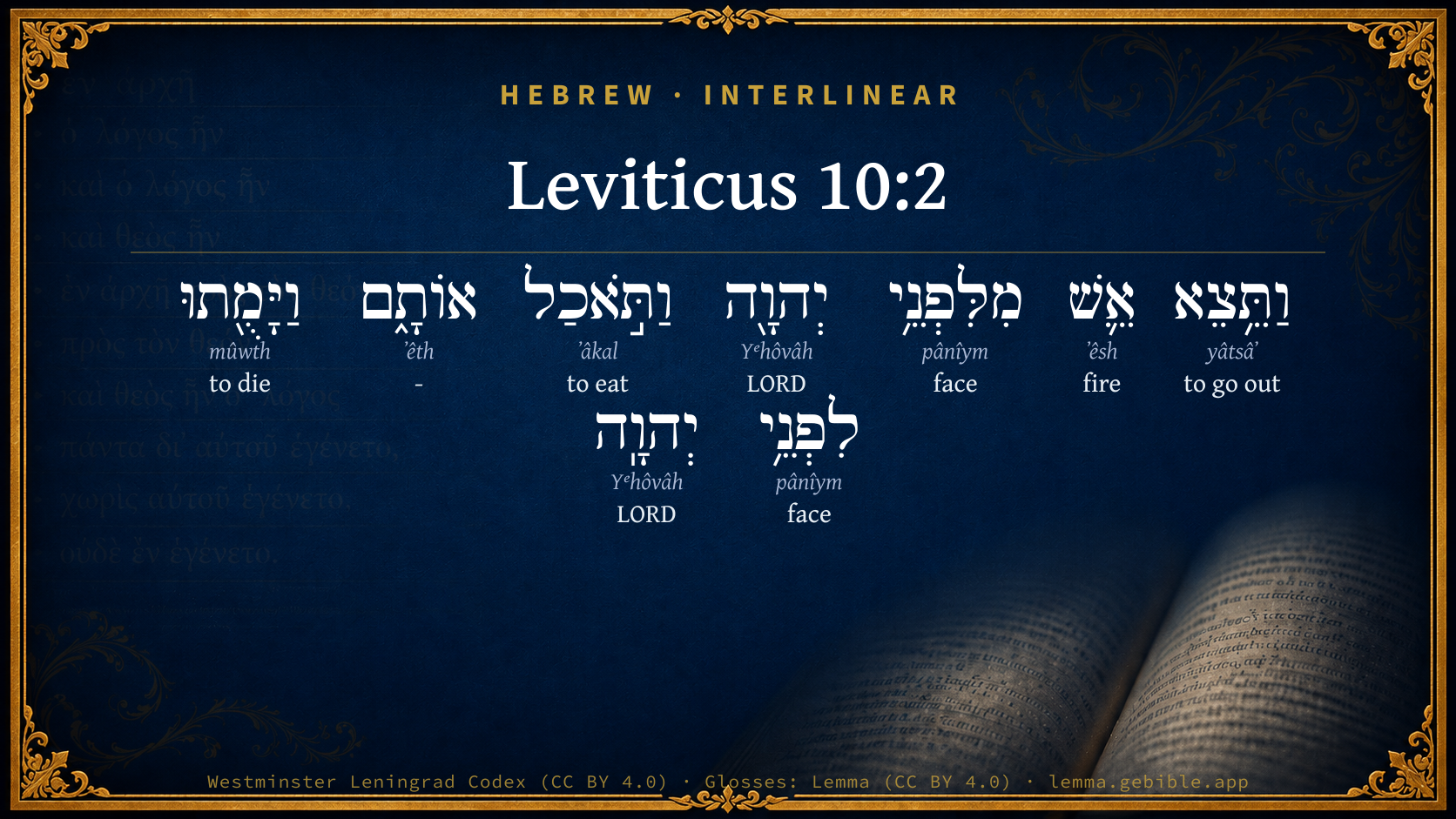
Leviticus 10:2

Hebrew (Westminster Leningrad Codex) Leviticus 10:2 appears in the Hebrew Old Testament. The text above is from the Westminster Leningrad Codex. Each word links to its Strong’s number, a concise gloss, and parsing drawn from the Open Scriptures Hebrew Bible morphology. Click any word for its full Brown-Driver-Briggs (BDB) entry.
Download image
Cite this verse

Leviticus 10:2 (World English Bible). Public Domain. Lemma interlinear Bible study tool, https://lemma.gebible.app/v/leviticus/10/2.

Show BibTeX & RIS
BibTeX
RIS
English Translation
And fire came forth from before Yahweh, and devoured them, and they died before Yahweh.
World English Bible · Public Domain
Download a study sheet

One document with this verse’s original text, its word-by-word gloss line, the meaning frame, cross-references with their text, attributed commentary, and full source and license credits — printable, and it pastes into notes with its structure intact.

This verse Autodidact and up

Study sheet (.html) Plain text (.txt)

A passage Seminary Student

Up to 50 verses in one chapter. A passage sheet keeps up to 6 commentary sources and 12 cross-references per verse, in the order this page ranks them, and says so on the sheet whenever that leaves anything out. Ask for a single verse and you get the Autodidact verse sheet above.

Everything on this page stays free to read, with no account — the sheet is a download of what is already on screen, not access to it.

Want to remove ads? Support Godless Engineer
Compare translations 3

The same verse in 3 English versions, stacked beneath the original-language interlinear above. Click any original word for its lexicon entry.

Each is an independent rendering of the whole verse — the interlinear is not word-aligned to these translations.

Highlighted words mark where these versions differ — a whole-verse word diff, not a word-by-word alignment.

  • World English Bible Public Domain
    And fire came forth from before Yahweh, and devoured them, and they died before Yahweh.
  • King James Version Public Domain
    And there went out fire from the LORD, and devoured them, and they died before the LORD.
  • unfoldingWord Literal Text CC BY-SA 4.0
    And fire went forth from before the face of Yahweh, and it consumed them. And they died to the face of Yahweh.

unfoldingWord Literal Text — © unfoldingWord, licensed CC BY-SA 4.0. Word-aligned USFM3 via Door43 (git.door43.org/unfoldingWord/en_ult).

Versions to compare (up to 4)

3 of 4 selected

Show all 18 translations

Every available English version of this verse, each an independent rendering of the whole verse.

  • World English Bible Public Domain
    And fire came forth from before Yahweh, and devoured them, and they died before Yahweh.
  • Berean Standard Bible Public Domain
    So fire came out from the presence of the LORD and consumed them, and they died in the presence of the LORD.
  • Majority Standard Bible Public Domain
    So fire came out from the presence of the LORD and consumed them, and they died in the presence of the LORD.
  • King James Version Public Domain
    And there went out fire from the LORD, and devoured them, and they died before the LORD.
  • American Standard Version (1901) Public Domain
    And there came forth fire from before Jehovah, and devoured them, and they died before Jehovah.
  • Revised Version (1885) Public Domain
    And there came forth fire from before the LORD, and devoured them, and they died before the LORD.
  • Geneva Bible (1599) Public Domain
    Therefore a fire went out from the Lord, and deuoured them: so they dyed before the Lord.
  • Douay-Rheims (1899) Public Domain
    And fire coming out from the Lord destroyed them, and they died before the Lord.
  • Young's Literal Translation Public Domain
    and fire goeth out from before Jehovah, and consumeth them, and they die before Jehovah.
  • Literal Standard Version CC BY-SA 4.0
    and fire goes out from before YHWH and consumes them, and they die before YHWH.
  • Unlocked Literal Bible CC BY-SA 4.0
    So fire came out from before Yahweh and devoured them, and they died before Yahweh.
  • unfoldingWord Literal Text CC BY-SA 4.0
    And fire went forth from before the face of Yahweh, and it consumed them. And they died to the face of Yahweh.
  • Darby Bible Public Domain
    And there went out fire from before Jehovah, and devoured them, and they died before Jehovah.
  • World Messianic Bible Public Domain
    Fire came out from before the LORD, and devoured them, and they died before the LORD.
  • Webster's Bible Public Domain
    And there went out fire from the LORD, and devoured them, and they died before the LORD.
  • Free Bible Version CC BY-SA 4.0
    Fire came out from the Lord's presence and burned them up. They died in the Lord's presence.
  • Bible in Basic English Public Domain
    And fire came out from before the Lord, burning them up and causing their destruction before the Lord.
  • JPS Tanakh (1917) Public Domain
    And there came forth fire from before the LORD, and devoured them, and they died before the LORD.

Literal Standard Version (2020), Covenant Press — licensed CC BY-SA 4.0. Text via the HelloAO Bible API (eBible.org). Unlocked Literal Bible (unfoldingWord) — licensed CC BY-SA 4.0. Text via the HelloAO Bible API (eBible.org). unfoldingWord Literal Text — © unfoldingWord, licensed CC BY-SA 4.0. Word-aligned USFM3 via Door43 (git.door43.org/unfoldingWord/en_ult). Free Bible Version, Dr. Jonathan Gallagher — licensed CC BY-SA 4.0. Text via the HelloAO Bible API (eBible.org).

Word by word

More ways to search: Search by grammar → Find every occurrence → Compare this word →

Practice this passage: Drill this verse → Learn its vocabulary →

אֵ֛שׁ
ʼêsh
H784
“fire”
Noun, Common, Both, Singular, Absolute
Part of Speech
Noun
Type
Common
Gender
Both
Number
Singular
State
Absolute
Full BDB Definition

Origin: a primitive word

TWOT: 172

fire - fire, flames - supernatural fire (accompanying theophany) - fire (for cooking, roasting, parching) - altar-fire - God's anger (figuratively)
  1. וַתֵּ֥צֵא yâtsâʼ H3318 “and · to go out” Conjunction + Verb, Qal, Sequential Imperfect, 3rd Person, Feminine, Singular
  2. מִלִּפְנֵ֥י pânîym H6440 “from · to/for · face(s) of” Preposition + Preposition + Noun, Common, Both, Plural, Construct
  3. יְהוָ֖ה Yᵉhôvâh H3068 “LORD” Noun, Proper
  4. וַתֹּ֣אכַל ʼâkal H398 “and · to eat” Conjunction + Verb, Qal, Sequential Imperfect, 3rd Person, Feminine, Singular
  5. אוֹתָ֑ם ʼêth H853 “- · them” Particle, Direct Object + Suffix, Personal, 3rd Person, Masculine, Plural
  6. וַיָּמֻ֖תוּ mûwth H4191 “and · to die” Conjunction + Verb, Qal, Sequential Imperfect, 3rd Person, Masculine, Plural
  7. לִפְנֵ֥י pânîym H6440 “to/for · face(s) of” Preposition + Noun, Common, Both, Plural, Construct
  8. יְהוָֽה Yᵉhôvâh H3068 “LORD” Noun, Proper

About this verse

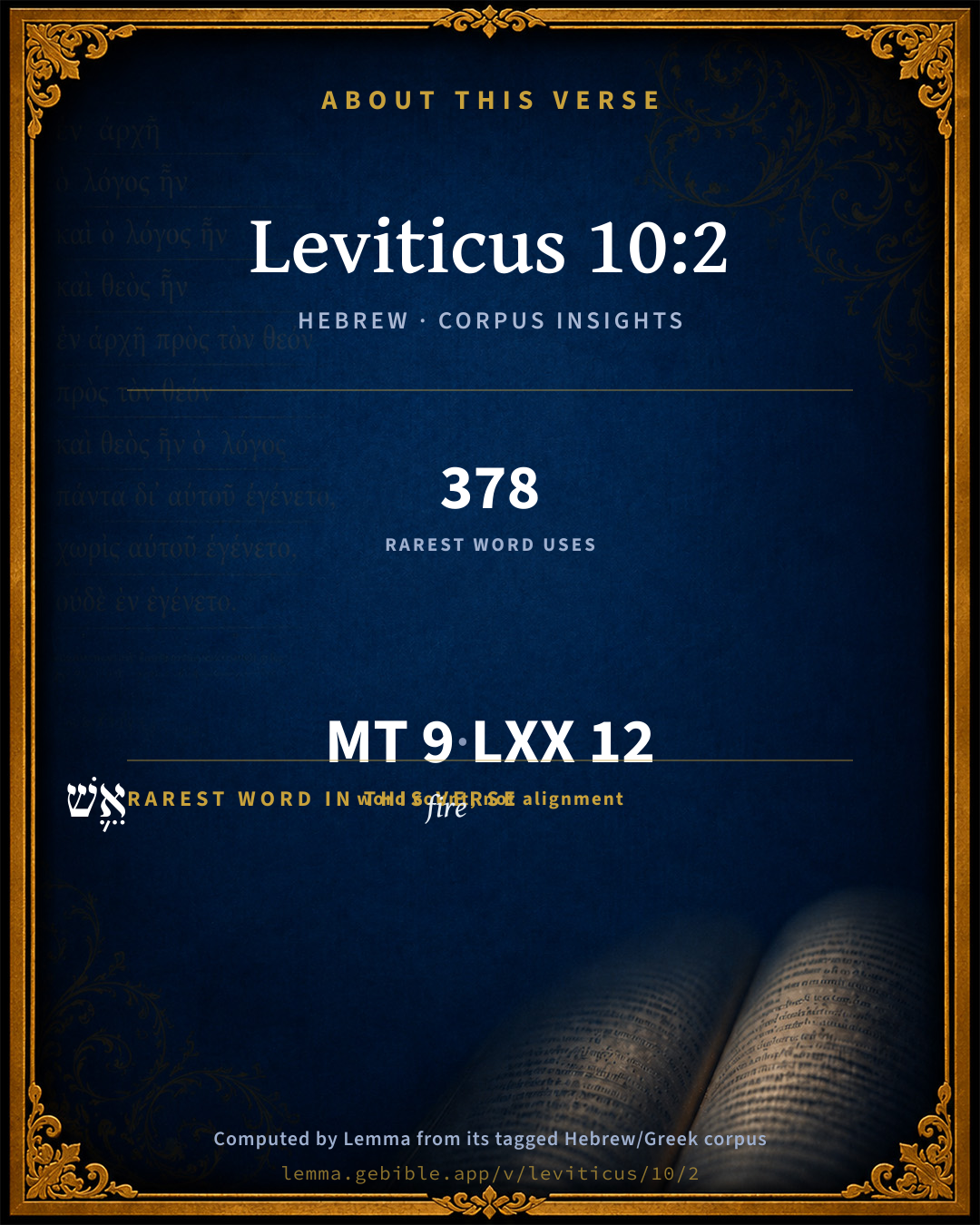
These counts appear in no published source. They are computed here, from the morphology-tagged text and Lemma’s own curated glosses. What Lemma adds →

9
words
7
distinct lemmas
Pentateuch
section

Grammatical profile

  • 3 verbs
  • 5 nouns
  • 1 particle

Verb forms

  • וַתֵּ֥צֵא Qal · Sequential Imperfect
  • וַתֹּ֣אכַל Qal · Sequential Imperfect
  • וַיָּמֻ֖תוּ Qal · Sequential Imperfect

Repetition

Words recur within this verse — often emphatic in Hebrew:

  • מִלִּפְנֵ֥י face H6440 ×2
  • יְהוָ֖ה LORD H3068 ×2

Hebrew & Septuagint length

In English translation the verse runs 15 words from the Hebrew and 16 from the Septuagint (LXX English) — closely comparable.

A rough comparison of the two English renderings, which tokenize alike — not a word-level alignment.

Word counts can differ between the Hebrew and the Greek without any difference in meaning — e.g. the Hebrew direct-object marker אֵת has no separate Greek word, and Greek often adds the article ὁ.

In the original languages it is 9 Hebrew tokens and 12 Greek tokens — but the two are counted differently (Hebrew bundles its prefixes and suffixes into one token; the Greek is in lemma form), so that isn’t a like-for-like length.

Cross-references

19

Topical passages linked to Leviticus 10:2 in the Treasury of Scripture Knowledge — connected by theme and wording, ordered by reader-vote popularity; previews shown in the World English Bible.

  • Numbers 26:61 Nadab and Abihu died, when they offered strange fire before Yahweh.
  • Leviticus 9:24 There came forth fire from before Yahweh, and consumed the burnt offering and the fat upon the altar: and when all the people saw it, they shouted, and fell on their faces.
  • Numbers 16:35 Fire came forth from Yahweh, and devoured the two hundred fifty men who offered the incense.
  • Numbers 3:3–4 These are the names of the sons of Aaron, the priests who were anointed, whom he consecrated to minister in the priest's office.
  • 2 Samuel 6:7 The anger of Yahweh was kindled against Uzzah; and God struck him there for his error; and there he died by the ark of God.
  • Leviticus 10:5 So they drew near, and carried them in their coats out of the camp, as Moses had said.
  • Leviticus 16:1 Yahweh spoke to Moses, after the death of the two sons of Aaron, when they drew near before Yahweh, and died;
  • Numbers 16:32–33 and the earth opened its mouth, and swallowed them up, and their households, and all the men who appertained to Korah, and all their goods.
  • Numbers 16:49 Now those who died by the plague were fourteen thousand and seven hundred, besides those who died about the matter of Korah.
  • 1 Samuel 6:19 He struck of the men of Beth-shemesh, because they had looked into the ark of Yahweh, he struck of the people fifty thousand seventy men; and the people mourned, because Yahweh had struck the people with a great slaughter.
  • 2 Kings 1:10 Elijah answered to the captain of fifty, If I be a man of God, let fire come down from the sky, and consume you and your fifty. Fire came down from the sky, and consumed him and his fifty.
  • 2 Kings 1:12 Elijah answered them, If I be a man of God, let fire come down from the sky, and consume you and your fifty. The fire of God came down from the sky, and consumed him and his fifty.
  • 1 Chronicles 13:10 The anger of Yahweh was kindled against Uzza, and he struck him, because he put forth his hand to the ark; and there he died before God.
  • 1 Chronicles 15:13 For because you didn't carry it at the first, Yahweh our God made a breach on us, because we didn't seek him according to the ordinance.
  • 1 Chronicles 24:2 But Nadab and Abihu died before their father, and had no children: therefore Eleazar and Ithamar executed the priest's office.
  • Isaiah 30:33 For a Topheth is prepared of old; yes, for the king it is made ready; he has made it deep and large; the pile of it is fire and much wood; the breath of Yahweh, like a stream of sulfur, does kindle it.
  • Acts 5:5 Ananias, hearing these words, fell down and died. Great fear came on all who heard these things.
  • Acts 5:10 She fell down immediately at his feet, and died. The young men came in and found her dead, and they carried her out and buried her by her husband.
  • 1 Corinthians 10:11 Now all these things happened to them by way of example, and they were written for our admonition, on whom the ends of the ages have come.

Cross-references courtesy of OpenBible.info (CC BY 4.0).

Hebrew and Greek witnesses Masoretic Hebrew ↔ Greek Septuagint

The same verse in the two great witnesses to the Old Testament, shown verse-for-verse.

These are two independent witnesses, not word-aligned to each other, and the Septuagint is shown in lemma (dictionary) form.

Hebrew Leviticus 10:2 Masoretic · Westminster Leningrad Codex

וַתֵּ֥צֵא אֵ֛שׁ מִלִּפְנֵ֥י יְהוָ֖ה וַתֹּ֣אכַל אוֹתָ֑ם וַיָּמֻ֖תוּ לִפְנֵ֥י יְהוָֽה

And fire came forth from before Yahweh, and devoured them, and they died before Yahweh.

World English Bible · Public Domain

Greek LXX Leviticus 10:2 Septuagint · lemma form

καί ἐκἔρχομαι πῦρ παρά κύριος καί καταἐσθίω αὐτός καί ἀποθνήσκω ἔναντι κύριος

and fire came forth from the Lord, and devoured them, and they died before the Lord.

LXX2012 (modern English Septuagint) · Public Domain

Hebrew: Westminster Leningrad Codex (CC BY 4.0). Greek: Septuagint (public domain); English from LXX2012 (modern English Septuagint) (Public Domain). How the Septuagint differs from the Hebrew →

Targum (Aramaic paraphrase)

2

The Targum is the ancient Jewish Aramaic paraphrase of the Hebrew Scriptures — an interpretive translation, not the Hebrew text itself. Onkelos (literal) and Pseudo-Jonathan (expansive) render the Torah, and Jonathan the Prophets. Coverage is partial: where no permissively-licensed English translation exists for a verse, only the Aramaic is shown. This is verse-level text, not a word-by-word alignment to the Hebrew.

  1. Targum Onkelos Torah (Genesis–Deuteronomy)
    וּנְפָקַת אֶשָׁתָא מִן קֳדָם יְיָ וַאֲכָלַת יָתְהוֹן וּמִיתוּ קֳדָם יְיָ

    (no public-domain English translation for this verse)

    Targum Onkelos — Aramaic: “Onkelos Genesis” (public domain); “Onkelos Exodus” (public domain); “Onkelos Leviticus” (public domain); “Onkelos Numbers” (public domain); “Onkelos Deuteronomy” (public domain). English: “Sefaria Community Translation” (CC0 1.0 (public-domain dedication)); “J.W. Etheridge. The Targums of Onkelos and Jonathan Ben Uzziel on the Pentateuch. London: Longmans, Green, 1862” (public domain). Text via Sefaria.

  2. Targum Pseudo-Jonathan Torah (Genesis–Deuteronomy)
    וּנְפָקַת שַׁלְהוֹבִית אֵישָׁתָא מִן קֳדָם יְיָ בִּרְגַז וְאִתְפַּלִיגַת לְאַרְבַּעְתֵּי חוּטִין וְאָעֲלַת בְּגוֹ אַפֵּיהוֹן וְאוֹקִידַת יַת נִשְׁמַתְהוֹן בְּרַם גוּפֵיהוֹן לָא אִיתְחַרְכוּ וּמִיתוּ קֳדָם יְיָ

    And a flame of fire came out from before the Lord (as) with anger, and divided itself into four streams, (or lines,) and penetrated their nostrils, and burned their lives (souls) without destroying their bodies; and they died before the Lord.

    Targum Pseudo-Jonathan — Aramaic: “Targum Jonathan on Genesis” (public domain); “Targum Jonathan on Exodus” (public domain); “Targum Jonathan on Leviticus” (public domain); “Targum Jonathan on Numbers” (public domain); “Targum Jonathan on Deuteronomy” (public domain). English: “The Targum of Jonathan ben Uzziel, trans. J. W. Etheridge, London, 1862” (public domain). Text via Sefaria.

Commentary

Notes on Leviticus 10:2 from classic Christian and Jewish commentators (each source and its license shown beneath its notes). The classic Christian expositions comment on the surrounding passage and are grouped to its opening verse, so a note may address several verses; the Jewish commentaries on the Tanakh (Rashi and others) are per-verse, so they appear only where the commentator wrote on this verse.

Lemma curates 59 commentaries, every one of them public domain or Creative Commons licensed, each selected and text-cleaned for this edition rather than reprinted as found. About our sources →

Trapp's Complete Commentary

John Trapp

Lev 10:2 And there went out fire from the LORD, and devoured them, and they died before the LORD.

Ver. 2. And there went out fire.] By fire they sinned, and by fire they perished.

“ Per quod quis peccat, per idem punitur et ipse:

Nestorii lingua vermibus exesa est. ” - Evag., lib. i.

So Archbishop Arundel’s tongue rotted in his head. The Archbishop of Tours in France made suit for the erection of a court called Chambre Ardent, wherein to condemn the Protestants to the fire. He was afterwards stricken with a disease called the fire of God, which began at his feet and so ascended upward, that he caused one member after another to be cut off, and so he died miserably. {a}

{a} Act. and Mon., fol. 1911.

John Trapp, A Commentary or Exposition upon All the Books of the Old and New Testament (1647–1656) — public domain. Text from a community e-Sword module.

Joseph Benson's Commentary

Lev 10:2. And there went out a fire from the Lord — From heaven, or rather, from the sanctuary; and devoured them — Not reduced them to ashes, as the word signifies at the end of the former chapter, but struck them dead in a moment, their bodies and garments remaining entire. Thus the sword is said to devour, 2Sa 2:26. Thus lightning often kills persons without injuring their garments. To take off from our surprise at this great severity, let it be considered, that the wisest legislators have always judged it necessary to inflict a heavy punishment upon the first transgressors of a law, especially in cases of great moment, in order to deter others from the like offence, Had this first irregularity been connived at in the inferior priests, it might have imboldened them, and much more the high-priests, to introduce further and more important innovations, to the total subversion of the order God had appointed. Thus Ananias and Sapphira, presuming to lie against the Holy Ghost, were punished in a way very similar, when the gospel law had been confirmed by the descent of a different fire from heaven.

Joseph Benson's Commentary on the Old and New Testaments (1811–1818) — public domain. Text from a community e-Sword module.

Tyndale Open Study Notes

Tyndale Open Resources

10:2 In 9:24, the fire blazed forth to show God’s acceptance. It now indicates his disapproval by bringing death to Nadab and Abihu, who had demonstrated a careless approach toward the worship of God (cp. Acts 5:1-11).

Tyndale Open Study Notes — © Tyndale Open Resources, licensed CC BY-SA 4.0. Text via the HelloAO Bible API.

Jamieson, Fausset & Brown

Robert Jamieson, A. R. Fausset & David Brown

there went out fire from the Lord, and devoured them--rather, "killed them"; for it appears (Lev 10:5) that neither their bodies nor their robes were consumed. The expression, "from the Lord," indicates that this fire issued from the most holy place. In the destruction of these two young priests by the infliction of an awful judgment, the wisdom of God observed the same course, in repressing the first instance of contempt for sacred things, as he did at the commencement of the Christian dispensation (Act 5:1-11).

Jamieson, Fausset & Brown — Commentary Critical and Explanatory on the Whole Bible (1871) — public domain (CC PDM 1.0). Text via the HelloAO Bible API.

Ellicott's Commentary for English Readers

(2) And there went out fire from the Lord.—By fire they sinned, and by fire they died. The Divine fire which issued forth to consume the sacrifices as a token of acceptance, now descended as the avenger of sin to consume the sacrificers, just as the same gospel is to one a savour of life unto life, and to another a savour of death unto death. (2Co_2:16.)

And devoured them.—That is, slay them, since we are told in Lev_10:5 that not only were their bodies in a perfect state of preservation, but even their garments were not burnt. The word consume, however, is used here to keep up the connection between this verse and chap 9:24.

They died before the Lord.—That is, in the court of the sanctuary (see Lev_10:1), on the very spot where the sin was committed.

A Bible Commentary for English Readers, edited by Charles John Ellicott (1878–1897) — public domain. Text from a community e-Sword module.

John Gill's Exposition

And there went out fire from the Lord,.... They sinned by fire, and they were punished by fire, either from heaven, or from the most holy place, where the Lord dwelt between the cherubim; this was of the nature of lightning, as appears by what follows:

and devoured them; not reduced them to ashes, for neither their bodies nor their clothes were burnt with this fire, as is clear from Lev 10:4 but their lives were destroyed, they were lifeless, their souls were separated from their bodies by it, and they died; which is often the case by the lightning, that the clothes of those who are killed with it are untouched, and scarce any marks of violence on their bodies; and so the Targum of Jonathan says of these, their bodies were not burnt:

and they died before the Lord; upon the spot where they were offering incense, in the holy place, over against the most holy place. This was very awful, like the case of Ananias and Sapphira, and may seem severe: it was for the terror of others in the priesthood, or who should come after, to take care that they performed their office according to the divine precepts, and brought in no innovation into their service. And when it is considered that these were the sons of the high priest, newly invested with an high and honourable office, and just had the laws of the priesthood delivered unto them, and yet deviated from them as soon as in their office, and very probably, from what follows, went drunk into their service, their sin will appear aggravated, and the punishment less severe. This shows there is nothing in carnal descent, these were the sons of Aaron the high priest, that acted this part, and came to this end; the proneness of men to transgress the laws of God as soon as given them; thus the people of Israel fell into idolatry as soon as the moral law was given; and here the priests, as soon as the ceremonial laws, relating to the priesthood, were delivered to them; and also that the law made sinful men priests, and that the Levitical priesthood was imperfect; and that no order of men are free from sin, or exempt from punishment: and the whole of the divine conduct in this affair may lead us to observe how jealous God is in matters of worship; how much he dislikes hypocrites, and formal professors; how severe he will be against such who bring in strange doctrines; what will be the fate of the contemners of Gospel doctrines and ordinances; and how much he resents those who trust in themselves, and their works, and bring in anything of their own in the business of salvation, which is strange fire, sparks of their own kindling, a burning incense to their own drag, and sacrificing to their own net.

John Gill's Exposition of the Whole Bible (1746–1763) — public domain (CC PDM 1.0). Text via the HelloAO Bible API.

Albert Barnes' Notes on the Bible

The fire which had just before sanctified the ministry of Aaron as well pleasing to God, now brought to destruction his two eldest sons because they did not sanctify Yahweh in their hearts, but dared to perform a self-willed act of worship; just as the same Gospel is to one a savor of life unto life, and to another a savor of death unto death 2Co 2:16.

Albert Barnes' Notes on the Bible (1834–1885) — public domain. Text from a community e-Sword/MySword module.

Haydock's Catholic Bible Commentary

Lord. Near the altar of incense, being stricken, as it were with lightning, so that their garments were not injured. (Calmet)

George Leo Haydock (1774–1849), Haydock's Catholic Family Bible and Commentary, 1859 edition — public domain. Excludes Psalms (Douay-Rheims chapter numbering differs from Protestant) and Deuterocanonical books (Catholic canon only).

Matthew Poole's English Annotations

From the Lord; from heaven, or rather from the sanctuary. See Lev 9:24.

Devoured them; destroyed their lives; for their bodies and garments were not consumed, as it appears from Lev 10:4,5. Thus the sword is said to devour, 2Sa 2:26. Thus lightning many times kills persons, without any hurt to their bodies or garments.

Matthew Poole's English Annotations on the Holy Bible (1683–1685) — public domain. Text from a community e-Sword/MySword module.

Whedon's Commentary on the Bible

Daniel D. Whedon

2. Fire from the Lord — The sacred fire which these priests had slighted had “come out from before the Lord.” Lev_9:24. “Fire had just consumed the burnt-offering and the fat upon the altar in token of divine complacency and sacred nearness, and the acceptance of human worship, and that same fire went out from the Lord and devoured the audacious priests — the sacerdotal blasphemers — ate them up as if they had been common bones! The Lord has never been negligent of his own altar.” — Joseph Parker. By a species of poetical justice, fire from the same source is the instrument of their punishment. “Our God is a consuming fire.” This fearful exhibition of wrath and power indicates his real presence where his name is. “A saint, when asked, ‘What is the most dangerous doctrine?’ replied, ‘God’s own truth held carnally, and to exalt self.’ For his light may blind, his ark destroy, his sanctuary smite, his table be damnation. And a truth perverted may be the firmest chain to hold and bind and blind us for ever.” — Jukes.

Devoured them — Literally, ate them up. But this strong word is used metaphorically for slew, since neither their bodies nor even their garments were consumed. The stroke was like a deadly flash of lightning issuing from the most holy place, the abode of the invisible Jehovah. Here we find another parallel between the opening of the dispensation of shadows and the beginning of the official work of the Holy Ghost. Two persons are struck dead at the inauguration of each dispensation, amid the displays of omnipotent power, and the rejoicings of the people at the tokens of Jehovah’s presence and favor. See Act_5:1-11. In both these passages we have the double action of the same fire, which consumes the burnt offering and baptizes the believer with fire in token of acceptance, and smites the sinning priest and the lying Ananias in token of judgment. “God is love.” “God is a consuming fire.” His anger against sin burns most intensely around his own altars. “Poetical justice might have closed the book of Leviticus with chap. 9. It would have been a glorious close — Aaron moved to feeling; Moses giving way to emotion; the Lord’s fire consuming the offering upon the altar; the people singing, shouting, and falling down in adoration! Why did not the history close there? That would have been Canaan enough for any nation, paradise enough for any people. But there is another chapter.”

Daniel D. Whedon (gen. ed.), Commentary on the Old and New Testaments (1874–1909) — public domain. Text from a community e-Sword module.

The Pulpit Commentary

And there went out fire from the Lord, and devoured. These are the exact words used in Lev_9:24 of the fire that consumed the sacrifices. The fire was the same; its source was the same; its effect was the same, and yet how different! They died before the Lord; that is, they were struck dead at the door of the tabernacle.

Fire was the instrument of the destruction of Nadab and Ahihu, whilst just before it had been the means of consuming the sacrifice, and in passing to the altar it had probably bathed Moses and Aaron in its harmless flames as they stood at the door of the tabernacle. Thus it is that the same thing serves as a means of glorification or of destruction, according to the qualities of that with which it comes in contact. The discipline of daily life makes one a saint, another a more determined sinner. The discipline of suffering softens one heart, hardens another. The difficulties of religious belief make one the more submissive, another an unbeliever. God is the joy of the believer and the misery of the infidel. And so we may suppose that it will be hereafter. The presence of God will be the exceeding great reward of those who have sought him, and that same presence would be the torture of those who have not submitted their wills to his. It may be that this in itself will be sufficient to constitute the punishment of the unrighteous in the world to come.

The Pulpit Commentary (1880–1919), ed. H.D.M. Spence-Jones & Joseph S. Exell — public domain. Text from a community e-Sword module.

John Wesley's Explanatory Notes

From the Lord - From heaven, or rather from the sanctuary. Devoured them - Destroyed their lives; for their bodies and garments were not consumed. Thus the sword is said to devour, 2 Sam. ii, 26. Thus lightning many times kill persons, without any hurt to their garments.

John Wesley, Explanatory Notes Upon the Whole Bible (1754–1765) — public domain. Text via the GEBible commentary corpus.

Rashi

Rabbi Shlomo Yitzchaki (Rashi)

ותצא אש AND THERE WENT OUT FIRE — Rabbi Eleizer said: the sons of Aaron died only because they gave decisions on religious matters in the presence of their teacher, Moses (Sifra, Shemini, Mechilta d'Miluim 2 32; Eruvin 63a). Rabbi Ishmael said: they died because they entered the Sanctuary intoxicated by wine. You may know that this is so, because after their death he admonished those who survived that they should not enter when intoxicated by wine (vv. 8—9). A parable! It may be compared to a king who had a bosom friend, etc., as is to be found in Leviticus Rabbah 12:1, 4 (cf. Biur).

Rashi on the Tanakh — English translations: “The Judaica Press complete Tanach with Rashi, translated by A. J. Rosenberg” (CC BY 4.0); “Pentateuch with Rashi's commentary by M. Rosenbaum and A.M. Silbermann, 1929-1934” (public domain); “The Metsudah Tanach series, Lakewood, N.J” (CC BY 4.0); and “The Book of Joshua, Metsudah Publications, 1997” (CC BY 4.0). Text via Sefaria.

Ramban (Nachmanides)

Rabbi Moshe ben Nachman (Ramban / Nachmanides)

AND THERE CAME FORTH FIRE ‘MILIPHNEI’ (FROM BEFORE) THE ETERNAL. The meaning of “miliphnei the Eternal” is like: “from before the pnei (presence of) the Eternal.” The student learned [in the mystic lore of the Cabala] will understand, for I have already explained this. The nature of the sin of Nadab and Abihu you may know from that which it says, and they offered ‘strange fire’ before the Eternal, and it does not say “and they offered before the Eternal ‘incense’ which He had not commanded them.” Thus they put incense upon the fire, similarly to that which Scripture says, they shall put incense ‘b’apecha’ (before Thee), and they directed their thoughts only to this, (literally: ‘before Thy anger’). It is for this reason that the burning of incense stays the plague. (Numbers 17:11-15). However, the priest who offered it had to direct his mind to the perfect Unity of G-d. And since Nadab and Abihu directed it only to the attribute of justice (see Note 58), therefore they were punished.” See further, my Hebrew commentary p. 46. and thus it was not a fire-offering of a sweet savor. This is the sense of the expression, and they laid ‘aleha’ (upon her) incense. (upon her) is an allusion to the attribute of justice. and it does not say “and they laid upon them [i.e., the censers] incense,” as is said with reference to the company of Korah, and put fire therein, and put incense upon them, and again it is said there, and put incense upon them., Verse 17. But here it says upon her, to allude [to the fact] that they put the incense only on “the fire,” [and therefore it says], And there came forth fire from before the Eternal, and devoured them. It is possible that the verse which He said, Ye shall offer no strange incense thereon, alludes to this, meaning that he should not cause it [the fire] to be strange. It is in connection with this that Scripture states, when they [Nadab and Abihu] drew near before the Eternal, and died, which means “when they offered l’phanav they died.” alone [to the attribute of justice alone, as explained above] they died.

Ramban (Nachmanides) on the Tanakh — English translation: “Commentary on the Torah by Ramban (Nachmanides). Translated and annotated by Charles B. Chavel. New York, Shilo Pub. House, 1971-1976” (CC BY 4.0). Text via Sefaria.

Lesson kit

Teaching starters — assembled from the data on this page, not authored interpretation. Every prompt links to the verse data it draws on. Edit before teaching.

Leviticus, in the Pentateuch, opens this verse with 9 words (7 distinct Hebrew lemmas). Its most distinctive word is ʼêsh (“fire”). A historical commentator’s framing appears above. Read the whole chapter for the surrounding context.

Discussion questions

  1. The word ʼêsh carries the sense “fire.” How does it shape the verse?
  2. How does Numbers 26:61, which shares this passage’s theme, read alongside this verse?
  3. What does the repetition of “face” (2× in this one verse) do in this verse?
  4. These translations render this verse differently. What is at stake in choosing one wording over another?
  5. «וַתֵּ֥צֵא» is a Qal Sequential Imperfect verb. How does that grammatical form shape the action described?
  6. Compare how Trapp's Complete Commentary and Joseph Benson's Commentary read this verse. Where do they agree or differ?

Things to notice

Reading settings

Reading text

Shown beneath each verse's original-language words.

Old Testament
Old Testament edition

Read the OT as the Masoretic Hebrew (MT) or the Greek Septuagint (LXX).

English shown for the Greek Septuagint (in the Hebrew ↔ Greek comparison).

Comparing translations? Open the Compare panel on any verse page to stack up to four side by side.