
2 Samuel 16:9

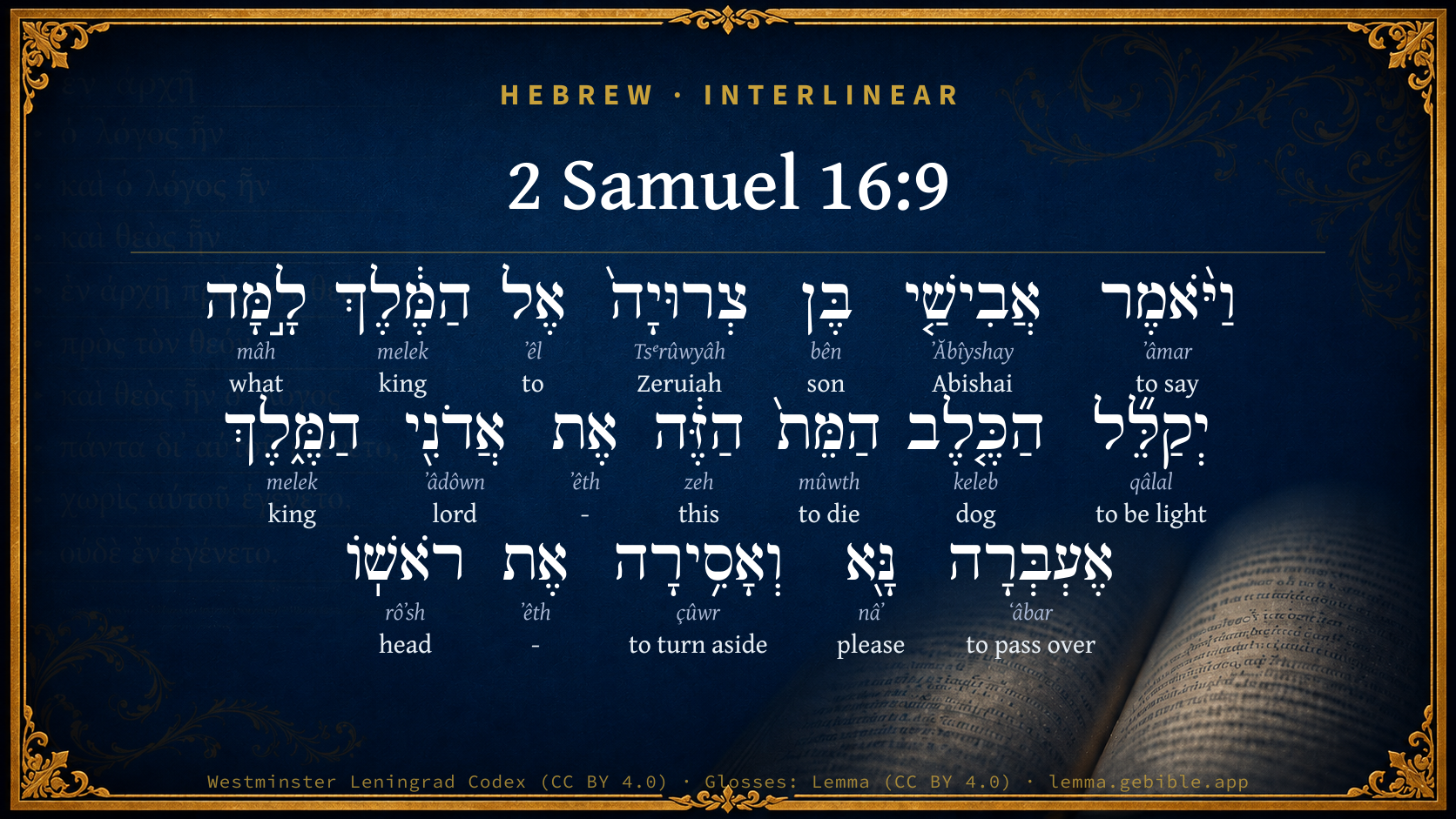
Hebrew (Westminster Leningrad Codex) 2 Samuel 16:9 appears in the Hebrew Old Testament. The text above is from the Westminster Leningrad Codex. Each word links to its Strong’s number, a concise gloss, and parsing drawn from the Open Scriptures Hebrew Bible morphology. Click any word for its full Brown-Driver-Briggs (BDB) entry.
Download image
Cite this verse

2 Samuel 16:9 (World English Bible). Public Domain. Lemma interlinear Bible study tool, https://lemma.gebible.app/v/2-samuel/16/9.

Show BibTeX & RIS
BibTeX
RIS
English Translation
Then said Abishai the son of Zeruiah to the king, "Why should this dead dog curse my lord the king? Please let me go over and take off his head."
World English Bible · Public Domain
Download a study sheet

One document with this verse’s original text, its word-by-word gloss line, the meaning frame, cross-references with their text, attributed commentary, and full source and license credits — printable, and it pastes into notes with its structure intact.

This verse Autodidact and up

Study sheet (.html) Plain text (.txt)

A passage Seminary Student

Up to 50 verses in one chapter. A passage sheet keeps up to 6 commentary sources and 12 cross-references per verse, in the order this page ranks them, and says so on the sheet whenever that leaves anything out. Ask for a single verse and you get the Autodidact verse sheet above.

Everything on this page stays free to read, with no account — the sheet is a download of what is already on screen, not access to it.

Want to remove ads? Support Godless Engineer
Compare translations 3

The same verse in 3 English versions, stacked beneath the original-language interlinear above. Click any original word for its lexicon entry.

Each is an independent rendering of the whole verse — the interlinear is not word-aligned to these translations.

Highlighted words mark where these versions differ — a whole-verse word diff, not a word-by-word alignment.

  • World English Bible Public Domain
    Then said Abishai the son of Zeruiah to the king, "Why should this dead dog curse my lord the king? Please let me go over and take off his head."
  • King James Version Public Domain
    Then said Abishai the son of Zeruiah unto the king, Why should this dead dog curse my lord the king? let me go over, I pray thee, and take off his head.
  • unfoldingWord Literal Text CC BY-SA 4.0
    And Abishai the son of Zeruiah said to the king, “Why should this dead dog curse my lord the king? Please, let me go over and let me remove his head.”

unfoldingWord Literal Text — © unfoldingWord, licensed CC BY-SA 4.0. Word-aligned USFM3 via Door43 (git.door43.org/unfoldingWord/en_ult).

Versions to compare (up to 4)

3 of 4 selected

Show all 18 translations

Every available English version of this verse, each an independent rendering of the whole verse.

  • World English Bible Public Domain
    Then said Abishai the son of Zeruiah to the king, "Why should this dead dog curse my lord the king? Please let me go over and take off his head."
  • Berean Standard Bible Public Domain
    Then Abishai son of Zeruiah said to the king, “Why should this dead dog curse my lord the king? Let me go over and cut off his head!”
  • Majority Standard Bible Public Domain
    Then Abishai son of Zeruiah said to the king, “Why should this dead dog curse my lord the king? Let me go over and cut off his head!”
  • King James Version Public Domain
    Then said Abishai the son of Zeruiah unto the king, Why should this dead dog curse my lord the king? let me go over, I pray thee, and take off his head.
  • American Standard Version (1901) Public Domain
    Then said Abishai the son of Zeruiah unto the king, Why should this dead dog curse my lord the king? let me go over, I pray thee, and take off his head.
  • Revised Version (1885) Public Domain
    Then said Abishai the son of Zeruiah unto the king, Why should this dead dog curse my lord the king? let me go over, I pray thee, and take off his head.
  • Geneva Bible (1599) Public Domain
    Then saide Abishai the sonne of Zeruiah vnto the King, Why doeth this dead dog curse my lord the King? let me goe, I pray thee, and take away his head.
  • Douay-Rheims (1899) Public Domain
    And Abisai the son of Sarvia said to the king: Why should this dead dog curse my lord the king? I will go, and cut off his head.
  • Young's Literal Translation Public Domain
    And Abishai son of Zeruiah saith unto the king, `Why doth this dead dog revile my lord the king? let me pass over, I pray thee, and I turn aside his head.'
  • Literal Standard Version CC BY-SA 4.0
    And Abishai son of Zeruiah says to the king, “Why does this dead dog revile my lord the king? Please let me pass over and I turn aside his head.”
  • Unlocked Literal Bible CC BY-SA 4.0
    Then Abishai son of Zeruiah, said to the king, “Why should this dead dog curse my master the king? Please let me go over and take off his head.”
  • unfoldingWord Literal Text CC BY-SA 4.0
    And Abishai the son of Zeruiah said to the king, “Why should this dead dog curse my lord the king? Please, let me go over and let me remove his head.”
  • Darby Bible Public Domain
    And Abishai the son of Zeruiah said to the king, Why should this dead dog curse my lord the king? let me go over, I pray thee, and take off his head.
  • World Messianic Bible Public Domain
    Then Abishai the son of Zeruiah said to the king, “Why should this dead dog curse my lord the king? Please let me go over and take off his head.”
  • Webster's Bible Public Domain
    Then said Abishai the son of Zeruiah to the king, Why should this dead dog curse my lord the king? let me go over, I pray thee, and take off his head.
  • Free Bible Version CC BY-SA 4.0
    Abishai, son of Zeruiah, asked the king, “Why should this dead dog curse Your Majesty? Let me go and cut off his head!”
  • Bible in Basic English Public Domain
    Then Abishai, the son of Zeruiah, said to the king, Is this dead dog to go on cursing my lord the king? let me go over and take off his head.
  • JPS Tanakh (1917) Public Domain
    Then said Abishai the son of Zeruiah unto the king: 'Why should this dead dog curse my lord the king? let me go over, I pray thee, and take off his head.'

Literal Standard Version (2020), Covenant Press — licensed CC BY-SA 4.0. Text via the HelloAO Bible API (eBible.org). Unlocked Literal Bible (unfoldingWord) — licensed CC BY-SA 4.0. Text via the HelloAO Bible API (eBible.org). unfoldingWord Literal Text — © unfoldingWord, licensed CC BY-SA 4.0. Word-aligned USFM3 via Door43 (git.door43.org/unfoldingWord/en_ult). Free Bible Version, Dr. Jonathan Gallagher — licensed CC BY-SA 4.0. Text via the HelloAO Bible API (eBible.org).

Word by word

More ways to search: Search by grammar → Find every occurrence → Compare this word →

Practice this passage: Drill this verse → Learn its vocabulary →

אֲבִישַׁ֤י
ʼĂbîyshay
H52
“Abishai”
Noun, Proper
Part of Speech
Noun
Type
Proper
Full BDB Definition

Origin: from H1 and H7862

TWOT: None

Abishai = "my father is Jesse" or " my father is a gift" - grandson of Jesse, nephew of David via his sister Zeruiah, brother of Joab
  1. וַיֹּ֨אמֶר ʼâmar H559 “and · to say” Conjunction + Verb, Qal, Sequential Imperfect, 3rd Person, Masculine, Singular
  2. בֶּן bên H1121 “son of” Noun, Common, Masculine, Singular, Construct
  3. צְרוּיָה֙ Tsᵉrûwyâh H6870 “Zeruiah” Noun, Proper
  4. אֶל ʼêl H413 “to” Preposition
  5. הַמֶּ֔לֶךְ melek H4428 “the · king” Particle, Definite Article + Noun, Common, Masculine, Singular, Absolute
  6. לָ֣מָּה mâh H4100 “to/for · what” Preposition + Particle, Interrogative
  7. יְקַלֵּ֞ל qâlal H7043 “to be light” Verb, Piel, Imperfect, 3rd Person, Masculine, Singular
  8. הַכֶּ֤לֶב keleb H3611 “the · dog” Particle, Definite Article + Noun, Common, Masculine, Singular, Absolute
  9. הַמֵּת֙ mûwth H4191 “the · dying” Particle, Definite Article + Verb, Qal, Participle Active, Masculine, Singular, Absolute
  10. הַזֶּ֔ה zeh H2088 “the · this” Particle, Definite Article + Pronoun, Demonstrative, Masculine, Singular
  11. אֶת ʼêth H853 “-” Particle, Direct Object
  12. אֲדֹנִ֖י ʼâdôwn H113 “lord · my” Noun, Common, Masculine, Singular, Construct + Suffix, Personal, 1st Person, Common, Singular
  13. הַמֶּ֑לֶךְ melek H4428 “the · king” Particle, Definite Article + Noun, Common, Masculine, Singular, Absolute
  14. אֶעְבְּרָה ʻâbar H5674 “to pass over” Verb, Qal, Cohortative, 1st Person, Common, Singular
  15. נָּ֖א nâʼ H4994 “please” Particle, Interjection
  16. וְאָסִ֥ירָה çûwr H5493 “and · to turn aside” Conjunction + Verb, Hiphil, Cohortative, 1st Person, Common, Singular
  17. אֶת ʼêth H853 “-” Particle, Direct Object
  18. רֹאשֽׁוֹ rôʼsh H7218 “head · his” Noun, Common, Masculine, Singular, Construct + Suffix, Personal, 3rd Person, Masculine, Singular

About this verse

These counts appear in no published source. They are computed here, from the morphology-tagged text and Lemma’s own curated glosses. What Lemma adds →

19
words
17
distinct lemmas
Historical
section

Notable vocabulary

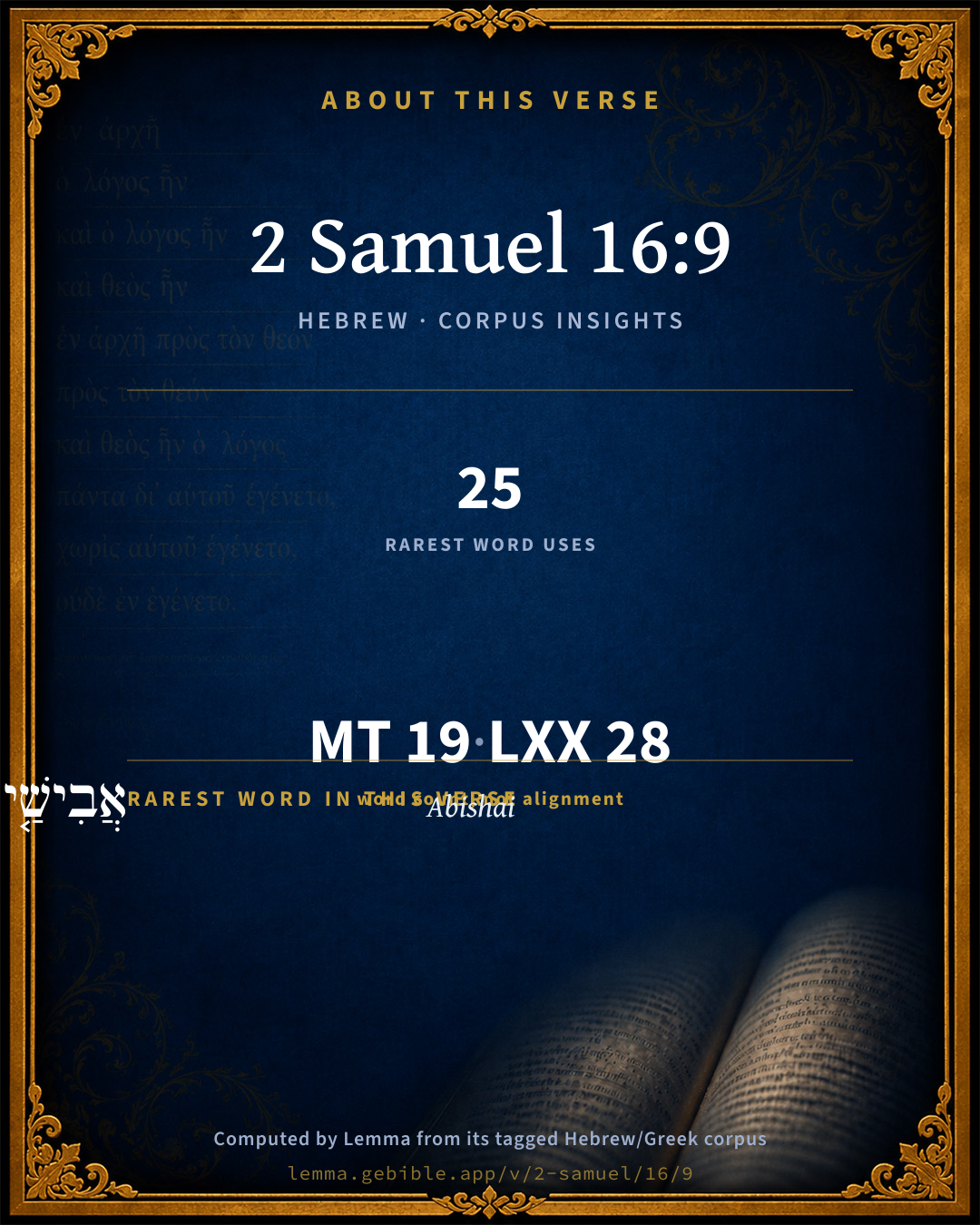
The rarest word here is אֲבִישַׁ֤י Abishai H52 — appearing just 25 times in the whole Hebrew Bible.

Shared distinctive vocabulary

אֲבִישַׁ֤י Abishai H52 occurs in 24 verses of the Hebrew Bible. Also found in:

Grammatical profile

  • 5 verbs
  • 8 nouns
  • 1 pronoun
  • 1 preposition
  • 4 particles

Verb forms

  • וַיֹּ֨אמֶר Qal · Sequential Imperfect
  • יְקַלֵּ֞ל Piel · Imperfect
  • הַמֵּת֙ Qal · Participle Active
  • אֶעְבְּרָה Qal · Cohortative
  • וְאָסִ֥ירָה Hiphil · Cohortative

Repetition

A word recurs within this verse — often emphatic in Hebrew:

  • הַמֶּ֔לֶךְ king H4428 ×2

Hebrew & Septuagint length

In English translation the verse runs 30 words from the Hebrew and 30 from the Septuagint (LXX English) — the same length.

A rough comparison of the two English renderings, which tokenize alike — not a word-level alignment.

Word counts can differ between the Hebrew and the Greek without any difference in meaning — e.g. the Hebrew direct-object marker אֵת has no separate Greek word, and Greek often adds the article ὁ.

In the original languages it is 19 Hebrew tokens and 28 Greek tokens — but the two are counted differently (Hebrew bundles its prefixes and suffixes into one token; the Greek is in lemma form), so that isn’t a like-for-like length.

Cross-references

11

Topical passages linked to 2 Samuel 16:9 in the Treasury of Scripture Knowledge — connected by theme and wording, ordered by reader-vote popularity; previews shown in the World English Bible.

  • Exodus 22:28 "You shall not blaspheme God, nor curse a ruler of your people.
  • 2 Samuel 9:8 He did obeisance, and said, "What is your servant, that you should look on such a dead dog as I am?"
  • 1 Samuel 24:14 After whom is the king of Israel come out? after whom do you pursue? after a dead dog, after a flea.
  • 2 Samuel 3:8 Then was Abner very angry for the words of Ish-bosheth, and said, Am I a dog's head that belongs to Judah? This day do I show kindness to the house of Saul your father, to his brothers, and to his friends, and have not delivered you into the hand of David; and yet you charge me this day with a fault concerning this woman.
  • 1 Samuel 26:6–11 Then answered David and said to Ahimelech the Hittite, and to Abishai the son of Zeruiah, brother to Joab, saying, Who will go down with me to Saul to the camp? Abishai said, I will go down with you.
  • 2 Samuel 3:30 So Joab and Abishai his brother killed Abner, because he had killed their brother Asahel at Gibeon in the battle.
  • Job 31:30–31 (Yes, I have not allowed my mouth to sin By asking his life with a curse);
  • Jeremiah 40:13–16 Moreover Johanan the son of Kareah, and all the captains of the forces who were in the fields, came to Gedaliah to Mizpah,
  • Luke 9:54 When his disciples, James and John, saw this, they said, "Lord, do you want us to command fire to come down from the sky, and destroy them, just as Elijah did?"
  • Acts 23:5 Paul said, "I didn't know, brothers, that he was high priest. For it is written, 'You shall not speak evil of a ruler of your people.'"
  • 1 Peter 2:17 Honor all men. Love the brotherhood. Fear God. Honor the king.

Cross-references courtesy of OpenBible.info (CC BY 4.0).

Hebrew and Greek witnesses Masoretic Hebrew ↔ Greek Septuagint

The same verse in the two great witnesses to the Old Testament, shown verse-for-verse.

These are two independent witnesses, not word-aligned to each other, and the Septuagint is shown in lemma (dictionary) form.

Hebrew 2 Samuel 16:9 Masoretic · Westminster Leningrad Codex

וַיֹּ֨אמֶר אֲבִישַׁ֤י בֶּן צְרוּיָה֙ אֶל הַמֶּ֔לֶךְ לָ֣מָּה יְקַלֵּ֞ל הַכֶּ֤לֶב הַמֵּת֙ הַזֶּ֔ה אֶת אֲדֹנִ֖י הַמֶּ֑לֶךְ אֶעְבְּרָה נָּ֖א וְאָסִ֥ירָה אֶת רֹאשֽׁוֹ

Then said Abishai the son of Zeruiah to the king, "Why should this dead dog curse my lord the king? Please let me go over and take off his head."

World English Bible · Public Domain

Greek LXX 2 Samuel 16:9 Septuagint · lemma form

καί εἶπον αβεσσα υἱός σαρουιας πρός ὁ βασιλεύς ἵνα τίς καταἀράομαι ὁ κύων ὁ θνήσκω οὗτος ὁ κύριος ἐγώ ὁ βασιλεύς διαβαίνω δή καί ἀποαἱρέω ὁ κεφαλή αὐτός

And Abessa the son of Saruia said to the king, Why does this dead dog curse my lord the king? let me go over now and take off his head.

LXX2012 (modern English Septuagint) · Public Domain

On this verse, Keil & Delitzsch discusses the Septuagint’s reading. Read the note in Commentary ↓

Hebrew: Westminster Leningrad Codex (CC BY 4.0). Greek: Septuagint (public domain); English from LXX2012 (modern English Septuagint) (Public Domain). How the Septuagint differs from the Hebrew →

Targum (Aramaic paraphrase)

1

The Targum is the ancient Jewish Aramaic paraphrase of the Hebrew Scriptures — an interpretive translation, not the Hebrew text itself. Onkelos (literal) and Pseudo-Jonathan (expansive) render the Torah, and Jonathan the Prophets. Coverage is partial: where no permissively-licensed English translation exists for a verse, only the Aramaic is shown. This is verse-level text, not a word-by-word alignment to the Hebrew.

  1. Targum Jonathan Prophets (Joshua–Malachi)
    וַאֲמַר אֲבִישַׁי בַּר צְרוּיָה לְמַלְכָּא לְמָא יְלַטֵט כַּלְבָּא מֵיתָא הָדֵין יַת רִבּוֹנִי מַלְכָּא אֶעְבַּר כְּעַן וְעַדִי יַת רֵישֵׁיהּ:

    (no public-domain English translation for this verse)

    Targum Jonathan — Aramaic: “Mikraot Gedolot” (public domain). English: “Sefaria Community Translation” (CC0 1.0 (public-domain dedication)); “London "Chaldee Paraphrase," 1871” (public domain). Text via Sefaria.

Commentary

Notes on 2 Samuel 16:9 from classic Christian and Jewish commentators (each source and its license shown beneath its notes). The classic Christian expositions comment on the surrounding passage and are grouped to its opening verse, so a note may address several verses; the Jewish commentaries on the Tanakh (Rashi and others) are per-verse, so they appear only where the commentator wrote on this verse.

Lemma curates 59 commentaries, every one of them public domain or Creative Commons licensed, each selected and text-cleaned for this edition rather than reprinted as found. About our sources →

Trapp's Complete Commentary

John Trapp

2Sa 16:9 Then said Abishai the son of Zeruiah unto the king, Why should this dead dog curse my lord the king? let me go over, I pray thee, and take off his head.

Ver. 9. Why should this dead dog curse my lord?] Abishai was no less zealous for David his kinsman than Shimei was for his, and would fain have been doing with him; his fingers even itched to take off his head, ut maledicire simul et vivere desineret. David is no less earnest with God to take an order with such dead dogs as blasphemed him and his truths. {Psa 74:10; Psa 74:18; Psa 74:22-23} This was true zeal in David; but revenge - ζηλος πικρος - in Abishai and Shimei.

John Trapp, A Commentary or Exposition upon All the Books of the Old and New Testament (1647–1656) — public domain. Text from a community e-Sword module.

Tyndale Open Study Notes

Tyndale Open Resources

16:9 Abishai was David’s nephew (1 Chr 2:13-16) and evidently a member of his personal guard. He believed that no one should talk this way to the king and live to tell about it (cp. 2 Sam 19:21). David was slower to judge (cp. 1 Kgs 2:8-9).

Tyndale Open Study Notes — © Tyndale Open Resources, licensed CC BY-SA 4.0. Text via the HelloAO Bible API.

The Cambridge Bible for Schools and Colleges

gen. ed. J. J. S. Perowne

9. Then said Abishai] Consistently with his character on the former occasion when he wished to slay Saul (1Sa_26:8), and on the later occasion, when he was for refusing Shimei’s suit for pardon (ch. 2Sa_19:21). His fiery zeal reminds us of the Sons of Thunder (Luk_9:54), and David’s answer recalls Christ’s answer to Peter (Joh_18:10-11).

this dead dog] See ch. 2Sa_9:8, 2Sa_3:8, and notes there.

The Cambridge Bible for Schools and Colleges (gen. ed. J. J. S. Perowne; Cambridge University Press, 1878–1918) — public domain. Text from a community e-Sword module.

John Gill's Exposition

Then said Abishai the son of Zeruiah unto the king,.... A sister's son of his, and a general in the army, who could not bear to hear the king abused in this manner:

why should this dead dog curse my lord the king? be suffered to do it with impunity; a "dog" he calls him, because of his vileness and baseness, and because of his impudence, and on account of his reproachful and abusive language, aptly signified by the snarling and barking of a dog; and a "dead" dog, as being useless, detestable, and abominable:

let me go over, I pray thee, and take off his head; go over the plain where David and his men were, to the hill on which Shimei was, and strike off his head with his sword; which he could easily do, and soon put an end to his cursing.

John Gill's Exposition of the Whole Bible (1746–1763) — public domain (CC PDM 1.0). Text via the HelloAO Bible API.

Albert Barnes' Notes on the Bible

This dead dog - See the marginal reference and 2Sa 9:8 note.

Go over - The ravine, possibly with a stream of water 2Sa 17:20, which lay between them and Shimei.

Albert Barnes' Notes on the Bible (1834–1885) — public domain. Text from a community e-Sword/MySword module.

Haydock's Catholic Bible Commentary

Dog. David’s nephew was moved with indignation. He could easily have punished the insolence of Semei. (Haydock)

George Leo Haydock (1774–1849), Haydock's Catholic Family Bible and Commentary, 1859 edition — public domain. Excludes Psalms (Douay-Rheims chapter numbering differs from Protestant) and Deuterocanonical books (Catholic canon only).

Whedon's Commentary on the Bible

Daniel D. Whedon

9. Dead dog — See note on 2Sa_9:8.

Curse… the king — This was transgression, for the law said, “Thou shalt not curse the ruler of thy people.” Exo_22:28.

Daniel D. Whedon (gen. ed.), Commentary on the Old and New Testaments (1874–1909) — public domain. Text from a community e-Sword module.

The Pulpit Commentary

Then said Abishai. Abishai"s indignation was natural, and it is evident, from ver. 10, that Joab shared it. Shimei"s conduct was abominable, and David finally condemned him to death for it, (1Ki_2:8, 1Ki_2:9) having probably found that, even after his pardon, he was an implacable enemy. His revilings now must not only have been painful to David, but depressing to all the people that were with him, and there must have been many a murmur in the ranks at the king allowing such conduct to go unpunished. But he was in a state of great mental distress and self-condemnation. He had borne sorrow after sorrow since the day when, by his own great sin, he had opened the floodgates of wickedness; and now the son whom he dearly loved, and who had first been put wrong by a crime which might never have been committed but for his own example, was seeking both his crown and his life, and had made his cup of sorrow full to the brim and running over. At such a time of agony it was even a relief to have outward affliction to bear; for it brought the consoling thought that the Divine chastisement had its merciful limit. Jehovah had bidden Shimei revile him, and he would bear it because it was Jehovah"s doing. "It may be that Jehovah will look upon my wrong, and that he will requite me good for his cursing of me this day." Go ever. Abishai"s word is explained by ver. 13. David"s route seems to have lain in a narrow valley, and Shimei, running along the ridge on one side, was near enough for his words to be heard, and for his stones to come near the king"s retinue. Abishai, therefore, asked permission to cross over to Shimei"s side of the steep ravine with a few men, who would seize him and put him to death.

Vers. 9, 10. (BAHURIM.)

The zeal of Abishai.

References: (1Ch_2:6; 1Sa_16:6; 2Sa_2:18 2Sa_10:14 2Sa_21:17 2Sa_23:18; 1Ch_18:12) Of the three sons of Zeruiah, (2Sa_5:3-9) the youngest, Asahel, was slain in early life; (2Sa_2:23) the oldest, Joab, was now present (ver. 10), "little trusting the revolution which a capricious stripling (like the Stuart Monmouth) was to lead;" the second, Abishai, was one of the earliest, bravest, and most faithful of David"s supporters. As on a former occasion, when he sought to destroy Saul with a stroke, so now his thoughtless, headstrong, and undevout impulses needed to be checked. "The characteristic trait of his nature was a blunt, impetuous ferocity." His passionate emotion was

I NATURALLY EXCITED by the conduct of Shimei; and was, in some respects, commendable; inasmuch as it showed:

1. An ardent affection toward the king, his "lord;" like that of James and John toward Jesus, (Luk_9:54) and of Peter and the other disciples (Luk_22:49; Mat_26:51) The zeal of the Lord"s enemies against him calls forth the zeal of his friends on his behalf.

2. A burning indignation against wrong doing. "Ye that love the Lord, hate evil.

3. A vehement desire for the triumph of justice. He doubtless felt that the offender deserved to die; and was eager to "take off his head," in order to the vindication of the royal honour, the maintenance of the Divine Law, and the promotion of the public good. He thus displayed something of the zeal of Phinehas (Num_25:13; Deu_33:9) and of Elijah (1Ki_18:40; 2Ki_1:10) without, however, being justified therein by the same necessity and authority, or imbued with the same simple, pure, and lofty spirit. It is difficult to indulge in resentment, even when proper to do so, without sin (Joh_2:17; Eph_4:26)

II WRONGLY INDULGED. "Let me go over," etc. This request was marked by:

1. Inconsideration and want of judgment. It is doubtful whether his attempt, if permitted, would have succeeded, for Shimei was hardly likely to be without defenders; (2Sa_19:17) it could scarcely fail to hinder the king"s flight and imperil his safety; and its success would have

2. effected no useful purpose at such a crisis. Zeal is often blind and misguided (Rom_10:2; Php_3:5; Act_17:5) as to the right end, the proper means, and the suitable time. "Zeal without knowledge is as wildfire in a fool"s hand.

3. Vindictiveness; such as frequently mingles with deserved indignation toward evil doers; is bitter (Jam_3:14) and violent; and makes him who entertains it partaker of the evil which he condemns. "The wrath of man worketh not the righteousness of God.

4. Presumption and vain glory; not altogether unlike that of Saul (2Sa_21:2) and of Jehu. (2Ki_10:16) How often do men feel confident of the rectitude of their course, although acting contrary to the will of God! and how often, whilst apparently full of zeal for public justice and "the glory of God," are they really full of pride and self-will!

True zeal is merciful and mild, Can pity and forbear; The false is headstrong, fierce, and wild, And breathes revenge and war.

III RIGHTLY REPROVED. "What have I to do with you," etc,? The spirit of Abishai and Joab (who, perhaps, joined in the request) was different from that of David; which, in its self-control, patience, and forbearance, displayed the highest heroism, and foreshadowed the meekness of Christ. "True Christian zeal is no other than the flame of love. This is the nature, the inmost essence of it" (Wesley). What is contrary to it should be rebuked by:

1. The indication of the will of God (ver. 10).

2. The exemplification of a spirit of submission (Joh_18:11) and charity.

3. The assurance of the blessing with which it will be followed (ver. 12)."so the travellers went on. The roads diverged. The curses died away. The stones fell short of their aim. The evening closed on that long day of weariness and sorrow the dreariest day that David had ever known; and he and the partners of his exile rested for the night" (Plumptre). D.

The Pulpit Commentary (1880–1919), ed. H.D.M. Spence-Jones & Joseph S. Exell — public domain. Text from a community e-Sword module.

Keil & Delitzsch

C. F. Keil & F. Delitzsch

Abishai wanted to put an end to this cursing (on the expression "dead dog," see Sa2 9:8). "Let me go," said he to David, "and take away his head," i.e., chop off his head. But David replied, "What have I to do with you, ye sons of Zeruiah?" Joab probably joined with Abishai. The formula "what to me and you?" signifies that a person did not wish to have anything in common with the feelings and views of another (cf. Kg1 17:18; Jos 22:24; and τὶ ἐμοὶ καὶ σοί, Joh 2:4. For the thing itself, comp. Luk 9:52-56). "If he curses, and if Jehovah hath said to him, Curse David, who shall then say, Wherefore hast thou done so?" For יה וכי יקלּל כּי (Chethib), the Masoretes give us the Keri, יה כּי יקלּל כּה, "so let him curse, for Jehovah," etc. This thought lies at the foundation of the rendering adopted by the lxx, who have inserted, by way of explanation, καὶ ἄφετε αὐτὸν καὶ: so let him go, and so may he curse. The Vulgate is just the same: dimittite eum ut maledicat. This interpolation is taken from Sa2 16:11, and, like the Keri, is nothing more than a conjecture, which was adopted simply because כּי was taken as a causal particle, and then offence was taken at וכי. But כּי signifies if, quando, in this passage, and the ו before the following וּמי introduces the apodosis.

Keil & Delitzsch — Biblical Commentary on the Old Testament (1861–1891) — public domain (CC PDM 1.0). Text via the HelloAO Bible API. (Old Testament only.)

unfoldingWord translationNotes

Door43 World Missions Community

Abishai

See how you translated this man's name in 2 Samuel 2:18. (See: How to Translate Names)

Zeruiah

See how you translated this man's name in 2 Samuel 2:13. (See: How to Translate Names)

Why should this dead dog curse my master the king?

Abishai asked this question to express his anger at the man. This rhetorical question can be translated as a statement. AT: "This dead dog must not speak to the king this way." (See: Rhetorical Question)

this dead dog

Here the man is being described as worthless by being compared to a dead dog. AT: "this worthless man" (See: Metaphor)

What have I to do with you, sons of Zeruiah?

This rhetorical question is asked to correct the sons of Zeruiah. It can be translated as a statement. AT: "I do not want to know what you think!" (See: Rhetorical Question)

Perhaps he is cursing me because

"He may be cursing me because"

Who then could say to him, 'Why are you cursing the king?

This is said as a rhetorical question to emphasize that the answer is "no one." This can be written as a statement. AT: "No one then can ask him, 'Why are you cursing the king?'" (See: Rhetorical Question)

translationWords

die

curse

lord

king

David

unfoldingWord translationNotes — © Distant Shores Media and the Door43 World Missions Community, licensed CC BY-SA 4.0. Source: git.door43.org/Door43/en_tn.

Lesson kit

Teaching starters — assembled from the data on this page, not authored interpretation. Every prompt links to the verse data it draws on. Edit before teaching.

2 Samuel, in the Historical, opens this verse with 19 words (17 distinct Hebrew lemmas). Its most distinctive word is ʼĂbîyshay (“Abishai”). A historical commentator’s framing appears above. Read the whole chapter for the surrounding context.

Discussion questions

  1. How does “Abishai” (ʼĂbîyshay) shape what this verse is saying?
  2. How does 1 Samuel 26:6, which shares the word «Abishai», read alongside this verse?
  3. What does the repetition of “king” (2× in this one verse) do in this verse?
  4. The translations on this page render this verse differently — a whole-verse word diff, not a word-by-word alignment. What might account for the different wordings?
  5. «וַיֹּ֨אמֶר» is a Qal Sequential Imperfect verb. How does that grammatical form shape the action described?
  6. Compare how Trapp's Complete Commentary and Tyndale Open Study Notes read this verse. Where do they agree or differ?

Things to notice

Reading settings

Reading text

Shown beneath each verse's original-language words.

Old Testament
Old Testament edition

Read the OT as the Masoretic Hebrew (MT) or the Greek Septuagint (LXX).

English shown for the Greek Septuagint (in the Hebrew ↔ Greek comparison).

Comparing translations? Open the Compare panel on any verse page to stack up to four side by side.