
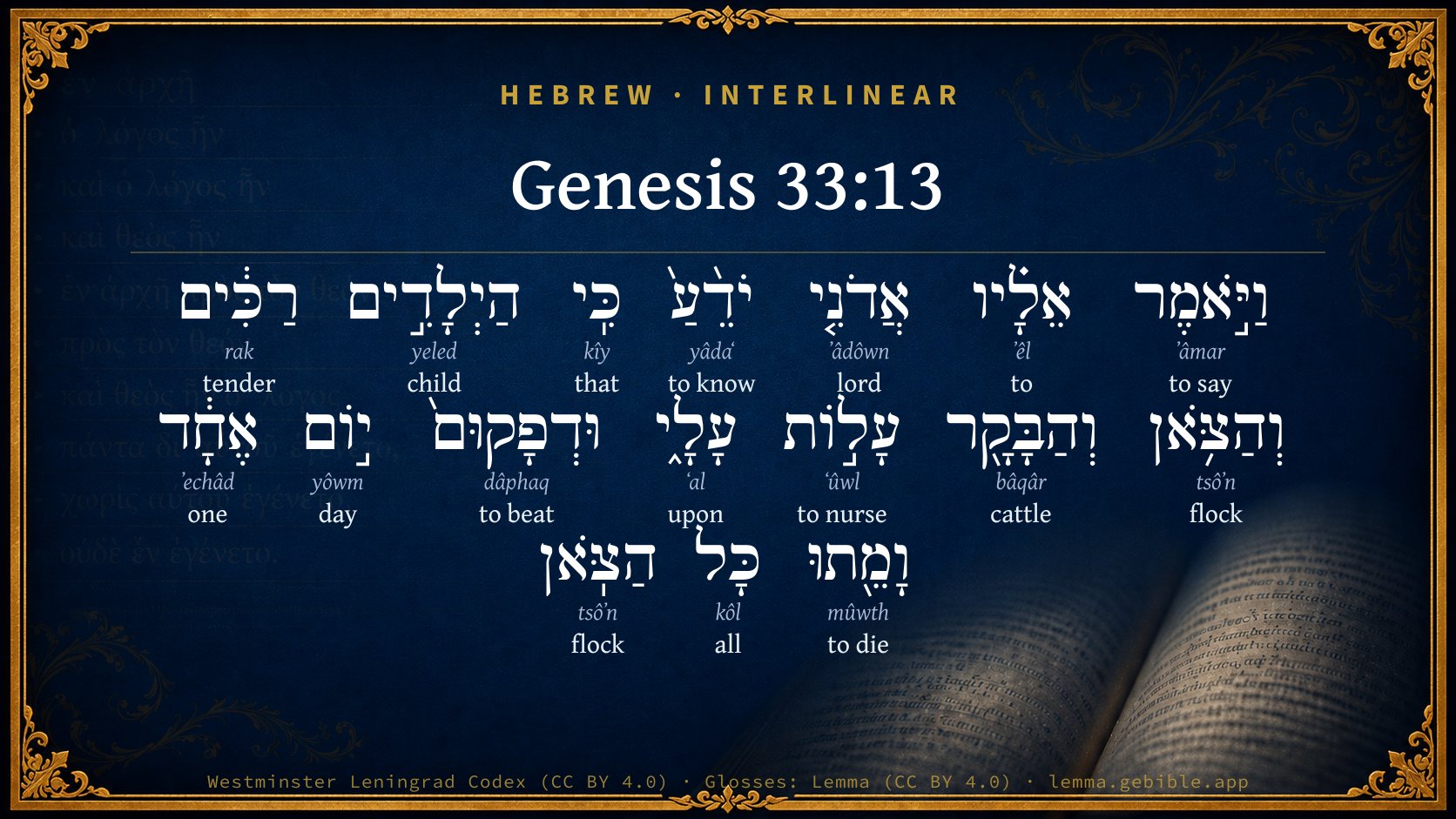
Genesis 33:13

Hebrew (Westminster Leningrad Codex) Genesis 33:13 appears in the Hebrew Old Testament. The text above is from the Westminster Leningrad Codex. Each word links to its Strong’s number, a concise gloss, and parsing drawn from the Open Scriptures Hebrew Bible morphology. Click any word for its full Brown-Driver-Briggs (BDB) entry.
Download image
Cite this verse

Genesis 33:13 (World English Bible). Public Domain. Lemma interlinear Bible study tool, https://lemma.gebible.app/v/genesis/33/13.

Show BibTeX & RIS
BibTeX
RIS
English Translation
Jacob said to him, "My lord knows that the children are tender, and that the flocks and herds with me have their young, and if they overdrive them one day, all the flocks will die.
World English Bible · Public Domain
Highlights
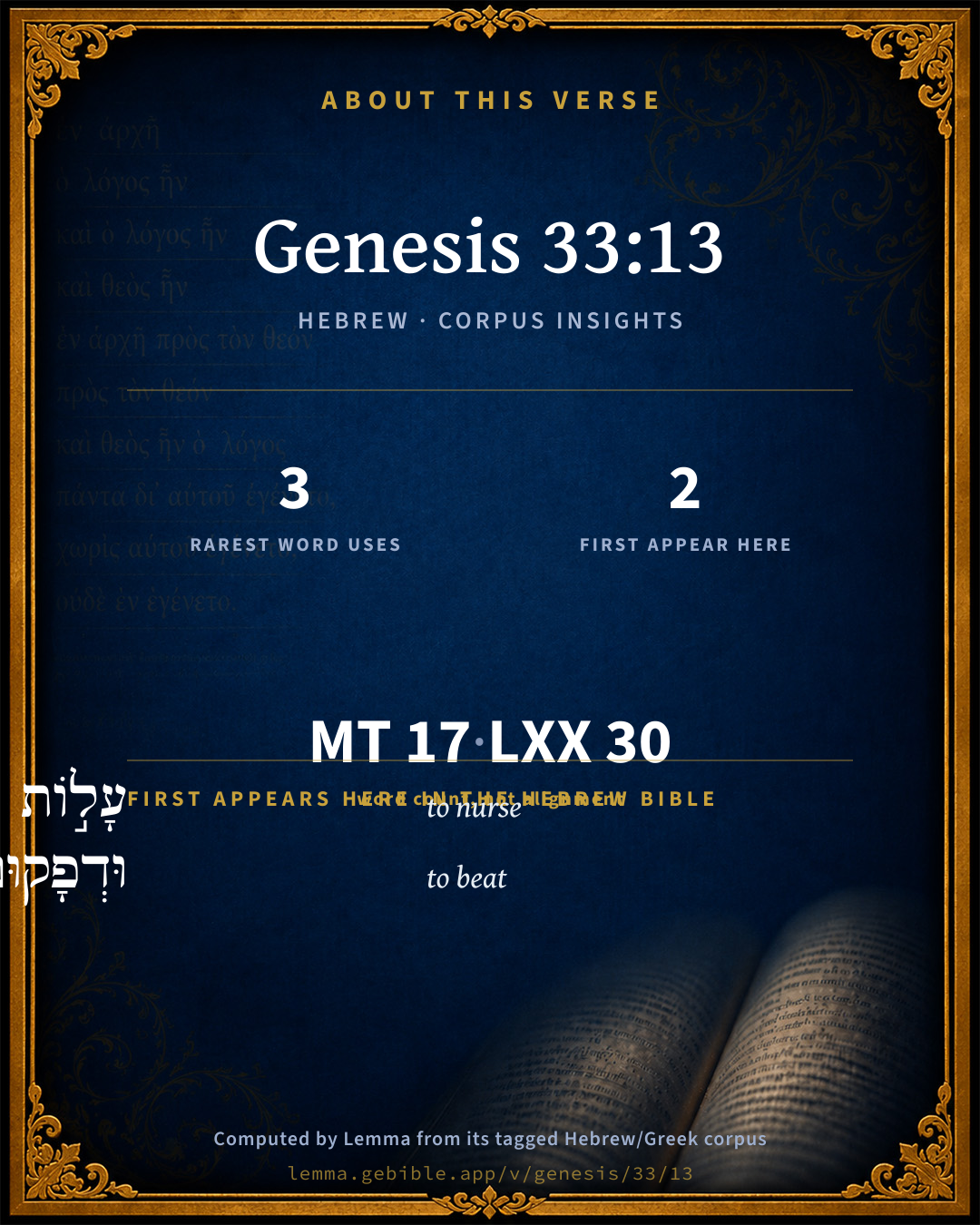
  • 2 first appearances in the Hebrew Bible
Full analysis ↓
Download a study sheet

One document with this verse’s original text, its word-by-word gloss line, the meaning frame, cross-references with their text, attributed commentary, and full source and license credits — printable, and it pastes into notes with its structure intact.

This verse Autodidact and up

Study sheet (.html) Plain text (.txt)

A passage Seminary Student

Up to 50 verses in one chapter. A passage sheet keeps up to 6 commentary sources and 12 cross-references per verse, in the order this page ranks them, and says so on the sheet whenever that leaves anything out. Ask for a single verse and you get the Autodidact verse sheet above.

Everything on this page stays free to read, with no account — the sheet is a download of what is already on screen, not access to it.

Want to remove ads? Support Godless Engineer
Compare translations 3

The same verse in 3 English versions, stacked beneath the original-language interlinear above. Click any original word for its lexicon entry.

Each is an independent rendering of the whole verse — the interlinear is not word-aligned to these translations.

Highlighted words mark where these versions differ — a whole-verse word diff, not a word-by-word alignment.

  • World English Bible Public Domain
    Jacob said to him, "My lord knows that the children are tender, and that the flocks and herds with me have their young, and if they overdrive them one day, all the flocks will die.
  • King James Version Public Domain
    And he said unto him, My lord knoweth that the children are tender, and the flocks and herds with young are with me: and if men should overdrive them one day, all the flock will die.
  • unfoldingWord Literal Text CC BY-SA 4.0
    But he said to him, “My lord knows that the children tender and the flock and the herd are nursing with me. And if they drive them one day, then all the flock will die.

unfoldingWord Literal Text — © unfoldingWord, licensed CC BY-SA 4.0. Word-aligned USFM3 via Door43 (git.door43.org/unfoldingWord/en_ult).

Versions to compare (up to 4)

3 of 4 selected

Show all 18 translations

Every available English version of this verse, each an independent rendering of the whole verse.

  • World English Bible Public Domain
    Jacob said to him, "My lord knows that the children are tender, and that the flocks and herds with me have their young, and if they overdrive them one day, all the flocks will die.
  • Berean Standard Bible Public Domain
    But Jacob replied, “My lord knows that the children are frail, and I must care for sheep and cattle that are nursing their young. If they are driven hard for even a day, all the animals will die.
  • Majority Standard Bible Public Domain
    But Jacob replied, “My lord knows that the children are frail, and I must care for sheep and cattle that are nursing their young. If they are driven hard for even a day, all the animals will die.
  • King James Version Public Domain
    And he said unto him, My lord knoweth that the children are tender, and the flocks and herds with young are with me: and if men should overdrive them one day, all the flock will die.
  • American Standard Version (1901) Public Domain
    And he said unto him, My lord knoweth that the children are tender, and that the flocks and herds with me have their young: and if they overdrive them one day, all the flocks will die.
  • Revised Version (1885) Public Domain
    And he said unto him, My lord knoweth that the children are tender, and that the flocks and herds with me give suck: and if they overdrive them one day, all the flocks will die.
  • Geneva Bible (1599) Public Domain
    Then he answered him, My lord knoweth, that the children are tender, and the ewes and kine with yong vnder mine hande: and if they should ouerdriue them one day, all the flocke would die.
  • Douay-Rheims (1899) Public Domain
    And Jacob said: My lord, thou knowest that I have with me tender children, and sheep, and kine with young: which if I should cause to be overdriven, in one day all the flocks will die.
  • Young's Literal Translation Public Domain
    And he saith unto him, `My lord knoweth that the children `are' tender, and the suckling flock and the herd `are' with me; when they have beaten them one day, then hath all the flock died.
  • Literal Standard Version CC BY-SA 4.0
    And he says to him, “My lord knows that the children [are] tender, and the suckling flock and the herd [are] with me; when they have beaten them one day, then all the flock has died.
  • Unlocked Literal Bible CC BY-SA 4.0
    Jacob said to him, “My master knows that the children are young, and that the sheep and the cattle are nursing their young. If they are driven hard even one day, all the animals will die.
  • unfoldingWord Literal Text CC BY-SA 4.0
    But he said to him, “My lord knows that the children tender and the flock and the herd are nursing with me. And if they drive them one day, then all the flock will die.
  • Darby Bible Public Domain
    And he said to him, My lord knows that the children are tender, and the suckling sheep and kine are with me; and if they should overdrive them only one day, all the flock would die.
  • World Messianic Bible Public Domain
    Jacob said to him, “My lord knows that the children are tender, and that the flocks and herds with me have their young, and if they overdrive them one day, all the flocks will die.
  • Webster's Bible Public Domain
    And he said to him, My lord knoweth that the children are tender, and the flocks and herds with young are with me, and if men should over-drive them one day, all the flock will die.
  • Free Bible Version CC BY-SA 4.0
    “My lord can see that the children are weak,” Jacob responded. “Also, the goats, sheep, and cattle are nursing their young, and if I push them too hard, they'll all die.
  • Bible in Basic English Public Domain
    But Jacob said, My lord may see that the children are only small, and there are young ones in my flocks and herds: one day's over-driving will be the destruction of all the flock.
  • JPS Tanakh (1917) Public Domain
    And he said unto him: 'My lord knoweth that the children are tender, and that the flocks and herds giving suck are a care to me; and if they overdrive them one day, all the flocks will die.

Literal Standard Version (2020), Covenant Press — licensed CC BY-SA 4.0. Text via the HelloAO Bible API (eBible.org). Unlocked Literal Bible (unfoldingWord) — licensed CC BY-SA 4.0. Text via the HelloAO Bible API (eBible.org). unfoldingWord Literal Text — © unfoldingWord, licensed CC BY-SA 4.0. Word-aligned USFM3 via Door43 (git.door43.org/unfoldingWord/en_ult). Free Bible Version, Dr. Jonathan Gallagher — licensed CC BY-SA 4.0. Text via the HelloAO Bible API (eBible.org).

Word by word

More ways to search: Search by grammar → Find every occurrence → Compare this word →

Practice this passage: Drill this verse → Learn its vocabulary →

וּדְפָקוּם֙
dâphaq
H1849
“and · to beat · them”
Conjunction + Verb, Qal, Sequential Perfect, 3rd Person, Common, Plural + Suffix, Personal, 3rd Person, Masculine, Plural
Part of Speech
Conjunction + Verb
Stem
Qal
Form
Sequential Perfect
Person
3rd Person
Gender
Common
Number
Plural
Full BDB Definition

Origin: a primitive root

TWOT: 447

to beat, knock - (Qal) - to beat, drive severely - to knock - (Hithpael) to beat violently
  1. וַיֹּ֣אמֶר ʼâmar H559 “and · to say” Conjunction + Verb, Qal, Sequential Imperfect, 3rd Person, Masculine, Singular
  2. אֵלָ֗יו ʼêl H413 “to · him” Preposition + Suffix, Personal, 3rd Person, Masculine, Singular
  3. אֲדֹנִ֤י ʼâdôwn H113 “lord · my” Noun, Common, Masculine, Singular, Construct + Suffix, Personal, 1st Person, Common, Singular
  4. יֹדֵ֨עַ֙ yâdaʻ H3045 “knowing” Verb, Qal, Participle Active, Masculine, Singular, Absolute
  5. כִּֽי kîy H3588 “that” Conjunction
  6. הַיְלָדִ֣ים yeled H3206 “the · children” Particle, Definite Article + Noun, Common, Masculine, Plural, Absolute
  7. רַכִּ֔ים rak H7390 “tender” Adjective, Adjective, Masculine, Plural, Absolute
  8. וְהַצֹּ֥אן tsôʼn H6629 “and · the · flock” Conjunction + Particle, Definite Article + Noun, Common, Both, Singular, Absolute
  9. וְהַבָּקָ֖ר bâqâr H1241 “and · the · cattle” Conjunction + Particle, Definite Article + Noun, Common, Both, Singular, Absolute
  10. עָל֣וֹת ʻûwl H5763 “nursing” Verb, Qal, Participle Active, Feminine, Plural, Absolute
  11. עָלָ֑י ʻal H5921 “upon · me” Preposition + Suffix, Personal, 1st Person, Common, Singular
  12. י֣וֹם yôwm H3117 “day” Noun, Common, Masculine, Singular, Absolute
  13. אֶחָ֔ד ʼechâd H259 “one” Adjective, Cardinal number, Masculine, Singular, Absolute
  14. וָמֵ֖תוּ mûwth H4191 “and · to die” Conjunction + Verb, Qal, Sequential Perfect, 3rd Person, Common, Plural
  15. כָּל kôl H3605 “all of” Noun, Common, Masculine, Singular, Construct
  16. הַצֹּֽאן tsôʼn H6629 “the · flock” Particle, Definite Article + Noun, Common, Both, Singular, Absolute

About this verse

These counts appear in no published source. They are computed here, from the morphology-tagged text and Lemma’s own curated glosses. What Lemma adds →

17
words
16
distinct lemmas
Pentateuch
section

Notable vocabulary

The rarest word here is וּדְפָקוּם֙ to beat H1849 — appearing just 3 times in the whole Hebrew Bible.

First appearance in Scripture

These words make their first canonical appearance in the Hebrew Bible here:

  • עָל֣וֹת to nurse H5763
  • וּדְפָקוּם֙ to beat H1849

Shared distinctive vocabulary

וּדְפָקוּם֙ to beat H1849 occurs in 3 verses of the Hebrew Bible. Also found in:

Grammatical profile

  • 5 verbs
  • 7 nouns
  • 2 adjectives
  • 2 prepositions
  • 1 conjunction

Verb forms

  • וַיֹּ֣אמֶר Qal · Sequential Imperfect
  • יֹדֵ֨עַ֙ Qal · Participle Active
  • עָל֣וֹת Qal · Participle Active
  • וּדְפָקוּם֙ Qal · Sequential Perfect
  • וָמֵ֖תוּ Qal · Sequential Perfect

Repetition

A word recurs within this verse — often emphatic in Hebrew:

  • וְהַצֹּ֥אן flock H6629 ×2

Hebrew & Septuagint length

In English translation the verse runs 35 words from the Hebrew and 39 from the Septuagint (LXX English) — closely comparable.

A rough comparison of the two English renderings, which tokenize alike — not a word-level alignment.

Word counts can differ between the Hebrew and the Greek without any difference in meaning — e.g. the Hebrew direct-object marker אֵת has no separate Greek word, and Greek often adds the article ὁ.

In the original languages it is 17 Hebrew tokens and 30 Greek tokens — but the two are counted differently (Hebrew bundles its prefixes and suffixes into one token; the Greek is in lemma form), so that isn’t a like-for-like length.

Cross-references

6

Topical passages linked to Genesis 33:13 in the Treasury of Scripture Knowledge — connected by theme and wording, ordered by reader-vote popularity; previews shown in the World English Bible.

  • Isaiah 40:11 He will feed his flock like a shepherd, he will gather the lambs in his arm, and carry them in his bosom, [and] will gently lead those who have their young.
  • Ezekiel 34:15–16 I myself will be the shepherd of my sheep, and I will cause them to lie down, says the Lord Yahweh.
  • 1 Chronicles 22:5 David said, Solomon my son is young and tender, and the house that is to be built for Yahweh must be exceedingly magnificent, of fame and of glory throughout all countries: I will therefore make preparation for it. So David prepared abundantly before his death.
  • Proverbs 12:10 A righteous man regards the life of his animal, But the tender mercies of the wicked are cruel.
  • Ezekiel 34:23–25 I will set up one shepherd over them, and he shall feed them, even my servant David; he shall feed them, and he shall be their shepherd.
  • John 21:15–17 So when they had eaten their breakfast, Jesus said to Simon Peter, "Simon, son of Jonah, do you love me more than these?" He said to him, "Yes, Lord; you know that I have affection for you." He said to him, "Feed my lambs."

Cross-references courtesy of OpenBible.info (CC BY 4.0).

Hebrew and Greek witnesses Masoretic Hebrew ↔ Greek Septuagint

The same verse in the two great witnesses to the Old Testament, shown verse-for-verse.

These are two independent witnesses, not word-aligned to each other, and the Septuagint is shown in lemma (dictionary) form.

Hebrew Genesis 33:13 Masoretic · Westminster Leningrad Codex

וַיֹּ֣אמֶר אֵלָ֗יו אֲדֹנִ֤י יֹדֵ֨עַ֙ כִּֽי הַיְלָדִ֣ים רַכִּ֔ים וְהַצֹּ֥אן וְהַבָּקָ֖ר עָל֣וֹת עָלָ֑י וּדְפָקוּם֙ י֣וֹם אֶחָ֔ד וָמֵ֖תוּ כָּל הַצֹּֽאן

Jacob said to him, "My lord knows that the children are tender, and that the flocks and herds with me have their young, and if they overdrive them one day, all the flocks will die.

World English Bible · Public Domain

Greek LXX Genesis 33:13 Septuagint · lemma form

εἶπον δέ αὐτός ὁ κύριος ἐγώ γιγνώσκω ὅτι ὁ παιδίον ἁπαλός καί ὁ πρόβατον καί ὁ βοῦς λοχεύω ἐπί ἐγώ ἐάν οὖν καταδιώκω αὐτός ἡμέρα εἷς ἀποθνήσκω πᾶς ὁ κτῆνος

And he said to him, My lord knows, that the children are very tender, and the flocks and the herds with me are with young; if then I shall drive them hard one day, all the cattle will die.

LXX2012 (modern English Septuagint) · Public Domain

Hebrew: Westminster Leningrad Codex (CC BY 4.0). Greek: Septuagint (public domain); English from LXX2012 (modern English Septuagint) (Public Domain). How the Septuagint differs from the Hebrew →

Targum (Aramaic paraphrase)

2

The Targum is the ancient Jewish Aramaic paraphrase of the Hebrew Scriptures — an interpretive translation, not the Hebrew text itself. Onkelos (literal) and Pseudo-Jonathan (expansive) render the Torah, and Jonathan the Prophets. Coverage is partial: where no permissively-licensed English translation exists for a verse, only the Aramaic is shown. This is verse-level text, not a word-by-word alignment to the Hebrew.

  1. Targum Onkelos Torah (Genesis–Deuteronomy)
    וַאֲמַר לֵהּ רִבּוֹנִי יְדַע אֲרֵי יָנְקַיָּא רַכִּיכִין וְעָנָא וְתוֹרֵי מֵינִקְתָּא עָלָי וּדְחוֹקִנּוּן יוֹמָא חַד וִימוּתוּן כָּל עָנָא

    (no public-domain English translation for this verse)

    Targum Onkelos — Aramaic: “Onkelos Genesis” (public domain); “Onkelos Exodus” (public domain); “Onkelos Leviticus” (public domain); “Onkelos Numbers” (public domain); “Onkelos Deuteronomy” (public domain). English: “Sefaria Community Translation” (CC0 1.0 (public-domain dedication)); “J.W. Etheridge. The Targums of Onkelos and Jonathan Ben Uzziel on the Pentateuch. London: Longmans, Green, 1862” (public domain). Text via Sefaria.

  2. Targum Pseudo-Jonathan Torah (Genesis–Deuteronomy)
    וַאֲמַר לֵיהּ רִבּוֹנִי יְדַע אֲרוּם טַלְיָיא חַטְיָן וְעָנָא וְתוֹרֵי דְמֵיַינְקַן עָלַי וְאִין דְחִיקְנָא לְהוֹם יוֹמָא חַד וִימוּתוּן כָּל עָנָא

    And he said to him, My lord knoweth that the children are tender, and the flocks and kine giving milk are with me; and if I overdrive them one day, all the flock may die.

    Targum Pseudo-Jonathan — Aramaic: “Targum Jonathan on Genesis” (public domain); “Targum Jonathan on Exodus” (public domain); “Targum Jonathan on Leviticus” (public domain); “Targum Jonathan on Numbers” (public domain); “Targum Jonathan on Deuteronomy” (public domain). English: “The Targum of Jonathan ben Uzziel, trans. J. W. Etheridge, London, 1862” (public domain). Text via Sefaria.

Commentary

Notes on Genesis 33:13 from classic Christian and Jewish commentators (each source and its license shown beneath its notes). The classic Christian expositions comment on the surrounding passage and are grouped to its opening verse, so a note may address several verses; the Jewish commentaries on the Tanakh (Rashi and others) are per-verse, so they appear only where the commentator wrote on this verse.

Lemma curates 59 commentaries, every one of them public domain or Creative Commons licensed, each selected and text-cleaned for this edition rather than reprinted as found. About our sources →

Trapp's Complete Commentary

John Trapp

Gen 33:13 And he said unto him, My lord knoweth that the children [are] tender, and the flocks and herds with young [are] with me: and if men should overdrive them one day, all the flock will die.

Ver. 13. If men should over-drive.] A pattern of a good pastor, ever to have an eye to the weak ones; and so to regard all in his flock, as he overdrive not any. "Who hath despised the day of small things?" {Zec 4:10} Weak ones are to be received, "but not to doubtful disputations." {Rom 14:1} Novices are not to be put upon the austerities of religion. {Mat 9:15} Christ preached "as they were able to hear." {Mar 4:33} Peter was specially charged to look to the "lambs." {Joh 21:15} Christ "bears them in his bosom, and gently leads those that are with young." {Isa 40:11}

John Trapp, A Commentary or Exposition upon All the Books of the Old and New Testament (1647–1656) — public domain. Text from a community e-Sword module.

The Biblical Illustrator

Joseph S. Exell

Gen_33:13

The children are tender

Gently! gently!

I.

LET US VIEW JACOB AS AN EXAMPLE TO US. Tender consideration for the young and feeble.

1. How we may overdrive.

(1) Puzzling them with deep and controversial points of doctrine, and condemning them because they are not quite correct in their opinions Rom_14:1).

(2) Setting up a standard of experience, and frowning at them because they have not felt all the sorrows or ecstasies which we have known.

(3) Requiring a high degree of faith, courage, patience, and other graces which in their case can only be tender buds.

(4) Fault-finding and never commending.

2. Why we should not overdrive the lambs.

(1) Common humanity forbids.

(2) Our own experience when we were young should teach us better.

(3) We may again become weak, and need great forbearance.

(4) We love them too well to be hard with them.

(5) Jesus thinks so much of them that we cannot worry them.

(6) The Holy Spirit dwells in them, and we must be gentle towards the faintest beginning of His work.

(7) We should be doing Satans work if we did overburden them.

(8) We should thus prove ourselves to have little wisdom and less grace. If we kill the lambs now, where shall we get our sheep from next year?

(9) We dare not bear the responsibility of offending these little ones, for terrible woes are pronounced on those who do them wrong.

(10) We remember how tender Jesus is: and this brings us to our second point.

II. LET US VIEW JACOB AS A PICTURE OF OUR LORD JESUS. See His portrait Isa_40:11.

1. The weak have a special place in His love.

2. He will not have it that any of them should die.

3. Therefore He never overdrives one of them.

4. But He suits His pace to their feebleness, I will lead on softly Gen_33:15).

I have many things to say unto you, but ye cannot bear them now. Has He not thus been very tender to us? Thy gentleness hath made me great Psa_18:35). Let us not fret and worry as though He were an exactor. We are not driven by Jehu, but led by Jesus. Let us rest in His love. At the same time let us not be slower than need be. Towards others let us be tenderness itself, for we are to love our neighbour as ourselves. (C. H.Spurgeon.)

Jacobs precaution

The angels of peace and of love seem to hover over the charm of the preceding scene; and the heart lingers with delight in contemplating the noble emulation of generosity and confidence. But is not this harmony too soon disturbed? Does not again a spirit of suspicion and reserve overshadow the mind of Jacob? Is he incapable of rising to the natural purity of his disinterested brother? Or does his keen intellect teach him how imprudent it would be unguardedly to rely upon the fallacious calmness of a passionate mind? Admitted even, that Jacobs apprehensions were, in this respect, exaggerated, his precaution was the result of a deep insight into Esaus character; the most insignificant circumstance might recall to his memory the events of the past; his rage might be re-kindled; and, though perhaps later bewailing his rashness, he might, by his superiority, be misled to deeds of cruel revenge. When, therefore, Esau wished to accompany Jacob, for protection, through the regions with which his excursions had made him familiar, the latter cautiously declined the offer; he refused even the garrison or guard which Esau proposed to leave him; but he promised, of his own accord, to visit him in his home in Seir; for he knew, that the sacred rights of hospitality would there protect him, even against an outbreak of passion. But though the objections of Jacob may have been as many evasions, they were not untruths; he could certainly not, without great danger, follow with his encumbered caravan, the march of Esau; and the latter seemed to acknowledge the justness of the remark; but he opposed the second offer with the simple question: Wherefore do I thus find grace in the sight of my lord? He invented no fictitious pretext; he thus almost exposed himself to the danger of arousing his brothers suspicion; but he had banished deceit from his heart; and he preferred risk to falsehood. (M. M. Kalisch, Ph. D.)

Sympathy for the feeble

The Lord chooses under-shepherds for His flock among men subject to weakness and infirmity, that they may have a fellow-feeling for the feeble. Selah Merrill, in his East of the Jordan, describes the movement of an Arab tribe, and says, The flocks of sheep and goats were mostly driven by small children. Sometimes there were flocks of lambs and kids driven by children not much older relatively than the lambs and kids themselves. Some of the men had in their arms two, three, four, or a whole armful of kids and lambs that were too young to walk; and among some cooking utensils there was a large saucepan, and in it was a pair of small kids that were too young for the journey. (C. H.Spurgeon.)

Gentle dealing for the feeble

When a candle is newly lighted and needs to be moved, it must be carried at a slow pace or it will be extinguished. A fire which is almost expiring may be revived by a gentle breath, but it will be blown out if the bellows are plied at their full force. You can drown a little plant by watering it too much, and destroy a lovely flower by exposing it to too much sun. (C. H. Spurgeon.)

Gentleness and strength go together

Nothing is so strong as gentleness; nothing so gentle as real strength. (Francis de Sales.)

Tenderness of manner

Even in our manner there should be tenderness. A truly kind act may be so performed as to cause as much grief as joy. We have heard of one who would throw a penny at a beggar and thus hurt him while relieving him. A heart full of love has a mode of its own by which its gifts are enhanced in value. There is enough misery in the world without our carelessly adding to it. Some persons are morbidly sensitive, and this is wrong on their part; but when we are aware of their failing we must be the more careful lest we cause them needless pain. A gouty man will cry out if we walk with heavy footstep across the room. Do we censure him for this? No, we pity him, and tread softly. Let us do the same for the sensitive. (C. H.Spurgeon.)

The weakest first

At the Stockwell Orphanage the usual rule of walking is--little boys first. In this way the younger children cannot be overdriven or left behind, and moreover all the boys can see before them, whereas by the usual practice of putting the tall fellows first the view in front is shut out from all but the few who lead the way. Let the Church have great care for the weaker brethren, and shape her action with a constant reference to them. A strong Christian might do a thousand things lawfully if he only thought of himself, but he will not do one of them because he wishes to act expediently, and would not grieve his brother, or cause him to stumble.

The Biblical Illustrator, edited by Joseph S. Exell (c. 1880s–1900s) — public domain. Text from a community e-Sword module.

John Calvin's Commentaries

13. My lord knoweth. The things which Jacob alleges, as grounds of excuse, are true; nevertheless he introduces them under false pretexts; except, perhaps, as regards the statement, that he was unwilling to be burdensome and troublesome to his brother. But since he afterwards turns his journey in another direction, it appears that he feigned something foreign to what was really in his mind. He says that he brings with him many encumbrances, and therefore requests his brother to precede him. “I will follow” (he says) “at the feet of the children;” that is, I will proceed gently as the pace of the children will bear; and thus I will follow at my leisure, until I come to thee in Mount Seir. In these words he promises what he was not intending to do; for, leaving his brother, he journeyed to a different place. But truth is so precious to God, that he will not allow us to lie or deceive, even when no injury follows. Wherefore, we must take care, when any fear of danger occupies our minds, that we do not turn aside to these subterfuges.

John Calvin's Commentaries (1540-1563) — public domain. Text from the Calvin Translation Society English edition (1840s-50s) via the Christian Classics Ethereal Library (ccel.org). Calvin's coverage is partial (roughly two-thirds of the Bible); uncommented books and verses are honest gaps, never fabricated. The 19th-century editor's footnotes and remarks are omitted so the notes are faithfully Calvin's own voice.

Ellicott's Commentary for English Readers

(13) Flocks and herds with young.—Heb., that give such. Thompson (Land and Book, p. 205) infers from this that it was now winter, and thinks that this is confirmed by Jacob making folds for his cattle at Succoth. If so, more than six months would have elapsed since Jacob’s flight from Haran; but the conclusion is uncertain, and Jacob probably halted at Succoth because of his lameness.

A Bible Commentary for English Readers, edited by Charles John Ellicott (1878–1897) — public domain. Text from a community e-Sword module.

The Cambridge Bible for Schools and Colleges

gen. ed. J. J. S. Perowne

13. tender] i.e. young and unequal to the fatigues of travel.

The Cambridge Bible for Schools and Colleges (gen. ed. J. J. S. Perowne; Cambridge University Press, 1878–1918) — public domain. Text from a community e-Sword module.

John Gill's Exposition

And he said unto him, my lord knoweth the children are tender,.... The eldest being but thirteen years of age, and the youngest about six; and Esau might easily perceive by their stature that they were young and tender, and not able to bear either riding or walking very fast:

and the flocks and herds with young are with me; or "upon me" (r); the charge of them was upon him, it was incumbent on him to take care of them, and especially in the circumstances in which they were, being big with young, both sheep and kine; or "suckling", giving milk to their young, as the Targums of Onkelos and Jonathan, and so having lambs and calves, some of them perhaps just yeaned and calved, they required more attendance and greater care in driving them, not being able to travel far in a day:

and if men should overdrive them one day, all the flock will die; if he, and the servants under him, should push them on too fast, beyond their strength, even but one day, all in the above circumstances would be in danger of being lost through overmuch fatigue and weariness.

(r) "super me", Montanus, Vatablus, "incumbere mihi", Junius & Tremellius, so Aben Ezra.

John Gill's Exposition of the Whole Bible (1746–1763) — public domain (CC PDM 1.0). Text via the HelloAO Bible API.

Haydock's Catholic Bible Commentary

Young, boves fœtus, giving milk, having calved lately, Seputagint. (Bochart.) (Calmet)

George Leo Haydock (1774–1849), Haydock's Catholic Family Bible and Commentary, 1859 edition — public domain. Excludes Psalms (Douay-Rheims chapter numbering differs from Protestant) and Deuterocanonical books (Catholic canon only).

Matthew Poole's English Annotations

The children are tender; the eldest of them, Reuben, not being yet fourteen years old.

The flocks and herds with young are with me; or, upon me, i.e. committed to my care, to be managed as their necessities require. See Isa 40:11.

Matthew Poole's English Annotations on the Holy Bible (1683–1685) — public domain. Text from a community e-Sword/MySword module.

The Pulpit Commentary

And he (Jacob, politely declining Esau"s society and protection, though apparently accepting his invitation to go to Mount Seir) said unto him, My lord knoweth that the children are tender (Joseph at this time being little over six years of age), and the flocks and herds with young (literally, giving milk; twOl, from lW, to give suck) are with me, literally, upon me, i.e. are an object of my special care, because of their condition (Rosenm Keil)and if men should overdrive them literally, and they (sc. the shepherds) will over-drive them, i.e. in order to keep pace with Esau"s armed followers they must do so, and in that case, if they were to do so for onlyone day, all the flock (literally, and all the flock) will die. Thomson says that Oriental shepherds gently lead along the mothers when in the condition spoken of by Jacob, knowing well that even one day"s over-driving would be fatal to them, and, from the fact that Jacob"s ewes were giving milk, infers that it was winter time, since then alone the flocks are in that condition an inference which he further confirms by observing that at Succoth Jacob constructed booths for their protection ("Land and Book," p. 205).

The Pulpit Commentary (1880–1919), ed. H.D.M. Spence-Jones & Joseph S. Exell — public domain. Text from a community e-Sword module.

Scofield Reference Notes

C. I. Scofield

My lord

Not all at once does "Jacob" cease to dominate the walk of "Israel." Cf. Gen 35:1-10 where the walk becomes according to the new name.

The Scofield Reference Bible (1917 edition), notes by C. I. Scofield — public domain. Text from a community e-Sword module.

Rashi

Rabbi Shlomo Yitzchaki (Rashi)

עלות עלי WITH YOUNG ARE WITH ME — The sheep and the oxen which are giving suck constitute a charge upon me (עלי) to drive them slowly.

עלות means bringing up their young. Words of the same root are found in (Lamentations 2:11) “young children (עולל) and the sucklings”: (IsaiahLXV.20) “an infant (עול) of days”: (1 Samuel 6:7) “and two milch kine (עלות)”. old French enfantées.

ודפקום יום אחד AND IF MEN SHOULD OVERDRIVE THEM, wearying them on the journey by making them run, מתו כל הצאן ALL THE FLOCKS WILL DIE.

ודפקום has the same meaning as in (Song. 5:2) “Hark, my beloved knocketh (דופק)” — knocks at the door — so that it means to beat the animals in order that they may travel quickly.

Rashi on the Tanakh — English translations: “The Judaica Press complete Tanach with Rashi, translated by A. J. Rosenberg” (CC BY 4.0); “Pentateuch with Rashi's commentary by M. Rosenbaum and A.M. Silbermann, 1929-1934” (public domain); “The Metsudah Tanach series, Lakewood, N.J” (CC BY 4.0); and “The Book of Joshua, Metsudah Publications, 1997” (CC BY 4.0). Text via Sefaria.

Ramban (Nachmanides)

Rabbi Moshe ben Nachman (Ramban / Nachmanides)

AND ALL THE FLOCKS WILL DIE. Jacob said this in a compassionate manner for he should have said, “And they will all die,” but he would not express himself this way about the children. Neither did he wish to say, “and they will die,” with reference to the herds and the flocks, because he had compassion on the children lest they be included by implication. He also did not want to be verbose and say, “and all the flocks and herds will die.” It may be that the explanation of the verse is that “the children are tender — even the youths shall faint and be weary — and they will not want to go, and that the flocks and herds giving suck are a care to me, and if they will be overdriven the flocks will die, as they are small cattle, but the herds [signifying larger cattle] will not die although they will be harmed.”

Ramban (Nachmanides) on the Tanakh — English translation: “Commentary on the Torah by Ramban (Nachmanides). Translated and annotated by Charles B. Chavel. New York, Shilo Pub. House, 1971-1976” (CC BY 4.0). Text via Sefaria.

Radak

Rabbi David Kimhi (Radak)

ויאמר...עלות עלי, the word עלות is a term denoting mother animals that are still suckling their young. It is important for their well being that they not be hurried.

עלי, it us to me to take care of them by leading them at a leisurely pace.

ודפקום, if they were to be pushed (rushed), Yaakov explained that if his shepherds were to rush these animals even for a single day the sheep would all die from exhaustion. [the author understands Yaakov as telling Esau that “too much can be too little, sometimes.” This is why he quotes Isaiah 30,20. Ed.] In that verse the prophet explains that when G’d provides לחם צר ומים לחץ, “meager bread and scant water,” this is a promise and not a punishment. Too much of a good thing would be counterproductive, would ruin the health of recipient. Hence it is better for the sheep not to travel too fast.

ומתו, the prefix ו in this word is analogous to similar prefixes in the words ורכב וסוס in Psalms76,7, and other similar examples. [the point is that the Torah did not write umeytu, but vameytu. Ed.]

Radak on the Tanakh — English translations: “Sefaria Community Translation” (CC0 1.0 (public-domain dedication)); “Eliyahu Munk, HaChut Hameshulash” (CC BY 4.0); “Rabbi Mike Feuer, Jerusalem Anthology” (CC BY 4.0); and “R. David Kimhi on the first book of Psalms, Translated by R.G. Finch, London, 1919” (public domain). Text via Sefaria.

Lesson kit

Teaching starters — assembled from the data on this page, not authored interpretation. Every prompt links to the verse data it draws on. Edit before teaching.

Genesis, in the Pentateuch, opens this verse with 17 words (16 distinct Hebrew lemmas). Its most distinctive word is dâphaq (“to beat”). A historical commentator’s framing appears above. Read the whole chapter for the surrounding context.

Discussion questions

  1. How does “to beat” (dâphaq) shape what this verse is saying?
  2. 2 words here appear for the first time in Scripture. What is being introduced at this debut?
  3. Judges 19:22 shares the word «to beat» with this verse. How do the two illuminate each other?
  4. “flock” occurs 2× in this one verse. What is the effect of the repetition?
  5. These translations render this verse differently. What is at stake in choosing one wording over another?
  6. The verb «וַיֹּ֣אמֶר» is Qal Sequential Imperfect. How does its form color the action?
  7. Reading how Trapp's Complete Commentary and The Biblical Illustrator read this verse, where do the two commentators agree and where do they part?

Things to notice

Reading settings

Reading text

Shown beneath each verse's original-language words.

Old Testament
Old Testament edition

Read the OT as the Masoretic Hebrew (MT) or the Greek Septuagint (LXX).

English shown for the Greek Septuagint (in the Hebrew ↔ Greek comparison).

Comparing translations? Open the Compare panel on any verse page to stack up to four side by side.