
Genesis 47:29

Hebrew (Westminster Leningrad Codex) Genesis 47:29 appears in the Hebrew Old Testament. The text above is from the Westminster Leningrad Codex. Each word links to its Strong’s number, a concise gloss, and parsing drawn from the Open Scriptures Hebrew Bible morphology. Click any word for its full Brown-Driver-Briggs (BDB) entry.
Download image
Cite this verse

Genesis 47:29 (World English Bible). Public Domain. Lemma interlinear Bible study tool, https://lemma.gebible.app/v/genesis/47/29.

Show BibTeX & RIS
BibTeX
RIS
English Translation
The time drew near that Israel must die, and he called his son Joseph, and said to him, "If now I have found favor in your sight, please put your hand under my thigh, and deal kindly and truly with me. Please don't bury me in Egypt,
World English Bible · Public Domain
Download a study sheet

One document with this verse’s original text, its word-by-word gloss line, the meaning frame, cross-references with their text, attributed commentary, and full source and license credits — printable, and it pastes into notes with its structure intact.

This verse Autodidact and up

Study sheet (.html) Plain text (.txt)

A passage Seminary Student

Up to 50 verses in one chapter. A passage sheet keeps up to 6 commentary sources and 12 cross-references per verse, in the order this page ranks them, and says so on the sheet whenever that leaves anything out. Ask for a single verse and you get the Autodidact verse sheet above.

Everything on this page stays free to read, with no account — the sheet is a download of what is already on screen, not access to it.

Want to remove ads? Support Godless Engineer
Compare translations 3

The same verse in 3 English versions, stacked beneath the original-language interlinear above. Click any original word for its lexicon entry.

Each is an independent rendering of the whole verse — the interlinear is not word-aligned to these translations.

Highlighted words mark where these versions differ — a whole-verse word diff, not a word-by-word alignment.

  • World English Bible Public Domain
    The time drew near that Israel must die, and he called his son Joseph, and said to him, "If now I have found favor in your sight, please put your hand under my thigh, and deal kindly and truly with me. Please don't bury me in Egypt,
  • King James Version Public Domain
    And the time drew nigh that Israel must die: and he called his son Joseph, and said unto him, If now I have found grace in thy sight, put, I pray thee, thy hand under my thigh, and deal kindly and truly with me; bury me not, I pray thee, in Egypt:
  • unfoldingWord Literal Text CC BY-SA 4.0
    and the days of Israel drew near to die. So he called for his son, for Joseph, and said to him, “If, please, I have found favor in your eyes, please put your hand under my thigh, and deal with me kindness and faithfulness. Please do not bury me in Egypt.

unfoldingWord Literal Text — © unfoldingWord, licensed CC BY-SA 4.0. Word-aligned USFM3 via Door43 (git.door43.org/unfoldingWord/en_ult).

Versions to compare (up to 4)

3 of 4 selected

Show all 18 translations

Every available English version of this verse, each an independent rendering of the whole verse.

  • World English Bible Public Domain
    The time drew near that Israel must die, and he called his son Joseph, and said to him, "If now I have found favor in your sight, please put your hand under my thigh, and deal kindly and truly with me. Please don't bury me in Egypt,
  • Berean Standard Bible Public Domain
    When the time drew near for Israel to die, he called his son Joseph and said to him, “If I have found favor in your eyes, put your hand under my thigh and promise to show me kindness and faithfulness. Do not bury me in Egypt,
  • Majority Standard Bible Public Domain
    When the time drew near for Israel to die, he called his son Joseph and said to him, “If I have found favor in your eyes, put your hand under my thigh and promise to show me kindness and faithfulness. Do not bury me in Egypt,
  • King James Version Public Domain
    And the time drew nigh that Israel must die: and he called his son Joseph, and said unto him, If now I have found grace in thy sight, put, I pray thee, thy hand under my thigh, and deal kindly and truly with me; bury me not, I pray thee, in Egypt:
  • American Standard Version (1901) Public Domain
    And the time drew near that Israel must die: and he called his son Joseph, and said unto him, If now I have found favor in thy sight, put, I pray thee, thy hand under my thigh, and deal kindly and truly with me: bury me not, I pray thee, in Egypt;
  • Revised Version (1885) Public Domain
    And the time drew near that Israel must die: and he called his son Joseph, and said unto him, If now I have found grace in thy sight, put, I pray thee, thy hand under my thigh, and deal kindly and truly with me; bury me not, I pray thee, in Egypt:
  • Geneva Bible (1599) Public Domain
    Now when the time drewe neere that Israel must dye, he called his sonne Ioseph, and sayde vnto him, If I haue nowe founde grace in thy sight, put thine hand nowe vnder my thigh, and deale mercifully and truely with me: burie me not, I pray thee, in Egypt.
  • Douay-Rheims (1899) Public Domain
    And when he saw that the day of his death drew nigh, he called his son Joseph, and said to him: If I have found favour in thy sight, put thy hand under my thigh; and thou shalt shew me this kindness and truth, not to bury me in Egypt:
  • Young's Literal Translation Public Domain
    And the days of Israel are near to die, and he calleth for his son, for Joseph, and saith to him, `If, I pray thee, I have found grace in thine eyes, put, I pray thee, thy hand under my thigh, and thou hast done with me kindness and truth; bury me not, I pray thee, in Egypt,
  • Literal Standard Version CC BY-SA 4.0
    And the days of Israel are near to die, and he calls for his son, for Joseph, and says to him, “Now if I have found grace in your eyes, please put your hand under my thigh, and you have done kindness and truth with me; please do not bury me in Egypt,
  • Unlocked Literal Bible CC BY-SA 4.0
    When the time approached for Israel to die, he called his son Joseph and said to him, “If now I have found favor in your eyes, put your hand under my thigh, and show me faithfulness and trustworthiness. Please do not bury me in Egypt.
  • unfoldingWord Literal Text CC BY-SA 4.0
    and the days of Israel drew near to die. So he called for his son, for Joseph, and said to him, “If, please, I have found favor in your eyes, please put your hand under my thigh, and deal with me kindness and faithfulness. Please do not bury me in Egypt.
  • Darby Bible Public Domain
    And the days of Israel approached that he should die. And he called his son Joseph, and said to him, If now I have found favour in thine eyes, put, I pray thee, thy hand under my thigh, and deal kindly and truly with me: bury me not, I pray thee, in Egypt;
  • World Messianic Bible Public Domain
    The time came near that Israel must die, and he called his son Joseph, and said to him, “If now I have found favor in your sight, please put your hand under my thigh, and deal kindly and truly with me. Please don’t bury me in Egypt,
  • Webster's Bible Public Domain
    And the time drew nigh that Israel must die: and he called his son Joseph, and said to him, If now I have found grace in thy sight, put, I pray thee, thy hand under my thigh, and deal kindly and truly with me; bury me not, I pray thee, in Egypt:
  • Free Bible Version CC BY-SA 4.0
    When the time came for Israel to die, he called for his son Joseph and said to him, “If you think well of me, place your hand under my thigh and promise to treat me with trustworthy love and faithfulness. Don't bury me here in Egypt.
  • Bible in Basic English Public Domain
    And the time of his death came near, and he sent for his son Joseph and said to him, If now I am dear to you, put your hand under my leg and take an oath that you will not put me to rest in Egypt;
  • JPS Tanakh (1917) Public Domain
    And the time drew near that Israel must die; and he called his son Joseph, and said unto him: 'If now I have found favour in thy sight, put, I pray thee, thy hand under my thigh, and deal kindly and truly with me; bury me not, I pray thee, in Egypt.

Literal Standard Version (2020), Covenant Press — licensed CC BY-SA 4.0. Text via the HelloAO Bible API (eBible.org). Unlocked Literal Bible (unfoldingWord) — licensed CC BY-SA 4.0. Text via the HelloAO Bible API (eBible.org). unfoldingWord Literal Text — © unfoldingWord, licensed CC BY-SA 4.0. Word-aligned USFM3 via Door43 (git.door43.org/unfoldingWord/en_ult). Free Bible Version, Dr. Jonathan Gallagher — licensed CC BY-SA 4.0. Text via the HelloAO Bible API (eBible.org).

Word by word

More ways to search: Search by grammar → Find every occurrence → Compare this word →

Practice this passage: Drill this verse → Learn its vocabulary →

יְרֵכִ֑י
yârêk
H3409
“thigh · my”
Noun, Common, Feminine, Singular, Construct + Suffix, Personal, 1st Person, Common, Singular
Part of Speech
Noun
Type
Common
Gender
Feminine
Number
Singular
State
Construct
Full BDB Definition

Origin: from an unused root meaning to be soft

TWOT: 916a

thigh, side, loin, base - thigh - outside of thigh (where sword was worn) - loins (as the seat of procreative power) - side (flank) (of object) - base
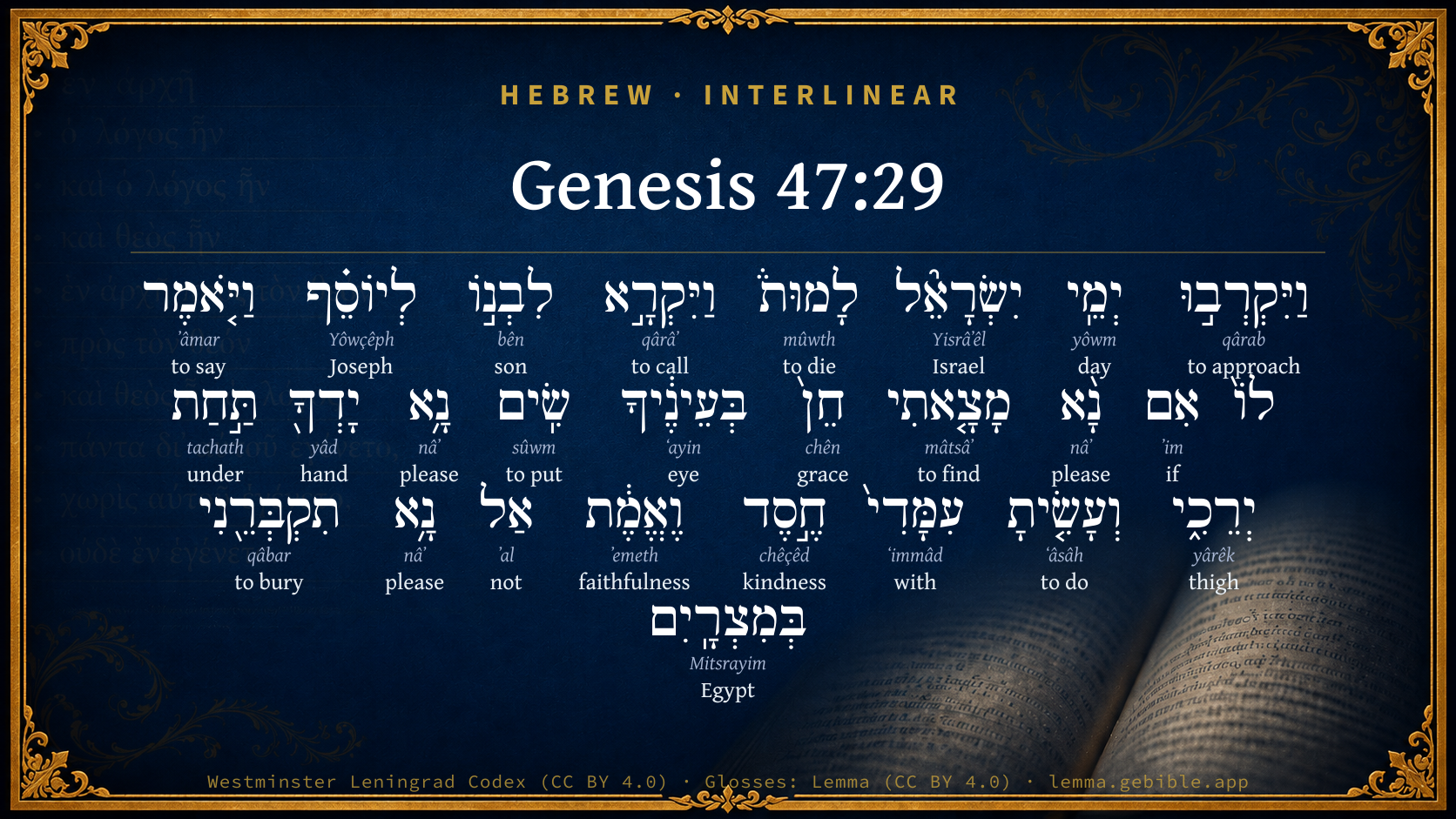
  1. וַיִּקְרְב֣וּ qârab H7126 “and · to approach” Conjunction + Verb, Qal, Sequential Imperfect, 3rd Person, Masculine, Plural
  2. יְמֵֽי yôwm H3117 “days of” Noun, Common, Masculine, Plural, Construct
  3. יִשְׂרָאֵ֘ל Yisrâʼêl H3478 “Israel” Noun, Proper
  4. לָמוּת֒ mûwth H4191 “to die” Preposition + Verb, Qal, Infinitive Construct
  5. וַיִּקְרָ֣א qârâʼ H7121 “and · to call” Conjunction + Verb, Qal, Sequential Imperfect, 3rd Person, Masculine, Singular
  6. לִבְנ֣וֹ bên H1121 “to/for · son · his” Preposition + Noun, Common, Masculine, Singular, Construct + Suffix, Personal, 3rd Person, Masculine, Singular
  7. לְיוֹסֵ֗ף Yôwçêph H3130 “to/for · Joseph” Preposition + Noun, Proper
  8. וַיֹּ֤אמֶר ʼâmar H559 “and · to say” Conjunction + Verb, Qal, Sequential Imperfect, 3rd Person, Masculine, Singular
  9. אִם ʼim H518 “if” Conjunction
  10. נָ֨א nâʼ H4994 “please” Particle, Exhortation
  11. מָצָ֤אתִי mâtsâʼ H4672 “to find” Verb, Qal, Perfect, 1st Person, Common, Singular
  12. חֵן֙ chên H2580 “grace” Noun, Common, Masculine, Singular, Absolute
  13. בְּעֵינֶ֔יךָ ʻayin H5869 “in/at · eyes · your” Preposition + Noun, Common, Both, Dual, Construct + Suffix, Personal, 2nd Person, Masculine, Singular
  14. שִֽׂים sûwm H7760 “put” Verb, Qal, Imperative, 2nd Person, Masculine, Singular
  15. נָ֥א nâʼ H4994 “please” Particle, Exhortation
  16. יָדְךָ֖ yâd H3027 “hand · your” Noun, Common, Both, Singular, Construct + Suffix, Personal, 2nd Person, Masculine, Singular
  17. תַּ֣חַת tachath H8478 “under” Preposition
  18. וְעָשִׂ֤יתָ ʻâsâh H6213 “and · to do” Conjunction + Verb, Qal, Sequential Perfect, 2nd Person, Masculine, Singular
  19. עִמָּדִי֙ ʻimmâd H5978 “with · me” Preposition + Suffix, Personal, 1st Person, Common, Singular
  20. חֶ֣סֶד chêçêd H2617 “kindness” Noun, Common, Masculine, Singular, Absolute
  21. וֶאֱמֶ֔ת ʼemeth H571 “and · faithfulness” Conjunction + Noun, Common, Feminine, Singular, Absolute
  22. אַל ʼal H408 “not” Particle, Negative
  23. נָ֥א nâʼ H4994 “please” Particle, Exhortation
  24. תִקְבְּרֵ֖נִי qâbar H6912 “to bury · me” Verb, Qal, Jussive, 2nd Person, Masculine, Singular + Suffix, Personal, 1st Person, Common, Singular
  25. בְּמִצְרָֽיִם Mitsrayim H4714 “in/at · Egypt” Preposition + Noun, Proper

About this verse

These counts appear in no published source. They are computed here, from the morphology-tagged text and Lemma’s own curated glosses. What Lemma adds →

27
words
24
distinct lemmas
Pentateuch
section

Shared distinctive vocabulary

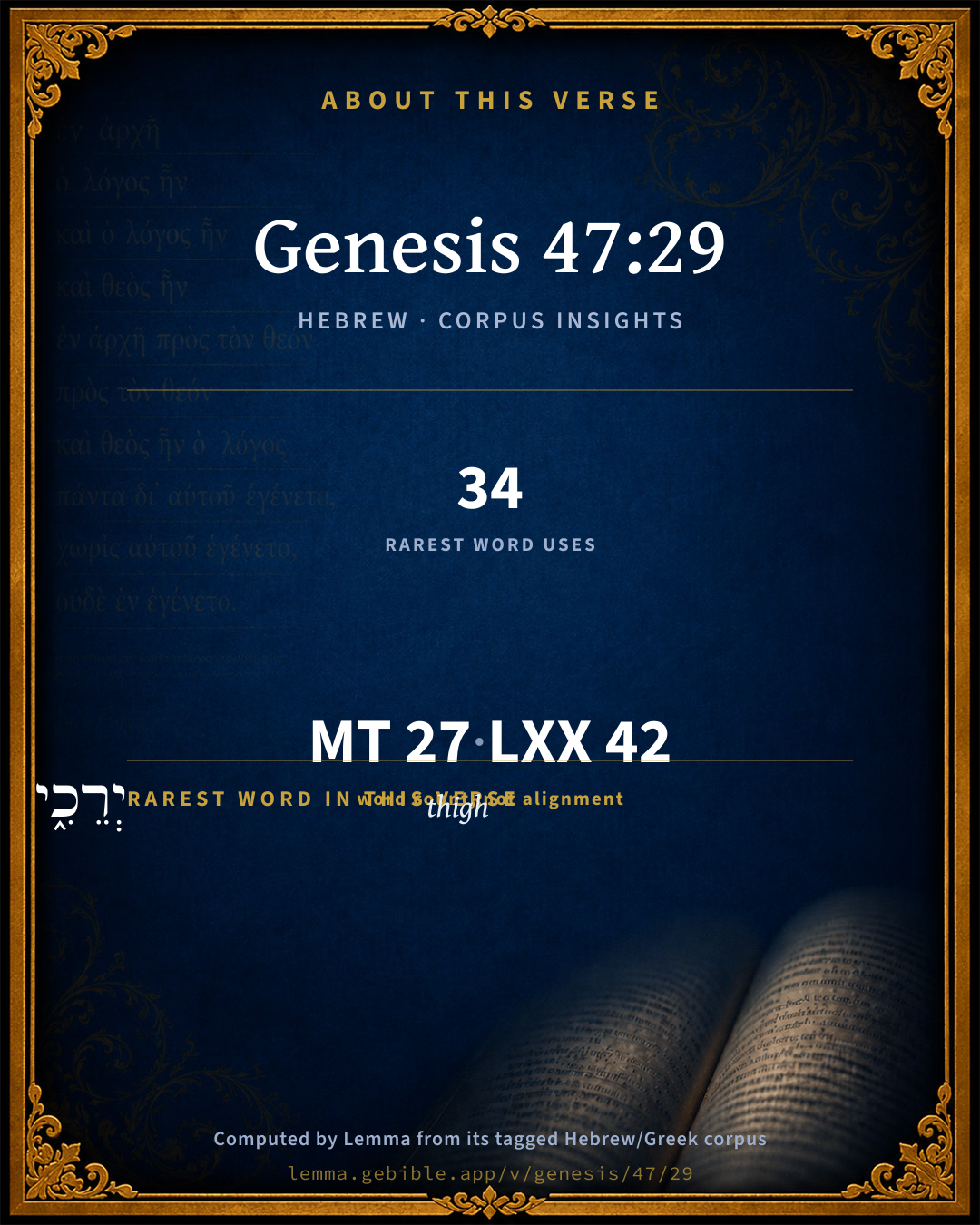
יְרֵכִ֑י thigh H3409 occurs in 32 verses of the Hebrew Bible. Also found in:

Grammatical profile

  • 8 verbs
  • 11 nouns
  • 3 prepositions
  • 1 conjunction
  • 4 particles

Verb forms

  • וַיִּקְרְב֣וּ Qal · Sequential Imperfect
  • לָמוּת֒ Qal · Infinitive Construct
  • וַיִּקְרָ֣א Qal · Sequential Imperfect
  • וַיֹּ֤אמֶר Qal · Sequential Imperfect
  • מָצָ֤אתִי Qal · Perfect
  • שִֽׂים Qal · Imperative
  • וְעָשִׂ֤יתָ Qal · Sequential Perfect
  • תִקְבְּרֵ֖נִי Qal · Jussive

Repetition

A word recurs within this verse — often emphatic in Hebrew:

  • נָ֨א please H4994 ×3

Hebrew & Septuagint length

In English translation the verse runs 47 words from the Hebrew and 51 from the Septuagint (LXX English) — closely comparable.

A rough comparison of the two English renderings, which tokenize alike — not a word-level alignment.

Word counts can differ between the Hebrew and the Greek without any difference in meaning — e.g. the Hebrew direct-object marker אֵת has no separate Greek word, and Greek often adds the article ὁ.

In the original languages it is 27 Hebrew tokens and 42 Greek tokens — but the two are counted differently (Hebrew bundles its prefixes and suffixes into one token; the Greek is in lemma form), so that isn’t a like-for-like length.

Cross-references

19

Topical passages linked to Genesis 47:29 in the Treasury of Scripture Knowledge — connected by theme and wording, ordered by reader-vote popularity; previews shown in the World English Bible.

  • Genesis 24:2 Abraham said to his servant, the elder of his house, who ruled over all that he had, "Please put your hand under my thigh.
  • Genesis 24:49 Now if you will deal kindly and truly with my master, tell me. If not, tell me. That I may turn to the right hand, or to the left."
  • Deuteronomy 31:14 Yahweh said to Moses, Behold, your days approach that you must die: call Joshua, and present yourselves in the tent of meeting, that I may give him a charge. Moses and Joshua went, and presented themselves in the tent of meeting.
  • 1 Kings 2:1 Now the days of David drew near that he should die; and he charged Solomon his son, saying,
  • Genesis 50:24–25 Joseph said to his brothers, "I am dying, but God will surely visit you, and bring you up out of this land to the land which he swore to Abraham, to Isaac, and to Jacob."
  • Acts 7:15–16 Jacob went down into Egypt, and he died, himself and our fathers,
  • Genesis 3:19 By the sweat of your face will you eat bread until you return to the ground, for out of it you were taken. For you are dust, and to dust you shall return."
  • Genesis 47:9 Jacob said to Pharaoh, "The days of the years of my pilgrimage are one hundred thirty years. Few and evil have been the days of the years of my life, and they have not attained to the days of the years of the life of my fathers in the days of their pilgrimage."
  • 2 Samuel 7:12 When your days are fulfilled, and you shall sleep with your fathers, I will set up your seed after you, who shall proceed out of your bowels, and I will establish his kingdom.
  • 2 Samuel 14:14 For we must needs die, and are as water split on the ground, which can't be gathered up again; neither does God take away life, but devises means, that he who is banished not be an outcast from him.
  • Job 7:1 "Isn't a man forced to labor on earth? Aren't his days like the days of a hired hand?
  • Job 14:14 If a man dies, shall he live again? All the days of my warfare would I wait, Until my release should come.
  • Job 30:23 For I know that you will bring me to death, To the house appointed for all living.
  • Psalms 6:5 For in death there is no memory of you. In Sheol, who shall give you thanks?
  • Psalms 49:7 None of them can by any means redeem his brother, Nor give God a ransom for him.
  • Psalms 49:9 That he should live on forever, That he should not see corruption.
  • Psalms 89:48 What man is he who shall live and not see death, Who shall deliver his soul from the power of Sheol? Selah.
  • Hebrews 9:27 Inasmuch as it is appointed for men to die once, and after this, judgment,
  • Hebrews 11:22 By faith, Joseph, when his end was near, made mention of the departure of the children of Israel; and gave instructions concerning his bones.

Cross-references courtesy of OpenBible.info (CC BY 4.0).

Hebrew and Greek witnesses Masoretic Hebrew ↔ Greek Septuagint

The same verse in the two great witnesses to the Old Testament, shown verse-for-verse.

These are two independent witnesses, not word-aligned to each other, and the Septuagint is shown in lemma (dictionary) form.

Hebrew Genesis 47:29 Masoretic · Westminster Leningrad Codex

וַיִּקְרְב֣וּ יְמֵֽי יִשְׂרָאֵ֘ל לָמוּת֒ וַיִּקְרָ֣א לִבְנ֣וֹ לְיוֹסֵ֗ף וַיֹּ֤אמֶר לוֹ֙ אִם נָ֨א מָצָ֤אתִי חֵן֙ בְּעֵינֶ֔יךָ שִֽׂים נָ֥א יָדְךָ֖ תַּ֣חַת יְרֵכִ֑י וְעָשִׂ֤יתָ עִמָּדִי֙ חֶ֣סֶד וֶאֱמֶ֔ת אַל נָ֥א תִקְבְּרֵ֖נִי בְּמִצְרָֽיִם

The time drew near that Israel must die, and he called his son Joseph, and said to him, "If now I have found favor in your sight, please put your hand under my thigh, and deal kindly and truly with me. Please don't bury me in Egypt,

World English Bible · Public Domain

Greek LXX Genesis 47:29 Septuagint · lemma form

ἐγγίζω δέ ὁ ἡμέρα ἰσραήλ ὁ ἀποθνήσκω καί καλέω ὁ υἱός αὐτός ιωσηφ καί εἶπον αὐτός εἰ εὑρίσκω χάρις ἐναντίον σύ ὑποτίθημι ὁ χείρ σύ ὑπό ὁ μηρός ἐγώ καί ποιέω ἐπί ἐγώ ἐλεημοσύνη καί ἀλήθεια ὁ μή ἐγώ θάπτω ἐν αἴγυπτος

and the days of Israel drew near for him to die: and he called his son Joseph, and said to him, If I have found favor before you, put your hand under my thigh, and you shall execute mercy and truth toward me, so as not to bury me in Egypt.

LXX2012 (modern English Septuagint) · Public Domain

Hebrew: Westminster Leningrad Codex (CC BY 4.0). Greek: Septuagint (public domain); English from LXX2012 (modern English Septuagint) (Public Domain). How the Septuagint differs from the Hebrew →

Targum (Aramaic paraphrase)

2

The Targum is the ancient Jewish Aramaic paraphrase of the Hebrew Scriptures — an interpretive translation, not the Hebrew text itself. Onkelos (literal) and Pseudo-Jonathan (expansive) render the Torah, and Jonathan the Prophets. Coverage is partial: where no permissively-licensed English translation exists for a verse, only the Aramaic is shown. This is verse-level text, not a word-by-word alignment to the Hebrew.

  1. Targum Onkelos Torah (Genesis–Deuteronomy)
    וּקְרִיבוּ יוֹמֵי יִשְׂרָאֵל לִמְמַת וּקְרָא לִבְרֵהּ לְיוֹסֵף וַאֲמַר לֵהּ אִם כְּעַן אַשְׁכָּחִית רַחֲמִין בְּעֵינָיךְ שַׁוִּי כְעַן יְדָךְ תְּחוֹת יַרְכִּי וְתַעְבֵּד עִמִּי טִיבוּ וּקְשׁוֹט לָא כְעַן תִּקְבְּרִנַּנִי בְּמִצְרַיִם

    (no public-domain English translation for this verse)

    Targum Onkelos — Aramaic: “Onkelos Genesis” (public domain); “Onkelos Exodus” (public domain); “Onkelos Leviticus” (public domain); “Onkelos Numbers” (public domain); “Onkelos Deuteronomy” (public domain). English: “Sefaria Community Translation” (CC0 1.0 (public-domain dedication)); “J.W. Etheridge. The Targums of Onkelos and Jonathan Ben Uzziel on the Pentateuch. London: Longmans, Green, 1862” (public domain). Text via Sefaria.

  2. Targum Pseudo-Jonathan Torah (Genesis–Deuteronomy)
    וּקְרִיבוּ יוֹמֵי יִשְרָאֵל לִמְמַת וּקְרָא לִבְרֵיהּ לְיוֹסֵף וַאֲמַר לֵיהּ אִין כְּדוֹן אַשְׁכָּחִית רַחֲמִין קֳדָמָךְ שַׁוִי כְּדוֹן אִידָךְ בִּגְזֵירַת מְהוּלְתִּי וְתַעֲבֵיד כְּדוּן עִמִי טִיבוּ וּקְשׁוֹט לָא כְדוֹן תִּקְבְּרִינַנִי בְּמִצְרָיִם

    And the days of Israel drew near to die. And he called to his son, to Joseph, and said to him, If now I have found favour before thee, put thy hand on the place of my circumcision, and deal with me in goodness and truth, That thou wilt not bury me in Mizraim,

    Targum Pseudo-Jonathan — Aramaic: “Targum Jonathan on Genesis” (public domain); “Targum Jonathan on Exodus” (public domain); “Targum Jonathan on Leviticus” (public domain); “Targum Jonathan on Numbers” (public domain); “Targum Jonathan on Deuteronomy” (public domain). English: “The Targum of Jonathan ben Uzziel, trans. J. W. Etheridge, London, 1862” (public domain). Text via Sefaria.

Commentary

Notes on Genesis 47:29 from classic Christian and Jewish commentators (each source and its license shown beneath its notes). The classic Christian expositions comment on the surrounding passage and are grouped to its opening verse, so a note may address several verses; the Jewish commentaries on the Tanakh (Rashi and others) are per-verse, so they appear only where the commentator wrote on this verse.

Lemma curates 59 commentaries, every one of them public domain or Creative Commons licensed, each selected and text-cleaned for this edition rather than reprinted as found. About our sources →

Trapp's Complete Commentary

John Trapp

Gen 47:29 And the time drew nigh that Israel must die: and he called his son Joseph, and said unto him, If now I have found grace in thy sight, put, I pray thee, thy hand under my thigh, and deal kindly and truly with me; bury me not, I pray thee, in Egypt:

Ver. 29. Bury me not, I pray thee, in Egypt.] This he requested, partly to testify his faith concerning the Promised Land, heaven, and the resurrection; partly to confirm his family in the same faith; and that they might not be glued to the pleasures of Egypt, but wait for their return to Canaan; and partly also to declare his love to his ancestors, together with the felicity he took in the communion of saints.

John Trapp, A Commentary or Exposition upon All the Books of the Old and New Testament (1647–1656) — public domain. Text from a community e-Sword module.

The Biblical Illustrator

Joseph S. Exell

Gen_47:29-30

Bury me not, I pray thee, in Egypt

Lessons -

1.

Approaching death should make men put their houses in order, and prepare for the grave.

2. The best of sons are best trusted with the interring of parents.

3. Favour, benevolence, and fidelity dying parents may beg of surviving children.

4. Parents may bind children not to bury them in places inconvenient (Gen_47:29).

5. The law of nature may appoint burial with fathers, much more the law of faith.

6. The faith of the Patriarchs did work as to the place of burial to appoint it.

7. The testamental word of parents, though hard, yet should be sacred with good sons (Gen_47:30).

8. Holy worship of God is meet from dying saints, for His gracious disposal to the grave. (G. Hughes, B. D.)

Prepared for death

Montmorency, constable of France, having been mortally wounded at an engagement, was exhorted by those who stood around him to die like a good Christian, and with the same courage which he had shown in his lifetime. To this he most nobly replied in the following manner:--Gentlemen and fellow-soldiers, I thank you all very kindly for your anxious care and concern about me; but the man who has been enabled to endeavour to live well for fourscore years past can never need to seek now how to die well for a quarter of an hour. (Dictionary of Religious Anecdote.)

Ready for death

At the time when His Majesty, George the Third, desirous that himself and family should repose in a less public sepulchre than that of Westminster Abbey, had ordered a royal tomb to be constructed at Windsor, Mr. Wyatt, his architect, waited upon him with a detailed report and plan of the building, and of the manner in which he proposed to arrange its various recesses. The king minutely examined the whole, and when finished, Mr. Wyatt, in thanking His Majesty said he had ventured to occupy so much of His Majestys time and attention with these details in order that it might not be necessary to bring so painful a subject again under his notice. To this the good king replied, Mr. Wyatt, I request that you will bring the subject before me whenever you please. I shall attend with as much pleasure to the building of a tomb to receive me when I am dead as I would to the decoration of a drawing-room to hold me while living, for, Mr. Wyatt, if it please God that I shall live to be ninety or a hundred years old I am willing to stay; but if it please God to take me this night I am ready to obey the summons. (Dictionary of Religious Anecdote.)

Love of home in death

It is almost the universal custom in America, and seems to be growing in favour here, for great men to be buried in the place where they have mostly lived, and among their own kith and kin. Washington lies at Mount Vernon; Lincoln at Springfield; Emerson and Hawthorne under the pines of New England; Irving on the banks of the Hudson; Clay in Kentucky. They are laid to rest not in some central city or great structure, but where they have lived, and where their families and neighbours may accompany them in their long sleep. (One Thousand New Illustrations.)

Preparation for death

This may suggest to those who have family arrangements to make, that they should not defer the making of them until they come to be in the article of death, but should settle their affairs while yet they are in full health, in the possession of a sound mind, and in calm, unbiassed spirit. If, for example, a will has to be made by a man--and every man, if he have anything to leave, both for his own sake and for the sake of those who are most nearly related to him, should make a will--why should he postpone the making of it until he come to die? It will not bring death any sooner if he should make it at once, and it may prevent many evils if it is made now. Then, if God should greatly prosper him in future years, and should thus alter his circumstances, let him destroy the former will and make another, lest terrible injustice and hardship be done to the survivors by putting them back into a scale of living to which they have not for long been accustomed, and leaving them with a pitiful provision instead of an ample sustenance such as could easily have been provided. I have known cases of great suffering just from this cause. Let every man keep his affairs well in hand, so that those around him shall have to mourn only his departure when he dies, and shall have no cause to blame him for want of thought for his nearest and his dearest relations. If there is anything that you feel you ought to do in the way of settling your affairs, so as to secure peace and comfort among the members of your family when you die, do it at once, for the uncertainty of life is proverbial, and you know not what a day may bring forth. You cannot read the newspapers for a week together without discovering that many unseemly squabbles over the division of property might have been prevented if those who in business were so energetic in the making of money had possessed only the foresight to arrange calmly, and in circumstances in which there could be no ground for the insinuation either of undue influence on the part of ethers, or of incompetence on their own, for its division. If there is anything you feel impelled to say or do before you die, then say or do it now, and the older you are, let the now be only the more emphatic. (W. M. Taylor, D. D.)

Jacobs request to be buried in Canaan

This request was rooted in something deeper than the merely natural desire of a man to have his body laid beside those of his nearest kindred. Under the New Testament dispensation, indeed, we have learned that it makes no matter where our bodies are buried, for by His brief occupancy of the tomb of Joseph the Lord Jesus Christ has consecrated the whole earth as a cemetery for His people; and by His resurrection from the grave He has given us the assurance that they that sleep in Him, wheresoever their resting-places are, shall hear His voice at the last great day, and shall come forth in spiritual and incorruptible forms to meet Him in the skies. The mere locality of our grave, therefore, is of comparatively small importance, whether we are laid away under the arctic snows, like the brave explorers who accompanied the dauntless Franklin, or beneath the shade of tropical shrubs on the rim of the Dark Continent, like those missionary martyrs who by their sepulchres have taken possession of the Machpelah in that new Land of Promise, or in the dark, unfathomed caves of ocean, with the white foam of the waves for our shroud, and the whistling of the winds for our requiem. It is all one to the Christian where his body is laid. And yet even the Christian has the natural desire to be laid beside his kindred; so that in all our cemeteries we have family lots, and in many of our old country homesteads we come yet upon the quiet and secluded enclosure where the ashes of the first settlers and those of their successors lie. But Jacobs desire that his body should be laid in Machpelah had a deeper root than nature. The land of Canaan was his by Gods covenant. He had not yet obtained it. For aught that he could see, he was to die without entering on its possession; but even in his death he would show that he still believed that his children would have its ownership, and therefore he made Joseph swear that he would bury him in the sepulchre of his fathers. Nor was this all. He wanted his sons and his descendants to know that Egypt was not their rest. He desired to fix their minds on Canaan, and to fan in their hearts the desire to return thither when God should open up the way. (W. M. Taylor, D. D.)

Buried where born

The inclination to return in old age to the place which is endeared by the recollections of infancy is very general. It is mentioned by Goldsmith, with that finished delicacy of description which scarcely admits of improvement, and by Chalien, in some of the most beautiful lines in the French language. It is thus described in some of the practical prose of Chateaubriand: After having wandered over the globe, man, by an affecting species of instinct, likes to return and die on the spot which gave him birth, and to sit for a moment, on the border of the grave, under the same tree which overshadowed his cradle. As John Leyden lay dying in India, whither he had gone to make his fortune, his heart dwelt on its child-memories, and his last words were about the little rural hamlet where he was born..

The Biblical Illustrator, edited by Joseph S. Exell (c. 1880s–1900s) — public domain. Text from a community e-Sword module.

Joseph Benson's Commentary

Gen 47:29. And the time drew nigh that Israel must die — Israel, that had power over the angel, and prevailed, yet must yield to death. He died by degrees; his candle was not blown out, but gradually burned down, so that he saw, at some distance, the time drawing nigh. He would be buried in Canaan, not because Canaan was the land of his nativity, but in faith, because it was the land of promise, which he desired thus, as it were, to keep possession of until the time should come when his posterity should be masters of it: and because it was a type of heaven, that better country, which he was in expectation of. When this was done, Israel bowed himself upon the bed’s head — Worshipping God, as it is explained, Heb 11:21, giving God thanks for all his favours, and particularly for this, that Joseph was ready to put his hand upon his eyes. Thus they that go down to the dust should, with humble thankfulness, bow before God, the God of their mercies.

Joseph Benson's Commentary on the Old and New Testaments (1811–1818) — public domain. Text from a community e-Sword module.

The Preacher's Complete Homiletical Commentary

Joseph S. Exell (gen. ed.)

MAIN HOMILETICS OF THE PARAGRAPH.—Gen_47:29-31

ISRAEL’S PREPARATION FOR DEATH

Jacob felt that the inevitable hour was drawing nigh. “The time drew nigh that Israel must die,”—even this man who had “power over the angel and prevailed.” He calmly prepares for the end of his earthly pilgrimage:—

I. By an act of faith. He engages Joseph by a solemn oath not to bury him in Egypt, but in the sepulchre of his fathers in Canaan. There was in this request the expression of a natural feeling. Men naturally desire to have at last with their kindred some kind of union in the grave. But with Jacob, there was a desire beyond this; a desire born of strong faith in God. Like Joseph, afterwards, he “by faith gave commandment concerning his bones.” He believed in God’s promise, and remembered His holy covenant. And as a sign of his faith, he desired that his body should take a previous possession of the promised land.

II. By an act of adoration. “Israel bowed himself upon the bed’s head.” In Heb_11:21, it is said that “he worshipped leaning on the top of his staff.” He adored the power and the goodness of God. He expressed the gratitude of his heart for past mercies, for God’s appearances to him in the time of trouble, for his faith often in darkness, but still patient to wait for the light; for the assurance of the truth of the Divine promise that his seed should inherit the land, and for the prospect before him of seeing God’s salvation, which he had so long waited for. He would also thank God for the closing token of filial duty rendered by his beloved son. The staff by which he crossed the Jordan, and which was with him through all his weary pilgrimage would, by the power of association, aid him to remember all the way which the Lord, his God, had led him.

SUGGESTIVE COMMENTS ON THE VERSES

Gen_47:29-30. This he requested, partly to testify his faith concerning the Promised Land, heaven, and the resurrection; partly to confirm his family in the same faith; and that they might not be glued to the pleasures of Egypt, but wait for their return to Canaan; and partly also to declare his love to his ancestors, together with the felicity he took in the communion of saints.—(Trapp).

Although we know that we can have no converse with our kindred in that house of silence, yet it gives us some pleasure while we yet live to think that our dust shall mingle with the dust of those whom we love. But the Apostle acquaints us with the secret of his injunction. (Heb_11:22). By having his dead body conveyed to that land, he published to his seed and to the world that he believed and embraced the promise, and that he was well satisfied both with the country and with the security given him for the possession of it. In this emphatic declaration of his faith he had in view also the benefit of survivors.—(Bush).

Gen_47:31. He could not go to an altar built for sacrifices of praise; but he exerted all the vigour left him, with the help of his staff, on which he leaned, and performed his devotions in such a posture as showed his reverence and joy.—(Bush).

The venerable man, however, is not yet at the point of death, but is desirous of setting things in order, that when he comes to die he may have nothing else to think about.—(Fuller).

The Preacher's Complete Homiletical Commentary (gen. ed. Joseph S. Exell; Funk & Wagnalls, c. 1892) — public domain (pre-1929). A full-Bible homiletical/sermon-outline anthology covering 65 of 66 books (2 John is absent from the source module). Text from a community e-Sword module.

Tyndale Open Study Notes

Tyndale Open Resources

47:29-31 bury me with my ancestors: Cp. 49:29-33. Jacob wanted to be buried with Abraham and Isaac in the cave of Machpelah (see study note on 49:29-33; see 23:1-20; 25:7-10; 35:27-29). • Put your hand under my thigh: This custom (cp. 24:1-9 and study note on 24:2) was a serious oath to carry on the covenant, which had as its main promise innumerable descendants in the Promised Land.

Tyndale Open Study Notes — © Tyndale Open Resources, licensed CC BY-SA 4.0. Text via the HelloAO Bible API.

Jamieson, Fausset & Brown

Robert Jamieson, A. R. Fausset & David Brown

the time drew nigh that Israel must die--One only of his dying arrangements is recorded; but that one reveals his whole character. It was the disposal of his remains, which were to be carried to Canaan, not from a mere romantic attachment to his native soil, nor, like his modern descendants, from a superstitious feeling for the soil of the Holy Land, but from faith in the promises. His address to Joseph--"if now I have found grace in thy sight," that is, as the vizier of Egypt--his exacting a solemn oath that his wishes would be fulfilled and the peculiar form of that oath, all pointed significantly to the promise and showed the intensity of his desire to enjoy its blessings (compare Num 10:29).

Jamieson, Fausset & Brown — Commentary Critical and Explanatory on the Whole Bible (1871) — public domain (CC PDM 1.0). Text via the HelloAO Bible API.

Adam Clarke's Commentary

Verse 29. Put - thy hand under my thigh] See Clarke on Ge 24:2.

Adam Clarke's Commentary on the Bible (1810–1826) — public domain. Text from a community e-Sword/MySword module.

John Calvin's Commentaries

29. And he called his son Joseph. Hence we infer, not only the anxiety of Jacob, but his invincible magnanimity. It is a proof of great courage, that none of the wealth or the pleasures of Egypt could so allure him, as to prevent him from sighing for the land of Canaan, in which he had always passed a painful and laborious life. But the constancy of his faith appeared still more excellent, when he, commanding his dead body to be carried back to Canaan, encouraged his sons to hope for deliverance. Thus it happened that he, being dead, animated those who were alive and remained, as with the sound of a trumpet. For, to what purpose was this great care respecting his sepulture, except that the promise of God might be confirmed to his posterity? Therefore, though his faith was tossed as upon the waves, yet it was so far from suffering shipwreck, that it conducted others into the haven. Moreover, he demands an oath from his son Joseph, not so much on account of distrust, as to show that a matter of the greatest consequence was in hand. Certainly he would not, by lightly swearing, profane the name of God: but the more sacred and solemn the promise was, the more ought all his sons to remember, that it was of great importance that his body should be carried to the sepulcher of his fathers. It is also probable that he prudently thought of alleviating any enmity which might be excited against his son Joseph. For he knew that this choice of his sepulcher would be, by no means, gratifying to the Egyptians; seeing it seemed like casting a reproach on their whole kingdom. This stranger, forsooth, as if he could find no fit place for his body in this splendid and noble country, wishes to be buried in the land of Canaan. Therefore, in order that Joseph might more freely dare to ask, and might more easily obtain, this favor from the king, Jacob binds him by an oath. And certainly Joseph afterwards makes use of this pretext, to avoid giving offense. This also was the reason why he required Joseph to do for him that last office, which was a duty devolving on the brothers in common; for such a favor would scarcely have been granted to the rest; and they would not have ventured on the act, unless permission had been obtained. But, as strangers and mean men, they had neither favor nor authority. Besides, it was especially necessary for Joseph to be on his guard, lest becoming ensnared by the allurements of Egypt, he should gradually forsake his own kindred. It must, however, be known, that the solemnity of an oath was designedly interposed by Jacob, to show that he did not, in vain, desire for himself, a sepulcher in the land where he had met with an unfavorable reception; where he had endured many sufferings; and from which, at length, being expelled by hunger, he had become an exile. As to his commanding the hand to be put under his thigh, we have explained what this symbol means in Genesis 24:2

John Calvin's Commentaries (1540-1563) — public domain. Text from the Calvin Translation Society English edition (1840s-50s) via the Christian Classics Ethereal Library (ccel.org). Calvin's coverage is partial (roughly two-thirds of the Bible); uncommented books and verses are honest gaps, never fabricated. The 19th-century editor's footnotes and remarks are omitted so the notes are faithfully Calvin's own voice.

Ellicott's Commentary for English Readers

ISRAEL IN EGYPT.

(29) The time drew nigh that Israel must die—For seventeen years Jacob lived in Egypt, and saw the growing prosperity of his race under the fostering hand of Joseph. Placed at the entrance of Egypt, on the side of Arabia and Palestine, the clans of his sons would daily grow in number by the addition of Semitic immigrants, by whose aid they would make the vast and fertile region assigned them, and which had previously had but a scanty population, a well-cultivated and thriving land. But at last Jacob feels his end approaching, though apparently he was not as yet in immediate danger of death. But there was a wish over which he had long pondered; and desiring to have his mind set at rest, he sends for Joseph, and makes him promise that he will bury him in the cave at Machpelah. We find him again charging all his sons to grant him this request (Gen_49:29-32); nor need we seek for any remote reason for it. Jacob’s whole nature was a loving one, and strongly influenced by home and domestic feelings; and at Machpelah his nearest relatives were buried. In the next chapter he dwells upon Rachel’s death, and his burial of her apart from the rest at Ephrath; and this seems to have increased his grief at her loss. At Machpelah, Abraham. whom he had known as a boy, his beloved father and mother, and Leah, who had evidently at last won his affections, all lay; and there, naturally, he too wished to lie among his own.

Put . . . thy hand under my thigh.—See Note on Gen_24:2.

A Bible Commentary for English Readers, edited by Charles John Ellicott (1878–1897) — public domain. Text from a community e-Sword module.

The Cambridge Bible for Schools and Colleges

gen. ed. J. J. S. Perowne

29–31 (J). Jacob makes Joseph swear to bury him in Canaan

29. And the time drew near] The description of Jacob’s dying moments may be compared with those of Moses (Deuteronomy 31-34) and of David (1Ki_2:1).

I have found grace] Cf. Gen_6:9, Gen_18:3, Gen_32:5, Gen_33:8; Gen_33:15 (J).

put … thy hand … thigh] See note on Gen_24:2 (J).

The Cambridge Bible for Schools and Colleges (gen. ed. J. J. S. Perowne; Cambridge University Press, 1878–1918) — public domain. Text from a community e-Sword module.

John Gill's Exposition

But I will lie with my fathers,.... Abraham and Isaac, whose bodies lay in the land of Canaan, where Jacob desired to be buried; partly to express his faith in the promised land, that it should be the inheritance of his posterity; and partly to draw off their minds from a continuance in Egypt, and to incline them to think of removing thither at a proper time, and to confirm them in the belief of their enjoyment of it; as well as to intimate his desire after, and faith in the heavenly glory he was going to, of which Canaan was a type:

and thou shalt carry me out of Egypt; into the land of Canaan:

and bury me in their burying place; in the burying place of his fathers, in the cave of Machpelah, near Hebron; see Gen 49:30,

and he said, I will do as thou hast said; Joseph promised his father to fulfil his request, and do as he had desired of him.

John Gill's Exposition of the Whole Bible (1746–1763) — public domain (CC PDM 1.0). Text via the HelloAO Bible API.

Haydock's Catholic Bible Commentary

Thigh. To swear, as the steward of Abraham did, chap. xxiv. 2. --- Kindness and truth. This act of real mercy; or, shew me mercy, by promising freely to comply with my request; and truth, by fulfilling this oath. (Menochius)

George Leo Haydock (1774–1849), Haydock's Catholic Family Bible and Commentary, 1859 edition — public domain. Excludes Psalms (Douay-Rheims chapter numbering differs from Protestant) and Deuterocanonical books (Catholic canon only).

Matthew Poole's English Annotations

Put thy hand under my thigh, i.e. swear to me, as Gen 47:31, that thou wilt do what I am now desiring of thee; see Poole on "Gen 24:2". He requires this, not out of any distrust of Joseph’s promise, but partly, as a more solemn protestation of his right to and affection for that promised land; partly, us a motive to all his children to have their minds and hearts there, even when their bodies were in Egypt; and partly, to give Joseph an argument and excuse to Pharaoh, that he might more willingly permit Joseph to fulfil his father’s desire, because of his own oath.

And deal kindly and truly, or, that thou wilt deal; as the Hebrew vau joined with the future tense is elsewhere used, as Psa 24:7; 35:24; 51:15. Kindly in promising, and truly in performing thy promise.

Matthew Poole's English Annotations on the Holy Bible (1683–1685) — public domain. Text from a community e-Sword/MySword module.

Whedon's Commentary on the Bible

Daniel D. Whedon

29. Israel must die — The weakness and infirmities of old age admonished him that his end was near at hand. My thigh. See note on Gen_24:2.

Daniel D. Whedon (gen. ed.), Commentary on the Old and New Testaments (1874–1909) — public domain. Text from a community e-Sword module.

The Pulpit Commentary

And the time drew nigh that Israel (i.e. Jacob) must die (literally, and the days of Israel to die drew near): and he called his son Joseph, and said unto him, If now I have found grace in thy sight (not as if Jacob doubted Joseph"s affection, but simply as desiring a last token of his love, perhaps also as unconsciously recognizing his son"s greatness), put, I pray thee, thy hand under my thigh, an ancient form of adjuration (cf. Gen_24:2) and deal kindly and truly with me; bury me not, I pray thee, in Egypt. On the root rbq; to bury (cf. Eng. cover), vide Gen_23:4.

The Pulpit Commentary (1880–1919), ed. H.D.M. Spence-Jones & Joseph S. Exell — public domain. Text from a community e-Sword module.

John Wesley's Explanatory Notes

And the time drew nigh that Israel must die - Israel, that had power over the angel, and prevailed, yet must yield to death. He died by degrees; his candle was not blown out, but gradually burnt down, so that he saw, at some distance, the time drawing nigh. He would be buried in Canaan, not because Canaan was the land of his nativity, but in faith, because it was the land of promise, which he desired thus, as it were to keep possession of 'till the time should come when his posterity should be masters of it: and because it was a type of heaven, that better country, which he was in expectation of. When this was done, Israel bowed himself upon the bed's head - Worshipping God, as it is explained, Heb. xi, 21, giving God thanks for all his favours, and particularly for this, that Joseph was ready, to put his hand upon his eyes. Thus they that go down to the dust should, with humble thankfulness, bow before God, the God of their mercies.

John Wesley, Explanatory Notes Upon the Whole Bible (1754–1765) — public domain. Text via the GEBible commentary corpus.

unfoldingWord translationNotes

Door43 World Missions Community

When the time approached for Israel to die

This speaks about time as if it travels and comes to a place. AT: "When it was almost time for Israel to die" (See: Metaphor)

If now I have found favor in your eyes

Here "eyes" is a metonym for sight, and "sight" stands for thoughts or opinions. AT: "If I have found favor with you" or "If I have pleased you" (See: Metonymy and Metaphor)

now

This does not mean "at this moment," but is used to draw attention to the important point that follows.

found favor

This means that someone is approved of by someone else. (See: Idiom)

put your hand under my thigh

This act is a sign of making a serious promise. See how you translated this in Genesis 24:2. (See: Symbolic Action)

show me faithfulness and trustworthiness

The abstract nouns "faithfulness" and "trustworthiness" can be translated as adjectives. AT: "treat me in a faithful and trustworthy manner" (See: Abstract Nouns)

Please do not bury me in Egypt

The word "please" adds emphasis to this request.

When I sleep with my fathers

Here "sleep" is a polite way to refer to dying. AT: "When I die and join my family members who died before me" (See: Euphemism)

Swear to me

"Promise me" or "Make an oath to me"

swore to him

"promised him" or "made an oath to him"

translationWords

Jacob

faithful

trust

bury

ancestor

oath

bow

unfoldingWord translationNotes — © Distant Shores Media and the Door43 World Missions Community, licensed CC BY-SA 4.0. Source: git.door43.org/Door43/en_tn.

Rashi

Rabbi Shlomo Yitzchaki (Rashi)

ויקרבו ימי ישראל למות AND WHEN THE DAYS OF ISRAEL S DEATH APPROACHED — Everyone of whom it is stated that his days drew near to die did not attain to the age of his fathers (Genesis Rabbah 76:3). Some editions add: Isaac lived 180 years, whereas Jacob lived only 147. Similarly it is said in the case of David, “his days drew near” and he lived 70 years, whereas his father reached the age of eighty.

ויקרא לבנו ליוסף AND HE CALLED HIS SON JOSEPH — he called that one who had the power in his hands to do what he was about to ask (Genesis Rabbah 96:3).

שים נא ידך PUT, I PRAY THEE, THY HAND — and take an oath.

חסד ואמת MERCY AND TRUTH — The mercy shown to the dead is “mercy of truth” (true, disinterested kindness) since one cannot hope for any reward (Genesis Rabbah 96:5).

אל נא תקברני במצרים BURY ME NOT, I PRAY THEE, IN EGYPT — Because its soil will ultimately become lice which would swarm beneath my body. Further, those who die outside the Land of Israel will not live again at the Resurrection except after the pain caused by the body rolling through underground-passages until it reaches the Holy Land) And another reason is that the Egyptians should not make me (my corpse or my tomb) the object of idolatrous worship (Genesis Rabbah 76:3).

Rashi on the Tanakh — English translations: “The Judaica Press complete Tanach with Rashi, translated by A. J. Rosenberg” (CC BY 4.0); “Pentateuch with Rashi's commentary by M. Rosenbaum and A.M. Silbermann, 1929-1934” (public domain); “The Metsudah Tanach series, Lakewood, N.J” (CC BY 4.0); and “The Book of Joshua, Metsudah Publications, 1997” (CC BY 4.0). Text via Sefaria.

Ramban (Nachmanides)

Rabbi Moshe ben Nachman (Ramban / Nachmanides)

AND WHEN THE DAYS OF ISRAEL DREW NEAR TO DIE. This means when the time for Israel’s death approached, which was during the last year of his life, he called his son Joseph. The purport of it is that he felt exhaustion and undue weakness in himself, but he was not sick. Rather, he knew that he would not live much longer, and therefore he called his son Joseph. Now after Joseph returned to Egypt [from visiting with his father who lived in Goshen, Jacob] became ill, whereupon Joseph was informed, and he came before him with his two sons so that he [Jacob] would bless them.In a similar sense is the verse, Now the days of David drew near that he should die, and there it says, I go the way of all the earth, Verse 2. [which clearly indicates that the meaning of the first verse is] that David knew in his heart that his end was approaching.

Ramban (Nachmanides) on the Tanakh — English translation: “Commentary on the Torah by Ramban (Nachmanides). Translated and annotated by Charles B. Chavel. New York, Shilo Pub. House, 1971-1976” (CC BY 4.0). Text via Sefaria.

Radak

Rabbi David Kimhi (Radak)

ויקרבו, Yaakov felt himself that he was approaching death, as his physical weakness kept increasing, and he began to be afraid that his death would occur without adequate warning signs, suddenly. This is why he commanded Joseph that when the time came he should carry him to his final resting place in the land of Canaan where he wished to lie next to his fathers.

שים נא ידך תחת ירכי, we explained the meaning of this phrase in Parshat Chayey Sarah (24,2).

חסד ואמת, the word אמת, a truth, i.e. a requirement he can insist on, referred to Joseph’s duty to bring his father to burial. The word חסד, an act of love, not required by law, was that he should take the trouble to transport his remains from Egypt and have them buried in the land of Canaan.

Radak on the Tanakh — English translations: “Sefaria Community Translation” (CC0 1.0 (public-domain dedication)); “Eliyahu Munk, HaChut Hameshulash” (CC BY 4.0); “Rabbi Mike Feuer, Jerusalem Anthology” (CC BY 4.0); and “R. David Kimhi on the first book of Psalms, Translated by R.G. Finch, London, 1919” (public domain). Text via Sefaria.

Lesson kit

Teaching starters — assembled from the data on this page, not authored interpretation. Every prompt links to the verse data it draws on. Edit before teaching.

Genesis, in the Pentateuch, opens this verse with 27 words (24 distinct Hebrew lemmas). Its most distinctive word is yârêk (“thigh”). A historical commentator’s framing appears above. Read the whole chapter for the surrounding context.

Discussion questions

  1. The word yârêk carries the sense “thigh.” How does it shape the verse?
  2. Genesis 24:2 shares the word «thigh» with this verse. How do the two illuminate each other?
  3. “please” occurs 3× in this one verse. What is the effect of the repetition?
  4. The translations on this page render this verse differently — a whole-verse word diff, not a word-by-word alignment. What might account for the different wordings?
  5. The verb «וַיִּקְרְב֣וּ» is Qal Sequential Imperfect. How does its form color the action?
  6. Reading how Trapp's Complete Commentary and The Biblical Illustrator read this verse, where do the two commentators agree and where do they part?

Things to notice

Reading settings

Reading text

Shown beneath each verse's original-language words.

Old Testament
Old Testament edition

Read the OT as the Masoretic Hebrew (MT) or the Greek Septuagint (LXX).

English shown for the Greek Septuagint (in the Hebrew ↔ Greek comparison).

Comparing translations? Open the Compare panel on any verse page to stack up to four side by side.