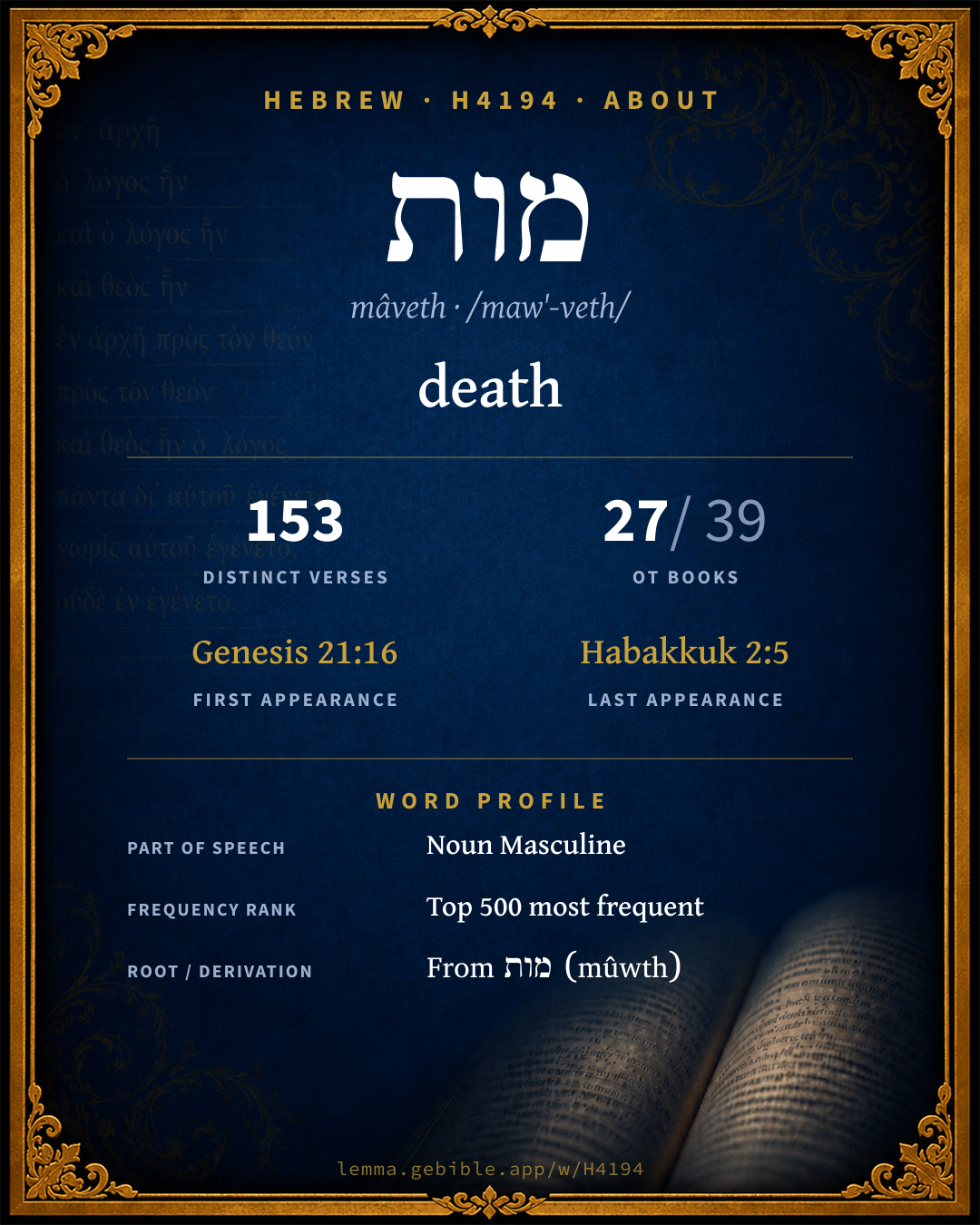
מָ֫וֶת
death
‘death’ is one of 4 main senses fuller range ↓
Full lexicon entry — Brown-Driver-Briggs (BDB)
From Brown-Driver-Briggs (BDB)
Where this word appears
See every Absolute-state word in the Hebrew Bible →
Grammar key — what these labels mean
Part of speech
- Noun
- A naming word — a person, place, thing, or idea.
- Verb
- An action or state-of-being word.
Noun type
- Common
- A common noun — a general class of person, place, or thing (“king,” “city,” “water”), not a specific name.
Stem
- Qal
- The basic, simple active stem — the plain form of the verb (“he wrote”).
Form
- Infinitive Construct
- A bound verbal noun, frequently with prepositions (“to write / in writing”).
State
- Absolute
- The independent form of a noun, not bound to a following word.
- Construct
- A noun bound to a following noun in a possessive / “of” relationship (the construct chain).
Gender
- Masculine
- Grammatically masculine.
Number
- Singular
- One.
- Plural
- More than one (in Hebrew, generally three or more).
Grammatical forms
- Noun, Common, Masculine, Singular, Absolute 92 times (58%)
- Noun, Common, Masculine, Singular, Construct 63 times (40%)
- Noun, Common, Masculine, Plural, Construct 2 times (1%)
- Verb, Qal, Infinitive Construct 1 time (1%)
Parsed forms decoded from the imported morphology (morphhb / Westminster Leningrad Codex — WLC text public domain, morphhb tagging CC BY 4.0), counted across 158 parsed occurrences — not distinct verses.
Every verse where H4194 appears — 153 distinct verses across 27 books. Click any verse to open its interlinear word-by-word view. Verse text shown in the World English Bible for context — . Each verse’s Hebrew form is shown with its reference; the English is not keyword-highlighted, since the data carries no word-level English alignment. Use “Compare translations” on any verse to read it across multiple English versions. This concordance covers the Hebrew Bible; Septuagint (Greek Old Testament) occurrences are not indexed here.
Genesis 7 verses
- Genesis 21:16 בְּ/מ֣וֹת prep + n c ms cs She went and sat down opposite him, a good way off, about a bow shot away. For she said, "Don't let me see the death of the child." She sat over against him, and lifted up her voice, and wept.
- Genesis 25:11 מ֣וֹת n c ms cs It happened after the death of Abraham, that God blessed Isaac, his son. Isaac lived by Beer Lahai Roi.
- Genesis 26:18 מ֣וֹת n c ms cs Isaac dug again the wells of water, which they had dug in the days of Abraham his father. For the Philistines had stopped them after the death of Abraham. He called their names after the names by which his father had called them.
- Genesis 27:2 מוֹתִֽ/י n c ms cs + sfx pers 1cs He said, "See now, I am old. I don't know the day of my death.
- Genesis 27:7 מוֹתִֽ/י n c ms cs + sfx pers 1cs 'Bring me venison, and make me savory food, that I may eat, and bless you before Yahweh before my death.'
- Genesis 27:10 מוֹתֽ/וֹ n c ms cs + sfx pers 3ms You shall bring it to your father, that he may eat, so that he may bless you before his death."
- Genesis 50:16 מוֹת֖/וֹ n c ms cs + sfx pers 3ms They sent a message to Joseph, saying, "Your father commanded before he died, saying,
Exodus 1 verse
Leviticus 3 verses
- Leviticus 11:31 בְּ/מֹתָ֖/ם prep + n c ms cs + sfx pers 3mp These are they which are unclean to you among all that creep. Whoever touches them when they are dead, shall be unclean until the evening.
- Leviticus 11:32 בְּ/מֹתָ֜/ם prep + n c ms cs + sfx pers 3mp On whatever any of them falls when they are dead, it shall be unclean; whether it is any vessel of wood, or clothing, or skin, or sack, whatever vessel it is, with which any work is done, it must be put into water, and it shall be unclean until the evening; then it will be clean.
- Leviticus 16:1 מ֔וֹת n c ms cs Yahweh spoke to Moses, after the death of the two sons of Aaron, when they drew near before Yahweh, and died;
Numbers 8 verses
- Numbers 6:7 בְּ/מֹתָ֑/ם prep + n c ms cs + sfx pers 3mp He shall not make himself unclean for his father, or for his mother, for his brother, or for his sister, when they die; because his separation to God is on his head.
- Numbers 16:29 כְּ/מ֤וֹת prep + n c ms cs If these men die the common death of all men, or if they be visited after the visitation of all men; then Yahweh hasn't sent me.
- Numbers 23:10 מ֣וֹת n c ms cs Who can count the dust of Jacob, Or number the fourth part of Israel? Let me die the death of the righteous, Let my last end be like his!
- Numbers 26:10 בְּ/מ֣וֹת prep + n c ms cs and the earth opened its mouth, and swallowed them up together with Korah, when that company died; what time the fire devoured two hundred fifty men, and they became a sign.
- Numbers 33:39 בְּ/מֹת֖/וֹ prep + n c ms cs + sfx pers 3ms Aaron was one hundred twenty-three years old when he died in Mount Hor.
- Numbers 35:25 מוֹת֙ n c ms cs and the congregation shall deliver the manslayer out of the hand of the avenger of blood, and the congregation shall restore him to his city of refuge, where he was fled: and he shall dwell therein until the death of the high priest, who was anointed with the holy oil.
- Numbers 35:28 מ֖וֹת מוֹת֙ n c ms cs n c ms cs because he should have remained in his city of refuge until the death of the high priest: but after the death of the high priest the manslayer shall return into the land of his possession.
- Numbers 35:32 מ֖וֹת n c ms cs You shall take no ransom for him who is fled to his city of refuge, that he may come again to dwell in the land, until the death of the priest.
Deuteronomy 9 verses
- Deuteronomy 19:6 מָ֔וֶת n c ms lest the avenger of blood pursue the manslayer, while his heart is hot, and overtake him, because the way is long, and strike him mortally; whereas he was not worthy of death, inasmuch as he didn't hate him in time past.
- Deuteronomy 21:22 מָ֖וֶת n c ms If a man have committed a sin worthy of death, and he be put to death, and you hang him on a tree;
- Deuteronomy 22:26 מָ֑וֶת n c ms but to the lady you shall do nothing; there is in the lady no sin worthy of death: for as when a man rises against his neighbor, and kills him, even so is this matter;
- Deuteronomy 30:15 הַ/מָּ֖וֶת ptcl def.art + n c ms Behold, I have set before you this day life and good, and death and evil;
- Deuteronomy 30:19 וְ/הַ/מָּ֨וֶת֙ conj + ptcl def.art + n c ms I call heaven and earth to witness against you this day, that I have set before you life and death, the blessing and the curse: therefore choose life, that you may live, you and your seed;
- Deuteronomy 31:27 מוֹתִֽ/י n c ms cs + sfx pers 1cs For I know your rebellion, and your stiff neck: behold, while I am yet alive with you this day, you have been rebellious against Yahweh; and how much more after my death?
- Deuteronomy 31:29 מוֹתִ/י֙ n c ms cs + sfx pers 1cs For I know that after my death you will utterly corrupt yourselves, and turn aside from the way which I have commanded you; and evil will happen to you in the latter days; because you will do that which is evil in the sight of Yahweh, to provoke him to anger through the work of your hands.
- Deuteronomy 33:1 מוֹתֽ/וֹ n c ms cs + sfx pers 3ms This is the blessing, with which Moses the man of God blessed the children of Israel before his death.
- Deuteronomy 34:7 בְּ/מֹת֑/וֹ prep + n c ms cs + sfx pers 3ms Moses was one hundred twenty years old when he died: his eye was not dim, nor his natural force abated.
Joshua 3 verses
- Joshua 1:1 מ֥וֹת n c ms cs Now it happened after the death of Moses the servant of Yahweh, that Yahweh spoke to Joshua the son of Nun, Moses' minister, saying,
- Joshua 2:13 מִ/מָּֽוֶת prep + n c ms and that you will save alive my father, and my mother, and my brothers, and my sisters, and all that they have, and will deliver our lives from death.
- Joshua 20:6 מוֹת֙ n c ms cs He shall dwell in that city, until he stand before the congregation for judgment, until the death of the high priest that shall be in those days: then shall the manslayer return, and come to his own city, and to his own house, to the city from whence he fled.
Judges 3 verses
- Judges 1:1 מ֣וֹת n c ms cs It happened after the death of Joshua, the children of Israel asked of Yahweh, saying, Who shall go up for us first against the Canaanites, to fight against them?
- Judges 13:7 מוֹתֽ/וֹ n c ms cs + sfx pers 3ms but he said to me, Behold, you shall conceive, and bear a son; and now drink no wine nor strong drink, and eat not any unclean thing; for the child shall be a Nazirite to God from the womb to the day of his death.
- Judges 16:30 בְּ/מוֹת֔/וֹ prep + n c ms cs + sfx pers 3ms Samson said, Let me die with the Philistines. He bowed himself with all his might; and the house fell on the lords, and on all the people who were therein. So the dead that he killed at his death were more than those who he killed in his life.
Ruth 2 verses
- Ruth 1:17 הַ/מָּ֔וֶת ptcl def.art + n c ms where you die, will I die, and there will I be buried: Yahweh do so to me, and more also, if anything but death part you and me."
- Ruth 2:11 מ֣וֹת n c ms cs Boaz answered her, It has fully been shown me, all that you have done to your mother-in-law since the death of your husband; and how you have left your father and your mother, and the land of your birth, and have come to a people that you didn't know before.
1 Samuel 6 verses
- 1 Samuel 5:11 מָ֨וֶת֙ n c ms They sent therefore and gathered together all the lords of the Philistines, and they said, Send away the ark of the God of Israel, and let it go again to its own place, that it not kill us and our people. For there was a deadly confusion throughout all the city; the hand of God was very heavy there.
- 1 Samuel 15:32 הַ/מָּֽוֶת ptcl def.art + n c ms Then said Samuel, Bring you here to me Agag the king of the Amalekites. Agag came to him cheerfully. Agag said, Surely the bitterness of death is past.
- 1 Samuel 15:35 מוֹת֔/וֹ n c ms cs + sfx pers 3ms Samuel came no more to see Saul until the day of his death; for Samuel mourned for Saul: and Yahweh repented that he had made Saul king over Israel.
- 1 Samuel 20:3 הַ/מָּֽוֶת ptcl def.art + n c ms David swore moreover, and said, Your father knows well that I have found favor in your eyes; and he says, Don't let Jonathan know this, lest he be grieved: but truly as Yahweh lives, and as your soul lives, there is but a step between me and death.
- 1 Samuel 20:31 מָ֖וֶת n c ms For as long as the son of Jesse lives on the earth, you shall not be established, nor your kingdom. Therefore now send and bring him to me, for he shall surely die.
- 1 Samuel 26:16 מָ֨וֶת֙ n c ms This thing isn't good that you have done. As Yahweh lives, you are worthy to die, because you have not kept watch over your lord, Yahweh's anointed. Now see where the king's spear is, and the jar of water that was at his head.
2 Samuel 10 verses
- 2 Samuel 1:1 מ֣וֹת n c ms cs It happened after the death of Saul, when David was returned from the slaughter of the Amalekites, and David had abode two days in Ziklag;
- 2 Samuel 1:23 וּ/בְ/מוֹתָ֖/ם conj + prep + n c ms cs + sfx pers 3mp Saul and Jonathan were lovely and pleasant in their lives, In their death they were not divided: They were swifter than eagles, They were stronger than lions.
- 2 Samuel 3:33 הַ/כְּ/מ֥וֹת ptcl inter + prep + n c ms cs The king lamented for Abner, and said, Should Abner die as a fool dies?
- 2 Samuel 6:23 מוֹתָֽ/הּ n c ms cs + sfx pers 3fs Michal the daughter of Saul had no child to the day of her death.
- 2 Samuel 12:5 מָ֔וֶת n c ms David's anger was greatly kindled against the man, and he said to Nathan, "As Yahweh lives, the man who has done this is worthy to die!
- 2 Samuel 15:21 לְ/מָ֨וֶת֙ prep + n c ms Ittai answered the king, and said, As Yahweh lives, and as my lord the king lives, surely in what place my lord the king shall be, whether for death or for life, even there also will your servant be.
- 2 Samuel 19:28 מָ֨וֶת֙ n c ms For all my father's house were but dead men before my lord the king; yet you set your servant among those who ate at your own table. What right therefore have I yet that I should cry any more to the king?
- 2 Samuel 20:3 מֻתָ֖/ן Qal inf.cs + sfx pers 3fp David came to his house at Jerusalem; and the king took the ten women his concubines, whom he had left to keep the house, and put them in custody, and provided them with sustenance, but didn't go in to them. So they were shut up to the day of their death, living in widowhood.
- 2 Samuel 22:5 מָ֑וֶת n c ms For the waves of death compassed me; The floods of ungodliness made me afraid:
- 2 Samuel 22:6 מָֽוֶת n c ms The cords of Sheol were round about me; The snares of death came on me.
1 Kings 2 verses
- 1 Kings 2:26 מָ֖וֶת n c ms To Abiathar the priest said the king, Get you to Anathoth, to your own fields; for you are worthy of death: but I will not at this time put you to death, because you bear the ark of the Lord Yahweh before David my father, and because you were afflicted in all in which my father was afflicted.
- 1 Kings 11:40 מ֥וֹת n c ms cs Solomon sought therefore to kill Jeroboam; but Jeroboam arose, and fled into Egypt, to Shishak king of Egypt, and was in Egypt until the death of Solomon.
2 Kings 6 verses
- 2 Kings 1:1 מ֥וֹת n c ms cs Moab rebelled against Israel after the death of Ahab.
- 2 Kings 2:21 מָ֥וֶת n c ms He went forth to the spring of the waters, and cast salt therein, and said, Thus says Yahweh, I have healed these waters; there shall not be from there any more death or miscarrying.
- 2 Kings 3:5 כְּ/מ֣וֹת prep + n c ms cs But it happened, when Ahab was dead, that the king of Moab rebelled against the king of Israel.
- 2 Kings 4:40 מָ֤וֶת n c ms So they poured out for the men to eat. It happened, as they were eating of the stew, that they cried out, and said, man of God, there is death in the pot. They could not eat of it.
- 2 Kings 14:17 מ֔וֹת n c ms cs Amaziah the son of Joash king of Judah lived after the death of Jehoash son of Jehoahaz king of Israel fifteen years.
- 2 Kings 15:5 מֹת֔/וֹ n c ms cs + sfx pers 3ms Yahweh struck the king, so that he was a leper to the day of his death, and lived in a separate house. Jotham the king's son was over the household, judging the people of the land.
1 Chronicles 2 verses
- 1 Chronicles 2:24 מוֹת n c ms cs After that Hezron was dead in Caleb Ephrathah, then Abijah Hezron's wife bore him Ashhur the father of Tekoa.
- 1 Chronicles 22:5 מוֹתֽ/וֹ n c ms cs + sfx pers 3ms David said, Solomon my son is young and tender, and the house that is to be built for Yahweh must be exceedingly magnificent, of fame and of glory throughout all countries: I will therefore make preparation for it. So David prepared abundantly before his death.
2 Chronicles 6 verses
- 2 Chronicles 22:4 מ֥וֹת n c ms cs He did that which was evil in the sight of Yahweh, as did the house of Ahab; for they were his counselors after the death of his father, to his destruction.
- 2 Chronicles 24:15 בְּ/מוֹתֽ/וֹ prep + n c ms cs + sfx pers 3ms But Jehoiada grew old and was full of days, and he died; one hundred thirty years old was he when he died.
- 2 Chronicles 24:17 מוֹת֙ n c ms cs Now after the death of Jehoiada came the princes of Judah, and made obeisance to the king. Then the king listened to them.
- 2 Chronicles 25:25 מ֔וֹת n c ms cs Amaziah the son of Joash king of Judah lived after the death of Joash son of Jehoahaz king of Israel fifteen years.
- 2 Chronicles 26:21 מוֹת֗/וֹ n c ms cs + sfx pers 3ms Uzziah the king was a leper to the day of his death, and lived in a separate house, being a leper; for he was cut off from the house of Yahweh: and Jotham his son was over the king's house, judging the people of the land.
- 2 Chronicles 32:33 בְ/מוֹת֔/וֹ prep + n c ms cs + sfx pers 3ms Hezekiah slept with his fathers, and they buried him in the ascent of the tombs of the sons of David: and all Judah and the inhabitants of Jerusalem did him honor at his death. Manasseh his son reigned in his place.
Esther 1 verse
Job 8 verses
- Job 3:21 לַ/מָּ֣וֶת prep det + n c ms Who long for death, but it doesn't come; Dig for it more than for hidden treasures,
- Job 5:20 מִ/מָּ֑וֶת prep + n c ms In famine he will redeem you from death; In war, from the power of the sword.
- Job 7:15 מָ֝֗וֶת n c ms So that my soul chooses strangling, Death rather than my bones.
- Job 18:13 מָֽוֶת n c ms The members of his body shall be devoured, The firstborn of death shall devour his members.
- Job 27:15 בַּ/מָּ֣וֶת prep det + n c ms Those who remain of him shall be buried in death. His widows shall make no lamentation.
- Job 28:22 וָ֭/מָוֶת conj + n c ms Destruction and Death say, 'We have heard a rumor of it with our ears.'
- Job 30:23 מָ֣וֶת n c ms For I know that you will bring me to death, To the house appointed for all living.
- Job 38:17 מָ֑וֶת n c ms Have the gates of death been revealed to you? Or have you seen the gates of the shadow of death?
Psalms 22 verses
- Psalms 6:5 בַּ/מָּ֣וֶת prep det + n c ms For in death there is no memory of you. In Sheol, who shall give you thanks?
- Psalms 7:13 מָ֑וֶת n c ms He has also prepared for himself the instruments of death. He makes ready his flaming arrows.
- Psalms 9:13 מָֽוֶת n c ms Have mercy on me, Yahweh. See my affliction by those who hate me, And lift me up from the gates of death;
- Psalms 13:3 הַ/מָּֽוֶת ptcl def.art + n c ms Behold, and answer me, Yahweh, my God. Give light to my eyes, lest I sleep in death;
- Psalms 18:4 מָ֑וֶת n c ms The cords of death surrounded me. The floods of ungodliness made me afraid.
- Psalms 18:5 מָֽוֶת n c ms The cords of Sheol were round about me; The snares of death came on me.
- Psalms 22:15 מָ֥וֶת n c ms My strength is dried up like a potsherd. My tongue sticks to the roof of my mouth. You have brought me into the dust of death.
- Psalms 33:19 מִ/מָּ֣וֶת prep + n c ms To deliver their soul from death, To keep them alive in famine.
- Psalms 49:14 מָ֤וֶת n c ms They are appointed as a flock for Sheol. Death shall be their shepherd. The upright shall have dominion over them in the morning. Their beauty shall decay in Sheol, Far from their mansion.
- Psalms 49:17 בְ֭/מוֹת/וֹ prep + n c ms cs + sfx pers 3ms For when he dies he shall carry nothing away. His glory shall not descend after him.
- Psalms 55:4 מָ֝֗וֶת n c ms My heart is severely pained within me. The terrors of death have fallen on me.
- Psalms 55:15 מָ֨וֶת n c ms Let death come suddenly on them. Let them go down alive into Sheol. For wickedness is in their dwelling, in the midst of them.
- Psalms 56:13 מִ/מָּוֶת֮ prep + n c ms For you have delivered my soul from death, And prevented my feet from falling, That I may walk before God in the light of the living.
- Psalms 68:20 לַ֝/מָּ֗וֶת prep det + n c ms God is to us a God of deliverance. To Yahweh, the Lord, belongs escape from death.
- Psalms 73:4 לְ/מוֹתָ֗/ם prep + n c ms cs + sfx pers 3mp For there are no struggles in their death, But their strength is firm.
- Psalms 78:50 מִ/מָּ֣וֶת prep + n c ms He made a path for his anger. He didn't spare their soul from death, But gave their life over to the pestilence,
- Psalms 89:48 מָּ֑וֶת n c ms What man is he who shall live and not see death, Who shall deliver his soul from the power of Sheol? Selah.
- Psalms 107:18 מָֽוֶת n c ms Their soul abhors all kinds of food. They draw near to the gates of death.
- Psalms 116:3 מָ֗וֶת n c ms The cords of death surrounded me, The pains of Sheol got a hold of me. I found trouble and sorrow.
- Psalms 116:8 מִ֫/מָּ֥וֶת prep + n c ms For you have delivered my soul from death, My eyes from tears, And my feet from falling.
- Psalms 116:15 הַ֝/מָּ֗וְתָ/ה ptcl def.art + n c ms + sfx h Precious in the sight of Yahweh is the death of his saints.
- Psalms 118:18 וְ֝/לַ/מָּ֗וֶת conj + prep det + n c ms Yah has punished me severely, But he has not given me over to death.
Proverbs 19 verses
- Proverbs 2:18 מָ֣וֶת n c ms For her house leads down to death, Her paths to the dead.
- Proverbs 5:5 מָ֑וֶת n c ms Her feet go down to death. Her steps lead straight to Sheol.
- Proverbs 7:27 מָֽוֶת n c ms Her house is the way to Sheol, Going down to the chambers of death.
- Proverbs 8:36 מָֽוֶת n c ms But he who sins against me wrongs his own soul. All those who hate me love death."
- Proverbs 10:2 מִ/מָּֽוֶת prep + n c ms Treasures of wickedness profit nothing, But righteousness delivers from death.
- Proverbs 11:4 מִ/מָּֽוֶת prep + n c ms Riches don't profit in the day of wrath, But righteousness delivers from death.
- Proverbs 11:7 בְּ/מ֤וֹת prep + n c ms cs When a wicked man dies, hope perishes, And expectation of power comes to nothing.
- Proverbs 11:19 לְ/מוֹתֽ/וֹ prep + n c ms cs + sfx pers 3ms He who is truly righteous gets life. He who pursues evil gets death.
- Proverbs 12:28 מָֽוֶת n c ms In the way of righteousness is life; In its path there is no death.
- Proverbs 13:14 מָֽוֶת n c ms The teaching of the wise is a spring of life, To turn from the snares of death.
- Proverbs 14:12 מָֽוֶת n c ms There is a way which seems right to a man, But in the end it leads to death.
- Proverbs 14:27 מָֽוֶת n c ms The fear of Yahweh is a fountain of life, Turning people from the snares of death.
- Proverbs 14:32 בְ/מוֹת֣/וֹ prep + n c ms cs + sfx pers 3ms The wicked is brought down in his calamity, But in death, the righteous has a refuge.
- Proverbs 16:14 מָ֑וֶת n c ms The king's wrath is a messenger of death, But a wise man will pacify it.
- Proverbs 16:25 מָֽוֶת n c ms There is a way which seems right to a man, But in the end it leads to death.
- Proverbs 18:21 מָ֣וֶת n c ms Death and life are in the power of the tongue; Those who love it will eat its fruit.
- Proverbs 21:6 מָֽוֶת n c ms Getting treasures by a lying tongue Is a fleeting vapor for those who seek death.
- Proverbs 24:11 לַ/מָּ֑וֶת prep det + n c ms Rescue those who are being led away to death! Indeed, hold back those who are staggering to the slaughter!
- Proverbs 26:18 וָ/מָֽוֶת conj + n c ms Like a madman who shoots firebrands, arrows, and death,
Ecclesiastes 5 verses
- Ecclesiastes 3:19 כְּ/מ֥וֹת מ֣וֹת prep + n c ms cs n c ms cs For that which happens to the sons of men happens to animals. Even one thing happens to them. As the one dies, so the other dies. Yes, they have all one breath; and man has no advantage over the animals: for all is vanity.
- Ecclesiastes 7:1 הַ/מָּ֔וֶת ptcl def.art + n c ms A good name is better than fine perfume; and the day of death better than the day of one's birth.
- Ecclesiastes 7:26 מִ/מָּ֗וֶת prep + n c ms I find more bitter than death the woman whose heart is snares and traps, whose hands are chains. Whoever pleases God shall escape from her; but the sinner will be ensnared by her.
- Ecclesiastes 8:8 הַ/מָּ֔וֶת ptcl def.art + n c ms There is no man who has power over the spirit to contain the spirit; neither does he have power over the day of death. There is no discharge in war; neither shall wickedness deliver those who practice it.
- Ecclesiastes 10:1 מָ֔וֶת n c ms Dead flies cause the oil of the perfumer to send forth an evil odor; so does a little folly outweigh wisdom and honor.
Song of Solomon 1 verse
Isaiah 8 verses
- Isaiah 6:1 מוֹת֙ n c ms cs In the year that king Uzziah died, I saw the Lord sitting on a throne, high and lifted up; and his train filled the temple.
- Isaiah 14:28 מ֖וֹת n c ms cs In the year that king Ahaz died was this burden.
- Isaiah 25:8 הַ/מָּ֨וֶת֙ ptcl def.art + n c ms He has swallowed up death forever; and the Lord Yahweh will wipe away tears from off all faces; and the reproach of his people will he take away from off all the earth: for Yahweh has spoken it.
- Isaiah 28:15 מָ֔וֶת n c ms Because you have said, We have made a covenant with death, and with Sheol are we at agreement; when the overflowing scourge shall pass through, it shall not come to us; for we have made lies our refuge, and under falsehood have we hid ourselves:
- Isaiah 28:18 מָ֔וֶת n c ms Your covenant with death shall be annulled, and your agreement with Sheol shall not stand; when the overflowing scourge shall pass through, then you shall be trodden down by it.
- Isaiah 38:18 מָ֣וֶת n c ms For Sheol can't praise you, death can't celebrate you: Those who go down into the pit can't hope for your truth.
- Isaiah 53:9 בְּ/מֹתָ֑י/ו prep + n c mp cs + sfx pers 3ms They made his grave with the wicked, and with a rich man in his death; although he had done no violence, neither was any deceit in his mouth.
- Isaiah 53:12 לַ/מָּ֨וֶת֙ prep det + n c ms Therefore will I divide him a portion with the great, and he shall divide the spoil with the strong; because he poured out his soul to death, and was numbered with the transgressors: yet he bore the sin of many, and made intercession for the transgressors.
Jeremiah 11 verses
- Jeremiah 8:3 מָ֨וֶת֙ n c ms Death shall be chosen rather than life by all the residue that remain of this evil family, that remain in all the places where I have driven them, says Yahweh of Hosts.
- Jeremiah 9:21 מָ֨וֶת֙ n c ms For death is come up into our windows, it is entered into our palaces; to cut off the children from outside, [and] the young men from the streets.
- Jeremiah 15:2 לַ/מָּ֤וֶת לַ/מָּ֨וֶת֙ prep det + n c ms prep det + n c ms It shall happen, when they tell you, Where shall we go forth? then you shall tell them, Thus says Yahweh: Such as are for death, to death; and such as are for the sword, to the sword; and such as are for the famine, to the famine; and such as are for captivity, to captivity.
- Jeremiah 18:21 מָ֑וֶת n c ms Therefore deliver up their children to the famine, and give them over to the power of the sword; and let their wives become childless, and widows; and let their men be slain of death, [and] their young men struck of the sword in battle.
- Jeremiah 18:23 לַ/מָּ֔וֶת prep det + n c ms Yet, Yahweh, you know all their counsel against me to kill me; don't forgive their iniquity, neither blot out their sin from your sight; but let them be overthrown before you; deal you with them in the time of your anger.
- Jeremiah 21:8 הַ/מָּֽוֶת ptcl def.art + n c ms To this people you shall say, Thus says Yahweh: Behold, I set before you the way of life and the way of death.
- Jeremiah 26:11 מָ֨וֶת֙ n c ms Then spoke the priests and the prophets to the princes and to all the people, saying, This man is worthy of death; for he has prophesied against this city, as you have heard with your ears.
- Jeremiah 26:16 מָ֔וֶת n c ms Then said the princes and all the people to the priests and to the prophets: This man is not worthy of death; for he has spoken to us in the name of Yahweh our God.
- Jeremiah 43:11 לַ/מָּ֣וֶת לַ/מָּ֗וֶת prep det + n c ms prep det + n c ms He shall come, and shall strike the land of Egypt; such as are for death [shall be given] to death, and such as are for captivity to captivity, and such as are for the sword to the sword.
- Jeremiah 52:11 מוֹתֽ/וֹ n c ms cs + sfx pers 3ms He put out the eyes of Zedekiah; and the king of Babylon bound him in fetters, and carried him to Babylon, and put him in prison until the day of his death.
- Jeremiah 52:34 מוֹת֑/וֹ n c ms cs + sfx pers 3ms and for his allowance, there was a continual allowance given him by the king of Babylon, every day a portion until the day of his death, all the days of his life.
Lamentations 1 verse
Ezekiel 5 verses
- Ezekiel 18:23 מ֣וֹת n c ms cs Have I any pleasure in the death of the wicked? says the Lord Yahweh; and not rather that he should return from his way, and live?
- Ezekiel 18:32 בְּ/מ֣וֹת prep + n c ms cs For I have no pleasure in the death of him who dies, says the Lord Yahweh: therefore turn yourselves, and live.
- Ezekiel 28:10 מוֹתֵ֧י n c mp cs You shall die the death of the uncircumcised by the hand of strangers: for I have spoken it, says the Lord Yahweh.
- Ezekiel 31:14 לַ/מָּ֜וֶת prep det + n c ms to the end that none of all the trees by the waters exalt themselves in their stature, neither set their top among the thick boughs, nor that their mighty ones stand up on their height, [even] all who drink water: for they are all delivered to death, to the lower parts of the earth, in the midst of the children of men, with those who go down to the pit.
- Ezekiel 33:11 בְּ/מ֣וֹת prep + n c ms cs Tell them, As I live, says the Lord Yahweh, I have no pleasure in the death of the wicked; but that the wicked turn from his way and live: turn you, turn you from your evil ways; for why will you die, house of Israel?
Hosea 1 verse
Jonah 2 verses
Habakkuk 1 verse
About this entry
At a glance — auto-summarized from this page’s data, not written by a person. Every figure links to its source below. This summary describes the numbers; it doesn’t interpret them.
מות — transliterated mâveth — is a Hebrew noun carrying the sense “death.” The lexicon spreads it across several senses; see its full sense range. It appears 153 verses across 27 books of the Hebrew Bible, among its common vocabulary. Its earliest occurrence is Genesis 21:16. It shares a root with מות, מות and ממות. See the sense tree, 153-verse concordance, and the renderings breakdown below.
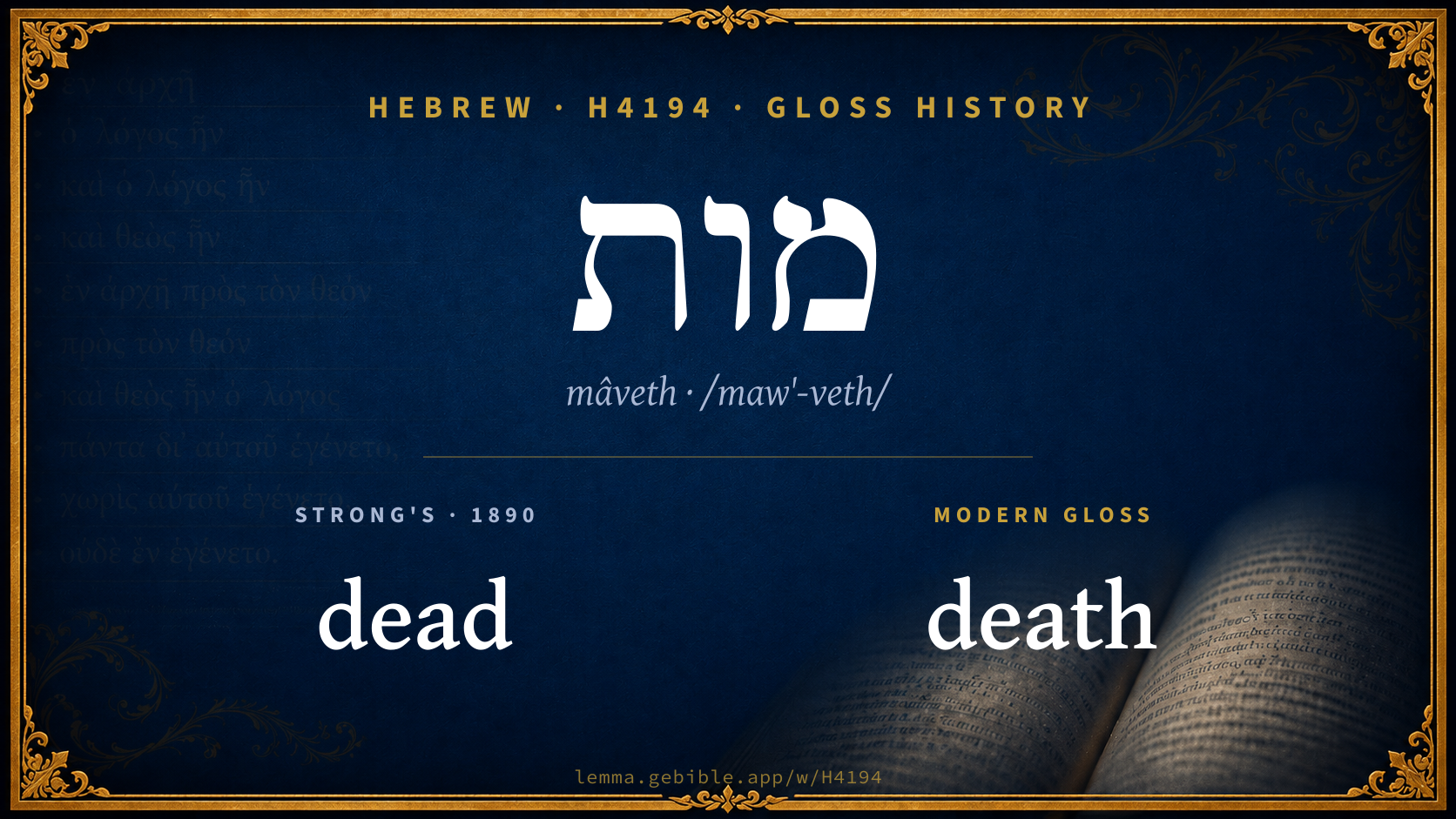
Gloss history
Strong's 1890 vs modern scholarship
About this word
Strong's H4194 catalogs a Hebrew word from the Hebrew Old Testament.
These counts are not copied from any lexicon or concordance. They are computed here, from the morphology-tagged Hebrew Old Testament. What Lemma adds →
- 153
- distinct verses
- The word appears in 153 distinct verses.
- 27 / 39
- OT books
- The word appears in 27 of 39 Old Testament books.
- #290
- by frequency
- Top 500 most frequent Hebrew words (rank 290 of 8,640 Hebrew words by occurrence).
View all 153 occurrences in the concordance →
By section of the Old Testament
By traditional corpus
Conventional, traditional groupings — biblical authorship is debated, so this is a traditional corpus grouping, not an authorship claim. Each share is this word’s portion of its verses in that division of the Hebrew canon. Each figure is a share of the word’s 153 distinct verses.
- Writings (Ketuvim) 67 verses · 44%
- Prophets (Nevi'im) 58 verses · 38%
- Torah (Pentateuch) 28 verses · 18%
How translations render this word
Counts come from each version’s own published word-to-Strong’s tagging or interlinear alignment — an approximate guide to how each version renders this word, not a word-level alignment the data otherwise carries. Because each total is that version’s own tagged count, the per-version totals vary from one another and need not match the appearance or distinct-verse counts above. These counts may also differ from a printed concordance because Lemma counts each distinctly tagged rendering and does not collapse phrase taggings into a single head-word total. This is a fixed set of word-tagged versions (KJV, ASV, BSB, ULT) and does not change with the reading translation you choose elsewhere. Each version’s license is shown beside its name below (and on Sources).
- King James Version: Death 104×, Die 6×, He died 4×
- American Standard Version: Death 99×, He died 4×, Until the death 4×
- Berean Standard Bible: Death 106×, Deadly 5×, Die 5×
- unfoldingWord Literal Text: Death 106×, Death of 30×, He died 2×
King James Version Public Domain
Renders H4194 across 159 tagged occurrences — most commonly:
Plus 28 renderings that appear only once — usually multi-word phrases or single function words the recovered tagging swept in, not distinct renderings. Not rendered by a distinct English word in 1 further occurrence.
American Standard Version Public Domain
Renders H4194 across 160 tagged occurrences — most commonly:
Plus 37 renderings that appear only once — usually multi-word phrases or single function words the recovered tagging swept in, not distinct renderings.
Berean Standard Bible Public Domain
Renders H4194 across 153 tagged occurrences — most commonly:
Plus 19 renderings that appear only once — usually multi-word phrases or single function words the recovered tagging swept in, not distinct renderings. Not rendered by a distinct English word in 1 further occurrence.
unfoldingWord Literal Text CC BY-SA 4.0
Renders H4194 across 158 tagged occurrences — most commonly:
Plus 14 renderings that appear only once — usually multi-word phrases or single function words the recovered tagging swept in, not distinct renderings.
Senses in the full BDB
What do BDB’s symbols mean?
BDB uses these scholarly abbreviations:
| Symbol | Meaning |
|---|---|
| 𝔊 | the Septuagint (the ancient Greek translation, LXX) |
| 𝔙 | the Vulgate (the Latin translation) |
| 𝔖 | the Syriac version (the Peshitta) |
| 𝔗 | the Targum (the Aramaic translation) |
| ψ | the Psalms |
| √ | root (the underlying root or stem) |
| ‖ | parallel passage (a synonymous or contrasted parallel) |
| † | the dagger: every passage where the word occurs is cited |
The 3 senses and sub-senses the full Brown-Driver-Briggs lexicon distinguishes for this word, in lexicon order (not ranked by frequency), with BDB’s own verbatim wording and sub-sense lettering. Shown in Hebrew script with BDB’s own scholarly abbreviations. The condensed entry is in the Lexicon Entry tab. See also the Forms in the corpus table below.
- 1. death, opp. life, Dt 30:15, 19 2 S 15:21; †מ׳ כל האדם the death of all men (that all go to) Nu 16:29 (J), as distinguished from violent death; יוֹם מ׳ day of death Gn 27:2 (J) Ju 13:7 1 S 15:35 +; שְׁנַת מ׳ Is 6:1; 14:28; עד מ׳ Nu 35:25, 28, 32 Jos 20:6 (P), 1 K 11:40; לפני מ׳ Gn 27:7, 10; 50:16 (JE); אחרי מ׳ Gn 26:18 (J), 25:11; Lv 16:1; Nu 35:28 (P), Dt 31:27, 29 (D) +; בכור מ׳ Jb 18:13 firstborn of death (deadly disease); of flies Ec 10:1, unclean animals Lv 11:31, 32 (P). e.g. Deuteronomy 30:15
- 2. death by violence as a penalty: †מִשְׁפַּט מ׳ + לְ or בְּ pers.: a case of death to, or in a man, guilty of capital crime Dt 19:6; 21:22 Je 26:11, 16; †חֵטְא מ׳ Dt 22:26; †בנ(י) מ׳ 1 S 20:31; 26:16; 2 S 12:5; אישׁ מ׳ 2 S 19:29; אנשׁי מ׳ 1 K 2:26; מַלְאֲכֵי מ׳ Pr 16:14 messengers of death; בְּמֹתָיו Is 53:9 in his (martyr-)death (v. BrMP 359). e.g. Deuteronomy 19:6
- 3. state of death or place of death (‖ שׁאול) Is 28:15, 18; 38:18; Ho 13:14; Hb 2:5; ψ 6:6; 49:15 Ct 8:6 Pr 5:5; 7:27; (‖ אבדון) Jb 28:22; שׁערי מ׳ gates of death ψ 9:14; 107:18; Jb 38:17. e.g. Isaiah 28:15
Senses from the full Brown-Driver-Briggs lexicon (Brown, Driver, Briggs; Oxford 1906 — public domain), digitized via Sefaria, supplemented by the OpenScriptures HebrewLexicon (CC BY 4.0). Full attribution on Sources.
Word origin
n.m. Ex 10:17 death;—abs. מ׳ Dt 19:6 +; מָֽ֫וְתָה ψ 116:15; cstr. מוֹת Gn 25:11 +; sf. מוֹתִי Gn 27:2 +; pl. cstr. מוֹתֵי Ez 28:10; sf. בְּמֹתָיו Is 53:9;—
— Brown-Driver-Briggs (Oxford 1906, public domain), digitized via Sefaria, supplemented by the OpenScriptures HebrewLexicon (CC BY 4.0). See Sources.
Derived from מות (mûwth) (H4191) — to die.
Jastrow Dictionary
A second Hebrew/Aramaic lexicon for comparison, covering Aramaic and post-biblical (Talmudic, Targumic, Midrashic) usage that the biblical-Hebrew BDB does not. Matched by lemma rather than by Strong’s number, so a lemma may carry more than one Jastrow headword (shown separately below), and the entries cover usage well beyond the Bible.
מוֹת
- (b. h.) to die. Gitt. VII, 3, a. fr. אם מַתִּי if I should die. Gen. R. s. 9 (play on מְאֹד, Gen. I, 31) והנה טזב מוֹת behold, it is good to die.—Kidd. 72ᵇ כשמֵת ר׳ וכ׳ when R … died. M. Kat. 28ᵃ מת פתאום if one dies suddenly. Sabb. 55ᵇ בחטאם מֵתוּ died for their sin. Tam. 32ᵃ (in Chald. dict.) מה יעביד אינש ויָמוֹת וכ׳ what must man do in order to die? Let him feed himself, v. הָיָה. Shebu. 18ᵃ, v. וָטוּב; a. v. fr.—V. מֵת. e.g. Genesis 1:31
- to put to death; to cause death. Snh. 53ᵃ אם אי אתה יכול לַהֲמִיתוֹ … שאתה מֵמִיתוֹ וכ׳ that if you cannot put him to death in the manner legally prescribed, you must execute judgment by whatever means you can. Ib. 56ᵇ דברים … מְמִיתִין עליהן acts on which a Jewish court passes a sentence of death. Tam. l. c. (in Chald. dict.) מה יעבד אינש … יָמִית עצמו what must man do in order to live?… Let him starve himself (his appetites). Ber. 63ᵇ אין ד"ת … שממית עצמו עליה the words of the Law remain only with him who kills himself (denies himself all enjoyments) for its sake (with play on Num. XIX, 14); a. v. fr. e.g. Numbers 19:14
- to be put to death. Keth. 37ᵇ מוּמָתִין בסייף those put to death by the sword. Snh. 55ᵇ מומתין על ידה are put to death on her account; a. fr.
מוּת
- v. מִית
מָוֶת
- preced.) death. Ab. II, 4 אל … עד יום מוֹתְךָ do not trust thyself (that thou wilt not sin) until thy dying day; Ber. 29ᵃ. Ib. 17ᵃ סוף אדם לַמָּ׳ man’s final destiny in death; a. v. fr.—מלאך המ׳ (abbrev. מה"מ) the angel of death. Ab. Zar. 5ᵃ. Gen. R. s. 9 והנה טוב מאד זה מה"מ ‘and behold, it was very good’ (Gen. I, 31) this refers to the angel of death; a. fr. e.g. Genesis 1:31
מוֹת ²
- Targ. Ex. X, 17. Targ. Jer. XI, 19 סמא דמ׳ poison; a. fr.—Targ. Y. Gen. XXXV, 18 fem.—Sabb. 88ᵇ סמא דמ׳, v. supra; Yoma 72ᵇ.—Yeb. 63ᵃ מידי דקשי ממ׳ something harder than death. M. Kat. 28ᵇ, v. חֲבוּלְיָא; a. fr.
A Dictionary of the Targumim, the Talmud Babli and Yerushalmi, and the Midrashic Literature (Marcus Jastrow; London, Luzac, 1903) — Public Domain. Digitized via Sefaria. Digitized via Sefaria. Full attribution on Sources.
Forms in the corpus
The 80 distinct written forms H4194 takes in the Hebrew Bible, most frequent first — each parse links to that state’s occurrences in the concordance. Hebrew forms include their vowel points and cantillation, so a single lemma takes many written forms.
The 60 most common forms are shown; 20 rarer forms follow in the full concordance.
Same root — word family
Other BDB entries built from the same root as H4194, grouped by Strong’s listed origin. These share a root / origin per the lexicon — not necessarily a shared meaning. Each links to that word’s own entry.
Derives from
Shares the same root
Derived from this word
Compare all same-root words → Showing 4 of 6 — not the complete family. They share a root, not necessarily a meaning.
Septuagint verse parallels
This word appears in 143 verses that also exist in the Greek Old Testament (Septuagint), out of the 153 Hebrew verses it occurs in. You can read those verses in Greek by switching the Old Testament edition to the Septuagint.
Read these verses in the Septuagint
- Genesis 21:16
- Exodus 10:17
- Leviticus 11:31
- Numbers 6:7
- Deuteronomy 19:6
- Joshua 1:1
- Judges 1:1
- Ruth 1:17
- 1 Samuel 5:11
- 2 Samuel 1:1
- 1 Kings 2:26
- 2 Kings 1:1
This is a verse-level parallel only — the same verses exist in both the Hebrew and Greek Old Testaments. No word-level Hebrew↔Greek correspondence is claimed: the data carries no such alignment, so no Greek word is shown as this Hebrew word’s translation. Coverage is not total — the Septuagint omits the deuterocanon and renumbers the Psalms, so some Hebrew verses have no direct Greek parallel.