
Genesis 44:31

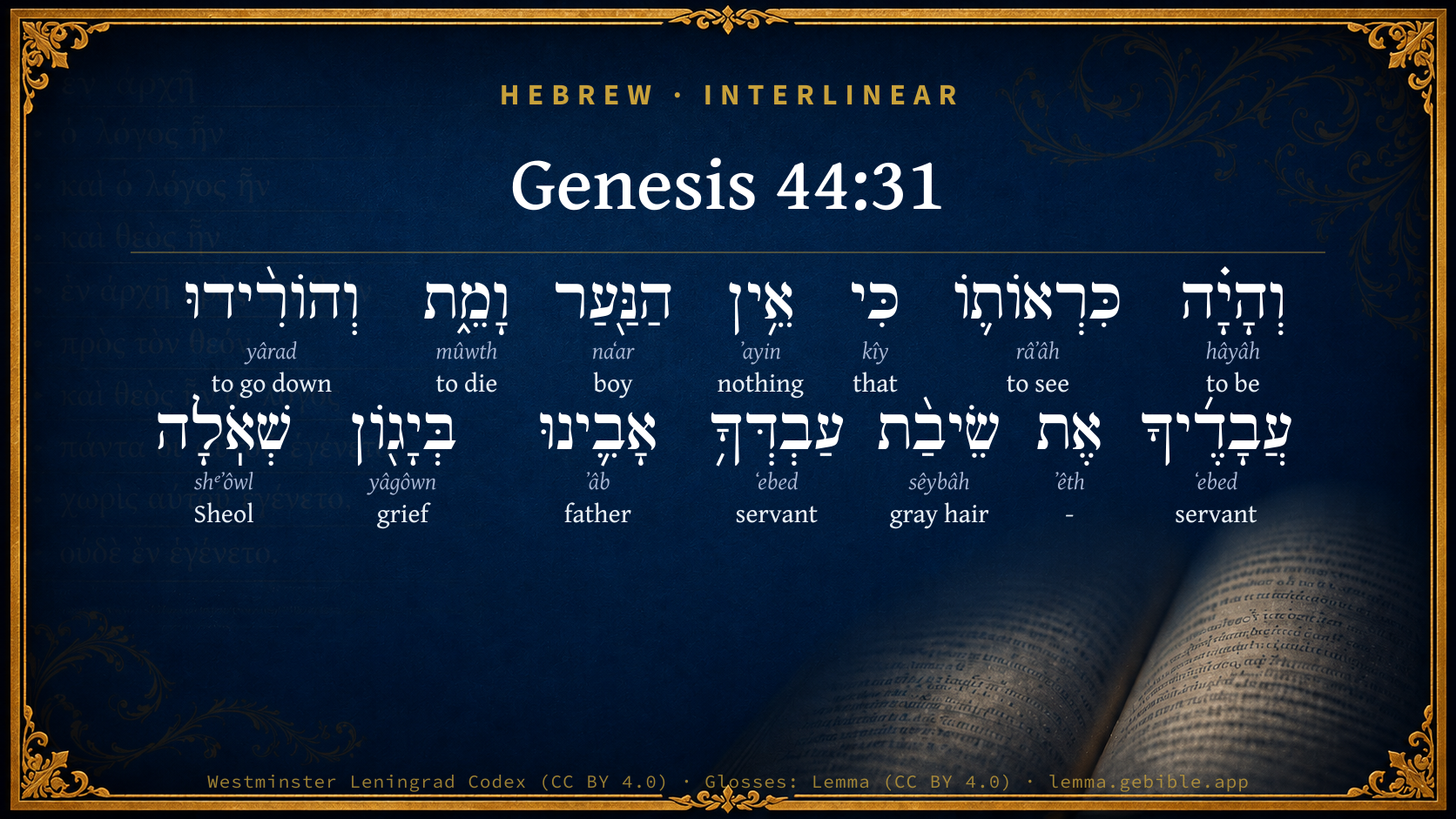
Hebrew (Westminster Leningrad Codex) Genesis 44:31 appears in the Hebrew Old Testament. The text above is from the Westminster Leningrad Codex. Each word links to its Strong’s number, a concise gloss, and parsing drawn from the Open Scriptures Hebrew Bible morphology. Click any word for its full Brown-Driver-Briggs (BDB) entry.
Download image
Cite this verse

Genesis 44:31 (World English Bible). Public Domain. Lemma interlinear Bible study tool, https://lemma.gebible.app/v/genesis/44/31.

Show BibTeX & RIS
BibTeX
RIS
English Translation
it will happen, when he sees that the boy is no more, that he will die. Your servants will bring down the gray hairs of your servant, our father, with sorrow to Sheol.
World English Bible · Public Domain
Download a study sheet

One document with this verse’s original text, its word-by-word gloss line, the meaning frame, cross-references with their text, attributed commentary, and full source and license credits — printable, and it pastes into notes with its structure intact.

This verse Autodidact and up

Study sheet (.html) Plain text (.txt)

A passage Seminary Student

Up to 50 verses in one chapter. A passage sheet keeps up to 6 commentary sources and 12 cross-references per verse, in the order this page ranks them, and says so on the sheet whenever that leaves anything out. Ask for a single verse and you get the Autodidact verse sheet above.

Everything on this page stays free to read, with no account — the sheet is a download of what is already on screen, not access to it.

Want to remove ads? Support Godless Engineer
Compare translations 3

The same verse in 3 English versions, stacked beneath the original-language interlinear above. Click any original word for its lexicon entry.

Each is an independent rendering of the whole verse — the interlinear is not word-aligned to these translations.

Highlighted words mark where these versions differ — a whole-verse word diff, not a word-by-word alignment.

  • World English Bible Public Domain
    it will happen, when he sees that the boy is no more, that he will die. Your servants will bring down the gray hairs of your servant, our father, with sorrow to Sheol.
  • King James Version Public Domain
    It shall come to pass, when he seeth that the lad is not with us, that he will die: and thy servants shall bring down the gray hairs of thy servant our father with sorrow to the grave.
  • unfoldingWord Literal Text CC BY-SA 4.0
    then it will happen when he sees that the young man is not, then he will die! And your servants will bring the gray head of your servant our father down in sorrow to Sheol!

unfoldingWord Literal Text — © unfoldingWord, licensed CC BY-SA 4.0. Word-aligned USFM3 via Door43 (git.door43.org/unfoldingWord/en_ult).

Versions to compare (up to 4)

3 of 4 selected

Show all 18 translations

Every available English version of this verse, each an independent rendering of the whole verse.

  • World English Bible Public Domain
    it will happen, when he sees that the boy is no more, that he will die. Your servants will bring down the gray hairs of your servant, our father, with sorrow to Sheol.
  • Berean Standard Bible Public Domain
    sees that the boy is not with us, he will die. Then your servants will have brought the gray hair of your servant our father down to Sheol in sorrow.
  • Majority Standard Bible Public Domain
    sees that the boy is not with us, he will die. Then your servants will have brought the gray hair of your servant our father down to Sheol in sorrow.
  • King James Version Public Domain
    It shall come to pass, when he seeth that the lad is not with us, that he will die: and thy servants shall bring down the gray hairs of thy servant our father with sorrow to the grave.
  • American Standard Version (1901) Public Domain
    it will come to pass, when he seeth that the lad is not `with us', that he will die: and thy servants will bring down the gray hairs of thy servant our father with sorrow to Sheol.
  • Revised Version (1885) Public Domain
    it shall come to pass, when he seeth that the lad is not with us, that he will die: and thy servants shall bring down the gray hairs of thy servant our father with sorrow to the grave.
  • Geneva Bible (1599) Public Domain
    Then when hee shall see that the childe is not come, he will die: so shall thy seruants bring the graye head of thy seruant our father with sorowe to the graue.
  • Douay-Rheims (1899) Public Domain
    And he shall see that he is not with us, he will die, and thy servants shall bring down his gray hairs with sorrow unto hell.
  • Young's Literal Translation Public Domain
    then it hath come to pass when he seeth that the youth is not, that he hath died, and thy servants have brought down the grey hairs of thy servant our father with sorrow to sheol;
  • Literal Standard Version CC BY-SA 4.0
    then it has come to pass, when he sees that the youth is not, that he has died, and your servants have brought down the grey hairs of your servant our father with sorrow to Sheol;
  • Unlocked Literal Bible CC BY-SA 4.0
    it will come about, when he sees the boy is not with us, he will die. Your servants will bring down the gray hair of your servant our father with sorrow to Sheol.
  • unfoldingWord Literal Text CC BY-SA 4.0
    then it will happen when he sees that the young man is not, then he will die! And your servants will bring the gray head of your servant our father down in sorrow to Sheol!
  • Darby Bible Public Domain
    it will come to pass when he sees that the lad is not [there], that he will die; and thy servants will bring down the grey hairs of thy servant our father with sorrow to Sheol.
  • World Messianic Bible Public Domain
    it will happen, when he sees that the boy is no more, that he will die. Your servants will bring down the gray hairs of your servant, our father, with sorrow to Sheol.
  • Webster's Bible Public Domain
    It shall come to pass, when he seeth that the lad is not with us, that he will die: and thy servants will bring down the gray hairs of thy servant our father, with sorrow to the grave.
  • Free Bible Version CC BY-SA 4.0
    as soon as he sees the boy isn't there he'll die, and we will really send this old man, our father, to his grave in grief.
  • Bible in Basic English Public Domain
    When he sees that the boy is not with us, he will come to his death, and our father's grey head will go down in sorrow to the underworld.
  • JPS Tanakh (1917) Public Domain
    it will come to pass, when he seeth that the lad is not with us, that he will die; and thy servants will bring down the gray hairs of thy servant our father with sorrow to the grave.

Literal Standard Version (2020), Covenant Press — licensed CC BY-SA 4.0. Text via the HelloAO Bible API (eBible.org). Unlocked Literal Bible (unfoldingWord) — licensed CC BY-SA 4.0. Text via the HelloAO Bible API (eBible.org). unfoldingWord Literal Text — © unfoldingWord, licensed CC BY-SA 4.0. Word-aligned USFM3 via Door43 (git.door43.org/unfoldingWord/en_ult). Free Bible Version, Dr. Jonathan Gallagher — licensed CC BY-SA 4.0. Text via the HelloAO Bible API (eBible.org).

Word by word

More ways to search: Search by grammar → Find every occurrence → Compare this word →

Practice this passage: Drill this verse → Learn its vocabulary →

בְּיָג֖וֹן
yâgôwn
H3015
“in/at · grief”
Preposition + Noun, Common, Masculine, Singular, Absolute
Part of Speech
Preposition + Noun
Type
Common
Gender
Masculine
Number
Singular
State
Absolute
Full BDB Definition

Origin: from H3013

TWOT: 839a

grief, sorrow, anguish
  1. וְהָיָ֗ה hâyâh H1961 “and · to be” Conjunction + Verb, Qal, Sequential Perfect, 3rd Person, Masculine, Singular
  2. כִּרְאוֹת֛וֹ râʼâh H7200 “like/as · to see · him” Preposition + Verb, Qal, Infinitive Construct + Suffix, Personal, 3rd Person, Masculine, Singular
  3. כִּי kîy H3588 “that” Conjunction
  4. אֵ֥ין ʼayin H369 “nothing” Particle, Negative
  5. הַנַּ֖עַר naʻar H5288 “the · boy” Particle, Definite Article + Noun, Common, Masculine, Singular, Absolute
  6. וָמֵ֑ת mûwth H4191 “and · to die” Conjunction + Verb, Qal, Sequential Perfect, 3rd Person, Masculine, Singular
  7. וְהוֹרִ֨ידוּ yârad H3381 “and · to go down” Conjunction + Verb, Hiphil, Sequential Perfect, 3rd Person, Common, Plural
  8. עֲבָדֶ֜יךָ ʻebed H5650 “servants · your” Noun, Common, Masculine, Plural, Construct + Suffix, Personal, 2nd Person, Masculine, Singular
  9. אֶת ʼêth H853 “-” Particle, Direct Object
  10. שֵׂיבַ֨ת sêybâh H7872 “gray hair of” Noun, Common, Feminine, Singular, Construct
  11. עַבְדְּךָ֥ ʻebed H5650 “servant · your” Noun, Common, Masculine, Singular, Construct + Suffix, Personal, 2nd Person, Masculine, Singular
  12. אָבִ֛ינוּ ʼâb H1 “father · our” Noun, Common, Masculine, Singular, Construct + Suffix, Personal, 1st Person, Common, Plural
  13. שְׁאֹֽלָה shᵉʼôwl H7585 “Sheol · toward” Noun, Proper + Suffix, Demonstrative

About this verse

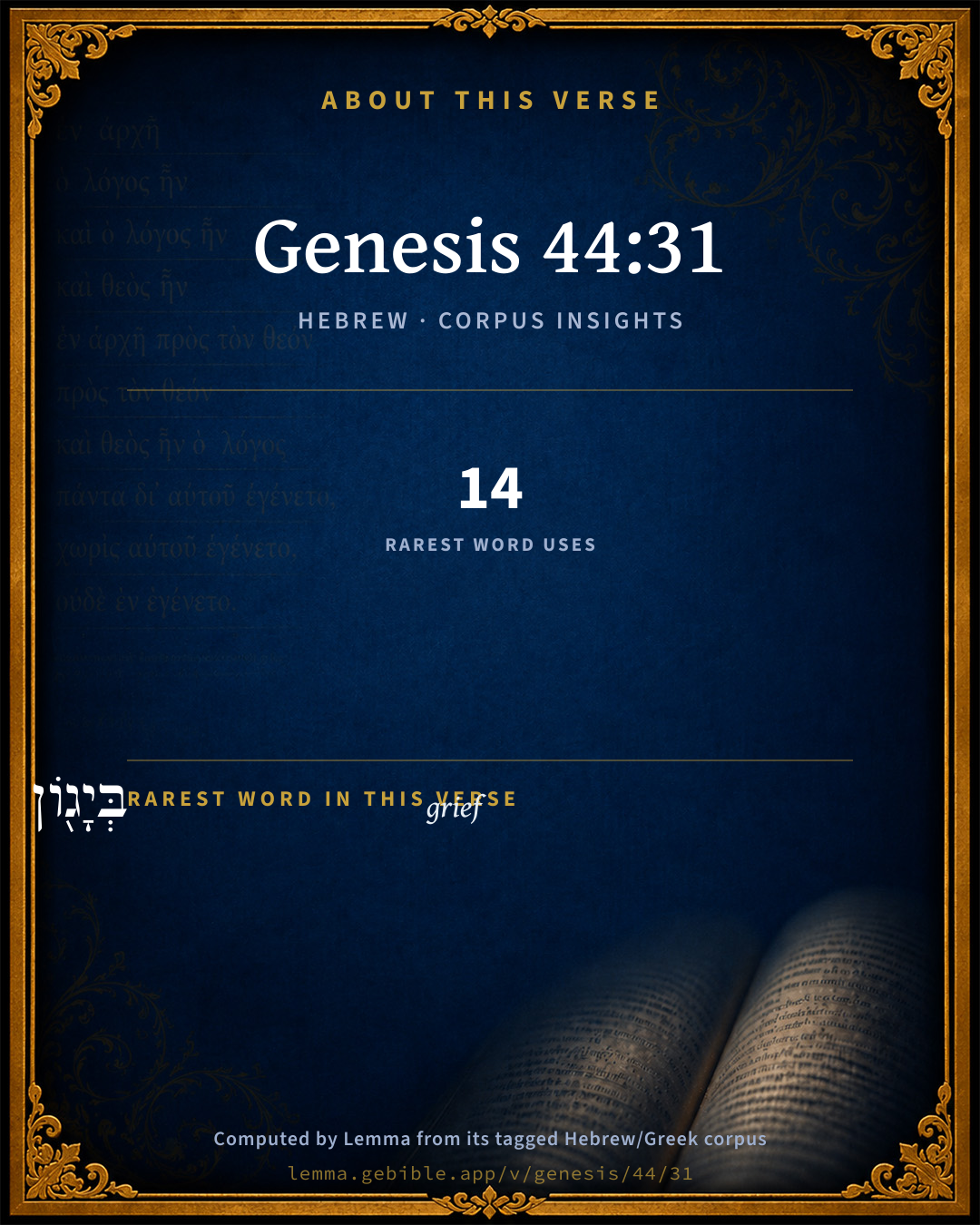
These counts appear in no published source. They are computed here, from the morphology-tagged text and Lemma’s own curated glosses. What Lemma adds →

14
words
13
distinct lemmas
Pentateuch
section

Notable vocabulary

The rarest word here is בְּיָג֖וֹן grief H3015 — appearing just 14 times in the whole Hebrew Bible.

Shared distinctive vocabulary

בְּיָג֖וֹן grief H3015 occurs in 14 verses of the Hebrew Bible. Also found in:

Grammatical profile

  • 4 verbs
  • 7 nouns
  • 1 conjunction
  • 2 particles

Verb forms

  • וְהָיָ֗ה Qal · Sequential Perfect
  • כִּרְאוֹת֛וֹ Qal · Infinitive Construct
  • וָמֵ֑ת Qal · Sequential Perfect
  • וְהוֹרִ֨ידוּ Hiphil · Sequential Perfect

Repetition

A word recurs within this verse — often emphatic in Hebrew:

  • עֲבָדֶ֜יךָ servant H5650 ×2

Hebrew & Septuagint length

In English translation the verse runs 33 words from the Hebrew and 39 from the Septuagint (LXX English) — closely comparable.

A rough comparison of the two English renderings, which tokenize alike — not a word-level alignment.

Word counts can differ between the Hebrew and the Greek without any difference in meaning — e.g. the Hebrew direct-object marker אֵת has no separate Greek word, and Greek often adds the article ὁ.

Cross-references

7

Topical passages linked to Genesis 44:31 in the Treasury of Scripture Knowledge — connected by theme and wording, ordered by reader-vote popularity; previews shown in the World English Bible.

  • Genesis 44:29 If you take this one also from me, and harm happens to him, you will bring down my gray hairs with sorrow to Sheol.'
  • Genesis 37:35 All his sons and all his daughters rose up to comfort him; but he refused to be comforted. He said, "For I will go down to Sheol to my son mourning." His father wept for him.
  • Genesis 37:26–27 Judah said to his brothers, "What profit is it if we kill our brother and conceal his blood?
  • 1 Samuel 4:17–18 He who brought the news answered, Israel is fled before the Philistines, and there has been also a great slaughter among the people, and your two sons also, Hophni and Phinehas, are dead, and the ark of God is taken.
  • 1 Samuel 22:22 David said to Abiathar, I knew on that day, when Doeg the Edomite was there, that he would surely tell Saul: I have occasioned [the death] of all the persons of your father's house.
  • 2 Corinthians 7:10 For godly sorrow works repentance to salvation, which brings no regret. But the sorrow of the world works death.
  • 1 Thessalonians 4:13 But we don't want you to be ignorant, brothers, concerning those who have fallen asleep, so that you don't grieve like the rest, who have no hope.

Cross-references courtesy of OpenBible.info (CC BY 4.0).

Hebrew and Greek witnesses Masoretic Hebrew ↔ Greek Septuagint

The same verse in the two great witnesses to the Old Testament, shown verse-for-verse.

These are two independent witnesses, not word-aligned to each other, and the Septuagint is shown in lemma (dictionary) form.

Hebrew Genesis 44:31 Masoretic · Westminster Leningrad Codex

וְהָיָ֗ה כִּרְאוֹת֛וֹ כִּי אֵ֥ין הַנַּ֖עַר וָמֵ֑ת וְהוֹרִ֨ידוּ עֲבָדֶ֜יךָ אֶת שֵׂיבַ֨ת עַבְדְּךָ֥ אָבִ֛ינוּ בְּיָג֖וֹן שְׁאֹֽלָה

it will happen, when he sees that the boy is no more, that he will die. Your servants will bring down the gray hairs of your servant, our father, with sorrow to Sheol.

World English Bible · Public Domain

Greek LXX Genesis 44:31 Septuagint · lemma form

καί εἰμί ἐν ὁ ὁράω αὐτός μή εἰμί ὁ παιδάριον μετά ἐγώ τελευτάω καί καταἄγω ὁ παῖς σύ ὁ γῆρας ὁ παῖς σύ πατήρ δέ ἐγώ μετά ὀδύνη εἰς ᾅδης

—it shall even come to pass, when he sees the boy is not with us, that he will die, and your servants will bring down the old age of your servant, and our father, with sorrow to the grave.

LXX2012 (modern English Septuagint) · Public Domain

On this verse, The Cambridge Bible for Schools and Colleges discusses the Septuagint’s reading. Read the note in Commentary ↓

Hebrew: Westminster Leningrad Codex (CC BY 4.0). Greek: Septuagint (public domain); English from LXX2012 (modern English Septuagint) (Public Domain). How the Septuagint differs from the Hebrew →

Targum (Aramaic paraphrase)

2

The Targum is the ancient Jewish Aramaic paraphrase of the Hebrew Scriptures — an interpretive translation, not the Hebrew text itself. Onkelos (literal) and Pseudo-Jonathan (expansive) render the Torah, and Jonathan the Prophets. Coverage is partial: where no permissively-licensed English translation exists for a verse, only the Aramaic is shown. This is verse-level text, not a word-by-word alignment to the Hebrew.

  1. Targum Onkelos Torah (Genesis–Deuteronomy)
    וִיהֵי כַּד יֶחֱזֵי אֲרֵי לֵית עוּלֵימָא וּמִית וְיַחֲתוּן עַבְדָּיךְ יָת שִׂיבַת עַבְדָּךְ אָבוּנָא בְּדָווֹנָא לִשְׁאוֹל

    (no public-domain English translation for this verse)

    Targum Onkelos — Aramaic: “Onkelos Genesis” (public domain); “Onkelos Exodus” (public domain); “Onkelos Leviticus” (public domain); “Onkelos Numbers” (public domain); “Onkelos Deuteronomy” (public domain). English: “Sefaria Community Translation” (CC0 1.0 (public-domain dedication)); “J.W. Etheridge. The Targums of Onkelos and Jonathan Ben Uzziel on the Pentateuch. London: Longmans, Green, 1862” (public domain). Text via Sefaria.

  2. Targum Pseudo-Jonathan Torah (Genesis–Deuteronomy)
    וִיהֵי כַּד יֶחֱזֵי אֲרֵי לֵית טַלְיָא וִימוּת וְיֵחְתוּן עַבְדָךְ יַת סֵיבַת עַבְדָךְ אָבוּנָא בְּדָווֹי לְבֵי קְבוּרְתָּא

    (no public-domain English translation for this verse)

    Targum Pseudo-Jonathan — Aramaic: “Targum Jonathan on Genesis” (public domain); “Targum Jonathan on Exodus” (public domain); “Targum Jonathan on Leviticus” (public domain); “Targum Jonathan on Numbers” (public domain); “Targum Jonathan on Deuteronomy” (public domain). English: “The Targum of Jonathan ben Uzziel, trans. J. W. Etheridge, London, 1862” (public domain). Text via Sefaria.

Commentary

Notes on Genesis 44:31 from classic Christian and Jewish commentators (each source and its license shown beneath its notes). The classic Christian expositions comment on the surrounding passage and are grouped to its opening verse, so a note may address several verses; the Jewish commentaries on the Tanakh (Rashi and others) are per-verse, so they appear only where the commentator wrote on this verse.

Lemma curates 59 commentaries, every one of them public domain or Creative Commons licensed, each selected and text-cleaned for this edition rather than reprinted as found. About our sources →

Trapp's Complete Commentary

John Trapp

Gen 44:31 It shall come to pass, when he seeth that the lad [is] not [with us], that he will die: and thy servants shall bring down the gray hairs of thy servant our father with sorrow to the grave.

Ver. 31. That he will die.] For, so great is the love, {a}

“ Corporibus binis spiritus unus inest. ”

{a} Propter impensum amorem.

John Trapp, A Commentary or Exposition upon All the Books of the Old and New Testament (1647–1656) — public domain. Text from a community e-Sword module.

The Cambridge Bible for Schools and Colleges

gen. ed. J. J. S. Perowne

31. with us] These words, which are not in the Heb., are added in the Sam., LXX, and Pesh. versions as essential to the meaning.

with sorrow] i.e. “with grief,” as in Gen_42:38; not “with evil,” as in Gen_44:29.

The Cambridge Bible for Schools and Colleges (gen. ed. J. J. S. Perowne; Cambridge University Press, 1878–1918) — public domain. Text from a community e-Sword module.

John Gill's Exposition

It shall come to pass, when he seeth that the lad is not with us, that he will die,.... As soon as ever he sees us, without asking any question and observes that Benjamin is missing he will conclude at once that he is dead, which will so seize his spirits, that he will expire immediately:

and thy servants shall bring down the gray hairs of thy servant, our father, with sorrow to the grave; as he said would be the case, Gen 44:29; and which would be very afflicting to his sons to be the cause of it, and could not be thought of without the utmost uneasiness and distress.

John Gill's Exposition of the Whole Bible (1746–1763) — public domain (CC PDM 1.0). Text via the HelloAO Bible API.

Haydock's Catholic Bible Commentary

With us, is not now found in Hebrew. But it is in the Samaritan, Septuagint, Syriac, and Chaldean. (Calmet) --- His grey hairs. That is, his person, now far advanced in years. --- With sorrow unto hell. The Hebrew word for hell is here Sheola, the Greek hades: it is not taken for the hell of the damned; but for that place of souls below, where the servants of God were kept before the coming of Christ. Which place, both in the Scripture and in the creed, is named hell. (Challoner) --- In this speech, we find many particulars not mentioned before; whence it appears, that the sacred historian does not always specify every circumstance. But, in relating the same speech, uses various expressions to the same purport. (Calmet)

George Leo Haydock (1774–1849), Haydock's Catholic Family Bible and Commentary, 1859 edition — public domain. Excludes Psalms (Douay-Rheims chapter numbering differs from Protestant) and Deuterocanonical books (Catholic canon only).

Rashi

Rabbi Shlomo Yitzchaki (Rashi)

והיה כראותו כי אין הנער ומת IT SHALL COME TO PASS WHEN HE SEETH THAT THE LAD IS NOT WITH US, THAT HE WILL DIE, i.e. his father will die of grief.

Rashi on the Tanakh — English translations: “The Judaica Press complete Tanach with Rashi, translated by A. J. Rosenberg” (CC BY 4.0); “Pentateuch with Rashi's commentary by M. Rosenbaum and A.M. Silbermann, 1929-1934” (public domain); “The Metsudah Tanach series, Lakewood, N.J” (CC BY 4.0); and “The Book of Joshua, Metsudah Publications, 1997” (CC BY 4.0). Text via Sefaria.

Lesson kit

Teaching starters — assembled from the data on this page, not authored interpretation. Every prompt links to the verse data it draws on. Edit before teaching.

Genesis, in the Pentateuch, opens this verse with 14 words (13 distinct Hebrew lemmas). Its most distinctive word is yâgôwn (“grief”). A historical commentator’s framing appears above. Read the whole chapter for the surrounding context.

Discussion questions

  1. What does “grief” (yâgôwn) contribute to the verse as a whole?
  2. Genesis 42:38 shares the word «grief» with this verse. How do the two illuminate each other?
  3. “servant” occurs 2× in this one verse. What is the effect of the repetition?
  4. The translations on this page render this verse differently — a whole-verse word diff, not a word-by-word alignment. What might account for the different wordings?
  5. The verb «וְהָיָ֗ה» is Qal Sequential Perfect. How does its form color the action?
  6. Reading how Trapp's Complete Commentary and The Cambridge Bible for Schools and Colleges read this verse, where do the two commentators agree and where do they part?

Things to notice

Reading settings

Reading text

Shown beneath each verse's original-language words.

Old Testament
Old Testament edition

Read the OT as the Masoretic Hebrew (MT) or the Greek Septuagint (LXX).

English shown for the Greek Septuagint (in the Hebrew ↔ Greek comparison).

Comparing translations? Open the Compare panel on any verse page to stack up to four side by side.