
Leviticus 16:2

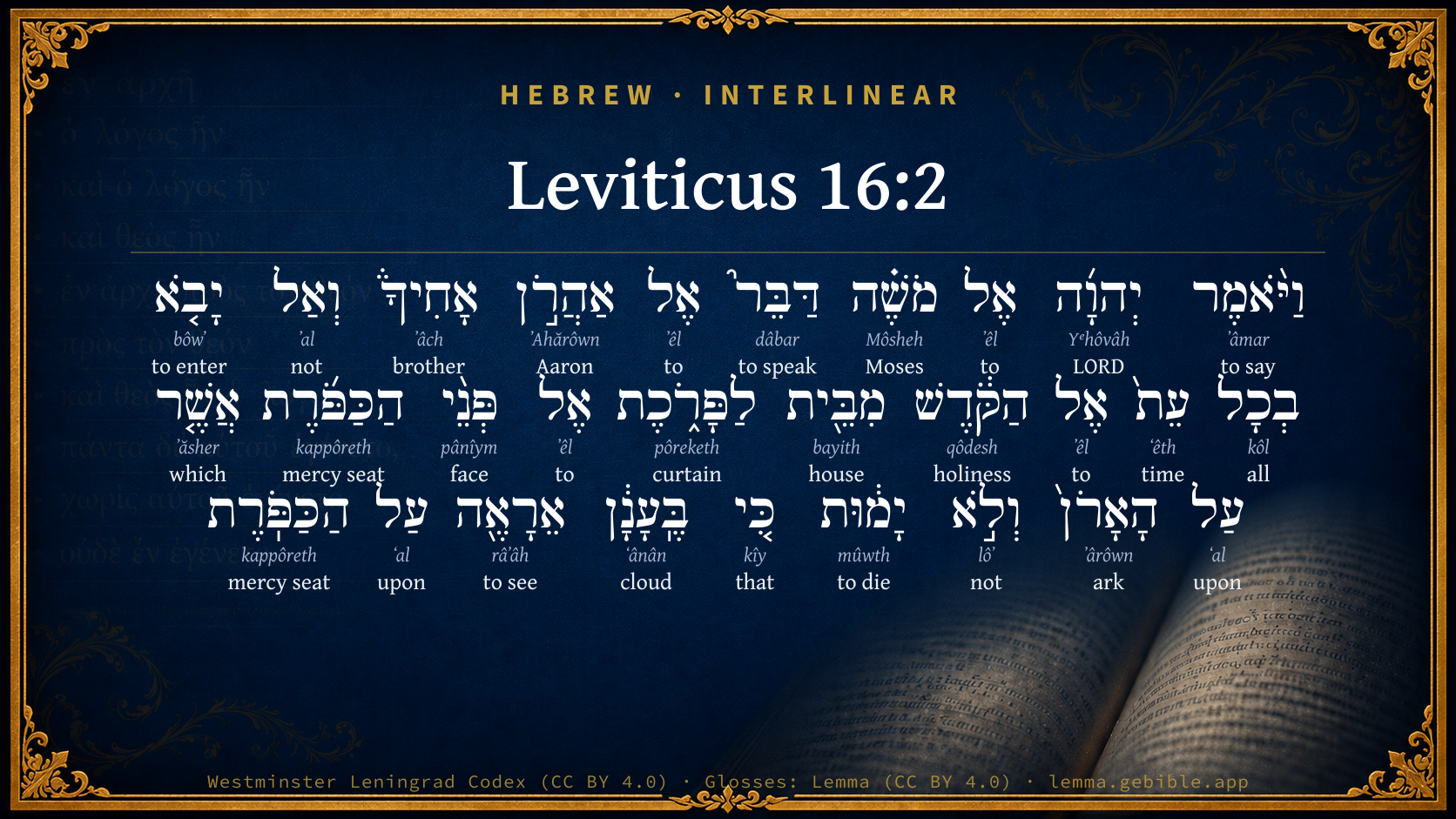
Hebrew (Westminster Leningrad Codex) Leviticus 16:2 appears in the Hebrew Old Testament. The text above is from the Westminster Leningrad Codex. Each word links to its Strong’s number, a concise gloss, and parsing drawn from the Open Scriptures Hebrew Bible morphology. Click any word for its full Brown-Driver-Briggs (BDB) entry.
Download image
Cite this verse

Leviticus 16:2 (World English Bible). Public Domain. Lemma interlinear Bible study tool, https://lemma.gebible.app/v/leviticus/16/2.

Show BibTeX & RIS
BibTeX
RIS
English Translation
and Yahweh said to Moses, "Tell Aaron your brother, not to come at all times into the Most Holy Place within the veil, before the mercy seat which is on the ark; lest he die: for I will appear in the cloud on the mercy seat.
World English Bible · Public Domain
Download a study sheet

One document with this verse’s original text, its word-by-word gloss line, the meaning frame, cross-references with their text, attributed commentary, and full source and license credits — printable, and it pastes into notes with its structure intact.

This verse Autodidact and up

Study sheet (.html) Plain text (.txt)

A passage Seminary Student

Up to 50 verses in one chapter. A passage sheet keeps up to 6 commentary sources and 12 cross-references per verse, in the order this page ranks them, and says so on the sheet whenever that leaves anything out. Ask for a single verse and you get the Autodidact verse sheet above.

Everything on this page stays free to read, with no account — the sheet is a download of what is already on screen, not access to it.

Want to remove ads? Support Godless Engineer
Compare translations 3

The same verse in 3 English versions, stacked beneath the original-language interlinear above. Click any original word for its lexicon entry.

Each is an independent rendering of the whole verse — the interlinear is not word-aligned to these translations.

Highlighted words mark where these versions differ — a whole-verse word diff, not a word-by-word alignment.

  • World English Bible Public Domain
    and Yahweh said to Moses, "Tell Aaron your brother, not to come at all times into the Most Holy Place within the veil, before the mercy seat which is on the ark; lest he die: for I will appear in the cloud on the mercy seat.
  • King James Version Public Domain
    And the LORD said unto Moses, Speak unto Aaron thy brother, that he come not at all times into the holy place within the vail before the mercy seat, which is upon the ark; that he die not: for I will appear in the cloud upon the mercy seat.
  • unfoldingWord Literal Text CC BY-SA 4.0
    And Yahweh said to Moses, “Speak to Aaron your brother, and he shall not enter at all times into the Holy Place inside of the curtain, to the face of the atonement lid that on the Box, and he will not die. For I will appear in a cloud over the atonement lid.

unfoldingWord Literal Text — © unfoldingWord, licensed CC BY-SA 4.0. Word-aligned USFM3 via Door43 (git.door43.org/unfoldingWord/en_ult).

Versions to compare (up to 4)

3 of 4 selected

Show all 18 translations

Every available English version of this verse, each an independent rendering of the whole verse.

  • World English Bible Public Domain
    and Yahweh said to Moses, "Tell Aaron your brother, not to come at all times into the Most Holy Place within the veil, before the mercy seat which is on the ark; lest he die: for I will appear in the cloud on the mercy seat.
  • Berean Standard Bible Public Domain
    And the LORD said to Moses: “Tell your brother Aaron not to enter freely into the Most Holy Place behind the veil in front of the mercy seat on the ark, or else he will die, because I appear in the cloud above the mercy seat.
  • Majority Standard Bible Public Domain
    And the LORD said to Moses: “Tell your brother Aaron not to enter freely into the Most Holy Place behind the veil in front of the mercy seat on the ark, or else he will die, because I appear in the cloud above the mercy seat.
  • King James Version Public Domain
    And the LORD said unto Moses, Speak unto Aaron thy brother, that he come not at all times into the holy place within the vail before the mercy seat, which is upon the ark; that he die not: for I will appear in the cloud upon the mercy seat.
  • American Standard Version (1901) Public Domain
    and Jehovah said unto Moses, Speak unto Aaron thy brother, that he come not at all times into the holy place within the veil, before the mercy-seat which is upon the ark; that he die not: for I will appear in the cloud upon the mercy-seat.
  • Revised Version (1885) Public Domain
    and the LORD said unto Moses, Speak unto Aaron thy brother, that he come not at all times into the holy place within the veil, before the mercy-seat which is upon the ark; that he die not: for I will appear in the cloud upon the mercy-seat.
  • Geneva Bible (1599) Public Domain
    And the Lord sayd vnto Moses, Speake vnto Aaron thy brother, that he come not at all times into the Holy place within the vayle, before the Merciseate, which is vpon the Arke, that he dye not: for I wil appeare in the cloude vpon the Merciseate.
  • Douay-Rheims (1899) Public Domain
    And he commanded him, saying, Speak to Aaron thy brother, that he enter not at all into the sanctuary, which is within the veil before the propitiatory, with which the ark is covered, lest he die, (for I will appear in a cloud over the oracle,)
  • Young's Literal Translation Public Domain
    yea, Jehovah saith unto Moses, `Speak unto Aaron thy brother, and he cometh not in at all times unto the sanctuary within the vail, unto the front of the mercy-seat, which `is' upon the ark, and he dieth not, for in a cloud I am seen upon the mercy-seat.
  • Literal Standard Version CC BY-SA 4.0
    indeed, YHWH says to Moses, “Speak to your brother Aaron, and he does not come in at all times to the holy place within the veil, to the front of the propitiatory covering, which [is] on the Ark, and he does not die, for I am seen in a cloud on the propitiatory covering.
  • Unlocked Literal Bible CC BY-SA 4.0
    Yahweh said to Moses, “Speak to Aaron your brother and tell him not to come at just any time into the most holy place inside the curtain, before the atonement lid that is on the ark. If he does, he will die, because I appear in the cloud over the atonement lid.
  • unfoldingWord Literal Text CC BY-SA 4.0
    And Yahweh said to Moses, “Speak to Aaron your brother, and he shall not enter at all times into the Holy Place inside of the curtain, to the face of the atonement lid that on the Box, and he will not die. For I will appear in a cloud over the atonement lid.
  • Darby Bible Public Domain
    and Jehovah said to Moses, Speak unto Aaron thy brother, that he come not at all times into the sanctuary inside the veil before the mercy-seat which is upon the ark, that he die not; for I will appear in the cloud upon the mercy-seat.
  • World Messianic Bible Public Domain
    and the LORD said to Moses, “Tell Aaron your brother not to come at just any time into the Most Holy Place within the veil, before the mercy seat which is on the ark; lest he die; for I will appear in the cloud on the mercy seat.
  • Webster's Bible Public Domain
    And the LORD said to Moses, Speak to Aaron thy brother, that he come not at all times into the holy place within the vail, before the mercy-seat, which is upon the ark; that he may not die: for I will appear in the cloud upon the mercy-seat.
  • Free Bible Version CC BY-SA 4.0
    The Lord told Moses: “Warn your brother Aaron not to come into the Most Holy Place whenever he wants, otherwise he'll die. For that's where I appear in the cloud above the atonement cover of the Ark, behind the veil.
  • Bible in Basic English Public Domain
    The Lord said to Moses, Say to Aaron, your brother, that he may not come at all times into the holy place inside the veil, before the cover which is on the ark, for fear that death may overtake him; for I will be seen in the cloud on the cover of the ark.
  • JPS Tanakh (1917) Public Domain
    and the LORD said unto Moses: 'Speak unto Aaron thy brother, that he come not at all times into the holy place within the veil, before the ark-cover which is upon the ark; that he die not; for I appear in the cloud upon the ark-cover.

Literal Standard Version (2020), Covenant Press — licensed CC BY-SA 4.0. Text via the HelloAO Bible API (eBible.org). Unlocked Literal Bible (unfoldingWord) — licensed CC BY-SA 4.0. Text via the HelloAO Bible API (eBible.org). unfoldingWord Literal Text — © unfoldingWord, licensed CC BY-SA 4.0. Word-aligned USFM3 via Door43 (git.door43.org/unfoldingWord/en_ult). Free Bible Version, Dr. Jonathan Gallagher — licensed CC BY-SA 4.0. Text via the HelloAO Bible API (eBible.org).

Word by word

More ways to search: Search by grammar → Find every occurrence → Compare this word →

Practice this passage: Drill this verse → Learn its vocabulary →

לַפָּרֹ֑כֶת
pôreketh
H6532
“to/for the · curtain”
Preposition, Determined + Noun, Common, Feminine, Singular, Absolute
Part of Speech
Preposition + Noun
Type
Common
Gender
Feminine
Number
Singular
State
Absolute
Full BDB Definition

Origin: act part of the same as H6531

TWOT: 1818a

curtain, veil
  1. וַיֹּ֨אמֶר ʼâmar H559 “and · to say” Conjunction + Verb, Qal, Sequential Imperfect, 3rd Person, Masculine, Singular
  2. יְהוָ֜ה Yᵉhôvâh H3068 “LORD” Noun, Proper
  3. אֶל ʼêl H413 “to” Preposition
  4. מֹשֶׁ֗ה Môsheh H4872 “Moses” Noun, Proper
  5. דַּבֵּר֮ dâbar H1696 “speak” Verb, Piel, Imperative, 2nd Person, Masculine, Singular
  6. אֶל ʼêl H413 “to” Preposition
  7. אַהֲרֹ֣ן ʼAhărôwn H175 “Aaron” Noun, Proper
  8. אָחִיךָ֒ ʼâch H251 “brother · your” Noun, Common, Masculine, Singular, Construct + Suffix, Personal, 2nd Person, Masculine, Singular
  9. וְאַל ʼal H408 “and · not” Conjunction + Particle, Negative
  10. יָבֹ֤א bôwʼ H935 “to enter” Verb, Qal, Jussive, 3rd Person, Masculine, Singular
  11. בְכָל kôl H3605 “in/at · all of” Preposition + Noun, Common, Masculine, Singular, Construct
  12. עֵת֙ ʻêth H6256 “time” Noun, Common, Both, Singular, Absolute
  13. אֶל ʼêl H413 “to” Preposition
  14. הַקֹּ֔דֶשׁ qôdesh H6944 “the · holiness” Particle, Definite Article + Noun, Common, Masculine, Singular, Absolute
  15. מִבֵּ֖ית bayith H1004 “from · house of” Preposition + Noun, Common, Masculine, Singular, Construct
  16. אֶל ʼêl H413 “to” Preposition
  17. פְּנֵ֨י pânîym H6440 “face(s) of” Noun, Common, Both, Plural, Construct
  18. הַכַּפֹּ֜רֶת kappôreth H3727 “the · mercy seat” Particle, Definite Article + Noun, Common, Feminine, Singular, Absolute
  19. אֲשֶׁ֤ר ʼăsher H834 “which” Particle, Relative
  20. עַל ʻal H5921 “upon” Preposition
  21. הָאָרֹן֙ ʼârôwn H727 “the · ark” Particle, Definite Article + Noun, Common, Both, Singular, Absolute
  22. וְלֹ֣א lôʼ H3808 “and · not” Conjunction + Particle, Negative
  23. יָמ֔וּת mûwth H4191 “to die” Verb, Qal, Imperfect, 3rd Person, Masculine, Singular
  24. כִּ֚י kîy H3588 “that” Conjunction
  25. בֶּֽעָנָ֔ן ʻânân H6051 “in/at the · cloud” Preposition, Determined + Noun, Common, Masculine, Singular, Absolute
  26. אֵרָאֶ֖ה râʼâh H7200 “to see” Verb, Niphal, Imperfect, 1st Person, Common, Singular
  27. עַל ʻal H5921 “upon” Preposition
  28. הַכַּפֹּֽרֶת kappôreth H3727 “the · mercy seat” Particle, Definite Article + Noun, Common, Feminine, Singular, Absolute

About this verse

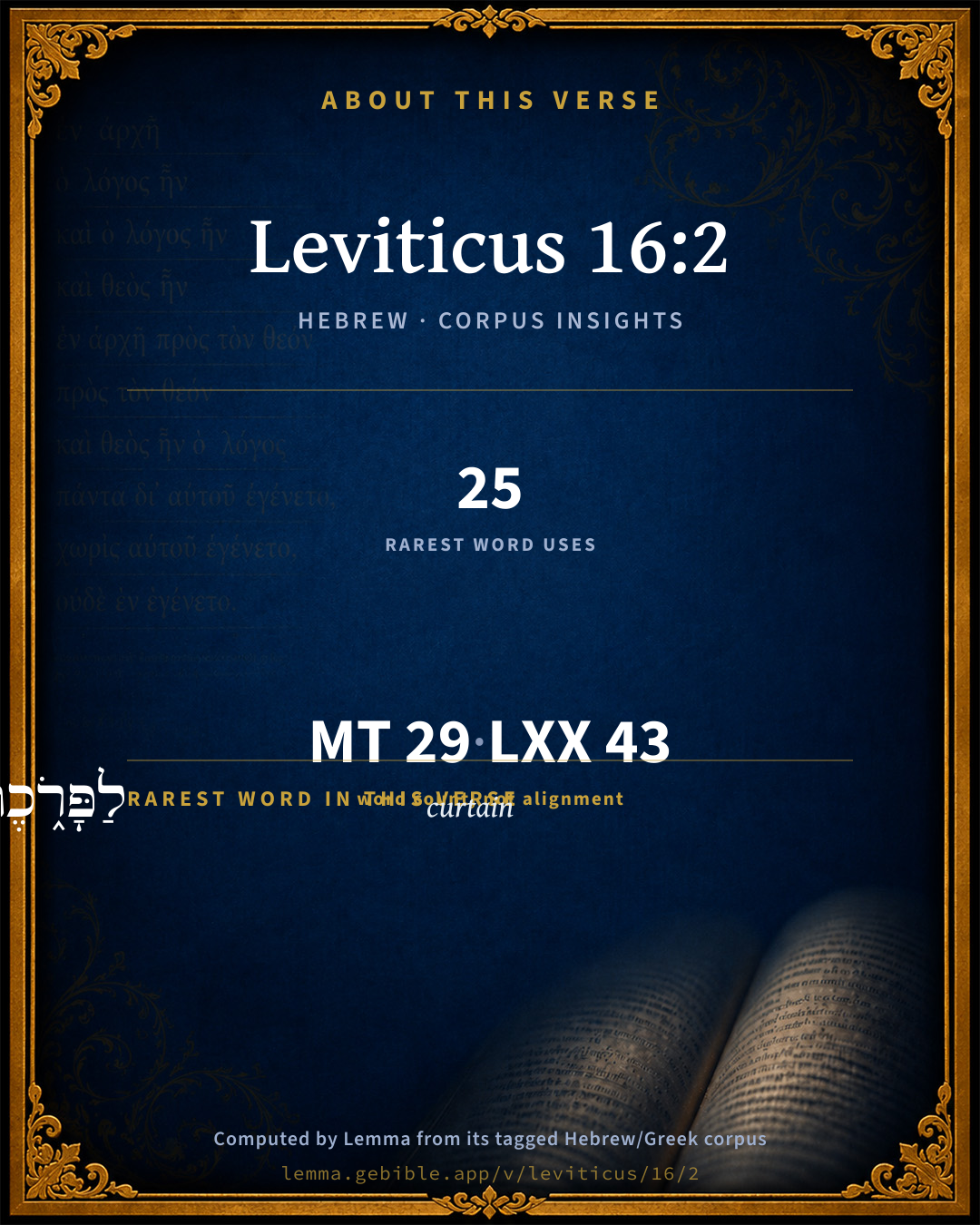
These counts appear in no published source. They are computed here, from the morphology-tagged text and Lemma’s own curated glosses. What Lemma adds →

29
words
24
distinct lemmas
Pentateuch
section

Notable vocabulary

The rarest word here is לַפָּרֹ֑כֶת curtain H6532 — appearing just 25 times in the whole Hebrew Bible.

Shared distinctive vocabulary

לַפָּרֹ֑כֶת curtain H6532 occurs in 23 verses of the Hebrew Bible. Also found in:

Grammatical profile

  • 5 verbs
  • 14 nouns
  • 6 prepositions
  • 1 conjunction
  • 3 particles

Verb forms

  • וַיֹּ֨אמֶר Qal · Sequential Imperfect
  • דַּבֵּר֮ Piel · Imperative
  • יָבֹ֤א Qal · Jussive
  • יָמ֔וּת Qal · Imperfect
  • אֵרָאֶ֖ה Niphal · Imperfect

Repetition

Words recur within this verse — often emphatic in Hebrew:

  • הַכַּפֹּ֜רֶת mercy seat H3727 ×2
  • עַל upon H5921 ×2
  • אֶל to H413 ×4

Hebrew & Septuagint length

In English translation the verse runs 46 words from the Hebrew and 53 from the Septuagint (LXX English) — closely comparable.

A rough comparison of the two English renderings, which tokenize alike — not a word-level alignment.

Word counts can differ between the Hebrew and the Greek without any difference in meaning — e.g. the Hebrew direct-object marker אֵת has no separate Greek word, and Greek often adds the article ὁ.

In the original languages it is 29 Hebrew tokens and 43 Greek tokens — but the two are counted differently (Hebrew bundles its prefixes and suffixes into one token; the Greek is in lemma form), so that isn’t a like-for-like length.

Cross-references

19

Topical passages linked to Leviticus 16:2 in the Treasury of Scripture Knowledge — connected by theme and wording, ordered by reader-vote popularity; previews shown in the World English Bible.

  • Exodus 30:10 Aaron shall make atonement on its horns once in the year; with the blood of the sin offering of atonement once in the year he shall make atonement for it throughout your generations. It is most holy to Yahweh."
  • 1 Kings 8:10–12 It came to pass, when the priests were come out of the holy place, that the cloud filled the house of Yahweh,
  • Hebrews 10:19–20 Having therefore, brothers, boldness to enter into the holy place by the blood of Jesus,
  • Hebrews 9:25 nor yet that he should offer himself often, as the high priest enters into the holy place year by year with blood not his own,
  • Hebrews 9:7–8 but into the second the high priest alone, once in the year, not without blood, which he offers for himself, and for the errors of the people.
  • Exodus 40:34–35 Then the cloud covered the tent of meeting, and the glory of Yahweh filled the tent.
  • 1 Kings 8:6 The priests brought in the ark of the covenant of Yahweh to its place, into the oracle of the house, to the most holy place, even under the wings of the cherubim.
  • 2 Chronicles 5:14 so that the priests could not stand to minister by reason of the cloud: for the glory of Yahweh filled the house of God.
  • Matthew 27:51 Behold, the veil of the temple was torn in two from the top to the bottom. The earth quaked and the rocks were split.
  • Exodus 25:17–22 You shall make a mercy seat of pure gold. Two and a half cubits shall be its length, and a cubit and a half its breadth.
  • Exodus 26:33–34 You shall hang up the veil under the clasps, and shall bring the ark of the testimony in there within the veil: and the veil shall separate the holy place from the most holy for you.
  • Exodus 40:20–21 He took and put the testimony into the ark, and set the poles on the ark, and put the mercy seat above on the ark.
  • Leviticus 8:35 At the door of the Tent of Meeting you shall stay day and night seven days, and keep the charge of Yahweh, that you don't die: for so I am commanded."
  • Leviticus 16:13 and he shall put the incense on the fire before Yahweh, that the cloud of the incense may cover the mercy seat that is on the testimony, so that he will not die.
  • Leviticus 23:27 "However on the tenth day of this seventh month is the day of atonement: it shall be a holy convocation to you, and you shall afflict yourselves; and you shall offer an offering made by fire to Yahweh.
  • Numbers 4:19 but thus do to them, that they may live, and not die, when they approach to the most holy things: Aaron and his sons shall go in, and appoint them everyone to his service and to his burden;
  • Numbers 17:10 Yahweh said to Moses, Put back the rod of Aaron before the testimony, to be kept for a token against the children of rebellion; that you may make an end of their murmurings against me, that they not die.
  • Hebrews 4:14–16 Having then a great high priest, who has passed through the heavens, Jesus, the Son of God, let us hold tightly to our confession.
  • Hebrews 9:3 After the second veil was the tabernacle which is called the Holy of Holies,

Cross-references courtesy of OpenBible.info (CC BY 4.0).

Hebrew and Greek witnesses Masoretic Hebrew ↔ Greek Septuagint

The same verse in the two great witnesses to the Old Testament, shown verse-for-verse.

These are two independent witnesses, not word-aligned to each other, and the Septuagint is shown in lemma (dictionary) form.

Hebrew Leviticus 16:2 Masoretic · Westminster Leningrad Codex

וַיֹּ֨אמֶר יְהוָ֜ה אֶל מֹשֶׁ֗ה דַּבֵּר֮ אֶל אַהֲרֹ֣ן אָחִיךָ֒ וְאַל יָבֹ֤א בְכָל עֵת֙ אֶל הַקֹּ֔דֶשׁ מִבֵּ֖ית לַפָּרֹ֑כֶת אֶל פְּנֵ֨י הַכַּפֹּ֜רֶת אֲשֶׁ֤ר עַל הָאָרֹן֙ וְלֹ֣א יָמ֔וּת כִּ֚י בֶּֽעָנָ֔ן אֵרָאֶ֖ה עַל הַכַּפֹּֽרֶת

and Yahweh said to Moses, "Tell Aaron your brother, not to come at all times into the Most Holy Place within the veil, before the mercy seat which is on the ark; lest he die: for I will appear in the cloud on the mercy seat.

World English Bible · Public Domain

Greek LXX Leviticus 16:2 Septuagint · lemma form

καί εἶπον κύριος πρός μωυσῆς λαλέω πρός ἀαρών ὁ ἀδελφός σύ καί μή εἰςπορεύομαι πᾶς ὥρα εἰς ὁ ἅγιος ἐσώτερον ὁ καταπέτασμα εἰς πρόσωπον ὁ ἱλαστήριον ὅς εἰμί ἐπί ὁ κιβωτός ὁ μαρτύριον καί οὐ ἀποθνήσκω ἐν γάρ νεφέλη ὁράω ἐπί ὁ ἱλαστήριον

And the Lord said to Moses, Speak to Aaron your brother, and let him not come in at all times into the holy place within the veil before the propitiatory, which is upon the ark of the testimony, and he shall not die; for I will appear in a cloud on the propitiatory.

LXX2012 (modern English Septuagint) · Public Domain

Hebrew: Westminster Leningrad Codex (CC BY 4.0). Greek: Septuagint (public domain); English from LXX2012 (modern English Septuagint) (Public Domain). How the Septuagint differs from the Hebrew →

Targum (Aramaic paraphrase)

2

The Targum is the ancient Jewish Aramaic paraphrase of the Hebrew Scriptures — an interpretive translation, not the Hebrew text itself. Onkelos (literal) and Pseudo-Jonathan (expansive) render the Torah, and Jonathan the Prophets. Coverage is partial: where no permissively-licensed English translation exists for a verse, only the Aramaic is shown. This is verse-level text, not a word-by-word alignment to the Hebrew.

  1. Targum Onkelos Torah (Genesis–Deuteronomy)
    וַאֲמַר יְיָ לְמֹשֶׁה מַלֵל עִם אַהֲרֹן אָחוּךְ וְלָא יְהֵי עָלֵל בְּכָל עִדָן לְקוּדְשָׁא מִגָיו לְפָרֻכְתָּא לָקֳדָם כַּפֻּרְתָּא דִי עַל אֲרוֹנָא וְלָא יְמוּת אֲרֵי בַּעֲנָנָא אֲנָא מִתְגְלִי עַל בֵּית כַּפֻּרְתָּא

    (no public-domain English translation for this verse)

    Targum Onkelos — Aramaic: “Onkelos Genesis” (public domain); “Onkelos Exodus” (public domain); “Onkelos Leviticus” (public domain); “Onkelos Numbers” (public domain); “Onkelos Deuteronomy” (public domain). English: “Sefaria Community Translation” (CC0 1.0 (public-domain dedication)); “J.W. Etheridge. The Targums of Onkelos and Jonathan Ben Uzziel on the Pentateuch. London: Longmans, Green, 1862” (public domain). Text via Sefaria.

  2. Targum Pseudo-Jonathan Torah (Genesis–Deuteronomy)
    וַאֲמַר יְיָ לְמשֶׁה מַלֵיל עִם אַהֲרן אָחוּךְ וְלָא יְהֵי עָלֵיל בְּכָל עִידַן לְקוּדְשָׁא מִן לְגֵיו לְפַרְגוֹדָא לִקְדָם כַּפּוּרְתָּא אֲרוּם בַּעֲנָנִי אִיקְרֵי שְׁכִינְתִּי מִתְגְלֵי עַל בֵּית כַּפּוֹרֵי

    And the Lord said unto Mosheh: Speak with Aharon thy brother, that he enter not at any time into the holy place within the veil before the mercy-seat; for the cloud of the glory of My Shekinah is revealed over the place of the mercy-seat.

    Targum Pseudo-Jonathan — Aramaic: “Targum Jonathan on Genesis” (public domain); “Targum Jonathan on Exodus” (public domain); “Targum Jonathan on Leviticus” (public domain); “Targum Jonathan on Numbers” (public domain); “Targum Jonathan on Deuteronomy” (public domain). English: “The Targum of Jonathan ben Uzziel, trans. J. W. Etheridge, London, 1862” (public domain). Text via Sefaria.

Commentary

Notes on Leviticus 16:2 from classic Christian and Jewish commentators (each source and its license shown beneath its notes). The classic Christian expositions comment on the surrounding passage and are grouped to its opening verse, so a note may address several verses; the Jewish commentaries on the Tanakh (Rashi and others) are per-verse, so they appear only where the commentator wrote on this verse.

Lemma curates 59 commentaries, every one of them public domain or Creative Commons licensed, each selected and text-cleaned for this edition rather than reprinted as found. About our sources →

The Cambridge Bible for Schools and Colleges

gen. ed. J. J. S. Perowne

The ritual to be observed (1–28)

2. into the holy place within the veil] the veil (pârôketh), which separates the ‘holy place’ from the ‘most holy’ (here called ‘the holy place within …’), cp. Exo_26:31-33.

the mercy-seat] Heb. kappôreth, here and in Lev_16:13-15, a solid gold plate of the same size as the top of the ark (2½ by 1½ cubits), to which the two cherubim were fixed, as described in Exo_25:17-21. It was the place where the Lord appeared (Lev_16:2); from which He gave His commands (see note on Lev_1:1); the most holy spot in the most holy place, the ‘footstool’ of the Lord who sitteth enthroned upon the cherubim (1Ch_28:2; Psa_99:5, cp. Lev_16:1; Psa_132:7, cp. Lev_16:5). The Heb. word is formed from kipper, to make propitiation, and means that which propitiates. The Gk. ἱλαστήριον exactly corresponds, and from the Vulg. propitiatorium the word ‘propitiatorie’ was used in Wiclif’s translation. This word is the best English equivalent for the Heb., and indicates the nature of the solemn rite performed within the veil on the Day of Atonement. As ‘oratory’ is the place of ‘oration’ or prayer, so ‘propitiatory’ in the sense of ‘place of propitiation’ would fitly express the Heb. word which is rendered in EVV by ‘mercy-seat.’ See note on Exo_25:17 (C.B.); Art. Mercy-seat in Enc. Bib.; and Art. Tabernacle in HDB. iv. 665 a. The mercy-seat is described as ‘upon the testimony’ in Lev_16:13. ‘The testimony’ is the name given to the two tables on which the Ten Words were written, so called because they contain the ‘testimony’ or witness of God’s will for man. See note on Exo_25:16, and Intr. to Pent. App. II. pp. 221 f.

that he die not] Here and in Lev_16:13 there is reference to the penalty attending breach of the rules to be observed in the service of the sanctuary. A general warning is given in Lev_22:9 to the priests who keep the charge of the Lord, ‘lest they bear sin for it, and die therein, if they profane it.’ The expression in the text is found in Exo_28:35 with reference to putting on the robe of the ephod with the bells on its skirt when going in unto the holy place; in Exo_28:43 the same penalty is threatened for omitting to wear the linen breeches; in Exo_30:20 for omitting to wash before entering the holy place; in 8:35 in connexion with the ceremonial prescribed at the inauguration of the priesthood; also in Exo_10:6-7; Exo_10:9, Num_4:19 (of the Kohathites, cp. Lev_16:15; Lev_16:20), Num_17:10, Num_18:3; Num_18:32, Num_35:12. The variety of the offences for which the penalty of death is threatened in these passages should be noticed. The expression ‘that he die not’ is used generally in connexion with infringement of rules by priests, Levites, and people, and its use here does not imply any reference to the story of Nadab and Abihu.

The Cambridge Bible for Schools and Colleges (gen. ed. J. J. S. Perowne; Cambridge University Press, 1878–1918) — public domain. Text from a community e-Sword module.

Trapp's Complete Commentary

John Trapp

Lev 16:2 And the LORD said unto Moses, Speak unto Aaron thy brother, that he come not at all times into the holy [place] within the vail before the mercy seat, which [is] upon the ark; that he die not: for I will appear in the cloud upon the mercy seat.

Ver. 2. that he come not at all times.] Whensoever he pleaseth, but when I appoint him, i.e., once a year only, {Exo 30:10} and then also with reverence and godly fear. God, as he loves to be acquainted with men in the walks of their obedience, so he takes state upon him in his ordinances, and will be trembled at in his judgments.

John Trapp, A Commentary or Exposition upon All the Books of the Old and New Testament (1647–1656) — public domain. Text from a community e-Sword module.

The Biblical Illustrator

Joseph S. Exell

Lev_16:2-3

I will appear in the cloud.

Jehovah appearing in a cloud

I. The cloudy dispensations. By a cloud I understand a density approaching to darkness and gloom; and yet that very density and darkness inhabited by the glory of God. If the glory of God were to burst upon us without a cloud, it would be nothing less than a consuming fire. The Church of God has to pass through dispensations that are cloudy in her public capacity, in Gods providential dealings with her individual members. Look, for instance, at the Church of God as a body at the present time. Is she not beclouded? Are there not clouds of ignorance, superstition, idolatry, despotic power--clouds of carnal wickedness under the name of Christianity, overspreading Zion? The cloud is still more dense when it overwhelms the soul, as it regards its conflicts when darkness overspreads the mind, and the poor believer cannot pray, cannot sing, nor cannot believe.

II. The appearance that is promised. I will appear in the cloud upon the mercy-seat. He appears as a wonder-working God; and when in any of the dispensations to which I have referred, the hand of God is seen, how are the souls of Gods people filled with awe! I will appear. Is it the Church that is overwhelmed with a cloud? I will appear for her deliverance, though I may suffer her to pass through fire and through water first. Is it Providence that is mysterious--every hope cut off, all prospects darkened? I will appear, says Jehovah. Mark the promise--it is positive--I will appear. The cattle upon a thousand hills are His property; the gold and the silver He declares are all His own; the hearts of kings are in His hands, and He turns them as rivers of water as He pleases. So that He appears working wonders frequently in the world, and those very things which were most threatening appear to be the very things that God was making use of for the real advantage of His people.

III. The mercy displayed. It is the mercy of the Triune Jehovah, the gift of mercy from God the Father--immutable, eternal, covenant mercy--the mercy of God. That mercy is fully and freely displayed in the person of Christ; yea, more, so far as regards our view of it--the mercy of God the Father laid up from everlasting, recorded in the covenant, fixed in decree, is, to a certain extent, concealed from us, until we discover it in the person of Christ. But when we are brought to view Him as the mercy promised, and then mark the display of that mercy in His incarnation, in His obedience, in His merit, in His blood, in His sufferings, in His victories, in His present employment before the throne, why He is all mercy--mercy embodied in the person of the glorious Mediator. And then, if we look at the merciful dealings of God the Holy Ghost with His people, in melting their hearts, making them new creatures, giving them life Divine, perfecting the work He has first commenced in personal experience--why we come to this conclusion that our God, Father, Son, and Holy Ghost, is the God of mercy, a merciful God. Then mark the transcendent glory of this mercy, how it is displayed in the face of misery, and rebellion, and ingratitude, and all our wanderings, and all our wants.

IV. The effects which follow when Jehovah comes down and appears in the midst of the cloud. It is not merely for a momentary interposition, but for a permanent deliverance, and mercies may be expected by all the praying seed of Jacob. Now allow a familiar illustration here. If a benevolent individual, very wealthy, were accustomed to take a seat, as they used to do in olden times, at the gate of the city, or in any other place of public concourse, and to do so for the very purpose of distributing his bounty, would not that gate be crowded? Who would not go there? Even if we did not want pecuniary alms, if honours, jewels were to be distributed by this person, who would not be there? Who would not receive some token of the kindness and favour of such an one? My hearer, is it not grievous that you and I are not oftener at the mercy-seat? (J. Irons.)

The concealing cloud

I once visited an invalid woman. She had been confined to bed for a long time, and when I spoke to her, she said: I think the Lord has forgotten me altogether. The eye of faith had grown dim through bodily weakness, and I replied to her, Did you ever go down the river and see the lighthouse? She said she had. Well, suppose you lived on the opposite side from it, and one day the mist came down, and it grew so thick that you could not see the lighthouse on the other side; would you believe it was there? Oh, yes, she said, because I had seen it before. And there is another thing would make you believe, I said; you would hear the shrill whistle coming from the lighthouse warning mariners of the danger that was near. In the same way you should believe that the Lord is still near you; that He has not forgotten you, although a cloud has come between you and God; if you will but listen, you will hear His voice speaking to you; the mist will soon roll away if you look right at Him with the eye of faith. She did look, and beheld Jesus as precious to her as ever. (J. Cameron.)

The Biblical Illustrator, edited by Joseph S. Exell (c. 1880s–1900s) — public domain. Text from a community e-Sword module.

Joseph Benson's Commentary

Lev 16:2. That he come not at all times — Not whensoever he pleaseth, but only when I shall appoint. Into the holy place without the veil, the high- priest, or one of the inferior priests, went every morning and evening when they offered incense but into this holy place within the veil, commonly called the holy of holies, or the most holy place, as none but the high-priest was to enter, so neither was he to enter it at all times, as a common place of worship, or to perform divine service there at his pleasure. He was ordinarily to enter it only once a year, and that on the great day of atonement, or expiation for the transgressions of the whole Israelitish nation. Upon extraordinary occasions, he might also enter it oftener, as when he was to consult the oracle of God, or when the tabernacle was to be taken down or set up, according to the journeyings of the people. Lest he die — For his presumption. For I will appear in the cloud — A bright and glorious cloud over the mercy-seat. This sacred apartment he was to look upon as the place of the special residence of the divine glory, and therefore was not to enter there but when appointed, and in such a manner as God directed.

Joseph Benson's Commentary on the Old and New Testaments (1811–1818) — public domain. Text from a community e-Sword module.

Tyndale Open Study Notes

Tyndale Open Resources

16:2 An inner curtain separated the Holy Place from the Most Holy Place. Conceptually, the sanctuary was God’s palace, the Most Holy Place was his throne room, and the Ark was his throne (see 1:1). In the ancient Near East, entering the presence of a king without invitation meant risking death (Esth 4:11). The Most Holy Place, therefore, was not a place that Aaron could enter casually. It was off-limits even to the high priest, except when his presence was required by God as part of the ritual of the Day of Atonement.

Tyndale Open Study Notes — © Tyndale Open Resources, licensed CC BY-SA 4.0. Text via the HelloAO Bible API.

Geneva Bible (1599)

Geneva Bible translators

The high Priest entered into the Holiest of all but once a year even in the month of September.

Geneva Bible (1599) marginal notes — public domain. Text via Bolls.life.

Jamieson, Fausset & Brown

Robert Jamieson, A. R. Fausset & David Brown

Speak unto Aaron thy brother, that he come not at all times into the holy place within the veil, &c.--Common priests went every day into the part of the sanctuary without the veil to burn incense on the golden altar. But none except the high priest was allowed to enter within the veil, and that only once a year with the greatest care and solemnity. This arrangement was evidently designed to inspire a reverence for the most holy place, and the precaution was necessary at a time when the presence of God was indicated by sensible symbols, the impression of which might have been diminished or lost by daily and familiar observation.

I will appear in the cloud--that is, the smoke of the incense which the high priest burnt on his yearly entrance into the most holy place: and this was the cloud which at that time covered the mercy seat.

Jamieson, Fausset & Brown — Commentary Critical and Explanatory on the Whole Bible (1871) — public domain (CC PDM 1.0). Text via the HelloAO Bible API.

Adam Clarke's Commentary

Verse 2. That he come not at all times into the holy place] By the holy place we are to understand here what is ordinarily called the Holy of Holies, or most holy place; that place within the veil where the ark of the covenant, c., were laid up and where God manifested his presence between the cherubim. In ordinary cases the high priest could enter this place only once in the year, that is, on the day of annual atonement; but in extraordinary cases he might enter more frequently, viz., while in the wilderness, in decamping and encamping, he must enter to take down or adjust the things; and on solemn pressing public occasions, he was obliged to enter in order to consult the Lord: but he never entered without the deepest reverence and due preparation.

That it may appear that the grand subject of this chapter, the ordinance of the scape-goat, typified the death and resurrection of Christ, and the atonement thereby made, I beg leave to refer to Heb 9:7-12, and Heb 9:24-26, which I shall here transcribe, because it is a key to the whole of this chapter. "Into the second [tabernacle] went the high priest alone once every year, not without blood, which he offered for himself, and for the errors of the people. The Holy Ghost this signifying, that the way into the holiest of all was not yet made manifest, while as the first tabernacle was yet standing: which was a figure for the time then present, in which were offered both gifts and sacrifices that could not make him that did the service perfect, as pertaining to the conscience; which stood only in meats and drinks, and divers washings, and carnal ordinances, imposed on them until the time of reformation. But Christ being come, a high priest of good things to come, by a greater and more perfect tabernacle, not made with hands, that is to say, not of this building; neither by the BLOOD of GOATS and CALVES, but by his OWN BLOOD; he entered into the holy place, having obtained eternal redemption for us. For Christ is not entered into the holy places made with hands, which are the figures of the true; but into heaven itself, now to appear in the presence of God for us: nor yet that he should offer himself often, as the high priest entereth into the holy place every year with the blood of others; (for then must he often have suffered since the foundation of the world;) but now once in the end of the world, hath he appeared TO PUT AWAY SIN BY THE SACRIFICE OF HIMSELF."

Adam Clarke's Commentary on the Bible (1810–1826) — public domain. Text from a community e-Sword/MySword module.

Ellicott's Commentary for English Readers

(2) That he come not at all times.—Moses is therefore to warn his brother Aaron, the high priest, that if he wishes to escape a similar fate, he is not to presume to enter the Holy of Holies except on one day of the year, the Day of Atonement. As Aaron here stands for all those who in future are to succeed him in the pontificate, so Moses, who teaches him his duty, stands for his successors who are hereafter to impart instruction to the high priests on these most solemn occasions. Hence during the second Temple the tuition and preparation of the high priest for his functions devolved upon the Sanhedrin, who prescribed most minute rules for his guidance. Seven days before the Day of Atonement he was separated from his wife, and lodged in a chamber in the Temple, lest he should contract defilement, which might unfit him for the performance of his pontifical duties. The elders or the representatives of the Sanhedrin read and expounded to him the ordinances contained in this chapter; which he had to practise in their [presence, so as to make sure that he could rightly perform all the ceremonies. This continued during the whole night previous to the Day of Atonement, when he was kept awake, so as to prevent any pollution arising from a dream or accident by night.

He read, in the silent hours of darkness, the Books of Job, Daniel, Ezra, and Chronicles; and if he was no scholar, and could not read, the elders read them to him. As it was deemed important that he should not fall asleep, the priests who surrounded him alternately snapped their fingers, and made him walk on the cold pavement of the court. When the chief of the thirteen priests who were appointed to perform the ordinary duties in connection with the service in the sanctuary had ascertained that the morning had dawned, that the ashes had been removed from the brazen altar, and that the time of the early sacrifice had arrived, the high priest was conducted to the baptistery, where he immersed his whole body in water.

Into the holy place.—This is here more minutely defined by “within the vail,” thus showing that the Holy of Holies is meant. In the succeeding portions of this chapter, however, the expression “holy” is used for “Holy of Holies” without this adjunct. (See Lev_16:3; Lev_16:16-17; Lev_16:20; Lev_16:27.)

Before the mercy seat, which is upon the ark.—Or, according to the accents of the received text, nor come to the mercy seat, which, &c. The present text exhibits the view of the Pharisees—that the high priest, though at some distance from the ark, is yet hid through the frankincense on the burning coals in the Holy of Holies itself (see Lev_16:12-13); whilst the Sadducees maintained that he must put it on the coals already in the court, because they deemed it improper to work in the presence of the Lord, and because the pontiff would otherwise see the ark. The Authorised Version, therefore, here, as elsewhere, follows the view of the Sadducees, and departs from the received accents, which are an essential part of the traditional text.

For I will appear in the cloud.—That is, because the Lord appeared over the mercy seat and between the cherubim in the bright luminous cloud which constituted the symbol of His Divine presence (see Exo_25:22), therefore even the high priest must not approach it except on the occasion here prescribed. The Sadducees, however, render it, only in the cloud of incense will I be seen on the cover, that is, in the cloud arising from the burning incense which the high priest is to produce by fumigation before he enters the Holy of Holies, and which is to conceal the manifested Deity.

A Bible Commentary for English Readers, edited by Charles John Ellicott (1878–1897) — public domain. Text from a community e-Sword module.

John Gill's Exposition

And the Lord said unto Moses, speak unto Aaron thy brother,.... Who was the high priest; and what is here said to him was binding on all high priests in succession from him:

that he come not at all times into the holy place; or "holiness" (p), which was holiness itself, or the most holy place, as distinguished from that which was sometimes called the holy place, where stood the incense altar, the showbread table, and the candlestick, into which Aaron went every day, morning and evening, to do the service there enjoined him; but into the holy of holies here described, as appears by the after description of it, he might not go at all times, or every day, or when he pleased, only once a year, on the day of atonement; though, according to the Jewish writers, he went in four times on that day, first to offer incense, a second time to sprinkle the blood of the bullock, a third time to sprinkle the blood of the goat, and a fourth time to fetch out the censer; and if he entered a fifth time, he was worthy of death (q). Some have observed (r), that this respected Aaron only, and not Moses; that though Aaron might not go in when he pleased, and only at a time fixed, yet Moses might at any time, and consult the Lord upon the mercy seat, see Exo 25:22. Pausanias makes mention of several Heathen temples which were opened but once a year, as the temples of Hades Dindymene, and Eurymone (s), and particularly the temple of Minerva, into which only a priest entered once a year (t); which perhaps was in imitation of the Jewish high priest:

within the vail, before the mercy seat, which is upon the ark; this is a description of the holy place, into which the high priest might not go at any time, or at pleasure; it was within the vail that divided between the holy place, and the most holy, where stood the mercy seat, which was a lid or covering to the ark, at the two ends of which were the cherubim, the seat of the divine Majesty; which was a type of heaven for its holiness, being the habitation of the holy God, Father, Son, and Spirit, and of holy angels, and holy men, and where only holy services are performed; and for its invisibility, where dwells the invisible God, where Christ in our nature is at present unseen by us, and the glories of which are not as yet to be beheld; only faith, hope, and love, enter within the vail, and have to do with unseen objects there; and also for what are in it, as the ark and mercy seat, types of Christ, through whom mercy is communicated in a way of justice, he being the propitiation and the fulfilling end of the law for righteousness. And this caution was given to Aaron:

that he die not; by appearing in the presence of God without his leave and order:

for I will appear in the cloud upon the mercy seat; this one would think should be a reason why he should not die, when he came into the most holy place, because there was the mercy seat, and Jehovah on it: and besides the cloud of incense on it, he went in with, for so many understand by the cloud, the cloud of incense: thus Aben Ezra says, the sense is, that he should not enter but with incense, which would make a cloud, and so the glory not be seen, lest he should die: and Jarchi observes, that the Midrash, or the more mystical and subtle sense is, he shall not go in but with the cloud of incense on the day of atonement; but the more simple meaning, or plain sense of the words is, as the same writer notes, that whereas he did continually appear there in the pillar of cloud; and because his Shechinah or glorious Majesty is revealed there, he is cautioned not to use himself to go in, i.e. at any time; with which agrees the Targum of Jonathan,"for in my cloud the glory of my Shechinah, or divine Majesty, shall be revealed upon the mercy seat.''And this being the case, such a glory being there, though wrapped up in a cloud and thick darkness, it was dangerous to enter but by divine order.

(p) "ad sanctitatem", Pagninus, Montanus. (q) Maimon. & Bartenora in Misn. Celim, c. 1. sect. 9. (r) Maimon. in Misn. Sanhedrin, c. 11. sect. 1. So Tikkune Zohar, correct. 18. fol. 28. 1. (s) Eliac 2. sive, l. 6. p. 392. Boeotica, sive, l. 9. p. 578. Arcadica, sive, l. 8. p. 522. (t) Ib. Arcadica, p. 531.

John Gill's Exposition of the Whole Bible (1746–1763) — public domain (CC PDM 1.0). Text via the HelloAO Bible API.

Albert Barnes' Notes on the Bible

The holy place within the vail - See Exo 26:33-34; Heb 9:3.

The cloud - Compare Exo 16:10 note.

The mercy seat - See Exo 25:17 note.

Albert Barnes' Notes on the Bible (1834–1885) — public domain. Text from a community e-Sword/MySword module.

Haydock's Catholic Bible Commentary

Enter not. No one but the high priest, and he but once a year, could enter into the sanctuary: to signify that no one could enter into the sanctuary of heaven till Christ our high priest opened it by his passion, Hebrews x. 8. (Challoner) --- When the tabernacle was to be removed, and when he had to consult the Lord, he might also enter, arrayed in his pontifical attire. If the high priest was prevented by any legal uncleanness, the next priest was substituted to perform his office. (Josephus, [Antiquities?] xvii. 8.) Adjutor vicarius propter cognationem ei datus est.

George Leo Haydock (1774–1849), Haydock's Catholic Family Bible and Commentary, 1859 edition — public domain. Excludes Psalms (Douay-Rheims chapter numbering differs from Protestant) and Deuterocanonical books (Catholic canon only).

Matthew Poole's English Annotations

That he come not at all times; not whensoever he pleaseth, but only when I shall appoint him, to wit, to take down the parts and furniture of it upon every removal, and to minister unto me once in the year, Exo 30:10.

Holyplace, i.e. into the most holy, or the holy of holies, as the following words demonstrate, which is sometimes called only the holy place, as Heb 9:2,3; the positive degree put for the comparative, which is not unusual in Scripture.

Within the veil, to wit, the second veil. See Lev 4:6.

That he die not, for his irreverence and presumption. I will appear, visibly and gloriously; that is, as it were, my presence-chamber whither the priest shall not dare to come but when I call him. In the cloud; either in that dark place, for there was no light came into it, and clouds and darkness go together, and one may be put for the other; or in a bright and glorious cloud, which used to be over the mercy-seat, or rather in the

cloud of incense mentioned afterward, Lev 16:13.

Matthew Poole's English Annotations on the Holy Bible (1683–1685) — public domain. Text from a community e-Sword/MySword module.

Whedon's Commentary on the Bible

Daniel D. Whedon

2. Come not at all times — Many of the ancient pagan shrines were inaccessible, and hence they were called adytum and abaton, “not to be approached.” This seclusion of the idol within the penetralia of the temple was requisite in order to preserve the veneration of the people, through the operation of that law of the human mind by which the mysterious is clothed by the imagination with extraordinary qualities. But no such reason is the ground of this prohibition. Jehovah’s majesty needs no imaginary splendours. The old covenant says, “Obey and live, disobey and die;” the new one says, “Believe and be saved, believe not and be damned.” Both covenants are essentially the same, inasmuch as faith is the root of obedience, and unbelief and disobedience are in the New Testament expressed by the same word — απειθεια.

In the cloud — Not the cloud of incense required to soften the insufferable splendours of the shekinah, but the shekinah itself. Hence the Targum of Jonathan, “The glory of my shekinah shall be revealed.” A resplendence beamed forth from between the cherubim; but to make the vision supportable to mortal eyes God hid himself while revealing himself. The cloud is the same as that mentioned in Exodus xl, which appeared over the mercy seat whenever the high priest came before it. The rabbins postulate a cloud continually hanging over the cherubim. Luther, on the contrary, says that “over the propitiatory and cherubim there was nothing located which might be seen, but by faith only was God believed to be seated there.” In the Scriptures the manifested glory of the Son of Man, the Jehovah of the Old Testament, is often associated with a cloud. Dan_7:13; Rev_1:7.

The mercy seat — We are required by the truth to say that this expression, so poetical and so consolatory to the God-fearing soul, is not a literal translation of the original Hebrew, capporeth, the cover of the ark, in which were enshrined the tables of the law. This cover was underneath the luminous cloud, and hence was the footstool or throne of Jehovah, as the sanctuary in which it was placed is called “the place for thee to dwell in.” Exo_15:17. The capporeth was a massive gold plate equal to the ark in length and breadth, at either end of which was a solid golden cherub. We find no scripture to sustain Ewald’s assertion that the ark had a cover distinct from this plate, yet it is usually mentioned separately. Exo_25:17. The word capporeth may be derived from the Piel form of the verb caphar, to cover, in which form it signifies to make atonement; it is very doubtful whether the noun ever signifies an instrument of propitiation (propitiatorium, Vulgate, ιλαστηριον, the Seventy) in the Pentateuch. Yet it is more probable that in later Hebrew, as in 1Ch_28:11, it acquired the additional meaning of an atonement for sin. This relieves the writer of the Epistle to the Hebrews of the imputation made by Furst, that he adopted a gloss in Heb_9:5. In Heb_4:16 the capporeth is very beautifully styled “the throne of grace,” to which we may come, not with trembling and overwhelming awe, as did the high priest, but “boldly.”

Daniel D. Whedon (gen. ed.), Commentary on the Old and New Testaments (1874–1909) — public domain. Text from a community e-Sword module.

The Pulpit Commentary

Speak unto Aaron thy brother, that he come not at all times into the holy place within the vail before the mercy seat, which is upon the ark; that he die not. Nadab and Abihu having died for their rash presumption in venturing unbidden into the tabernacle, it was natural that Aaron, who had as yet but once penetrated into the holy of holies, should be struck with fear, and that he should desire Divine instruction as to the times and manner in which he was to appear before the Lord, lest he should be struck dead like his sons. If the attempt to enter the outer chamber of the tabernacle had been so fatal to them, what might not be the result to him of entering within the vail which hung before the mercy-seat which is upon the ark? The mercy-seatcapporeth, ilasthrion , propitiatorium formed the top of the ark, and was the place where God specially exhibited his Presence, on the occasions of his manifestation, by the bright cloud which then rested upon it between the cherubim. It was this Presence which made it perilous for Aaron to appear within the vail unbidden or without the becoming ritual; for man might not meet God unless he were sanctified for the purpose. (Exo_19:14, 21-24 1Sa_6:19) The words, for I will appear in the cloud upon the mercy seat, refer to the Divine Presence thus visibly manifested, (see 1Ki_8:10-12) and not, as they have strangely been misinterpreted, to the cloud of smoke raised by the incense burnt by the high priest on his entrance. They do not, however, prove that the manifestation was constantly there, still less that it was continued, according to Jewish tradition, in later times. "The reason for the prohibition of Aaron"s entrance at his own pleasure, or without the expiatory blood of sacrifice, is to be found in the fact that the holiness communicated to the priest did not cancel the sin of his nature, but only covered it over for the performance of his official duties; and so long as the Law, which produced only the knowledge of sin, and not its forgiveness and removal, was not abolished by the complete atonement, the holy God was and remained to mortal and sinful man a consuming fire, before which no one could stand" (Keil).

Vers. 2-17. Type and antitype the priest.

The high priest offering sacrifices for the sin of the people was a clear type of" the High Priest of our profession," who offered the one sacrifice for sin, who became the Propitiation for our sin, even for the sins of the whole world. (1Jn_2:2) We have

I FOUR FEATURES OF RESEMBLANCE.

1. Aaron acted under Divine direction. He was appointed by God to take the post he took, and was charged to do everything he did. He might not deviate in any particular from the instructions which came from heaven. "Aaron shall" is the continually recurring strain; almost every other verse contains this formula; departure from direction was utter failure in his work and death to himself (verse 2).

2. Aaron divested himself of his rich attire he wore not the ephod with precious stones, nor the mitre glittering with golden crown; this splendid attire he laid by on this occasion, and he put on the simple linen coat, and was girded with a linen girdle, and wore a linen mitre (verse 4).

3. Aaron did his priestly work alone. "There shall be no man in the tabernacle when he goeth in... until he come out" (verse 17). No other foot but his might enter within the vail; no other hand but his might sprinkle the blood on the mercy-seat.

4. Aaron bore a heavy burden for the people. "So laborious and trying was his work that, after it was over, the people gathered round him with sympathy and congratulation that he was brought through it in safety." So Christ, the great antitype,

(1) was appointed of God; (Heb_5:4, Heb_5:5) he was "the Anointed," the Sent One; he "came to do his Father"s will," and though under no such minute commandments as those which regulated the actions of Aaron, he was ever consulting the will of the Father, doing "nothing of himself". (Joh_5:19-30 Joh_8:28 Joh_9:4)

(2) Divested himself of the robe of his divinity, and put on the frail garment of our humanity. (Joh_1:14 Heb_2:14 Php_2:7)

(3) "Trod the winepress alone." "Ye shall leave me alone," said he (Joh_16:32) and alone he agonized in the garden, and alone he suffered and died on the cross. His was a most lonely life, for not even his most loved disciple understood the meaning of his mission; and his was a lonely death, none of those who stood weeping by being able to take any part in the sacrificial work he then wrought out.

(4) Bore so heavy a burden for us that his heart broke beneath it.

II THREE POINTS OF CONTRAST.

1. Aaron was compelled to present offerings for himself (verses 6, 11-14).

2. Had to present an offering that was provided for him; a bullock had to be brought from the herds of Israel (verse 6), or he would have been a priest without an offering.

3. Could offer no availing sacrifice for deliberate transgressions: presumptuous sin had already paid the penalty of death. But Christ Jesus, our Great High Priest,

(1) needed not to present any sacrifice for himself; the holy, harmless, undefiled One, separate from sinners, did not need to offer up sacrifices first for his own sins. (Heb_7:26, Heb_7:27)

(2) Had no need to procure a victim, for himself "... came down to be The offering and the priest.

He appeared to put away sin by the sacrifice of himself. (Heb_9:26)

(3) Offered a sacrifice which avails for all sin. His blood "cleanseth us from all sin". C. (1Jn_1:7 1Co_6:11 Eph_1:7 Heb_9:14 Heb_7:25, etc.)

The Pulpit Commentary (1880–1919), ed. H.D.M. Spence-Jones & Joseph S. Exell — public domain. Text from a community e-Sword module.

John Wesley's Explanatory Notes

At all times - Not whensoever he pleaseth, but only when I shall appoint him, namely, to take down the parts and furniture of it upon every removal, and to minister unto me once in the year. Lest he die - For his irreverence and presumption. In the cloud - In a bright and glorious cloud, over the mercy-seat, as a token when I would have him come.

John Wesley, Explanatory Notes Upon the Whole Bible (1754–1765) — public domain. Text via the GEBible commentary corpus.

Rashi

Rabbi Shlomo Yitzchaki (Rashi)

יבא‎ ויאמר ה׳ אל משה דבר אל אהרן אחיך ואל AND THE LORD SPOKE UNTO MOSES, SPEAK UNTO AARON THY BROTHER THAT HE COME NOT [AT ALL TIMES INTO THE HOLY PLACE]! THAT HE DIE NOT as his sons have died (Sifra, Acharei Mot, Section 1 4).

ולא ימות THAT HE DIE NOT — for if he comes into the Holy of Holies at any time other than Yom-Kippur he will die (Sifra, Acharei Mot, Section 1 4).

כי בענן אראה means, for I constantly show Myself there with My pillar of cloud, and because the revelation of My Shechinah takes place there he should take care not to make it his habit to come there. This is the literal meaning of the verse. The Halachic explanation is: He shall not come into the Holy of Holies except with (i.e. on the occasion when he is going to raise) a cloud of incense on the Day of Atonement (Yoma 53a).

Rashi on the Tanakh — English translations: “The Judaica Press complete Tanach with Rashi, translated by A. J. Rosenberg” (CC BY 4.0); “Pentateuch with Rashi's commentary by M. Rosenbaum and A.M. Silbermann, 1929-1934” (public domain); “The Metsudah Tanach series, Lakewood, N.J” (CC BY 4.0); and “The Book of Joshua, Metsudah Publications, 1997” (CC BY 4.0). Text via Sefaria.

Ramban (Nachmanides)

Rabbi Moshe ben Nachman (Ramban / Nachmanides)

SPEAK UNTO AARON THY BROTHER. The meaning of the epithet thy brother is that “you are to warn him because he is your brother, for even though you are not under this prohibition against coming [into the holy place at all times, thus you might think that Aaron, too, is not subject to this restriction, since he is your brother, nonetheless] Aaron, your brother, is under the prohibition against coming [into the holy place at all times].”Now Rabbi Abraham ibn Ezra commented that this Scriptural section indicates that Aaron’s sons [died because they] brought the fire of incense into the innermost part of the Sanctuary. (M’kor Chayim). But in my opinion this is not correct. For the verses which mention their sin always say, when they offered ‘strange’ fire before the Eternal., 26:61. And if [you accept as] proof that they entered into the innermost part of the Sanctuary, the prohibition with which G-d warned Moses concerning their father [i.e., Aaron], so that he die not [as Ibn Ezra said], then [you should] certainly accept as proof [that they died because] they entered the Sanctuary whilst intoxicated by wine, the prohibition that was said to Aaron himself immediately after their death, [Drink no wine nor strong drink etc.]! Moreover, how could it have occurred to them to enter on that day the [innermost] part [of the Sanctuary] which [even] their father did not enter, for Aaron burnt the incense on the “inner” altar [which stood in the Sanctuary proper], and why should they bring in their incense to a place further inside [the Sanctuary] than their father! Now I have already hinted at the nature of their sin, and the language of the verses point thereto. But the expression ‘b’korvatham’ (when they approached) [does not mean, as Ibn Ezra interpreted it, “when they approached by entering the innermost part of the holy place”, but] according to its plain meaning is like the expression ‘uv’korvatham’ (and when they come near) to the altar to minister. (ibid., 30:20). Thus the verse here is stating that Aaron’s sons died when they ministered before G-d. If so, [the sense of the warning here] is that He warned Aaron that he should only minister in the place which He commands [that it be done], and at the time He specifies for it.It is possible that the sense of the verse is similar to that which our Rabbis have said, 6. See also Rashi, Numbers 17:13. that the people were speaking perversely of the incense, saying, “Through it Nadab and Abihu [Aaron’s sons] died etc.” Therefore Scripture stated that after the death of the two sons of Aaron, when they drew near before the Eternal with the incense, He said to Aaron that he should come even nearer before the Eternal than they did, and with incense, for if he comes into the holy place [i.e., the Holy of Holies] without the incense, he will die, for with it he shall enter there first, just as He said, and he shall bring it within the Veil … and the cloud of the incense will cover the ark-cover that is upon the testimony, that he die not. This then is the meaning of the phrase [here in Verse 2 before us], for I will appear in the cloud upon the ark-cover, meaning that he [Aaron now, and the High Priest in succeeding generations] is only to enter there with the incense whose cloud rises up there [upon the ark-cover], even as He said, and the cloud of the incense will cover the ark-cover.

THAT HE COME NOT AT ALL TIMES INTO THE HOLY PLACE WITHIN THE VEIL. The meaning of the expression at all times is that since He had already mentioned the Day of Atonement, saying, And Aaron shall make atonement upon the horns of it [i.e., the golden altar which stood within the Sanctuary] once in the year, therefore He stated here that Aaron is not to come at any time into the holy place [within the Veil], except with this [procedure], that is to say, on the day that he brings these offerings to effect atonement. Later on in this section He explains with what Aaron shall enter, just as He said, and he shall bring it within the Veil, and then He specifies the day, that it be in the seventh month, on the tenth day of the month, and then He states again that it be [only] once in the year.

Ramban (Nachmanides) on the Tanakh — English translation: “Commentary on the Torah by Ramban (Nachmanides). Translated and annotated by Charles B. Chavel. New York, Shilo Pub. House, 1971-1976” (CC BY 4.0). Text via Sefaria.

Lesson kit

Teaching starters — assembled from the data on this page, not authored interpretation. Every prompt links to the verse data it draws on. Edit before teaching.

Leviticus, in the Pentateuch, opens this verse with 29 words (24 distinct Hebrew lemmas). Its most distinctive word is pôreketh (“curtain”). A historical commentator’s framing appears above. Read the whole chapter for the surrounding context.

Discussion questions

  1. The word pôreketh carries the sense “curtain.” How does it shape the verse?
  2. How does Exodus 26:31, which shares the word «curtain», read alongside this verse?
  3. What does the repetition of “mercy seat” (2× in this one verse) do in this verse?
  4. These translations render this verse differently. What is at stake in choosing one wording over another?
  5. «וַיֹּ֨אמֶר» is a Qal Sequential Imperfect verb. How does that grammatical form shape the action described?
  6. Compare how The Cambridge Bible for Schools and Colleges and Trapp's Complete Commentary read this verse. Where do they agree or differ?

Things to notice

Reading settings

Reading text

Shown beneath each verse's original-language words.

Old Testament
Old Testament edition

Read the OT as the Masoretic Hebrew (MT) or the Greek Septuagint (LXX).

English shown for the Greek Septuagint (in the Hebrew ↔ Greek comparison).

Comparing translations? Open the Compare panel on any verse page to stack up to four side by side.