Jeremiah 21:6

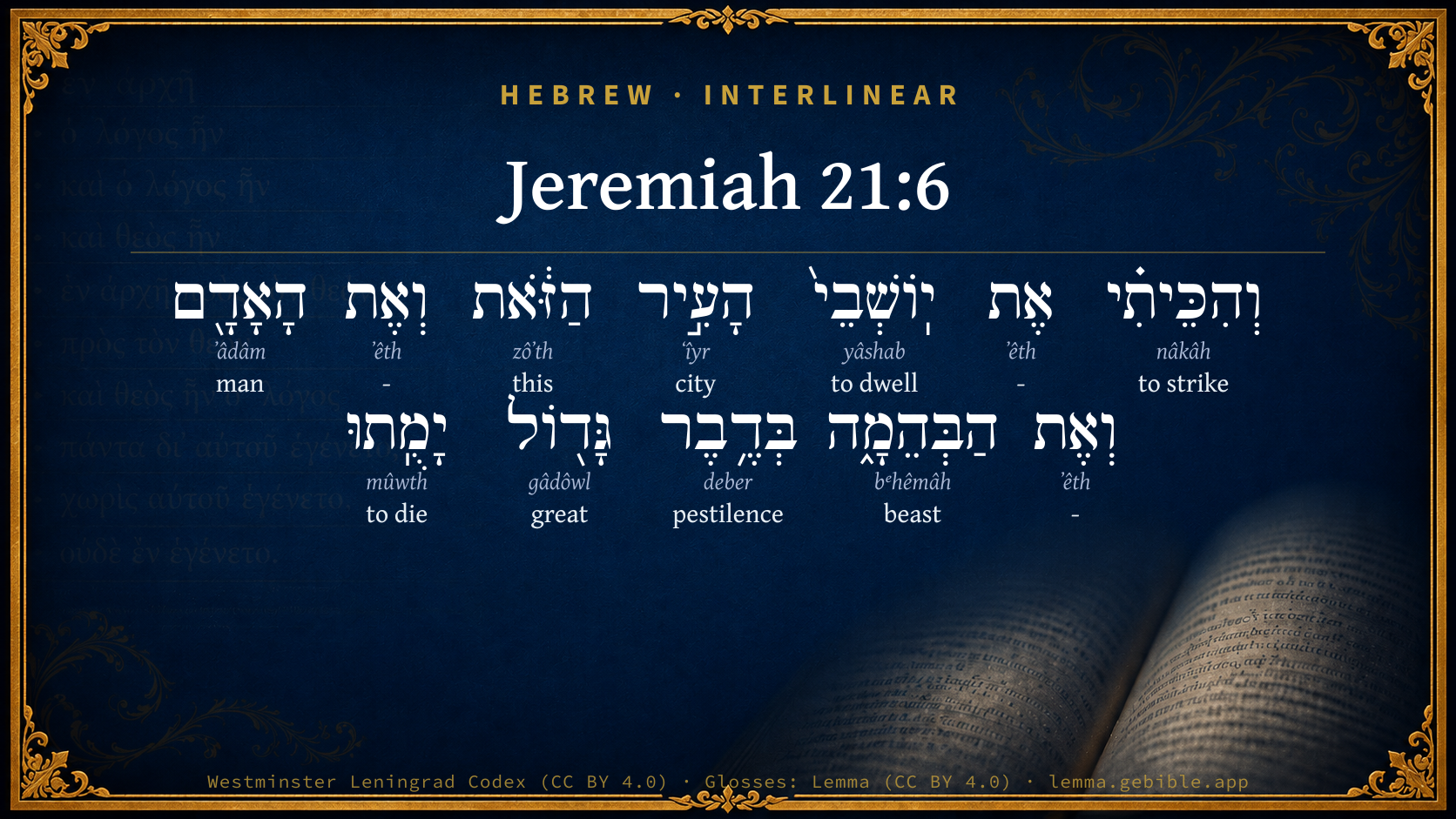
Hebrew (Westminster Leningrad Codex) Jeremiah 21:6 appears in the Hebrew Old Testament. The text above is from the Westminster Leningrad Codex. Each word links to its Strong’s number, a concise gloss, and parsing drawn from the Open Scriptures Hebrew Bible morphology. Click any word for its full Brown-Driver-Briggs (BDB) entry.
Download image
Cite this verse

Jeremiah 21:6 (World English Bible). Public Domain. Lemma interlinear Bible study tool, https://lemma.gebible.app/v/jeremiah/21/6.

Show BibTeX & RIS
BibTeX
RIS
English Translation
I will strike the inhabitants of this city, both man and animal: they shall die of a great pestilence.
World English Bible · Public Domain
Download a study sheet

One document with this verse’s original text, its word-by-word gloss line, the meaning frame, cross-references with their text, attributed commentary, and full source and license credits — printable, and it pastes into notes with its structure intact.

This verse Autodidact and up

Study sheet (.html) Plain text (.txt)

A passage Seminary Student

Up to 50 verses in one chapter. A passage sheet keeps up to 6 commentary sources and 12 cross-references per verse, in the order this page ranks them, and says so on the sheet whenever that leaves anything out. Ask for a single verse and you get the Autodidact verse sheet above.

Everything on this page stays free to read, with no account — the sheet is a download of what is already on screen, not access to it.

Want to remove ads? Support Godless Engineer
Compare translations 3

The same verse in 3 English versions, stacked beneath the original-language interlinear above. Click any original word for its lexicon entry.

Each is an independent rendering of the whole verse — the interlinear is not word-aligned to these translations.

Highlighted words mark where these versions differ — a whole-verse word diff, not a word-by-word alignment.

  • World English Bible Public Domain
    I will strike the inhabitants of this city, both man and animal: they shall die of a great pestilence.
  • King James Version Public Domain
    And I will smite the inhabitants of this city, both man and beast: they shall die of a great pestilence.
  • unfoldingWord Literal Text CC BY-SA 4.0
    And I will strike the dwellers of this city, both man and beast. They will die by a great plague.

unfoldingWord Literal Text — © unfoldingWord, licensed CC BY-SA 4.0. Word-aligned USFM3 via Door43 (git.door43.org/unfoldingWord/en_ult).

Versions to compare (up to 4)

3 of 4 selected

Show all 18 translations

Every available English version of this verse, each an independent rendering of the whole verse.

  • World English Bible Public Domain
    I will strike the inhabitants of this city, both man and animal: they shall die of a great pestilence.
  • Berean Standard Bible Public Domain
    I will strike down the residents of this city, both man and beast. They will die in a terrible plague.’
  • Majority Standard Bible Public Domain
    I will strike down the residents of this city, both man and beast. They will die in a terrible plague.’
  • King James Version Public Domain
    And I will smite the inhabitants of this city, both man and beast: they shall die of a great pestilence.
  • American Standard Version (1901) Public Domain
    And I will smite the inhabitants of this city, both man and beast: they shall die of a great pestilence.
  • Revised Version (1885) Public Domain
    And I will smite the inhabitants of this city, both man and beast: they shall die of a great pestilence.
  • Geneva Bible (1599) Public Domain
    And I will smite the inhabitants of this citie, both man, and beast: they shall die of a great pestilence.
  • Douay-Rheims (1899) Public Domain
    And I will strike the inhabitants of this city, men and beasts shall die of a great pestilence.
  • Young's Literal Translation Public Domain
    And I have smitten the inhabitants of this city, Both man and beast, By a great pestilence do they die.
  • Literal Standard Version CC BY-SA 4.0
    And I have struck the inhabitants of this city, || Both man and beast, || They die by a great pestilence.
  • Unlocked Literal Bible CC BY-SA 4.0
    For I will attack the inhabitants of this city, both man and beast. They will die in a severe plague.
  • unfoldingWord Literal Text CC BY-SA 4.0
    And I will strike the dwellers of this city, both man and beast. They will die by a great plague.
  • Darby Bible Public Domain
    And I will smite the inhabitants of this city, both man and beast: they shall die of a great pestilence.
  • World Messianic Bible Public Domain
    I will strike the inhabitants of this city, both man and animal. They will die of a great pestilence.
  • Webster's Bible Public Domain
    And I will smite the inhabitants of this city, both man and beast; they shall die by a great pestilence.
  • Free Bible Version CC BY-SA 4.0
    I will kill those living in this city, human beings and animals. They will die from a terrible plague.
  • Bible in Basic English Public Domain
    And I will send a great disease on the people living in this town, on man and on beast, causing their death.
  • JPS Tanakh (1917) Public Domain
    And I will smite the inhabitants of this city, both man and beast; they shall die of a great pestilence.

Literal Standard Version (2020), Covenant Press — licensed CC BY-SA 4.0. Text via the HelloAO Bible API (eBible.org). Unlocked Literal Bible (unfoldingWord) — licensed CC BY-SA 4.0. Text via the HelloAO Bible API (eBible.org). unfoldingWord Literal Text — © unfoldingWord, licensed CC BY-SA 4.0. Word-aligned USFM3 via Door43 (git.door43.org/unfoldingWord/en_ult). Free Bible Version, Dr. Jonathan Gallagher — licensed CC BY-SA 4.0. Text via the HelloAO Bible API (eBible.org).

Word by word

More ways to search: Search by grammar → Find every occurrence → Compare this word →

Practice this passage: Drill this verse → Learn its vocabulary →

בְּדֶ֥בֶר
deber
H1698
“in/at · pestilence”
Preposition + Noun, Common, Masculine, Singular, Absolute
Part of Speech
Preposition + Noun
Type
Common
Gender
Masculine
Number
Singular
State
Absolute
Full BDB Definition

Origin: from H1696 (in the sense of destroying)

TWOT: 399b

pestilence, plague - murrain, cattle disease, cattle-plague
  1. וְהִכֵּיתִ֗י nâkâh H5221 “and · to strike” Conjunction + Verb, Hiphil, Sequential Perfect, 1st Person, Common, Singular
  2. אֶת ʼêth H853 “-” Particle, Direct Object
  3. יֽוֹשְׁבֵי֙ yâshab H3427 “dwelling” Verb, Qal, Participle Active, Masculine, Plural, Construct
  4. הָעִ֣יר ʻîyr H5892 “the · city” Particle, Definite Article + Noun, Common, Feminine, Singular, Absolute
  5. הַזֹּ֔את zôʼth H2063 “the · this” Particle, Definite Article + Pronoun, Demonstrative, Feminine, Singular
  6. וְאֶת ʼêth H853 “and · -” Conjunction + Particle, Direct Object
  7. הָאָדָ֖ם ʼâdâm H120 “the · man” Particle, Definite Article + Noun, Common, Masculine, Singular, Absolute
  8. וְאֶת ʼêth H853 “and · -” Conjunction + Particle, Direct Object
  9. הַבְּהֵמָ֑ה bᵉhêmâh H929 “the · beast” Particle, Definite Article + Noun, Common, Feminine, Singular, Absolute
  10. גָּד֖וֹל gâdôwl H1419 “great” Adjective, Adjective, Masculine, Singular, Absolute
  11. יָמֻֽתוּ mûwth H4191 “to die” Verb, Qal, Imperfect, 3rd Person, Masculine, Plural

About this verse

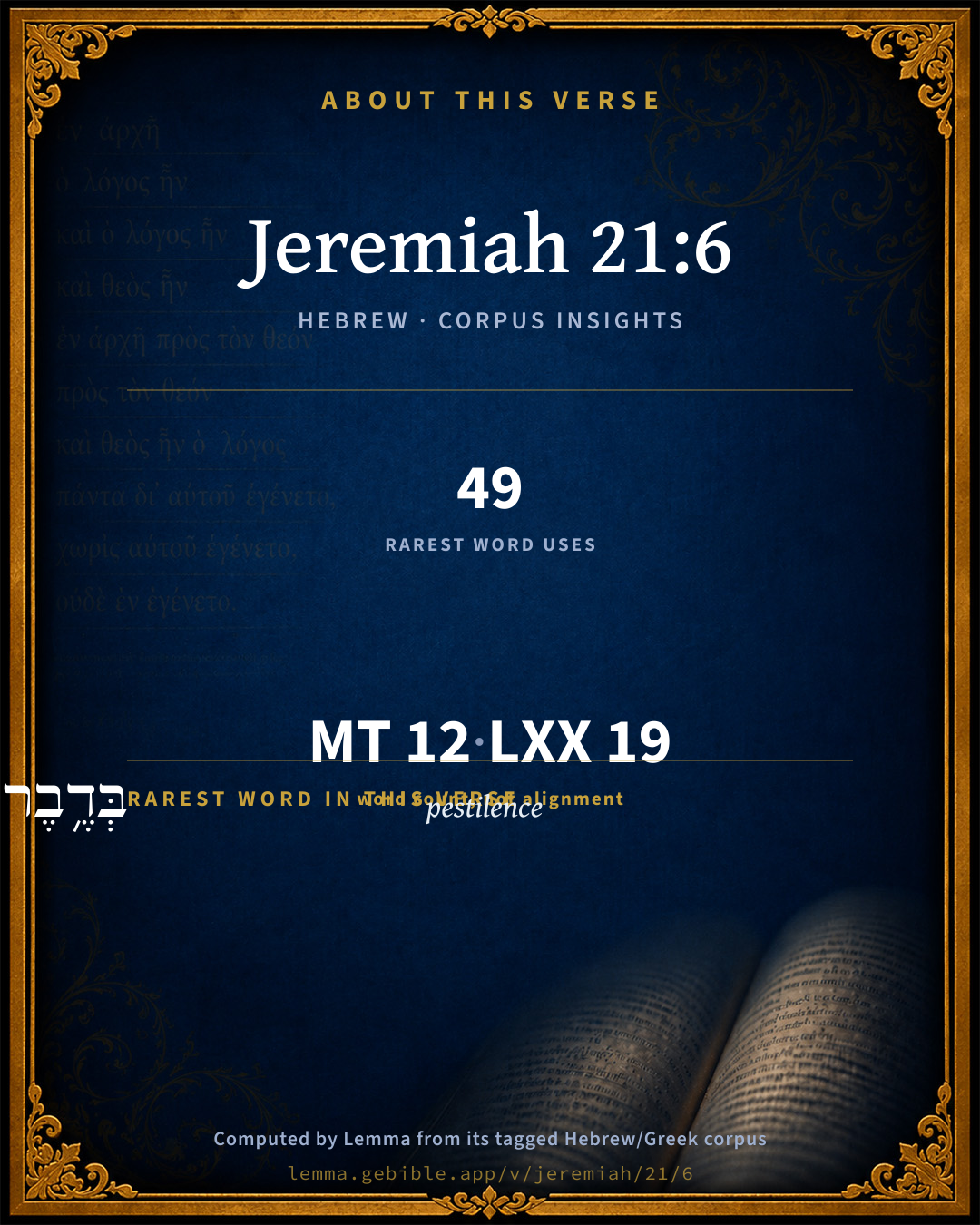
These counts appear in no published source. They are computed here, from the morphology-tagged text and Lemma’s own curated glosses. What Lemma adds →

12
words
10
distinct lemmas
Prophets
section

Shared distinctive vocabulary

בְּדֶ֥בֶר pestilence H1698 occurs in 48 verses of the Hebrew Bible. Also found in:

Grammatical profile

  • 3 verbs
  • 4 nouns
  • 1 adjective
  • 1 pronoun
  • 3 particles

Verb forms

  • וְהִכֵּיתִ֗י Hiphil · Sequential Perfect
  • יֽוֹשְׁבֵי֙ Qal · Participle Active
  • יָמֻֽתוּ Qal · Imperfect

Hebrew & Septuagint length

In the original languages it is 12 Hebrew tokens and 19 Greek tokens — but the two are counted differently (Hebrew bundles its prefixes and suffixes into one token; the Greek is in lemma form), so that isn’t a like-for-like length.

Cross-references

24

Topical passages linked to Jeremiah 21:6 in the Treasury of Scripture Knowledge — connected by theme and wording, ordered by reader-vote popularity; previews shown in the World English Bible.

  • Isaiah 6:11 Then I said, "Lord, how long?" He answered, "Until cities are waste without inhabitant, And houses without man, And the land becomes utterly waste,
  • Jeremiah 12:3–4 But you, Yahweh, know me; you see me, and try my heart toward you: pull them out like sheep for the slaughter, and prepare them for the day of slaughter.
  • Jeremiah 32:24 Behold, the mounds, they are come to the city to take it; and the city is given into the hand of the Chaldeans who fight against it, because of the sword, and of the famine, and of the pestilence; and what you have spoken has happened; and, behold, you see it.
  • Jeremiah 33:12 Thus says Yahweh of Hosts: Yet again shall there be in this place, which is waste, without man and without animal, and in all the cities of it, a habitation of shepherds causing their flocks to lie down.
  • Ezekiel 14:13 Son of man, when a land sins against me by committing a trespass, and I stretch out my hand on it, and break the staff of the bread of it, and send famine on it, and cut off from it man and animal;
  • Ezekiel 14:17 Or if I bring a sword on that land, and say, Sword, go through the land; so that I cut off from it man and animal;
  • Ezekiel 14:19 Or if I send a pestilence into that land, and pour out my wrath on it in blood, to cut off from it man and animal;
  • Ezekiel 14:21 For thus says the Lord Yahweh: How much more when I send my four sore judgments on Jerusalem, the sword, and the famine, and the evil animals, and the pestilence, to cut off from it man and animal!
  • Hosea 4:3 Therefore the land will mourn, And everyone who dwells therein will waste away. All living things in her, Even the animals of the field and the birds of the sky; Yes, the fish of the sea also die.
  • Zephaniah 1:3 I will sweep away man and animal. I will sweep away the birds of the sky, the fish of the sea, and the heaps of rubble with the wicked. I will cut off man from the surface of the earth, says Yahweh.
  • Genesis 6:7 Yahweh said, "I will destroy man whom I have created from the surface of the ground; man, along with animals, creeping things, and birds of the sky; for I am sorry that I have made them."
  • Isaiah 24:1–6 Behold, Yahweh makes the earth empty, and makes it waste, and turns it upside down, and scatters abroad the inhabitants of it.
  • Jeremiah 7:20 Therefore thus says the Lord Yahweh: Behold, my anger and my wrath shall be poured out on this place, on man, and on animal, and on the trees of the field, and on the fruit of the ground; and it shall burn, and shall not be quenched.
  • Jeremiah 14:12 When they fast, I will not hear their cry; and when they offer burnt offering and meal-offering, I will not accept them; but I will consume them by the sword, and by the famine, and by the pestilence.
  • Jeremiah 34:17 Therefore thus says Yahweh: you have not listened to me, to proclaim liberty, every man to his brother, and every man to his neighbor: behold, I proclaim to you a liberty, says Yahweh, to the sword, to the pestilence, and to the famine; and I will make you to be tossed back and forth among all the kingdoms of the earth.
  • Jeremiah 36:29 Concerning Jehoiakim king of Judah you shall say, Thus says Yahweh: You have burned this scroll, saying, Why have you written therein, saying, The king of Babylon shall certainly come and destroy this land, and shall cause to cease from there man and animal?
  • Jeremiah 42:22 Now therefore know certainly that you shall die by the sword, by the famine, and by the pestilence, in the place where you desire to go to sojourn there.
  • Ezekiel 5:12–13 A third part of you shall die with the pestilence, and with famine shall they be consumed in the midst of you; and a third part shall fall by the sword round about you; and a third part I will scatter to all the winds, and will draw out a sword after them.
  • Ezekiel 7:15 The sword is outside, and the pestilence and the famine within: he who is in the field shall die with the sword: and he who is in the city, famine and pestilence shall devour him.
  • Ezekiel 12:16 But I will leave a few men of them from the sword, from the famine, and from the pestilence; that they may declare all their abominations among the nations where they come; and they shall know that I am Yahweh.
  • Ezekiel 33:27 Thus shall you tell them, Thus says the Lord Yahweh: As I live, surely those who are in the waste places shall fall by the sword; and him who is in the open field will I give to the animals to be devoured; and those who are in the strongholds and in the caves shall die of the pestilence.
  • Ezekiel 33:29 Then shall they know that I am Yahweh, when I have made the land a desolation and an astonishment, because of all their abominations which they have committed.
  • Micah 3:12 Therefore Zion for your sake will be plowed like a field, And Jerusalem will become heaps of rubble, And the mountain of the temple like the high places of a forest.
  • Luke 21:24 They will fall by the edge of the sword, and will be led captive into all the nations. Jerusalem will be trampled down by the Gentiles, until the times of the Gentiles are fulfilled.

Cross-references courtesy of OpenBible.info (CC BY 4.0).

Hebrew and Greek witnesses Masoretic Hebrew ↔ Greek Septuagint

The same verse in the two great witnesses to the Old Testament, shown verse-for-verse.

These are two independent witnesses, not word-aligned to each other, and the Septuagint is shown in lemma (dictionary) form.

Hebrew Jeremiah 21:6 Masoretic · Westminster Leningrad Codex

וְהִכֵּיתִ֗י אֶת יֽוֹשְׁבֵי֙ הָעִ֣יר הַזֹּ֔את וְאֶת הָאָדָ֖ם וְאֶת הַבְּהֵמָ֑ה בְּדֶ֥בֶר גָּד֖וֹל יָמֻֽתוּ

I will strike the inhabitants of this city, both man and animal: they shall die of a great pestilence.

World English Bible · Public Domain

Greek LXX Structure differs

In the Septuagint, Jeremiah is about an eighth shorter than the Hebrew and arranges its material differently — the Oracles Against the Nations (Hebrew chapters 46–51) appear in the middle of the Greek book, after 25:13. Because the chapter and verse boundaries do not line up, a verse-for-verse comparison with the Hebrew is not shown.

A verse-for-verse comparison isn’t shown here because the chapters and verses don’t line up. Switch to the LXX edition with the MT / LXX toggle above to read the Greek directly.

On this verse, Haydock's Catholic Bible Commentary discusses the Septuagint’s reading. Read the note in Commentary ↓

Hebrew: Westminster Leningrad Codex (CC BY 4.0). Greek: Septuagint (public domain); English from a public-domain English Septuagint. How the Septuagint differs from the Hebrew →

Targum (Aramaic paraphrase)

1

The Targum is the ancient Jewish Aramaic paraphrase of the Hebrew Scriptures — an interpretive translation, not the Hebrew text itself. Onkelos (literal) and Pseudo-Jonathan (expansive) render the Torah, and Jonathan the Prophets. Coverage is partial: where no permissively-licensed English translation exists for a verse, only the Aramaic is shown. This is verse-level text, not a word-by-word alignment to the Hebrew.

  1. Targum Jonathan Prophets (Joshua–Malachi)
    וְאֶמְחֵי יַת יַתְבֵי קַרְתָּא הָדָא וְיַת אֱנָשָׁא וְיַת בְּעִירָא בְּמוֹתָא סְגִיאָה יְמוּתוּן:

    (no public-domain English translation for this verse)

    Targum Jonathan — Aramaic: “Mikraot Gedolot” (public domain). English: “Sefaria Community Translation” (CC0 1.0 (public-domain dedication)); “London "Chaldee Paraphrase," 1871” (public domain). Text via Sefaria.

Commentary

Notes on Jeremiah 21:6 from classic Christian and Jewish commentators (each source and its license shown beneath its notes). The classic Christian expositions comment on the surrounding passage and are grouped to its opening verse, so a note may address several verses; the Jewish commentaries on the Tanakh (Rashi and others) are per-verse, so they appear only where the commentator wrote on this verse.

Lemma curates 59 commentaries, every one of them public domain or Creative Commons licensed, each selected and text-cleaned for this edition rather than reprinted as found. About our sources →

Trapp's Complete Commentary

John Trapp

Jer 21:6 And I will smite the inhabitants of this city, both man and beast: they shall die of a great pestilence.

Ver. 6. They shall die of a great pestilence.] See Jer 16:4; Jer 18:21. Hippocrates calleth the pestilence το θειον, the divine disease; because there is much of God’s hand in it, like as there was here in the sweating sickness, wherewith the English only were chased, not only in England, but in all countries. {a}

{a} Sir John Heywood’s Life of Edward VI

John Trapp, A Commentary or Exposition upon All the Books of the Old and New Testament (1647–1656) — public domain. Text from a community e-Sword module.

The Biblical Illustrator

Joseph S. Exell

Jer_21:6

They shall die of a great pestilence.

Pestilence

In a romance, The End of an Epoch, by A. Lincoln Green, the hero, Adam Godwin, makes the acquaintance of a German professor, bearing the ominous name of Azrael Falk, who comes to London, bringing with him a large quantity of an active and deadly germ poison, which would depopulate any country where it might be turned loose. His idea is to make an enormous fortune by selling it to either Russia or Germany, between whom at the time discords had arisen. The catastrophe is brought on in a simple way. The professor, with his jars in his possession (he is too jealous and suspicious ever to part from them), carries out a long-cherished fancy to see the Derby, and on Epsom Downs is taken for a welsher, and set upon by the mob. His precious jars are broken, and he himself is removed insane and dying to a neighbouring asylum. The death dealing contents of the jars rise in a brown mist and float in the air. Adam Godwin knows that London is in mortal peril, but he has not been told the secret of the anti-toxin, and Falk dies without recovering his reason. The most exciting pages are those in which we watch the slow creeping of the plague over London. It attacks all except aged persons, and there is no remedy. The calamity which in this book is merely fictitious was, in dire fact, to befall Jerusalem Disobedience, stubbornness, and impenitence were the deadly germ poison by which the inhabitants of the city were to be swept away.

The Biblical Illustrator, edited by Joseph S. Exell (c. 1880s–1900s) — public domain. Text from a community e-Sword module.

Adam Clarke's Commentary

Verse 6. They shall die of a great pestilence.] The sword may appear to be that of man, though I have given the Chaldeans their commission; but the pestilence shall appear to be the immediate act of GOD.

Adam Clarke's Commentary on the Bible (1810–1826) — public domain. Text from a community e-Sword/MySword module.

John Calvin's Commentaries

Jeremiah goes on with the same discourse, even that God had resolved to destroy Jerusalem and the people, at least for a time. But he points out here what he intended to do, even that he would consume them by pestilence and famine, as long as they continued in the city; as though he had said, “Though these Chaldeans may not immediately take the city by means of a siege, yet its destruction shall be worse, for famine shall rage within and consume them.” We now perceive the design of the Prophet.

But we must keep in mind what I reminded you of yesterday, — that God assumes to himself what might have been ascribed to the Chaldeans, for he makes himself the author of all these calamities; I will smite, he says, the inhabitants of this city, both man and beast; by a great pestilence shall they die This was the first kind of punishment; before the enemy rushed into the city the pestilence had consumed many of the people. Now there is a circumstance mentioned which shews how dreadful would be their state, for not only men would perish, but even brute animals. It was no wonder that God’s vengeance extended to horses, and oxen, and asses; for we know that all these were created for the use of man. Hence when God manifested his wrath as to these animals, His object was to fill men with greater terrors; for they thus saw oxen and asses, though innocent, involved in the same punishment with themselves. For how can we suppose that horses and asses deserved to perish by diseases, or through want of daily food? But God sets forth such a spectacle as this, that he may more effectually touch men; for they thus see that the whole world is exposed to a curse through their sins. They are indeed constrained to know how great their sinfulness is; for on this account it is that the earth becomes dry and barren, that the elements above and below perform not their offices, so that the sterility of the ground deprives animals of their food, and the infection of the air kills them. But on this subject we have spoken elsewhere.

John Calvin's Commentaries (1540-1563) — public domain. Text from the Calvin Translation Society English edition (1840s-50s) via the Christian Classics Ethereal Library (ccel.org). Calvin's coverage is partial (roughly two-thirds of the Bible); uncommented books and verses are honest gaps, never fabricated. The 19th-century editor's footnotes and remarks are omitted so the notes are faithfully Calvin's own voice.

Ellicott's Commentary for English Readers

(6) They shall die of a great pestilence.—This was doubtless, as in other instances (Thuc. ii. 52), the natural consequence of the siege, but it came before the people as another proof that Jehovah had stretched out his arm against them, that they were fighting against that arm as well as against the host of the invaders. The “outstretched hand” may be noted as another Deuteronomic phrase (Deu_4:34; Deu_5:15; Deu_26:8).

A Bible Commentary for English Readers, edited by Charles John Ellicott (1878–1897) — public domain. Text from a community e-Sword module.

John Gill's Exposition

And I will smite the inhabitants of this city,.... With one or other of his arrows after mentioned: or, "them that abide in this city" (o); that do not go out of it, and surrender themselves to the king of Babylon; see Jer 21:9;

both man and beast; the latter for the sin of the former; particularly such beasts as were fit for food are meant, whereby the famine would be increased, and so the greater destruction of men:

they shall die of a great pestilence; both man and beast; a disease which comes immediately from the hand of God; hence Hippocrates used to call it , "the divine disease": here it denotes a very uncommon one, which should sweep away large numbers; called great, both for quality, or the nature of it, and for the quantity of persons that died of it.

(o) "manentes in hac urbe", Gataker.

John Gill's Exposition of the Whole Bible (1746–1763) — public domain (CC PDM 1.0). Text via the HelloAO Bible API.

Albert Barnes' Notes on the Bible

A great pestilence - As the result of the excessive crowding of men and animals in a confined space with all sanitary regulations utterly neglected.

Albert Barnes' Notes on the Bible (1834–1885) — public domain. Text from a community e-Sword/MySword module.

Haydock's Catholic Bible Commentary

Pestilence. Septuagint, "death;" the sword, and various diseases. (Haydock)

George Leo Haydock (1774–1849), Haydock's Catholic Family Bible and Commentary, 1859 edition — public domain. Excludes Psalms (Douay-Rheims chapter numbering differs from Protestant) and Deuterocanonical books (Catholic canon only).

Matthew Poole's English Annotations

Still God proclaimeth himself this people’s enemy. Pestilences are but the usual consequents of long sieges, through the scantness and unwholesomeness of food; but God is the first cause of such sore judgments, though there be other second causes. The murrain of beasts bears proportion to the pestilence amongst men, and the beasts are threatened as well as men, not because of any sin in them, but because men are punished in them, they being part of their substance; and this is a part of that bondage of corruption from which the creature groaneth to be delivered, of that vanity to which they are subject, which maketh the irrational part of the creation to be brought in by the apostle, Rom 8:20-22, like as a woman travailing in pain, and desiring the day of judgment.

Matthew Poole's English Annotations on the Holy Bible (1683–1685) — public domain. Text from a community e-Sword/MySword module.

unfoldingWord translationNotes

Door43 World Missions Community

inhabitants of this city

"those who live in Jerusalem"

this is Yahweh's declaration

Yahweh speaks of himself by name to express the certainty of what he is declaring. See how you translated this in Jeremiah 1:8. AT: "this is what Yahweh has declared" or "this is what I, Yahweh, have declared" (See: First, Second, or Third Person)

the sword

Here this refers to the battle in which swords are used. AT: "the war" (See: Metonymy)

into the hand

Here "hand" refers to the power of their enemies over them. AT: "into the power" (See: Metonymy)

Nebuchadnezzar king of Babylon ... their enemies ... those seeking their life

All of these phrases refer to Nebuchadnezzar and his army. (See: Parallelism)

seeking their life

"wanting to kill them"

with the edge of the sword

Possible meanings are 1) this is a metonym for death in battle. AT: "in battle" or 2) they will be killed by literal swords. (See: Metonymy)

He will not pity them, spare them, or have compassion

These three phrases have the same meaning and emphasize that Nebuchadnezzar will deal severely with them. AT: "He will not show them any mercy or compassion at all" (See: Doublet)

translationWords

beast

die

plague

kingdom of Judah

servant

people group

sword

famine

hand

adversary

life

compassion

unfoldingWord translationNotes — © Distant Shores Media and the Door43 World Missions Community, licensed CC BY-SA 4.0. Source: git.door43.org/Door43/en_tn.

Lesson kit

Teaching starters — assembled from the data on this page, not authored interpretation. Every prompt links to the verse data it draws on. Edit before teaching.

Jeremiah, in the Prophets, opens this verse with 12 words (10 distinct Hebrew lemmas). Its most distinctive word is deber (“pestilence”). A historical commentator’s framing appears above. Read the whole chapter for the surrounding context.

Discussion questions

  1. The word deber carries the sense “pestilence.” How does it shape the verse?
  2. Exodus 5:3 shares the word «pestilence» with this verse. How do the two illuminate each other?
  3. These translations render this verse differently; the difference is in the English rendering, not the original. What questions does that raise?
  4. The verb «וְהִכֵּיתִ֗י» is Hiphil Sequential Perfect. How does its form color the action?
  5. Reading how Trapp's Complete Commentary and The Biblical Illustrator read this verse, where do the two commentators agree and where do they part?

Things to notice

Reading settings

Reading text

Shown beneath each verse's original-language words.

Old Testament
Old Testament edition

Read the OT as the Masoretic Hebrew (MT) or the Greek Septuagint (LXX).

English shown for the Greek Septuagint (in the Hebrew ↔ Greek comparison).

Comparing translations? Open the Compare panel on any verse page to stack up to four side by side.