
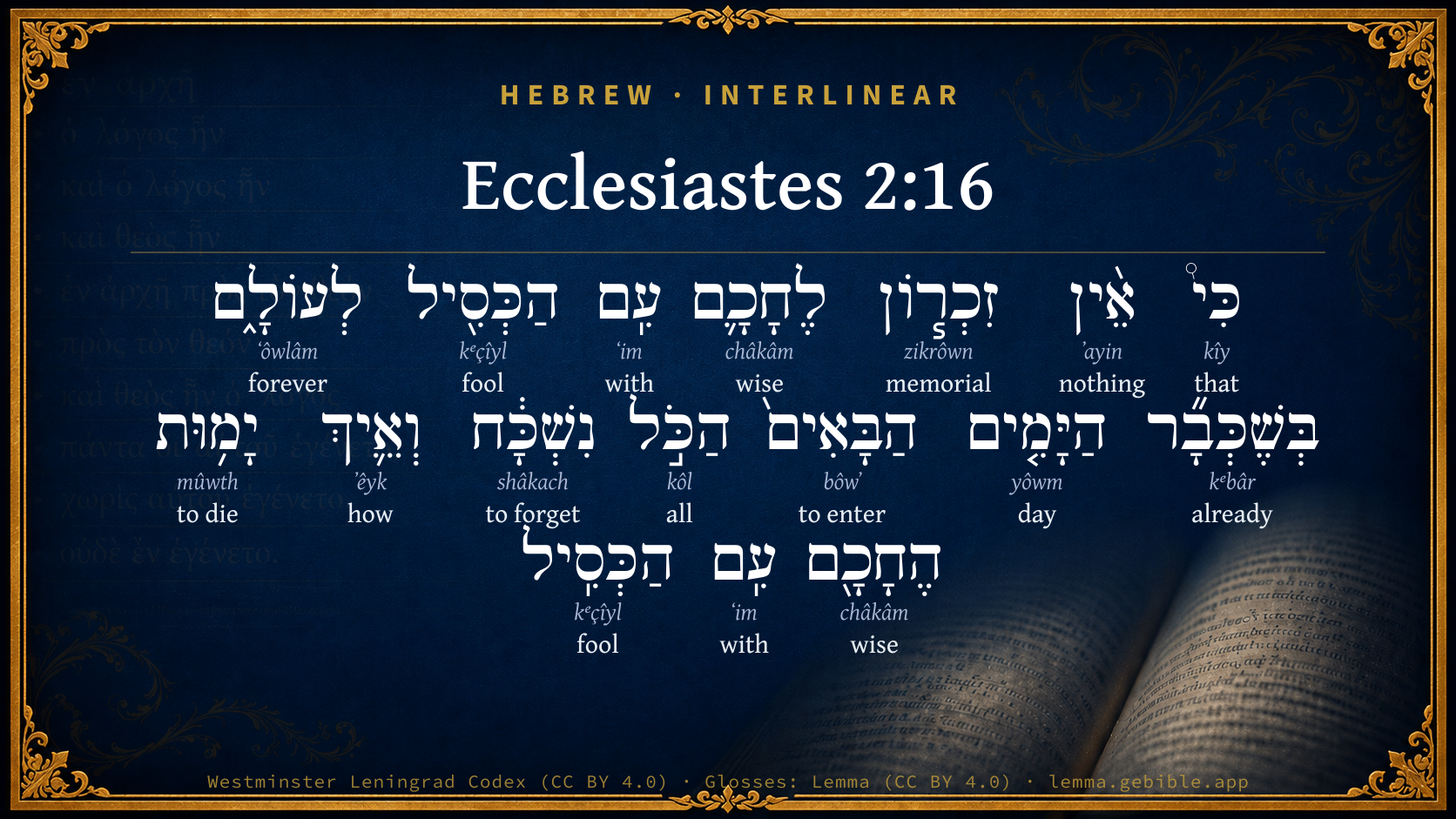
Ecclesiastes 2:16

Hebrew (Westminster Leningrad Codex) Ecclesiastes 2:16 appears in the Hebrew Old Testament. The text above is from the Westminster Leningrad Codex. Each word links to its Strong’s number, a concise gloss, and parsing drawn from the Open Scriptures Hebrew Bible morphology. Click any word for its full Brown-Driver-Briggs (BDB) entry.
Download image
Cite this verse

Ecclesiastes 2:16 (World English Bible). Public Domain. Lemma interlinear Bible study tool, https://lemma.gebible.app/v/ecclesiastes/2/16.

Show BibTeX & RIS
BibTeX
RIS
English Translation
For of the wise man, even as of the fool, there is no memory for ever, seeing that in the days to come all will have been long forgotten. Indeed, the wise man must die just like the fool!
World English Bible · Public Domain
Download a study sheet

One document with this verse’s original text, its word-by-word gloss line, the meaning frame, cross-references with their text, attributed commentary, and full source and license credits — printable, and it pastes into notes with its structure intact.

This verse Autodidact and up

Study sheet (.html) Plain text (.txt)

A passage Seminary Student

Up to 50 verses in one chapter. A passage sheet keeps up to 6 commentary sources and 12 cross-references per verse, in the order this page ranks them, and says so on the sheet whenever that leaves anything out. Ask for a single verse and you get the Autodidact verse sheet above.

Everything on this page stays free to read, with no account — the sheet is a download of what is already on screen, not access to it.

Want to remove ads? Support Godless Engineer
Compare translations 3

The same verse in 3 English versions, stacked beneath the original-language interlinear above. Click any original word for its lexicon entry.

Each is an independent rendering of the whole verse — the interlinear is not word-aligned to these translations.

Highlighted words mark where these versions differ — a whole-verse word diff, not a word-by-word alignment.

  • World English Bible Public Domain
    For of the wise man, even as of the fool, there is no memory for ever, seeing that in the days to come all will have been long forgotten. Indeed, the wise man must die just like the fool!
  • King James Version Public Domain
    For there is no remembrance of the wise more than of the fool for ever; seeing that which now is in the days to come shall all be forgotten. And how dieth the wise man? as the fool.
  • unfoldingWord Literal Text CC BY-SA 4.0
    For there is no memory of the wise with the fool in perpetuity, because already, the coming days, both forgotten. Alas! The wise die with the fool!

unfoldingWord Literal Text — © unfoldingWord, licensed CC BY-SA 4.0. Word-aligned USFM3 via Door43 (git.door43.org/unfoldingWord/en_ult).

Versions to compare (up to 4)

3 of 4 selected

Show all 18 translations

Every available English version of this verse, each an independent rendering of the whole verse.

  • World English Bible Public Domain
    For of the wise man, even as of the fool, there is no memory for ever, seeing that in the days to come all will have been long forgotten. Indeed, the wise man must die just like the fool!
  • Berean Standard Bible Public Domain
    For there is no lasting remembrance of the wise, just as with the fool, seeing that both will be forgotten in the days to come. Alas, the wise man will die just like the fool!
  • Majority Standard Bible Public Domain
    For there is no lasting remembrance of the wise, just as with the fool, seeing that both will be forgotten in the days to come. Alas, the wise man will die just like the fool!
  • King James Version Public Domain
    For there is no remembrance of the wise more than of the fool for ever; seeing that which now is in the days to come shall all be forgotten. And how dieth the wise man? as the fool.
  • American Standard Version (1901) Public Domain
    For of the wise man, even as of the fool, there is no remembrance for ever; seeing that in the days to come all will have been long forgotten. And how doth the wise man die even as the fool!
  • Revised Version (1885) Public Domain
    For of the wise man, even as of the fool, there is no remembrance for ever; seeing that in the days to come all will have been already forgotten. And how doth the wise man die even as the fool!
  • Geneva Bible (1599) Public Domain
    For there shalbe no remembrance of the wise, nor of the foole for euer: for that that now is, in the dayes to come shall all be forgotten. And howe dyeth the wise man, as doeth the foole?
  • Douay-Rheims (1899) Public Domain
    For there shall be no remembrance of the wise no more than of the fool for ever, and the times to come shall cover all things together with oblivion: the learned dieth in like manner as the unlearned.
  • Young's Literal Translation Public Domain
    That there is no remembrance to the wise -- with the fool -- to the age, for that which `is' already, `in' the days that are coming is all forgotten, and how dieth the wise? with the fool!
  • Literal Standard Version CC BY-SA 4.0
    That there is no remembrance to the wise—with the fool—for all time, for that which [is] already, [in] the days that are coming is all forgotten, and how dies the wise? With the fool!
  • Unlocked Literal Bible CC BY-SA 4.0
    For the wise man, like the fool, is not remembered for very long. In the days to come everything will have been long forgotten. The wise man dies just like the fool dies.
  • unfoldingWord Literal Text CC BY-SA 4.0
    For there is no memory of the wise with the fool in perpetuity, because already, the coming days, both forgotten. Alas! The wise die with the fool!
  • Darby Bible Public Domain
    For there shall be no remembrance of the wise more than of the fool for ever; because everything is already forgotten in the days which come. And how dieth the wise even as the fool?
  • World Messianic Bible Public Domain
    For of the wise man, even as of the fool, there is no memory forever, since in the days to come all will have been long forgotten. Indeed, the wise man must die just like the fool!
  • Webster's Bible Public Domain
    For there is no remembrance of the wise more than of the fool for ever; seeing that which now is in the days to come shall all be forgotten. And how dieth the wise man? as the fool.
  • Free Bible Version CC BY-SA 4.0
    Nobody remembers the wise or the fool for very long—in the future everything will be forgotten. Whether wise or foolish, they both die.
  • Bible in Basic English Public Domain
    Of the wise man, as of the foolish man, there is no memory for ever, seeing that those who now are will have gone from memory in the days to come. See how death comes to the wise as to the foolish!
  • JPS Tanakh (1917) Public Domain
    For of the wise man, even as of the fool, there is no remembrance for ever; seeing that in the days to come all will long ago have been forgotten. And how must the wise man die even as the fool!

Literal Standard Version (2020), Covenant Press — licensed CC BY-SA 4.0. Text via the HelloAO Bible API (eBible.org). Unlocked Literal Bible (unfoldingWord) — licensed CC BY-SA 4.0. Text via the HelloAO Bible API (eBible.org). unfoldingWord Literal Text — © unfoldingWord, licensed CC BY-SA 4.0. Word-aligned USFM3 via Door43 (git.door43.org/unfoldingWord/en_ult). Free Bible Version, Dr. Jonathan Gallagher — licensed CC BY-SA 4.0. Text via the HelloAO Bible API (eBible.org).

Word by word

More ways to search: Search by grammar → Find every occurrence → Compare this word →

Practice this passage: Drill this verse → Learn its vocabulary →

בְּשֶׁכְּבָ֞ר
kᵉbâr
H3528
“in/at · who/which · already”
Preposition + Particle, Relative + Adverb
Part of Speech
Preposition + Particle + Adverb
Full BDB Definition

Origin: from H3527

TWOT: 947c

already, long ago, a great while
  1. כִּי֩ kîy H3588 “that” Conjunction
  2. אֵ֨ין ʼayin H369 “nothing” Particle, Negative
  3. זִכְר֧וֹן zikrôwn H2146 “memorial of” Noun, Common, Masculine, Singular, Construct
  4. לֶחָכָ֛ם châkâm H2450 “to/for the · wise” Preposition, Determined + Adjective, Adjective, Masculine, Singular, Absolute
  5. עִֽם ʻim H5973 “with” Preposition
  6. הַכְּסִ֖יל kᵉçîyl H3684 “the · fool” Particle, Definite Article + Adjective, Adjective, Masculine, Singular, Absolute
  7. לְעוֹלָ֑ם ʻôwlâm H5769 “to/for · forever” Preposition + Noun, Common, Masculine, Singular, Absolute
  8. הַיָּמִ֤ים yôwm H3117 “the · days” Particle, Definite Article + Noun, Common, Masculine, Plural, Absolute
  9. הַבָּאִים֙ bôwʼ H935 “the · entering” Particle, Definite Article + Verb, Qal, Participle Active, Masculine, Plural, Absolute
  10. הַכֹּ֣ל kôl H3605 “the · all” Particle, Definite Article + Noun, Common, Masculine, Singular, Absolute
  11. נִשְׁכָּ֔ח shâkach H7911 “to forget” Verb, Niphal, Perfect, 3rd Person, Masculine, Singular
  12. וְאֵ֛יךְ ʼêyk H349 “and · how” Conjunction + Particle, Interrogative
  13. יָמ֥וּת mûwth H4191 “to die” Verb, Qal, Imperfect, 3rd Person, Masculine, Singular
  14. הֶחָכָ֖ם châkâm H2450 “the · wise” Particle, Definite Article + Adjective, Adjective, Masculine, Singular, Absolute
  15. עִֽם ʻim H5973 “with” Preposition
  16. הַכְּסִֽיל kᵉçîyl H3684 “the · fool” Particle, Definite Article + Adjective, Adjective, Masculine, Singular, Absolute

About this verse

These counts appear in no published source. They are computed here, from the morphology-tagged text and Lemma’s own curated glosses. What Lemma adds →

17
words
14
distinct lemmas
Wisdom
section

Notable vocabulary

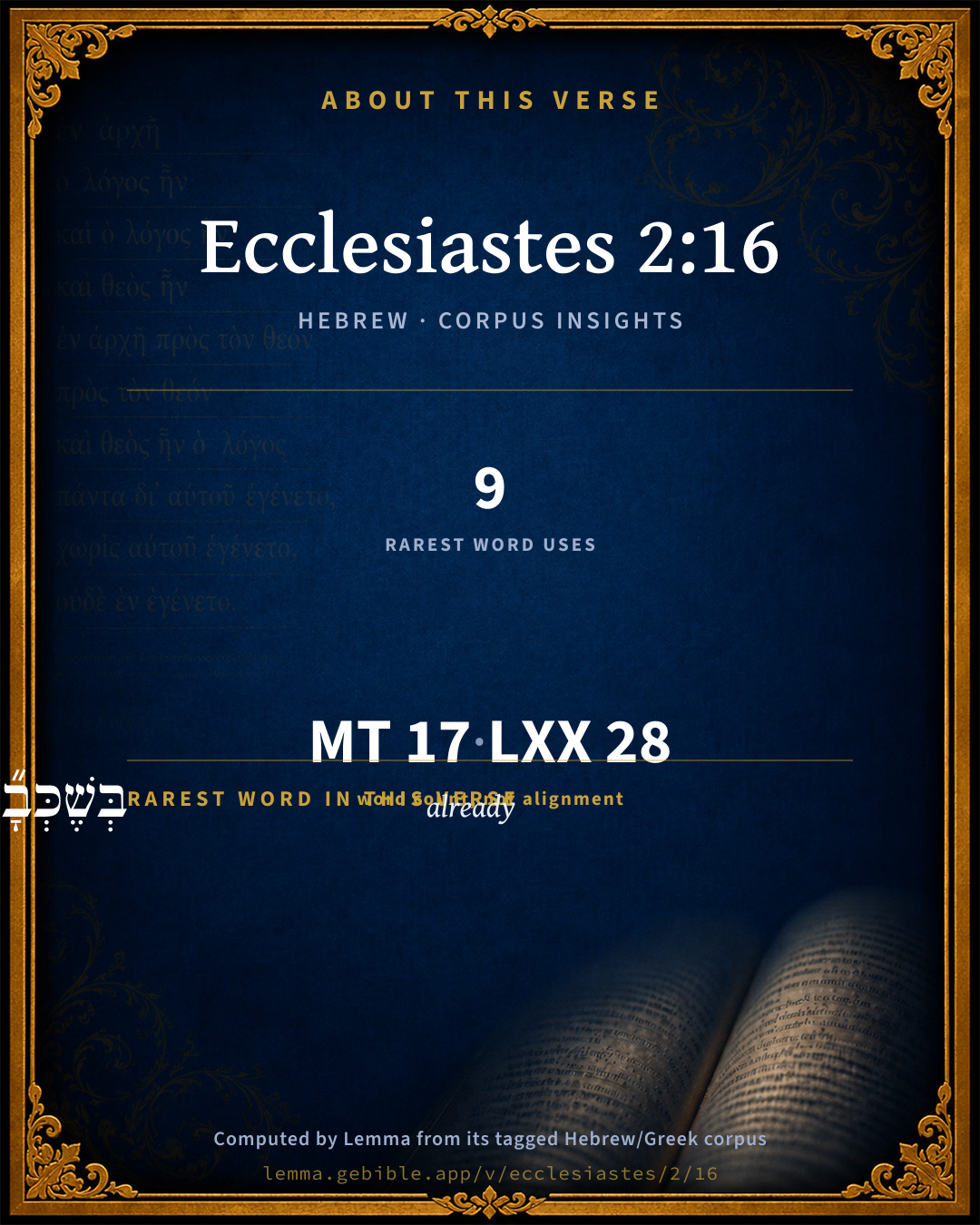
The rarest word here is בְּשֶׁכְּבָ֞ר already H3528 — appearing just 9 times in the whole Hebrew Bible.

Shared distinctive vocabulary

בְּשֶׁכְּבָ֞ר already H3528 occurs in 8 verses of the Hebrew Bible. Also found in:

Grammatical profile

  • 3 verbs
  • 4 nouns
  • 4 adjectives
  • 2 prepositions
  • 1 conjunction
  • 1 adverb
  • 2 particles

Verb forms

  • הַבָּאִים֙ Qal · Participle Active
  • נִשְׁכָּ֔ח Niphal · Perfect
  • יָמ֥וּת Qal · Imperfect

Repetition

Words recur within this verse — often emphatic in Hebrew:

  • לֶחָכָ֛ם wise H2450 ×2
  • הַכְּסִ֖יל fool H3684 ×2
  • עִֽם with H5973 ×2

Hebrew & Septuagint length

In English translation the verse runs 39 words from the Hebrew and 35 from the Septuagint (LXX English) — closely comparable.

A rough comparison of the two English renderings, which tokenize alike — not a word-level alignment.

Word counts can differ between the Hebrew and the Greek without any difference in meaning — e.g. the Hebrew direct-object marker אֵת has no separate Greek word, and Greek often adds the article ὁ.

In the original languages it is 17 Hebrew tokens and 28 Greek tokens — but the two are counted differently (Hebrew bundles its prefixes and suffixes into one token; the Greek is in lemma form), so that isn’t a like-for-like length.

Cross-references

12

Topical passages linked to Ecclesiastes 2:16 in the Treasury of Scripture Knowledge — connected by theme and wording, ordered by reader-vote popularity; previews shown in the World English Bible.

  • Ecclesiastes 1:11 There is no memory of the former; neither shall there be any memory of the latter that are to come, among those that shall come after.
  • Ecclesiastes 9:5 For the living know that they will die, but the dead don't know anything, neither do they have any more a reward; for the memory of them is forgotten.
  • Exodus 1:8 Now there arose a new king over Egypt, who didn't know Joseph.
  • Psalms 88:12 Are your wonders made known in the dark? Or your righteousness in the land of forgetfulness?
  • Malachi 3:16 Then those who feared Yahweh spoke one with another; and Yahweh listened, and heard, and a book of memory was written before him, for those who feared Yahweh, and who honored his name.
  • Hebrews 9:27 Inasmuch as it is appointed for men to die once, and after this, judgment,
  • Exodus 1:6 Joseph died, as did all his brothers, and all that generation.
  • 2 Samuel 3:33 The king lamented for Abner, and said, Should Abner die as a fool dies?
  • Psalms 49:10 For he sees that wise men die; Likewise the fool and the senseless perish, And leave their wealth to others.
  • Psalms 103:16 For the wind passes over it, and it is gone. Its place remembers it no more.
  • Ecclesiastes 2:14 The wise man's eyes are in his head, and the fool walks in darkness--and yet I perceived that one event happens to them all.
  • Ecclesiastes 6:8 For what advantage has the wise more than the fool? What has the poor man, that knows how to walk before the living?

Cross-references courtesy of OpenBible.info (CC BY 4.0).

Hebrew and Greek witnesses Masoretic Hebrew ↔ Greek Septuagint

The same verse in the two great witnesses to the Old Testament, shown verse-for-verse.

These are two independent witnesses, not word-aligned to each other, and the Septuagint is shown in lemma (dictionary) form.

Hebrew Ecclesiastes 2:16 Masoretic · Westminster Leningrad Codex

כִּי֩ אֵ֨ין זִכְר֧וֹן לֶחָכָ֛ם עִֽם הַכְּסִ֖יל לְעוֹלָ֑ם בְּשֶׁכְּבָ֞ר הַיָּמִ֤ים הַבָּאִים֙ הַכֹּ֣ל נִשְׁכָּ֔ח וְאֵ֛יךְ יָמ֥וּת הֶחָכָ֖ם עִֽם הַכְּסִֽיל

For of the wise man, even as of the fool, there is no memory for ever, seeing that in the days to come all will have been long forgotten. Indeed, the wise man must die just like the fool!

World English Bible · Public Domain

Greek LXX Ecclesiastes 2:16 Septuagint · lemma form

ὅτι οὐ εἰμί μνήμη ὁ σοφός μετά ὁ ἄφρων εἰς αἰών καθότι ἤδη ὁ ἡμέρα ὁ ἔρχομαι ὁ πᾶς ἐπιλανθάνω καί πῶς ἀποθνήσκω ὁ σοφός μετά ὁ ἄφρων

For there is no remembrance of the wise man with the fool for ever; forasmuch as now in the coming days all things are forgotten: and how shall the wise man die with the fool?

LXX2012 (modern English Septuagint) · Public Domain

On this verse, The Pulpit Commentary discusses the Septuagint’s reading. Read the note in Commentary ↓

Hebrew: Westminster Leningrad Codex (CC BY 4.0). Greek: Septuagint (public domain); English from LXX2012 (modern English Septuagint) (Public Domain). How the Septuagint differs from the Hebrew →

Commentary

Notes on Ecclesiastes 2:16 from classic Christian and Jewish commentators (each source and its license shown beneath its notes). The classic Christian expositions comment on the surrounding passage and are grouped to its opening verse, so a note may address several verses; the Jewish commentaries on the Tanakh (Rashi and others) are per-verse, so they appear only where the commentator wrote on this verse.

Lemma curates 59 commentaries, every one of them public domain or Creative Commons licensed, each selected and text-cleaned for this edition rather than reprinted as found. About our sources →

Trapp's Complete Commentary

John Trapp

Ecc 2:16 For [there is] no remembrance of the wise more than of the fool for ever; seeing that which now [is] in the days to come shall all be forgotten. And how dieth the wise [man]? as the fool.

Ver. 16. For there is no remembrance of the wise.] viz., Unless he be also wise to salvation, for then he shall be had in everlasting remembrance. Or otherwise, either he shall be utterly forgotten, as being not written among the living in Jerusalem, {Isa 4:3} or else he shall not have the happiness to be forgotten in the city where he had so done; {Ecc 8:10} I mean, where he had been either a dogmatic, or at least a practical atheist, as the very best of the philosophers were, {Rom 1:18-31 1Co 1:17-31} the choicest and the most picked men among them. {1Co 3:21}

And how dieth the wise man? as the fool.] {See Trapp on "Ecc 2:14"} {See Trapp on "Ecc 2:15"} Wise men die as well as fools, {Psa 49:10} good men die as well as bad, {Eze 21:4} yet with this difference, that "the righteous hath hope in his death," which to him is neither total, but of the body only; nor perpetual, but for a time only, till the day of refreshing. See both these, Rom 8:10-11.

John Trapp, A Commentary or Exposition upon All the Books of the Old and New Testament (1647–1656) — public domain. Text from a community e-Sword module.

Geneva Bible (1599)

Geneva Bible translators

He wondereth that men forget a wise man, being dead, as soon as they do a fool.

Meaning, in this world.

Geneva Bible (1599) marginal notes — public domain. Text via Bolls.life.

Jamieson, Fausset & Brown

Robert Jamieson, A. R. Fausset & David Brown

remembrance--a great aim of the worldly (Gen 11:4). The righteous alone attain it (Psa 112:6; Pro 10:7).

for ever--no perpetual memorial.

that which now is--MAURER, "In the days to come all things shall be now long ago forgotten."

Jamieson, Fausset & Brown — Commentary Critical and Explanatory on the Whole Bible (1871) — public domain (CC PDM 1.0). Text via the HelloAO Bible API.

Adam Clarke's Commentary

Verse 16. There is no remembrance] The wise and the fool are equally subject to death; and, in most instances, they are equally forgotten. Time sweeps away all remembrances, except the very few out of millions which are preserved for a while in the page of history.

Adam Clarke's Commentary on the Bible (1810–1826) — public domain. Text from a community e-Sword/MySword module.

Ellicott's Commentary for English Readers

(16) It might be urged on behalf of the Solomonic authorship that Solomon himself might imagine that in the days to come he and his wisdom would be forgotten, but that such a thought does not become a long subsequent writer who had been induced by Solomon’s reputation for wisdom to make him the hero of his work. It would seem to follow that the writer is here only giving the history of Solomon’s reflections, and not his ultimate conclusions. Better to omit the note of interrogation after “wise man,” and put a note of exclamation after “fool,” the “how” being used as in Isa_14:4; Eze_26:17.

A Bible Commentary for English Readers, edited by Charles John Ellicott (1878–1897) — public domain. Text from a community e-Sword module.

The Cambridge Bible for Schools and Colleges

gen. ed. J. J. S. Perowne

16. there is no remembrance of the wise] More accurately, For the wise man as for the fool there is no remembrance for ever, the last two words being emphatic, almost as if intentionally calling in question the teaching of Psa_112:6, that “the righteous shall be had in everlasting remembrance.” The assertion seems at first too sweeping. There are sages, we say, who live yet in the memory of men whose names the world will not willingly let die. Practically, however, as regards the influence of the desire for posthumous fame as a motive, the number of such names is inappreciably small, even with the manifold resources of monuments and written records. The scribes and doctors, the artists and the poets of one age are forgotten in the next, and only here or there can any man be bold to say with Bacon that he commits his memory “to the care of future ages.” (See note on ch. Ecc_1:11.) Even a biographical dictionary is often but as the sepulchre of the mouldering remains of reputations that have been long since dead, and their place knoweth them no more. Then, as in later days, there were those who substituted the permanence of fame for that of personal being, and the Debater, with his incisive question shatters the unsubstantial fabric.

And how dieth the wise man? As the fool] Literally, “with the fool,” as if in partnership with him, sharing the same lot. Better, perhaps, as an exclamation, not a question, “How dieth the wise man with (= as) the fool. The absence of any hope of an immortality beyond that of fame has been already implied. The present clause brings before us the manner and circumstances of death. We stand, as it were, by the two death-beds, of the wise and of the fool, and note the same signs of the end, the same glazed eye, the same death-dew on the brow, the same failing power of thought. The picture of chap. Ecc_12:1-6 is true of both. The seeker had apparently never stood by the death-bed of one whose face was lit up, and, as it were, transfigured by a “hope full of immortality.” Here also we may trace in the later personator of Solomon a deliberate protest against what seemed to him the teaching of Ecclesiastes (Wis_2:1-9).

The Cambridge Bible for Schools and Colleges (gen. ed. J. J. S. Perowne; Cambridge University Press, 1878–1918) — public domain. Text from a community e-Sword module.

John Gill's Exposition

For there is no remembrance of the wise more than of the fool for ever,.... The Targum interprets it, in the world to come; but even in this world the remembrance of a wise man, any more than of a fool, does not always last; a wise man may not only be caressed in life, but may be remembered after death for a while; the fame of him may continue for a little time, and his works and writings may be applauded; but by and by rises up another genius brighter than he, or at least is so thought, and outshines him; and then his fame is obscured, his writings are neglected and despised, and he and his works buried in oblivion; and this is the common course of things. This shows that Solomon is speaking of natural wisdom, and of man's being wise with respect to that; and his remembrance on that account; otherwise such who are truly good and wise, their memory is blessed; they are had in everlasting remembrance, and shall never be forgotten in this world, nor in that to come, when the memory of the wicked shall rot; whose names are only written in the dust Jer 17:13, and not in the Lamb's book of life;

seeing that which now is, in the days to come shall all be forgotten: what now is in the esteem of men, and highly applauded by them; what is in the mouths of men, and in their minds and memories, before long, future time, after the death of a man, as the Targum, or in some time after, will be thought of no more, and be as if it never had been, or as if there never had been such men in the world. Many wise men have been in the world, whose names are now unknown, and some their names only are known, and their works are lost; and others whose works remain, yet in no esteem: this is to be understood in general, and for the most part; otherwise there may be some few exceptions to this general observation.

And how dieth the wise man? as the fool; they are both liable to death; it is appointed for men, rinse or unwise, learned or unlearned, to die, and both do die; wisdom cannot secure a man from dying; and then wise and fools are reduced to the same condition and circumstances; all a man's learning, knowledge, and wisdom, cease when he dies, and he is just as another man is; in that day all his learned thoughts perish, and he is upon a level with the fool. Solomon, the wisest of men, died as others; a full proof of his own observation, and which his father made before him, Psa 49:10. But this is not true of one that is spiritually wise, or wise unto salvation; the death of a righteous man is different from the death of a wicked man; both die, yet not alike, not in like manner; the good man dies in Christ, he dies in faith, has hope in his death, and rises again to eternal life. The Targum is,

"and how shall the children of men say, that the end of the righteous is as the end of the wicked?''

John Gill's Exposition of the Whole Bible (1746–1763) — public domain (CC PDM 1.0). Text via the HelloAO Bible API.

Haydock's Catholic Bible Commentary

Unlearned. He answers, (Jansenius) or rather continues the objections. (Geier) (Calmet)

George Leo Haydock (1774–1849), Haydock's Catholic Family Bible and Commentary, 1859 edition — public domain. Excludes Psalms (Douay-Rheims chapter numbering differs from Protestant) and Deuterocanonical books (Catholic canon only).

Matthew Poole's English Annotations

There is no remembrance of the wise more than of the fool for ever; their name and memory, though it may flourish for a season among some men, yet it will not last for ever, but will in a little time be worn out; as we see in most of the wise men of former ages, whose very names, together with all their monuments, are utterly lost, as hath been oft observed and bewailed by learned writers in several ages.

As the fool; he must die as certainly as the fool, and after death be as little remembered and honoured.

Matthew Poole's English Annotations on the Holy Bible (1683–1685) — public domain. Text from a community e-Sword/MySword module.

Whedon's Commentary on the Bible

Daniel D. Whedon

16. Seeing that which… forgotten — Rather, Since both will be forgotten in coming days, as [has been the case] long ago. Very many wise and fools have lain down in oblivion, and so it will ever be. How, etc., is in Hebrew an exclamation of grief, equal to Alas, that the wise man dieth as the fool! In the original there is here no question.

Daniel D. Whedon (gen. ed.), Commentary on the Old and New Testaments (1874–1909) — public domain. Text from a community e-Sword module.

The Pulpit Commentary

For there is no remembrance of the wise more than of the fool forever; Revised Version, more emphatically, for of the wise man, even as of the fool, there is no remembrance forever. This, of course, is not absolutely true. There are men whose names are history, and will endure as long as the world lasts; but speaking generally, oblivion is the portion of all; posterity soon forgets the wisdom of one and the folly of another. Where the belief in the future life was not a strong and animating motive, posthumous fame exercised a potent attraction for many minds. To be the founder of a long line of descendants, -r to leave a record which should be fresh in the minds of future generations, these were objects of intense ambition, and valued as worthy of highest aspirations and best efforts. The words of classical poets will occur to our memory; e.g. Horace, "Carm.," 3:30.

Exegi monumentum aere perennius Non omnis metier, multaque pars mei Vitabit Libitinam.

Ovid, Amor.," 1:15. 4

Ergo etiam, cum me supremus adederit ignis, Vivam, parsquc mei multa supersteserit.

But Koheleth shows the vanity of all such hopes; they are based on sounds which experience proves to be unsubstantial. Though Solomon"s own fame gives the lie to the statement received without limitation, (comp. RAPC Wis 8:13) yet his reflections might well have taken this turn, and the writer is quite justified in putting the thought into his mouth, as the king could not know how subsequent ages would regard his wisdom and attainments. Seeing that which now is in the days to come shall all be forgotten. The clause has been variously translated. Septuagint, "Forasmuch as the coming days, even all the things, are forgotten;" Vulgate, "And future times shall cover all things equally with oblivion." Modern editors give, "Since in the days that are to come they are all forgotten;" "As in time past, so in days to come, all will be forgotten.... In the days which are coming it will be said by-and-by, The whole of them are long ago forgotten. This is a specimen of the uncertainty of exact interpretation, where the intended meaning is well ascertained. All" (lkh) may refer either to wise and foolish, or to the circumstances of their lives. And how dieth the wise man? as the fool. Better taken as one sentence, with an exclamation, How doth the wise man die with (even as) the fool I (For "with" ira), equivalent to "as," comp. (Ecc_7:11; Job_9:26; Psa_106:6) "How" (Dyae) is sarcastic, as Isa_14:4, or sorrowful, as 2Sa_1:19. The same complaint falls from a psalmist"s lips, "He seeth that wise men die; the fool and the brutish together perish". (Psa_49:10) So David laments the death of the murdered leader, "Should Abner die as a fool dieth?". (2Sa_3:33) Plumptre considers that the author of the Book of Wisdom expands this view with the design of exposing its fallacy, and introducing a better hope. (Ecc_2:1-9) But that writer would not have designated Solomon"s sentiments as those of the ungodly" (ajsebeiv), nor foisted these utterances of sensualists and materialists upon so honored a source. At the same time, it is only as being victims, nil miserantis Opel, the prey of the pitiless and indiscriminating grave, that the wise and foolish are placed in the same category. There is the widest difference between the death-beds of the two, as the experience of any one who has watched them will testify, the one happy with the consciousness of duty done honestly, however imperfectly, and bright with the hope of immortality; the other darkened by vain regrets and shrinking despair, or listless in brutish insensibility.

The Pulpit Commentary (1880–1919), ed. H.D.M. Spence-Jones & Joseph S. Exell — public domain. Text from a community e-Sword module.

John Wesley's Explanatory Notes

For - Their memory, though it may flourish for a season, yet will in a little time be worn out; as we see it, most of the wise men of former ages, whose very names, together with all their monuments, are utterly lost. As the fool - He must die as certainly as the fool.

John Wesley, Explanatory Notes Upon the Whole Bible (1754–1765) — public domain. Text via the GEBible commentary corpus.

Keil & Delitzsch

C. F. Keil & F. Delitzsch

"For no remembrance of the wise, as of the fool, remains for ever; since in the days that are to come they are all forgotten. And how dieth the wise man: as the fool!" As in Ecc 1:11, so here זכרון is the principal form, not different from זכּרון. Having no remembrance forever, is equivalent to having no eternal endurance, having simply no onward existence (Ecc 9:6). עם is both times the comparat. combin., as at Ecc 7:11; Job 9:26; Job 37:18; cf. יחד, Psa 49:11. There are, indeed, individual historically great men, the memory of whom is perpetuated from generation to generation in words and in monuments; but these are exceptions, which do not always show that posterity is able to distinguish between wise men and fools. As a rule, men have a long appreciating recollection of the wise as little as they have of the fools, for long ago (vid., beshekvar, p. 640) in the coming days (כּב אבּ, accus. of the time, like the ellipt.הב, Isa 27:6) all are forgotten; הכּל is, as at Psa 14:3, meant personally: the one as the other; and נשׁכּח is rendered by the Masora, like Psa 9:6, כּב אב, as the pausal form of the finite; but is perhaps thought of as part., denoting that which only in the coming days will become too soon a completed fact, since those who survive go from the burial of the one, as well as from that of the other, to the ordinary duties of the day. Death thus sinks the wise man, as it does the fool, in eternal oblivion; it comes to both, and brings the same to both, which extorted from the author the cry: How dieth the wise man? as the fool! Why is the fate which awaits both thus the same! This is the pointed, sarcastic איך (how!) of the satirical Mashal, e.g., Isa 14:4; Eze 26:17; and ימוּת is = moriendum est, as at Sa2 3:3, moriendum erat. Rambach well: איך est h. l. particula admirationis super rei indignitate.

What happened to the author from this sorrowful discovery he now states.

Keil & Delitzsch — Biblical Commentary on the Old Testament (1861–1891) — public domain (CC PDM 1.0). Text via the HelloAO Bible API. (Old Testament only.)

Rashi

Rabbi Shlomo Yitzchaki (Rashi)

for seeing that in the coming days all is forgotten Because I see the wicked who already lived, and who were very successful, and in the days that came after them, all their heroism and their success were forgotten.

And how shall the wise die with the fool I see the righteous prospering in their deaths and availing their children, for example (Lev. 26:42): “And I shall remember My covenant with Jacob, etc.”; (Jer. 2:2): “I remember for you the love of your youth.”

Rashi on the Tanakh — English translations: “The Judaica Press complete Tanach with Rashi, translated by A. J. Rosenberg” (CC BY 4.0); “Pentateuch with Rashi's commentary by M. Rosenbaum and A.M. Silbermann, 1929-1934” (public domain); “The Metsudah Tanach series, Lakewood, N.J” (CC BY 4.0); and “The Book of Joshua, Metsudah Publications, 1997” (CC BY 4.0). Text via Sefaria.

Lesson kit

Teaching starters — assembled from the data on this page, not authored interpretation. Every prompt links to the verse data it draws on. Edit before teaching.

Ecclesiastes, in the Wisdom, opens this verse with 17 words (14 distinct Hebrew lemmas). Its most distinctive word is kᵉbâr (“already”). A historical commentator’s framing appears above. Read the whole chapter for the surrounding context.

Discussion questions

  1. The word kᵉbâr carries the sense “already.” How does it shape the verse?
  2. How does Ecclesiastes 1:10, which shares the word «already», read alongside this verse?
  3. What does the repetition of “wise” (2× in this one verse) do in this verse?
  4. The translations on this page render this verse differently — a whole-verse word diff, not a word-by-word alignment. What might account for the different wordings?
  5. «הַבָּאִים֙» is a Qal Participle Active verb. How does that grammatical form shape the action described?
  6. Compare how Trapp's Complete Commentary and Geneva Bible (1599) read this verse. Where do they agree or differ?

Things to notice

Reading settings

Reading text

Shown beneath each verse's original-language words.

Old Testament
Old Testament edition

Read the OT as the Masoretic Hebrew (MT) or the Greek Septuagint (LXX).

English shown for the Greek Septuagint (in the Hebrew ↔ Greek comparison).

Comparing translations? Open the Compare panel on any verse page to stack up to four side by side.