Numbers 15:35

Hebrew (Westminster Leningrad Codex) Numbers 15:35 appears in the Hebrew Old Testament. The text above is from the Westminster Leningrad Codex. Each word links to its Strong’s number, a concise gloss, and parsing drawn from the Open Scriptures Hebrew Bible morphology. Click any word for its full Brown-Driver-Briggs (BDB) entry.
Download image
Cite this verse

Numbers 15:35 (World English Bible). Public Domain. Lemma interlinear Bible study tool, https://lemma.gebible.app/v/numbers/15/35.

Show BibTeX & RIS
BibTeX
RIS
English Translation
Yahweh said to Moses, The man shall surely be put to death: all the congregation shall stone him with stones outside of the camp.
World English Bible · Public Domain
Download a study sheet

One document with this verse’s original text, its word-by-word gloss line, the meaning frame, cross-references with their text, attributed commentary, and full source and license credits — printable, and it pastes into notes with its structure intact.

This verse Autodidact and up

Study sheet (.html) Plain text (.txt)

A passage Seminary Student

Up to 50 verses in one chapter. A passage sheet keeps up to 6 commentary sources and 12 cross-references per verse, in the order this page ranks them, and says so on the sheet whenever that leaves anything out. Ask for a single verse and you get the Autodidact verse sheet above.

Everything on this page stays free to read, with no account — the sheet is a download of what is already on screen, not access to it.

Want to remove ads? Support Godless Engineer
Compare translations 3

The same verse in 3 English versions, stacked beneath the original-language interlinear above. Click any original word for its lexicon entry.

Each is an independent rendering of the whole verse — the interlinear is not word-aligned to these translations.

Highlighted words mark where these versions differ — a whole-verse word diff, not a word-by-word alignment.

  • World English Bible Public Domain
    Yahweh said to Moses, The man shall surely be put to death: all the congregation shall stone him with stones outside of the camp.
  • King James Version Public Domain
    And the LORD said unto Moses, The man shall be surely put to death: all the congregation shall stone him with stones without the camp.
  • unfoldingWord Literal Text CC BY-SA 4.0
    And Yahweh said to Moses, “Dying, the man shall be put to death, all the congregation stoning him with the stones from outside to the camp.”

unfoldingWord Literal Text — © unfoldingWord, licensed CC BY-SA 4.0. Word-aligned USFM3 via Door43 (git.door43.org/unfoldingWord/en_ult).

Versions to compare (up to 4)

3 of 4 selected

Show all 18 translations

Every available English version of this verse, each an independent rendering of the whole verse.

  • World English Bible Public Domain
    Yahweh said to Moses, The man shall surely be put to death: all the congregation shall stone him with stones outside of the camp.
  • Berean Standard Bible Public Domain
    And the LORD said to Moses, “The man must surely be put to death. The whole congregation is to stone him outside the camp.”
  • Majority Standard Bible Public Domain
    And the LORD said to Moses, “The man must surely be put to death. The whole congregation is to stone him outside the camp.”
  • King James Version Public Domain
    And the LORD said unto Moses, The man shall be surely put to death: all the congregation shall stone him with stones without the camp.
  • American Standard Version (1901) Public Domain
    And Jehovah said unto Moses, The man shall surely be put to death: all the congregation shall stone him with stones without the camp.
  • Revised Version (1885) Public Domain
    And the LORD said unto Moses, The man shall surely be put to death: all the congregation shall stone him with stones without the camp.
  • Geneva Bible (1599) Public Domain
    Then the Lord said vnto Moses, This man shall dye the death: and let al the multitude stone him with stones without the hoste.
  • Douay-Rheims (1899) Public Domain
    And the Lord said to Moses: Let that man die, let all the multitude stone him without the camp.
  • Young's Literal Translation Public Domain
    And Jehovah saith unto Moses, `The man is certainly put to death, all the company stoning him with stones, at the outside of the camp.'
  • Literal Standard Version CC BY-SA 4.0
    And YHWH says to Moses, “The man is certainly put to death [by] all the congregation stoning him with stones at the outside of the camp.”
  • Unlocked Literal Bible CC BY-SA 4.0
    Then Yahweh said to Moses, “The man must surely be put to death. All the community must stone him with stones outside the camp.”
  • unfoldingWord Literal Text CC BY-SA 4.0
    And Yahweh said to Moses, “Dying, the man shall be put to death, all the congregation stoning him with the stones from outside to the camp.”
  • Darby Bible Public Domain
    And Jehovah said to Moses, The man shall certainly be put to death: the whole assembly shall stone him with stones outside the camp.
  • World Messianic Bible Public Domain
    The LORD said to Moses, “The man shall surely be put to death. All the congregation shall stone him with stones outside of the camp.”
  • Webster's Bible Public Domain
    And the LORD said to Moses, The man shall surely be put to death: all the congregation shall stone him with stones without the camp.
  • Free Bible Version CC BY-SA 4.0
    The Lord told Moses, “This man has to be executed. All the Israelites are to stone him outside the camp.”
  • Bible in Basic English Public Domain
    Then the Lord said to Moses, Certainly the man is to be put to death: let him be stoned by all the people outside the tent-circle.
  • JPS Tanakh (1917) Public Domain
    And the LORD said unto Moses: 'The man shall surely be put to death; all the congregation shall stone him with stones without the camp.'

Literal Standard Version (2020), Covenant Press — licensed CC BY-SA 4.0. Text via the HelloAO Bible API (eBible.org). Unlocked Literal Bible (unfoldingWord) — licensed CC BY-SA 4.0. Text via the HelloAO Bible API (eBible.org). unfoldingWord Literal Text — © unfoldingWord, licensed CC BY-SA 4.0. Word-aligned USFM3 via Door43 (git.door43.org/unfoldingWord/en_ult). Free Bible Version, Dr. Jonathan Gallagher — licensed CC BY-SA 4.0. Text via the HelloAO Bible API (eBible.org).

Word by word

More ways to search: Search by grammar → Find every occurrence → Compare this word →

Practice this passage: Drill this verse → Learn its vocabulary →

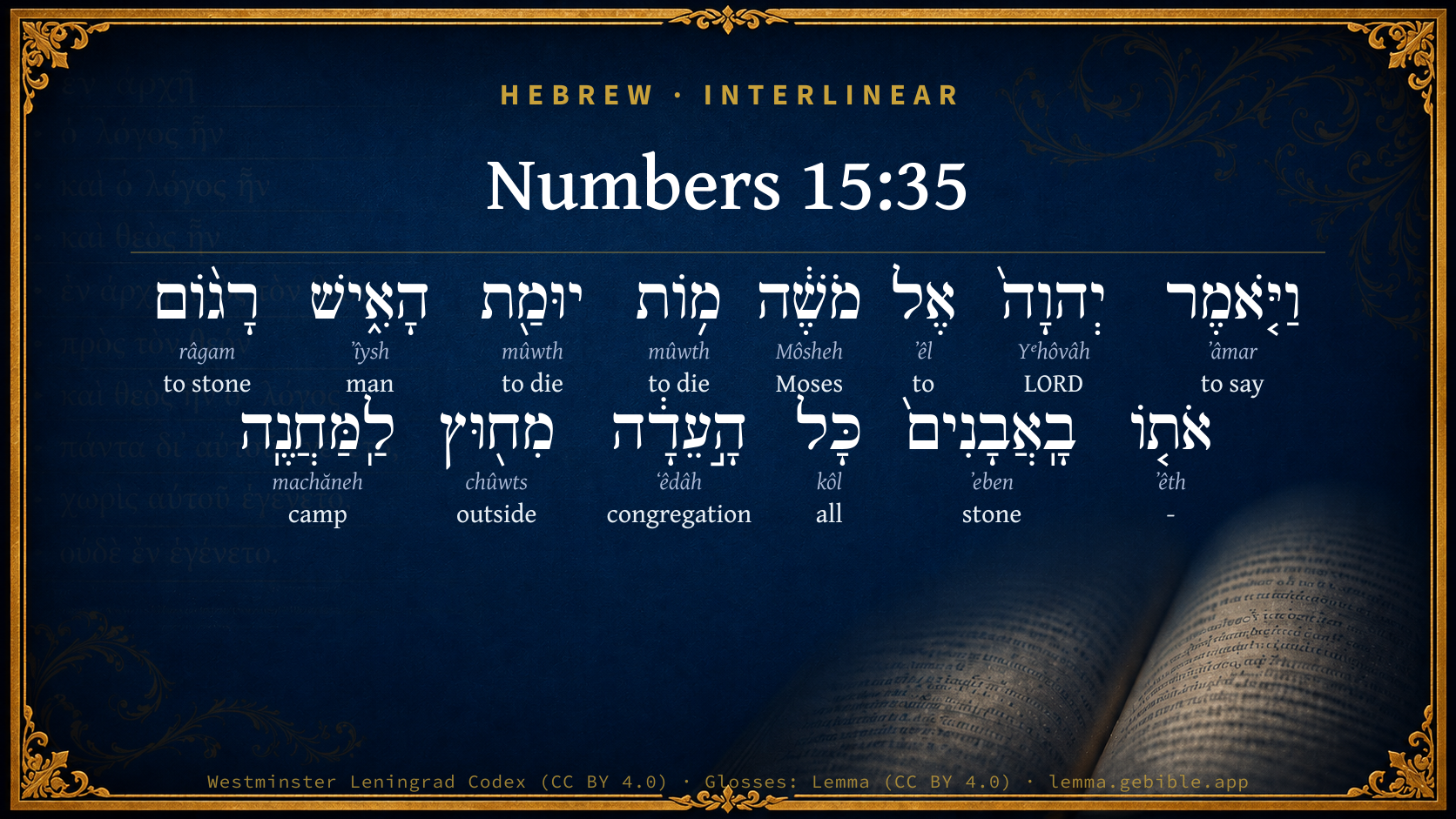
רָג֨וֹם
râgam
H7275
“to stone”
Verb, Qal, Infinitive Absolute
Part of Speech
Verb
Stem
Qal
Form
Infinitive Absolute
Full BDB Definition

Origin: a primitive root [compare H7263 , H7321 , H7551 ]

TWOT: 2114

to stone, slay or kill by stoning - (Qal) to stone
  1. וַיֹּ֤אמֶר ʼâmar H559 “and · to say” Conjunction + Verb, Qal, Sequential Imperfect, 3rd Person, Masculine, Singular
  2. יְהוָה֙ Yᵉhôvâh H3068 “LORD” Noun, Proper
  3. אֶל ʼêl H413 “to” Preposition
  4. מֹשֶׁ֔ה Môsheh H4872 “Moses” Noun, Proper
  5. מ֥וֹת mûwth H4191 “to die” Verb, Qal, Infinitive Absolute
  6. יוּמַ֖ת mûwth H4191 “to die” Verb, Hophal, Imperfect, 3rd Person, Masculine, Singular
  7. הָאִ֑ישׁ ʼîysh H376 “the · man” Particle, Definite Article + Noun, Common, Masculine, Singular, Absolute
  8. אֹת֤וֹ ʼêth H853 “- · him” Particle, Direct Object + Suffix, Personal, 3rd Person, Masculine, Singular
  9. בָֽאֲבָנִים֙ ʼeben H68 “in/at the · stones” Preposition, Determined + Noun, Common, Feminine, Plural, Absolute
  10. כָּל kôl H3605 “all of” Noun, Common, Masculine, Singular, Construct
  11. הָ֣עֵדָ֔ה ʻêdâh H5712 “the · congregation” Particle, Definite Article + Noun, Common, Feminine, Singular, Absolute
  12. מִח֖וּץ chûwts H2351 “from · outside” Preposition + Noun, Common, Masculine, Singular, Absolute
  13. לַֽמַּחֲנֶֽה machăneh H4264 “to/for the · camp” Preposition, Determined + Noun, Common, Both, Singular, Absolute

About this verse

These counts appear in no published source. They are computed here, from the morphology-tagged text and Lemma’s own curated glosses. What Lemma adds →

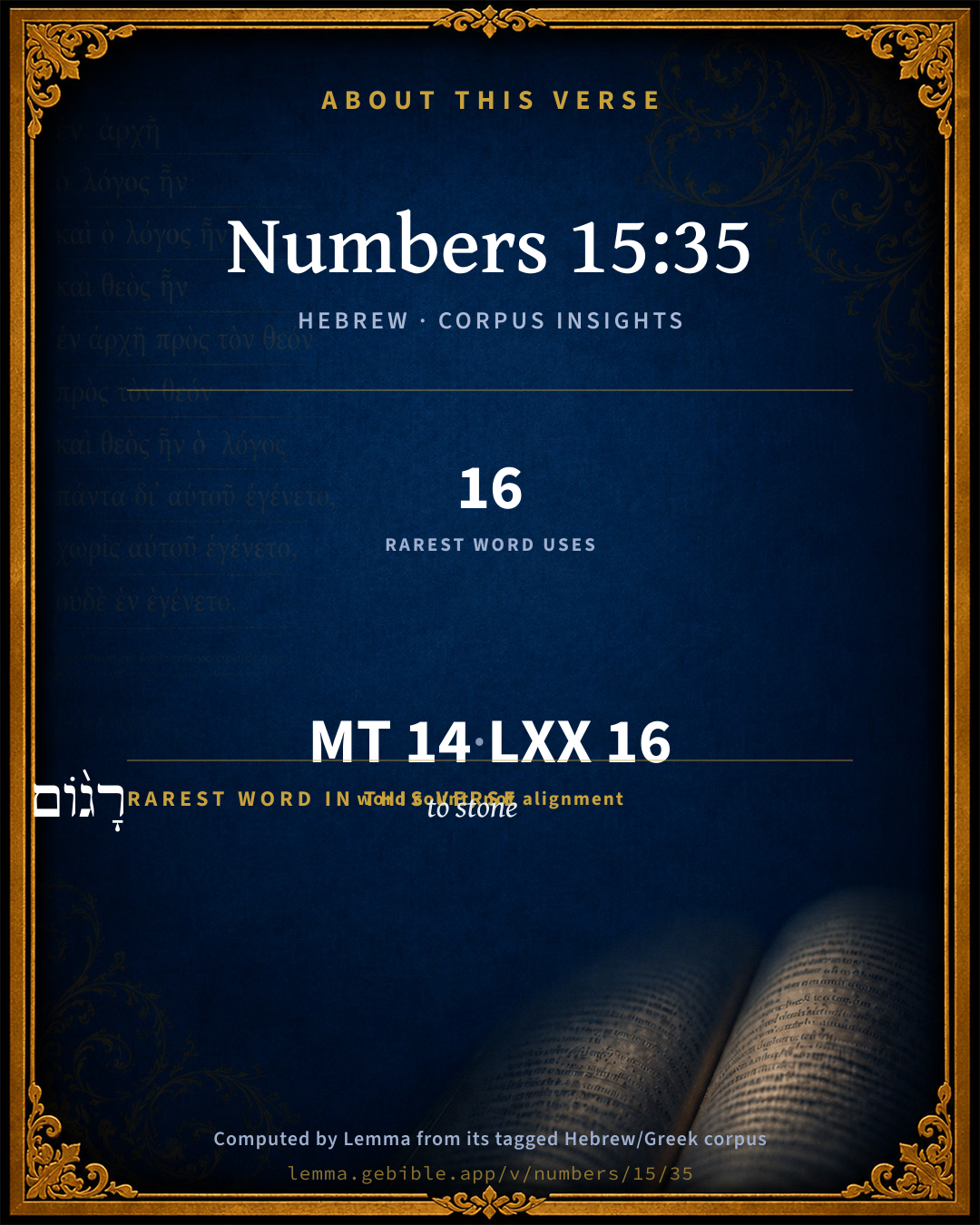
14
words
13
distinct lemmas
Pentateuch
section

Notable vocabulary

The rarest word here is רָג֨וֹם to stone H7275 — appearing just 16 times in the whole Hebrew Bible.

Shared distinctive vocabulary

רָג֨וֹם to stone H7275 occurs in 15 verses of the Hebrew Bible. Also found in:

Grammatical profile

  • 4 verbs
  • 8 nouns
  • 1 preposition
  • 1 particle

Verb forms

  • וַיֹּ֤אמֶר Qal · Sequential Imperfect
  • מ֥וֹת Qal · Infinitive Absolute
  • יוּמַ֖ת Hophal · Imperfect
  • רָג֨וֹם Qal · Infinitive Absolute

Repetition

A word recurs within this verse — often emphatic in Hebrew:

  • מ֥וֹת to die H4191 ×2

Hebrew & Septuagint length

In English translation the verse runs 24 words from the Hebrew and 26 from the Septuagint (LXX English) — closely comparable.

A rough comparison of the two English renderings, which tokenize alike — not a word-level alignment.

Word counts can differ between the Hebrew and the Greek without any difference in meaning — e.g. the Hebrew direct-object marker אֵת has no separate Greek word, and Greek often adds the article ὁ.

In the original languages it is 14 Hebrew tokens and 16 Greek tokens — but the two are counted differently (Hebrew bundles its prefixes and suffixes into one token; the Greek is in lemma form), so that isn’t a like-for-like length.

Cross-references

8

Topical passages linked to Numbers 15:35 in the Treasury of Scripture Knowledge — connected by theme and wording, ordered by reader-vote popularity; previews shown in the World English Bible.

  • Exodus 31:14–15 You shall keep the Sabbath therefore; for it is holy to you. Everyone who profanes it shall surely be put to death; for whoever does any work therein, that soul shall be cut off from among his people.
  • Acts 7:58 They threw him out of the city, and stoned him. The witnesses placed their garments at the feet of a young man named Saul.
  • 1 Kings 21:13 The two men, the base fellows, came in and sat before him: and the base fellows bore witness against him, even against Naboth, in the presence of the people, saying, Naboth did curse God and the king. Then they carried him forth out of the city, and stoned him to death with stones.
  • Leviticus 24:14–16 "Bring out of the camp him who cursed; and let all who heard him lay their hands on his head, and let all the congregation stone him.
  • Leviticus 24:23 Moses spoke to the children of Israel; and they brought forth him who had cursed out of the camp, and stoned him with stones. The children of Israel did as Yahweh commanded Moses.
  • Deuteronomy 21:21 All the men of his city shall stone him to death with stones: so shall you put away the evil from the midst of you; and all Israel shall hear, and fear.
  • Leviticus 20:2 "Moreover, you shall tell the children of Israel, 'Anyone of the children of Israel, or of the strangers who live as foreigners in Israel, who gives any of his seed to Molech; he shall surely be put to death. The people of the land shall stone him with stones.
  • Hebrews 13:11–12 For the bodies of those animals, whose blood is brought into the holy place by the high priest as an offering for sin, are burned outside of the camp.

Cross-references courtesy of OpenBible.info (CC BY 4.0).

Hebrew and Greek witnesses Masoretic Hebrew ↔ Greek Septuagint

The same verse in the two great witnesses to the Old Testament, shown verse-for-verse.

These are two independent witnesses, not word-aligned to each other, and the Septuagint is shown in lemma (dictionary) form.

Hebrew Numbers 15:35 Masoretic · Westminster Leningrad Codex

וַיֹּ֤אמֶר יְהוָה֙ אֶל מֹשֶׁ֔ה מ֥וֹת יוּמַ֖ת הָאִ֑ישׁ רָג֨וֹם אֹת֤וֹ בָֽאֲבָנִים֙ כָּל הָ֣עֵדָ֔ה מִח֖וּץ לַֽמַּחֲנֶֽה

Yahweh said to Moses, The man shall surely be put to death: all the congregation shall stone him with stones outside of the camp.

World English Bible · Public Domain

Greek LXX Numbers 15:35 Septuagint · lemma form

καί λαλέω κύριος πρός μωυσῆς λέγω θάνατος θανατόω ὁ ἄνθρωπος λιθοβολέω αὐτός λίθος πᾶς ὁ συναγωγή

And the Lord spoke to Moses, saying, Let the man be by all means put to death: do you⌃ all the congregation, stone him with stones.

LXX2012 (modern English Septuagint) · Public Domain

Hebrew: Westminster Leningrad Codex (CC BY 4.0). Greek: Septuagint (public domain); English from LXX2012 (modern English Septuagint) (Public Domain). How the Septuagint differs from the Hebrew →

Targum (Aramaic paraphrase)

2

The Targum is the ancient Jewish Aramaic paraphrase of the Hebrew Scriptures — an interpretive translation, not the Hebrew text itself. Onkelos (literal) and Pseudo-Jonathan (expansive) render the Torah, and Jonathan the Prophets. Coverage is partial: where no permissively-licensed English translation exists for a verse, only the Aramaic is shown. This is verse-level text, not a word-by-word alignment to the Hebrew.

  1. Targum Onkelos Torah (Genesis–Deuteronomy)
    וַאֲמַר יְיָ לְמשֶׁה אִתְקְטָלָא יִתְקְטֵל גַבְרָא רְגוּמוּ יָתֵיהּ בְּאַבְנַיָא כָּל כְּנִשְׁתָּא מִבָּרָא לְמַשְׁרִיתָא

    (no public-domain English translation for this verse)

    Targum Onkelos — Aramaic: “Onkelos Genesis” (public domain); “Onkelos Exodus” (public domain); “Onkelos Leviticus” (public domain); “Onkelos Numbers” (public domain); “Onkelos Deuteronomy” (public domain). English: “Sefaria Community Translation” (CC0 1.0 (public-domain dedication)); “J.W. Etheridge. The Targums of Onkelos and Jonathan Ben Uzziel on the Pentateuch. London: Longmans, Green, 1862” (public domain). Text via Sefaria.

  2. Targum Pseudo-Jonathan Torah (Genesis–Deuteronomy)
    וַאֲמַר יְיָ לְמשֶׁה אִתְקְטָלָא יִתְקְטֵיל גַבְרָא אַטְלוּ יָתֵיהּ בְאַבְנָא כָּל כְּנִישְׁתָּא מִבָּרָא לְמַשְׁרִיתָא

    And the Lord said to Mosheh: The man shall be surely put to death; the whole congregation shall stone him with stones without the camp;

    Targum Pseudo-Jonathan — Aramaic: “Targum Jonathan on Genesis” (public domain); “Targum Jonathan on Exodus” (public domain); “Targum Jonathan on Leviticus” (public domain); “Targum Jonathan on Numbers” (public domain); “Targum Jonathan on Deuteronomy” (public domain). English: “The Targum of Jonathan ben Uzziel, trans. J. W. Etheridge, London, 1862” (public domain). Text via Sefaria.

Commentary

Notes on Numbers 15:35 from classic Christian and Jewish commentators (each source and its license shown beneath its notes). The classic Christian expositions comment on the surrounding passage and are grouped to its opening verse, so a note may address several verses; the Jewish commentaries on the Tanakh (Rashi and others) are per-verse, so they appear only where the commentator wrote on this verse.

Lemma curates 59 commentaries, every one of them public domain or Creative Commons licensed, each selected and text-cleaned for this edition rather than reprinted as found. About our sources →

Joseph Benson's Commentary

Num 15:35. The man shall surely be put to death — One reason why the breach of the sabbath was punished with such severity by the Jewish law is, that it was an implicit denying of God to be the Creator of the world. For the sabbath being a sign, (Exo 31:13,) whereby the worshippers of the one true God, who created the world, were distinguished from the idolatrous nations, who believed the world was eternal, and who worshipped the sun, moon, and stars, and a multitude of nominal gods, the violation of this institution implied or led to a defection from the true religion to polytheism and idolatry.

Joseph Benson's Commentary on the Old and New Testaments (1811–1818) — public domain. Text from a community e-Sword module.

Jamieson, Fausset & Brown

Robert Jamieson, A. R. Fausset & David Brown

The Lord said unto Moses, The man shall be surely put to death--The Lord was King, as well as God of Israel, and the offense being a violation of the law of the realm, the Sovereign Judge gave orders that this man should be put to death; and, moreover, He required the whole congregation unite in executing the fatal sentence.

Jamieson, Fausset & Brown — Commentary Critical and Explanatory on the Whole Bible (1871) — public domain (CC PDM 1.0). Text via the HelloAO Bible API.

John Gill's Exposition

And all the congregation brought him without the camp,.... What was done by the order of Moses and the seventy elders is said to be done by the whole congregation, though it was by a few persons only the man was actually brought out, who were the proper officers to do such business:

and stoned him with stones, and he died: stoned him to death:

as the Lord commanded Moses: at the time he consulted him in the sanctuary, which he acquainted the court with, and they immediately ordered the execution, which was accordingly done.

John Gill's Exposition of the Whole Bible (1746–1763) — public domain (CC PDM 1.0). Text via the HelloAO Bible API.

Whedon's Commentary on the Bible

Daniel D. Whedon

35. All the congregation — Only where the executive is sustained by a high tone of public sentiment can all kinds of vice be punished. This is especially true of sabbath desecration and drunkenness.

Daniel D. Whedon (gen. ed.), Commentary on the Old and New Testaments (1874–1909) — public domain. Text from a community e-Sword module.

The Pulpit Commentary

Without the camp. That it might not be defiled. (cf. Act_7:58, and Heb_13:12)

The Pulpit Commentary (1880–1919), ed. H.D.M. Spence-Jones & Joseph S. Exell — public domain. Text from a community e-Sword module.

unfoldingWord translationNotes

Door43 World Missions Community

The man must surely be put to death

This can be stated in active form. AT: "You must surely put the man to death" or "The man must surely die" (See: Active or Passive)

translationWords

Yahweh

die

stone

unfoldingWord translationNotes — © Distant Shores Media and the Door43 World Missions Community, licensed CC BY-SA 4.0. Source: git.door43.org/Door43/en_tn.

Rashi

Rabbi Shlomo Yitzchaki (Rashi)

רגום expresses the idea of “doing” something (that is, it is an infinitive or verbal noun); in O. F. faisant; (English = doing). Similarly הלוך allant, “going“, and so, too, זכור “remembering”, שמור “keeping”.

Rashi on the Tanakh — English translations: “The Judaica Press complete Tanach with Rashi, translated by A. J. Rosenberg” (CC BY 4.0); “Pentateuch with Rashi's commentary by M. Rosenbaum and A.M. Silbermann, 1929-1934” (public domain); “The Metsudah Tanach series, Lakewood, N.J” (CC BY 4.0); and “The Book of Joshua, Metsudah Publications, 1997” (CC BY 4.0). Text via Sefaria.

Lesson kit

Teaching starters — assembled from the data on this page, not authored interpretation. Every prompt links to the verse data it draws on. Edit before teaching.

Numbers, in the Pentateuch, opens this verse with 14 words (13 distinct Hebrew lemmas). Its most distinctive word is râgam (“to stone”). A historical commentator’s framing appears above. Read the whole chapter for the surrounding context.

Discussion questions

  1. The word râgam carries the sense “to stone.” How does it shape the verse?
  2. Leviticus 20:2 shares the word «to stone» with this verse. How do the two illuminate each other?
  3. “to die” occurs 2× in this one verse. What is the effect of the repetition?
  4. These translations render this verse differently; the difference is in the English rendering, not the original. What questions does that raise?
  5. The verb «וַיֹּ֤אמֶר» is Qal Sequential Imperfect. How does its form color the action?
  6. Reading how Joseph Benson's Commentary and Jamieson, Fausset & Brown read this verse, where do the two commentators agree and where do they part?

Things to notice

Reading settings

Reading text

Shown beneath each verse's original-language words.

Old Testament
Old Testament edition

Read the OT as the Masoretic Hebrew (MT) or the Greek Septuagint (LXX).

English shown for the Greek Septuagint (in the Hebrew ↔ Greek comparison).

Comparing translations? Open the Compare panel on any verse page to stack up to four side by side.