Numbers 20:26

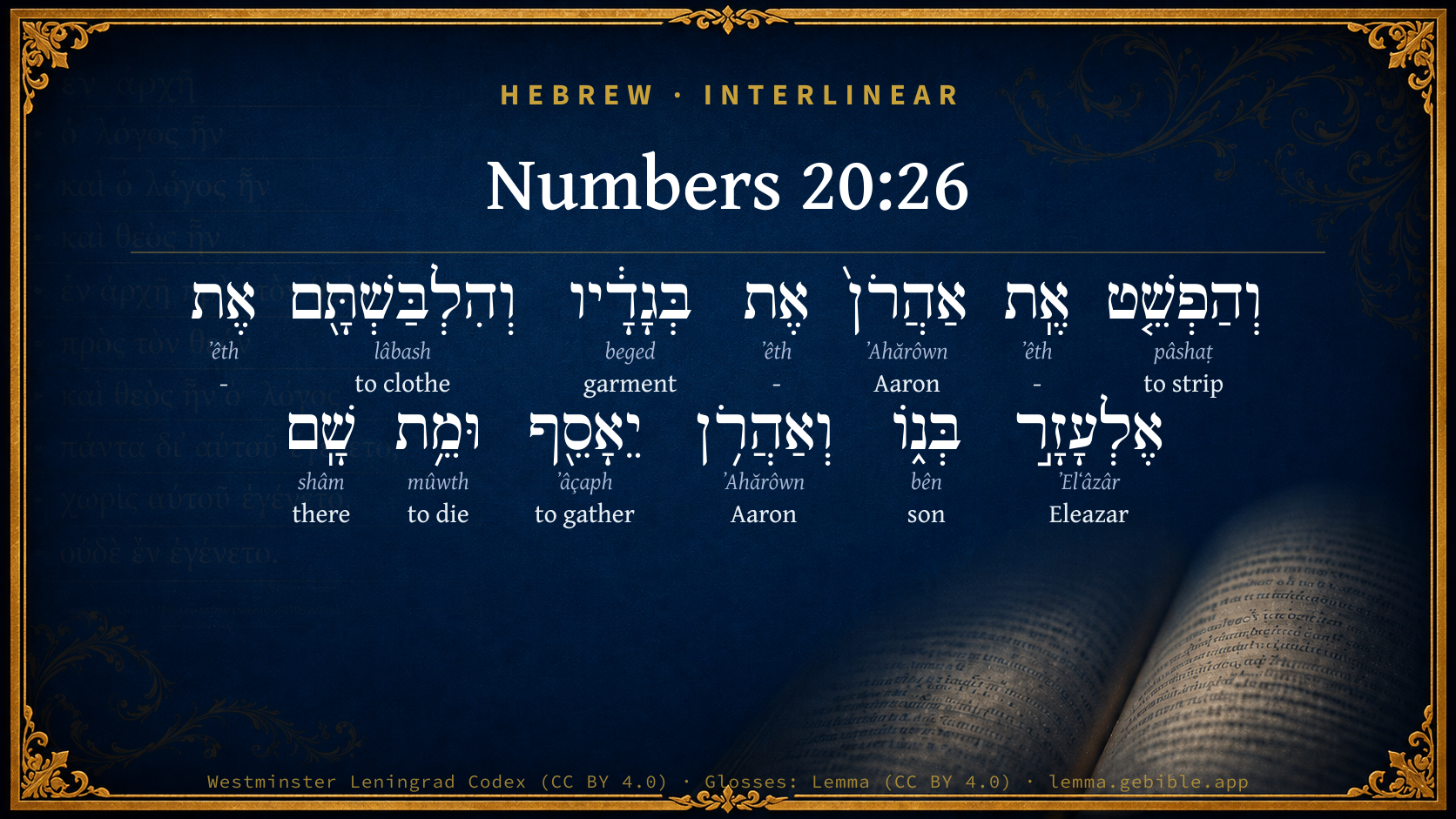
Hebrew (Westminster Leningrad Codex) Numbers 20:26 appears in the Hebrew Old Testament. The text above is from the Westminster Leningrad Codex. Each word links to its Strong’s number, a concise gloss, and parsing drawn from the Open Scriptures Hebrew Bible morphology. Click any word for its full Brown-Driver-Briggs (BDB) entry.
Download image
Cite this verse

Numbers 20:26 (World English Bible). Public Domain. Lemma interlinear Bible study tool, https://lemma.gebible.app/v/numbers/20/26.

Show BibTeX & RIS
BibTeX
RIS
English Translation
and strip Aaron of his garments, and put them on Eleazar his son: and Aaron shall be gathered [to his people], and shall die there.
World English Bible · Public Domain
Download a study sheet

One document with this verse’s original text, its word-by-word gloss line, the meaning frame, cross-references with their text, attributed commentary, and full source and license credits — printable, and it pastes into notes with its structure intact.

This verse Autodidact and up

Study sheet (.html) Plain text (.txt)

A passage Seminary Student

Up to 50 verses in one chapter. A passage sheet keeps up to 6 commentary sources and 12 cross-references per verse, in the order this page ranks them, and says so on the sheet whenever that leaves anything out. Ask for a single verse and you get the Autodidact verse sheet above.

Everything on this page stays free to read, with no account — the sheet is a download of what is already on screen, not access to it.

Want to remove ads? Support Godless Engineer
Compare translations 3

The same verse in 3 English versions, stacked beneath the original-language interlinear above. Click any original word for its lexicon entry.

Each is an independent rendering of the whole verse — the interlinear is not word-aligned to these translations.

Highlighted words mark where these versions differ — a whole-verse word diff, not a word-by-word alignment.

  • World English Bible Public Domain
    and strip Aaron of his garments, and put them on Eleazar his son: and Aaron shall be gathered [to his people], and shall die there.
  • King James Version Public Domain
    And strip Aaron of his garments, and put them upon Eleazar his son: and Aaron shall be gathered unto his people, and shall die there.
  • unfoldingWord Literal Text CC BY-SA 4.0
    And strip Aaron of his clothes and clothe Eleazar his son with them. And Aaron will be gathered and will die there.”

unfoldingWord Literal Text — © unfoldingWord, licensed CC BY-SA 4.0. Word-aligned USFM3 via Door43 (git.door43.org/unfoldingWord/en_ult).

Versions to compare (up to 4)

3 of 4 selected

Show all 18 translations

Every available English version of this verse, each an independent rendering of the whole verse.

  • World English Bible Public Domain
    and strip Aaron of his garments, and put them on Eleazar his son: and Aaron shall be gathered [to his people], and shall die there.
  • Berean Standard Bible Public Domain
    Remove Aaron’s priestly garments and put them on his son Eleazar. Aaron will be gathered to his people and will die there.”
  • Majority Standard Bible Public Domain
    Remove Aaron’s priestly garments and put them on his son Eleazar. Aaron will be gathered to his people and will die there.”
  • King James Version Public Domain
    And strip Aaron of his garments, and put them upon Eleazar his son: and Aaron shall be gathered unto his people, and shall die there.
  • American Standard Version (1901) Public Domain
    and strip Aaron of his garments, and put them upon Eleazar his son: and Aaron shall be gathered `unto his people', and shall die there.
  • Revised Version (1885) Public Domain
    and strip Aaron of his garments, and put them upon Eleazar his son: and Aaron shall be gathered unto his people, and shall die there.
  • Geneva Bible (1599) Public Domain
    And cause Aaron to put off his garmentes and put them vpon Eleazar his sonne: for Aaron shall be gathered to his fathers, and shall die there.
  • Douay-Rheims (1899) Public Domain
    And when thou hast stripped the father of his vesture, thou shalt vest therewith Eleazar his son: Aaron shall be gathered to his people, and die there.
  • Young's Literal Translation Public Domain
    and strip Aaron of his garments, and thou hast clothed `with' them Eleazar his son, and Aaron is gathered, and doth die there.'
  • Literal Standard Version CC BY-SA 4.0
    and strip Aaron of his garments, and you have clothed his son Eleazar [with] them, and Aaron is gathered, and dies there.”
  • Unlocked Literal Bible CC BY-SA 4.0
    Take Aaron's priestly garments off him and put them on Eleazar his son. Aaron must die and be gathered to his people there.”
  • unfoldingWord Literal Text CC BY-SA 4.0
    And strip Aaron of his clothes and clothe Eleazar his son with them. And Aaron will be gathered and will die there.”
  • Darby Bible Public Domain
    and strip Aaron of his garments, and put them upon Eleazar his son; and Aaron shall be gathered [to his peoples], and shall die there.
  • World Messianic Bible Public Domain
    and strip Aaron of his garments, and put them on Eleazar his son. Aaron shall be gathered, and shall die there.”
  • Webster's Bible Public Domain
    And strip Aaron of his garments, and put them upon Eleazar his son: and Aaron shall be gathered to his people, and shall die there.
  • Free Bible Version CC BY-SA 4.0
    Take off Aaron's priestly clothes and put them on his son Eleazar. Aaron is going to die there and join his forefathers in death.”
  • Bible in Basic English Public Domain
    And take Aaron's robes off him and put them on Eleazar, his son: and death will come to Aaron there, and he will be put to rest with his people.
  • JPS Tanakh (1917) Public Domain
    And strip Aaron of his garments, and put them upon Eleazar his son; and Aaron shall be gathered unto his people, and shall die there.'

Literal Standard Version (2020), Covenant Press — licensed CC BY-SA 4.0. Text via the HelloAO Bible API (eBible.org). Unlocked Literal Bible (unfoldingWord) — licensed CC BY-SA 4.0. Text via the HelloAO Bible API (eBible.org). unfoldingWord Literal Text — © unfoldingWord, licensed CC BY-SA 4.0. Word-aligned USFM3 via Door43 (git.door43.org/unfoldingWord/en_ult). Free Bible Version, Dr. Jonathan Gallagher — licensed CC BY-SA 4.0. Text via the HelloAO Bible API (eBible.org).

Word by word

More ways to search: Search by grammar → Find every occurrence → Compare this word →

Practice this passage: Drill this verse → Learn its vocabulary →

וְהַפְשֵׁ֤ט
pâshaṭ
H6584
“and · strip”
Conjunction + Verb, Hiphil, Imperative, 2nd Person, Masculine, Singular
Part of Speech
Conjunction + Verb
Stem
Hiphil
Form
Imperative
Person
2nd Person
Gender
Masculine
Number
Singular
Full BDB Definition

Origin: a primitive root

TWOT: 1845

to strip, invade, strip off, make a dash, raid, spread out - (Qal) - to strip off, put off - to put off (one's shelter), make a dash - (Piel) to strip - (Hiphil) - to strip of - to strip off - to flay - (Hithpael) to strip oneself of
  1. אֶֽת ʼêth H853 “-” Particle, Direct Object
  2. אַהֲרֹן֙ ʼAhărôwn H175 “Aaron” Noun, Proper
  3. אֶת ʼêth H853 “-” Particle, Direct Object
  4. בְּגָדָ֔יו beged H899 “garments · his” Noun, Common, Masculine, Plural, Construct + Suffix, Personal, 3rd Person, Masculine, Singular
  5. וְהִלְבַּשְׁתָּ֖ם lâbash H3847 “and · to clothe · them” Conjunction + Verb, Hiphil, Sequential Perfect, 2nd Person, Masculine, Singular + Suffix, Personal, 3rd Person, Masculine, Plural
  6. אֶת ʼêth H853 “-” Particle, Direct Object
  7. אֶלְעָזָ֣ר ʼElʻâzâr H499 “Eleazar” Noun, Proper
  8. בְּנ֑וֹ bên H1121 “son · his” Noun, Common, Masculine, Singular, Construct + Suffix, Personal, 3rd Person, Masculine, Singular
  9. וְאַהֲרֹ֥ן ʼAhărôwn H175 “and · Aaron” Conjunction + Noun, Proper
  10. יֵאָסֵ֖ף ʼâçaph H622 “to gather” Verb, Niphal, Imperfect, 3rd Person, Masculine, Singular
  11. וּמֵ֥ת mûwth H4191 “and · to die” Conjunction + Verb, Qal, Sequential Perfect, 3rd Person, Masculine, Singular
  12. שָֽׁם shâm H8033 “there” Adverb

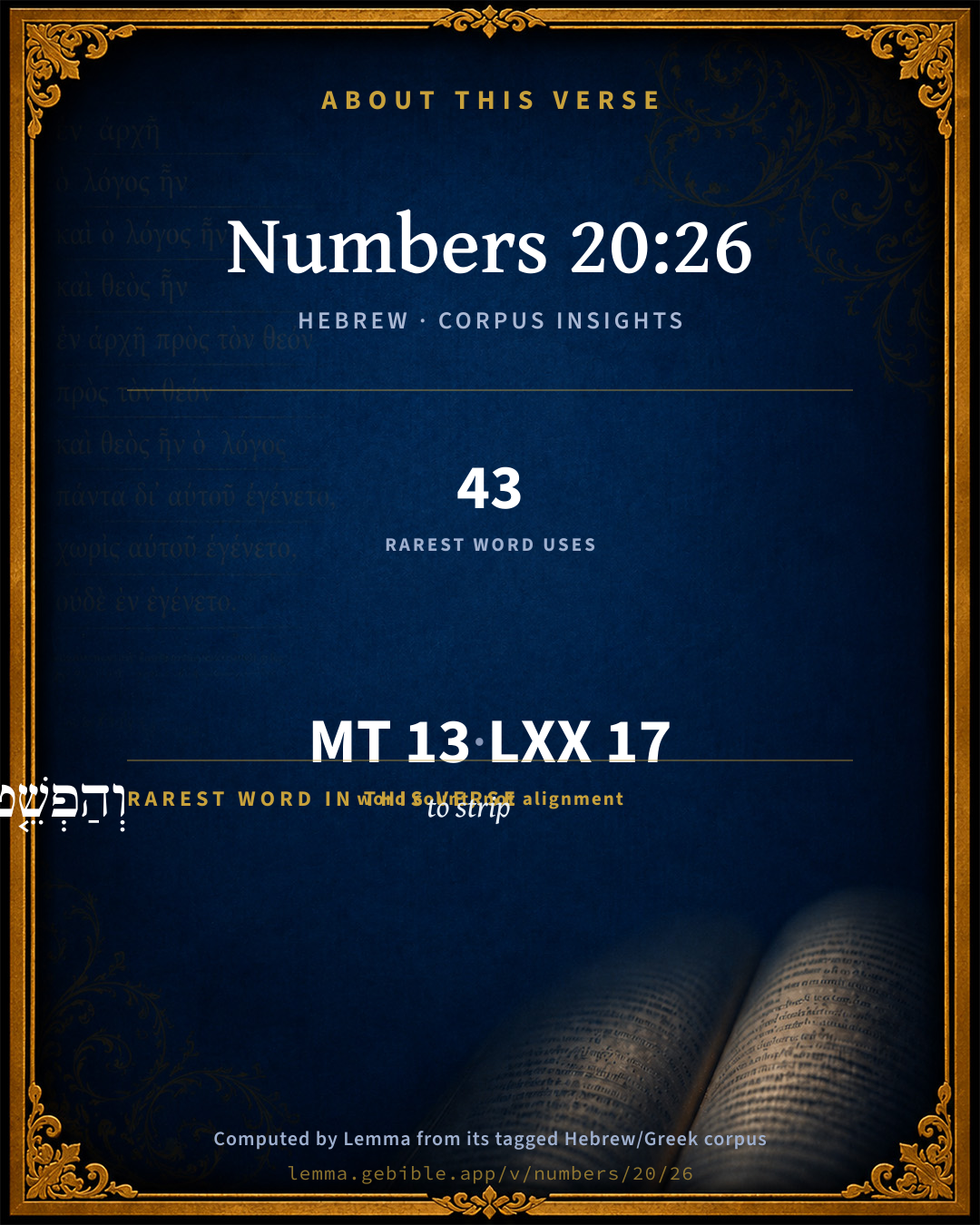
About this verse

These counts appear in no published source. They are computed here, from the morphology-tagged text and Lemma’s own curated glosses. What Lemma adds →

13
words
10
distinct lemmas
Pentateuch
section

Shared distinctive vocabulary

וְהַפְשֵׁ֤ט to strip H6584 occurs in 42 verses of the Hebrew Bible. Also found in:

Grammatical profile

  • 4 verbs
  • 5 nouns
  • 1 adverb
  • 3 particles

Verb forms

  • וְהַפְשֵׁ֤ט Hiphil · Imperative
  • וְהִלְבַּשְׁתָּ֖ם Hiphil · Sequential Perfect
  • יֵאָסֵ֖ף Niphal · Imperfect
  • וּמֵ֥ת Qal · Sequential Perfect

Repetition

A word recurs within this verse — often emphatic in Hebrew:

  • אַהֲרֹן֙ Aaron H175 ×2

Hebrew & Septuagint length

In English translation the verse runs 25 words from the Hebrew and 25 from the Septuagint (LXX English) — the same length.

A rough comparison of the two English renderings, which tokenize alike — not a word-level alignment.

Word counts can differ between the Hebrew and the Greek without any difference in meaning — e.g. the Hebrew direct-object marker אֵת has no separate Greek word, and Greek often adds the article ὁ.

In the original languages it is 13 Hebrew tokens and 17 Greek tokens — but the two are counted differently (Hebrew bundles its prefixes and suffixes into one token; the Greek is in lemma form), so that isn’t a like-for-like length.

Cross-references

5

Topical passages linked to Numbers 20:26 in the Treasury of Scripture Knowledge — connected by theme and wording, ordered by reader-vote popularity; previews shown in the World English Bible.

  • Numbers 20:24 Aaron shall be gathered to his people; for he shall not enter into the land which I have given to the children of Israel, because you rebelled against my word at the waters of Meribah.
  • Exodus 29:29–30 "The holy garments of Aaron shall be for his sons after him, to be anointed in them, and to be consecrated in them.
  • Isaiah 22:21–22 and I will cloth him with your robe, and strengthen him with your belt, and I will commit your government into his hand; and he shall be a father to the inhabitants of Jerusalem, and to the house of Judah.
  • Hebrews 7:11 Now if there was perfection through the Levitical priesthood (for under it the people have received the law), what further need was there for another priest to arise after the order of Melchizedek, and not be called after the order of Aaron?
  • Hebrews 7:23–24 Many, indeed, have been made priests, because they are hindered from continuing by death.

Cross-references courtesy of OpenBible.info (CC BY 4.0).

Hebrew and Greek witnesses Masoretic Hebrew ↔ Greek Septuagint

The same verse in the two great witnesses to the Old Testament, shown verse-for-verse.

These are two independent witnesses, not word-aligned to each other, and the Septuagint is shown in lemma (dictionary) form.

Hebrew Numbers 20:26 Masoretic · Westminster Leningrad Codex

וְהַפְשֵׁ֤ט אֶֽת אַהֲרֹן֙ אֶת בְּגָדָ֔יו וְהִלְבַּשְׁתָּ֖ם אֶת אֶלְעָזָ֣ר בְּנ֑וֹ וְאַהֲרֹ֥ן יֵאָסֵ֖ף וּמֵ֥ת שָֽׁם

and strip Aaron of his garments, and put them on Eleazar his son: and Aaron shall be gathered [to his people], and shall die there.

World English Bible · Public Domain

Greek LXX Numbers 20:26 Septuagint · lemma form

καί ἐκδύω ἀαρών ὁ στολή αὐτός καί ἐνδύω ελεαζαρ ὁ υἱός αὐτός καί ἀαρών προςτίθημι ἀποθνήσκω ἐκεῖ

and take Aaron's apparel from off him, and put it on Eleazar his son: and let Aaron die there and be added to his people.

LXX2012 (modern English Septuagint) · Public Domain

Hebrew: Westminster Leningrad Codex (CC BY 4.0). Greek: Septuagint (public domain); English from LXX2012 (modern English Septuagint) (Public Domain). How the Septuagint differs from the Hebrew →

Targum (Aramaic paraphrase)

2

The Targum is the ancient Jewish Aramaic paraphrase of the Hebrew Scriptures — an interpretive translation, not the Hebrew text itself. Onkelos (literal) and Pseudo-Jonathan (expansive) render the Torah, and Jonathan the Prophets. Coverage is partial: where no permissively-licensed English translation exists for a verse, only the Aramaic is shown. This is verse-level text, not a word-by-word alignment to the Hebrew.

  1. Targum Onkelos Torah (Genesis–Deuteronomy)
    וְאַשְׁלַח יָת אַהֲרֹן יָת לְבוּשׁוֹהִי וְתַלְבֵּישִׁנוּן יָת אֶלְעָזָר בְּרֵיהּ וְאַהֲרֹן יִתְכְּנֵישׁ וִימוּת תַּמָן

    (no public-domain English translation for this verse)

    Targum Onkelos — Aramaic: “Onkelos Genesis” (public domain); “Onkelos Exodus” (public domain); “Onkelos Leviticus” (public domain); “Onkelos Numbers” (public domain); “Onkelos Deuteronomy” (public domain). English: “Sefaria Community Translation” (CC0 1.0 (public-domain dedication)); “J.W. Etheridge. The Targums of Onkelos and Jonathan Ben Uzziel on the Pentateuch. London: Longmans, Green, 1862” (public domain). Text via Sefaria.

  2. Targum Pseudo-Jonathan Torah (Genesis–Deuteronomy)
    וְאַשְׁלַח יַת אַהֲרן יַת לְבוּשׁוֹי אִיקַר כְּהוּנְתָּא וְתַלְבִּישׁוּנוּן יַת אֶלְעָזָר בְּרֵיהּ וְאַהֲרן יִתְכְּנֵישׁ וִימוּת תַּמָן

    And thou shalt strip Aharon of his vestments, the adornment (glory) of the priesthood, and put them on Elazar his son; but Aharon shall be gathered, and die there.

    Targum Pseudo-Jonathan — Aramaic: “Targum Jonathan on Genesis” (public domain); “Targum Jonathan on Exodus” (public domain); “Targum Jonathan on Leviticus” (public domain); “Targum Jonathan on Numbers” (public domain); “Targum Jonathan on Deuteronomy” (public domain). English: “The Targum of Jonathan ben Uzziel, trans. J. W. Etheridge, London, 1862” (public domain). Text via Sefaria.

Commentary

Notes on Numbers 20:26 from classic Christian and Jewish commentators (each source and its license shown beneath its notes). The classic Christian expositions comment on the surrounding passage and are grouped to its opening verse, so a note may address several verses; the Jewish commentaries on the Tanakh (Rashi and others) are per-verse, so they appear only where the commentator wrote on this verse.

Lemma curates 59 commentaries, every one of them public domain or Creative Commons licensed, each selected and text-cleaned for this edition rather than reprinted as found. About our sources →

Joseph Benson's Commentary

Num 20:26-27. His garments — His priestly garments, in token of his resignation of his office. Put them upon Eleazar — By way of admission and inauguration to his office. In the sight of all the congregation — That their hearts might be more affected with their loss of so great a pillar, and that they all might be witnesses of the translation of the priesthood from Aaron to Eleazar.

Joseph Benson's Commentary on the Old and New Testaments (1811–1818) — public domain. Text from a community e-Sword module.

Jamieson, Fausset & Brown

Robert Jamieson, A. R. Fausset & David Brown

strip Aaron of his garments--that is, his pontifical robes, in token of his resignation. (See Isa 22:20-25).

put them on his son--as the inauguration into his high office. Having been formerly anointed with the sacred oil, that ceremony was not repeated, or, as some think, it was done on his return to the camp.

Jamieson, Fausset & Brown — Commentary Critical and Explanatory on the Whole Bible (1871) — public domain (CC PDM 1.0). Text via the HelloAO Bible API.

Adam Clarke's Commentary

Verse 26. Strip Aaron of his garments] This was, in effect, depriving him of his office; and putting the clothes on his son Eleazar implied a transfer of that office to him. A transfer of office, from this circumstance of putting the clothes of the late possessor on the person intended to succeed him, was called investing or investment, (clothing); as removing a person from an office was termed divesting or unclothing. Among the Catholics, and in the Church of England, this same method is used in degrading ecclesiastics. Hence such a degradation is termed by the common people stripping a man of his gown.

Adam Clarke's Commentary on the Bible (1810–1826) — public domain. Text from a community e-Sword/MySword module.

Ellicott's Commentary for English Readers

(26) And strip Aaron of his garments.—Thus the same hands which had invested Aaron with the sacred garments were employed in divesting him of them, and, in both cases, in obedience to the express command of God. The removal of the priestly robes from Aaron may be regarded as typical of the future disannulling of his priesthood when a priest after the order of Melchizedek should arise. “The succession of the priesthood,” says Dean Stanley (who refers to Ewald’s Geschichte, 5:13), “was made through that singular usage, preserved even to the latest days of the Jewish hierarchy, by the transference of the vestments and drapery of the dead High Priest to the living successor.” (Lectures on Jewish History, 1:182.)

A Bible Commentary for English Readers, edited by Charles John Ellicott (1878–1897) — public domain. Text from a community e-Sword module.

The Cambridge Bible for Schools and Colleges

gen. ed. J. J. S. Perowne

26. his garments] the official high-priest’s vestments, with which Eleazar was robed, in token of his succession to the office; cf. Deu_10:6.

The Cambridge Bible for Schools and Colleges (gen. ed. J. J. S. Perowne; Cambridge University Press, 1878–1918) — public domain. Text from a community e-Sword module.

John Gill's Exposition

And Moses did as the Lord commanded,.... Though it must be very cutting, distressing, and afflicting to him, to part with a brother so dear to him, and who had been so many years a companion of him, and a partner with him in the care and government of the people of Israel; but it being the Lord's will, he submits unto it, and faithfully and readily obeyed his orders, as he always did:

and they went up into Mount Hor, in the sight of all the congregation; that is, Moses, Aaron, and Eleazar, and perhaps there might be some others that went with them as servants, to attend them and assist them in some things to be done, particularly in the burial of Aaron; they all saw Aaron go up, but he came down no more, and so it was ordered in this public manner, that they might be witnesses of the translation of the priesthood from Aaron to Eleazar, who, after this affair was over, came down with Moses.

John Gill's Exposition of the Whole Bible (1746–1763) — public domain (CC PDM 1.0). Text via the HelloAO Bible API.

Albert Barnes' Notes on the Bible

The priestly garments, wherewith Moses had invested Aaron Lev 8:7-9, were put upon Eleazar by way of solemn transference of Aaron’s office to him; compare 1Ki 19:19.

Albert Barnes' Notes on the Bible (1834–1885) — public domain. Text from a community e-Sword/MySword module.

Haydock's Catholic Bible Commentary

Vesture, or pontifical attire. Eleazar had been anointed already, so that perhaps he stood in need of no other ceremony to be acknowledged high priest. He was dispensed with on this occasion to attend his dying father. The spirit of God gives great encomiums to Aaron, Malachias ii. 4-7., and Ecclesiasticus xlv. 7, 27. He, at the same time, prefigured Christ, the gospel, and the old law. He spoke plainly, and was allowed to enter the holy of holies; while Moses was excluded, spoke with difficulty, and had a veil on his face. See St. Jerome, ep. ad Fab. man. 33. But on the other hand, he represented the law with all its defects. He falls into several great faults, and dies despoiled of his glorious vestments, to shew the abrogation of his priesthood. The pagans have, perhaps, introduced some parts of his history into that of Mercury, the god of thieves and of travellers, the messenger of the other gods, whom they adorn with a wand, &c., in imitation of the rod of Aaron, who was the interpreter of Moses, and the head of that people, which wandered for 40 years, after plundering Egypt. (Calmet)

George Leo Haydock (1774–1849), Haydock's Catholic Family Bible and Commentary, 1859 edition — public domain. Excludes Psalms (Douay-Rheims chapter numbering differs from Protestant) and Deuterocanonical books (Catholic canon only).

Matthew Poole's English Annotations

Of his garments, to wit, of his priestly garments, Exo 28:2; Lev 8:7-9, in token of his resignation of his office. See the like Isa 22:15,19-21.

Put them upon Eleazar, by way of admission and inauguration of him to his office.

Matthew Poole's English Annotations on the Holy Bible (1683–1685) — public domain. Text from a community e-Sword/MySword module.

Whedon's Commentary on the Bible

Daniel D. Whedon

26. Strip Aaron of his garments — The high priest was to be disrobed before death, because his robes, the ordained investiture of his successor, (Exo_29:29,) would be defiled by contact with his dead body. Num_5:2; Lev_10:5, notes.

Put them upon Eleazar — Eleazar was inducted into office before his father’s death in order that there might be no interruption in the high priesthood.

Daniel D. Whedon (gen. ed.), Commentary on the Old and New Testaments (1874–1909) — public domain. Text from a community e-Sword module.

John Wesley's Explanatory Notes

His garments - His priestly garments, in token of his resignation of his office. Put them on Eleazar - By way of admission and inauguration to his office.

John Wesley, Explanatory Notes Upon the Whole Bible (1754–1765) — public domain. Text via the GEBible commentary corpus.

Rashi

Rabbi Shlomo Yitzchaki (Rashi)

את בגדיו [AND STRIP AARON OF] HIS GARMENTS — i.e., the garments of the high priesthood. — He clothed him in these and stripped them off him to place them on his son in his presence. He (Moses) said to him (Aaron), “Enter the cave”, and he entered. — He saw a bed already made (more lit., outspread, i.e., with its sheets, etc.) and a light burning. He said to him, “Ascend the bed”, and he ascended. — “Stretch out your hands”, and he stretched them out. — “Close your mouth”, and he closed it. — “Close your eyes”, and he closed them. At that moment Moses longed for that self-same death, and this is what was said to him (Deuteronomy 32:50), “[And die] … as Aaron thy brother died” — the death, for which you longed (Siphre on that verse).

Rashi on the Tanakh — English translations: “The Judaica Press complete Tanach with Rashi, translated by A. J. Rosenberg” (CC BY 4.0); “Pentateuch with Rashi's commentary by M. Rosenbaum and A.M. Silbermann, 1929-1934” (public domain); “The Metsudah Tanach series, Lakewood, N.J” (CC BY 4.0); and “The Book of Joshua, Metsudah Publications, 1997” (CC BY 4.0). Text via Sefaria.

Ramban (Nachmanides)

Rabbi Moshe ben Nachman (Ramban / Nachmanides)

AND STRIP AARON OF HIS GARMENTS. These are the garments [reserved only] for the High Priest, with which Eleazar his son was now appointed [High Priest in his stead]. It is likely that when Aaron came down from offering the Daily Whole-offering, and burnt the incense and kindled the lamps, Moses took him up to Mount Hor whilst he was still dressed in the garments of the [High] Priest, and [then] he stripped him of them. And according to the plain meaning of Scripture [the verse is to be interpreted: And strip Aaron of his garments in order to] put on him the shrouds of a dead man which he had prepared for him, and then he stripped Eleazar of his ordinary clothes and put the sacred garments upon him, as he did to him on the day of initiation. And according to the Midrashic interpretation of our Rabbis, 1:6. various miracles occurred in connection with these garments. Thus they said: “How could Moses strip Aaron of his garments in their proper order? Are not the upper ones always on top, and the lower ones always underneath? But G-d did miraculous deeds for Aaron at the time of his death, even more so than during his lifetime. Thus Moses put Aaron upon the rock and stripped him of the priestly garments, and [alternative] celestial garments clothed themselves [upon him] underneath them. robe, he was covered with a corresponding celestial garment underneath his tunic [which was the lower garment directly on his body]. Moses could then proceed to remove the tunic [which was now above the celestial “upper” robe, thereby fulfilling the Divine command of stripping Aaron of his garments “in their proper order.” As he removed the tunic, a corresponding celestial tunic likewise clothed itself underneath the celestial robe. This interpretation of the Torath Kohanim is based upon Malbim’s commentary. And he put them upon Eleazar his son. But how could Moses put the garments upon Eleazar in their proper order? [We must say that this was not natural], but that G-d bestowed a great honor upon Aaron at the time of his death, even more so than during his lifetime, in that celestial garments first [miraculously] clothed themselves underneath [the other garments], and then Moses stripped Aaron of the priestly garments in their proper order, and [also] put them on Eleazar in their proper order.” So it is taught in the Torath Kohanim. 1:6.

Ramban (Nachmanides) on the Tanakh — English translation: “Commentary on the Torah by Ramban (Nachmanides). Translated and annotated by Charles B. Chavel. New York, Shilo Pub. House, 1971-1976” (CC BY 4.0). Text via Sefaria.

Lesson kit

Teaching starters — assembled from the data on this page, not authored interpretation. Every prompt links to the verse data it draws on. Edit before teaching.

Numbers, in the Pentateuch, opens this verse with 13 words (10 distinct Hebrew lemmas). Its most distinctive word is pâshaṭ (“to strip”). A historical commentator’s framing appears above. Read the whole chapter for the surrounding context.

Discussion questions

  1. How does “to strip” (pâshaṭ) shape what this verse is saying?
  2. Genesis 37:23 shares the word «to strip» with this verse. How do the two illuminate each other?
  3. “Aaron” occurs 2× in this one verse. What is the effect of the repetition?
  4. The translations on this page render this verse differently — a whole-verse word diff, not a word-by-word alignment. What might account for the different wordings?
  5. The verb «וְהַפְשֵׁ֤ט» is Hiphil Imperative. How does its form color the action?
  6. Reading how Joseph Benson's Commentary and Jamieson, Fausset & Brown read this verse, where do the two commentators agree and where do they part?

Things to notice

Reading settings

Reading text

Shown beneath each verse's original-language words.

Old Testament
Old Testament edition

Read the OT as the Masoretic Hebrew (MT) or the Greek Septuagint (LXX).

English shown for the Greek Septuagint (in the Hebrew ↔ Greek comparison).

Comparing translations? Open the Compare panel on any verse page to stack up to four side by side.