
Numbers 3:4

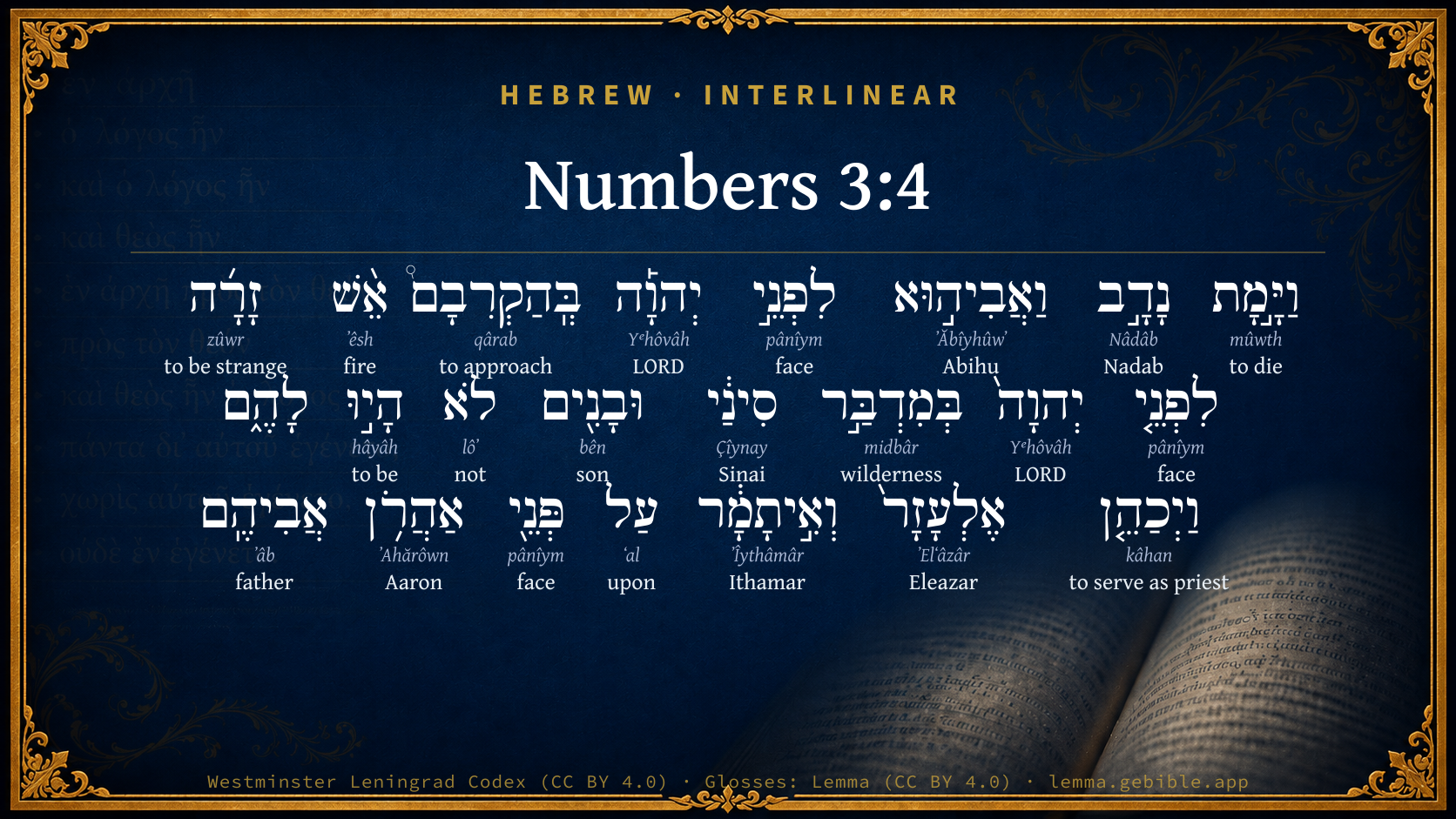
Hebrew (Westminster Leningrad Codex) Numbers 3:4 appears in the Hebrew Old Testament. The text above is from the Westminster Leningrad Codex. Each word links to its Strong’s number, a concise gloss, and parsing drawn from the Open Scriptures Hebrew Bible morphology. Click any word for its full Brown-Driver-Briggs (BDB) entry.
Download image
Cite this verse

Numbers 3:4 (World English Bible). Public Domain. Lemma interlinear Bible study tool, https://lemma.gebible.app/v/numbers/3/4.

Show BibTeX & RIS
BibTeX
RIS
English Translation
Nadab and Abihu died before Yahweh, when they offered strange fire before Yahweh, in the wilderness of Sinai, and they had no children. Eleazar and Ithamar ministered in the priest's office in the presence of Aaron their father.
World English Bible · Public Domain
Download a study sheet

One document with this verse’s original text, its word-by-word gloss line, the meaning frame, cross-references with their text, attributed commentary, and full source and license credits — printable, and it pastes into notes with its structure intact.

This verse Autodidact and up

Study sheet (.html) Plain text (.txt)

A passage Seminary Student

Up to 50 verses in one chapter. A passage sheet keeps up to 6 commentary sources and 12 cross-references per verse, in the order this page ranks them, and says so on the sheet whenever that leaves anything out. Ask for a single verse and you get the Autodidact verse sheet above.

Everything on this page stays free to read, with no account — the sheet is a download of what is already on screen, not access to it.

Want to remove ads? Support Godless Engineer
Compare translations 3

The same verse in 3 English versions, stacked beneath the original-language interlinear above. Click any original word for its lexicon entry.

Each is an independent rendering of the whole verse — the interlinear is not word-aligned to these translations.

Highlighted words mark where these versions differ — a whole-verse word diff, not a word-by-word alignment.

  • World English Bible Public Domain
    Nadab and Abihu died before Yahweh, when they offered strange fire before Yahweh, in the wilderness of Sinai, and they had no children. Eleazar and Ithamar ministered in the priest's office in the presence of Aaron their father.
  • King James Version Public Domain
    And Nadab and Abihu died before the LORD, when they offered strange fire before the LORD, in the wilderness of Sinai, and they had no children: and Eleazar and Ithamar ministered in the priest's office in the sight of Aaron their father.
  • unfoldingWord Literal Text CC BY-SA 4.0
    But Nadab died and Abihu to the face of Yahweh when they offered strange fire to the face of Yahweh in the wilderness of Sinai, and sons were not to them. And Eleazar served as priest and Ithamar against the face of Aaron their father.

unfoldingWord Literal Text — © unfoldingWord, licensed CC BY-SA 4.0. Word-aligned USFM3 via Door43 (git.door43.org/unfoldingWord/en_ult).

Versions to compare (up to 4)

3 of 4 selected

Show all 18 translations

Every available English version of this verse, each an independent rendering of the whole verse.

  • World English Bible Public Domain
    Nadab and Abihu died before Yahweh, when they offered strange fire before Yahweh, in the wilderness of Sinai, and they had no children. Eleazar and Ithamar ministered in the priest's office in the presence of Aaron their father.
  • Berean Standard Bible Public Domain
    Nadab and Abihu, however, died in the presence of the LORD when they offered unauthorized fire before the LORD in the Wilderness of Sinai. And since they had no sons, only Eleazar and Ithamar served as priests during the lifetime of their father Aaron.
  • Majority Standard Bible Public Domain
    Nadab and Abihu, however, died in the presence of the LORD when they offered unauthorized fire before the LORD in the Wilderness of Sinai. And since they had no sons, only Eleazar and Ithamar served as priests during the lifetime of their father Aaron.
  • King James Version Public Domain
    And Nadab and Abihu died before the LORD, when they offered strange fire before the LORD, in the wilderness of Sinai, and they had no children: and Eleazar and Ithamar ministered in the priest's office in the sight of Aaron their father.
  • American Standard Version (1901) Public Domain
    And Nadab and Abihu died before Jehovah, when they offered strange fire before Jehovah, in the wilderness of Sinai, and they had no children; and Eleazar and Ithamar ministered in the priest's office in the presence of Aaron their father.
  • Revised Version (1885) Public Domain
    And Nadab and Abihu died before the LORD, when they offered strange fire before the LORD, in the wilderness of Sinai, and they had no children: and Eleazar and Ithamar ministered in the priest’s office in the presence of Aaron their father.
  • Geneva Bible (1599) Public Domain
    And Nadab and Abihu died before the Lord, when they offred strange fire before the Lord in the wildernesse of Sinai, and had no children: but Eleazar and Ithamar serued in ye Priestes office in the sight of Aaron their father.
  • Douay-Rheims (1899) Public Domain
    Now Nadab and Abiu died, without children, when they offered strange fire before the Lord, in the desert of Sinai: and Eleazar and Ithamar performed the priestly office in the presence of Aaron their father.
  • Young's Literal Translation Public Domain
    And Nadab dieth -- Abihu also -- before Jehovah, in their bringing near strange fire before Jehovah, in the wilderness of Sinai, and sons they had not; and Eleazar -- Ithamar also -- acteth as priest in the presence of Aaron their father.
  • Literal Standard Version CC BY-SA 4.0
    And Nadab dies—Abihu also—before YHWH, in their bringing strange fire near before YHWH, in the wilderness of Sinai, and they did not have sons; and Eleazar—Ithamar also—acts as priest in the presence of their father Aaron.
  • Unlocked Literal Bible CC BY-SA 4.0
    But Nadab and Abihu fell dead before Yahweh when they offered to him unacceptable fire in the wilderness of Sinai. Nadab and Abihu had no children, so just Eleazar and Ithamar served as priests with Aaron their father.
  • unfoldingWord Literal Text CC BY-SA 4.0
    But Nadab died and Abihu to the face of Yahweh when they offered strange fire to the face of Yahweh in the wilderness of Sinai, and sons were not to them. And Eleazar served as priest and Ithamar against the face of Aaron their father.
  • Darby Bible Public Domain
    And Nadab and Abihu died before Jehovah when they offered strange fire before Jehovah in the wilderness of Sinai, and they had no sons; and Eleazar and Ithamar exercised the priesthood in the presence of Aaron their father.
  • World Messianic Bible Public Domain
    Nadab and Abihu died before the LORD when they offered strange fire before the LORD in the wilderness of Sinai, and they had no children. Eleazar and Ithamar ministered in the priest’s office in the presence of Aaron their father.
  • Webster's Bible Public Domain
    And Nadab and Abihu died before the LORD, when they offered strange fire before the LORD, in the wilderness of Sinai, and they had no children: and Eleazar and Ithamar ministered in the priest's office in the sight of Aaron their father.
  • Free Bible Version CC BY-SA 4.0
    Nadab and Abihu died in the Lord's presence when they offered forbidden fire before the Lord in the Sinai desert. Since they didn't have any sons, Eleazar and Ithamar served as priests while their father Aaron was alive.
  • Bible in Basic English Public Domain
    And Nadab and Abihu were put to death before the Lord when they made an offering of strange fire before the Lord, in the waste land of Sinai, and they had no children: and Eleazar and Ithamar did the work of priests before Aaron their father.
  • JPS Tanakh (1917) Public Domain
    And Nadab and Abihu died before the LORD, when they offered strange fire before the LORD, in the wilderness of Sinai, and they had no children; and Eleazar and Ithamar ministered in the priest's office in the presence of Aaron their father.

Literal Standard Version (2020), Covenant Press — licensed CC BY-SA 4.0. Text via the HelloAO Bible API (eBible.org). Unlocked Literal Bible (unfoldingWord) — licensed CC BY-SA 4.0. Text via the HelloAO Bible API (eBible.org). unfoldingWord Literal Text — © unfoldingWord, licensed CC BY-SA 4.0. Word-aligned USFM3 via Door43 (git.door43.org/unfoldingWord/en_ult). Free Bible Version, Dr. Jonathan Gallagher — licensed CC BY-SA 4.0. Text via the HelloAO Bible API (eBible.org).

Word by word

More ways to search: Search by grammar → Find every occurrence → Compare this word →

Practice this passage: Drill this verse → Learn its vocabulary →

וַאֲבִיה֣וּא
ʼĂbîyhûwʼ
H30
“and · Abihu”
Conjunction + Noun, Proper
Part of Speech
Conjunction + Noun
Type
Proper
Full BDB Definition

Origin: from H1 and H1931

TWOT: None

Abihu = "he is (my) father" - a son of Aaron destroyed for sacrificing strange fire to God
  1. וַיָּ֣מָת mûwth H4191 “and · to die” Conjunction + Verb, Qal, Sequential Imperfect, 3rd Person, Masculine, Singular
  2. נָדָ֣ב Nâdâb H5070 “Nadab” Noun, Proper
  3. לִפְנֵ֣י pânîym H6440 “to/for · face(s) of” Preposition + Noun, Common, Both, Plural, Construct
  4. יְהוָ֡ה Yᵉhôvâh H3068 “LORD” Noun, Proper
  5. בְּֽהַקְרִבָם֩ qârab H7126 “in/at · to approach · them” Preposition + Verb, Hiphil, Infinitive Construct + Suffix, Personal, 3rd Person, Masculine, Plural
  6. אֵ֨שׁ ʼêsh H784 “fire” Noun, Common, Both, Singular, Absolute
  7. זָרָ֜ה zûwr H2114 “strange” Adjective, Adjective, Feminine, Singular, Absolute
  8. לִפְנֵ֤י pânîym H6440 “to/for · face(s) of” Preposition + Noun, Common, Both, Plural, Construct
  9. יְהוָה֙ Yᵉhôvâh H3068 “LORD” Noun, Proper
  10. בְּמִדְבַּ֣ר midbâr H4057 “in/at · wilderness of” Preposition + Noun, Common, Masculine, Singular, Construct
  11. סִינַ֔י Çîynay H5514 “Sinai” Noun, Proper
  12. וּבָנִ֖ים bên H1121 “and · sons” Conjunction + Noun, Common, Masculine, Plural, Absolute
  13. לֹא lôʼ H3808 “not” Particle, Negative
  14. הָי֣וּ hâyâh H1961 “to be” Verb, Qal, Perfect, 3rd Person, Common, Plural
  15. וַיְכַהֵ֤ן kâhan H3547 “and · to serve as priest” Conjunction + Verb, Piel, Sequential Imperfect, 3rd Person, Masculine, Singular
  16. אֶלְעָזָר֙ ʼElʻâzâr H499 “Eleazar” Noun, Proper
  17. וְאִ֣יתָמָ֔ר ʼÎythâmâr H385 “and · Ithamar” Conjunction + Noun, Proper
  18. עַל ʻal H5921 “upon” Preposition
  19. פְּנֵ֖י pânîym H6440 “face(s) of” Noun, Common, Both, Plural, Construct
  20. אַהֲרֹ֥ן ʼAhărôwn H175 “Aaron” Noun, Proper
  21. אֲבִיהֶֽם ʼâb H1 “father · their” Noun, Common, Masculine, Singular, Construct + Suffix, Personal, 3rd Person, Masculine, Plural

About this verse

These counts appear in no published source. They are computed here, from the morphology-tagged text and Lemma’s own curated glosses. What Lemma adds →

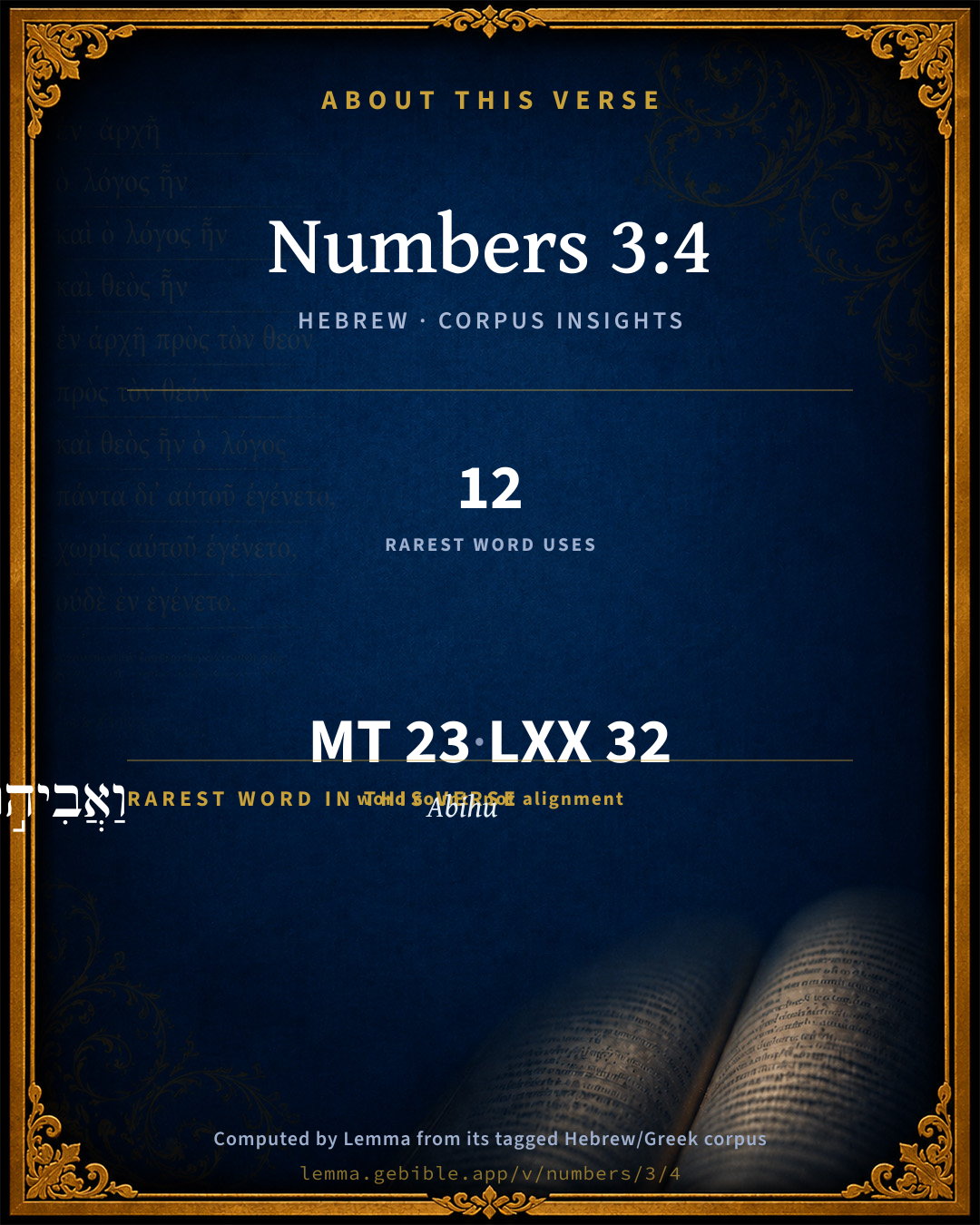
23
words
19
distinct lemmas
Pentateuch
section

Notable vocabulary

The rarest word here is וַאֲבִיה֣וּא Abihu H30 — appearing just 12 times in the whole Hebrew Bible.

Shared distinctive vocabulary

וַאֲבִיה֣וּא Abihu H30 occurs in 12 verses of the Hebrew Bible. Also found in:

Grammatical profile

  • 4 verbs
  • 15 nouns
  • 1 adjective
  • 2 prepositions
  • 1 particle

Verb forms

  • וַיָּ֣מָת Qal · Sequential Imperfect
  • בְּֽהַקְרִבָם֩ Hiphil · Infinitive Construct
  • הָי֣וּ Qal · Perfect
  • וַיְכַהֵ֤ן Piel · Sequential Imperfect

Repetition

Words recur within this verse — often emphatic in Hebrew:

  • לִפְנֵ֣י face H6440 ×3
  • יְהוָ֡ה LORD H3068 ×2

Hebrew & Septuagint length

In English translation the verse runs 38 words from the Hebrew and 39 from the Septuagint (LXX English) — closely comparable.

A rough comparison of the two English renderings, which tokenize alike — not a word-level alignment.

Word counts can differ between the Hebrew and the Greek without any difference in meaning — e.g. the Hebrew direct-object marker אֵת has no separate Greek word, and Greek often adds the article ὁ.

In the original languages it is 23 Hebrew tokens and 32 Greek tokens — but the two are counted differently (Hebrew bundles its prefixes and suffixes into one token; the Greek is in lemma form), so that isn’t a like-for-like length.

Cross-references

2

Topical passages linked to Numbers 3:4 in the Treasury of Scripture Knowledge — connected by theme and wording, ordered by reader-vote popularity; previews shown in the World English Bible.

  • Leviticus 10:1–2 Nadab and Abihu, the sons of Aaron, each took his censer, and put fire in it, and laid incense on it, and offered strange fire before Yahweh, which he had not commanded them.
  • Numbers 26:61 Nadab and Abihu died, when they offered strange fire before Yahweh.

Cross-references courtesy of OpenBible.info (CC BY 4.0).

Hebrew and Greek witnesses Masoretic Hebrew ↔ Greek Septuagint

The same verse in the two great witnesses to the Old Testament, shown verse-for-verse.

These are two independent witnesses, not word-aligned to each other, and the Septuagint is shown in lemma (dictionary) form.

Hebrew Numbers 3:4 Masoretic · Westminster Leningrad Codex

וַיָּ֣מָת נָדָ֣ב וַאֲבִיה֣וּא לִפְנֵ֣י יְהוָ֡ה בְּֽהַקְרִבָם֩ אֵ֨שׁ זָרָ֜ה לִפְנֵ֤י יְהוָה֙ בְּמִדְבַּ֣ר סִינַ֔י וּבָנִ֖ים לֹא הָי֣וּ לָהֶ֑ם וַיְכַהֵ֤ן אֶלְעָזָר֙ וְאִ֣יתָמָ֔ר עַל פְּנֵ֖י אַהֲרֹ֥ן אֲבִיהֶֽם

Nadab and Abihu died before Yahweh, when they offered strange fire before Yahweh, in the wilderness of Sinai, and they had no children. Eleazar and Ithamar ministered in the priest's office in the presence of Aaron their father.

World English Bible · Public Domain

Greek LXX Numbers 3:4 Septuagint · lemma form

καί τελευτάω ναδαβ καί αβιουδ ἔναντι κύριος προςφέρω αὐτός πῦρ ἀλλότριος ἔναντι κύριος ἐν ὁ ἔρημος σινα καί παιδίον οὐ εἰμί αὐτός καί ἱερατεύω ελεαζαρ καί ιθαμαρ μετά ἀαρών ὁ πατήρ αὐτός

And Nadab and Abiud died before the Lord, when they offered strange fire before the Lord, in the wilderness of Sina; and they had no children; and Eleazar and Ithamar ministered in the priests' office with Aaron their father.

LXX2012 (modern English Septuagint) · Public Domain

On this verse, John Gill's Exposition discusses the Septuagint’s reading. Read the note in Commentary ↓

Hebrew: Westminster Leningrad Codex (CC BY 4.0). Greek: Septuagint (public domain); English from LXX2012 (modern English Septuagint) (Public Domain). How the Septuagint differs from the Hebrew →

Targum (Aramaic paraphrase)

2

The Targum is the ancient Jewish Aramaic paraphrase of the Hebrew Scriptures — an interpretive translation, not the Hebrew text itself. Onkelos (literal) and Pseudo-Jonathan (expansive) render the Torah, and Jonathan the Prophets. Coverage is partial: where no permissively-licensed English translation exists for a verse, only the Aramaic is shown. This is verse-level text, not a word-by-word alignment to the Hebrew.

  1. Targum Onkelos Torah (Genesis–Deuteronomy)
    וּמִית נָדָב וַאֲבִיהוּא קֳדָם יְיָ בְּקָרוֹבֵיהוֹן אֶשָׁתָא נוּכְרֵיתָא קֳדָם יְיָ בְּמַדְבְּרָא דְסִינַי וּבְנִין לָא הֲווֹ לְהוֹן וְשַׁמֵּשׁ אֶלְעָזָר וְאִיתָמָר עַל אַפֵּי אַהֲרֹן אֲבוּהוֹן

    (no public-domain English translation for this verse)

    Targum Onkelos — Aramaic: “Onkelos Genesis” (public domain); “Onkelos Exodus” (public domain); “Onkelos Leviticus” (public domain); “Onkelos Numbers” (public domain); “Onkelos Deuteronomy” (public domain). English: “Sefaria Community Translation” (CC0 1.0 (public-domain dedication)); “J.W. Etheridge. The Targums of Onkelos and Jonathan Ben Uzziel on the Pentateuch. London: Longmans, Green, 1862” (public domain). Text via Sefaria.

  2. Targum Pseudo-Jonathan Torah (Genesis–Deuteronomy)
    וּמִית נָדָב וַאֲבִיהוּא קֳדָם יְיָ בְאֵישָׁתָא מְצַלְהֲבָא בִּזְמַן קְרוֹבֵיהוֹן אֵישָׁתָא נוּכְרֵיתָא מִן חַפְיָן וּבְנִין לָא הֲווֹ לְהוֹן וְשַׁמֵשׁ אֶלְעָזָר וְאִיתָמָר עַל אַפֵּי אַהֲרן אֲבוּהוֹן

    But Nadab and Abihu died by the flaming fire at the time of their offering the strange fire from their own tents; and they had no children. And Elazar and Ithamar ministered before Aharon their father.

    Targum Pseudo-Jonathan — Aramaic: “Targum Jonathan on Genesis” (public domain); “Targum Jonathan on Exodus” (public domain); “Targum Jonathan on Leviticus” (public domain); “Targum Jonathan on Numbers” (public domain); “Targum Jonathan on Deuteronomy” (public domain). English: “The Targum of Jonathan ben Uzziel, trans. J. W. Etheridge, London, 1862” (public domain). Text via Sefaria.

Commentary

Notes on Numbers 3:4 from classic Christian and Jewish commentators (each source and its license shown beneath its notes). The classic Christian expositions comment on the surrounding passage and are grouped to its opening verse, so a note may address several verses; the Jewish commentaries on the Tanakh (Rashi and others) are per-verse, so they appear only where the commentator wrote on this verse.

Lemma curates 59 commentaries, every one of them public domain or Creative Commons licensed, each selected and text-cleaned for this edition rather than reprinted as found. About our sources →

Trapp's Complete Commentary

John Trapp

Num 3:4 And Nadab and Abihu died before the LORD, when they offered strange fire before the LORD, in the wilderness of Sinai, and they had no children: and Eleazar and Ithamar ministered in the priest’s office in the sight of Aaron their father.

Ver. 4. And Nadab and Abihu.] Such a cross had David in his two eldest, Amnon and Absalom. {See Trapp on "Lev 10:1"} {See Trapp on "Lev 10:2"}

John Trapp, A Commentary or Exposition upon All the Books of the Old and New Testament (1647–1656) — public domain. Text from a community e-Sword module.

Matthew Poole's English Annotations

In the time of Aaron’s life, as this phrase is taken, Num 3:4; see also Psa 72:5,17; and under their father’s inspection and direction, and as their father’s servants or ministers in the priest’s office; for servants are oft described by this phrase of being, or standing, or serving in the sight or presence, we of their master.

Matthew Poole's English Annotations on the Holy Bible (1683–1685) — public domain. Text from a community e-Sword/MySword module.

Joseph Benson's Commentary

Num 3:4. In the sight of Aaron — Under his inspection and direction, and as his servants or ministers in the priest’s office.

Joseph Benson's Commentary on the Old and New Testaments (1811–1818) — public domain. Text from a community e-Sword module.

Tyndale Open Study Notes

Tyndale Open Resources

3:4 The deaths of Nadab and Abihu (see Lev 10:1-2) highlighted the importance of guarding the holiness of the sanctuary and of strict obedience to God’s instructions (Num 26:61; Lev 16:1; 1 Chr 24:2; cp. Acts 5:1-11; 1 Cor 10:6-11; 11:29-30). • Eleazar and Ithamar: See “Eleazar” Profile.

Tyndale Open Study Notes — © Tyndale Open Resources, licensed CC BY-SA 4.0. Text via the HelloAO Bible API.

Geneva Bible (1599)

Geneva Bible translators

Or, before the Altar.

Whiles their father lived.

Geneva Bible (1599) marginal notes — public domain. Text via Bolls.life.

Adam Clarke's Commentary

Verse 4. Nadab and Abihu died] See the notes on Le 10:1-5.

Adam Clarke's Commentary on the Bible (1810–1826) — public domain. Text from a community e-Sword/MySword module.

Ellicott's Commentary for English Readers

(4) Died before the Lord.—The account is given in Lev_10:1-2, where the same expression “before the Lord” is used both in regard to the offering of strange fire by Nadab and Abihu, and also in regard to their death.

And they had no children.—To die childless was regarded not only as a reproach, but also as a judgment. This was especially the case in regard to Nadab and Abihu, inasmuch as the sons of one, or of both (as was the case in regard to the sons of Eleazar and of Ithamar), would have succeeded to the high priesthood.

A Bible Commentary for English Readers, edited by Charles John Ellicott (1878–1897) — public domain. Text from a community e-Sword module.

The Cambridge Bible for Schools and Colleges

gen. ed. J. J. S. Perowne

4. The incident here referred to is related in Lev_10:1-7. The meaning of ‘strange fire’ is uncertain. Either the incense which they burnt was not made in accordance with the divine prescription (given in Exo_30:34-38). or the fire was not taken from the proper place—the altar of burnt-offering. ‘Strange’ means ‘not in accordance with the regular ritual’; see n. on Num_1:51.

they had no children] The point of this lies in the fact that after the exile all the priestly families called themselves ‘sons of Aaron,’ and traced their descent through Eleazar or Ithamar (see p. xvi).

The Cambridge Bible for Schools and Colleges (gen. ed. J. J. S. Perowne; Cambridge University Press, 1878–1918) — public domain. Text from a community e-Sword module.

John Gill's Exposition

And Nadab and Abihu died before the Lord,...., By flaming fire, as the Targum of Jonathan adds, see Lev 10:2; and so were not alive at this time when the account of the priests and Levites was taken:

when they offered strange fire before the Lord in the wilderness of Sinai; after the tabernacle was set up, and the service of it begun, and quickly after their unction and consecration: of this strange fire; see Gill on Num 10:1,

and they had no children; which is observed, partly to show the punishment of them, and the reproach upon their names, that they died childless, and had none to succeed them in the priesthood; for as the Jewish writers (n) observe if they had left any behind them, those would have come into the office before Eleazar and Ithamar; and partly to show that all the priests in succeeding ages sprung from those next mentioned:

and Eleazar and Ithamar ministered in the priest's office, in the sight of Aaron their father; in his presence, under his inspection, and by his direction, he seeing and observing that they did everything according to the laws delivered by Moses, relating to, the office of the priesthood; or while he was yet alive, as Aben Ezra, they were concerned with him, and acted under him in the priestly office; and so the Septuagint version renders it, "with Aaron their father" (o); but a Jewish writer (p) interprets it in a different manner, "in the room of Aaron their father"; as if it respected not any conjunction with him in the then present exercise of their office in his lifetime, but their succession in it after his death; but the former seems most correct.

(n) Torat Cohanim apud Ceseph Misnah in Maimon. Melachim, c. 1. sect. 7. Chaskuniin in loc. (o) Which is approved by Noldius, p. 731. (p) Chaskuni.

John Gill's Exposition of the Whole Bible (1746–1763) — public domain (CC PDM 1.0). Text via the HelloAO Bible API.

Haydock's Catholic Bible Commentary

Presence; or as it is expressed, (1 Paralipomenon xxiv. 9,) under the hand of Aaron, by his direction, and in quality of his assistant, (Calmet) while he lived. Eleazar succeeded him in the high priesthood; (Josue xxiv. 33,) and his children possessed that dignity, till the posterity of Ithamar came in under Heli, chap. xxv. 3. (Haydock)

George Leo Haydock (1774–1849), Haydock's Catholic Family Bible and Commentary, 1859 edition — public domain. Excludes Psalms (Douay-Rheims chapter numbering differs from Protestant) and Deuterocanonical books (Catholic canon only).

Whedon's Commentary on the Bible

Daniel D. Whedon

4. Nadab and Abihu — The tragic end of these sacrilegious priests is detailed in full in Lev_10:1-7, where see an extended annotation. They had but just been inducted into office. As men of note, they had been taken up the mount and had seen God. Exo_24:9. A glorious manifestation of the power and mercy of God had just been given: “And the glory of Jehovah appeared unto all the people, and there came a fire out from before the Lord, and consumed upon the altar the burnt offering.” The effect upon the people was to awaken the commingling emotions of joy and awe: “They shouted and fell on their faces.” Amid this scene Nadab and Abihu committed a rash act of sacrilege, “and there went out fire from the Lord, and devoured them.” One vengeful flash from the Shekinah “struck them dead, with their censers in their hands, with not a moment’s warning. What a fearful exhibition of the truth that God’s jealousy burns fiercest about his altar!”

Strange fire — Up to this event, which occurred just after the tabernacle was set up, and hence not more than four weeks before the census of the Levites, there is no record of any regulation respecting the character of the fire to be used for burning incense. But immediately after this sad catastrophe, in Lev_16:12, the command is given to take the coals of fire from the altar of burnt offerings on which it was perpetually burning. Lev_6:9; Lev_6:13. We infer that such a command had been given before to these newly-robed priests. The fire on the altar had been enkindled by God, and it was the duty of the priests to see that it never should go out. It is probable that this fire, and this only, had been prescribed for this service, and that these sons of Aaron wilfully transgressed this requirement. Some are of the opinion that the fire was called “strange” because the incense was not prepared in accordance with the prescription, “Ye shall offer no strange incense.” Exo_30:9. It has also been suggested that the incense was burned in uncanonical hours, and that this was the offence.

Before the Lord — These words do not necessarily imply that they had usurped the office of their father Aaron, and had rushed into the awful sanctity of the most holy place, where Jehovah, in the cloud of the Shekinah, was enthroned between the cherubim, for the entire tabernacle was filled with the special presence of the Lord. See on Lev_1:3. But from the prohibition of wine and strong drink to Aaron and his sons immediately following the account of the awful death of these two, we have good grounds for the inference that these priests were drunken when this impious act was committed. See Lev_10:8-11, and note the preceding context. Drunkenness impairs the faculty of moral discernment to discriminate “between the holy and the unholy,” and incapacitates to “teach all the statutes of the Lord.” “I will be sanctified in them that come nigh unto me.” Inebriation involves all vices and sacrileges.

Eleazar and Ithamar — Aaron’s sole surviving sons. Half the Aaronic priesthood had been cut off at a stroke, as before noticed. God can carry on his work better with a pure ministry few in number, than with a multitude of unholy men in priestly robes serving their own lusts.

Daniel D. Whedon (gen. ed.), Commentary on the Old and New Testaments (1874–1909) — public domain. Text from a community e-Sword module.

The Pulpit Commentary

They had no children. If they had left sons, these would have succeeded to their office, and to the headship of the priestly line. In the sight of Aaron. In his lifetime. (cf. Gen_11:28) Septuagint, "with Aaron." In the time of David the descendants of Eleazar were divided into sixteen courses, the descendants of Ithamar into eight. (2Ch_24:3)

HOMILIES BY E.S. PROUT Ver. 4. "Strange fire.

There are various kinds of fire used in the service of God which, if not as hateful in his sight as that offered by Nadab and Abihu, are "strange." There is a fire which is appropriate and acceptable, because kindled by God; all others are "strange fire, which he commanded not". (Lev_10:1) E.g.

I ILLEGITIMATE ZEAL, as seen in every kind of persecution. (see Luk_9:51-56) Yet a writer on the origin of the Inquisition quotes the passage in justification of the burning of heretics: "Lo! fire the punishment of heretics, for the Samaritans were the heretics of those times" (Prescott"s "Ferdinand and Isabella," 1:319, n.). See Gal_4:18. But let the zeal run in the path marked out for it by Christ towards enemies, (Mat_5:44) backsliders, (Gal_6:1) or heretics. (Jam_5:19, Jam_5:20)

II UNAUTHORISED SERVICES; whether offered by unauthorized persons, as Korah, who yet had the true fire, (Num_16:17, Num_16:18) or Saul, (1Sa_13:9-14) or Uzziah; (2Ch 26) or by God"s servants, but in ways alien to his mind. (Illus., Uzzah, 1Ch_13:9, 10 15:13) Such are the "voluntary humility" and "neglecting of the body" condemned in Col_2:18-23, and all similar austerities. The fire God approves must be presented by accepted worshippers in an appointed way.

III SUPERSTITIOUS DEVOTIONS. These may be presented through Christ "the way," and yet marred by ignorant fears of God, or unworthy fancies, or errors intertwined with God"s truth in the many ways known to ancient or modern superstition. (1Jn_4:18 1Jn_5:13-15)

IV ARTIFICIAL EMOTION. We need never dread the emotion caused by God"s own truth, used in legitimate ways. Truth is like solid fuel that ought to keep up a glowing heat, whether of alarm (Act_2:37 Act_24:25) or of joy. (Act_2:41) But emotion excited apart from the communication of appropriate truth may be disastrous; or at best like a blaze of straw, soon leaving only blackness and ashes. All such "strange fire" tends to the injury, or even the destruction, of the offerers. (Joh_4:24) To worship God in truth we must ourselves be "accepted in the beloved," enlightened by the Holy Spirit, and must present spiritual sacrifices kindled by his own celestial fire of love. P.

HOMILIES BY D. YOUNG Ver. 4. A mortal sin.

"And Nadab and Abihu died before the Lord," &c. ;

I WHO THEY WERE THAT COMMITTED THIS SIN. Sons of Aaron; elder sons: in whom, therefore, a greater sense of thoughtfulness and responsibility might have been expected. They had also been duly anointed and consecrated. They could hardly plead ignorance and inexperience in the things of God. They had nothing else to do than attend to the tabernacle. They knew, or ought to have considered, that Jehovah had laid down instructions, even to the minutest points, as to what the priests were to do. It is a warning then to all who stand among peculiar privileges and enjoy greater light, e.g., those who live in a household where there is piety at the head, arid a continual regard in all things for the will of God. (Mat_11:20-24)

II THE SIN THEY COMMITTED. They offered strange fire before the Lord. The fire to be used was the holy fire ever burning upon the altar. (Lev_6:13) To offer incense was to symbolize thanksgiving and supplication, and this, of all things, requires to be done in most careful conformity with Divine appointments. All offerings to God, to be worth anything, must be voluntary; yet even a voluntary offering may be an abomination before him when it is a random and reckless exercise of our own freedom. The highest of human actions is to do God"s will with all our will, as seeing clearly that it is the right thing to do.

III The TERRIBLE CONSEQUENCE. It was truly a mortal sin, a sin which on the very commission of it was followed by death, like the taking of some swift-working poison. It was as dangerous for a careless priest to take up the tabernacle services as for a man to take naked lights about a powder magazine. The fire of the Lord was a hidden thing, yet in a moment its full energy might be revealed, either to bless or destroy. (cf. Lev_9:24 with Lev_10:2) But though the sin was a mortal sin, it was not in itself worse than other offences against which sentence is not executed speedily. All sin is mortal, though the deadly result be spread over long periods. This sin was punished promptly and terribly, as were some other sins in Israel, not because they were worse, but because the people, and particularly the Levites, needed a lesson in the most impressive way in which it could be given. The fire of the Lord went out against the priests here, but soon after it went out against the people. (Num_11:1) "Except ye repent, ye shall all likewise perish.

Lessons:A worthy office may have an unworthy occupant. There are a Nadab and Abihu here; there were a Hophni and Phinehas afterwards, and a Judas among the apostles. Anointing, consecration, imposition of hands may have official value, but God only can give the faculty of true inward service. We may bring strange fire before God when we bring zeal not according to knowledge. There may be great fire and intensity and activity with nothing of the baptism of the Holy Ghost and of fire. Consider the lamentations of Paul over his persecuting days. There is here another instance of the letter killing. In the Old Testament punishment predominated over reward, because disobedience predominated over obedience. Y.

The Pulpit Commentary (1880–1919), ed. H.D.M. Spence-Jones & Joseph S. Exell — public domain. Text from a community e-Sword module.

John Wesley's Explanatory Notes

In the sight of Aaron - Under his inspection and direction, and as their father's servants or ministers in the priest's office.

John Wesley, Explanatory Notes Upon the Whole Bible (1754–1765) — public domain. Text via the GEBible commentary corpus.

Rashi

Rabbi Shlomo Yitzchaki (Rashi)

על פני אהרן [AND ELEAZAR AND ITHAMAR MINISTERED] BEFORE THE FACE OF AARON — i.e. during his lifetime (cf. Rashi on Genesis 11:28).

Rashi on the Tanakh — English translations: “The Judaica Press complete Tanach with Rashi, translated by A. J. Rosenberg” (CC BY 4.0); “Pentateuch with Rashi's commentary by M. Rosenbaum and A.M. Silbermann, 1929-1934” (public domain); “The Metsudah Tanach series, Lakewood, N.J” (CC BY 4.0); and “The Book of Joshua, Metsudah Publications, 1997” (CC BY 4.0). Text via Sefaria.

Ramban (Nachmanides)

Rabbi Moshe ben Nachman (Ramban / Nachmanides)

AND ELEAZAR AND ITHAMAR MINISTERED ‘AL PNEI’ AARON THEIR FATHER - “that is, during the lifetime [of Aaron their father].” This is the language of Rashi. Now [Rashi] does not mean to say that they ministered during their father’s lifetime, for all priests of the family of Aaron may minister during their fathers’ lifetime [so why should Scripture single out Eleazar and Ithamar in this respect?] Rather, [the verse says that they were anointed during Aaron’s lifetime], because He had stated [that Aaron’s sons were] the priests that were anointed, meaning that they too were like the High Priests in that they were anointed during Aaron’s lifetime, just as he [Aaron] was anointed, a procedure which was not applicable in later generations. But the correct interpretation is that the expression al pnei refers to the beginning [of the verse, and the order of the phrases is to be understood as if inverted, as follows]: “And Nadab and Abihu died before the Eternal ‘al pnei’ (in the presence of) Aaron their father, when they offered strange fire.”. And so indeed it is stated in the Book of Chronicles: And Nadab and Abihu died before their father, and had no children, and Eleazar and Ithamar executed the priest’s office. The meaning of [the expression] before the Eternal is that they died a miraculous death which came [directly] from Him. Similarly it is stated in the case of the spies that they died by the plague before the Eternal.

Ramban (Nachmanides) on the Tanakh — English translation: “Commentary on the Torah by Ramban (Nachmanides). Translated and annotated by Charles B. Chavel. New York, Shilo Pub. House, 1971-1976” (CC BY 4.0). Text via Sefaria.

Lesson kit

Teaching starters — assembled from the data on this page, not authored interpretation. Every prompt links to the verse data it draws on. Edit before teaching.

Numbers, in the Pentateuch, opens this verse with 23 words (19 distinct Hebrew lemmas). Its most distinctive word is ʼĂbîyhûwʼ (“Abihu”). A historical commentator’s framing appears above. Read the whole chapter for the surrounding context.

Discussion questions

  1. The word ʼĂbîyhûwʼ carries the sense “Abihu.” How does it shape the verse?
  2. How does Exodus 6:23, which shares the word «Abihu», read alongside this verse?
  3. What does the repetition of “face” (3× in this one verse) do in this verse?
  4. These translations render this verse differently; the difference is in the English rendering, not the original. What questions does that raise?
  5. «וַיָּ֣מָת» is a Qal Sequential Imperfect verb. How does that grammatical form shape the action described?
  6. Compare how Trapp's Complete Commentary and Matthew Poole's English Annotations read this verse. Where do they agree or differ?

Things to notice

Reading settings

Reading text

Shown beneath each verse's original-language words.

Old Testament
Old Testament edition

Read the OT as the Masoretic Hebrew (MT) or the Greek Septuagint (LXX).

English shown for the Greek Septuagint (in the Hebrew ↔ Greek comparison).

Comparing translations? Open the Compare panel on any verse page to stack up to four side by side.