Numbers 27:8

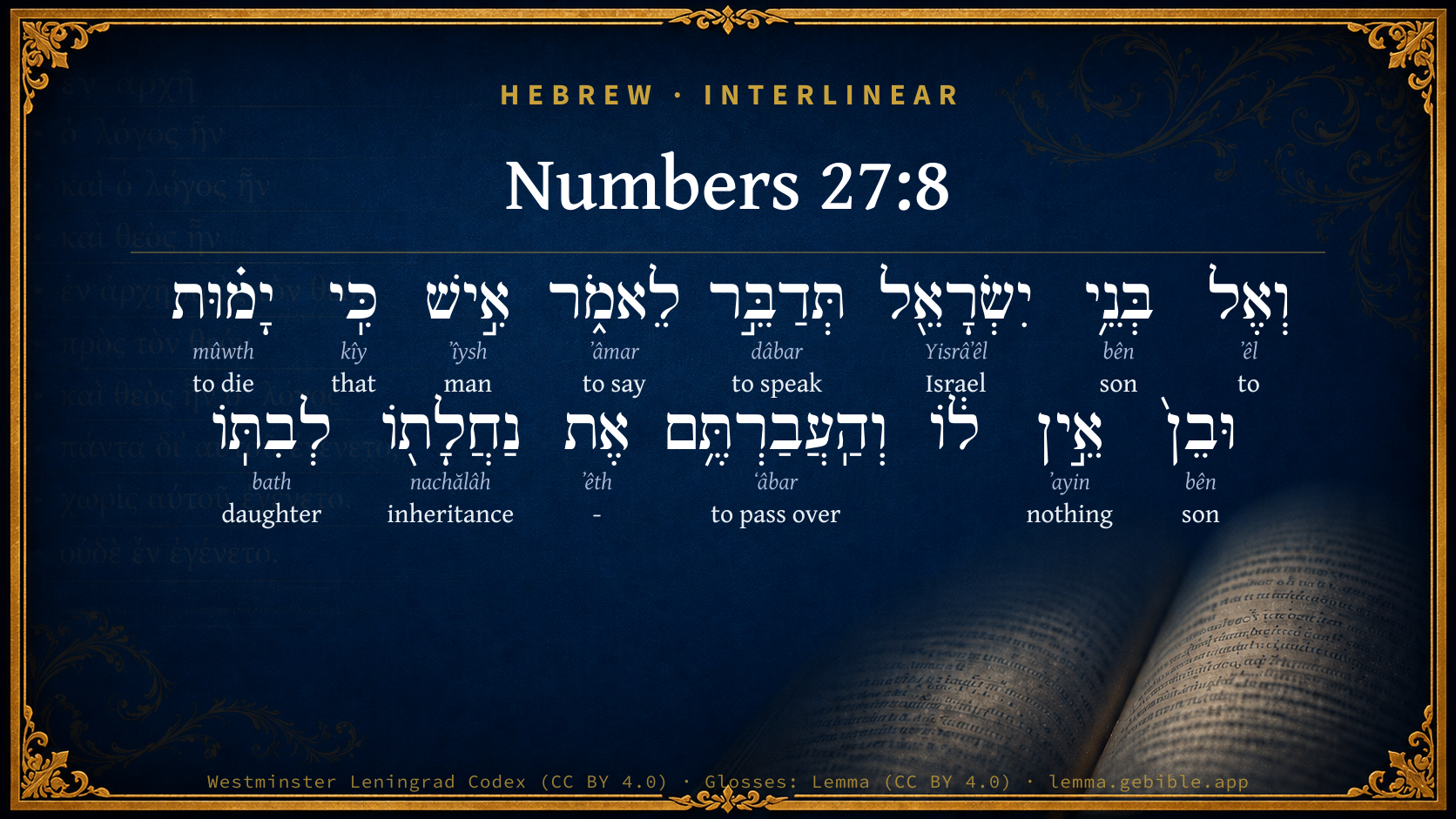
Hebrew (Westminster Leningrad Codex) Numbers 27:8 appears in the Hebrew Old Testament. The text above is from the Westminster Leningrad Codex. Each word links to its Strong’s number, a concise gloss, and parsing drawn from the Open Scriptures Hebrew Bible morphology. Click any word for its full Brown-Driver-Briggs (BDB) entry.
Download image
Cite this verse

Numbers 27:8 (World English Bible). Public Domain. Lemma interlinear Bible study tool, https://lemma.gebible.app/v/numbers/27/8.

Show BibTeX & RIS
BibTeX
RIS
English Translation
You shall speak to the children of Israel, saying, If a man die, and have no son, then you shall cause his inheritance to pass to his daughter.
World English Bible · Public Domain
Download a study sheet

One document with this verse’s original text, its word-by-word gloss line, the meaning frame, cross-references with their text, attributed commentary, and full source and license credits — printable, and it pastes into notes with its structure intact.

This verse Autodidact and up

Study sheet (.html) Plain text (.txt)

A passage Seminary Student

Up to 50 verses in one chapter. A passage sheet keeps up to 6 commentary sources and 12 cross-references per verse, in the order this page ranks them, and says so on the sheet whenever that leaves anything out. Ask for a single verse and you get the Autodidact verse sheet above.

Everything on this page stays free to read, with no account — the sheet is a download of what is already on screen, not access to it.

Want to remove ads? Support Godless Engineer
Compare translations 3

The same verse in 3 English versions, stacked beneath the original-language interlinear above. Click any original word for its lexicon entry.

Each is an independent rendering of the whole verse — the interlinear is not word-aligned to these translations.

Highlighted words mark where these versions differ — a whole-verse word diff, not a word-by-word alignment.

  • World English Bible Public Domain
    You shall speak to the children of Israel, saying, If a man die, and have no son, then you shall cause his inheritance to pass to his daughter.
  • King James Version Public Domain
    And thou shalt speak unto the children of Israel, saying, If a man die, and have no son, then ye shall cause his inheritance to pass unto his daughter.
  • unfoldingWord Literal Text CC BY-SA 4.0
    And you shall speak to the sons of Israel, saying, ‘If a man dies and there is no son for him, then you shall cause his inheritance to pass over to his daughter.

unfoldingWord Literal Text — © unfoldingWord, licensed CC BY-SA 4.0. Word-aligned USFM3 via Door43 (git.door43.org/unfoldingWord/en_ult).

Versions to compare (up to 4)

3 of 4 selected

Show all 18 translations

Every available English version of this verse, each an independent rendering of the whole verse.

  • World English Bible Public Domain
    You shall speak to the children of Israel, saying, If a man die, and have no son, then you shall cause his inheritance to pass to his daughter.
  • Berean Standard Bible Public Domain
    Furthermore, you shall say to the Israelites, ‘If a man dies and leaves no son, you are to transfer his inheritance to his daughter.
  • Majority Standard Bible Public Domain
    Furthermore, you shall say to the Israelites, ‘If a man dies and leaves no son, you are to transfer his inheritance to his daughter.
  • King James Version Public Domain
    And thou shalt speak unto the children of Israel, saying, If a man die, and have no son, then ye shall cause his inheritance to pass unto his daughter.
  • American Standard Version (1901) Public Domain
    And thou shalt speak unto the children of Israel, saying, If a man die, and have no son, then ye shall cause his inheritance to pass unto his daughter.
  • Revised Version (1885) Public Domain
    And thou shalt speak unto the children of Israel, saying, If a man die, and have no son, then ye shall cause his inheritance to pass unto his daughter.
  • Geneva Bible (1599) Public Domain
    Also thou shalt speake vnto the children of Israel, saying, If a man die and haue no sonne, then ye shall turne his inheritaunce vnto his daughter.
  • Douay-Rheims (1899) Public Domain
    When a man dieth without a son, his inheritance shall pass to his daughter.
  • Young's Literal Translation Public Domain
    `And unto the sons of Israel thou dost speak, saying, When a man dieth, and hath no son, then ye have caused his inheritance to pass over to his daughter;
  • Literal Standard Version CC BY-SA 4.0
    And you speak to the sons of Israel, saying, When a man dies and has no son, then you have caused his inheritance to pass over to his daughter;
  • Unlocked Literal Bible CC BY-SA 4.0
    You must speak to the people of Israel and say, 'If a man dies and has no son, then you must cause his inheritance to pass to his daughter.
  • unfoldingWord Literal Text CC BY-SA 4.0
    And you shall speak to the sons of Israel, saying, ‘If a man dies and there is no son for him, then you shall cause his inheritance to pass over to his daughter.
  • Darby Bible Public Domain
    And unto the children of Israel shalt thou speak, saying, If a man die, and have no son, then ye shall cause his inheritance to pass unto his daughter.
  • World Messianic Bible Public Domain
    You shall speak to the children of Israel, saying, ‘If a man dies, and has no son, then you shall cause his inheritance to pass to his daughter.
  • Webster's Bible Public Domain
    And thou shalt speak to the children of Israel, saying, If a man shall die, and have no son, then ye shall cause his inheritance to pass to his daughter.
  • Free Bible Version CC BY-SA 4.0
    In addition, tell the Israelites, ‘If a man dies and doesn't have a son, give his property to his daughter.
  • Bible in Basic English Public Domain
    And say to the children of Israel, If a man has no son at the time of his death, let his heritage go to his daughter.
  • JPS Tanakh (1917) Public Domain
    And thou shalt speak unto the children of Israel, saying: If a man die, and have no son, then ye shall cause his inheritance to pass unto his daughter.

Literal Standard Version (2020), Covenant Press — licensed CC BY-SA 4.0. Text via the HelloAO Bible API (eBible.org). Unlocked Literal Bible (unfoldingWord) — licensed CC BY-SA 4.0. Text via the HelloAO Bible API (eBible.org). unfoldingWord Literal Text — © unfoldingWord, licensed CC BY-SA 4.0. Word-aligned USFM3 via Door43 (git.door43.org/unfoldingWord/en_ult). Free Bible Version, Dr. Jonathan Gallagher — licensed CC BY-SA 4.0. Text via the HelloAO Bible API (eBible.org).

Word by word

More ways to search: Search by grammar → Find every occurrence → Compare this word →

Practice this passage: Drill this verse → Learn its vocabulary →

נַחֲלָת֖וֹ
nachălâh
H5159
“inheritance · his”
Noun, Common, Feminine, Singular, Construct + Suffix, Personal, 3rd Person, Masculine, Singular
Part of Speech
Noun
Type
Common
Gender
Feminine
Number
Singular
State
Construct
Full BDB Definition

Origin: from H5157 (in its usual sense)

TWOT: 1342a

possession, property, inheritance, heritage - property - portion, share - inheritance, portion
  1. וְאֶל ʼêl H413 “and · to” Conjunction + Preposition
  2. בְּנֵ֥י bên H1121 “sons of” Noun, Common, Masculine, Plural, Construct
  3. יִשְׂרָאֵ֖ל Yisrâʼêl H3478 “Israel” Noun, Proper
  4. תְּדַבֵּ֣ר dâbar H1696 “to speak” Verb, Piel, Imperfect, 2nd Person, Masculine, Singular
  5. לֵאמֹ֑ר ʼâmar H559 “to say” Preposition + Verb, Qal, Infinitive Construct
  6. אִ֣ישׁ ʼîysh H376 “man” Noun, Common, Masculine, Singular, Absolute
  7. כִּֽי kîy H3588 “that” Conjunction
  8. יָמ֗וּת mûwth H4191 “to die” Verb, Qal, Imperfect, 3rd Person, Masculine, Singular
  9. וּבֵן֙ bên H1121 “and · son” Conjunction + Noun, Common, Masculine, Singular, Absolute
  10. אֵ֣ין ʼayin H369 “nothing” Particle, Negative
  11. וְהַֽעֲבַרְתֶּ֥ם ʻâbar H5674 “and · to pass over” Conjunction + Verb, Hiphil, Sequential Perfect, 2nd Person, Masculine, Plural
  12. אֶת ʼêth H853 “-” Particle, Direct Object
  13. לְבִתּֽוֹ bath H1323 “to/for · daughter · his” Preposition + Noun, Common, Feminine, Singular, Construct + Suffix, Personal, 3rd Person, Masculine, Singular

About this verse

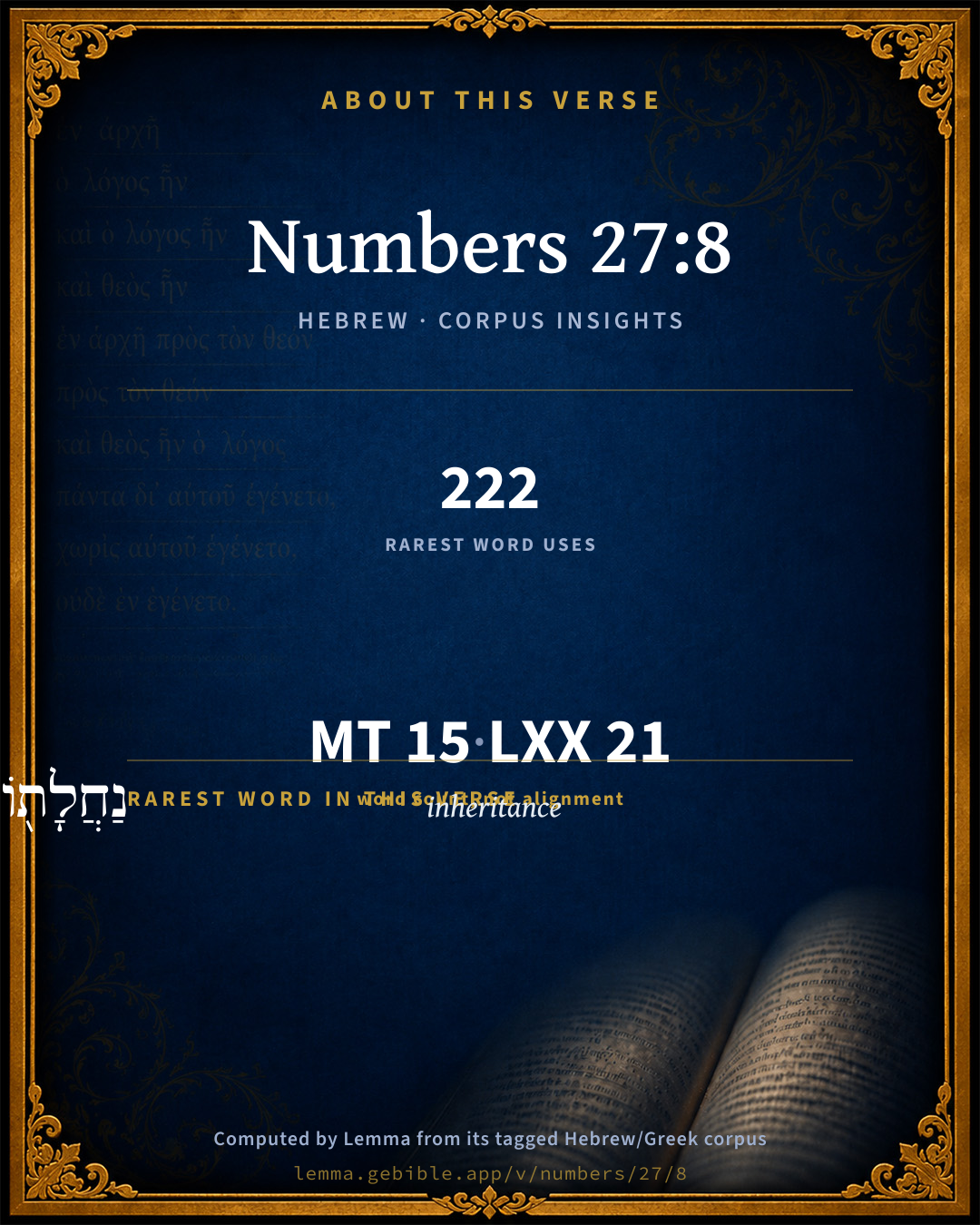
These counts appear in no published source. They are computed here, from the morphology-tagged text and Lemma’s own curated glosses. What Lemma adds →

15
words
13
distinct lemmas
Pentateuch
section

Grammatical profile

  • 4 verbs
  • 6 nouns
  • 2 prepositions
  • 1 conjunction
  • 2 particles

Verb forms

  • תְּדַבֵּ֣ר Piel · Imperfect
  • לֵאמֹ֑ר Qal · Infinitive Construct
  • יָמ֗וּת Qal · Imperfect
  • וְהַֽעֲבַרְתֶּ֥ם Hiphil · Sequential Perfect

Repetition

A word recurs within this verse — often emphatic in Hebrew:

  • בְּנֵ֥י son H1121 ×2

Hebrew & Septuagint length

In English translation the verse runs 28 words from the Hebrew and 16 from the Septuagint (LXX English) — the Septuagint runs noticeably shorter here. See the side-by-side →

A rough comparison of the two English renderings, which tokenize alike — not a word-level alignment.

Word counts can differ between the Hebrew and the Greek without any difference in meaning — e.g. the Hebrew direct-object marker אֵת has no separate Greek word, and Greek often adds the article ὁ.

In the original languages it is 15 Hebrew tokens and 21 Greek tokens — but the two are counted differently (Hebrew bundles its prefixes and suffixes into one token; the Greek is in lemma form), so that isn’t a like-for-like length.

Hebrew and Greek witnesses Masoretic Hebrew ↔ Greek Septuagint

The same verse in the two great witnesses to the Old Testament, shown verse-for-verse.

Here the Septuagint runs noticeably shorter than the Hebrew — LXX2012 (modern English Septuagint) 16 words vs World English Bible 28. A rough length comparison of the two English translations, not a word-level alignment — read both below.

These are two independent witnesses, not word-aligned to each other, and the Septuagint is shown in lemma (dictionary) form.

Hebrew Numbers 27:8 Masoretic · Westminster Leningrad Codex

וְאֶל בְּנֵ֥י יִשְׂרָאֵ֖ל תְּדַבֵּ֣ר לֵאמֹ֑ר אִ֣ישׁ כִּֽי יָמ֗וּת וּבֵן֙ אֵ֣ין ל֔וֹ וְהַֽעֲבַרְתֶּ֥ם אֶת נַחֲלָת֖וֹ לְבִתּֽוֹ

You shall speak to the children of Israel, saying, If a man die, and have no son, then you shall cause his inheritance to pass to his daughter.

World English Bible · Public Domain

Greek LXX Numbers 27:8 Septuagint · lemma form

καί ὁ υἱός ἰσραήλ λαλέω λέγω ἄνθρωπος ἐάν ἀποθνήσκω καί υἱός μή εἰμί αὐτός περιτίθημι ὁ κληρονομία αὐτός ὁ θυγάτηρ αὐτός

If a man die, and have no son, you⌃ shall assign his inheritance to his daughter.

LXX2012 (modern English Septuagint) · Public Domain

Hebrew: Westminster Leningrad Codex (CC BY 4.0). Greek: Septuagint (public domain); English from LXX2012 (modern English Septuagint) (Public Domain). How the Septuagint differs from the Hebrew →

Targum (Aramaic paraphrase)

2

The Targum is the ancient Jewish Aramaic paraphrase of the Hebrew Scriptures — an interpretive translation, not the Hebrew text itself. Onkelos (literal) and Pseudo-Jonathan (expansive) render the Torah, and Jonathan the Prophets. Coverage is partial: where no permissively-licensed English translation exists for a verse, only the Aramaic is shown. This is verse-level text, not a word-by-word alignment to the Hebrew.

  1. Targum Onkelos Torah (Genesis–Deuteronomy)
    וְעִם בְּנֵי יִשְׂרָאֵל תְּמַלֵיל לְמֵימָר גְבַר אֲרֵי יְמוּת וּבַר לֵית לֵיהּ וְתַעַבְרוּן יָת אַחֲסַנְתֵּיהּ לִּבְרַתֵּיהּ

    (no public-domain English translation for this verse)

    Targum Onkelos — Aramaic: “Onkelos Genesis” (public domain); “Onkelos Exodus” (public domain); “Onkelos Leviticus” (public domain); “Onkelos Numbers” (public domain); “Onkelos Deuteronomy” (public domain). English: “Sefaria Community Translation” (CC0 1.0 (public-domain dedication)); “J.W. Etheridge. The Targums of Onkelos and Jonathan Ben Uzziel on the Pentateuch. London: Longmans, Green, 1862” (public domain). Text via Sefaria.

  2. Targum Pseudo-Jonathan Torah (Genesis–Deuteronomy)
    וְעִם בְּנֵי יִשְרָאֵל תְּמַלֵיל לְמֵימָר גְבַר אֲרוּם יְמוּת וּבִיר דְכַר לֵית לֵיהּ וְתַעֲבְרוּן יַת אַחְסַנְתֵּיהּ לִבְרַתֵּיהּ

    And when a son of Israel shall speak, and say, A man hath died without having a male child, then you shall make over his inheritance to his daughter:

    Targum Pseudo-Jonathan — Aramaic: “Targum Jonathan on Genesis” (public domain); “Targum Jonathan on Exodus” (public domain); “Targum Jonathan on Leviticus” (public domain); “Targum Jonathan on Numbers” (public domain); “Targum Jonathan on Deuteronomy” (public domain). English: “The Targum of Jonathan ben Uzziel, trans. J. W. Etheridge, London, 1862” (public domain). Text via Sefaria.

Commentary

Notes on Numbers 27:8 from classic Christian and Jewish commentators (each source and its license shown beneath its notes). The classic Christian expositions comment on the surrounding passage and are grouped to its opening verse, so a note may address several verses; the Jewish commentaries on the Tanakh (Rashi and others) are per-verse, so they appear only where the commentator wrote on this verse.

Lemma curates 59 commentaries, every one of them public domain or Creative Commons licensed, each selected and text-cleaned for this edition rather than reprinted as found. About our sources →

The Cambridge Bible for Schools and Colleges

gen. ed. J. J. S. Perowne

8–11. A formal statement of the law of inheritance. Failing sons, the property passes to a daughter; failing daughters, to brothers; failing brothers, to uncles; and failing uncles, to the next-of-kin (see on Num_27:8).

The Cambridge Bible for Schools and Colleges (gen. ed. J. J. S. Perowne; Cambridge University Press, 1878–1918) — public domain. Text from a community e-Sword module.

Ellicott's Commentary for English Readers

(8) If a man die, and have no son . . . —On the general law of inheritance which is here laid down, see Selden’s De Successionibus, London, 1636, and Keil’s Archœol., 2, s. 142.

A Bible Commentary for English Readers, edited by Charles John Ellicott (1878–1897) — public domain. Text from a community e-Sword module.

John Gill's Exposition

And if he have no daughter,.... Dies without any issue:

then ye shall give his inheritance unto his brethren; and the children descending from them; that is, if his father was dead; otherwise, if he was living, he was to be preferred to them, according to the Jewish writers; though, according to our law, no estate in fee simple ascends lineally, or goes from a son, who has made a purchase of it, to a father: in the Misnah it is said (x), the order of inheritances is thus,"if a man dies and has no son, then they cause his inheritance to pass to his daughter; a son is before a daughter, and all that descend from the son are before the daughter; the daughter is before the brethren (of her father), and those that descend from the daughter are before the brethren; the brethren (of a man) are before his father's brethren (or his uncles); and they that descend from his brethren are before his father's brethren: this is the general rule, everyone that is before in the inheritance, those that descend from him are before others, and a father is before all that descend from him.''

(x) Ut supra, (Bava Bathra, c. 8.) sect. 2.

John Gill's Exposition of the Whole Bible (1746–1763) — public domain (CC PDM 1.0). Text via the HelloAO Bible API.

Whedon's Commentary on the Bible

Daniel D. Whedon

8-11. A statute of judgment — A statute or law, determining order in the succession of heirs to landed estates where there were no sons; namely, daughters, father’s brothers, paternal uncles, next of kin on the father’s side. The heirship of the daughters was on the condition that they did not marry out of their own tribe, (Num_36:6-12;) otherwise the patrimony was forfeited. The seed of each class “to the world’s end” inherited to the exclusion of all others. According to Hebrew usage the widow was supported by the heirs till a dowry was granted her in the judgment hall. The daughters commonly received at marriage a tenth of the deceased father’s goods or personal estate, each a tenth of what remained, thus: 1/10, 9/100, 81/1000. The sons inherited the remainder.

Daniel D. Whedon (gen. ed.), Commentary on the Old and New Testaments (1874–1909) — public domain. Text from a community e-Sword module.

The Pulpit Commentary

If a man die, and have no son. On this particular case a general rule of much wider incidence was founded. The Mosaic law of succession followed the same lines as the feudal law of Europe, equally disallowing disposition by will, and discouraging, if not disallowing, alienation by grant. Upon the land was to rest the whole social fabric of Israel, and all that was valued and permanent in family life and feeling was to be tied as it were to the landed inheritance. Hence the land was in every case so to pass that the name and fame, the privilege and duty, of the deceased owner might be as far as possible perpetuated. Unto his daughter. Not for her maintenance, but in order that her husband might represent her father. In most cases he would take her name, and be counted as one of her father"s family. This had no doubt already become customary among the Jews, as among almost all nations. Compare the cases of Sheshan and Jarha, (1Ch_2:34, 1Ch_2:35) of Jair, (Num_32:41) and subsequently of the Levitical "sons of Barzillai". (Ezr_2:61) The question, however, would only become of public importance at the time when Israel became a nation of landed proprietors.

The Pulpit Commentary (1880–1919), ed. H.D.M. Spence-Jones & Joseph S. Exell — public domain. Text from a community e-Sword module.

Keil & Delitzsch

C. F. Keil & F. Delitzsch

On this occasion God issued a general law of inheritance, which was to apply to all cases as "a statute of judgment" (or right), i.e., a statute determining right. If any one died without leaving a son, his landed property was to pass to his daughter (or daughters); in default of daughters, to his brothers; in the absence of brothers, to his paternal uncles; and if there were none of them, to his next of kin. - On the intention of this law, see my Archaeol. 142 (ii. pp. 212, 213); and on the law of inheritance generally, see J. Selden, de success. ad leges Hebr. in bona defunctorum, Fkft. a. O. 1695.

Keil & Delitzsch — Biblical Commentary on the Old Testament (1861–1891) — public domain (CC PDM 1.0). Text via the HelloAO Bible API. (Old Testament only.)

Lesson kit

Teaching starters — assembled from the data on this page, not authored interpretation. Every prompt links to the verse data it draws on. Edit before teaching.

Numbers, in the Pentateuch, opens this verse with 15 words (13 distinct Hebrew lemmas). Its most distinctive word is nachălâh (“inheritance”). The Greek Septuagint runs shorter here. A historical commentator’s framing appears above. Read the whole chapter for the surrounding context.

Discussion questions

  1. The word nachălâh carries the sense “inheritance.” How does it shape the verse?
  2. What does the repetition of “son” (2× in this one verse) do in this verse?
  3. The Septuagint runs shorter here than the Hebrew. What might account for the difference?
  4. The translations on this page render this verse differently — a whole-verse word diff, not a word-by-word alignment. What might account for the different wordings?
  5. «תְּדַבֵּ֣ר» is a Piel Imperfect verb. How does that grammatical form shape the action described?
  6. Compare how The Cambridge Bible for Schools and Colleges and Ellicott's Commentary for English Readers read this verse. Where do they agree or differ?

Things to notice

Reading settings

Reading text

Shown beneath each verse's original-language words.

Old Testament
Old Testament edition

Read the OT as the Masoretic Hebrew (MT) or the Greek Septuagint (LXX).

English shown for the Greek Septuagint (in the Hebrew ↔ Greek comparison).

Comparing translations? Open the Compare panel on any verse page to stack up to four side by side.